
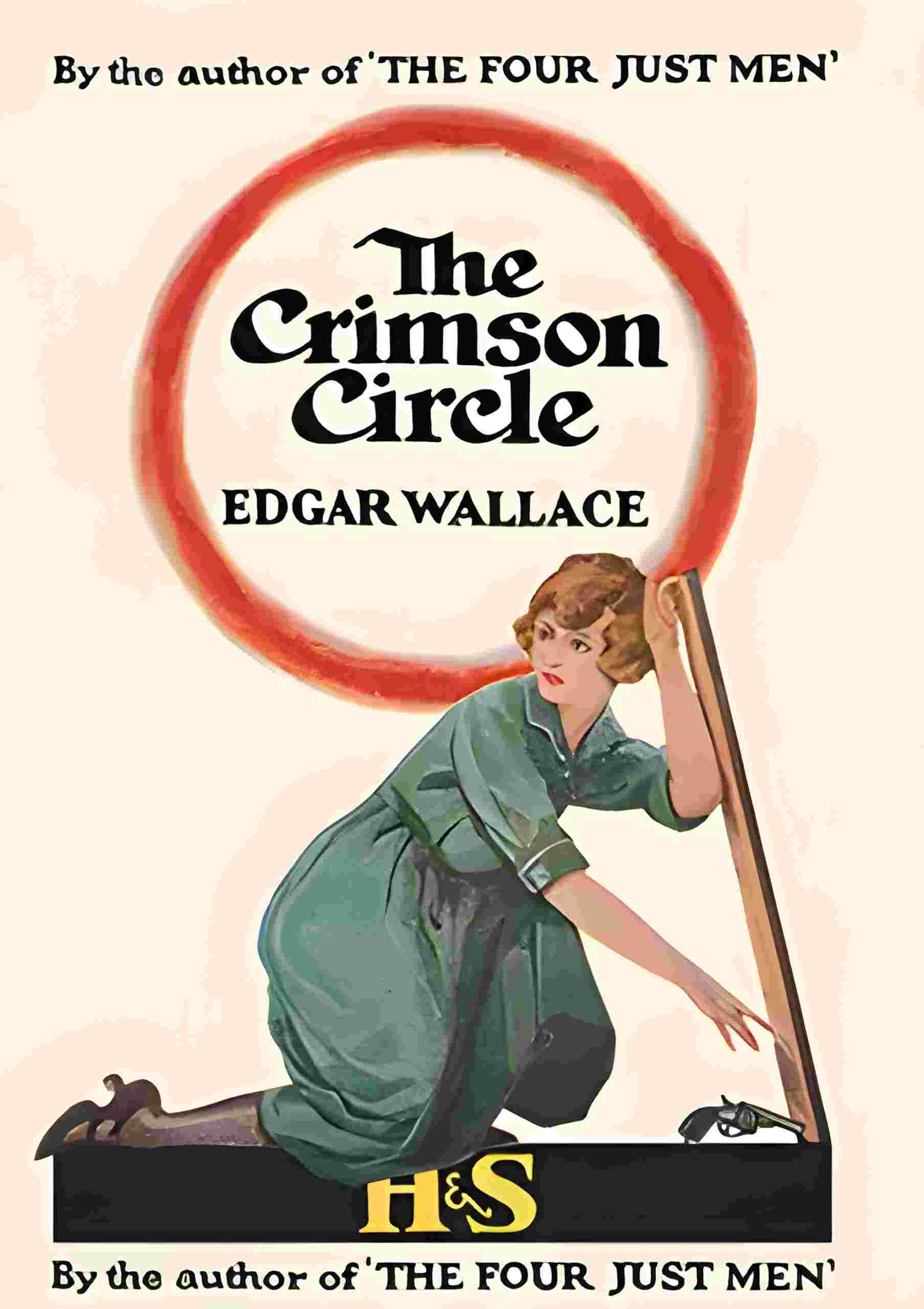
Chapter XXIX.
“The Red Circle”
It was Harvey Froyant’s boast that he trusted nobody completely. He trusted the lawyer up to a point, but his known connection with questionable people would have been alone sufficient to prevent Harvey from trusting implicitly to his agent.
Two nights after the shooting of Inspector Parr the little lawyer called on his employer, and he was all a-quiver with excitement. He had traced one of the new series of bank-notes which the Crimson Circle had taken from Brabazon.
“Now, we’ve got a good line on this, Mr. Froyant, and if we continue in the direction we are going, we can certainly pick up the original changer.”
But here Mr. Harvey Froyant was firm. He could not and would not place the case completely in the hands of this man. So far might the knowledgeable firm of Heggitt take him, but he would carry on the rest through another agency. He said so in as many words.
“I’m sorry you won’t let me go on with it,” said the disappointed Heggitt. “I have undertaken this search personally, and I can assure you that there are only a few steps now between the man we discovered with the money and the man you are looking for.”
Harvey Froyant knew that as well as the lawyer.
Jack Beardmore had spoken a great truth when he said that this mean man would never be satisfied until he had recovered the money he had lost. It was a goad and an irritation, a source of thought which kept him awake at night and woke him in the morning with a sense of blank despair.
And Harvey was well equipped to carry the investigations to their final stage now that he had the ground clear for him. He had derived his fortune from buying and selling land in every country in the world. Beginning with practically no capital, he had, by personal application to his business, built up a seven figure fortune. And this had not been accomplished by sitting in an office and trusting to subordinates. It had involved considerable travel, restless inquiry and relentless probing into the private circumstances of negotiators, a peculiarity he had shared with James Beardmore, though this he did not know.
He took up his own case with alacrity, and informed neither Yale nor Parr of his intentions.
As Heggitt had said, it was a fairly simple matter to trace the note, for at least three stages. His investigations brought Mr. Froyant successively to a money-changer’s in the Strand, a tourist office and finally to a highly respectable bank. And here he was particularly favoured, for it was a branch of one of the banks which conducted his business.
For three days he pried and questioned, searched books—which he had no right to search—and slowly but surely he came to a conclusion. He was not, however, satisfied to leave the matter with the discovery of the original passer of the note. Not even the bank manager, who gave him facilities for examining private accounts, and was afterwards reprimanded by his superiors for doing so, knew exactly what object he had, or against whom his investigations were directed.
On the morning of the first day Froyant left hurriedly for France. He spent only two hours in Paris, and the night found him on his way to the south. Toulouse he reached at nine o’clock in the morning; here again luck was with him, for an important official of the city had been an agent of his in a purchase he had made a few years before.
Monsieur Brassard offered his guest an emphatic welcome, which Mr. Froyant discounted on the ground that his former agent was under the impression that a new deal and a new commission was in prospect. This seemed to be the case, for he was less enthusiastic when he learnt the object of the visit.
“I do not trouble myself with these matters,” he said, shaking his head, “for although I am a lawyer, my dear Mr. Froyant, my practice does not touch the criminal court.” He stroked his long beard thoughtfully. “I remember Marl very well indeed—Marl and another man, an Englishman, I think.”
“A man named Lightman?”
“Yes, that was the fellow. Good gracious, yes!” He made a grimace of disgust. “Of course, that is common history,” he went on. “They were scoundrels, those men. One shot the cashier and the watchman of the Nimes Bank, and there were two murders here in Toulouse with which their names were associated. I remember their names very well—and the terrible incident!” He shook his head.
“What terrible incident?” asked Mr. Froyant curiously.
“It was when Lightman was led to execution. I think our executioners must have been drunk, for the knife did not work; twice, three times it fell, but only just touched his neck. And when the horrified spectators interfered—you know our French people are very emotional—there would have been a riot if they had not taken the prisoner back to gaol. Yes, the Red Circle escaped the knife.”
Mr. Froyant, who was sipping a cup of coffee, leapt to his feet, overturning the cup and its contents.
“The what?” he almost shouted.
Mr. Brassard looked at him open-mouthed.
“Why, what is wrong, m’sieur?” he asked, one eye on the damaged carpet.
“The Red Circle! What do you mean?” demanded Froyant, trembling with excitement.
“That was Lightman,” nodded Brassard, astonished at the effect his words produced. “It was his public name. But my clerk will know more, for he was interested in the matter, which I was not.”
He rang the bell, and an elderly Frenchman came in.
“Do you remember the Red Circle, Jules?”
The aged Jules nodded.
“Very well, m’sieur. I was at the execution. What horror!” He raised his two hands in an expressive gesture.
“Why was he called the Red Circle?” demanded Froyant.
“Because of a mark.” The man drew his long finger about his neck. “Around his throat, m’sieur, was a red circle; it was the colour of his skin, and it was a legend long before the execution that no knife would ever touch him, for such marks are said to be charmed. I think it was a birth-mark, but I know that on the way to the execution I met a great number of people—my friend Thiep, for example—who were sure that the execution would not take place. If they were as sure that the executioner and his assistants would be drunk,” added Jules, “and that they had put up the guillotine in the morning so badly that the knife would not work, I think they would have been more intelligent.”
Mr. Froyant was now breathing quickly.
Little by little the truth was being revealed, and now he saw the whole thing clearly.
“What happened to the Red Circle?” he asked.
“I do not know,” shrugged Jules. “He was sent to one of the island settlements, but Marl was released because he had given evidence for the Republic. I heard some time ago that Lightman had escaped, but I don’t know how true that is.”
Lightman had escaped, as Froyant had already guessed. He passed that day in a feverish search of all available documents, in a visit to the Public Prosecutor, and he ended a strenuous twelve hours in the bureau of the prison governor, examining photographs.
It may be said that Mr. Harvey Froyant went to bed that night in the Hotel Anglaise with a feeling of complete satisfaction, and with the added pleasure that he had succeeded where the cleverest police had failed. The secret of the Crimson Circle was no longer a secret.
Chapter XXX.
The Silencing of Froyant
Harvey Froyant’s visit to France had not escaped attention, and both Derrick Yale and Inspector Parr knew that he had gone; so also did the Crimson Circle, if Thalia Drummond’s telegram reached its destination.
Curiously enough these telegrams and messages which Thalia was sending was the excuse for Derrick Yale’s call at police head-quarters, on the very evening that Mr. Froyant was returning triumphantly from France.
Parr, returning to his office, found Yale sitting at the inspector’s table, delighting a small but select audience of police officials with an exhibition of his curious power.
His ability in this direction was amazing. From a ring which a police inspector handed him he told the mystified hearer not only his known history but, to his confusion, a little secret history of the man’s life.
As Parr came in his assistant gave him a sealed envelope. He glanced at the typewritten address, and then laid it on Yale’s outstretched hand.
“Tell me who sent that?” he said, and Yale laughed.
“A very small man with an absurd yellow beard; he talks through his nose and keeps a shop.”
A slow smile dawned on Parr’s face.
Yale added:
“And that isn’t psychometry, because I happen to know it is from Mr. Johnson of Mildred Street.”
He chuckled at the inspector’s blank expression, and when they were alone, explained.
“I happen to know that you discovered the place to which all the Crimson Circle messages were sent. I, on the contrary, have known of its existence for a long time, and every message which has been sent to the Crimson Circle has been read by me. Mr. Johnson told me you were making inquiries, and I asked him to give you a very full explanation in the addressed envelope which you sent to him.”
“So you knew it all the time?” asked Parr slowly.
Derrick Yale nodded.
“I know that messages intended for the Crimson Circle have been addressed to this little newsagent, and that every afternoon and evening a small boy calls to collect them. It is a humiliating confession to make, but I have never been able to trace the person who picks the boy’s pocket.”
“Picks his pocket?” repeated Parr, and Yale enjoyed the mystery.
“The boy’s instructions are to put the letters in his pocket, and to walk into the crowded High Street. Whilst he is there somebody takes them from his pocket without his being any the wiser.”
Inspector Parr sat down on the chair which Yale had vacated, and rubbed his chin.
“You’re an amazing fellow,” he said. “And what else have you discovered?”
“What I have all along suspected,” said Yale, “that Thalia Drummond is in communication with the Crimson Circle and has given him every scrap of information which she has been able to gather.”
Parr shook his head.
“What are you going to do about that?”
“I told you all along that she would lead us to the Crimson Circle,” said Yale quietly, “and sooner or later I am sure my predictions will be justified. It is nearly two months since I induced our friend who keeps a small newsagent’s shop to which letters may be addressed, to give me the first look over all letters addressed to Johnson. He wanted a little inducing, because our newsagent is a very honest, straightforward man, but it is my experience, and probably yours, that the mere suggestion that a man is assisting the cause of justice will induce him to commit the most outrageous acts of disloyalty. I took the liberty of suggesting, without stating, that I was a regular police officer; I hope you don’t mind.”
“There are times when I think you should be a regular police officer,” said Parr. “So Thalia Drummond is in communication with the Crimson Circle?”
“I shall continue to employ her, of course,” said Yale. “The closer she is to me, the less dangerous she will be.”
“Why did Froyant go abroad?” asked Parr.
The other shrugged his shoulders.
“He has many business connections abroad, and probably is engaged in a deal. He owns about a third of the vineyards in the Champagne. I suppose you know that?”
The inspector nodded. Then, for some reason or other, a silence fell upon them. Each man was busy with his own thoughts, and Mr. Parr particularly was thinking of Froyant, and wondering why he had gone to Toulouse.
“How did you know he had gone to Toulouse?” asked Derrick Yale.
The question was so unexpected, such a startling continuation of his own thoughts, that Parr jumped.
“Good heavens!” he said, “can you read a man’s mind?”
“Sometimes,” said Yale, unsmilingly. “I thought he had gone to Paris.”
“He went to Toulouse,” said the inspector shortly, and did not explain how he came to know.
Possibly nothing Derrick Yale had ever done, no demonstration he had given of his gifts, had so disconcerted this placid inspector of police as that experiment in thought transference. It alarmed, indeed, frightened him, and he was still shaken in his mind when Harvey Froyant’s telephone call came through.
“Is that you, Parr? I want you to come to my house. Bring Yale with you. I have a very important communication to make.”
Inspector Parr hung up the receiver deliberately.
“Now, what the devil does he know?” he said, speaking to himself, and Derrick Yale’s keen eyes, which had not left the inspector’s face all the time he was speaking, shone for a moment with a strange light.
* * * *
Thalia Drummond had finished her simple dinner and was engaged in the domestic task of darning a stocking. Her undomestic task, which was of greater urgency, was to prevent herself thinking of Jack Beardmore. There were times when the thought of him was an acute agony, and since such moments of quietness and solitude as these were favourable for such meditation, she had just put down her work and turned to something new for distraction, when the door bell rang.
It was a district messenger, and he carried in his hand a square parcel that looked like a boot box.
It was addressed to her in pen-printed characters, and she had a little flutter at her heart as she realised from whom it had come.
Back in her room she cut the string and opened the box. On the top lay a letter which she read. It was from the Crimson Circle, and ran:
“You know the way into Froyant’s house. There is an entrance from the garden into the bomb-proof shelter beneath his study. Gain admission, taking with you the contents of this box. Wait in the underground room until I give you further instructions.”
She lifted out the contents of the box. The first article was a large gauntlet glove that reached almost to her elbow. It was a man’s glove, and left-handed. The only other thing in the box was a long, sharp-pointed knife with a cup-like guard. She handled it carefully, feeling the edge; it was as sharp as a razor. For a long time she sat looking at the weapon and the glove, and then she got up and went to the telephone and gave a number. She waited for a long time, until the operator told her there was no answer.
At nine o’clock.
She looked at her watch. It was past eight already, and she had no time to lose. She put the glove and the knife in a big leather hand-bag, wrapped herself in her cloak, and went out.
Half an hour later, Derrick Yale and Mr. Parr ascended the steps of Froyant’s residence and were admitted by a servant. The first thing Derrick Yale noticed was that the passage was brilliantly illuminated; all the lights in the hall were on, and even the lamps on the landing above were in full blaze, a curious circumstance, remembering Mr. Harvey Froyant’s parsimony. Usually he contented himself with one feeble light in the hall, and any room in the house that was not in use was in darkness.
The library was a room opening from the main hall; the door was wide open, and the visitors saw that the room was as brilliantly lighted as the hall.
Harvey Froyant was sitting at his desk, a smile on his tired face, but for all his weariness there was self-satisfaction in every gesture, every note in his voice.
“Well, gentlemen,” he said almost jovially, “I’m going to give you a little information which I think will startle and amuse you.” He chuckled and rubbed his hands. “I have just called up the Chief Commissioner, Parr,” he said, peering up at the stout detective. “In a case like this one wants to be on the safe side. Anything may happen to you two gentlemen after you leave this house, and we cannot have too many people in our secret. Will you take your overcoats off? I am going to tell you a story which may take some time.”
At that moment the telephone bell trilled, and they stood watching him as he took down the receiver.
“Yes, yes, colonel,” he said. “I have a very important communication to make; may I call you up in a second or two? You will be there? Good.” He replaced the instrument. They saw him frown undecidedly, and then:
“I think I’ll talk to the colonel now, if you don’t mind stepping into another room and closing the door. I don’t want to anticipate the little sensation which I am creating.”
“Certainly,” said Parr, and walked from the room.
Derrick Yale hesitated.
“Is this communication about the Crimson Circle?”
“I will tell you,” said Mr. Froyant. “Just give me five minutes and then you shall have your thrill of sensation.”
Derrick Yale laughed, and Parr, who had reached the hall, smiled in sympathy.
“It takes a lot to thrill me,” said Derrick.
He came out of the room, stood for a moment with the door edge in his hand.
“And afterwards I think I shall be able to tell you something about our young friend Drummond,” he said. “Oh, I know you’re not interested, but this little fact will interest you perhaps as much as the story you are going to tell us.”
Parr saw him smile, and guessed that Froyant had growled something uncomplimentary about Thalia Drummond.
Derrick Yale closed the door softly.
“I wonder what his sensation is, Parr,” he mused thoughtfully. “And what the dickens has he to tell your colonel?”
They walked into the front drawing-room, which was equally well lighted.
“This is unusual, isn’t it, Steere?” said Derrick Yale, who knew the butler.
“Yes, sir,” said the stately man. “Mr. Froyant is not as a rule extravagant in the matter of current. But he told me that he’d want all the lights to-night, and that he was not taking any risks, whatever that might mean. I’ve never known him to do such a thing. He’s got two loaded revolvers in his pocket—that is what strikes me as queer. He hates firearms, does Mr. Froyant, as a rule.”
“How do you know he has revolvers?” asked Parr sharply.
“Because I loaded them for him,” replied the butler. “I used to be in the Yeomanry, and I understand the use of weapons. One of them is mine.”
Derrick Yale whistled and looked at the inspector.
“It looks as if he not only knows the Crimson Circle, but he expects a visit,” he said. “By the way, have you any men on hand?”
Parr nodded.
“There are a couple of detectives in the street; I told them to hang around in case they were wanted,” he said.
They could not hear Froyant’s voice at the telephone, for the house was solidly built, and the walls were thick.
Half an hour passed, and Yale grew impatient.
“Will you ask him if he wants us, Steere?” he said, but the butler shook his head.
“I can’t interrupt him, sir. Perhaps one of you gentlemen would go in. We never go in unless we are rung for.”
Parr was half-way out of the room, and in an instant had flung open the door of Harvey Froyant’s study. The lights were blazing, and he had no doubt of what had happened from the second his eyes fell upon the figure huddled back in his chair. Harvey Froyant was dead. The handle of a knife projected from his left breast, a knife with a steel cup-like guard. On the narrow desk was a blood-stained leather gauntlet.
It was the startled cry of Parr that brought Derrick Yale rushing into the room. Parr’s face was as white as death as he stared at the tragic figure in the chair, and neither man spoke a word.
Then Parr spoke.
“Call my men in,” he said. “Nobody is to leave this house. Tell the butler to assemble the servants in the kitchen and to keep them there.”
He took in every detail of the room. Across the big windows which looked on to a square of green at the back of the house, heavy velvet curtains were drawn. He pulled them aside. Behind these were shutters and they were securely fastened.
How had Harvey Froyant been killed?
His desk was opposite the fire-place, and the desk was a narrow Jacobean affair which would have distracted any ordinary man by its lack of width, but it was a favourite of the dead financier.
From which way had the murderer approached him? From behind? The knife was thrust in a downward direction, and the theory that his assailant came upon him unawares was at least plausible. But why the glove? Inspector Parr handled it gingerly. It was a leather gauntlet, such as a chauffeur uses, and had been well worn.
His next move was to call the Police Commissioner and, as he had suspected, the colonel was waiting for a communication from Harvey Froyant.
“Then he did not telephone to you?”
“No. What has happened?”
Parr told him briefly, and listened unmoved to the almost incoherent fury of his chief at the other end of the wire. Presently he hung up the receiver and went back to the hall, to find his men already posted.
“I am searching every room in the house,” he said.
He was gone half an hour, and returned to Derrick Yale.
“Well?” asked Yale eagerly.
Parr shook his head.
“Nothing,” he said. “There is nobody here who has no right to be here.”
“How did they get into the room? The hall-way was never empty except when Steere came into the drawing-room.”
“There may be a trap in the floor,” suggested Yale.
“There are no traps in drawing-room floors in the West End of London,” snapped Parr, but a further search had a surprising result.
Turning up one corner of the carpet, a small trap-door was discovered, and the butler explained that in the days of the war, when air raids were a nightly occurrence, Mr. Froyant had had a bomb-proof shelter constructed of concrete in a lower wine cellar, ingress to which was gained by means of a flight of stairs leading from his study.
Parr went down the stairs with a lighted candle and discovered himself in a small, square, cell-like room. There was a door, which was locked, but, searching the body of Harvey Froyant, they found a master key. Beyond the first door was a second of steel and this brought them into the open.
The houses in the street shared a common strip of lawn and shrubbery.
“It is quite possible to get into here through the gate at the end of the garden,” said Yale, “and I should say that the murderer came this way.”
He was flashing his electric lamp along the ground. Suddenly he went down on to the ground and peered.
“Here is a recent footprint,” he said, “and a woman’s!”
Parr looked over his shoulder.
“I don’t think there is any doubt about that,” he said. “It is recent.”
And then suddenly he stepped back.
“My God!” he gasped in awe-stricken tones. “What a devilish plot!”
For it came upon him with a rush that this was the footprint of Thalia Drummond.
Chapter XXXI.
Thalia Answers a Few Questions
Derrick Yale sat with his head on his hands, reading a newspaper. He had read a dozen that morning, and one by one he had cast them aside to open another.
“Under the eyes of the police,” he quoted. “Incompetence at Police Head-quarters.” He shook his head. “They are giving our poor friend Parr a bad time in this morning’s press,” he said as he threw the paper aside, “and yet he was as incapable of preventing that crime as you or I, Miss Drummond.”
Thalia Drummond looked a little peaked that morning. There were dark circles about her eyes, and an air of general listlessness which was in contrast to her usual cheerful buoyancy.
“If you’re in that game you expect to get kicks, don’t you?” she asked coolly. “The police can’t have it all their own way.”
He looked at her curiously.
“You aren’t a particular admirer of police methods, are you, Miss Drummond?” he asked.
“Not tremendously,” she replied, as she laid a stack of correspondence before him. “You aren’t expecting me to get up testimonials to the efficiency of head-quarters, are you?”
He laughed quietly.
“You’re a strange girl,” he said. “Sometimes I think that you were born without compassion. And you worked for Froyant, too, didn’t you?”
“Yes,” she said shortly.
“You lived some time in the house?”
She did not reply, but her grey eyes met his steadily.
“I did live some time in the house,” she admitted. “Why do you ask that?”
“I wondered if you knew of the existence of this underground room?” said Derrick Yale carelessly.
“Of course I knew of the room. Poor Mr. Froyant made no secret of his cleverness. He has told me a dozen times how much it cost,” she added with a faint smile.
He cogitated a moment.
“Where were the keys usually kept that opened the door of the bomb-proof room?”
“In Mr. Froyant’s desk. Are you suggesting that I have had access to them, or that I was concerned in last night’s murder?”
He laughed.
“I am not suggesting anything,” he said. “I am merely inquiring, and as you seem to know a great deal more about the house than most of the people who live in it, my curiosity is natural. Would it be possible, do you think, to push up that trap without making a noise?”
“Quite,” she said. “The trap-door works on counter-balances. Are you going to answer any of those letters?”
He pushed the pile of letters aside.
“What were you doing last night, Miss Drummond?”
This time his method was more direct.
“I spent my evening at home,” she said. Her hands went behind her, and that curious rigidity which he had noticed before stiffened her frame.
“Did you spend the whole of the evening at home?”
She did not answer.
“Isn’t it a fact that about half-past eight you went out, carrying a small parcel?”
Again she made no reply.
“One of my men accidentally saw you,” said Derrick Yale carelessly, “and then lost sight of you. Where did you spend the evening—you did not return to your flat until nearly eleven o’clock at night.”
“I went for a walk,” said Thalia Drummond coolly. “If you will give me a map of London, I will endeavour to retrace my footsteps.”
“Suppose some of them have already been traced?”
Her eyes narrowed.
“In that case,” she said quietly, “I am saved the bother of telling you where I went.”
“Now look here, Miss Drummond,” he leant across the table. “I am perfectly sure that you are not, in your heart of hearts, a murderess. That word makes you wince, and it is an ugly one. But there are suspicious circumstances which I have not yet revealed to Parr about your movements last night.”
“Being under suspicion is a normal condition with me,” she said, “and since you know so much, it is quite unnecessary for me to tell you more.”
He looked at her, but she returned his gaze without faltering, and then with a shrug of his shoulders, he said:
“Really, I don’t think it matters where you were.”
“I’m almost inclined to agree with you,” she mocked him, and went back to her office and her typewriter.
“An amazing personality,” thought Derrick Yale.
Women did not ordinarily interest him, but Thalia Drummond was beyond and outside of the general run. Her beauty had no appeal for him; he knew she was pretty, just as he knew his office door was painted brown and that the colour of a penny stamp was red.
He took up the paper again and re-read some of the comments upon the inefficiency of police head-quarters, and soon after, as he had expected, Parr came into the room with a certain briskness and dropped into a chair.
“The Commissioner has asked for my resignation,” he said, and to the other’s surprise, his voice was almost cheerful. “I’m not worrying. I intended to retire three years ago when my brother left me his money.”
This was the first intimation Derrick Yale had received that Inspector Parr was a comparatively rich man.
“What are you going to do?” he asked, and Parr smiled.
“In Government offices when you are asked to resign, you resign,” he said drily. “But my resignation will not take effect until the end of next month. I must wait and see what happens to you, my friend.”
“To me?” said Derrick in surprise. “Oh, you mean the warning that I am to be polished off on the fourth? Let me see, there are only two or three days of life left for me,” he laughed ironically as he glanced at the calendar. “I don’t think you need wait for that. But, joking apart, why resign at all? Do you think if I saw the Commissioner——”
“He’d take much less notice of you than he would of a row of beans if they started articulating,” said Mr. Parr. “As a matter of fact, he isn’t taking me off the case until my resignation comes into effect, and I have you to thank for that.”
“Me?”
The stout inspector was laughing silently.
“I told him that your life was so precious to the country that it was necessary I should remain on duty until I had got you over the fatal date,” he said.
Thalia Drummond came in at that moment with another batch of correspondence.
“Good morning, Miss Drummond.”
The inspector raised his eyes to the girl.
“I’ve been reading about you this morning,” said Thalia coolly. “You’re becoming quite a public character, Mr. Parr.”
“Anything for the sake of a little advertisement,” murmured the inspector without resentment. “It is a long time since I saw your name in the paper, Miss Drummond.”
His reference to her appearance in a police court seemed to afford Thalia a great deal of amusement.
“I shall have my share in time,” she said. “What is the latest news about the Crimson Circle?”
“The latest news,” said Mr. Parr slowly, “is that all correspondence addressed to the Crimson Circle of Mildred Street must in future be sent elsewhere.”
He saw her face change; it was only a momentary flash, but the effect was very gratifying to Inspector Parr.
“Are they opening offices in the city?” she asked, recovering herself rapidly. “I don’t see why they shouldn’t. They seem to do almost as much as they like, and I don’t see why they should not live in a very handsome block with elevators and electric signs—no, I don’t think they’d better have electric signs, because even the police would see them!”
“Sarcasm in a young woman,” said Mr. Parr severely, “is not only unbecoming, it is indecent!”
Yale was listening to this exchange with a delighted smile. If the girl surprised him, there were moments when Inspector Parr surprised him as much. This heavy man had a very light malicious touch when he wished.
“And where were you last night, Miss Drummond?” asked Parr, his eyes on the ground.
“In bed and dreaming,” said Thalia Drummond.
“Then you must have been walking in your sleep when you were loafing about at the back of Froyant’s house about half-past nine,” suggested the inspector.
“So that is it, eh?” said Thalia. “You found my dainty footsteps in the garden? Mr. Yale has hinted as much already. No, inspector, I went for a walk in the park at night. The solitude is very inspiring.”
Still Parr regarded the carpet attentively.
“Well, when you walk in the park, young lady, keep at some distance from Jack Beardmore, because the last time you trailed him, you scared him!”
He had hit truly this time. Her face flushed crimson and her delicate eyebrows met in a frown.
“Mr. Beardmore isn’t easily scared,” she said, “and besides—besides——”
Suddenly she turned and went from the room, and when Parr, after a little further conversation, also went into the outer office, she looked up at him and scowled.
“There are times, inspector, when I positively hate you!” she said vehemently.
“You surprise me,” said Inspector Parr.
Chapter XXXII.
A Trip to the Country
Police head-quarters was on its trial. The uncomfortable amount of space which the newspapers were giving to the latest of these tragedies which were associated with the name of Crimson Circle, the questions which were on the paper to be asked in Parliament, no less than the conferences behind closed doors at head-quarters, and the aloofness of all who were ordinarily connected with Inspector Parr in his work, were ominous signs which he did not fail to appreciate.
There was hardly a newspaper which did not publish a very complete list of the outrages for which the Crimson Circle was responsible, and not one which did not mention pointedly the damning fact that from the very beginning of the Circle’s activity, Inspector Parr had had charge of the various cases.
He asked for, and was granted, leave to make enquiries in France. During his few days’ absence, his superiors arranged for his successor. He had only one friend at head-quarters, and that curiously and strangely enough was Colonel Morton, the Commissioner in control of Parr’s department.
Morton fought his case, but knew that it was a hopeless one from the beginning. In this he had the assistance of Derrick Yale. Yale made an early call at head-quarters and gave the fullest particulars with the object of exonerating his official colleague.
“The mere fact that I was on the spot, and that I had been specially engaged to protect Froyant, must take a lot of responsibility from Parr’s shoulders,” he urged.
The Commissioner leant back in his chair and folded his arms.
“I don’t want to hurt your feelings, Mr. Yale,” he said bluntly, “but officially you have no existence, and I am afraid that nothing you will say is going to help Mr. Parr. He has had his chance—in fact, he has had several chances, and he has missed them.”
Just as Yale was going the Commissioner beckoned him to remain.
“You can throw light upon one subject, Mr. Yale,” he said. “It has reference to the killing of the man who shot James Beardmore: you remember Sibly, the sailor.”
Yale nodded, and resumed the seat he had vacated.
“Who was in the cell when you were taking this man’s evidence?”
“Myself, Mr. Parr and an official shorthand writer.”
“Man or woman?” asked the Commissioner.
“A man. I think he was a member of your staff. And that was all. The jailer came in once or twice; in fact he came in while we were there, and brought the water, which was found afterwards to contain the poison.”
The Commissioner opened a folder and selected from many documents a sheet of foolscap.
“Here is the jailer’s statement,” he said. “I’ll save you the preliminaries, but this is what he says,” said the Commissioner; he fixed his glasses and read slowly:
“The prisoner sat on his bed. Mr. Parr was sitting facing him and Mr. Yale was standing with his back to the cell door, which was open when I went in. I took a tin mug half full of water which I drew from a faucet which had been fixed for the purpose of supplying drinking water. I remember putting the tin down whilst I attended a bell call from another cell. So far as I know it was impossible that this tin could be tampered with, though it is true that the door into the yard was open. When I went into the cell Mr. Parr took the tin from my hand, and set it on a ledge near the door and told me not to interrupt them.”
“You notice that no reference is made to the shorthand-writer. Was he obtained locally, do you think?”
“I’m almost sure he was from your office.”
“I must ask Parr about that,” said the Commissioner.
Mr. Parr (who had returned from France) when questioned on the telephone, admitted that the shorthand-writer was a local man whom he had secured by making enquiries in the little town. In the confusion which had followed the discovery that Sibly was dead, he had not thought to enquire about the man’s identity.
A typewritten transcript of Sibly’s statement had been given to him, and he remembered indistinctly paying the writer for his trouble. That was as far as he could help the Commissioner, whose information on the subject was not greatly increased.
Derrick Yale waited whilst this telephonic communication was in progress, and when the colonel had finished, he gathered from his dissatisfied expression that Parr’s information was of no particular value.
“You don’t remember the man yourself?”
Yale shook his head.
“His back was to me, most of the time,” he said, “and he sat by the side of Parr.”
The Commissioner muttered something about gross carelessness, and then:
“I shouldn’t be surprised if your shorthand-writer was an emissary of the Crimson Circle,” he said. “It was a piece of criminal neglect to have taken a man whose identity cannot be established for such an important piece of work. Yes, Parr has failed.” He sighed. “I am sorry, in many ways. I like Parr. Of course, he’s one of the old-fashioned police officers whom you bright outside men affect to despise, and he hasn’t any extraordinary gifts, although he has been, in his time, a remarkably good officer. But he’ll have to go. That is decided. I may tell you this, because I have already made the same intimation to Parr himself. It is a thousand pities.”
It was no news to Yale: nor was it news to the youngest officer at police head-quarters.
But the person who seemed least concerned was Inspector Parr himself. He went about his routine work as though unconscious that any extraordinary change in his position was contemplated, and even when he met his successor, who came to look at the office he was shortly to occupy, was geniality itself.
One afternoon he met Jack Beardmore by accident in the park, and Jack was struck by the stout little man’s good spirits.
“Well, inspector,” said Jack, “are we any nearer the end?”
Parr nodded.
“I think we are,” he said. “The end of me.”
This was the first definite news Jack had received of the inspector’s retirement.
“But surely you’re not going? You have all the threads in your hands, Mr. Parr. They can’t be so foolish as to dispense with you at this very critical moment unless they have given up all hope of capturing the scoundrel.”
Mr. Parr thought “they” had given up all hope long ago, but the attitude of head-quarters was a subject which he did not care to pursue.
Jack was going down to his country house. He had not visited the place since his father’s death, and he would not have gone now but the necessity had arisen for revising a number of farm leases, and since the business could not be done in town, and there were other matters which needed local attention, he decided to spend a night in a place which had, in addition to the memory of this tragedy, memories almost as distasteful.
“Going down into the country are you?” said Mr. Parr thoughtfully. “Alone?”
“Yes,” said Jack, and then as he guessed the other’s thoughts, he asked eagerly, “You would not care to come down as my guest, would you, Mr. Parr? I should be delighted if you could, but I suppose this Crimson Circle investigation will keep you in town.”
“I think they’ll get on very well without me,” said Mr. Parr grimly. “Yes, I think I should like to come down with you. I haven’t been to the house since your poor father’s death, and I should like to go over the grounds again.”
He asked for an additional two days’ leave, and head-quarters, which would have willingly dispensed with him for the remainder of his lifetime, agreed.
As Jack was leaving that night the inspector went home, packed a small Gladstone bag, and met him at the station.
Neither the weather nor the roads were conducive to a long motor-car journey, and on the whole the inspector agreed that travelling by train was more comfortable.
He had left a little note addressed to Derrick Yale, telling him where he was going, and added at the foot:
“It is possible circumstances may arise which would need my presence in town. Do not hesitate to send for me if this should be the case.”
Remembering this postscript, Mr. Parr’s subsequent conduct was not a little odd.
Chapter XXXIII.
The Posters
Jack did not find him a pleasant travelling companion; the inspector had brought with him a whole bundle of newspapers, in each of which he read religiously the comments upon the Crimson Circle. His host saw what he was reading, and was astonished that the man, phlegmatic as he was, could find any pleasure in the uncomplimentary references to himself which filled the journals. He said as much.
The inspector put down a paper on his knees, and took off his steel-rimmed pince-nez.
“I don’t know,” he said. “Criticism never did anybody any harm; it is only when a man knows he is wrong that this kind of stuff irritates him. As I happen to know I am right, it doesn’t matter to me what they say.”
“You really think you are right? In what respect?” asked Jack curiously, but here Parr was not offering any information.
They arrived at the little station and drove the three miles which separated the line from the big gaunt house which had been James Beardmore’s delight.
Jack’s butler, who had come down to superintend arrangements for his master’s comfort, handed a telegram to Inspector Parr almost as soon as he put his foot across the threshold.
Parr looked at the face of the envelope and then at the back.
“How long has this been here?”
“It arrived about five minutes ago; a cyclist messenger brought it up from the village,” he said.
The inspector tore open the envelope and extracted the form. It was signed “Derrick Yale,” and read:
“Come back to London at once; most important development.”
Without a word he handed the message to the young man.
“Of course you’ll go. It’s rather a nuisance; there isn’t a train until nine o’clock,” said Jack, who was disappointed at the prospect of losing his companion.
“I’m not going,” said Parr calmly. “Nothing in the wide world would make me take another train journey to-night. It must wait.”
This attitude toward the summons did not somehow go with Jack’s perception of the inspector’s character. He was, if the truth be told, secretly disappointed, although he was glad enough that Parr would share his first night in the house, every corner, every room of which, seemed to have its own especial ghost.
Parr looked at the telegram again.
“He must have sent this within half-an-hour of our leaving the station,” he said. “You have a telephone, haven’t you?”
Jack nodded, and Parr put through a long distance call. It was a quarter of an hour before the tinkle of the bell announced that he had been connected.
Jack heard his voice in the hall, and presently the detective came in.
“As I thought,” he said, “the wire was a fake. I’ve just been on to friend Yale.”
“And did you guess it was a fake?”
Mr. Parr nodded.
“I’m getting almost as good a guesser as Yale,” said the detective good-humouredly.
He spent the evening initiating the young man into the mysteries of picquet, of which Parr was a past-master. There is probably no more fascinating card game for two in the world than this, and so pleasantly was the evening passed, that it was with a shock that Jack looked at the clock and found it was midnight.
The room to which the inspector was shown was that which had been occupied by James Beardmore in his lifetime. It was a roomy apartment, lofty and expansive. There were three long windows, and at night the room, as the rest of the house, was lighted by means of an acetylene-gas plant which James Beardmore had installed.
“Where are you sleeping, by the way?” he said as he paused at the entrance of his room, after saying good-night.
“I’m in the next room,” said Jack, and Parr nodded, closed the door, locking it behind him.
He heard Jack’s door shut, and proceeded to divest himself of part of his clothing. He made no attempt to undress, but taking from his battered suit-case an old silk dressing-gown, he wrapped it about him, turned out the light and, walking to the windows, pulled up the three blinds.
The night was fairly light; there was sufficient to enable him to find his way back to the bed, on which he lay, pulling the eiderdown over him. There is a method by which the worst cases of insomnia-haunted patients may obtain sleep, though it is one which I believe is very little known. It is to attempt deliberately to keep one’s eyes open in the dark.
Mr. Parr succeeded only by turning on his side and staring out of the nearest window, which he had opened a little.
Towards morning he rose suddenly and stepped noiselessly towards the nearest window; he had heard a faint whirr of sound, a noise which a smoothly-running motor-car makes, but now there was a profound silence. He went to the washstand, and rubbed his face with cold water, drying it leisurely. Then he walked back to the window, pulled up a chair and sat so that he commanded whatever view there was of the avenue leading to the front of the house.
He had to wait nearly half an hour before he saw a dark figure steal from the shadow of the trees, only to disappear again in a deeper shadow. He momentarily glimpsed it again as it passed out of his range of vision into the shadow of the house itself.
The inspector moved softly from the room and, crossing the landing, went down the stairs. The main door of the house was bolted and locked, and it was some time before he could open it. When he stepped out into the night there was nobody in sight. He crept stealthily along the path which ran parallel with the house, but found no intruder, and he had reached the main entrance again when he heard the sound of the motor fading gradually—the midnight visitor had gone.
He closed and bolted the door and went back to his room. This visit puzzled him. It was clear that the man, whoever he was, had not seen Parr, nor could he have been certain that he was under observation. He must have come and gone almost immediately.
It was not until he came down to breakfast in the morning that the mystery of the visitation was revealed.
Jack was standing before the fire reading a crumpled paper which looked as if it had been posted up and torn. It was the size of a small poster and hand-printed. Before he saw its contents, Parr knew that it was a message from the Crimson Circle.
“What do you think of this?” asked Jack, looking round as the detective came in. “We found half a dozen of these posters pasted or tacked on to the trees of the drive, and this one was stuck up under my window!”
The detective read:
“Your father’s debt is still unpaid. It will remain unpaid if you persuade your friends Derrick Yale and Parr to cease their activity.”
Underneath was written in smaller characters, and evidently added as an afterthought:
“We shall make no further demands upon private individuals.”
“So he was bill-posting,” said Parr thoughtfully. “I wondered why he came and left so early.”
“Did you see him?” asked Jack in surprise.
“I just glimpsed him. In fact, I knew he would call, though I expected a more startling consequence,” said the detective.
He sat through breakfast without saying a word, except to answer the questions that Jack put to him, and then only in the briefest fashion, and it was not until they were walking across the meadows that Parr asked:
“I wonder if he knows you’re fond of Thalia Drummond?”
Jack went red.
“Why do you ask that?” he said a little anxiously. “You don’t think they will take their vengeance on Thalia, do you?”
“If it would serve his purpose, he would wipe out Thalia Drummond like that.” The detective snapped his fingers.
He put an end to further conversation by stopping and turning about in his tracks.
“This will do,” he said.
“I thought you wanted to go to the station gate—the way Marl came to the house that morning?”
Parr shook his head.
“No, I wished to be sure how he approached the house. Can you point out the spot where he suddenly became so agitated?”
“Why, of course,” said Jack readily, but wondering what it was all about. “It was much nearer the house; in fact, I can give you the exact spot, because I particularly remember his stepping aside from the path and ruining a young rose tree on which he put his foot. There is the tree—or one the gardener has put in its place.”
He pointed, and Parr nodded his large head several times.
“This is very important,” he said. He walked to where the ruined tree had been. “I knew he was lying,” he said half to himself. “You cannot see the terrace from here at all. Marl told me that he saw your father standing on the terrace at the very moment he had his seizure, and my first impression was that it was the sight of your father which was responsible for his scare.”
He gave Jack details of the conversation he had had with Felix Marl before his death.
“I could have corrected that,” said Jack. “My father was in the library all the morning, and he did not come out of the house until we were ascending the steps of the terrace.”
Parr, note-book in hand, was making a rough sketch. On his left front was the solid block of Sedgwood House, immediately before him were the gardens, enclosed by light iron railings to prevent the cattle straying on to the flower beds, and broken by the gate through which Marl must have passed. On the right was a patch of bushes, in the midst of which showed the gay top of a garden umbrella.
“Dad was very fond of the shrubbery,” explained Jack. “We get high winds here even on the warmest days, and the shrubbery affords shelter. Dad used to sit there for hours reading.”
Parr was slowly turning on his heel, taking in every detail of the view. Presently he nodded.
“I think I have seen all there is to be seen,” he said.
As they were walking back to the house he reverted to the midnight bill-poster, and to Jack’s surprise:
“That was the only false move that the Crimson Circle have made, and I think it was very much an afterthought. That was not their original intention, I’ll swear.”
He sat down on the steps of the terrace and stared out over the landscape. Jack could not but think that a more uninspiring figure than Mr. Parr he had never met. His lack of inches, his rotundity, his large placid face, did not somehow fit in with Jack’s conception of a shrewd criminal investigator.
“I’ve got it,” said Parr at last. “My first idea was right. He was coming down to blackmail you for the money your father did not pay. On his way he conceived this new idea, which is hinted at in the postscript of his message. He has decided upon some big coup, so that the reference to myself and Yale may be genuine; and he really does want us out of the game, though he’d be a fool if he did not know that the likelihood of his wishes being fulfilled in that respect are pretty remote. Let me see the poster again.”
Jack brought it and the inspector spread it upon the pavement of the terrace.
“Yes, this has been written in a hurry; probably written in his car, and it is a substitute for the poster he originally intended.” He rubbed his chin impatiently. “Now, what is the new scheme?”
He was to learn almost immediately, for the butler came hurrying out to say that the telephone bell had been ringing in Jack’s study for five minutes.
“It is you they want,” said Jack, handing the receiver to the detective.
Mr. Parr took the instrument in his hands, and recognised immediately Colonel Morton’s voice.
“Come back to London at once, Parr; you are to attend a meeting of the Cabinet this afternoon.”
Mr. Parr put down the receiver, and a smile spread over his big face.
“What is it?” asked Jack.
“I’m joining the Cabinet,” said Mr. Parr, and laughed as Jack had never seen him laugh before.
Chapter XXXIV.
Blackmailing a Government
When they reached London the evening newspapers were filled with the new sensation.
The Crimson Circle had indeed decided upon an ambitious programme.
Briefly the story, as related in an official communique to the Press, was as follows:
That morning every member of the Government had received a type-written document, bearing no address and no other indication of its origin save a Crimson Circle stamped on every page. The document ran:
“Every effort of your police, both official and private, the genius of Mr. Derrick Yale, and the plodding efforts of Chief Inspector Parr, have failed to check Our activity. The full story of Our success is not known. It has been unfortunately Our unpleasant duty to remove a number of people from life, not so much in a spirit of vengeance, as to serve as a salutary warning to others, and only this morning it has been Our unhappy duty to remove Mr. Samuel Heggitt, a lawyer, who was engaged by the late Harvey Froyant on particular work, in the course of which he came unpleasantly close to Our identity.
“Fortunately for the other members of his firm, he undertook that task personally. His body will be found by the side of the railway between Brixton and Marsden.
“Since the police are unable to hold Us, and since We are in complete agreement with those in authority who say that We are the most dangerous menace to society that exists, We have agreed to forego Our activities on condition that the sum of a million pounds sterling is placed at Our disposal. The method by which this money shall be transferred will be detailed later. This must be accompanied by a free pardon in blank, so that We may, if occasion necessitates, or hereinafter Our identity is disclosed, avail Ourselves of that document.
“Refusal to agree to Our terms will have unpleasant consequences. We name hereunder twelve eminent Parliamentarians, who must stand as hostages for the fulfilment of Our desire. If, at the end of the week, the Government have not agreed to Our terms, one of these gentlemen will be removed.”
The first person that Parr met on his arrival at Whitehall was Derrick Yale, and for once the famous detective looked worried.
“I was afraid of this development,” he said, “and the queer thing is that it has come at a moment when I thought I was in a position to lay my hand on the chief offender.”
He took Parr’s hand in his, and walked him along the gloomy corridor.
“This spoils my day’s fishing,” he said, and Inspector Parr remembered.
“Of course, to-day is the day you die! But I suppose you are reprieved under the general amnesty which the Crimson Circle have issued,” he said drily, and his companion laughed.
“I want to tell you, before we go into this meeting, that I am willing to place myself unreservedly at your disposal,” he said quietly. “I think you ought to know, Parr, that the present wishes of the Cabinet are to give me an official status and place the whole of the investigations in my charge. I have been sounded on the matter, and have given them point-blank refusal. I am convinced that you are the best man for the job, and I will serve under no other chief.”
“Thank you,” said Parr simply. “Perhaps the Cabinet will take another view.”
The Cabinet meeting was held in the Secretary of State’s office; all the recipients of the Crimson Circle’s memo. were present from the beginning, but it was some time before outsiders were called in.
Yale was summoned first, and a quarter of an hour later the messenger beckoned the inspector.
Inspector Parr knew most of the illustrious gathering by sight, and being on the opposite side in politics, had no particular respect for any. He felt an air of hostility as he came into the big room, and the chilly nod which the white-bearded Prime Minister gave him in response to his bow, confirmed this impression.
“Mr. Parr,” said the Prime Minister icily, “we are discussing the question of the Crimson Circle, which, as you must realise, has become almost a national problem. Their dangerous character has been emphasised by a memorandum which has been addressed to the various members of the Cabinet by this infamous association, and which, I have no doubt, you have read in the newspapers.”
“Yes, sir,” said the inspector.
“I will not disguise from you the fact that we are profoundly dissatisfied with the course which your investigations have taken. Although you have had every facility and every power granted you, including,” he consulted a paper before him, but Parr interrupted him.
“I should not like you to tell the meeting what powers I have received, Prime Minister,” he said firmly, “or what particular privileges have been granted me by the Secretary of State.”
The Prime Minister was taken aback.
“Very well,” he said. “I will add that, although you have had extraordinary privileges, and opportunities, and you have even been present when the outrages have taken place, you have not succeeded in bringing the criminal to justice.”
The inspector nodded.
“It was our original wish to place the matter in the hands of Mr. Derrick Yale, who has been especially successful in tracing two of the murderers, without, however, being able to bring the prime culprit to justice. Mr. Yale, however, refuses to accept the commission unless you are in control. He has kindly expressed his willingness to serve under you, and in this course we are agreed. I understand that your resignation is already before the Commissioners, and that it has been formally accepted. That acceptance, for the time being, is reserved. Now remember, Mr. Parr,” the Prime Minister leant forward and spoke very earnestly and emphatically: “It is absolutely impossible that we can accede to the Crimson Circle’s demands: such a course would be the negation of all law, and the surrender of all authority. We rely upon you to afford to every member of the Government who is threatened, that protection which is his right as a citizen. Your whole career is in the balance.”
The inspector, thus dismissed, rose slowly.
“If the Crimson Circle keeps its word,” he said, “I guarantee that not a hair of one member of your Government shall be harmed in London. Whether I can capture the man who describes himself as the Crimson Circle, remains to be seen.”
“I suppose,” said the Prime Minister, “there is no doubt that this unfortunate man, Heggitt, has been killed.”
It was Derrick Yale who answered.
“No, sir; the body was found early this morning. Mr. Heggitt, who lives at Marsden, left London last night by train, and apparently the crime was committed en route.”
“It is deplorable, deplorable.” The Prime Minister shook his head. “A terrible orgy of murder and crime, and it seems that we are not at the end of it yet.”
When they came out into Whitehall, Yale and his companion found that a large crowd had gathered, for news had leaked out that a meeting was being held to discuss this new and extraordinary problem which confronted the Government.
Yale, who was recognised, was cheered, but Inspector Parr passed unnoticed through the crowd—to his intense relief.
Undoubtedly the Crimson Circle was the sensation of the hour. Some of the evening newspaper placards bore a crimson circle in imitation of the famous insignia of the gang, and wherever men met, there the possibility of the Circle carrying their threat into effect was discussed.
Thalia Drummond looked up as her employer came in. The evening newspaper was in front of her, and her chin rested on her clasped hands, and she read every line, word by word.
Derrick noticed the interest, and observed, too, her momentary confusion as she folded the paper and put it away.
“Well, Miss Drummond, what do you think of their last exploit?”
“It is colossal,” she said. “In some respects, admirable.”
He looked at her gravely.
“I confess I can see little to admire,” he said. “You take rather a queer, twisted view of things.”
“Don’t I?” she said coolly. “You must never forget, Mr. Yale, that I have a queer, twisted mind.”
He paused at the door of his room and looked back at her, a long, keen scrutiny, which she met without so much as an eyelid quivering.
“I think you should be very grateful that Mr. Johnson, of Mildred Street, no longer receives your interesting communications,” he said, and she was silent.
He came out again soon after.
“I am probably going to establish my offices at police head-quarters,” he said, “and realising that that atmosphere is one in which you will not flourish, I am leaving you here in control of my ordinary business.”
“Are you accepting the responsibility for capturing the Crimson Circle?” she asked steadily.
He shook his head.
“Inspector Parr is in control,” he said, “but I am going to help him.”
He made no further reference to his new task, and the rest of the morning was spent in routine work. He went out to lunch and said he would not be back that day, giving her instructions regarding letters he wished despatched.
He had hardly gone before his telephone bell went, and at the sound of the voice at the other end, she nearly dropped the receiver.
“Yes, it is I,” she said. “Good morning, Mr. Beardmore.”
“Is Yale there?” asked Jack.
“He has just gone out: he will not be back to-day. If there is anything important to tell him, I may be able to find him,” she said, steadying her voice with an effort.
“I don’t know whether it’s important or not,” said Jack, “but I was going through my father’s papers this morning, a very disagreeable job, by the way, and I found a whole bunch of papers relating to Marl.”
“To Marl?” she said slowly.
“Yes, apparently poor Dad knew a great deal more about Marl than we imagined. He had been in prison: did you know that?”
“I could have guessed it,” said Thalia.
“Father always put through an inquiry about people before he did business with them,” Jack went on, “and apparently there is a lot of explanation about Marl’s early life, collected by a French agency. He seems to have been a pretty bad lot, and I wonder the governor had dealings with him. One curious document is an envelope which is marked ‘Photograph of Execution’: it was sealed up by the French people, and apparently the governor didn’t open it. He hated gruesome things of that kind.”