
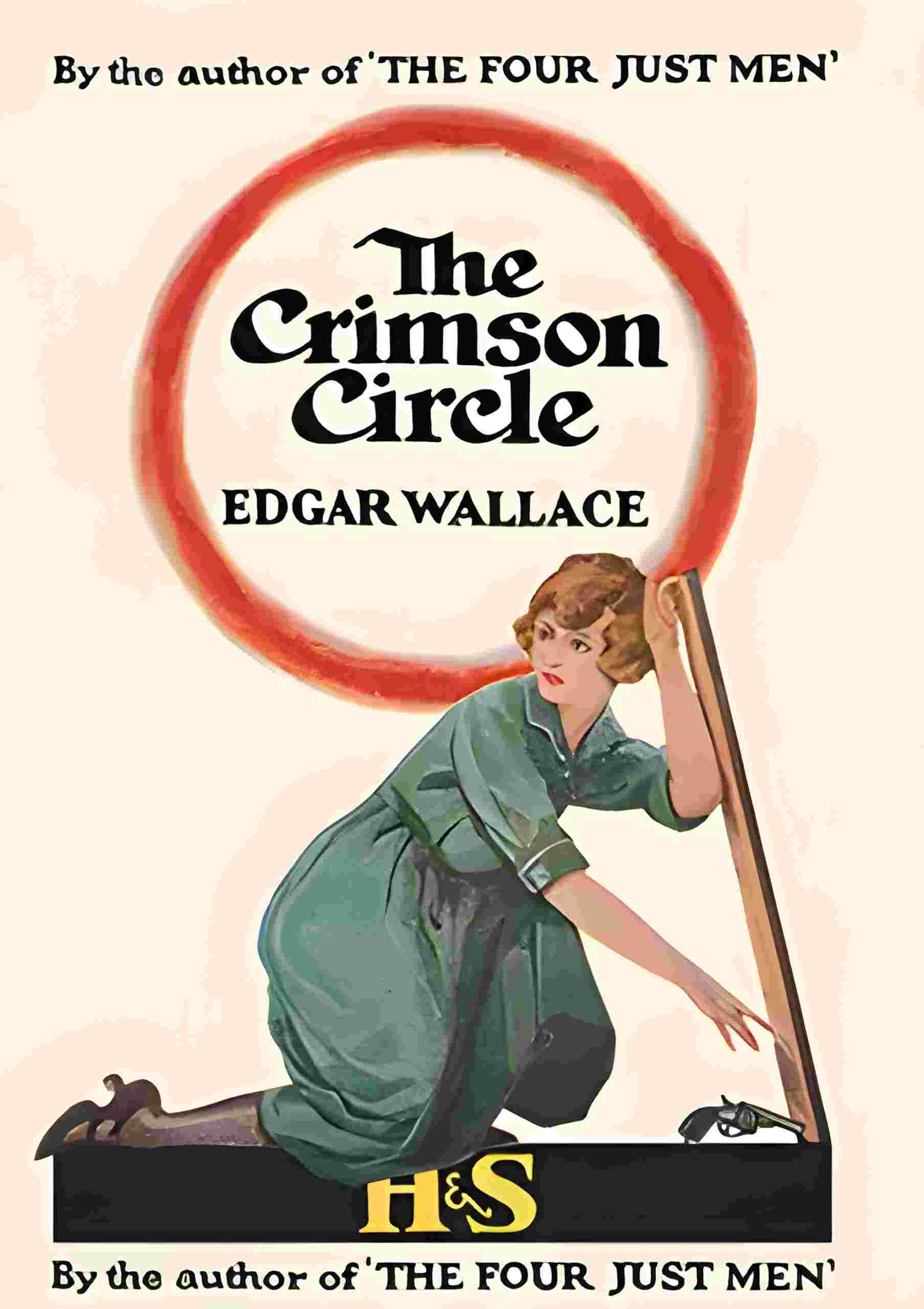
The Project Gutenberg eBook of The crimson circle
Title: The crimson circle
Author: Edgar Wallace
Release date: June 9, 2025 [eBook #76257]
Language: English
Original publication: London: Hodder and Stoughton Ltd, 1922
Credits: an anonymous Project Gutenberg volunteer
THE
CRIMSON CIRCLE
BY
EDGAR WALLACE
HODDER AND STOUGHTON LTD
[DEDICATION]
TO
BRYAN
All the characters represented in this book are purely imaginary.
Contents
Chapter II. The Man Who Did Not Pay
Chapter III. The Girl Who Was Indifferent
Chapter VI. “Thalia Drummond is a Crook”
Chapter IX. Thalia in the Police Court
Chapter X. The Summons of The Crimson Circle
Chapter XII. The Pointed Boots
Chapter XIII. Mr. Marl Squeezes a Little More
Chapter XIV. Thalia is Asked Out
Chapter XV. Thalia Joins the Gang
Chapter XVI. Mr. Marl Goes Out
Chapter XVII. The Blower of Bubbles
Chapter XVIII. “Flush” Barnet’s Story
Chapter XIX. Thalia Accepts an Offer
Chapter XX. The Key of River House
Chapter XXII. The Messenger of The Circle
Chapter XXIII. The Woman in the Cupboard
Chapter XXV. The Tenant of River House
Chapter XXVI. The Bottle of Chloroform
Chapter XXVII. Mr. Parr’s Mother
Chapter XXVIII. A Shot in the Night
Chapter XXIX. “The Red Circle”
Chapter XXX. The Silencing of Froyant
Chapter XXXI. Thalia Answers a Few Questions
Chapter XXXII. A Trip to the Country
Chapter XXXIV. Blackmailing a Government
Chapter XXXV. Thalia Lunches with a Cabinet Minister
Chapter XXXVI. The Circle Meets
Chapter XXXVII. “I Will See You—If You Are Alive”
Chapter XXXVIII. The Arrest of Thalia
Chapter XLI. Who is The Crimson Circle?
Chapter XLIII. The Story Continued
Prologue.
The Nail
It is a ponderable fact that had not the 29th of a certain September been the anniversary of Monsieur Victor Pallion’s birth, there would have been no Crimson Circle mystery; a dozen men, now dead, would in all probability be alive, and Thalia Drummond would certainly never have been described by a dispassionate inspector of police as “a thief and the associate of thieves.”
M. Pallion entertained his three assistants to dinner at the Coq d’Or in the city of Toulouse, and the proceedings were both joyous and amiable. At three o’clock in the morning it dawned upon M. Pallion that the occasion of his visit to Toulouse was the execution of an English malefactor named Lightman.
“My children,” he said gravely but unsteadily, “it is three hours and the ‘red lady’ has yet to be assembled!”
So they adjourned to the place before the prison where a trolley containing the essential parts of the guillotine had been waiting since midnight, and with a skill born of practice they erected the grisly thing, and fitted the knife into its proper slots.
But even mechanical skill is not proof against the heady wines of southern France, and when they tried the knife it did not fall truly.
“I will arrange this,” said M. Pallion, and drove a nail into the frame at exactly the place where a nail should not have been driven.
But he was getting flurried, for the soldiers had marched on to the ground.…
Four hours later (it was light enough for an enterprising photographer to snap the prisoner close at hand), they marched a man from the prison.…
“Courage!” murmured M. Pallion.
“Go to hell!” said the victim, now lying strapped upon the plank.
M. Pallion pulled a handle and the knife fell… but only as far as the nail.
Three times he tried and three times he failed, and then the indignant spectators broke through the military cordon, and the prisoner was taken back into the gaol.
Eleven years later that nail killed many people.
Chapter I.
The Initiation
It was an hour when most respectable citizens were preparing for bed, and the upper windows of the big, old-fashioned houses in the square showed patches of light, against which the outlines of the leafless trees, bending and swaying under the urge of the gale, were silhouetted. A cold wind was sweeping up the river, and its outriders penetrated icily into the remotest and most sheltered places.
The man who paced slowly by the high iron railings shivered, though he was warmly clad, for the unknown had chosen a rendezvous which seemed exposed to the full blast of the storm.
The débris of the dead autumn whirled in fantastic circles about his feet, the twigs and leaves came rattling down from the trees which threw their long gaunt arms above him, and he looked enviously at the cheerful glow in the windows of a house where, did he but knock, he would be received as a welcome guest.
The hour of eleven boomed out from a nearby clock, and the last stroke was reverberating when a car came swiftly and noiselessly into the square and halted abreast of him. The two head-lamps burned dimly. Within the closed body there was no spark of light. After a moment’s hesitation the waiting man stepped to the car, opened the door, and got in. He could only guess the outline of the driver’s figure in the seat ahead, and he felt a curious thumping of heart as he realised the terrific importance of the step he had taken. The car did not move, and the man in the driver’s seat remained motionless. For a little time there was a dead silence, which was broken by the passenger.
“Well?” he asked nervously, almost irritably.
“Have you decided?” asked the driver.
“Should I be here if I hadn’t?” demanded the passenger. “Do you think I’ve come out of curiosity? What do you want of me? Tell me that, and I will tell you what I want of you.”
“I know what you want of me,” said the driver. His voice was muffled and indistinct, as one who spoke behind a veil.
When the newcomer’s eyes grew accustomed to the gloom, he detected the vague outline of the black silk cowl which covered the driver’s head.
“You are on the verge of bankruptcy,” the driver went on. “You have used money which was not yours to use, and you are contemplating suicide. And it is not your insolvency which makes you consider this way out. You have an enemy who has discovered something to your discredit, something which would bring you into the hands of the police. Three days ago you obtained from a firm of manufacturing chemists, a member of which is a friend of yours, a particularly deadly drug, which cannot be obtained from a retail chemist. You have spent a week reading up poisons and their effects, and it is your intention, unless something turns up which will save you from ruin, to end your life either on Saturday or Sunday. I think it will be Sunday.”
He heard the man behind him gasp, and laughed softly.
“Now, sir,” said the driver, “are you prepared for a consideration to act for me?”
“What do you want me to do?” demanded the man behind him shakily.
“I ask no more than that you should carry out my instructions. I will take care that you run no risks and that you are well paid. I am prepared at this moment to place in your hands a very large sum of money, which will enable you to meet your more pressing obligations. In return for this I shall want you to put into circulation all the money I send you, to make the necessary exchanges, to cover up the trail of bills and bank-notes, the numbers of which are known to the police; to dispose of bonds, which I cannot dispose of, and generally to act as my agent——” he paused, adding significantly, “and to pay on demand what I ask.”
The man behind him did not reply for some time, and then he asked with a hint of petulance:
“What is the Crimson Circle?”
“You,” was the startling reply.
“I?” gasped the man.
“You are of the Crimson Circle,” said the other carefully. “You have a hundred comrades, none of whom will ever be known to you, none of whom will ever know you.”
“And you?”
“I know them all,” said the driver. “You agree?”
“I agree,” said the other after a pause.
The driver half-turned in his seat and held out his hand.
“Take this,” he said.
“This” was a large, bulky envelope, and the newly initiated member of the Crimson Circle thrust it into his pocket.
“And now get out,” said the driver curtly, and the man obeyed without question.
He slammed the door behind him and walked abreast of the driver. He was still curious as to his identity, and for his own salvation it was necessary that he should know the man who drove.
“Don’t light your cigar here,” said the driver, “or I shall think that your smoking is really an excuse to strike a match. And remember this, my friend, that the man who knows me, carries his knowledge to hell.”
Before the other could reply the car moved on and the man with the envelope stood watching its red tail light until it disappeared from view.
He was shaking from head to foot, and when he did light the cigar which his chattering teeth gripped, the flame of the match quivered tremulously.
“That is that,” he said huskily, and crossed the road, to disappear in one of the side-turnings.
He was scarcely out of sight before a figure moved stealthily from the doorway of a dark house and followed. It was the figure of a man tall and broad, and he walked with difficulty, for he was naturally short of breath. He had gone a hundred paces in his pursuit before he realised that he still held in his hand the ship’s binoculars through which he had been watching.
When he reached the main street his quarry had vanished. He had expected as much and was not perturbed. He knew where to find him. But who was in the car? He had read the number and could trace its owner in the morning. Mr. Felix Marl grinned. Had he so much as guessed the character of the interview he had overlooked, he would not have been amused. Stronger men than he had grown stiff with fear at the menace of the Crimson Circle.
Chapter II.
The Man Who Did Not Pay
Philip Bassard paid, and lived, for apparently the Crimson Circle kept faith; Jacques Rizzi, the banker, also paid, but in a panic. He died from natural causes a month later, having a weak heart. Benson, the railway lawyer, pooh-poohed the threat and was found dead by the side of his private saloon.
Mr. Derrick Yale, with his amazing gifts, ran down the coloured man who had crept into Benson’s private car and killed him before he threw the body from the window, and the coloured man was hanged, without, however, revealing the identity of his employer. The police might sneer at Yale’s psychometrical powers—as they did—but within forty-eight hours he had led the police to the crimp’s house at Yareside and the dazed murderer had confessed.
Following this tragedy many men must have paid without reporting the matter to the police, for there was a long period during which no reference to the Crimson Circle found its way into the newspapers. And then one morning there came to the breakfast table of James Beardmore, a square envelope containing a card, on which was stamped a Crimson Circle.
“You are interested in the melodrama of life, Jack—read that.”
James Stamford Beardmore tossed the message across the table to his son and proceeded to open the next letter in the pile which stood beside his plate.
Jack retrieved the message from the floor, where it had fallen, and examined it with a little frown. It was a very ordinary letter-card, save that it bore no address. A big circle of crimson touched its four edges and had the appearance of having been printed with a rubber stamp, for the ink was unevenly distributed. In the centre of the circle, written in printed characters, were the words:
“One hundred thousand represents only a small portion of your possessions. You will pay this in notes to a messenger I will send in response to an advertisement in the ‘Tribune’ within the next twenty-four hours, stating the exact hour convenient to you. This is the final warning.”
There was no signature.
“Well?”
Old Jim Beardmore looked up over his spectacles and his eyes were smiling.
“The Crimson Circle!” gasped his son.
Jim Beardmore laughed aloud at the concern in the boy’s voice.
“Yes, the Crimson Circle—I have had four of ’em!”
The young man stared at him.
“Four?” he repeated. “Good heavens! Is that why Yale has been staying with us?”
Jim Beardmore smiled.
“That is a reason,” he said.
“Of course, I knew that he was a detective, but I hadn’t the slightest idea——”
“Don’t worry about this infernal circle,” interrupted his father a little impatiently. “I’m not scared of them. Froyant is in terror of his life that he will be marked down. And I don’t wonder. He and I have made a few enemies in our time.”
James Beardmore, with his hard, lined face and his stubbly grey beard, might have been mistaken for the grandfather of the good-looking young man who sat opposite to him. The Beardmore fortune had been painfully won. It had materialised from the wreckage of dreams and had its beginnings in the privations, the dangers and the heartaches of a prospector’s life. This man whom Death had stalked on the waterless plains of the Kalahari, who had scraped in the mud of the Vale River for illusory diamonds, and thawed out his claim in the Klondyke, had faced too many real dangers to be greatly disturbed by the threat of the Crimson Circle. For the moment his perturbation was based on a more tangible peril, not to himself, but to his son.
“I’ve got a whole lot of faith in your good sense, Jack,” he said, “so don’t be hurt by anything I’m going to say. I’ve never interfered in your amusements or questioned your judgment—but—do you think that you’re being wise just now?”
Jack understood.
“You mean about Miss Drummond, father?”
The older man nodded.
“She’s Froyant’s secretary,” began the youth.
“I know she is Froyant’s secretary,” said the other, “and she’s none the worse for that. But the point is, Jack, do you know anything more about her?”
The young man rolled his napkin deliberately. His face was red and there was a queer set look about his jaw which secretly amused Jim.
“I like her. She is a friend of mine. I’ve never made love to her, if that is what you mean, dad, and I rather think our friendship would be at an end if I did.”
Jim nodded. He had said all that was necessary and now he took up a more bulky envelope and looked at it curiously. Jack saw that it bore French postage stamps and wondered who was the correspondent.
Tearing open the flap, the old man took out a pad of correspondence, which included yet another envelope heavily sealed. He read the superscription and his nose wrinkled.
“Ugh!” he said, and put the envelope down unopened. He glanced through the remainder of the correspondence, then looked across at his son.
“Never trust a man or woman until you know the worst of them,” he said. “I’ve got a man coming to see me to-day who is a respectable member of society. He has a record as black as my hat and yet I’m going to do business with him—I know the worst!”
Jack laughed. Further conversation was interrupted by the arrival of their guest.
“Good morning, Yale—did you sleep well?” asked the old man. “Ring for some more coffee, Jack.”
Derrick Yale’s visit had been an unmixed pleasure to Jack Beardmore. He was at the age when romance had its full appeal and the companionship of the most commonplace detective would have brought him a peculiar joy. But the glamour which surrounded Yale was the glamour of the supernatural. This man had unusual and peculiar qualities which made him unique. The delicate æsthetic face, the grave mystery of his eyes, the very gesture of his long, sensitive hands, were part of his uniqueness.
“I never sleep,” he said good-humouredly as he unrolled his serviette. He held the silver napkin ring for a second between his two fingers, and James Beardmore watched him with amusement. As for Jack, his eager admiration was unconcealed.
“Well?” asked the old man.
“Who handled this last has had very bad news—some near relation is desperately ill.”
Beardmore nodded.
“Jane Higgins was the servant who laid the table,” he said. “She had a letter this morning saying that her mother was dying.”
Jack gasped.
“And you felt that in the serviette ring?” he asked in amazement. “How do you get that impression, Mr. Yale?”
Derrick Yale shook his head.
“I don’t attempt to explain,” he said quietly. “All that I know is that the moment I took up my serviette I had a sensation of profound and poignant sorrow. It is weird, isn’t it?”
“But how did you know about her mother?”
“I traced it somehow,” said the other almost brusquely; “it is a matter of deduction. Have you any news, Mr. Beardmore?”
For answer Jim handed him the card he had received that morning.
Yale read the message, then weighed the card on the palm of his white hand.
“Posted by a sailor,” he said, “a man who has been in prison and has recently lost a great deal of money.”
Jim Beardmore laughed.
“Which I shall certainly not replace,” he said, rising from the table. “Do you take these warnings seriously?”
“I take them very seriously,” said Derrick in his quiet way. “So seriously that I do not advise you to leave this house except in my company. The Crimson Circle,” he went on, arresting Beardmore’s indignant protest with a characteristic gesture, “is, I admit, vulgarly melodramatic in its operations, but it will be no solace to your heirs to learn that you have died theatrically.”
Jim Beardmore was silent for a time, and his son regarded him anxiously.
“Why don’t you go abroad, father?” he asked, and the old man snapped round on him.
“Go abroad be damned!” he roared. “Run away from a cheap Black Hand gang? I’ll see them——!”
He did not mention their destination, but they could guess.
Chapter III.
The Girl Who Was Indifferent
A heavy weight lay on Jack Beardmore’s mind as he walked slowly across the meadows that morning. His feet carried him instinctively in the direction of the little valley which lay a mile from the house, and in the exact centre of which ran the hedge which marked the division between the Beardmore and Froyant estates. It was a glorious morning. The storm of wind and rain which had swept the country the night before had blown itself out, and the world lay bathed in yellow sunlight. Far away, beyond the olive-green coverts that crowned Penton Hill, he caught a glimpse of Harvey Froyant’s big white mansion. Would she venture out with the ground so sodden and the grasses soaked with rain, he wondered?
He stopped by a big elm tree on the lip of the valley and cast an anxious glance along the untidy hedge, until his eyes rested on a tiny summer house which the former owners of Tower House had erected—Harvey Froyant, who loathed solitude, would never have been guilty of such extravagance.
There was nobody in sight, and his heart sank. Ten minutes’ walking brought him to the gap he had made in the fence, and he stepped through. The girl who sat in the tiny house might have heard his sigh of relief.
She looked round, then rose with some evidence of reluctance.
She was remarkably pretty, with her fair hair and flawless skin, but there was no welcome in her eyes as she came slowly toward him.
“Good morning,” she said coolly.
“Good morning, Thalia,” he ventured, and her frown returned.
“I wish you wouldn’t,” she said, and he knew that she meant what she said. Her attitude toward him puzzled and worried him. For she was a thing of laughter and bubbling life. He had once surprised her chasing a hare, and had watched, spellbound, the figure of this laughing Diana as her little feet flew across the field in pursuit of the scared beast. He had heard her singing, too, and the very joy of life was vibrant in her voice—but he had seen her so depressed and gloomy that he had feared she was ill.
“Why are you always so stiff and formal with me?” he grumbled.
For a second a ghost of a smile showed at the corner of her mouth.
“Because I’ve read books,” she said solemnly, “and poor girl secretaries who aren’t stiff and formal with millionaire’s sons usually come to a bad end!”
She had a trick of directness which was very disconcerting.
“Besides,” she said, “there is no reason why I shouldn’t be stiff and formal. It is the conventional attitude which people adopt toward their fellow creatures, unless they are very fond of them, and I’m not very fond of you.”
She said this calmly and deliberately, and the young man’s face went red. He felt a fool, and cursed himself for provoking this act of cruelty.
“I will tell you something, Mr. Beardmore,” she went on in her even tone. “Something which you haven’t realised. When a boy and girl are thrown together on a desert island, it is only natural that the boy gets the idea that the girl is the only girl in the world. All his wayward fancies are concentrated on one woman and as the days pass she grows more and more wonderful in his eyes. I’ve read a lot of these desert island stories, and I’ve seen a lot of pictures that deal with that interesting situation, and that is how it strikes me. You are on a desert island here—you spend too much time on your estate, and the only things you see are rabbits and birds and Thalia Drummond. You should go into the city and into the society of people of your own station.”
She turned from him with a nod, for she had seen her employer approaching, had watched him out of the corner of her eye as he stopped to survey them, and had guessed his annoyance.
“I thought you were doing the house accounts, Miss Drummond,” he said with asperity.
He was a skinny man, in the early fifties, colourless, sharp-featured, prematurely bald. He had an unpleasant habit of baring his long yellow teeth when he asked a question, a grimace which in some curious way suggested his belief that the answer would be an evasion.
“Morning, Beardmore,” he jerked the salutation grudgingly and turned again to his secretary.
“I don’t like to see you wasting your time, Miss Drummond,” he said.
“I am not wasting either your time or mine, Mr. Froyant,” she answered calmly. “I have finished the accounts—here!” She tapped the worn leather portfolio which was under her arm.
“You could have done the work in my library,” he complained; “there is no need to go into the wilderness.”
He stopped and rubbed his long nose and glanced from the girl to the silent young man.
“Very good; that will do,” he said. “I am going to see your father, Beardmore. Perhaps you will walk with me?”
Thalia was already on her way to Tower House, and Jack had no excuse for lingering.
“Don’t occupy that girl’s time, Beardmore, don’t, please,” said Froyant testily. “You’ve no idea how much she has to do—and I’m sure your father wouldn’t like it.”
Jack was on the point of saying something offensive, but checked himself. He loathed Harvey Froyant, and at the moment hated him for his domineering attitude toward the girl.
“That class of girl,” began Mr. Froyant, turning to walk by the side of the hedge toward the gate at the end of the valley, “that class of girl——” he stood still and stared. “Who the devil has broken through the hedge?” he demanded, pointing with his stick.
“I did,” said Jack savagely. “It is our hedge, anyway, and it saves half a mile—come on, Mr. Froyant.”
Harvey Froyant made no comment as he stepped gingerly through the hedge.
They walked slowly up the hill toward the big elm tree where Jack had stood looking down into the valley.
Mr. Harvey Froyant preserved a tight-lipped silence. He was a stickler for the conventions, where their observations benefited himself.
They had reached the crest of the rise, when suddenly his arm was gripped, and he turned to see Jack Beardmore, staring at the bole of the tree. Froyant followed the direction of his eye and took a step backward, his unhealthy face a shade paler. Painted on the tree trunk was a rough circle of crimson, and the paint was yet wet.
Chapter IV.
Mr. Felix Marl
Jack Beardmore looked round, scanning the country. The only human being in sight was a man who was walking slowly away from them, carrying a bag in his hand. Jack shouted, and the man turned.
“Who are you?” demanded Jack. Then, “What are you doing here?”
The stranger was a tall, stoutish man, and the exertion of carrying his grip had left him a little breathless. It was some time before he could reply.
“My name is Marl,” he said, “Felix Marl. You may have heard of me. I think you are young Mr. Beardmore, aren’t you?”
“That is my name,” said Jack. “What are you doing here?” he asked again.
“They told me there was a short cut from the railway station, but it is not so short as they promised,” said Mr. Marl, breathing stertorously. “I’m on my way to see your father.”
“Have you been near that tree?” asked Jack, and Marl glared at him.
“Why should I go near any tree?” he demanded aggressively. “I tell you I’ve come straight across the fields.”
By this time Harvey Froyant arrived, and apparently recognised the new-comer.
“This is Mr. Marl; I know him. Marl, did you see anybody near that tree?”
The man shook his head. Apparently the tree and its secret was a mystery to him.
“I never knew there was a tree there,” he said. “What—what has happened?”
“Nothing,” said Harvey Froyant sharply.
They came to the house soon after, Jack carrying the visitor’s bag. He was not impressed by the big man’s appearance. His voice was coarse, his manner familiar, and Jack wondered what association this uncouth specimen of humanity could have with his father.
They were nearing the house when suddenly and for no obvious reason the stout Mr. Marl emitted a frightened squeal and leapt back. There was no doubt of his fear. It was written visibly in the blanched cheeks and the quivering lips of the man, who was shaking from head to foot.
Jack could only look at him in astonishment—and even Harvey Froyant was startled into an interest.
“What the hell is wrong with you, Marl?” he asked savagely.
His own nerves were on edge, and the sight of the big man’s undisguised terror was a further strain which he could scarcely endure.
“Nothin’—nothin’,” muttered Marl huskily. “I’ve been——”
“Drinking, I should think,” snapped Froyant.
After seeing the man into the house Jack hurried off in search of Derrick Yale. He discovered the detective in the shrubbery sitting in a big cane chair, his chin upon his breast, his arms folded, a characteristic attitude of his.
Yale looked up at the sound of the young man’s footsteps.
“I can’t tell you,” he said, before Jack had framed his question, and then, seeing the look of astonishment on his face, he laughed. “You were going to ask me what scared Marl, weren’t you?”
“I came with that intention,” laughed Jack. “What an extraordinary fellow you are, Mr. Yale! Did you see his extraordinary exhibition of funk?”
Derrick Yale nodded.
“I saw him just before he had his shock,” he said. “You can see the field path from here.”
He frowned.
“He reminds me of somebody,” he said slowly, “yet I cannot for the life of me tell who it is. Is he a frequent visitor here? Your father told me he was coming, and I guessed it was he.”
Jack shook his head.
“This is the first time I’ve seen him,” he said. “I remember now, though, that father and Froyant have had some business dealings with a man named Marl—dad mentioned him one day. I think he is a land speculator. Father is rather interested in land just now. By the way, I have seen the mark of the Crimson Circle,” he added, and described the newly-painted “O” he had found on the elm.
Instantly Yale lost interest in Mr. Marl.
“It was not on the tree when I went down into the valley,” said Jack. “I’ll swear to that. It must have been painted whilst I was talking to—to a friend. The trunk is out of sight from the boundary fence, and it was quite possible for somebody to have painted the sign without being seen. What does it mean, Mr. Yale?”
“It means trouble,” said Yale shortly.
He rose abruptly and began pacing the flagged walk, and Jack, after waiting a little while, left him to his meditations.
In the meantime, Mr. Felix Marl was comparatively a useless third of a conference which dealt with the transfer of lands. Marl was, as Jack had said, a land speculator, and he had come that morning bringing a promising proposition which he was wholly incapable of explaining.
“I can’t help it, gentlemen,” he said, and for the fourth time his trembling hand rose to his lips. “I’ve had a bit of a shock this morning.”
“What was that?”
But Marl seemed incapable of explanation. He could only shake his head helplessly.
“I’m not fit to discuss things calmly,” he said. “You’ll have to put the matter off until to-morrow.”
“Do you think I’ve come here to-day for the purpose of listening to that sort of nonsense?” snarled Mr. Froyant. “I tell you I want this business settled. So do you, Beardmore.”
Jim Beardmore, who was indifferent as to whether the matter was settled then or the following week, laughed.
“I don’t know that it is very important,” he said. “If Mr. Marl is upset, why should we bother him? Perhaps you’ll stay here to-night, Marl?”
“No, no, no,” the man’s voice rose almost to a shout. “No, I won’t stay here, if you don’t mind—I would much rather not!”
“Just as you like,” said Jim Beardmore indifferently, and folded up the papers he had prepared for signature.
They walked out into the hall together, and there Jack found them.
Beardmore’s car carried the visitor and his bag back to the station, and from there on Mr. Marl’s conduct was peculiar. He registered his bag through to the city, but he himself descended at the next station, and for a man who so disliked walking, and was by nature so averse from physical exercise, he displayed an almost heroic spirit, for he set forth to walk the nine miles which separated him from the Beardmore estate—and he did not go by the shortest route.
It was nearing nightfall when Mr. Marl made his furtive way into a thick plantation on the edge of the Beardmore property.
He sat down, a tired, dusty but determined man, and waited for the night to close down over the countryside. And during the period of waiting, he examined with tender care the heavy automatic pistol he had taken from his bag in the train.
Chapter V.
The Girl Who Ran
“I can’t understand why that fellow hasn’t come back this morning,” said Jim Beardmore with a frown.
“Which fellow?” asked Jack carelessly.
“I’m speaking of Marl,” said his father.
“Was that the large-sized gentleman I saw yesterday?” asked Derrick Yale.
They were standing on the terrace of the house, which, from its elevated position, gave them a view across the country.
The morning train had come and gone. They could see the trail of white smoke it left as it disappeared into the foothills nine miles away.
“Yes. I’d better ’phone Froyant, and tell him not to come over.”
Jim Beardmore stroked his stubbly chin.
“Marl puzzles me,” he said. “He is a brilliant fellow I believe, a reformed thief I know—at least I hope he is reformed. What upset him yesterday, Jack? He came into the library looking like death.”
“I haven’t the slightest idea,” said Jack. “I think he has a weak heart, or something of the sort. He told me he gets these spasms occasionally.”
Beardmore laughed softly, and going into the house returned with a walking-stick.
“I’m going for a stroll, Jack. No, you needn’t come along. I’ve one or two things I wish to think out, and I promise you, Yale, I won’t leave the grounds, though I think you attach too much importance to the threats of these ruffians.”
Yale shook his head.
“What of the sign on the tree?” he asked.
Jim Beardmore snorted contemptuously.
“It will take more than that to extract a hundred thousand from me,” he said.
He waved a farewell at them as he went down the broad stone steps, and they watched him walking slowly across the park.
“Do you really think my father is in any kind of danger?” asked Jack.
Yale, who had been staring after the figure, turned with a start.
“In danger?” he repeated, and then after a second’s hesitation. “Yes, I believe there is very serious danger for him in the next day or two.”
Jack turned his troubled gaze upon the disappearing figure.
“I hope you’re wrong,” he said. “Father doesn’t seem to take the matter as seriously as you.”
“That is because your father has not the same experience,” said the detective, “but I understand that he saw Chief Inspector Parr, and the inspector thought there was considerable danger.”
Jack chuckled in spite of his fears.
“How do the lion and the lamb amalgamate?” he asked. “I didn’t think that head-quarters had much use for private men like you, Mr. Yale?”
“I admire Parr,” said Derrick slowly. “He’s slow, but thorough. I am told that he is one of the most conscientious men at head-quarters, and I fancy that the head-quarters chiefs have treated him badly over the last Crimson Circle crime. They have practically told him that if he cannot run the organisation to earth he must send in his resignation.”
Whilst they were speaking, the figure of Mr. Beardmore had disappeared into the gloom of a little wood on the edge of the estate.
“I worked with him during the last Circle murder,” Derrick Yale went on, “and he struck me——”
He stopped, and the two men looked at one another.
There was no mistaking the sound. It was a shot near and distinct, and it came from the direction of the wood. In an instant Jack had leapt over the balustrade and was racing across the meadow, Derrick Yale behind him.
Twenty paces along the woodland path they found Jim Beardmore lying on his face, and he was quite dead, and even as Jack was staring down at his father with horrified eyes, a girl emerged from the wood at the farther end, and stopping only long enough to wipe with a handful of grass something that was red from her hands, she flew along the shadow of the hedge which divided the Froyant estate.
Never once did Thalia Drummond look back until she reached the shelter of the little summer house. Her face was drawn and white, and her breath came gaspingly as she stood for a second in the doorway of the little hut, and looked back to the wood. A swift glance round and she was in the house and on her knees tugging with quivering hands at the end of a floor board. It came up disclosing a black cavity. Another second’s hesitation, and she threw into the hole the revolver she had held in her hand, and dropped the board back into its place.
Chapter VI.
“Thalia Drummond is a Crook”
The Commissioner looked down at the newspaper cutting before him and tugged at his grey moustache. Inspector Parr, who knew the signs, watched with an apparently detached interest.
He was a short, thick-set man, so lacking in inches that it was remarkable that he had ever satisfied the stringent requirements of the police authorities. His age was something below fifty, but his big red face was unlined. It was a face from whence every indication of intelligence and refinement was absent. The round, staring eyes were bovine in their lack of expression, the big fleshy nose, the heavy cheeks, pouched beneath the jaws, and the half-bald head, were units of his unimpressiveness.
The Commissioner picked up the cutting.
“Listen to this,” he said curtly, and read. It was the editorial of the Morning Monitor and it was direct to a point of offensiveness.
“ ‘For the second time during the past year the country has been shocked and outraged by the assassination of a prominent man. It is not necessary to give here the details of this Crimson Circle crime, particulars of which appear on another page. But it is very necessary that we should state in emphatic and unmistakable terms that we view with consternation the seeming helplessness of police head-quarters to deal with this criminal gang. Inspector Parr, who has devoted himself for the past year to tracking the murdering blackmailers, can offer us nothing more than vague promises of revelations which never materialise. It is obvious that police head-quarters needs a thorough overhauling, and the introduction of new blood, and we trust that those responsible for the government of the country, will not hesitate to make the drastic changes which are necessary.’ ”
“Well,” growled Colonel Morton, “what do you think of that, Parr?”
Mr. Parr rubbed his big chin and said nothing.
“James Beardmore was murdered after due warning had been given to the police,” said the Commissioner deliberately. “He was shot within sight of his house, and the murderer is at large. This is the second bad case, Parr, and I’ll tell you candidly that it is my intention to act on the advice which this newspaper gives.”
He tapped the cutting suggestively.
“On the previous occasion you allowed Mr. Yale to get away with all the kudos for the capture of the murderer. You have seen Mr. Yale, I presume?”
The detective nodded.
“And what does he say?”
Mr. Parr shifted uneasily on his feet.
“He told me a lot of nonsense about a dark man with toothache.”
“How did he get that?” asked the Commissioner quickly.
“From the shell of the cartridge he found on the ground,” said the detective. “I don’t take any notice of this psychometrical stuff——”
The Commissioner leant back in his chair and sighed.
“I don’t think you take notice of any stuff that is serviceable, Parr,” he said, “and don’t sneer at Yale. That man has unusual and peculiar gifts. The fact that you don’t understand them, does not make them any less peculiar.”
“Do you mean to say, sir,” said Parr, stirred into protest, “that a man can take a cartridge in his hand and tell you from that the appearance of the person who last handled it and what he was thinking about? Why, it is absurd!”
“Nothing is absurd,” said the Commissioner quietly. “The science of psychometry has been practised for years. Some people, unusually sensitive to impression, are able to tell the most remarkable things, and Yale is one of these.”
“He was there when the murder was committed,” replied Parr. “He was with Mr. Beardmore’s son, not a hundred yards away, and yet he did not catch the murderer.”
The Commissioner nodded.
“Neither have you,” he said. “Twelve months ago you told me of your scheme for trapping the Crimson Circle, and I agreed. We’ve both expected a little too much for your plan, I think. You must try something else. I hate to say it, but there it is.”
Parr did not answer for a time, and then to the Commissioner’s surprise, he pulled up a chair to the desk and sat down uninvited.
“Colonel,” he said, “I’m going to tell you something,” and he was so earnest, so unlike his usual self, that the Commissioner could only look at him in amazement.
“The Crimson Circle gang is easy to get. I can find every one of them, and will find them if you will give me time. But it is the hub of the wheel that I’m after. If I can get the hub the spokes don’t count. But you’ve got to give me a little more authority than I have at present.”
“A little more authority?” said the dumbfounded Commissioner. “What the devil do you mean?”
“I’ll explain,” said the bovine Mr. Parr, and he explained to such purpose that he left the Commissioner a very silent and a very thoughtful man.
After he left head-quarters, Mr. Parr’s first call was at an office in the centre of the city.
On the third floor, in a tiny suite, which was distinguished only by the name of the occupant, Mr. Derrick Yale was waiting for him, and a greater contrast between the two men could not be imagined.
Yale, the overstrung, nervous, and sensitive dreamer; Parr, solid and beefy, seemingly incapable of an independent thought.
“How did your interview go on, Parr?”
“Not very well,” said Parr, ruefully. “I think the Commissioner’s got one against me. Have you discovered anything?”
“I’ve discovered your man with the toothache,” was the astonishing reply. “His name is Sibly; he is a seafaring man, and was seen in the vicinity of the house the following day. Yesterday,” he picked up a telegram, “he was arrested for drunken and disorderly conduct, and in his possession was found an automatic pistol, which I should imagine was the weapon with which the crime was committed. You remember that the bullet which was extracted from poor Beardmore, was obviously fired from an automatic.”
Parr gaped at him in amazement.
“How did you find this out?”
And Derrick Yale laughed softly.
“You haven’t a great deal of faith in my deductions,” he said with a glint of humour in his eyes. “But when I felt that cartridge I was as certain that I could see the man as I am certain I can see you. I sent one of my own staff down to make enquiries, with this result.” He picked up the telegram.
Mr. Parr stood, a heavy frown disfiguring what little claim to beauty he might have.
“So they’ve caught him,” he said softly. “Now I wonder if he wrote this?”
He took out a pocket-book, and Derrick Yale saw him extract a scrap of paper which had evidently been burnt, for the edges were black.
Yale took the scrap from his hand.
“Where did you find this?” he asked.
“I raked it out of the ashpan at Beardmore’s place yesterday,” he said.
The writing was in a large scrawling hand, and the scrap ran:
You alone
me alone
Block B
Graft
“ ‘Me alone… you alone,’ ” read Yale. “ ‘Block B… Graft’?”
He shook his head.
“It is Greek to me.”
He balanced the letter upon the palm of his hand and shook his head.
“I can’t even feel an impression,” he said. “Fire destroys the aura.”
Parr carefully put away the scrap into his case and replaced it in his pocket.
“There is another thing I’d like to tell you,” he said. “Somebody was in the wood who wore pointed shoes and smoked cigars. I found the cigar ashes in a little hollow, and his footprint was on the flower-beds.”
“Near the house?” asked Derrick Yale, startled.
The solid man nodded.
“My own theory is,” he went on, “that somebody wanted to warn Beardmore, wrote this letter and brought it to the house after dark. It must have been received by the old man, because he burnt it. I found the ashes in the place where the servants dump their cinders.”
There was a gentle tap at the door.
“Jack Beardmore,” said Yale under his breath.
Jack Beardmore showed signs of the distressing period through which he had passed. He nodded to Parr and came toward Yale with outstretched hand.
“No news, I suppose?” he asked, and turning to the other: “You were at the house yesterday, Mr. Parr. Did you find anything?”
“Nothing worth speaking about,” said Parr.
“I’ve just been to see Froyant, he is in town,” said Jack. “It wasn’t a very successful visit, for he is in a pitiable state of nerves.”
He did not explain that the unsatisfactory part of his call was that he had not seen Thalia Drummond, and only one of the men guessed the reason of his disappointment.
Derrick Yale told him of the arrest which had been made.
“I don’t want you to build any hopes on this,” he said, “even if he is the man who fired the shot, he is certain to be no more than the agent. We shall probably hear the same story as we heard before, that he was in low water and that the chief of the Crimson Circle induced him to commit the act. We are as far from the real solution as ever we have been.”
They strolled out of the office together, into the clean autumn sunlight.
Jack, who had an engagement with a lawyer who was settling his father’s estate, accompanied the two men, who were on their way to catch a train for the town where the suspected murderer was detained. They were passing through one of the busiest streets when Jack uttered an exclamation. On the opposite side of the road was a big pawnbroker’s, and a girl was coming from the side entrance devoted to the service of those who needed temporary loans.
“Well, I’m blessed!” It was Parr’s unemotional voice. “I haven’t seen her for two years.”
Jack turned on him open-eyed.
“Haven’t seen her for two years,” he said slowly. “Are you referring to that lady?”
Parr nodded.
“I’m referring to Thalia Drummond,” he said calmly, “who is a crook and a companion of crooks!”
Chapter VII.
The Stolen Idol
Jack heard him and was stunned.
He stood motionless and speechless, as the girl, as though unconscious of the scrutiny, hailed a taxi-cab and was driven away.
“Now what the dickens was she doing there?” said Parr.
“A crook and a companion of crooks,” repeated Jack mechanically. “Good God! Where are you going?” he asked quickly, as the inspector took a step into the roadway.
“I intend discovering what she has been doing in the pawnbroker’s,” said the stolid Parr.
“She may have gone there because she was short of money. It is no crime to be short of money.”
Jack realised the feebleness of his defence even as he spoke.
Thalia Drummond a thief! It was incredible, impossible! And yet he followed unresistingly the detective as he crossed the road; followed him down the dark passage to the loaning department, and was present in the manager’s room when an assistant brought in the article which the girl had pledged. It was a small golden figure of Buddha.
“I thought it queer,” said the manager, when Parr had made himself known. “She only wanted ten pounds and it is worth a hundred if it’s worth a penny.”
“What explanation did she give?” asked Derrick Yale, who had been a silent listener.
“She said she was short of money and that her father had a number of these curios, but wanted to pledge them at a price which would allow him to redeem them.”
“Did she leave her address? What name did she give?”
“Thalia Drummond,” said the assistant, “of 29, Park Gate.”
Derrick Yale uttered an exclamation.
“Why that’s Froyant’s address, isn’t it?”
Too well Jack knew it was the address of the miserly Harvey Froyant, and he remembered with a sinking of heart that Froyant made a hobby of collecting these eastern antiquities. The inspector gave a receipt for the idol and slipped it into his pocket.
“We’ll go along and see Mr. Froyant,” he said, and Jack interposed desperately:
“For heaven’s sake, don’t let us get this girl into trouble,” he pleaded. “It may have been some sudden temptation—I will make things right, if money can settle the affair.”
Derrick Yale was eyeing the young man with a grave, understanding look.
“You know Miss Drummond?”
Jack nodded. He was too miserable to speak; he felt an absurd desire to run away and hide himself.
“It can’t be done,” said Inspector Parr definitely. He was the conventional police officer now. “I’m going along to Froyant’s to discover whether this article was pledged with his approval.”
“Then you’ll go by yourself,” said Jack wrathfully.
He could not contemplate being a witness of the girl’s humiliation. It was monstrous. It was beastly of Parr, he said to Yale when they were alone.
“The girl would not commit so mean a theft, the stupid, blundering fool! I wish to heaven I had never called his attention to her.”
“It was he who saw her first,” said Yale, and dropped his hand upon the young man’s shoulder. “Jack, you’re a little unstrung, I think. Why are you so interested in Miss Drummond? Of course,” he said suddenly, “you must have seen a lot of her when you were at home. Froyant’s estate joins yours, doesn’t it?”
Jack nodded.
“If he would give as much attention to the running down of the Crimson Circle as he gives to the hounding of that poor girl,” he said bitterly, “my poor father would be alive to-day.”
Derrick Yale did his best to soothe him. He took him back to his office and tried to bring his thoughts to a more pleasant channel. They had been there a quarter of an hour when the telephone bell rang. It was Parr who spoke.
“Well?” asked Yale.
“I’ve arrested Thalia Drummond, and I am charging her in the morning,” was the laconic message.
Yale put down the receiver gently and turned to the young man.
“She’s arrested?” Jack guessed before he spoke.
Yale nodded.
Jack Beardmore’s face was very white.
“You see, Jack,” said Yale gently, “you have probably been as much deceived as Froyant. The girl is a thief.”
“If she were a thief and murderess,” said Jack doggedly, “I love her.”