
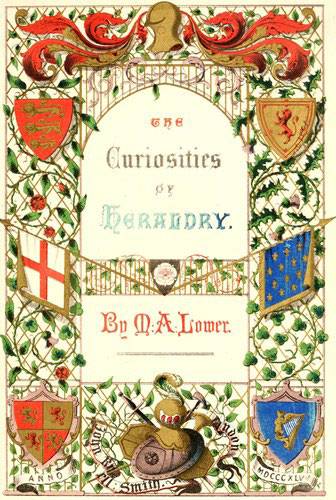
The Project Gutenberg eBook of The Curiosities of Heraldry
Title: The Curiosities of Heraldry
Author: Mark Antony Lower
Release date: February 22, 2012 [eBook #38951]
Most recently updated: January 8, 2021
Language: English
Credits: Produced by The Online Distributed Proofreading Team at
https://www.pgdp.net (This file was produced from images
generously made available by The Internet Archive.)
THE
CURIOSITIES OF HERALDRY.
WITH
Illustrations from Old English Writers.
BY
MARK ANTONY LOWER,
AUTHOR OF “ENGLISH SURNAMES,” ETC.
WITH NUMEROUS WOOD ENGRAVINGS,
From Designs by the Author.
LONDON:
JOHN RUSSELL SMITH,
4, OLD COMPTON STREET, SOHO.
MDCCCXLV.
C. AND J. ADLARD, PRINTERS, BARTHOLOMEW CLOSE.
PREFACE.
Little need be said to the lover of antiquity in commendation of the subject of this volume; and I take it for granted that every one who reads the history of the Middle Ages in a right spirit will readily acknowledge that Heraldry, as a system, is by no means so contemptible a thing as the mere utilitarian considers it to be. Yet, notwithstanding, how few are there who have even a partial acquaintance with its principles. To how many, even of those who find pleasure in archæological pursuits, does the charge apply:
“—neque enim clypei cælamina norit.”
Two hundred years ago, when the study of armory was much more cultivated than at present, this general ignorance of our ‘noble science’ called forth the censure of its admirers. Master Ri. Brathwait, lamenting it, says of some of his contemporaries:
“They weare theire grandsire’s signet on their thumb,
Yet aske them whence their crest is, they are mum;”
and adds:
“Who weare gay coats, but can no coat deblaze,
Display’d for gulls, may bear gules in their face!”[1]
This invective is perhaps a little too severe, yet it is mildness itself when compared with that of Ranulphus Holme, son of the author of the ‘Academy of Armory,’ who declares that unless the reader assents to what is contained in his father’s book he is
“neither Art’s nor Learning’s friend,
But an ignorant, empty, brainless sot,
Whose chiefest study is the can and pot!”
Now, though I would by no means place the objector to Heraldry upon the same bench with the devotee of Bacchus, nor even upon the stool of the dunce, yet I hope to make it appear that the study is worthy of more attention than is generally conceded to it.[2] At the same time I wish it to be distinctly understood that I do not over-rate its importance. “The benefit arising from different pursuits will differ, of course, in degree, but nothing that exercises the intellect can be useless, and in this spirit it may be possible to study even conchology without degradation.”
Many persons regard arms as nothing more than a set of uncouth and unintelligible emblems by which families are distinguished from one another; the language by which they are described as an antiquated “jargon;” and both as little worthy of an hour’s examination as astrology, alchemy or palmistry. This is a mistake; and such individuals are guilty, however unintentionally, of a great injustice to a lordly, poetical, and useful science.
That Heraldry is a lordly science none will deny; that it is also a poetical science I shall shortly attempt to prove; but there are some sour spirits who know not how to dissever the idea of lordliness from that of tyranny, and who “thank the gods for not having made them poetical.” These, therefore, will be no recommendations of our subject to such readers; but should I be able to show that it is a useful science, what objections can those cavillers then raise?
I purpose to give a short dissertation on the utility of Heraldry, but first let me say a few words on the poetry of the subject. Do not the ‘Lion of England,’ the ‘Red-Cross Banner,’ the ‘White and Red Roses,’ the ‘Shamrock of Ireland,’ and ‘Scotia’s barbed Thistle’ occupy a place in the breast of every patriot? and what are they but highly poetical expressions? Do not the poetry of Chaucer and Spenser and Shakspeare, not to mention our old heroic ballads and the pleasant legends of a Scott, abound with heraldrical allusions? Tasso is minute, though inaccurate, in the description of the banners of his Christian heroes; he was far from despising blazon as a poetical accessory. And, lastly, see how nobly the stately Drayton makes the ‘jargon’ of Heraldry chime in with his glorious numbers:
“Upon his surcoat valiant Neville bore
A SILVER SALTIRE upon martial red;
A LADIE’S SLEEVE high-spirited Hastings wore;
Ferrers his tabard with rich VAIRY spred,
Well known in many a warlike match before;
A RAVEN sate on Corbet’s armed head;
And Culpeper in SILVER ARMS enrailed
Bore thereupon a BLOODIE BEND ENGRAILED;
The noble Percie in that dreadful day
With a BRIGHT CRESCENT in his guidhomme came;
In his WHITE CORNET Verdon doth display
A FRET OF GULES,” &c.
Barons’ War, B. 1, 22, 23.
I now proceed to show that Heraldry is a useful science. It has already been said that nothing which calls into exercise the intellectual powers can be useless. But it may be said that there is an abundance of studies calculated more profitably to exercise them. Granted: but it should be remembered that, as there is a great diversity of tastes, so there is a great disparity in the mental capacities of mankind. Heraldry may therefore be recommended as a study to those who are not qualified to grasp more profound subjects, and as a source of amusement to those who wish to relieve their minds in the intervals of graver and more important pursuits. To either class a very brief study will give an insight into the theory of heraldry, and a competent knowledge of the terms it employs.
The nomenclature of Heraldry is somewhat repulsive to those who casually look into a treatise on the subject, and often deters even the unprejudiced from entering upon the study; but what science is there that is not in a greater or less degree liable to the same objection?
A recent writer observes: “The language of Heraldry is occasionally barbarous in sound and appearance, but it is always peculiarly expressive; and a practice which involves habitual conciseness and precision in their utmost attainable degree, and in which tautology is viewed as fatally detrimental, may insensibly benefit the student on other more important occasions.”[3]
But Heraldry is useful on higher grounds than these, and particularly as an aid to the right understanding of that important period of the history of Christendom, the reign of feudalism. An eminent French writer, Victor Hugo, declares that “for him who can decipher it, Heraldry is an algebra, a language. The whole history of the second half of the middle ages is written in blazon, as that of the preceding period is in the symbolism of the Roman church.” To the student of history, then, Heraldry is far from useless.
The sculptured stone or the emblazoned shield often speaks when the written records of history are silent. A grotesque carving of coat or badge in the spandrel of some old church-door, or over the portal of a decayed mansion, often points out the stock of the otherwise forgotten patron or lord. “A dim-looking pane in an oriel window, or a discoloured coat in the dexter corner of an old Holbein may give not only the name of the benefactor or the portrait, but also identify him personally by showing his relation to the head of the house, his connexions and alliances.”[4] The antiquary and the local historian, then, possess in Heraldry a valuable key to many a secret of other times.
To the genealogist a knowledge of Heraldry is indispensable. Coats of arms in church windows, on the walls, upon tombs, and especially on seals, are documents of great value. Many persons of the same name can now only be classed with their proper families by an inspection of the arms they bore. In Wales, where the number of surnames is very limited, families are much better recognized by their arms than by their names.[5]
The painter, in representing the gaudy scenes of the courts and camps of other days, can by no means dispense with a knowledge of our science; and the architect who should attempt to raise some stately Gothic fane, omitting the well-carved shield, the heraldric corbel, and the blazoned grandeur of
“rich windows that exclude the light,”
would inevitably fail to impart to his work one of the greatest charms possessed by that noblest of all styles of building, and produce a meagre, soulless, abortion! Heraldry is, then, in the eyes of every man of any pretensions to taste, a useful, because an indispensable, science.
Now for an argument far stronger than all: Heraldry has been known to further the ends of justice. “I know three families,” says Garter Bigland, “who have acquired estates by virtue of preserving the arms and escutcheons of their ancestors.” I repeat, therefore, without the fear of contradiction, that Heraldry is a useful science. Q. E. D.
With respect to the sheets now submitted to the reader a few observations may be necessary. In the first place, I wish it to be understood that I have avoided, as much as possible, the technicalities of blazon: it was not my wish to supersede (even had I been competent to do so) the various excellent treatises on the subject already extant. The sole motive I entertained in writing this volume was a desire to render the science of Heraldry more intelligible to the general reader, and to present it in aspects more interesting and attractive than those writers can possibly do who treat of blazon merely as an art, and to make him acquainted with its origin and progress by means of brief historical and biographical sketches, and by inquiries into the derivation and meaning of armorial figures. In such an antient and well-explored field there has been but little scope for original discovery; but if I have succeeded in concentrating, and placing in a somewhat new light, old and well-known truths, my labour has not been lost, and my wish to render popular a too-much neglected study has been in some measure realized.
The references at the foot of nearly every page render acknowledgments to the authors whose works I have consulted almost unnecessary. It is, however, but justice to confess my obligations to Dallaway and Montagu for the general subject, to Noble for the notices of the heralds, and to Moule for the bibliography. For the illustrations and extracts I am principally indebted to the Boke of St. Albans, Leigh, Bossewell, Ferne, Guillim, Morgan, Randle Holme, and nearly all the writers of the antient school; whose works are rarely met with in an ordinary course of reading. From all these, both antient and modern, it has been my aim to select such points as appeared likely to interest both those who have some acquaintance with the subject and those who are confessedly ignorant of it.
Besides the authors of acknowledged reputation named above, I have consulted many others of comparatively little importance and value, convinced with Pliny, “nullum esse librum tam malum ut non aliquâ parte posset prodesse.” Should a small proportion only of the reading public peruse my ‘Curiosities of Heraldry’ on the same principle, I shall not want readers!
My thanks are due to William Courthope, Esq. Rouge-Croix pursuivant of arms, for several obliging communications from the records of the Heralds’ Office, as well as for the great courtesy and promptitude with which he has invariably attended to every request I have had occasion to make during the progress of the work.
For the notice of the interesting relic discovered at Lewes (Appendix E), I am indebted to the kindness of W. H. Blaauw, Esq., M.A., author of the ‘Barons’ War,’ some remarks from whom on the subject were read at the late meeting of the Archæological Association at Canterbury, where the relic itself was exhibited.
The reader is requested to view the simple designs which illustrate these pages with all the candour with which an amateur draughtsman is usually indulged. Every fault they exhibit belongs only to myself, not to Mr. Vasey, the engraver, who, unlike Sir John Ferne’s artist,[6] must be acknowledged to have “done his duety” in a very creditable manner.
It is not unlikely that I may be called upon to justify the orthography of several words of frequent occurrence in this work. I will therefore anticipate criticism by a remark or two, premising that I am too thoroughly imbued with the spirit of antiquarianism to make innovations without good and sufficient reason. The words to which I allude are antient, lyon, escocheon, and, particularly, heraldric. The first three cannot be regarded as innovations, as they were in use centuries ago. For ‘antient,’ apology is scarcely necessary, as many standard writers have used it; and it must be admitted to be quite as much like the low Latin antianus as ancient is. ‘Lyon’ looks picturesque, and seems to be in better keeping with the form in which the monarch of the forest is pourtrayed in heraldry than the modern spelling: an antiquarian predilection is all that I can urge in its defence. I would never employ it except in heraldry. ‘Escocheon’ is used by many modern writers on heraldry in preference to escutcheon, not only as a more elegant orthography, but as a closer approximation to the French écusson, from which it is derived.
For ‘HERALDRIC’ more lengthened arguments may be deemed necessary, as I am not aware that it occurs in any English dictionary. This adjective is almost invariably spelt without the R—heraldic; and that orthography, though sometimes correct, is still oftener false. I contend that two spellings are necessary, because two totally different words are required in different senses,—to wit,
I. Heraldic, belonging to a herald; and
II. Heraldric, belonging to heraldry.
I will illustrate the distinction by an example or two.
(I) “The office of Garter is the ‘ne plus ultra’ of heraldic ambition,” i. e., it is the height of the herald’s ambition ultimately to arrive at that honour. The word here has no relation whatever to proficiency in the science of coat-armour or heraldry, since it is possible that a herald or pursuivant may entertain the desire of gaining the post, causâ honoris, without any particular predilection for the study. Again,
“Queen Elizabeth was a staunch defender of heraldic prerogatives;” in other words, she defended the rights and privileges of her officers of arms; not the prerogatives of coats of arms, for to what prerogatives can painted ensigns lay claim?
(II) “A. B. is engaged in heraldric pursuits;” that is, in the study of armorial bearings; not in the pursuits of a herald, which consist in the proclamation of peace or war, the attendance on state ceremonials, the granting of arms, &c. To say that A. B., who has no official connexion with the College of Arms, is a herald, would be an obvious misnomer, although he may be quite equal in heraldrical skill to any gentleman of the tabard.
“The so-called arms of the town of Guildford have nothing heraldric about them,” that is, they are not framed in accordance with the laws of blazon. To say that they are not heraldic, would be to say that they do not declare war, attend coronations, wear a tabard, or perform any of the functions of a herald—a gross absurdity.
A literary friend, who objects to my reasoning, thinks that the one word, heraldic, answers every purpose for both applications. That it has done so, heretofore, is not certainly a reason why it should after the distinction has been pointed out. Besides, my doctrine is not unsupported by analogy. We have a case precisely parallel in the words monarchal and monarchical; and he who would charge me with innovation must, to be consistent with himself, expunge monarchical from his dictionary as a useless word.
Lewes; Dec. 1844.
Contents.
| CHAP. | PAGE | |
| I. | THE FABULOUS HISTORY OF HERALDRY | 1 |
| II | THE AUTHENTIC HISTORY OF HERALDRY | 15 |
| III | RATIONALE OF THE FIGURES EMPLOYED IN HERALDRY | 49 |
| IV | THE CHIMERICAL FIGURES OF HERALDRY | 89 |
| V | THE LANGUAGE OF ARMS | 105 |
| VI | ALLUSIVE ARMS—ARMES PARLANTES | 119 |
| VII | CRESTS, SUPPORTERS, BADGES, etc. | 133 |
| VIII | HERALDRIC MOTTOES | 151 |
| IX | HISTORICAL ARMS—AUGMENTATIONS | 161 |
| X | DISTINCTIONS OF RANK AND HONOUR | 197 |
| XI | HISTORICAL NOTICES OF THE COLLEGE OF ARMS | 219 |
| XII | BRIEF NOTICES OF DISTINGUISHED HERALDS AND HERALDRIC WRITERS, WITH QUOTATIONS FROM THEIR WORKS |
245 |
| XIII | GENEALOGY | 281 |
| Appendix. | ||
| A | ON DIFFERENCES IN ARMS, NOW FIRST PRINTED FROM A MS. BY SIR EDWARD DERING, BART. |
297 |
| B | THE ANTIENT PRACTICE OF BORROWING ARMORIAL ENSIGNS ILLUSTRATED FROM THE ARMS OF CORNISH FAMILIES |
309 |
| C | ABATEMENTS | 313 |
| D | GRANT OF ARMS TEMP. EDW. III. | 315 |
| E | NOTICE OF AN ANTIENT STEELYARD WEIGHT DISCOVERED AT LEWES |
317 |
Errata.
| Page 15, | line 6, for pays? read pays! |
| 20, | — 15, for preterea read præterea. |
The distinction between the supports and tenans of French heraldry made at page 144 is erroneous. The true distinction is that human figures and angels, when employed to support the shield, are called tenans, while quadrupeds, fishes, or birds engaged in the same duty are styled supports.
THE
CURIOSITIES OF HERALDRY.
CHAPTER I.
Fabulous History of Heraldry.
“You had a maister that hath fetched the beginning of Gentry from Adam, and of Knighthood from Olybion.”
Ferne’s Blazon of Gentrie.
“Gardons nous de mêler le douteux an certain, et le chimérique avec le vrai.”
Voltaire, Essai sur les Mœurs.
ntiquity has, in a greater or less degree, charms for all; and it is supposed to stamp such a value on things as nothing else can confer. This feeling, unexceptionable in itself, is liable to great abuse; especially in relation to historical matters. In States and in Families, Antiquity implies greatness, strength, and those other attributes which command veneration and respect. Hence the first historians of nations have uniformly endeavoured to carry up their annals to periods far beyond the limits of probability, thus rendering the earlier portions of their works a tissue of absurdity deduced from the misty regions of tradition, conjecture, and song.[7]
This reverence for antiquity has extended itself to genealogists, and to those who have recorded the history of sciences and inventions. Thus has it been with the earliest writers on Heraldry, a system totally unknown till within the last thousand years; but which in the fancies of its zealous admirers has been presumed to have existed, not merely in the first ages of the world, but at a period
“Ere Nature was, or Adam’s dust
Was fashioned to a man!”
We are gravely assured by a writer of the fifteenth century that heraldric ensigns were primarily borne by the ‘hierarchy of the skies,’ “At hevyn,” says the author of the Boke of St. Albans, “I will begin; where were V orderis of aungelis, and now stand but IV, in cote armoris of knawlege, encrowned ful hye with precious stones, where Lucifer with mylionys of aungelis, owt of hevyn fell into hell and odyr places, and ben holdyn ther in bondage; and all [the remaining angels] were erected in hevyn of gentill nature!”
Thus, in one short sentence, the origin both of nobility and of its external symbols is summarily disposed of. When proofs are not to be adduced, how can we regret that it is no longer?
But to descend a little lower, let us quote again the poetical language of this indisputable authority: “Adam, the begynnyng of mankind, was as a stocke unsprayed and unfloreshed,”—having neither boughs nor leaves—“and in the braunches is knowledge wich is rotun and wich is grene;” that is, if I rightly understand it, (for poetry is not always quite intelligible,) both the gentle and the ungentle, the earl and the churl, are descended from one progenitor; omnes communem parentem habent; a truth which, it is presumed, will not be called in question.
The gentility of the great ancestor of our race is stoutly contended for, and, that his claim to that distinction might not want support, Morgan, an enthusiastic armorist of the seventeenth century, has assigned him two coats of arms; one as borne in Eden—when he neither used nor needed either coat for covering or arms for defence—and another suited to his condition after the fall. The first was a plain red shield, described in the language of modern heraldry as ‘gules,’ while the arms of Eve, a shield of white, or ‘argent,’ were borne upon it as an ‘escocheon of pretence,’ she being an heiress! The arms of Abel were, as a matter of course, those of his father and mother borne ‘quarterly,’ and ensigned with a crosier, like that of a bishop, to show that he was a ‘shepheard’[8]
Sir John Ferne, a man of real erudition, was so far carried away by extravagant notions of the great antiquity of heraldric insignia, as seriously to deduce the use of furs in heraldry from the ‘coats of skins’ which the Creator made for Adam and Eve after their transgression. This, independently of its absurdity, is an unfortunate idea; for coats of arms are as certainly marks of honour as these were badges of disgrace; and as Morgan says, ‘innocens was Adam’s best gentility.’[9] The second coat of Adam, says this writer, was ‘paly tranche, divided every way and tinctured of every colour.’ Cain, also, after his fall, changed his armorials “by ingrailing and indented lines—to show, as the preacher saith, There is a generation whose teeth are as swords, and their jaw-teeth as knives to devour the poor from the earth.” He was the first, it is added, who desired to have his arms changed—‘So God set a mark upon him!’[10]
This ante-diluvian heraldry is expatiated upon by our author in a manner far too prolix for us to follow him through all his grave statements and learned proofs. I shall therefore only observe, en passant, that arms are assigned to the following personages, viz.: Jabal, the inventor of tents, Vert, a tent argent, (a white tent in a green field!) Jubal, the primeval musician, Azure, a harp, or, on a chief argent three rests gules;[11] Tubal-Cain, Sable, a hammer argent, crowned or, and Naamah, his sister, the inventress of weaving, In a lozenge gules, a carding-comb argent.
Noah, according to the Boke of St. Albans, “came a gentilman by kynde ... and had iij sonnys begetyn by kinde ... yet in theys iij sonnys gentilness and ungentilnes was fownde.” The sin of Ham degraded him to the condition of a churl; and upon the partition of the world between the three brethren Noah pronounced a malediction against him. “Wycked kaytiff,” says he, “I give to thee the north parte of the worlde to draw thyne habitacion, for ther schall it be, where sorow and care, cold and myschef, as a churle thou shalt live in the thirde parte of the worlde wich shall be calde Europe, that is to say, the contre of churlys!”
“Japeth,” he continues, “cum heder my sonne, thou shalt have my blessing dere.... I make the a gentilman of the west parte of the world and of Asia, that is to say, the contre of gentilmen.” He then in like manner creates Sem a gentleman, and gives him Africa, or “the contre of tempurnes.”[12]
“Of the offspryng of the gentleman Japheth come Habraham, Moyses, Aron, and the profettys, and also the kyng of the right lyne of Mary, of whom that gentilman Jhesus ... kyng of the londe of Jude and of Jues, gentilman by his modre Mary prynce[ss] of cote-armure!”... “Jafet made the first target and therin he made a ball in token of all the worlde.”
Morgan’s researches do not seem to have furnished him with the arms of Abraham, Isaac, and Jacob, but those of the twelve patriarchs are given by him and others. Joseph’s “coat of many colours,” Morgan, by a strange oversight, makes to consist of two tinctures only, viz. black, chequered with white—in the language of heraldry, chequy sable and argent,—to denote the lights and shadows of his history.
The pathetic predictions and benedictions pronounced by the dying patriarch Jacob to his sons, furnished our old writers with one of their best pretences for giving coat-armour to persons in those remote ages. The standards ordered to be set up around the Israelitish camp in the desert[13] are likewise adduced in support of the notion that regular heraldry was then known. The arms of the twelve tribes are given by Morgan in the following hobbling verses:[14]
“Judah bare Gules, a lion[15] couchant or;
Zebulon’s black Ship’s[16] like to a man of war;
Issachar’s asse[17] between two burthens girt;
As Dan’s[18] sly snake lies in a field of vert;
Asher with Azure a Cup[19] of gold sustains;
And Nephtali’s Hind[20] trips o’er the flow’ry plains;
Ephraim’s strong Ox lyes with the couchant Hart;
Manasseh’s Tree its branches doth impart;
Benjamin’s Wolfe in the field gules resides;
Reuben’s field argent and blew bars wav’d glides;
Simeon doth beare his Sword; and in that manner
Gad, having pitched his Tent, sets up his Banner.”
The same authority gives as the arms of Moses a cross, because he preferred “taking up the cross,” and suffering the lot of his brethren to a life of pleasure and dignity in the court of Pharaoh. The ‘parfight armory of Duke Joshua,’ given by Leigh, is Partie bendy sinister, or and gules, a backe displayed sable. The arms of Gideon were Sable, a fleece argent, a chief azure gutté d’eau,[21] evidently a ‘composition’ from the miracle recorded in the Book of Judges. To Samson is ascribed, Gules, a lion couchant or, within an orle argent, semée of bees sable, an equally evident allusion to a passage in the bearer’s history. David, as a matter of course, bore a golden harp in a field azure.[22]
But it is not alone to the worthies of sacred history that these honourable insignia are ascribed—the heroes of classical story, too, had their ‘atchievements,’ Hector of Troy, for example, bore, Sable, ij lyons combatand or.[23] Here again our great authority, Dame Julyan Berners,[24] may be cited. “Two thousand yere and xxiiij,” says she, “before thyncarnation of Christe, Cote-Armure was made and figurid at the sege of Troye, where in gestis troianorum it tellith that the first begynnyng of the lawe of armys was; the which was effygured and begunne before any lawe in the world bot the lawe of nature, and before the X commaundementis of God.”
I have been favoured with the following curious extract from a MS. at the College of Arms,[25] which also refers the origin of arms to the siege of Troy. I believe it has never been printed.
“What Armes be, and where they were firste invented. As kinges of Armes record, the begynynge of armes was fyrste founded at the great sege of Troye wthin the Cytie and wthout, for the doughtines of deades don on bothe partyes and for so mouche as thier were soo many valliaunt knights on bothe sydes wch did soo great acts of Armes, and none of them myght be knowen from other, the great Lords on both p’ties by thier dyscreate advice assembled together and accorded that every man that did a great acte of armes shoulde bere upon him a marke in token of his doutye deades, that the pepoell myght have the betr knowledge of him, and if it were soo that suche a man had any chylderen, it was ordeyned that they should also bere the same marke that their father did wth dyvers differences, that ys to saye, Theldeste as his father did wth a labell, the secounde wth a cressente, the third wth a molett, the fourth a marlet, the vth an annellet, the vjth a flewer delisse. And if there be anye more than sixe the rest to bere suche differences as lyketh the herauld to geve them. And when the said seige was ended ye lordes went fourth into dyvers landes to seke there adventures, and into England came Brute and [his] knights wth there markes and inhabited the land; and after, because the name of MERKES was rewde, they terned the same into ARMES, for as mouche as that name was far fayerer, and becausse that markes were gotten through myght of armes of men.”
The humour of Alexander the Great must have been somewhat of the quaintest when he assumed the arms ascribed to him by Master Gerard Leigh, to wit, Gules a GOLDEN LYON SITTING IN A CHAYER and holding a battayle-axe of silver.[26] The ‘atchievement’ of Cæsar was, if we may trust the same learned armorist, Or, an eagle displayed with two heads sable.[27]
Arms are also assigned to King Arthur, Charlemagne, Sir Guy of Warwick, and other heroes, who, though belonging to much more recent periods, still flourished long before the existence of the heraldric system, and never dreamed of such honours.
That these pretended armorials were the mere figments of the writers who record them, no one doubts. In these ingenious falsehoods we recognize a principle similar to that which produced the ‘pious frauds’ of enthusiastic churchmen, and to that which led self-duped alchemists to deceive others. In their zeal for the antiquity of arms—a zeal of so glowing a character that no one who has not read their works can estimate it—they imagined that they must have existed from the beginning of the world. Then, throwing the reins upon the neck of their fancy, they ascribed to almost every celebrated personage of the earliest ages, the ensigns they deemed the most appropriate to his character and pursuits. The feeling inducing such a procedure originated in a mistake as to the antiquity of chivalry, of which heraldry was part and parcel. Feelings unknown before the existence of this institution are attributed to the heroes of antiquity. ‘Duke Joshua’ is presumed to have been only another Duke William of Normandy, influenced in war by similar motives and surrounded by the same social circumstances in time of peace. Chaucer talks of classical heroes as if they were knights of some modern order; and Lydgate, in his Troy Boke invests the heroes of the Iliad with the costume of his own times, carrying emblazoned shields and fighting under feudal banners:
“And to behold in the knights shields
The fell beastes.
“Where that he saw,
In the shields hanging on the hookes,
The beasts rage.
“The which beastes as the storie leres
Were wrought and bete upon their banners
Displaied brode, when they schould fight.”[28]
The fabulous history of the science might be fairly deduced to the eleventh century, as the Saxon monarchs up to that date are all represented to have borne arms. Yet as there are not wanting, even in our day, those who admit the authenticity of those bearings, their claims will be briefly referred to in the next chapter.
In justice to the credulous and inventive armorists of the ‘olden tyme,’ the reader should be reminded that warriors did, in very antient times, bear various figures upon their shields. These seem in general to have been engraved in, rather than painted upon, the metal of which the shield was composed. The French word escu and escussion, the Italian scudo, and the English escocheon, are evident derivations from the Latin scutum, and the equivalent word clypeus is derived from the Greek verb γλυφειν, TO ENGRAVE. But those sculptured devices were regarded as the peculiar ensigns of one individual, who could change them at pleasure, and did not descend hereditarily like the modern coat of arms.
A few references to the shields here alluded to may not be unacceptable. Homer describes the shield of Agamemnon as being ornamented with the Gorgon, his peculiar badge; and Virgil says of Aventinus,[29] the son of Hercules—
“Post hos insignem palmâ per gramina currum,
Victoresque ostentat equos, satus Hercule pulchro
Pulcher Aventinus: clypeoque, insigne paternum,
Centum angues, cinctamq: gerit serpentibus hydram.”
Æneid. vii, 655.
“Next Aventinus drives his chariot round
The Latian plains, with palms and laurels crowned;
Proud of his steeds he smokes along the field,
His father’s hydra fills his ample shield.”
Dryden, vii, 908.
The Greek dramatists describe the symbols and war-cries placed upon their shields by the seven chiefs, in their expedition against the city of Thebes. As an example, Capaneus is represented as bearing the figure of a giant with a blazing torch, and the motto, “I will fire the city!” Such ensigns seem to have been the peculiar property of the valiant and well-born, and so far they certainly resembled modern heraldry. Virgil, speaking of Helenus, whose mother had been a slave, says,
“Slight were his arms—a sword and silver shield;
No marks of honour charged its empty field.”[30]
Several of our more recent writers, while they disclaim all belief of the existence of armorial bearings in earlier times, still think they find traces of these distinctions in the days of the Roman commonwealth. The family of the Corvini are particularly cited as having hereditarily borne a raven as their crest; but this device was, as Nisbet has shown,[31] merely an ornament bearing allusion to the apocryphal story of an early ancestor of that race having been assisted in combat by a bird of this species. The jus imaginum of the Romans is also adduced. In every condition of civilized society distinctions of rank and honour are recognized. Thus the Romans had their three classes distinguished as nobiles, novi, and ignobiles. Those whose ancestors had held high offices in the state, as Censor, Prætor, or Consul, were accounted nobiles, and were entitled to have statues of their progenitors executed in wood, metal, stone, or wax, and adorned with the insignia of their several offices, and the trophies they had earned in war. These they usually kept in presses or cabinets, and on occasions of ceremony and solemnity exhibited before the entrances of their houses. He who had a right to exhibit his own effigy only, was styled novus, and occupied the same position with regard to the many-imaged line as the upstart of our own times, who bedecks his newly-started equipage with an equally new coat of arms, does to the head of an antient house with a shield of forty quarterings. The ignobiles were not permitted to use any image, and therefore stood upon an equality with modern plebeians, who bear no arms but the two assigned them by the heraldry of nature.
The patricians of our day to a certain extent carry out the jus imaginum of antiquity, only substituting painted canvas for sculptured marble or modelled wax; and there is no sight better calculated to inspire respect for dignity of station than the gallery of some antient hall hung with a long series of family portraits; in which, as in a kind of physiognomical pedigree, the speculative mind may also find matter of agreeable contemplation. The jus imaginum doubtless originated in the same class of feelings that gave birth to heraldry, but there is no further connexion or analogy between the two. It is to hereditary shields and hereditary banners we must limit the true meaning of heraldry, and all attempts to find these in the classical era will end in a disappointment as inevitable as that which accompanies the endeavour to gather “grapes of thorns or figs of thistles.”