
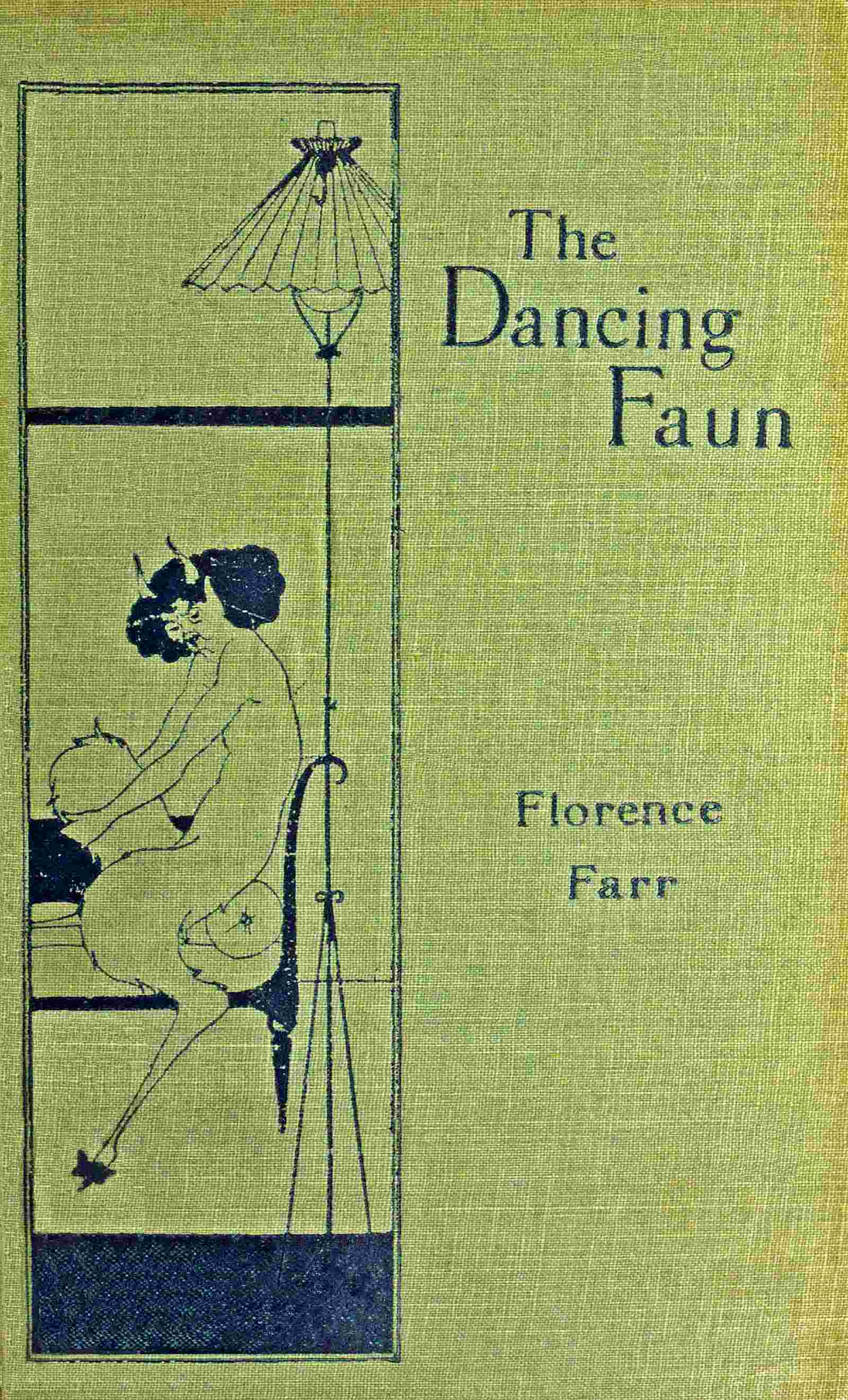
THE DANCING FAUN
‘Yes, Lady Geraldine, the only beauty in modern life is its falsehood. Its reality is ridiculous.’
‘Truth always was undignified, Mr. Travers.’
‘Just so; that is why the art of life consists in not realising the truth,’ replied the man, with charming languor.
‘You are the first person I have met who has dared put these things into words,’ murmured the woman.
‘Your life has been a dream hitherto.’
‘According to you, I had better not awake.’
‘One wants experience to give a wider scope to one’s dreams,’ said he paternally.
‘A woman’s imagination has no such needs.’
‘That depends. What are your favourite books?’
‘I dislike reading. In novels, people always do what you expect. The only tolerable people are those who do what you do not expect.’
‘And this is your first season!’
‘I have four elder sisters.’
‘Ah!—’ he paused, then he added, ‘one never realises how much women tell each other.’
‘No, in men’s eyes, women are always at daggers drawn, fighting for the exclusive possession of a masculine heart.’
‘Geraldine,’ cried her mother, from the other end of the drawing-room, ‘come and sing to us, my dear. Mr. Clausen has not heard your voice since your return from Paris.’
‘Have you made a serious study of singing, Lady Geraldine?’ asked Travers.
‘I had a course of lessons from Sautussi in the winter.’
‘Oh yes, Mr. Travers, indeed she has,’ broke in Lady Kirkdale as she crossed the room; ‘and I insisted on her singing at Sautussi’s reception, just the same as the other pupils. I think it is the greatest mistake to make distinctions of rank in matters of art. In art all are equal. There is something so beautiful in that thought.’ Lady Kirkdale pulled up the rose-coloured blind. ‘Will you open the piano, Mr. Travers? I am sure you are devoted to music, you have the musical physiognomy.’
‘Then I fear I have a very foolish physiognomy.’
‘Now, now, don’t be severe. Kirkdale tells me you are most delightfully severe, and say such witty things.’
‘Then Lord Kirkdale has done me an infinite wrong: to have the reputation of a wit precede him is the ruin of a man.’
‘I assure you, you are mistaken; most people are much too stupid to distinguish the qualities of wit; once establish a reputation, half the world takes you on trust, and considers the other half criticises you because it envies you.’
‘You give me hope, Lady Kirkdale.’
‘Mr. Travers, I am afraid you are a very, very bad man. Come, let us go to the piano.’
The Marchioness of Kirkdale had always been enterprising. She had the experience of life only given to those ladies whose husbands are thoroughly and brutally immoral: voluptuaries who have no foresight, who do not realise that it is sometimes amusing to talk to an innocent woman, when one is thoroughly bored by those who are not innocent.
Lady Kirkdale’s suspicions had been aroused by the violent friendship her young son had conceived for George Travers; and having her own theories about the education of young men, she at once invited her son’s crony to afternoon tea at the little house they occupied in Davies Street, Berkeley Square. ‘A man’s behaviour in a drawing-room is one of the tests you should always apply before you allow him to enjoy your confidence, Stephen,’ she had said.
‘A drawing-room is such an inconceivably uninteresting place,’ sighed Stephen.
‘That is the reason why, as a test, it is so invaluable; any commonly brilliant man can amuse men in a club, or women at the Continental; but it requires the most subtle quintessence of wit to penetrate the brain of the great world without shocking its susceptibilities; neither radical paradoxes nor coarse allusions can be brought into play there, without social ruin.’
‘Is social ruin possible nowadays?’
‘My dear Kirkdale!’
‘I gauge the public feeling of society by its attitude in public, and when I sit in a box at the theatre and see the stalls greet the passionate utterances of a ruined woman with a contemptuous smile, as if that sort of sentiment were quite out of date, I come to the conclusion that social ruin means nothing now.’
‘My poor Kirkdale, if you think society is represented in the stalls at a theatre, you are still more unsophisticated than I had dared hope. But you and Geraldine are always puzzling me. There is a persistence of innocence, I might almost say ignorance, of life about you both, which I cannot understand.’
Kirkdale laughed gaily. ‘The rule of contraries always does surprise people.’
Lady Kirkdale looked hard at her son; he smiled pleasantly; then she said, ‘You will never appreciate the difficulties of my position, Kirkdale.’
‘Yes, I do, mother, although I may be stupid about obvious truths everybody else appreciates at once; I have a sort of brain of my own concealed in my skull. Geraldine and I were both born old, and we’re growing young by degrees, don’t you see?’
‘My dear boy, what nonsense you talk!’
‘Every one must have a childhood some time or other on their own account. In our old home, when my father was alive, childhood was impossible. Let us enjoy it now.’
‘Enjoy it, certainly. But bring this new man to see me.’ Kirkdale agreed, and Lady Kirkdale sent a note to her old friend John Clausen asking him to come and meet Mr. Travers. John Clausen was a man of vast experience. He had never married, and romantic people told a romantic story of an early love ending tragically in eternal fidelity. He was a walking peerage and encyclopedia; he could tell you the cast of every theatrical success, and the scandals about all the ephemeral celebrities, that have come under the notice of society, and passed thence into the darkness of the outer world during the last forty years. As Lady Maisy Potter, one of Lady Kirkdale’s married daughters, said—
‘He is one of those charming observant people, who always listen to what you say, and notice what you wear.’
As he sat in Lady Kirkdale’s drawing-room on this particular hot June afternoon, he was both listening and observing. Lady Geraldine looked like a fair and sweet flower as she sang Gounod’s passionate love-song, Ce que je suis sans toi. She was a blonde, with tiny hands which melted in the touch as it were; they appeared to have no strength, no bone, they were so soft, so delicate. Yet now she was playing, you could see they were full of nervous tension; and her style had a certain vigour and distinction surprising to those who had only seen her in her idle moments. Mr. Clausen’s eyes wandered from her to the figure of George Travers: he was of light build, his face was clean shaven save for a moustache several shades lighter than his hair, his eyes were brown and rather close together, his nostrils delicate, and his chin well cut. There was a suggestion of cat-like agility about him, and good solid muscle at the corners of his mouth gave evidence that he was a man of endless resource. He stood behind Lady Geraldine, his hand resting on her brother’s shoulder. When the song was over, Travers said, ‘I should like to hear you singing to a mandolin on the lawn, down at my place at Old Windsor. Can you not persuade Lady Kirkdale to bring you down there one day? It is a charming old place, filled with quaint things I have collected from all parts of the world. I am sure it would interest you. What do you say, Stephen, will your mother and sister come with you and see me in my Arcadia?’
‘Certainly, old fellow. I didn’t know you had a place in the country.’
‘Oh, it is not a property, I simply lease it; but it is convenient to have a house of a certain size in which to store one’s collections. I am such a wanderer that I often forget I possess even this little pied à terre.’
‘I hear you have such exquisite taste in furnishing,’ said Lady Geraldine. ‘Lord Foreshot was telling me you had superintended the decoration of his chambers in the Albany, and that they are a perfect dream.’
‘I fear Lord Foreshot had some ulterior object in view.’
‘I don’t understand you, Mr. Travers.’
‘I am sure of that, quite sure of that,’ and Mr. Travers bestowed upon her a fatherly and forgiving smile. Then he advanced to Lady Kirkdale to bid her good-bye and invite her to make arrangements for the expedition to Old Windsor. A minute or two later they were joined by Kirkdale, who had remained behind talking to Geraldine. The details were arranged, and the expedition fixed for the following Wednesday by Mr. Travers, who said, ‘The middle of the week is always best; one can enjoy one’s-self in one’s own way without being disgusted by seeing too many other people enjoying themselves in theirs.’
He and Kirkdale left the house together.
‘My sister does not like you,’ said Kirkdale.
‘I am most fortunate.’
‘How so?’
‘The degrees in a woman’s favour are, interest, dislike; interest, hate; interest—well, I suppose I may say more interest.’
‘Why do you hesitate, old fellow?’
‘Lady Geraldine is a woman who wants a special language to express her. Unfortunately for me, I have not learned it yet.’
‘It would please her to hear that.’
‘Would it? Then tell her,’ and Travers gently stroked his moustache as they turned into Piccadilly.
Lady Geraldine left the drawing-room by one door as her brother and George Travers quitted it by the other. So that Lady Kirkdale and Mr. Clausen were left tête-a-tête. She turned to him and said, ‘What is your opinion of this man?’
‘He is the sort of danger Stephen is bound to encounter sooner or later. The sooner it is over the better; young men must be initiated personally into the mysteries of life, no mother can bear the tests for them.’
‘You are quite right there; but I could have wished the serpent of Stephen’s choice had taken another form.’
‘There I disagree with you; if you had had a free hand in the matter I don’t think you could have chosen better.’
Lady Geraldine re-entered; her mother made room for her beside her on the sofa, and said, ‘We were talking of Mr. Travers; what do you think of him?’
‘I dislike him, and told Stephen I did so; there is an uncomfortable feeling that you are walking on very thin ice when you are talking to him. I wish we had not arranged this visit to Old Windsor.’
‘Shall we write and put him off? We had other engagements for the day; I can easily make excuses.’
‘Oh no, we had better go. The country air will be pleasant in any case.’
‘And how are you getting through your first season, Lady Geraldine?’ said Mr. Clausen.
‘I feel as if I had been through it again and again before. It interested me at first; it was amusing to see my sisters’ old experiences renewing themselves as my turn came. But it is terrible to think that whether you are in it or not, the world goes on just the same: in another season, girls now in the schoolroom will be going through the mill exactly in the same way as I am doing. How one longs for something different!’
‘Yes we all have felt that. I believe it is the strongest passion of the human race to get at “something different”; it is the secret of all sin, the secret of all progress.’
‘And it is the function of society to suppress this tendency,’ said Lady Kirkdale. ‘It crystallises, I may say sanctifies, the present state of things. “Whatever is, is right” must be the ostensible motto of those who would retain their places in it. It is the solid edifice round which an empire is gathered.’
‘The solid centre of a very wobbling circumference,’ interrupted Mr. Clausen.
‘Mr. Travers was saying that the beautiful was only a veil to cover the ridiculous. It seems to me that in the same way the stupidity of society is concealed by hiding it behind very high walls,’ murmured Geraldine, as she leaned her head on the broad back of the Chesterfield sofa.
‘There you are wrong; those high walls contain everything. There is nothing without that is not within; the only difference is that people in society keep within bounds, others do not.’
‘That is a great deal to be thankful for,’ said Lady Kirkdale. ‘I once had to go down to Richmond by the last underground train from Hampstead on a Saturday night. I have had a good deal of experience, but never have I witnessed such a pandemonium. I would not enter one of those underground stations, when the rabble is at large, to save a hundred pounds.’
‘All vice loses its attraction when it is seen from the outside,’ said Mr. Clausen.
‘Has vice any attraction?’ asked Geraldine.
‘Not to the refined or cultivated pleasure-seeker, but the crude youngster often finds himself thoroughly enjoying the most vulgar vices: it is only after being repeatedly shocked at the appearance of other people when they are enjoying similar ecstasies that our cultivated perceptions render us incapable of revelling in the ridiculous.’
‘Ah, how true! nothing excites virtue so much as the spectacle of other people’s vices,’ said Lady Kirkdale.
‘It is the last rope thrown out by Providence to save us from our sins,’ replied Mr. Clausen.
‘How curious it would be,’ said Geraldine, ‘if the next Saviour of the world should be one who would bestow a universal sense of humour!’
‘But nobody is so ridiculous as a humorist,’ cried Lady Kirkdale.
‘One can forgive anything when it is done with deliberate intent,’ was Mr. Clausen’s rejoinder, ‘but other people’s instinctive emotions can never be forgiven, unless we happen to share them.’
‘So you think we might be redeemed by a humorist.’
‘He certainly should have a trial. Lady Geraldine, here is a chance for you—start in life as the high priestess of humour.’
‘I am not old enough, Mr. Clausen; I am afraid I have not worn out my instinctive emotions yet.’
‘Ah, well! when you have, you will know where to fly for refuge.’
Lady Kirkdale sighed, and said, ‘I suppose our most lasting delusion is that our experiences can be of service to others.’
‘It is not a delusion,’ replied Mr. Clausen warmly. ‘Experience teaches us through our own agony to sympathise with others. When they have passed through a like experience, we can help to heal their wounds; but we cannot prevent them fighting out the battle for themselves.’ He stopped suddenly, walked to the window, looked out, and said in a lighter tone to Geraldine, ‘And how are all your sisters?’
‘They are very well. Mary has just taken the new baby into the country, where her husband joins her as soon as the session is over. Emily is still working in the East End; she lectures at Toynbee Hall on Temperance next Friday. Gladys writes from the Embassy at Vienna that her life is wasted in writing official notes; and Maisy and her husband seem to have disappeared altogether ever since they were married; they were most ridiculously attached to each other, as no doubt you remember. All the while they were engaged, I was afraid of stirring about the house, and got into a habit of humming, coughing, and rattling door handles, which I have not overcome yet.’
‘And where were they when you last heard of them?’
‘Well, they remained in Egypt on their honeymoon, until it became too hot to hold them, and now they’ve taken refuge in a yacht.’
‘Dear! dear! dear! who would have thought so much romance was left in the world? How long have they been married?’
‘Six months.’
‘The other day I heard it said that the first six months of married life were the most miserable in a woman’s existence. Maisy would not agree with that.’
‘I suppose not; they utterly refused to return to London for the season, although mamma begged Maisy to come and take me about. Poor mamma, how tired you must be of chaperoning us!’
‘No, I am not. As age comes over one, one begins to take an interest in details quite incomprehensible to the young.’
The door opened, and the footman announced in a loud voice, ‘Mr. Potter and Lady Maisy Potter.’
‘Mamma!’
‘Maisy!’
‘Robert! Where have you come from?’
‘Landed at Portsmouth this morning. Thought we would take you by surprise.’
The reunited family settled itself into groups, more tea was ordered, and confidences exchanged.
Maisy, pert, pretty, and blooming with health, sat between her mother and sister on the sofa. Mr. Clausen and Robert foregathered at the other end of the room. Geraldine said, ‘Last time you wrote, you said nothing would induce you to return to England yet.’
‘That was all poor dear Robert; he begged and prayed me to stay out there with him, until I really had to threaten him.’
‘My dear Maisy!’
‘Yes, mamma, I positively had to threaten him that, if he persisted in staying I should come home alone.’
‘And that brought him round at once, of course,’ said Geraldine.
‘Oh yes, he can’t bear me to be out of his sight for a moment. People tell me his devotion positively makes him ridiculous.’
‘You don’t mind that, I suppose.’
‘Geraldine, what has come over you? What is the matter with her, mamma? Has she been crossed in love?’
‘My dear Maisy, why should you think so?’
‘There’s something so nasty, and hard, and cynical about her—positively there is, mamma; one always notices these changes when one first comes home more than people who are living in the house.’
‘I don’t expect you noticed me at all before you went away.’
‘Oh yes, I did; you were always most interested about my affairs, and anxious to know how Robert had behaved, and what he had said. And I know very well you never spoke in that tone then. You hurt my feelings, Geraldine. I’m not used to cynicism. Robert is so straightforward and manly, he never makes fun of me.’
‘I wasn’t making fun, I assure you; I think you the most enviable woman in the world; really I do.’
Maisy aggrievedly allowed herself to be kissed, and peace was restored. In the meantime, Mr. Clausen was discussing the subject of his return with Mr. Robert Potter. Clausen began by making the remark, that the last news had led him to believe that they had not proposed returning to England yet. Mr. Potter led Mr. Clausen into the recess of the window and said: ‘The truth is, my wife was most anxious to remain out there. Personally, I hate missing a season; it is like losing sight of a generation in the evolution of the race, one is always looking for the missing link; and the next year one is horribly out of it. However, I got my wife to believe that this was her own feeling, and after two months of delicate manœuvring, I induced her to persuade me to return to England.’
‘I congratulate you on your patience.’
‘A capacity for patience is the bulwark alike of the solid Englishman and of the British Constitution. The principle of the Government has always been to acknowledge such and such a move to be a good one, but to take no step in the matter until it is forced upon it from the outside. It endures. I shall endure. What is the use of having such a splendid public constitution if you do not model your own constitution upon it?’
Mr. Clausen laughed; Mr. Potter smiled. They turned away from the window and joined the ladies.
In a miserable little garret in a small street off the Strand, a young woman lay tossing and turning in her bed; sometimes a little moan escaped her, then she would bury her face in her pillow and break into passionate sobs. As it became light she got up and looked out of the window; she could see a wide expanse of roofs, and in the distant sky the thin lines of white light through the grey river mist. She shuddered at the cold, and crept into bed again. Just as she was falling asleep, a man in evening dress and a loose overcoat of the latest fashion softly entered the room, and she sprang up, saying—
‘O my George, my dear one, where have you been? I was terrified.’
‘My poor little child, all is well, don’t cry: there, there! I have done great things to-night, and if you are very careful our fortune’s made. To-morrow we go down to the place on the river Guaschaci has lent us; but my little wife will have to be very obedient, and do exactly what her husband tells her. Does she promise not to cry any more, and not to spoil her pretty eyes?’ He held her face between his hands, and kissed her on the mouth.
‘Yes, yes, George, anything. I will do anything you tell me, only promise me never to leave me again like this. It makes me so unhappy.’
‘My darling, I never will; but you should trust me.’
She threw her arms round his neck passionately, ‘I do, George, I do. God knows what will become of me if I ever lose that trust.’
‘My sweet love!’ and he sat down on the bed. ‘Now tell me. Do you remember the simple little cotton dress you wore when I first saw you on the stage, and when you stole my heart from me all at once, before I had time to realise my danger? Do you remember it?’
‘Yes, George, of course I do, of course I do.’
‘Well, what do you think I have in my head?’
‘I can’t think. O George! are you going to let me go back on the stage, and earn money to keep you out of this miserable poverty?’
‘Pooh! child, what would five pounds a week be to a man like me? That’s no good. No, now listen. In this world the only way to make money is to be supposed to have money. If I can really get the position which is mine by right, and from which my cursed ill-luck cut me off six years ago, when that affair about the duel with Prince Blank, I told you about, came out, the world will be at my feet: I shall be in a position which will be unassailable, because it will be founded on a rock. My exile has been useful to me in this way, it has enabled me to find out secrets which will be invaluable to me; secrets which will make me feared by the leaders of society.’
‘O George, but that sounds dreadful!’
‘My Gracie knows her husband would disdain to use the knowledge in his possession. Of all blackguards the blackmailer is the lowest. But there are certainly delicate means of working things, called wire-pulling in diplomatic circles, which have a certain charm—a sensation between that of a spider weaving its web and the pleasure of exercising skill experienced by the consummate chess-player. This is a feeling not ignoble; it is one shared by all great statesmen. It is the exercise of this power that evolved the Conqueror of Europe from the Corsican soldier. My wife must learn that all success is the result of carefully adjusted combinations. She must learn to know that to help her husband, and herself, she must exercise inviolable secrecy and enduring self-control.’
‘O George, can I help you? Will you trust me? Oh, how happy, how happy you make me!’
‘You can and shall; but at first secretly, and in a way which would make an ordinary woman quail.’
‘I can endure anything, anything for you. Only tell me, you shall see. I seemed so useless in your real life; it seemed as if I wasn’t really necessary to you; now I shall be the happiest woman in the world.’
‘Well, I’ll tell you my plan. When I go down to Windsor, I want you to live in the little cottage belonging to The Oaks, and to save you from scandal you must pretend to be a poor relation of Guaschaci’s. You shall have a little girl to wait on you; no real hard work. Then at night, when the house is locked up and the servants are gone to bed, I shall steal down to you and we will adorn you with silks and jewels and lace, and you shall be my beautiful transformed bride.’
‘But, dearest, why?’
‘For two reasons. One is that, to work my present plans, I must not be supposed to be married, least of all must I be supposed to have married an actress; and the second is, that that foolish boy whom you met me walking with the other day has never forgotten you. He is constantly asking who you were. I said you came from the country, so that he will not be surprised to find you down at Windsor when he comes next week. He is quite a boy, and very easy to manage. It will lead to no unpleasantness for you, my dearest, or you know I should not propose it. He is the Marquis of Kirkdale, only twenty-one, and by means of his family, who are in the best set, I propose to get really into the swim; once there, the rest is easy.’
‘I thought we should have such a lovely time down there, boating and lying about on the lawn; and all the servants to wait on us.’
‘It would have been ideal, but, under the circumstances, what am I to do? I must either make my fortune in society, or out of it. I am not born to be poor; I have no talent for it. In society all things are possible, out of it all things are possible; but out of society diplomacy is called lying; statesmanship, cheating; gallantry, seduction; a fine taste in champagne, drunkenness. No, Gracie, you must not ask me to give up society. I am made for it, and it for me. Besides, am I not providing you with the means of gratifying your taste for acting?’
‘But what will the servants think?’
‘A gentleman’s servants know that their first duty is not to think,’ said Travers, kissing her.
‘Dear George,’ she murmured, ‘I am a nasty, bad-tempered creature. I have always been teasing you to let me go back to the stage, and after all this will be great fun, and I shall have the leading part at last!’
‘Yes, the leading part, Gracie. The other women will only be walking ladies. They will come on, speak a few words to explain the plot, and be seen no more.’
‘Who are the other ladies, George?’
‘Only Kirkdale’s mother and sister, Lady Kirkdale and Lady Geraldine Fitzjustin. They are coming down with him on Wednesday; but if you play your cards properly he will find The Oaks sufficiently attractive to come down without them in future.’
‘George, do you think it is quite right, all this deception? Wouldn’t it be better to say you were married, but your wife would never, never interfere with you?’
‘Dear little baby-wife, no. Don’t you see what fun we’re all going to have? Women never have scruples about anything on their own account, but they are always full of them when they think their husbands are risking the purity of their moral characters.’
‘Now you are laughing at me, George, but really——’
‘No more buts. I’m dead tired,’ and he yawned as he turned out the light.
‘He is a delightful man,’ said Lady Kirkdale, as she leaned back in the corner of the railway carriage after making a charming bow to George Travers, who stood on the platform watching their departure from Datchet station. ‘And the house is a perfect gem of exquisite taste.’
‘He is much nicer than I thought at first,’ said Geraldine. ‘It was too bad of you, Stephen, to stay behind, and let him do all the work. Punting two women about must be most wearisome.’
‘I fancy Travers likes punting; he knows he has a good figure. I didn’t want to spoil the effect,’ rejoined Stephen.
‘That’s the first time I’ve heard you speak a word against him,’ said Lady Kirkdale.
‘One stands up for a fellow as long as he’s being abused by one’s people, of course, but when they begin to appreciate him one can slack off a little.’
‘What is the matter with you, Stephen?’
‘Oh, nothing—I’m tired, that’s all.’
In the meantime George Travers rebalanced the dogcart, fondled the horse, lighted a cigar, and drove slowly back to The Oaks. It certainly had been a successful day for him. His was one of those natures which delighted in gorgeous dreams. He felt realities to be most inadequate, he hated them. Just as he had mounted the winged steed of his imagination, some dirty little fact was always seizing the reins, and dragging him down to earth; but to-day everything had gone smoothly.
His father had been a successful actor in the ’sixties, named Swanwick. Now there are two kinds of bad parents: the parent who looks upon a child as a machine capable of perfect rectitude if its moral principles are manufactured on a certain plan, and the parent whose only notion of a child is that it is a sort of toy sent by Providence for his amusement. Now it amused old Swanwick to see his little son imitating the manners behind the footlights, lounging at bars, patronising pretty girls, advising them as to their costumes, for the actresses soon discovered that it pleased his father to see him taken notice of, and pleasing old Swanwick went a long way towards success. It made all the difference between the smooth and the seamy side of theatrical life. Blind admiration for him, and his, was all that was necessary; but woe to any one who suggested an alteration in his arrangements. He would turn on his most favoured fair one the moment she overstepped the bounds with which his vanity entrenched him, saying, ‘Am I the stage manager of this theatre or are you, madam?’ This outburst would be followed by language unfit for publication, and days of sullen anger, the clouds only departing after the most complete self-humiliation of the offending one. Now old Swanwick loved his profession; he loved trotting along the Strand and turning in to ‘have a drink’ with all the cronies he met in his progress. He also loved racing. Whenever, by hook or by crook, he could escape rehearsals, which were much less intermittent in those days than now, off he would go with his friend Travers, to Newmarket, Epsom, Sandown, anywhere. Driving for choice, and making a day of it, getting back to the theatre in a state of robust hilarity, putting his head in a basin of cold water, and coming out ‘fresh as a daisy,’ as he put it—at any rate capable of giving a capital performance of the tender, good-hearted fellow he delighted in portraying. When he died, his friend Travers adopted the little orphan boy. He was a man of old family, and felt the necessity, which old Swanwick had ignored, of doing something more for the boy than sending him to a day-school. Accordingly he talked seriously to the small precocious person whom he had taken under his protection; told him he intended to make him his heir, and that to learn to keep up his position he must acquire some knowledge of the life led in the world on this side of the footlights. He spoke in a way which appealed to the lively imagination of the boy; and when he had stayed for a few months with Travers in his house in Piccadilly, and had been taken down to the place in Gloucestershire for the shooting season, he was completely prepared to ignore his previous experiences; and could treat them lightly as the excursions of a gentleman’s son into Bohemia. Travers got very fond of the boy as time went on, and by the time he was thirteen made up his mind to do his very best for him. He sent him to Harrow and afterwards to Oxford, but the City of Spires was rather too much for young Travers, as he was everywhere called now, and he was sent down after one term.
However, he had got all he thought necessary out of the university. He could talk about it, and that was all he wanted. He then was put in a crack regiment; but unfortunately for him, he had not been there a year before his patron unexpectedly died, having made no will, and George Travers was thrown on the world with very little but a thorough knowledge of the ropes, some talent for backing the right horse, and a very considerable talent for winning at poker; and it was not a duel but a card scandal that brought his early career in London society to an untimely end. He was obliged to leave England, although circumstances necessitated the hushing up of the scandal. He joined a theatrical company in America, and made a somewhat substantial success out there. He returned to England with some money and the intention of continuing his stage career under his father’s name. While waiting for a chance, unaccountably to himself, he fell in love with Grace Lovell; we all have our moments of weakness, and in one of these he married this child, who was full of dreams, full of ambition, full of hopes, wild as only those of a young actress who has made her first success can be. She had been engaged as understudy for one of London’s favourite soubrettes, had been called upon to play the part at a moment’s notice. She had done so with such dainty freshness, and had made her points with such innocent piquancy, that she had attracted public notice to a very considerable extent. She played the part three weeks, and during those weeks George Travers came to the theatre, saw, and conquered. When her engagement was over she married him at a registry office, and disappeared from the stage.
As fate would have it, almost the moment he had taken this step George Travers made the acquaintance of Lord Kirkdale at the Junior Carlton, whither he had been taken by Charles Melton, an owner of racehorses. The two got on very well; the next day they lunched together, and, strolling along Pall Mall afterwards, encountered Mrs. George Travers. She looked at them expectantly; George smiled, nodded, and gave her a little sign to pass on without speaking. She did so, but not before Kirkdale’s curiosity had been vividly aroused. However, Travers vouchsafed no information, but that she lived in the country and he supposed she was up in town shopping for the day.
A week or two later, just as he was changing his last fiver, he encountered an Italian, Count Guaschaci, whose life he had saved in a tap-room free fight, out in the Western States. Guaschaci listened to his troubles sympathetically, and as he was leaving England for six months, told him he should be really obliged if he would look after his establishment at Old Windsor; all he asked of him was to keep things going until his return.
Then Travers saw his opportunity had come. Ten years had passed since the old scandal. A new generation ruled; all was forgotten, or could be explained away. The trustful Count gave him a cheque for two hundred pounds, and left all his affairs in his hands. It must be noted here that Travers had many most endearing qualities. He could not bear to see animals suffer; he got on splendidly with children. He treated women as if he was their father, and men as if he was their redeemer. He took a favour as if he were bestowing a benediction. He had discovered the art of living upon other people with as much grace as if he belonged to the highest circles; none of the bourgeois arrogance of the parvenu or the middleman was perceptible; he took other people’s money, their property, and their affections, with equal grace and admirable cordiality.
Grace peeped timidly out of her cottage door as he drove by. He whispered, ‘All right, little woman, I will be over directly.’ Then he drove the cart into the stable-yard, threw the reins to the groom, and strolled into the house through the back way, calling out as he passed the kitchen, ‘Just bring me a whisky and Seltzer in the grey-room; I shall want nothing more to-night.’
He lighted another cigar and threw himself full length on the white bear-skin which covered the canopied divan at the upper end of the room. The walls were hung with dull grey material, and decorated with strips and borders of faded Eastern embroidery. Guaschaci certainly knew how to do things well. There was not another man in England for whose decorations Travers felt he could have brought himself to take the responsibility. Certainly this place positively did even him credit; he felt no hesitation whatever in saying that it was his own. A middle-aged woman brought in the whisky, then courtesying gravely she asked if the master would speak to her little boy, he cried to see the master before he went to bed.
‘Bring him in, certainly, bring him in.’
‘I put him to bed, sir; but I can’t get him to sleep; perhaps you will excuse me bringing him down in his little dressing-gown.’
‘Certainly, I’ll put him to sleep in no time; don’t you trouble, Madame Kudner.’
The housekeeper went and fetched her little boy. As she carried him in he held out his arms to Travers, who lay back on the white divan laughing gaily.
‘Want a romp, little man?’ he cried. ‘All right, you shall have one. It is a shame. I haven’t seen him all day. Come and look in the cupboard, and see if we can find anything nice there.’
And the boy, who was a miracle of baby prettiness, with little brown curls dancing round his rosy cheeks, and bright eyes, was carried off in triumph to the old oak chest in which the stores were kept.
‘There, figs won’t hurt him, will they, Madame Kudner? Now, we’ll take in the dish; come along. Why, you’ve got no shoes on! Well, jump upon my back,’ and he raced round the room with the child, carrying the piece of massive church plate which did duty for a dessert dish in their curious establishment.
Little Pierre sat gravely in the corner of the divan with his feet stretched out straight in front of him, munching the green figs and gazing with rapture at the purple lusciousness which each fresh bite discovered. Travers promised to bring him upstairs when he appeared sleepy, and soon the whole house was still.
The two had a long serious conversation, and Pierre was instructed in full detail how to make himself a little paper punt, which he was to float down the river next evening with a wax taper in it; it was to be saturated with oil, so that when the taper had burnt down the whole boat would flare up splendidly and go down the stream like a real burning ship. Just as this exciting point was reached, a gentle tap was heard outside the window.
Travers listened for a moment, then he hurried off his protégé, popped him down on his bed, told him he must go to sleep at once, kissed him on both cheeks, and ran downstairs. He opened the verandah windows, at which the taps had become more and more persistent.
Grace entered in a loose white dress.
‘Why have you come here? I told you not to on any account.’
Grace stopped short, it was the first time he had spoken to her in that hard voice.
‘You said you were coming down to the cottage. I saw all the servants’ lights put out here. I was tired of waiting.’
‘I was playing with Pierre.’
‘Pierre, at this time of night! You prefer anything to me; even a child.’
‘Even a child! That’s good. Children are the only perfectly satisfactory companions in the world. They never seriously reproach you, and as for beauty, no woman can touch them.’
‘George, let me go away. Let me go back to London, to my old life.’
‘I tell you once for all, I can’t allow my wife to go on the stage.’
‘It is too hard, too hard. You make life a perfect torture to me. Why won’t you let me try to forget you, and my love, my unhappy love for you?’ she sobbed.
‘Don’t be ridiculous; and for Heaven’s sake don’t make such a row. How do I make you miserable?’
‘I wouldn’t mind if I never saw you at all. When you were quite away at Boulogne the other day, I could set to work at things I wanted to do quite happily; but when I know you are near me, and I am hoping to see you come in at any moment, my hope tortures me. They say hope is a pleasant feeling, I think it is the keenest form of torture the devil ever dressed up as an angel. I sit there in that cottage and wait, and as time goes on all my love turns sick; I get to hate you for causing me such pain. I feel as if I could kill you sometimes, to put an end to it, once for all.’
‘Oh dear! oh dear! How absurd, how absolutely ridiculous all this is! If you had just come out of the schoolroom I could have understood it, but any woman who has led the life you have must surely have grasped a few of the elementary realities of life. You appear to think what people say on the stage is real life, and what you see behind the scenes is play-acting.’
‘So it is. Behind the scenes of a theatre nobody is the same as they are in their own homes; we all play our parts there, but we put all the reality we have in us into our acting.’
‘Silly child! I am saying the absurd notions you have about love appear to have come out of plays. Of course, people always say beforehand that eternity will not be long enough for their raptures. The curtain falls on this situation; if it was to rise again, they would have to own ignominiously that half an hour had been found ample.’
‘My God! and I believed you when you told me you could not live without me. In six weeks I see you flirting with another woman.’
‘Oh, is that it? Well, I suppose if I had cared to play the spy, I should have seen you flirting with another man.’
‘How dare you! how dare you speak like that, when you know you asked me to be your decoy! You needn’t deny it; that is the long and short of it, and I refuse, I will not submit to this. I will go away, and you can get a divorce if you like. The whole thing is a miserable, degrading, horrible dream. Now I am awake, and will escape.’ She rushed to the door; he reached it first, and caught her in his arms.
‘I never saw you look so beautiful.’ He covered her face with kisses. She struggled; he murmured, ‘My own dear love, I was only teasing; don’t let us remember a word we have said.’
‘But you were flirting with that Lady Geraldine!’
‘Never mind her; she is the sort of woman men always imagine they are in love with, except when they are alone with her.’
‘When were you alone with her?’
‘I haven’t been alone with her, but I can read women like books; you needn’t be afraid that curiosity about the sex will lead me astray.’
‘And you really meant it when you said I was the only woman you ever really loved?’
‘You know it well enough, my darling. When a man like me marries, he has been shot straight through the heart.’
After a pause, she said, ‘Well, shall we go back to the cottage?’
‘No, we’ll stay here and have a little feast. Come along, we will forage about and get up a bottle of champagne. You get the things out of this cupboard, while I go down to the cellar.’
The next morning Grace Travers woke up rather earlier than usual. The scene of the previous evening had left a distinct memory behind, although it had ended in a reconciliation. She had exchanged a few sentences with Lord Kirkdale, and there was an air of truth, candour, and unsophistication that appealed strongly to her imagination, as a contrast to her husband’s somewhat brutal analysis of sexual relations. A civilised woman has very little taste for what may be termed pure passion; it pleases her instinct perhaps, but it revolts her intellect, her imagination, her delicacy, her pride. To an intellectual person the whole business of love-making is ridiculous, and without dignity. Dreams and fancies are invoked to give it an adventitious interest, and so a sort of mesmerism is exercised, and blissful dreams of eternal happiness come into existence, depending for their duration very much upon the sympathy between the imaginations of the lovers, which sometimes is powerful enough to build up a reality from a vision. However this may be, when love comes in at the door intellect flies out of the window or sleeps the sleep of the disgusted. When it returns to its habitation it delivers stern judgment on the follies that have been committed in its absence. Now a lovers’ quarrel interferes considerably with the glamour of the situation, it disturbs the harmony which is essential to the conditions described, and the intellect takes the chance to slip in and give an opinion. So it happened to Grace. She was clever, and before the madness came over her (for in her case it was not a sympathetic imagination which attracted her) was considered witty and brilliant. But the first effect of her love was to make her take life very, very seriously; she became quite incapable, for a time, of seeing the humour of any situation. She had hitherto led a wild roving life, and her ideal had been to settle down in a little nest of her own and play Joan to George Travers’s Darby for the rest of her life. Now Travers did not particularly object to her playing Joan, but he did find himself unequal to the combined rôles of Romeo and Darby. Romance and domesticity are not a very suitable combination, and poor Travers may perhaps be forgiven for falling short of the ideal set before him.
As has been said by a lady who has made some study of the female heart: ‘What is really necessary to a woman’s happiness is two husbands, one for everyday and one for Sundays.’ She really meant that she has discovered that Romeo and Darby cannot be combined in one poor mortal man, so is willing to take them separately. Grace was not so reasonable. The romantic attachment she had formed for Romeo, in the person of Travers, prevented her enduring the presence of Darby, in the person of Kirkdale. She did not object to Darby’s homage, but it was certainly not worth thinking of, and would certainly meet with no reward from her hands.
All the same, she was conscious that a potential Darby was looming in the horizon, that she was not the woman to waste her life at the beck and call of a man who could talk to her as Romeo had last night. As all this was passing through her mind her eyes fell on an old bookshelf, on which various dusty old volumes were heaped. She walked over to the corner, wondering she had not noticed them before, and took one down: it was a book of plays. She stood reading to herself and laughed, then she replaced the volume and opened a book of Shelley’s poetry. She opened it at the last pages of a play and softly murmured the words to herself. By degrees she read louder, something about her voice struck her. She listened, it sounded different, a new beauty had come into it. She read on and on, wondering at the pathos of the tones she uttered, almost crying with sympathy. As she listened to the laments of Beatrice di Cenci, it seemed to her some inspired spirit had entered her body and was making use of her voice to reveal to her what life, and love, and divine sorrow meant.
From that day she settled down to hard work. She heard that some of the words, as she spoke them, sounded round and full, and moved her to the depths of her heart; others sounded little and thin, and she resolved to work away until she had got all alike resonantly beautiful. Often she caught an ugly jarring sound in her voice when calling out to her little maid, and at once corrected herself. However she was occupied, she kept the one idea before her of making every sound she uttered beautiful.
On Saturday night Travers brought down Lord Kirkdale to stay till Monday. Grace went to church, and was listening to the curate’s reading with a severely critical ear when she became aware that Kirkdale had entered the building. He overtook her as she was crossing the fields on her way home. He raised his hat, and said—
‘So you are still here? I thought you would have left long ago, you seemed so terribly bored last time I had the pleasure of seeing you.’
‘Yes, I’m still here.’
‘And still bored?’
‘No; I’m not bored now.’
‘How is that?’
‘I am studying something.’
‘What?’
‘Well, I suppose you’d laugh at a country girl like me if I told you, but I’m studying because I want to go back—I mean—I want to go on the stage.’
‘I think it would be a very good idea.’
‘Do you really? Oh, how nice it is to hear some one say that!’
‘Why, don’t you get any encouragement from your people?’
‘No, I don’t’
‘Look here! can I help you in any way? I might perhaps be able to; I sometimes meet actors and fellows who know a lot about the stage.’
‘Oh, thanks. I don’t think I want help—yet. But it is most kind of you to offer. I dare say I shall get a chance some day.’
‘But I’ve always heard you can’t learn acting off the stage. You can’t do much by yourself down here surely?’
‘You can’t learn to act, but you can learn to speak beautifully; life teaches you that, more than all the theatres in the world.’
He looked at her in surprise.
‘I don’t know, of course, but that’s my idea of things,’ she said smiling.
‘And how do you study?’
‘I learn parts, and say them over and over again to myself until I get just the sound I want into my voice.’
‘What parts? Juliet?’
‘Well, Beatrice in The Cenci is the one I like best. I don’t like Juliet; all that sort of sentiment is such a delusion, you know. I can’t pretend to believe in it; but there is a real, terrible tragedy in Beatrice, you can’t help feeling it; it takes hold of you, you can’t escape it.’
‘The Cenci is very improper, isn’t it?’
‘I dare say; I just read the play through once to understand the part of Beatrice, I forget about the details. I only know the fact that she has a real, terrible wrong done her, which makes her loathe herself and lose her wits for a while, that she revenges it, and is beheaded for her crime just as life had become possible for her, when the father that had poisoned the very air in which she grew up had ceased to live. It seems to me that is the only really tragic part ever written for a woman. Lady Macbeth was a fiend, Juliet a baby.’
‘Will you read some of it to me?’
‘No. I can’t bear reading in a room, it is so amateurish.’
‘But just quietly, to one person, surely that is different.’
‘Well, perhaps I will. No, I’ll tell you what; if you like to come down to the river mead, I will bring out the book and read a little of it this afternoon. Now go; I don’t want the girl to see us come in together.’ He obediently went on ahead. She sat on a stile for a moment or two thinking. ‘Suppose I go off; suppose I get an engagement, what then?’ Lord Kirkdale looked round as he turned the corner, which took him out of her sight. And she wondered why he looked so heavy and sheepish, and foolish.
In case my reader should get a wrong impression of Lord Kirkdale, they must be here informed that he was an extremely well made young man, six feet one in height, thirteen stone in weight, with fair hair and ruddy complexion; there was nothing comic or unseemly about his appearance, but to a woman who had taken it into her head to adore the type of man represented by the Dancing Faun, no Hercules, however laboriously devoted, need apply.
‘Who is this dreadful ineligible man Robert tells me was dining here the other night?’ said Maisy. She had been lunching at Davies Street with her mother and sister, and the three were sitting in the drawing-room.
‘I don’t think you need trouble about his being detrimental, unless it is on mamma’s account; he devotes himself entirely to her,’ said Geraldine.
Lady Kirkdale laughed. ‘I was telling Geraldine the other day, that in a few seasons no woman this side of fifty will have a chance in society.’
‘I wonder what the meaning of it is,’ said Maisy.
‘Age has its advantages,’ said Lady Kirkdale. ‘Besides, as Edgar Allen Poe says, “What man truly loves in woman is her womanhood.”’
‘That’s so true, dear mamma; a womanly woman can do anything she likes with a man, the other sort sets his teeth on edge at once.’
‘A womanly woman indeed,’ broke out Geraldine; ‘it is only within the last few years women have dared show their womanhood. At last they are permitted to possess a small quota of human nature; they may be something more than waxen masks of doll-like acquiescence without disgracing themselves in the eyes of the world.’
‘My dear Geraldine, don’t be so disgustingly Ibsenish.’
‘You make me perfectly wild, Maisy. Do you suppose all these questions haven’t been working in everybody’s mind for the last fifty years. You may be pretty sure they have, if we have come to hear of them. I consider the whole machinery of society to be especially contrived to keep an influential set of people sufficiently ignorant to effectually counter-balance the work of men and women of genius, who see clearly enough what the next stage of progress will be; and the mob would follow them readily if the dead weight of authority and influence did not keep them back.’
‘Mamma, what is becoming of her? My dear Geraldine, you’ll never get married if you go on like this. You’ll have to take to lecturing on temperance or something, like poor Emily.’
‘I hate marriage; I think it’s a degrading bargain, which can only be carried out by unlimited lying on both sides.’
‘Really, mamma; why don’t you speak to her?’
‘Because I can’t deny the truth of what she says.’
‘But—look at Robert and me!’
‘Yes, look at you, that’s just what I mean——’
‘Geraldine, my dear, my dear, hush!’ cried Lady Kirkdale. ‘You mustn’t talk like this, you distress Maisy. And after all, you needn’t be so bitter about it. God knows, if you prefer not to marry, I am not the woman to wish to force you to it. You’ve been upset, hadn’t you better go and lie down?’
‘Oh no! I’m all right. One must speak sometimes, one can’t spend one’s life grinning like a Cheshire cat, and pretending one thinks everything perfect.’
‘Well, to change this very unpleasant subject,’ said Maisy, ‘what is this Mr. George Travers like?’
‘He is tall and slight, I should say about forty, with a careworn face and a charming smile: he can dance, ride, scull, and play billiards to perfection. There is no subject on which he is not well informed,—in fact, if he were only safely married, he would be a great acquisition to society,’ replied Lady Kirkdale.
‘And Geraldine is in love with him,’ said Maisy.
‘How dare you say such things!’ cried Geraldine.
‘When a girl, who is generally good-tempered, becomes snappish and disagreeable, you may be sure she is in love with a detrimental. The detrimental is on the spot, you are snappish. The situation is complete, my dear.’
Geraldine walked out of the room and banged the door loudly.
‘What is to be done about her, mamma?’
‘I must take her abroad, I suppose. Love is like bronchitis, a thorough change is the only cure.’
At this moment Mr. Travers was announced.
‘I must apologise for this untimely call; but I have just been at the club, and Lord Snordenham was mentioning that he must send round to tell you that his coach had to start half an hour earlier for Hurlingham to-morrow than was arranged. I said I should be passing your door, and he commissioned me to deliver the message.’
‘Thank you very much. You are to be one of us, then?’
‘I have that honour.’
‘May I introduce you to my daughter, Lady Maisy Potter. She has just returned from her honeymoon.’
‘O mamma, don’t give such a wrong impression! I must tell you, Mr. Travers, my honeymoon lasted six months,’ she said, turning to him with an engaging smile.
‘It ought to last for ever,’ he said, bowing. ‘At any rate it has agreed with you splendidly.’
‘Oh, please don’t say that; I know I am terribly sunburnt. It is so dreadful to come to London looking so healthy, late in the season, isn’t it?’
‘I am afraid my tastes are not sufficiently æsthetic to allow me to appreciate a sickly style of beauty.’
‘I am so glad to hear you say that. It is exactly what I think myself; only it doesn’t do nowadays to say anything you think, or one might be taken for one of those dreadful advanced people that are always clamouring for free thought, and free speech, and free everything. I feel it so very necessary to keep on thinking just what is right and proper. Our responsibilities as leaders of thought are so grave. For we are the leaders of thought, are we not, Mr. Travers?’
‘After a certain point necessarily so. Progress is made in circles; and if you stand still long enough you will find yourself in the van.’
‘But,’ said Lady Kirkdale, ‘suppose it doesn’t come back to the same point exactly, but goes onward in a spiral.’
‘That’s the whole problem of life. Is it a circle or a spiral?’ said Travers.
‘If it’s the latter I am sorry for all of us.’
‘Oh, don’t be afraid, mamma, life is very nice as it is. We’ll take it for granted it’s a circle, and sit still and not bother ourselves. Spirals are such uncomfortable-looking things.’
The carriage was announced, and Lady Kirkdale asked Travers to drive with them. He did so, sitting next to Geraldine and opposite Maisy. They dropped Maisy at the hotel in Albemarle Street she and Mr. Potter were staying at. Travers of course escorted her in, and as they parted she hoped he would accept the invitation to come to Cowes that her husband was going to send him for the yacht-week.
When he re-entered the carriage he said to Lady Geraldine, ‘I imagined your sisters were all out of town.’
‘So they were when we last spoke of them, but Maisy and Mr. Potter returned last month.’
‘Ah, I met Mr. Potter at your dinner-party on Thursday, of course. I didn’t know he was a relation.’
‘He is an odd man. He has inherited a large fortune from his father. He is what I call disgustingly rich; he never seems to do anything with his money. His chief pleasure in life seems to be sitting still and thinking.’
‘What does he think about?’
‘Nobody knows. I used to offer him a penny for his thoughts last year, but he always made one answer.’
‘What was that?’
‘He only said, “My mind is a perfect blank.”’
‘Oh,’ cried Lady Kirkdale, ‘that is like those Indian people who sit contemplating their big toes all day. What are they called?’
‘Do you mean the Yogis?’
‘Ah yes, that was it.’
‘I am never quite accurate about things. You see, Geraldine, dear, it’s one of my womanly qualities.’
‘Are you going down to Cowes, Mr. Travers? I think I heard Maisy asking you to join her party.’
‘Are you going?’
‘We have taken rooms in the hotel.’
‘Then I shall certainly take advantage of the proposal. That is, if Mr. Potter sends the invitation. Does his mind ever cease to be a blank?’
‘No one knows.’
It was the first Sunday in August. Lady Kirkdale and Lady Geraldine Fitzjustin had gone to spend a few days in Essex with Mary, the eldest daughter of the family, before proceeding to Cowes. Lord Kirkdale, left in possession at Davies Street, had invited Travers to dinner, and the two men were sitting in the smoking-room ruminating over their cigars and whisky and Seltzer. There had been a long pause in the conversation when Kirkdale suddenly looked up and said, ‘Look here, Travers, who is this girl down at the cottage?’
‘I’ve been waiting for that question for some time; I thought she must have told you herself.’
‘Not a word.’
‘Well, I think perhaps I ought to let you know that she is secretly married to a very dear friend of mine.’
‘Ah, I knew it; she is your wife.’
‘Ha! ha! ha! that’s good; my dear fellow, you never made such a mistake in your life. I may be foolish, but I’m not such a fool as to go and put my head into a noose like that.’
‘Travers, I don’t believe you. I am sure she loves you.’
‘That’s quite possible.’
‘Look here, you think you’re a very clever man; you think you are deceiving the whole world, because you can deceive a parcel of women. But the time has come for a little plain speaking, old fellow. I know all about you. Clausen has told me. He recognised you that first day you called in Davies Street. He was present when the card-party at Canning’s ended your career in London society. Since then I have had many proofs of how a fellow can go from bad to worse; how a man who begins with cheating at cards can end by picking up half-crowns from his friend’s dressing-table. No! no! old fellow, hitting me won’t put it right,’ and he seized Travers by the wrists.
‘What are you going to do?’ said Travers, helpless and sullen in Kirkdale’s powerful grasp.
‘I am going to hear the truth about this girl.’
‘And what else?’
‘Then I shall decide what to do. Who is she?’
‘My wife, you fool! Now are you satisfied?’
Kirkdale dropped his hands suddenly. Travers walked over to the looking-glass, settled his cuffs, and wiped his forehead. Then he leaned his back against the mantelpiece and surveyed Kirkdale, who had thrown himself into an armchair on the other side of the room. After a pause he spoke.
‘I need not tell you, Kirkdale, that I have long foreseen this situation: I knew we should have to come to an understanding sooner or later.’
‘And you played your cards accordingly?’
‘There is no necessity to be so bitter about it. When a man has absolutely nothing but his wits to rely upon, he must cultivate them. Because I have acquired some skill in the marshalling of events, I don’t see that you need reproach me. We all have our temptations. Your father succumbed to the temptations of idleness, I to the temptations of necessity. I was brought up rather more luxuriously than yourself, for my father’s vices did not make him bad-tempered; your father’s did, and that always has a chastening effect upon a man’s offspring. As I was saying, no want of mine was denied until I was practically cast on my own resources, just at the age when one’s tastes are most expensive. I needn’t tell you what it means to be in a crack regiment with no private income. I had not learnt how to make money as a middleman, or by gambling on the stock exchange; the only resources open to me I took advantage of and kept afloat for some time, then luck deserted me and the crash came. I went abroad; I associated with men not fit to black my boots. My life was a perfect hell. My God! how do you suppose a man brought up as I have been can earn enough to keep him going in a way that makes life worth living? One must have at least five thousand a year. Where is it to come from?’
‘Oh, go to the devil!’
‘Precisely, that is the only answer to my question. I have been.’
Kirkdale rose and walked up and down the room impatiently. He snapped his fingers.
‘I don’t care that for you. I am thinking of her.’
‘I don’t think that is at all a proper way to talk to a man about his wife, my dear boy.’