
It took them three days of arduous labour; but the valley at last opened out, and they saw a broad expanse of country stretching before them. No one had either met or passed them on the way down; but here in the lower valley there were several flocks of sheep and goats watched over by Arab boys. These, at the sight of strangers, hastily collected their animals and drove them up the hillside, but at a shout from Ben Ibyn, saying that they were friends and would do them no harm, two of them presently came down.
On hearing that the travellers intended to camp for the night they led the way to the wells, and for three yards of cotton killed and brought in a sheep. Presently the rest of the lads came down and squatted near the fire that Yussuf had kindled, and after the party had dined were rejoiced by the present of some wheaten cakes and a portion of the cooked meat. They now became very communicative. They belonged to the Hadendowah tribe. There were three or four hundred of the dervishes at Tokar. Osman Digma had in all four or five thousand men at Handoub, and was soon going to drive the Kaffirs into the sea. Many of their tribe were with him, but others were disheartened at the long delay to carry his promise into effect. They had lost, too, a great many of their best fighting men in the battles with the Kaffirs, but no doubt when Osman Digma announced that the favourable time had arrived, all would again join him in order to have their share of the plunder of Suakim.
The next day they stopped at the wells, telling the boys that the camels were sorely wearied by their journey down the gorge, and that they needed a day's rest. In the evening as soon as the meal was over they mounted their camels, much to the surprise of the native boys, and started. Edgar could judge of the general position, for though he had not been as far as Tokar he could tell pretty well the line they should take to come down upon Trinkitat. As soon as they were fairly out of the valley the camels were put to their full speed, and in four hours the sea shining in the bright moonlight lay before them. Crossing a shallow lagoon they were upon the sandy beach.
The pace of the camels was now slackened, as it was useless to arrive at Suakim before daybreak, as they would have been liable to be shot by the sentries in the forts if they approached in the darkness. When day broke Edgar and Rupert gave a shout of joy, for three or four miles away could be seen the masts of shipping. Again the camels broke into a trot, and in half an hour they approached the forts raised to defend the town on the land side from the attacks by Osman Digma's followers. No questions were asked them, for natives belonging to friendly tribes frequently entered or left the town.
As they crossed the ground between the forts and the town they saw a party of marines marching out to relieve those who had occupied the fort at night. They reined in their camels, and Rupert addressed the officer marching at the head of the party.
"Can you tell me, sir, if Lieutenant Skinner is at Suakim at present?"
The officer was astounded at being thus addressed in pure English by a wild-looking native, and the men following him were no less astonished.
"Is it possible," the officer exclaimed, "that you are Mr. Clinton?"
"That is my name," Rupert replied.
The officer advanced and grasped his hand warmly. "I am glad indeed to see you," he said; "Skinner is my subaltern, and has often spoken to me of what he considered your hopeless journey to try to find your brother, and said that if you did get through it alive you were as likely as not to turn up here. I congratulate you indeed. Have you been successful?" and he looked doubtfully at Rupert's companions.
"Yes, thank God, I have succeeded. This is my brother Edgar."
The officer shook hands warmly with Edgar, and even the men who had heard what was said raised a shout of welcome.
"I forgot; Skinner is in the rear," the officer said; and raising his voice shouted his name.
Skinner came running up. He had been wondering what the halt was for. Edgar and Rupert had dismounted by this time and ran forward to meet him. He stopped in surprise and then recognized Rupert, whom he had already seen in his present disguise.
"Clinton!" he exclaimed with a joyous shout; "is it really you? Thank God, you have got back again, and—and—"
"And this is Edgar," Rupert put in.
For a minute or two the three stood shaking each other's hands, too excited and joyous to speak, while the soldiers cheered lustily. The captain in command came up.
"Look here, Skinner; it would be too bad to take you away from your friends now, so I will take it upon myself to give you leave off duty. I will get Thomson to stay out until to-morrow morning in your place. He won't mind when I tell him why, and you can take his turn on duty on shore next time."
Talking excitedly together they entered the town, the Arabs following on their camels and Yussuf leading the two heiries.
"The first thing to do," Skinner said, "is to get you rigged out decently. I suppose it will be some time before you can get rid of your dye, but at any rate you can get dressed like Christians; and you can get rid of that fearful wig, Rupert. I will send off a boat to my ship with a note, and they will soon send you on shore a couple of suits of clothes. Mine would be of no use; you could not get into them. This is the only hotel in the place."
"First of all we must see about these Arabs being made comfortable. Where can they put up their camels?"
"Oh! that will be all right," Skinner said; "one of the fellows here will take them under his charge."
Skinner entered and came out with a servant.
"You can put your camels in the court-yard here, El Bakhat," Edgar said after speaking to the men. "Yussuf will look after them. You had better find a lodging for yourselves. You will be more at home there than you would here. Get everything you want; you will have no difficulty in finding everything in the Arab quarter. Skinner, lend me a sovereign, will you? We have been living on barter for a long time, but they will want money here."
"This is worth five dollars," he said as he handed the money to El Bakhat; "but, ah! I forgot, Ben Ibyn knows about the value of English money. If you will come here at noon I may be able to tell you something about the money."
They then entered the hotel with Skinner.
"Get breakfast, the best you can get," Skinner ordered; "and show me to a room where there is plenty of water and towels. These are Englishmen, though you would not think so from their appearance."
The young fellows enjoyed a thorough wash, and Rupert got rid of his wig, but they had to attire themselves in their former garments for breakfast. After existing for months upon native fare the breakfast was a luxury indeed. By the time they had finished, the messenger Skinner sent off returned with two suits of clothes sent ashore by the officers of his ship, and having attired themselves in these they went with Skinner to the political officer. When he understood who they were he received them with much warmth.
"I have had letters from Captain Clinton," he said, "respecting you; saying that it was possible that you might turn up here, and requesting me to assist you in getting any bills you might draw on him cashed. I will go with you to the principal merchant here. No doubt he will do it, but if not I can manage the affair with one of the ships' paymasters."
The merchant, however, was perfectly willing to honour their draft upon their father for a thousand pounds upon the statement of the officer that he would himself guarantee its payment, and he told them that his servants should bring the money in silver to the hotel. Four hundred pounds was the amount that Ben Ibyn had been promised on delivering Rupert in safety at one of the ports, and an equal sum was to be given to El Bakhat. This left them two hundred pounds for getting to England, for Edgar had learned that his regiment had a month previously sailed for India, and he considered that under the circumstances he was perfectly justified in reporting himself at the depot at home.
The sheiks on their arrival at the hotel received with great satisfaction the bags of money containing the stipulated amount. To these were added a brace of revolvers each, being the two Rupert had carried and two they had purchased in Suakim, together with ten boxes of ammunition. Edgar also gave to El Bakhat a set of jewellery and several silk scarves for Amina.
"Now, sheik," he said, "I should like to purchase the freedom of Yussuf. What do you value him at?"
"I will give him to you," the sheik said. "You have treated me well and honourably."
"No, I will not have that, sheik; he is your property, and is a very useful slave. I will give you two hundred dollars for him."
"It is well," El Bakhat said; "he is yours."
"Now," Rupert said, "there are the two heiries; they are yours by right, Ben Ibyn, but I would fain give one to El Bakhat. I will give you three hundred dollars to forego your claim to it. I know the beast is worth more; but if you possess one of them it will suffice for your needs, and you will oblige me if you will part with the other."
"I can refuse my lord nothing," Ben Ibyn said, "and the possession of two such heiries might well draw envy and enmity upon me. I will accept his offer."
"Then the other heirie is yours, El Bakhat," Rupert said, "as a special present from me for the kindness you have shown my brother. What do you both mean to do now?"
"We have agreed to journey up the coast together and then to travel across the mountains to Assouan, and there buy camels and goods, or we may buy them here if we see bargains to suit us. Then we shall turn south. I shall go on alone to Khartoum; I know many of the Mahdi's officers, and shall by presents to them obtain a pardon for El Bakhat, and permission for him to return to his tribe. Money will do as much among the Mahdi's people as elsewhere."
"We shall see you again to-morrow, sheiks. A steamer sails in the afternoon for Suez, and we shall go in her. Come here to say good-bye to us in the morning."
When the sheiks had left Yussuf was called in, and Edgar told him that he had purchased his freedom from El Bakhat. The negro threw himself on his knees in an ecstasy of delight and poured out his thanks.
"Now, what would you like to do, Yussuf?" Edgar went on when the negro had quieted down. "I can recommend you here to some merchant as a faithful man whom he can trust, or if you would like to set up a shop here I will give you two hundred dollars with which to trade. Or I can take you up with us to Suez and give you strong letters of recommendation with which you can obtain employment there."
"No, my lord," Yussuf cried, "none of these things. I would go with you and be your servant; I will never leave you."
"But I don't want a servant, Yussuf," Edgar said. "As I have told you, I am a soldier, and soldiers do not have servants."
"Oh, that is nonsense!" Rupert put in. "You are not going on as a private soldier. You know you need not reckon upon that, Edgar. You like the fellow, and there is no doubt he would make you a faithful servant; and anyhow they could find something to do for him at home."
Edgar pointed out to Yussuf that the life would be strange to him, the climate altogether different to that to which he was accustomed, and that he would find no one who could speak his language. But Yussuf was unmoved, and entreated so earnestly to be taken that Edgar gave in, saying that after all, if he repented afterwards, he could be sent back to Egypt.
Just as this was settled a messenger entered with a telegram from Captain Clinton in answer to that they had despatched before they had sat down to breakfast announcing their safe arrival. It contained simply the words, "Thank God! Come home at once."
They went off to dinner with Skinner on board ship, and the story of their adventures excited immense interest among the officers. Skinner returned with them on shore, and remained with them until the steamer left in the afternoon. Yussuf, who had been rigged out in white trousers and jacket, a checked shirt, and straw hat, accompanying them. The two sheiks saw them off, and stood looking after them with grave regret until the steamer was far from land. At Suez Edgar and Rupert provided themselves with a stock of linen and clothing; two days later they took passage to Brindisi in a P. and O. steamer, and travelled rapidly across Europe. Their colour excited much surprise among the passengers on board the steamer, but as they had no wish to keep on telling their story they kept themselves apart, and made no acquaintances during the short voyage. Yussuf was astounded at everything he saw: the ship and her machinery, the trains, the fertile country through which they travelled, the frequent villages, and great towns. There was no stay in London. They drove across from Charing Cross to Paddington, and went down by the first train. A telegram had been despatched from Dover, and a carriage was at the station to meet them, and the servant handed Rupert a note. It contained a few words from his father, saying that he had not come to meet them, as he thought it better that they should all meet together at home. It was Edgar who received the first greeting from father, mother, and sister, while Rupert stood by, well content that his brother should on this occasion come first. It was little over a year since he had said good-bye to them, while it was more than three since Edgar had seen them, and his own greeting, though delayed for a moment, was no less warm than that of Edgar.
"Father and mother," Edgar began as soon as they turned again from Rupert, "I want to say that I feel how wrong I was—"
"Then don't say it," Captain Clinton broke in. "We won't talk about that time at all. You suffered, and we have all suffered; but good has come out of it. Thank God the matter is settled now for ever, and we know there is nothing more to be found out about it, and that there is no fear of our ever having to look at one or other of you in a different light to that with which we regard you, as our two sons, of both of whom we have every reason to be proud. There now, let us talk of other things. You have both gone through wonderful adventures, which we are burning to hear about."
"You have changed a great deal, Edgar," Mrs. Clinton said. "Of course we have seen Rupert comparatively lately; but I think that you have changed more than he has from what you both were three years ago. You look older than he does, and your figure is more set."
"He has gone through so much more," Rupert said; "he has been doing man's work for three years. I have only had a year and a half of it."
"You need not be in a hurry to look old, Rupert," Captain Clinton laughed; "that will come soon enough, and you have widened out a good deal in this last year. You had got very weedy, and I am glad to see that you are filling up.
"I have some news for you, Edgar. I saw Lord Wolseley on his return to England, and he spoke very kindly of you both, and when I got your telegram from Suakim I wrote to him again and received a very warm letter of congratulation from him in reply. He told me that he had received a most favourable report of you from your colonel, who said that your conduct had been most exemplary since you had entered the regiment, and that as you had been recommended for the Victoria Cross he had intended to recommend you for a commission as soon as you had served a qualifying time as a sergeant. But Lord Wolseley said that he thought it would be a great pity for you to lose four or five years' seniority by waiting to get your commission from the ranks, and that he had that morning spoken to the Duke of Cambridge about you, and that the latter had put your name down for a Queen's Cadetship, so that if you could pass the mere qualifying examination you could have a commission at once. There will be an examination in two months' time, and if you go up to a crammer and work hard you will be able to brush up your school work and get through; if not, of course you can go in again six months later. I am afraid you will hardly get ready in time for the first."
"I don't know, father," Rupert said; while Edgar expressed his lively satisfaction. "Edgar speaks Arabic like a native, and if he takes that up as a subject he is sure to get full marks for it, and that will help him tremendously. Of course he would have no chance of getting through if he had to go in for the competition; but something like half the number of marks are enough for the qualifying examination."
"Well, we mustn't be too sanguine," Captain Clinton said; "and eight months' quiet study won't hurt him after campaigning in Egypt for two years. By the way, Edgar, I paid in the money for you to buy out, and sent in an application in your name. These things take some little time before they are carried out, but no doubt we shall soon hear. But in the meantime you had better write at once to the officer commanding your depôt, saying that you have returned home, and asking for a month's leave of absence. You are sure to get your discharge before that is over."
Edgar remained at home for a week, spending much of his time, however, over his old school-books. Then he went up to town and worked at a crammer's until the examination came off, when, thanks in no small degree to the number of marks he obtained for his Arabic, he just managed to get the number necessary to qualify him. To his great satisfaction he was at once gazetted to a regiment as if he had been promoted from the ranks, instead of having to go through the course at Sandhurst, and thus gained several months' seniority. Three months' leave was granted him, and at the end of that time he joined his regiment, which was stationed at Malta.
No question as to which of the Clintons is the legitimate son of the captain and his wife has ever again troubled them. Edgar and Rupert know that they are equally dear to those at home, and all are happy in the knowledge that nothing henceforth can break the closeness of their tie, and that it can never be known which is the lawful heir of the estates. What is much more important to them both, neither of them can say which has the first claim on the love and affection of Captain and Mrs. Clinton, and of their sister.
THE END.
BLACKIE & SON'S BOOKS FOR YOUNG PEOPLE.
"Messrs. Blackie are essentially a firm of publishers after a boy's own heart. Their list of stories of enterprise and adventure is perhaps unrivalled."—The Daily News.
"The stories published by Messrs. Blackie are of the best, and the paper, print, binding, and illustrations provided are worthy of the stories."—Guardian.
"The lad who owns a complete collection of Mr. Henty's writings will have a remarkably good knowledge of the wars of the world, for all periods of history and all parts of the globe seem equally familiar to this able author."—Graphic.
BY G. A. HENTY.
"Mr. Henty is one of the best of story-tellers for young people."—Spectator.
"Surely Mr. Henty should understand boys' tastes better than any man living."—The Times.
"Among writers of stories of adventure for boys Mr. Henty stands in the very first rank."—Academy.
"Mr. Henty is one of our most successful writers of historical tales."—Scotsman.
St. Bartholomew's Eve: A Tale of the Huguenot Wars. By G. A. Henty. With 12 page Illustrations by H. J. Draper, and a Map. Crown 8vo, cloth elegant, olivine edges, 6s.
"A really noble story, which adult readers will find to the full as satisfying as the boys. Lucky boys! to have such a caterer as Mr. G. A. Henty."—Black and White.
"What would boys do without Mr. Henty? Ever fresh and vigorous, his books have at once the solidity of history and the charm of romance. St. Bartholomew's Eve is in his best style, and the interest never flags. The book is all that could possibly be wished from a boy's point of view."—Journal of Education.
"A really good story.... He is a most attractive hero, always plucky and fine-spirited. Numerous hair-breadth escapes and a happy ending—what more could young people want? Boys, and girls too, are strongly advised to read the book, the best Mr. Henty has provided for them lately. The illustrator, Mr. Draper, should have his share of their gratitude."—The Bookman.
Through the Sikh War: A Tale of the Conquest of the Punjab. By G. A. Henty. With 12 page Illustrations by Hal Hurst, and a Map. Crown 8vo, cloth elegant, olivine edges, 6s.
"Percy is always well to the front in skirmishes and pitched battles.... His luck is as good as his pluck, and he is covered with credit and glory."—Times.
"The picture of the Punjab during its last few years of independence, the description of the battles on the Sutlej, and the portraiture generally of native character, seem admirably true.... On the whole, we have never read a more vivid and faithful narrative of military adventure in India."—The Academy.
"It is well to make boys proud of the manner in which Englishmen built up our Indian Empire, and no one knows better how to accomplish this than this author."—Daily Graphic.
Beric the Briton: A Story of the Roman Invasion. By G. A. Henty. With 12 page Illustrations by W. Parkinson. Crown 8vo, cloth elegant, olivine edges, 6s.
"Beric the Briton is the boy's book of the year."—Observer.
"We are not aware that any one has given us quite so vigorous a picture of Britain in the days of the Roman conquest. Mr. Henty has done his utmost to make an impressive picture of the haughty Roman character, with its indomitable courage, sternness, and discipline. Beric is good all through."—Spectator.
In Greek Waters: A Story of the Grecian War of Independence (1821-1827). By G. A. Henty. With 12 page Illustrations by W. S. Stacey, and a Map. Crown 8vo, cloth elegant, olivine edges, 6s.
"There are adventures of all kinds for the hero and his friends, whose pluck and ingenuity in extricating themselves from awkward fixes are always equal to the occasion. It is an excellent story, and if the proportion of history is smaller than usual, the whole result leaves nothing to be desired."—Journal of Education.
Redskin and Cow-boy: A Tale of the Western Plains. By G. A. Henty. With 12 page Illustrations by Alfred Pearse. Crown 8vo, cloth elegant, olivine edges, 6s.
"It has a good plot; it abounds in action; the scenes are equally spirited and realistic, and we can only say we have read it with much pleasure from first to last. The pictures of life on a cattle ranche are most graphically painted, as are the manners of the reckless but jovial cow-boys."—Times.
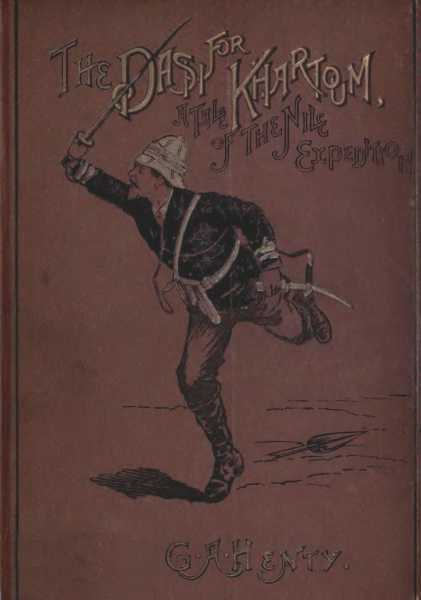
The Dash for Khartoum: A Tale of the Nile Expedition. By G. A. Henty. With 10 page Illustrations by J. Schönberg and J. Nash, and 4 Plans. Crown 8vo, cloth elegant, olivine edges, 6s.
"The Dash for Khartoum is your ideal boys' book."—Tablet.
"It is literally true that the narrative never flags a moment; for the incidents which fall to be recorded after the dash for Khartoum has been made and failed are quite as interesting as those which precede it."—Academy.
By England's Aid: The Freeing of the Netherlands (1585-1604). By G. A. Henty. With 10 page Illustrations by Alfred Pearse, and 4 Maps. Crown 8vo, cloth elegant, olivine edges, 6s.
"Boys know and love Mr. Henty's books of adventure, and will welcome his tale of the Freeing of the Netherlands."—Athenæum.
"The story is told with great animation, and the historical material is most effectively combined with a most excellent plot."—Saturday Review.
By Right of Conquest: Or, With Cortez in Mexico. By G. A. Henty. With 10 page Illustrations by W. S. Stacey, and 2 Maps. Crown 8vo, cloth elegant, olivine edges, 6s.
"Mr. Henty's skill has never been more convincingly displayed than in this admirable and ingenious story."—Saturday Review.
"By Right of Conquest is the nearest approach to a perfectly successful historical tale that Mr. Henty has yet published."—Academy.
With Lee in Virginia: A Story of the American Civil War. By G. A. Henty. With 10 page Illustrations by Gordon Browne, and 6 Maps. Crown 8vo, cloth elegant, olivine edges, 6s.
"The story is a capital one and full of variety, and presents us with many picturesque scenes of Southern life. Young Wingfield, who is conscientious, spirited, and 'hard as nails,' would have been a man after the very heart of Stonewall Jackson."—Times.
By Pike and Dyke: A Tale of the Rise of the Dutch Republic. By G. A. Henty. With 10 page Illustrations by Maynard Brown, and 4 Maps. Crown 8vo, cloth elegant, olivine edges, 6s.
"The mission of Ned to deliver letters from William the Silent to his adherents at Brussels, the fight of the Good Venture with the Spanish man-of-war, the battle on the ice at Amsterdam, the siege of Haarlem, are all told with a vividness and skill, which are worthy of Mr. Henty at his best."—Academy.
With Clive in India: Or, The Beginnings of an Empire. By G. A. Henty. With 12 page Illustrations by Gordon Browne. Crown 8vo, cloth elegant, olivine edges, 6s.
"Among writers of stories of adventure for boys Mr. Henty stands in the very first rank. Those who know something about India will be the most ready to thank Mr. Henty for giving them this instructive volume to place in the hands of their children."—Academy.
The Lion of St. Mark: A Tale of Venice in the Fourteenth Century. By G. A. Henty. With 10 page Illustrations by Gordon Browne. Crown 8vo, cloth elegant, olivine edges, 6s.
"Every boy should read The Lion of St. Mark. Mr. Henty has never produced any story more delightful, more wholesome, or more vivacious. From first to last it will be read with keen enjoyment."—The Saturday Review.
Under Drake's Flag: A Tale of the Spanish Main. By G. A. Henty. Illustrated by 12 page Pictures by Gordon Browne. Crown 8vo, cloth elegant, olivine edges, 6s.
"There is not a dull chapter, nor, indeed, a dull page in the book; but the author has so carefully worked up his subject that the exciting deeds of his heroes are never incongruous or absurd."—Observer.
Bonnie Prince Charlie: A Tale of Fontenoy and Culloden. By G. A. Henty. With 12 page Illustrations by Gordon Browne. Crown 8vo, cloth elegant, olivine edges, 6s.
"Ronald, the hero, is very like the hero of Quentin Durward. The lad's journey across France with his faithful attendant Malcolm, and his hairbreadth escapes from the machinations of his father's enemies, make up as good a narrative of the kind as we have ever read. For freshness of treatment and variety of incident, Mr. Henty has here surpassed himself."—Spectator.
For the Temple: A Tale of the Fall of Jerusalem. By G. A. Henty. With 10 page Illustrations by S. J. Solomon, and a Coloured Map. Crown 8vo, cloth elegant, olivine edges, 6s.
"Mr. Henty's graphic prose pictures of the hopeless Jewish resistance to Roman sway adds another leaf to his record of the famous wars of the world. The book is one of Mr. Henty's cleverest efforts."—Graphic.
True to the Old Flag: A Tale of the American War of Independence. By G. A. Henty. With 12 page Illustrations by Gordon Browne. Crown 8vo, cloth elegant, olivine edges, 6s.
"Does justice to the pluck and determination of the British soldiers. The son of an American loyalist, who remains true to our flag, falls among the hostile redskins in that very Huron country which has been endeared to us by the exploits of Hawkeye and Chingachgook."—The Times.
The Lion of the North: A Tale of Gustavus Adolphus and the Wars of Religion. By G. A. Henty. With 12 page Pictures by J. Schönberg. Crown 8vo, cloth elegant, olivine edges, 6s.
"A praiseworthy attempt to interest British youth in the great deeds of the Scotch Brigade in the wars of Gustavus Adolphus. Mackay, Hepburn, and Munro live again in Mr. Henty's pages, as those deserve to live whose disciplined bands formed really the germ of the modern British army."—Athenæum.
The Young Carthaginian: A story of the Times of Hannibal. By G. A. Henty. With 12 page Illustrations by C. J. Staniland, r.i. Crown 8vo, cloth elegant, olivine edges, 6s.
"The effect of an interesting story, well constructed and vividly told, is enhanced by the picturesque quality of the scenic background. From first to last nothing stays the interest of the narrative. It bears us along as on a stream, whose current varies in direction, but never loses its force."—Saturday Review.
With Wolfe in Canada: Or, The Winning of a Continent. By G. A. Henty. With 12 page Illustrations by Gordon Browne. Crown 8vo, cloth elegant, olivine edges, 6s.
"A model of what a boys' story-book should be. Mr. Henty has a great power of infusing into the dead facts of history new life, and as no pains are spared by him to ensure accuracy in historic details, his books supply useful aids to study as well as amusement."—School Guardian.
In Freedom's Cause: A Story of Wallace and Bruce. By G. A. Henty. With 12 page Illustrations by Gordon Browne. Crown 8vo, cloth elegant, olivine edges, 6s.
"Mr. Henty has broken new ground as an historical novelist. His tale of the days of Wallace and Bruce is full of stirring action, and will commend itself to boys."—Athenæum.
Through the Fray: A Story of the Luddite Riots. By G. A. Henty. With 12 page Illustrations by H. M. Paget. Crown 8vo, cloth elegant, olivine edges, 6s.
"Mr. Henty inspires a love and admiration for straightforwardness, truth, and courage. This is one of the best of the many good books Mr. Henty has produced, and deserves to be classed with his Facing Death."—Standard.
Captain Bayley's Heir: A Tale of the Gold Fields of California. By G. A. Henty. With 12 page Illustrations by H. M. Paget. Crown 8vo, cloth elegant, olivine edges, 6s.
"A Westminster boy who makes his way in the world by hard work, good temper, and unfailing courage. The descriptions given of life are just what a healthy intelligent lad should delight in."—St. James's Gazette.
A Jacobite Exile: Being the Adventures of a Young Englishman in the Service of Charles XII. of Sweden. By G. A. Henty. With 8 page Illustrations by Paul Hardy, and a Map. Crown 8vo, cloth elegant, olivine edges, 5s.
"Mr. Henty has never produced a more truly historical romance, and scarcely ever a more piquantly-written narrative. One, at least, of his battle-pieces is full of the old 'special correspondent' fire."—The Academy.
"Incident succeeds incident, and adventure is piled upon adventure, and at the end the reader, be he boy or man, will have experienced breathless enjoyment in a romantic story that must have taught him much at its close."—Army and Navy Gazette.
"Shows Mr. Henty at his best. A Jacobite Exile is full of life, adventure, and movement, and admirably illustrated; it is in Mr. Henty's best manner, and while never losing sight of the imaginative and romantic interest, has a substantial value as a bit of historical painting."—Scotsman.
Condemned as a Nihilist: A Story of Escape from Siberia. By G. A. Henty. With 8 page Illustrations by Walter Paget. Crown 8vo, cloth elegant, olivine edges, 5s.
"The best of this year's Henty. His narrative is more interesting than many of the tales with which the public is familiar, of escape from Siberia. Despite their superior claim to authenticity these tales are without doubt no less fictitious than Mr. Henty's, and he beats them hollow in the matter of sensations. The escape of the hero and his faithful Tartar from the Samoyedes is quite the high-water mark of this author's achievement."—National Observer.
Orange and Green: A Tale of the Boyne and Limerick. By G. A. Henty. With 8 full-page Illustrations by Gordon Browne. Crown 8vo, cloth elegant, olivine edges, 5s.
"An extremely spirited story, based on the struggle in Ireland, rendered memorable by the defence of 'Derry and the siege of Limerick."—Sat. Review.
"The narrative is free from the vice of prejudice, and ripples with life as vivacious as if what is being described were really passing before the eye.... Should be in the hands of every young student of Irish history."—Belfast News.
BY GEORGE MACDONALD.
A Rough Shaking. By George Macdonald. With 12 page Illustrations by W. Parkinson. Crown 8vo, cloth elegant, olivine edges, 6s.
"One of Mr. MacDonald's wonderful and charming stories."—Athenæum.
"One of the very best books for boys that has been written. It is full of material peculiarly well adapted for the young, containing in a marked degree, the elements of all that is necessary to make up a perfect boys' book."—Teachers' Aid.
At the Back of the North Wind. By George Macdonald. With 75 Illustrations by Arthur Hughes. Crown 8vo, cloth elegant, olivine edges, 5s.
"In At the Back of the North Wind we stand with one foot in fairyland and one on common earth. The story is thoroughly original, full of fancy and pathos, and underlaid with earnest but not too obtrusive teaching"—The Times.
Ranald Bannerman's Boyhood. By George Macdonald. With 36 Illustrations by Arthur Hughes. Crown 8vo, cloth elegant, olivine edges, 5s.
"The sympathy with boy-nature in Ranald Bannerman's Boyhood is perfect. It is a beautiful picture of childhood, teaching by its impressions and suggestions all noble things."—British Quarterly Review.
The Princess and the Goblin. By George Macdonald. With 33 Illustrations. Crown 8vo, cloth extra, 3s. 6d.
"Little of what is written for children has the lightness of touch and play of fancy which are characteristic of George MacDonald's fairy tales. Mr. Arthur Hughes's illustrations are all that illustrations should be."—Manchester Guardian.
The Princess and Curdie. By George Macdonald. With 8 page Illustrations. Crown 8vo, cloth extra, 3s. 6d.
"There is the finest and rarest genius in this brilliant story. Upgrown people would do wisely occasionally to lay aside their newspapers and magazines to spend an hour with Curdie and the Princess."—Sheffield Independent.
BY J. K. H. DENNY.
The Clever Miss Follett. By J. K. H. Denny. With 12 page Illustrations by Gertrude D. Hammond. Crown 8vo, cloth elegant, olivine edges, 6s.
"The story is well written; the dialogue is easy and unconstrained, and the intention and tone are all that could be desired."—The Spectator.
"The story is well constructed, and the character-drawing of the Follett family is good. Girls will like the story, for it is interesting."—The Queen.
"One of the most entertaining stories of the season, full of vigorous action and strong in character-painting. Elder girls will be charmed with it, and adults may read its pages with profit."—The Teachers' Aid.
"The story is well written; it is not goody-goody, although its moral is excellent; and it is just the book to give to girls, who will delight both in the letterpress and the twelve illustrations by Miss Hammond, who has never done better work."—Review of Reviews.
NEW EDITION OF THE UNIVERSE.
The Universe: Or The Infinitely Great and the Infinitely Little. A Sketch of Contrasts in Creation, and Marvels revealed and explained by Natural Science. By F. A. Pouchet, m.d. With 272 Engravings on wood, of which 55 are full-page size, and a Coloured Frontispiece. Eleventh Edition, medium 8vo, cloth elegant, gilt edges, 7s. 6d.; also morocco antique, 16s.
"We can honestly commend Professor Pouchet's book, which is admirably, as it is copiously illustrated."—The Times.
"Scarcely any book in French or in English is so likely to stimulate in the young an interest in the physical phenomena."—Fortnightly Review.
BY ROBERT LEIGHTON.
The Wreck of "The Golden Fleece:" The Story of a North Sea Fisher-boy. By Robert Leighton. With 8 page Illustrations by Frank Brangwyn. Crown 8vo, cloth elegant, olivine edges, 5s.
"This story should add considerably to Mr. Leighton's high reputation. Excellent in every respect, it contains every variety of incident. The plot is very cleverly devised, and the types of the North Sea sailors are capital."—The Times.
"If Mr. Leighton writes many more boys' books of equal merit with The Wreck of the Golden Fleece, more than one hitherto popular story-teller will have to look to his laurels."—University Correspondent.
"The whole story is told simply and movingly, and will both interest and instruct all young readers. Of the illustrations, it is enough to say that they are by Mr. Frank Brangwyn, the best modern painter of sailors."—The Academy.
"It recalls the freshness and brightness of his Pilots of Pomona.... It is a capital story. The characters are marked and lifelike, and it is full of incident and adventure."—Standard.
The Pilots of Pomona: A Story of the Orkney Islands. By Robert Leighton. With 8 page Illustrations by John Leighton, and a Map. Crown 8vo, cloth elegant, olivine edges, 5s.
"A story which is quite as good in its way as Treasure Island, and is full of adventure of a stirring yet most natural kind. Although it is primarily a boys' book, it is a real godsend to the elderly reader who likes something fresh—something touched with the romance and magic of youth."—Glasgow Evening Times.
"His pictures of Orcadian life and nature are charming."—Saturday Review.
"Few of this season's books have given us so much pleasure. It is a charming story of home-life, and takes a place among the best books for young people."—Practical Teacher.
The Thirsty Sword: A Story of the Norse Invasion of Scotland (1262-63). By Robert Leighton. With 8 page Illustrations by Alfred Pearse, and a Map. Crown 8vo, cloth elegant, olivine edges, 5s.
"This is one of the most fascinating stories for boys that it has ever been our pleasure to read. From first to last the interest never flags. Boys will worship Kenric, who is a hero in every sense of the word."—Schoolmaster.
"It gives a lively idea of the wild life of the Western Islands in those rough days, reminding one not seldom of Sir Walter Scott's Lord of the Isles. It is full of incident and sensational adventure."—The Guardian.
BY GEORGE MANVILLE FENN.
"Mr. Fenn stands in the foremost rank of writers in this department."—Daily News.
"No one can find his way to the hearts of lads more readily than Mr. Fenn."—Nottingham Guardian.
Quicksilver: Or, A Boy with no Skid to his Wheel. By George Manville Fenn. With 10 page Illustrations by Frank Dadd. Crown 8vo, cloth elegant, olivine edges, 6s.
"Quicksilver is little short of an inspiration. In it that prince of story-writers for boys—George Manville Fenn—has surpassed himself. It is an ideal book for a boy's library."—Practical Teacher.
"The story is capitally told, it abounds in graphic and well-described scenes, and it has an excellent and manly tone throughout."—The Guardian.
Dick O' the Fens: A Romance of the Great East Swamp. By G. Manville Fenn. With 12 page Illustrations by Frank Dadd. Crown 8vo, cloth elegant, olivine edges, 6s.
"We conscientiously believe that boys will find it capital reading. It is full of incident and mystery, and the mystery is kept up to the last moment. It is rich in effective local colouring; and it has a historical interest."—Times.
"Deserves to be heartily and unreservedly praised as regards plot, incidents, and spirit. It is its author's masterpiece as yet."—Spectator.
Devon Boys: A Tale of the North Shore. By G. Manville Fenn. With 12 page Illustrations by Gordon Browne. Crown 8vo, cloth elegant, olivine edges, 6s.
"An admirable story, as remarkable for the individuality of its young heroes as for the excellent descriptions of coast scenery and life in North Devon. It is one of the best books we have seen this season."—Athenæum.
The Golden Magnet: A Tale of the Land of the Incas. By G. Manville Fenn. Illustrated by 12 page Pictures by Gordon Browne. Crown 8vo, cloth elegant, olivine edges, 6s.
"There could be no more welcome present for a boy. There is not a dull page in the book, and many will be read with breathless interest. 'The Golden Magnet' is, of course, the same one that attracted Raleigh and the heroes of Westward Ho!"—Journal of Education.
In the King's Name: Or, The Cruise of the Kestrel. By G. Manville Fenn. Illustrated by 12 page Pictures by Gordon Browne. Crown 8vo, cloth elegant, olivine edges, 6s.
"A capital boys' story, full of incident and adventure, and told in the lively style in which Mr. Fenn is such an adept."—Globe.
"The best of all Mr. Fenn's productions in this field. It has the great quality of always 'moving on,' adventure following adventure in constant succession."—Daily News.
Nat the Naturalist: A Boy's Adventures in the Eastern Seas. By G. Manville Fenn. With 8 page Pictures. Crown 8vo, cloth elegant, olivine edges, 5s.
"This sort of book encourages independence of character, develops resource, and teaches a boy to keep his eyes open."—Saturday Review.
Bunyip Land: The Story of a Wild Journey in New Guinea. By G. Manville Fenn. With 6 page Illustrations by Gordon Browne. Crown 8vo, cloth elegant, 4s.
"Mr. Fenn deserves the thanks of everybody for Bunyip Land, and we may venture to promise that a quiet week may be reckoned on whilst the youngsters have such fascinating literature provided for their evenings' amusement."—Spectator.
Brownsmith's Boy: A Romance in a Garden. By G. Manville Fenn. With 6 page Illustrations. New Edition. Crown 8vo, cloth elegant, 3s. 6d.
"Mr. Fenn's books are among the best, if not altogether the best, of the stories for boys. Mr. Fenn is at his best in Brownsmith's Boy."—Pictorial World.
See also under heading of Blackie's 3/ Series for other Books by G. Manville Fenn.
Grettir the Outlaw: A Story of Iceland. By S. Baring-Gould. With 10 page Illustrations by M. Zeno Diemer, and a Coloured Map. Crown 8vo, cloth elegant, olivine edges, 6s.
"Is the boys' book of its year. That is, of course, as much as to say that it will do for men grown as well as juniors. It is told in simple, straightforward English, as all stories should be, and it has a freshness, a freedom, a sense of sun and wind and the open air, which make it irresistible."—National Observer.
Two Thousand Years Ago: Or, The Adventures of a Roman Boy. By Professor A. J. Church. With 12 page Illustrations by Adrien Marie. Crown 8vo, cloth elegant, olivine edges, 6s.
"Adventures well worth the telling. The book is extremely entertaining as well as useful, and there is a wonderful freshness in the Roman scenes and characters."—The Times.
The Seven Wise Scholars. By Ascott R. Hope. With nearly 100 Illustrations by Gordon Browne. Cloth elegant, 5s.
"As full of fun as a volume of Punch; with illustrations, more laughter-provoking than most we have seen since Leech died."—Sheffield Independent.
Stories of Old Renown: Tales of Knights and Heroes. By Ascott R. Hope. With 100 Illustrations by Gordon Browne. Crown 8vo, cloth elegant, 3s. 6d.
"A really fascinating book worthy of its telling title. There is, we venture to say, not a dull page in the book, not a story which will not bear a second reading."—Guardian.
BY G. NORWAY.
A True Cornish Maid. By G. Norway. With 6 page Illustrations by J. Finnemore. Crown 8vo, cloth elegant, 3s. 6d.
"There is some excellent reading.... Mrs. Norway brings before the eyes of her readers the good Cornish folk, their speech, their manners, and their ways. A True Cornish Maid deserves to be popular."—Athenæum.
"The incident is plentiful and exciting; the characters are drawn with no common skill. The contrast between the two girls—the rough, free-spoken Ph[oe]be, and the refined, retiring Honor—is excellent."—The Spectator.
"Among girls' books the success of the year has fallen, we think, to Mrs. Norway, whose True Cornish Maid is really an admirable piece of work.... The book is full of vivid and accurate local colour; it contains, too, some very clever character studies."—Review of Reviews.
Hussein the Hostage: Or, A Boy's Adventures in Persia. By G. Norway. With 8 page Illustrations by John Schönberg. Crown 8vo, cloth elegant, olivine edges, 5s.
"Hussein the Hostage is full of originality and vigour. The characters are lifelike, there is plenty of stirring incident, the interest is sustained throughout, and every boy will enjoy following the fortunes of the hero."—Journal of Education.
The Loss of John Humble: What Led to It, and what Came of It. By G. Norway. With 8 page Illustrations by John Schönberg. Crown 8vo, cloth elegant, olivine edges, 5s.
"This story will place the author at once in the front rank. It is full of life and adventure. He is equally at home in his descriptions of life in Sweden and in the more stirring passages of wreck and disaster, and the interest of the story is sustained without a break from first to last."—Standard.
BY HARRY COLLINGWOOD.
The Pirate Island: A Story of the South Pacific. By Harry Collingwood. With 8 page Pictures by C. J. Staniland and J. R. Wells. Crown 8vo, cloth elegant, olivine edges, 5s.
"A capital story of the sea; indeed in our opinion the author is superior in some respects as a marine novelist to the better known Mr. Clark Russell."—The Times.
The Congo Rovers: A Story of the Slave Squadron. By Harry Collingwood. With 8 page Illustrations by J. Schönberg. Crown 8vo, cloth elegant, olivine edges, 5s.
"No better sea story has lately been written than the Congo Rovers. It is as original as any boy could desire."—Morning Post.
The Log of the "Flying Fish:" A Story of Aerial and Submarine Peril and Adventure. By Harry Collingwood. With 6 page Illustrations by Gordon Browne. New and cheaper Edition. Crown 8vo, cloth elegant, 3s. 6d.
"The Flying Fish actually surpasses all Jules Verne's creations; with incredible speed she flies through the air, skims over the surface of the water, and darts along the ocean bed. We strongly recommend our school-boy friends to possess themselves of her log."—Athenæum.
BY DR. GORDON STABLES.
Westward With Columbus. By Gordon Stables, m.d., c.m. With 8 page Illustrations by Alfred Pearse. Crown 8vo, cloth elegant, olivine edges, 5s.
"This is quite one of the best books for boys that we have seen this autumn. It is the duty of every British and American lad to know the story of Christopher Columbus."—School Guardian.
"Our author treats his subject in a dignified, historical fashion which well becomes it, and we must place Westward with Columbus among those books that all boys ought to read."—The Spectator.
"Will be greatly in request as a school prize. The tone is healthy, the characters are lifelike, and the narrative of the great discoverer's adventures through his chequered career is replete with incidents and sensational episodes."—Church Review.
'Twixt School and College: A Tale of Self-reliance. By Gordon Stables, c.m., m.d., r.n. With 8 page Illustrations by V. Parkinson. Crown 8vo, cloth elegant, olivine edges, 5s.
"One of the best of a prolific writer's books for boys, being full of practical instructions as to keeping pets, from white mice upwards, and inculcates in a way which a little recalls Miss Edgeworth's 'Frank' the virtue of self-reliance, though the local colouring of the home of the Aberdeenshire boy is a good deal more picturesque."—Athenæum.
BY FRANCES ARMSTRONG.
A Fair Claimant: Being a Story for Girls. By Frances Armstrong. With 8 page Illustrations by Gertrude D. Hammond. Crown 8vo, cloth elegant, olivine edges, 5s.
"The story is a great success—one of the best tales for girls that we have seen for some time."—London Quarterly.
"There is a fascination about this story.... The splendid character of the heroine, together with the happy manner in which the interest is sustained to the end, combine to make this one of the most acceptable gift-books of the season."—Church Review.
"A story at once strong and sympathetic, a quality rightly esteemed at a high value by girl readers."—The Quiver.
"As a gift-book for big girls A Fair Claimant is among the best new books of the kind. The story is interesting and natural, from first to last."—Westminster Gazette.
BY ANNE BEALE.
The Heiress of Courtleroy. By Anne Beale. With 8 page Illustrations by T. C. H. Castle. Crown 8vo, cloth elegant, olivine edges, 5s.
"We can speak highly of the grace with which Miss Beale relates how the young 'Heiress of Courtleroy' had such good influence over her uncle as to win him from his intensely selfish ways."—Guardian.
"In Le Roy we have perhaps the most striking and original creation that Miss Beale has made. He interests us to the last."—Spectator.
BY KIRK MUNROE.
The White Conquerors of Mexico: A Tale of Toltec and Aztec. By Kirk Munroe. With 8 page Illustrations by W. S. Stacey. Crown 8vo, cloth elegant, olivine edges, 5s.
"Mr. Munroe gives most vivid pictures of the religious and civil polity of the Aztecs, and of everyday life, as he imagines it, in the streets and market-places of the magnificent capital of Montezuma."—The Times.
"There are, in truth, fine scenes in this narrative and stirring deeds; heroism and self-sacrifice as well as cunning cruelty. The story runs along the true lines of the ideal story for the young."—Educational Review.
"The reader becomes carried away by conflicting emotions of wonder and sympathy, and feels compelled to pursue the story, which he cannot lay down. No present can be more acceptable than such a volume as this, where courage, intrepidity, resource and devotion are so pleasantly mingled. It is very fully illustrated with pictures worthy of the book."—The Schoolmaster.
With the Sea Kings: A Story of the Days of Lord Nelson. By F. H. Winder. With 6 page Illustrations by W. S. Stacey. Crown 8vo, cloth elegant, 4s.
"A really good story, and boys will like it."—The Spectator.
"Just the book to put into a boy's hands. Every chapter contains boardings, cuttings out, fighting pirates, escapes of thrilling audacity, and captures by corsairs, sufficient to turn the quietest boy's head. The story culminates in a vigorous account of the battle of Trafalgar, as seen from the Victory. Happy boys!"—The Academy.
"Is brimming over with realistic adventure. There is 'derring-do' enough here for half a dozen volumes, and there is just that spice of history in the book which adds interest to a narrative."—Daily Chronicle.
BY F. FRANKFORT MOORE.
Highways and High Seas: Cyril Harley's Adventures on both. By F. Frankfort Moore. With 8 page Illustrations by Alfred Pearse. Crown 8vo, cloth elegant, olivine edges, 5s.
"This is one of the best stories Mr. Moore has written, perhaps the very best. The exciting adventures among highwaymen and privateers are sure to attract boys."—Spectator.
Under Hatches: Or, Ned Woodthorpe's Adventures. By F. Frankfort Moore. With 8 page Illustrations by A. Forestier. Crown 8vo, cloth elegant, olivine edges, 5s.
"The story as a story is one that will just suit boys all the world over. The characters are well drawn and consistent; Patsy, the Irish steward, will be found especially amusing."—Schoolmaster.
Giannetta: A Girl's Story of Herself. By Rosa Mulholland. With 8 page Illustrations by Lockhart Bogle. Crown 8vo, cloth elegant, olivine edges, 5s.
"Giannetta is a true heroine—warm-hearted, self-sacrificing, and, as all good women nowadays are, largely touched with the enthusiasm of humanity. One of the most attractive gift-books of the season."—The Academy.