
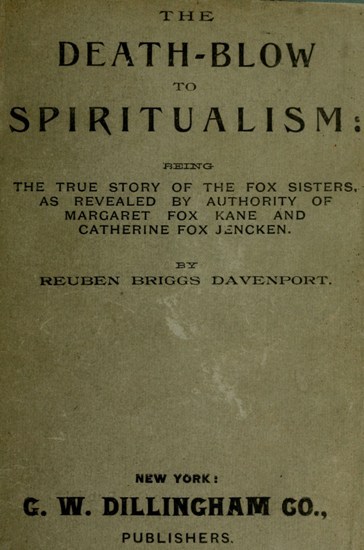
The Project Gutenberg eBook of The Death-Blow to Spiritualism: Being the True Story of the Fox Sisters
Title: The Death-Blow to Spiritualism: Being the True Story of the Fox Sisters
Author: Reuben Briggs Davenport
Release date: August 23, 2010 [eBook #33506]
Language: English
Credits: Produced by Suzanne Shell and the Online Distributed
Proofreading Team at http://www.pgdp.net (This file was
produced from images generously made available by The
Internet Archive/American Libraries.)
0807. THE DEATH BLOW TO SPIRITUALISM.
Being the true story of the Fox sisters, as revealed by authority of Margaret
Fox Kane and Catherine Fox Jencken. Written by R. B. Davenport. 147 pages.
Deathblow to Spiritualism. R. B. Davenport 1.00
OCT. 1897. ISSUED MONTHLY. $5.00 PER YEAR.
ENTERED AT THE NEW YORK POST OFFICE AS SECOND-CLASS MATTER.
THE
DEATH-BLOW
TO
SPIRITUALISM:
BEING
THE TRUE STORY OF THE FOX SISTERS, AS REVEALED
BY AUTHORITY OF MARGARET FOX
KANE AND CATHERINE FOX JENCKEN.
BY
REUBEN BRIGGS DAVENPORT.
NEW YORK:
G. W. Dillingham Co., Publishers.
MDCCCXCVII.
Copyright, 1888.
BY
Reuben Briggs Davenport.
[All Rights Reserved.]
TO
MRS. HESTER S. DWINELLE.
| “Alonso. This is as strange a maze as ere men trod, And there is in this business more than nature Was ever conduct of: some oracle Must rectify our knowledge. “Prospero. Sir, my liege, Do not infest your mind with beating on The strangeness of this business: at picked leisure, Which shall be shortly, single I’ll resolve you (Which to you shall seem probable) of every These happen’d accidents: till when be cheerful, And think of each thing well.—Come hither, spirit; Set Caliban and his companions free: Untie the spell.” Shakespeare.—The Tempest. |
PREFACE.
This book has been written in extreme haste. It does not pretend to literary style. But it pretends to absolute truthfulness and a reverent regard for justice.
Its sole value is its character as a contribution to the real history of Spiritualism. As such, it is unquestionably of great importance, greater even than any work of the kind that has been published since the beginning of modern Spiritualism.
It is, in fact, what its title sets forth—“The DEATH-BLOW to SPIRITUALISM.”
No one who does not love illusion for illusion’s sake—better, in other words, than he loves the truth—can, after reading this volume, remain a follower of Spiritualism and its hypocritical apostles.
The full authorization of Mrs. Margaret Fox Kane and Mrs. Catherine Fox Jencken for the publication of this work will be found on the next to the following page.
29th October, 1888.
We hereby approve of Mr. Reuben B. Davenport’s design to write a true account of the origin of Spiritualism and of our connection therewith, and we authorize him to make proper use of all data and material that we furnish him.
New York, 15th Oct., 1888.
CONTENTS
| I. INTRODUCTION. | ||
| Poetic Justice of the Exposure | 13 | |
| II. RENUNCIATION. | ||
| Chapter. | Page | |
| I. | “God Has Not Ordered It.” | 25 |
| II. | The Discomfited Enemy. | 39 |
| III. | A Second Blow. | 53 |
| IV. | The Hand of the Persecutor. | 60 |
| V. | Solemn Abjuration. | 65 |
| III. HISTORY. | ||
| VI. | Origin of the Fraud. | 81 |
| VII. | Garbled and Distorted Testimony | 94 |
| VIII. | Development of the Fraud | 102 |
| IX. | The Mercenary Campaign. | 121 |
| X. | Spiritualistic Boomerangs. | 131 |
| XI. | The Supreme Audacity of Fraud. | 150 |
| XII. | A Scientific Jury. | 164 |
| XIII. | The Unalterable Verdict. | 201 |
| IV. REPENTANCE. | ||
| XIV. | The Heart Pleads for the Soul. | 209 |
| XV. | From Shadow to Light. | 231 |
| Index. | 241 | |
I. INTRODUCTION.
INTRODUCTION.
POETIC JUSTICE OF THE EXPOSURE.
That the inventors of an infamous fraud should deal to it its death-blow,
is the poetic justice of fate.
Over the creature, the creator has power of life and death.
The creators of Spiritualism abjure its infamy.
They decree its death.
They condemn it to final destruction.
They fasten upon those who continue to practice it the obloquy of history, and the scorn of mankind for all time to come.
Margaret and Catharine Fox, the youngest of three sisters, were the first to produce “spiritualistic manifestations.”
They are now the most earnest in denunciation of those impostures; the most eager to dissipate the foolish belief of thousands in the flimsiest system of deception that was ever cloaked with the hypocrisy of so-called religion.
When, as by accident, they discovered a method of deceiving those around them by means of mysterious noises, they were but little children, innocent of the thought of wrong, ignorant of the world and the world’s guile, and imagining only that what they did was a clever lark, such as the adult age easily pardons to exuberant and sprightly youth.
Not to them did the base suggestion come that this singular, this simple discovery, should be the means of deluding the world, of exalting them in the minds of the weakly credulous and of bringing them fame and splendor and sumptuous pleasure.
No one who learns their true history can still believe them guilty of the willful inception of this most grotesque, most transparent and corrupting of superstitions.
The idea had its monstrous birth in older heads, heads that were seconded by hearts lacking the very essence of truth and the fountain of honest human sympathy.
The two children, who had at first delighted, as younglings will, in what was but a laughable mystification, were dragged into a sordid, wicked and loathsome speculation, built upon lying and fraud, as unforgivable as the sin of Satan, and of which they were but the unthinking instruments, often reluctant and remorseful, yet docile and compliant by nature.
Thus the “Rochester knockings,” the example and prototype of all later so-called spiritualistic “phenomena,” began merely in a curious childish freak, disguised without effort, and which, from the first, was encouraged to partly formed understandings by the wonder and intense spirit of inquiry it provoked.
The young operators were carried away by the undreamt-of current of enthusiasm and awe in which they soon became involved. They felt the natural need of maintaining with unabating dexterity, that false sense of the miraculous which by chance they had called forth.
Thus they went from one stage to another of this queer illusion, and, being compelled by a harder and more mature intelligence to repeat their part over and over again, became the chief means of establishing that injurious belief in communications from the spirits of the departed, of which such great numbers have become the victims.
Many an older offender against common sense, reason and strict morality persists through force of circumstance in the pathway he has chosen, and does not turn backward, merely because he cannot do so without wearing the face of shame.
From such slight and trivial beginning came the great movement—great because of the number which it comprised and of the sensation which attended its progress—that for more than forty years has alternately surprised, puzzled, disgusted and amused the world.
From so little a plant has grown a gigantic weed of deceit, corruption and fraud, nurtured upon the fattening lust of money, and of the flesh.
What has developed from it is not alone a system of so-called communications through a puerile code of signals with an unseen world; but, as Dante describes, in his incomparable epic, forms of monstrosity which combine a hideous human semblance and a loathly animal foulness, so this venomous evil has become conglomerate in its hateful phases of delusion, and its petty sordidness and depravity.
Thus the Tuscan bard describes the spirit of fraud:
“’Lo! the fell monster with the deadly sting!
Who passes mountains, breaks through fenced walls
And firm embattled spears, and with his filth
Taints all the world! Thus me my guide addressed,
And beckon’d him, that he should come to shore,
Near to the stony causeway’s utmost edge.
“Forthwith that image vile of fraud appear’d,
His head and upper part expos’d on land,
But laid not on the shore his bestial train.
His face the semblance of a just man’s wore.
So kind and gracious was its outward cheer;
The rest was serpent all; two shaggy claws
Reach’d to the armpits, and the back and breast,
And either side, were painted o’er with nodes
And orbits. Colors variegated more
Nor Turks nor Tartars e’er on cloth of state
With interchangeable embroidery wove,
Nor spread Arachne o’er her curious loom.
As ofttimes a light skiff, moor’d to the shore,
Stands part in water, part upon the land;
Or, as where dwells the greedy German boor,
The beaver settles watching for his prey;
So on the rim, that fenced the sand with rock,
Sat perched the fiend of evil. In the void
Glancing, his tail upturn’d its venomous fork,
With sting like scorpion’s armed.”
The world has not seen in all its long procession of follies, vagaries, and strange mania, one so utterly devoid of a reasonable foundation as this.
Yet none has been more eagerly believed; and this very tendency has evolved into so strong a desire to believe that thousands of those who have professed to investigate it have done so only ostensibly, their eyes, figuratively speaking, tightly bandaged, to shut out everything but the artificial vision that they were most eager to see.
It is to be hoped that the world will now form its ultimate conclusion upon this flagrant and audacious system of humbuggery:—that, regarded as a superstition, it ranks even below voudooism and fetich-worship, and, as an illusion, below the effects produced by the most ordinary magician at a country fair.
Dragged into this life when infants, rescued from it for an interval by two men[1] whose names are historical, the one as a hero and explorer, the other as a journalist and daily philosopher; borne back to it again by the tide of ill-fortune; used and controlled, by those whose heart’s were “dry as summer’s dust,” for their own hateful purposes; menaced when conscience rebelled and suggested retraction and amends; driven to seek momentary oblivion of their present degradation in a vice that was the result of their enforced public career; finally, persecuted in a stealthy and treacherous way by those who had profited most by the fraud that they had set up, because it was feared that sooner or later they could no longer keep silent and would betray its real origin; seeing their existence slipping away from them with nothing but Dead Sea fruit remaining to their bitter portion; feeling more and more the need of an atonement to conscience and the opinion of the world—Margaret and Catherine Fox now denounce and anathematize Spiritualism as absolutely and utterly false from beginning to end; and they declare their solemn intention to devote themselves henceforth to the noble task of undoing the great evil which they have done, and of leaving no single stone of foundation behind them for weak-minded future generations to base a futile faith upon.
In these pages will be found the full and truthful story of Spiritualism, as it was and is, as gathered from the lips of both Margaret Fox Kane and Catharine Fox Jencken, and verified by letters, documents and published data. It is written with their full knowledge and earnest sanction.
The bold fabric of lies built up to sustain the claim that the “rappings” in which all spiritualistic so-called phenomena originated were unaccountable except on the supernatural hypothesis, can no longer be cited to an intelligent mind. The elaborate narrative published by the eldest sister, Mrs. Ann Leah Fox Underhill, who is now the only remaining stay of spiritualistic deception, is proven to be false from title-page to finis.
I have given in the following pages, the real lives of Mrs. Kane and Mrs. Jencken, in so far as they bear in any important degree upon the development of the fraud of Spiritualism.
II. RENUNCIATION.
CHAPTER I.
GOD HAS NOT ORDERED IT.
The world of “spiritualists” and non-spiritualists was startled on the
24th of September, 1888, by the publication in the New York Herald, of
an article with the following head-lines:
“GOD HAS NOT ORDERED IT.”
A Celebrated Medium Says the
Spirits Never Return.
CAPTAIN KANE’S WIDOW.
One of the Fox Sisters Promises an Interesting
Exposure of Fraud.
To many, an article of this kind seemed in a degree sensational. Not to those, however, who had previously had some inkling of the secret history of Spiritualism, and who for years had looked for the day of its inevitable confounding.
A sudden disclosure like this, by one of the “Mothers of Spiritualism,” if the term may be used, suggested a sort of reckless vagary, a species of extravagance, due, as might have been fancied, to some abnormal condition of the mind.
Yet to those who had had an intimate acquaintance with Maggie Fox Kane this step had long been foreshadowed. As will appear later, no one could have imagined the real intensity of moral pain that for years she had endured.
In recent years, both she and her sister, Catharine Fox Jencken, had been but poorly provided with this world’s goods. Obliged to depend almost wholly on themselves for support, they had dropped more and more out of sight, till the public at last hardly recognized their names, if perchance they appeared in print, as those of the principal instruments in the founding of Spiritualism. For this, there was a reason. It was a deep-seated and long increasing disgust with their fraudulent profession—the fuller realization to their minds, as their knowledge of the world grew broader, of the monstrous evil to which, innocently at first, they had given birth. So at intervals they were filled with despairing despondency and remorse. Their weaknesses, their self-indulgence, their lack of providence for themselves, are largely attributable to these causes. It could not be said of them that they were ever remarkably selfish, or cold-hearted or calculating. Such a character, however, has of right been coupled with the name of their elder sister, who by reason of the ties of blood and of her older experience ought long ago to have led them out of the by-ways of imposture, instead of persistently seeking to shut off their escape from this horrible bondage, and to plunge them deeper into the mire of guilt and infamy, so that the chance of their rising above it, and denouncing it, might grow less and less.
The impulse to set herself right on the record of the world, after years of enslavement in the hateful gyves of charlatanism, must stand to Maggie Fox’s credit alone. It sprang from her own bosom, not from the inspiration, suggestion or persuasion of any one else. Returning from Europe in September, 1888, after a peculiar experience, which had convinced her that those chiefs of spiritualistic fraud who feared her and her sister, because they held the key of the whole of the artificial mystery, were bent upon persecuting them into an abject silence, she at once put in execution the resolution which had been so long in process of growth, but until then had never been fully ripened.
This was to effect the unqualified exposure of the false system of Spiritualism. She naturally chose as a medium for her repentant message to the world, that great cosmopolitan journal, the New York Herald, which is known in every corner of the earth, and is ever ready to perform an important service to mankind. Before she started on her homeward voyage, she committed herself once and for all to this courageous and worthy step.
The disclosures regarding the notorious Madam Diss De Barr had offended Mrs. Kane more than anything which had occurred in Spiritualism in a long time, for they presented the enforced association of her name and the simple, childish origin of the “Rochester knockings,” with the gross and revolting frauds which had been their outgrowth. So imbued had she become, by this time, with the idea that the developed system of Spiritualism was something to be loathed, as Milton loathed the hideous creature who sat by the inner portals of hell, that words could not express her utter scorn and hatred of this common woman, who posed as an agent of sacred communications between the living and the dead.
The New York Herald of May 27, 1888, contained this letter, written by Mrs. Margaret Fox Kane in London:
Gower Street, Bedford Square, W. C.,
London, May 14, 1888.
To the Editor of the Herald:
I read in the Herald of Saturday, May 5, an account of the sad misfortune that has befallen my dear sister Katie, Mrs. Kate Fox Jencken, and in the article it is stated that I am still a resident of New York, which is a mistake. I sailed for England on the 22d of March, and I presume my absence has added to my darling sister’s depressed state of mind. The sad news has nearly killed me. My sister’s two beautiful boys referred to are her idols.
Spiritualism is a curse. God has set His seal against it! I call it a curse, for it is made use of as a covering for heartless persons like the Diss De Barrs, and the vilest miscreants make use of it to cloak their evil doings. Fanatics like Mr. Luther R. Marsh, Mr. John L. O’Sullivan, ex-Minister to Portugal, and hundreds equally as learned, ignore the “rappings” (which is the only part of the phenomena that is worthy of notice) and rush madly after the glaring humbugs that flood New York. But a harmless “message” that is given through the “rappings” is of little account to them; they want the “spirit” to come to them in full form, to walk before them, talk to them, to embrace them, and all such nonsense, and what is the result? Like old Judge Edmonds and Mr. Seybert, of Philadelphia, they become crazed, and at the direction of their fraud “mediums” they are induced to part with all their worldly possessions as well as their common sense, which God intended they should hold sacred. Mr. Marsh’s experience is but another example of hundreds who have preceded him.
No matter in what form Spiritualism may be presented, it is, has been and always will be a curse and a snare to all who meddle with it. No right minded man or woman can think otherwise.
I have found that fanatics are as plentiful among “inferior men and women” as they are among the more learned. They are all alike. They cannot hold their fanaticism in check, and it increases as their years increase. All they will ever achieve for their foolish fanaticism will be loss of money, softening of the brain and a lingering death.
MARGARET F. KANE.
This anathema dismayed those who had basely profited by Spiritualism, and it brought a deeper shock to the hearts of many who were sincere believers. The publication, however, in the Herald, three months later, of an interview with Mrs. Kane on her arrival in this city, the striking head-lines of which I have cited above, capped the climax of consternation. This article is well worthy of reproduction.
The eccentric circles wherein “isms” reign in discordant supremacy will be probably as deeply exercised over an approaching exposure of the tricks and illusions of Spiritualism, as they were over the rude logic of common sense and justice which drew aside the thin veil of fraud in the case of Madam Diss De Barr, and revealed the real nature of her flimsy system of deception in all its vulgar absurdity.
I called yesterday at a modest little house in West Forty-fourth street, and was received by a small, magnetic woman of middle age, whose face bears the traces of much sorrow and of a world-wide experience. She was negligently dressed, and she was not in the calmest possible mood. But she knew what she was talking about when, in response to my questions, she told a story of as strange and fantastic a life as has ever been recorded, and declared over and over again her intention of balancing the account which the world of humbug-loving mortals held against her, by making a clean breast of all her former miracles and wonders. In intervals of her talk, when she had risen from her chair, and paced the room, or had covered her face with her hands and almost sobbed with emotion, she would seat herself suddenly at a piano and pour forth fitful floods of wild, incoherent melody, which coincided strangely with that reminiscent weirdness which, despite its cynical reality, still characterized the scene.
This woman, albeit a notorious career has classed her with mountebanks and worse in the minds of reasonable beings, had yet by some element or other in her character retained a degree of public respect. Perhaps it is because months ago she abandoned the art of deception and has since to her intimate friends evinced no ordinary measure of contempt for all who still pursue it. She is known on both sides of the Atlantic, and when in London, is entertained by some of the best-to-do of the great and comprehensive middle class.
Circumstances had brought me to this house, and I did not at first know her. I soon found, however, that this was the most famous of the celebrated trio of witches, the Fox sisters, among the earliest spiritualistic mediums in this country. She is also the widow of Dr. Elisha Kent Kane, the heroic Arctic explorer, who died of the effects of his exposure in searching for Sir John Franklin and his ill-fated party. Mrs. Margaret Fox Kane has lately returned from England for a brief visit here, and she purposes in a very short time to deliver just one lecture, and no more, which shall shame and dumfound all the spiritualistic frauds who have not yet repented into poverty or exile of their nebulous ways. She will reveal one after another of the methods by which willing believers have been so briskly duped and robbed, and will herself demonstrate how simple, natural and easy are most of those methods.
Brooding upon the troubles that had been brought upon her by Spiritualism and on her personal guilt in connection with it, it is hardly strange that Mrs. Kane, even when bent upon making a sweeping confession of the whole imposture, should in intervals of nervous excitement have turned to the thought of suicide.
“‘My troubles weighed upon me,’ she said, ‘and when I was coming over on the Italy, I do believe that I should have gone overboard but for the Captain and the doctor and some of the sailors. They prevented me, and when I landed, I could not express to them the gratitude I felt. I had very little English money with me, but all of that I distributed to the men.’”
As Mrs. Kane told of her impulse to commit suicide her manner became tragic and she clutched her listener’s arm. After a moment, however, she reverted quietly enough to the original subject.
But she speedily became much excited again, as what follows will show. It was but natural:
“Since you now despise Spiritualism, how was it that you were engaged in it so long?” I asked.
“Another sister of mine,” and she coupled the name with an injurious adjective, “made me take up with it. She’s my damnable enemy. I hate her. My God! I’d poison her! No, I wouldn’t, but I’ll lash her with my tongue. She was twenty-three years old the day I was born. I was an aunt seven years before I was born. Ha! ha!
“Yes, I am going to expose Spiritualism from its very foundation. I have had the idea in my head for many a year, but I have never come to a determination before. I’ve thought of it day and night. I loath the thing I have been. As I used to say to those who wanted me to give a séance, ‘You are driving me into hell.’ Then the next day I would drown my remorse in wine. I was too honest to remain a ‘medium.’ That’s why I gave up my exhibitions.
“When Spiritualism first began Kate and I were little children, and this old woman, my other sister, made us her tools. Mother was a silly woman. She was a fanatic. I call her that because she was honest. She believed in these things. Spiritualism started from just nothing. We were but innocent little children. What did we know? Ah, we grew to know too much! Our sister used us in her exhibitions and we made money for her. Now she turns upon us because she’s the wife of a rich man, and she opposes us both wherever she can. Oh, I am after her! You can kill sometimes without using weapons, you know.
“Dr. Kane found me when I was leading this life. [The woman’s voice trembled just here and she nearly broke down.] I was only thirteen when he took me out of it and placed me at school. I was educated in Philadelphia. When I was sixteen years old he returned from the Arctic and we were married. Now comes the sad, sad tale. He was very ill. The physicians ordered him to London, but before he arrived he had a paralytic stroke of the heart. Then he was sent back from London and to Havana. Newsboys shouted in the streets of New York the news of his critical condition. Oh, my God! it was anguish to my ears! Mother and I were to have joined him in two weeks. He died before we arrived. Then I had brain fever. No one but God can know what sorrows I have had!
“When I recovered I was driven again into Spiritualism, and I gave exhibitions with my sister Katie. I knew, of course, then, that every effect produced by us was absolute fraud. Why, I have explored the unknown as far as human will can. I have gone to the dead so that I might get from them some little token. Nothing ever came of it—nothing, nothing. I have been in graveyards at dead of night, having permission to enter from those in charge. I have sat alone on a gravestone, that the spirits of those who slept underneath might come to me. I have tried to obtain some sign. Not a thing! No, no, the dead shall not return, nor shall any that go down into hell. So says the Catholic Bible, and so say I. The spirits will not come back. God has not ordered it.
“You want to know what are the points of my coming exposé? First the ‘rappings.’”
Mrs. Kane paused here, and I heard first a rapping under the floor near my feet, then under the chair in which I was seated, and again under a table on which I was leaning. She led me to the door and I heard the same sound on the other side of it. Then, when she sat on the piano stool, the legs of the instrument reverberated more loudly, and the tap, tap, resounded throughout its hollow structure.
“It is all a trick?”
“Absolutely. Spirits, is he not easily fooled?”
Rap, rap, rap!
“I can always get an affirmative answer to that question,” she remarked.
Then I addressed certain suppositions to her. At last she said, “Yes, you have hit it. It is, as you say, the manner in which the joints of the foot can be used without lifting it from the floor. The power of doing this can only be acquired by practice begun in early youth. One must begin as early as twelve years. Thirteen is rather late. We children, when we were playing together, years ago, discovered it, and it was my eldest sister who first put the discovery to such an infamous use.
“I call it infamous, for it was.”
CHAPTER II.
THE DISCOMFITED ENEMY.
What has gone before is the whole story, in a sense.
The article in the Herald either relates or suggests it. Indeed, no refutation of it has been attempted. If there is one striking negative feature in the circumstances surrounding this exposure of Spiritualism, it is the entire absense of any reply from the great body of professional spiritualists commensurate with the accusation made.
This confession of Mrs. Margaret Fox Kane was to them the handwriting on the wall, the “Mene, mene, tekel, upharsin,” of Spiritualism.
Leah Fox Fish-Brown-Underhill, who has published a book of the flimsiest and most absurd narrative, intended to be accepted as a proof of Spiritualism, is the one person in all the world who could be expected to defend the system from this fatal attack, if any defense were possible. Reporters of the daily press would have been but too glad to record whatever she might say, were it even the veriest drivel, on an issue that jeopardized the existence of the brazen and pretentious “ism” which, as by an obscene spell, still enlists the curiosity of a great proportion of the world.
But as Mrs. Underhill’s book itself, which I shall notice more in detail hereafter, shows to the critical mind how futile would be an attempted refutation on her part, the public can very readily understand the reason of this most careful silence. Blunderingly, however, prior to having consulted her, Mr. Daniel Underhill, her husband, consented to talk upon the subject. The statements hostile to Mrs. Kane, to be found in the excerpt here given, were, of course, to be expected. Were they ever so true, however, they could not in any way lesson the damning force of her repentant avowals:—
Mr. Daniel Underhill, president of a wealthy insurance company, whose office is in Wall street, and who is the husband of the eldest of the Fox sisters, whom Margaret declares to be her “damnable enemy,” is a Spiritualist, but in a moderate sense. Mrs. Underhill’s maiden name was Ann Leah Fox. She was twice married before she met her present husband, and she is twenty-three years older than Margaret.
A large part of the public do not realize that Ann Leah, Margaret and Cathie Fox were the founders of what is specifically known as Spiritualism. The first so-called phenomena came to the two youngest girls in 1848, at Hydesville, in this State, while their sister Leah was residing elsewhere. When she heard of what had taken place and of the intense public excitement which it had created, she joined them, and then began the public history of Spiritualism. She took the incipient “ism” vigorously in hand, and for a series of years gave exhibitions in all the principal cities, which were attended by the most eminent men and the most brilliant women in the country.
Of late years Mrs. Underhill has entirely withdrawn from public participation in spiritualistic exhibitions. She is still held, however, in high estimation by all who accept supernatural communications, and her reply to what her sister Margaret has said regarding the practice of fraud, would at this time be interesting. Unfortunately she is now in the country, and there is no person in the city to speak for her excepting her husband. I obtained an interview with him yesterday. He was reluctant to be brought into the controversy, but, while speaking in a most uncomplimentary manner of Margaret and denouncing her proposed new departure, did not evince any great amount of indignation.
“I have for years,” he began, “helped both Maggie and Katie, and my wife has done everything in the world for them. We have furnished apartments for Maggie twice. They might both do well if they would only keep sober. Maggie can be as nice as you please or as vicious as a devil. Several persons have undertaken to manage her, but all have failed. Nobody can do anything with her. The first I knew that she was back in the city was through the Herald.
“I don’t think she’s in her right mind. I have done so much for her and she has behaved so badly in return that I have given her up now and will have nothing to do with her. She says she will lecture, does she? Well, I don’t believe she ever will. She’s incapable of it.
“It’s a great pity, though, that she should say such things about Spiritualism, because of the odium which will result from it. But it isn’t the first time she has said that she would declare against Spiritualism. She has had such spells before. It is astonishing to me that people have stuck to her and Katie as they have. It is all bosh about revealing the manner of producing the raps. I don’t believe she can do it. I don’t believe she knows how they are produced, except that it is done by an occult agency. Of course, there are frauds in Spiritualism. Mme. Diss De Barr was one of them. I don’t believe much in materialization, but I’ve seen some real manifestations. They were in my own house. Nearly all my spiritualistic experience has been in my own house, and these sisters were the mediums.
“Of course Maggie’s statement will be something of a shock to spiritualists the world over, because they regard her and her sisters as the founders of their belief. In my opinion she is not accountable for what she says.”
Mrs. Underhill remained quietly in the country many weeks after the exposé, safe from the keen inquisition of reporters.
The notorious “mediums” in New York who were approached on the subject, were all excessively guarded in their comments upon the step taken by Mrs. Kane, yet they admitted her personal importance as an originator of Spiritualism. Mrs. E. A. Wells, whose fraudulent exhibitions have had a certain success, expressed herself as much shocked at the determination of Mrs. Kane; “‘but,’ she added to the reporter, with seeming naîveté, ‘you don’t believe she will do it, do you?’”
The account from which I am quoting, continues as follows: