
And when he bowled a line
I saw the way his eyes would smile
When things were going fine.
That made him look so grave
And older than his twenty years
When things would not behave.
I heard that he was dead.
The savage sea, not you nor me,
Knows where he is instead.
SOUTH PACIFIC
The sky as deep a blue
Behind long, tired stretched-out clouds
When I was then with you.
Which you so much admired
With archipelagos of foam
Been bright and ruby-fired.
DECK-APE
With a happy kind of smile,
And a line of boyish chatter
That could make you laugh awhile.
Always ready with a hand
When a shipmate needed someone
Who would help or understand.
And we buried him at sea
When he stopped a strafer’s bullet
That was meant, I think, for me.
SAILOR BOY
Majestic image of a heathen god
Cast down unknown centuries of time,
And on his back for all the world to see.
A smile upon his lips, his cheeks aglow
With all the fire of his rhythmic heart
Betraying there the secret of his dream.
And where the texture of his thighs impress
The pagan phallic frontlet in his loins
He testifies unknowingly to youth.
He slumbers in the wakeful watch
Of envy and desire!
AVENGE
The massacre of these
Ten thousand Polish soldier lads,
All hung from gallows’ trees.
Send down Thy fiery lake,
Avenge the tortured, fiercely marred,
And killed for killing’s sake,
Brave prisoners of Guam, Bataan, Corregidor, and Wake!
Five times five thousand slain
In one red week of murderous lust,
New Christs, new cross, new pain!
THE CROSSING OF THE RHINE
As we fill our glasses amber bright
And drink to the guys who are in the fight,
The crossing of the Rhine.
Of a tune that moves with a martial swing
To a set of words that have caught the ring,
The crossing of the Rhine.
And then we remember the lads who fell
By blasted bridge and screaming shell,
The crossing of the Rhine.
The guys who are fighting everywhere
Through blood and guts and the power of prayer,
The crossing of the Rhine!
THE BALLAD OF THE DEAD SAILOR
And why am I not at sea,
And what is this lonely valley
Where no one is but me?
Will they ever again return?
I never thought when he was dead
A sailor’s heart would yearn.
Or how did I die? Asleep?
Were there any who laughed when they heard it?
Were any too stunned to weep?
Who brushed and combed my hair?
Some fellow just doing his duty
Or someone who tried to care?
But what have they done to my heart
That it will not rest like a lonesome guest
In this world where they’ve set me apart?
And want them again at my side,
Though breath is forbidden me ever
As the longing I want to confide?
THE DEATH OF THE SCHARNHORST
The Nazi Scharnhorst put to sea,
For word somehow had reached Berlin
An Allied convoy was within
Two hundred miles of where she lay
In some Norwegian, hidden bay.
A mighty, master-monster steed,
She left the fjords, mountain walled,
Where oft her echoing bugles called,
She cleared the channel, marked the land
Drop far astern on either hand.
And then at night, when darkness lay
Completely over all the waste,
The Scharnhorst charged with fuller haste
To intercept the Allied ships
Which dared these bold Murmansk-bound trips.
Behind an escort naval screen,
Proceeded eastward off North Cape.
The Scharnhorst sensed the coming rape,
And manned her guns that early dawn,
But this is what she came upon:
And Sheffield, all the long night past
Had known the wild sea horse was free
To terrorize the Northern Sea,
And they had placed themselves between
The charging Scharnhorst and the screen.
The Scharnhorst held her plotted way.
The Norfolk, Sheffield, and Belfast
Were tense with waiting. Hours passed
As closer these two forces drew,
Determined ships, determined crew.
The Scharnhorst paused within the gloom,
But then a star shell, bursting high,
Illumined her against the sky.
The great seabeast began to snort
From every nostril turret fort.
Belfast’s quick turrets did the same,
The Norfolk’s screaming shell bursts bit
The monster’s triple hull, a hit!
The Scharnhorst screamed, she turned and fled
To mend her wound, to count her dead.
He judged what Scharnhorst meant to do,
Pretend retreat and then renew
Attack upon the convoy later.
Scharnhorst’s speed he knew was greater,
So he kept his course the straighter.
Hoped to bring her power forward.
But the convoy changed its course
To shun this grim, abhorrent horse.
The cruisers cut the arc and then
Awaited Scharnhorst’s charge again.
The Scharnhorst, plotted to engage
Just merchant ships and escort craft,
Had reappeared to run the raft,
She met instead the concerted blast
Of Norfolk, Sheffield and Belfast.
Scharnhorst knew that she had blundered,
While her gunners cursed and wondered
Shells and fire as before
Through the gloomy twilight tore,
Swiftly, surely, more and more.
A blaze of flame, the air was lit.
The Scharnhorst did not wait to see
What damage or what victory.
She turned once more in fearful dread,
Homeward set her course and fled.
Correctly had she made surmise
That other ships, the British fleet,
Would steam to intercept or meet,
And so she fled, a wounded beast,
To seek the dark, protective east.
Between the Scharnhorst and her base,
To cut the Nazi monster’s course,
To bridle all her vicious force,
To leave a wreck of twisted torque,
There steamed the mighty Duke of York.
The Duke and her destroyers bore
When first the battle message came.
Belfast continued to proclaim
The Scharnhorst’s course, and from this plot
The Duke, her speed, position got.
And Norfolk this time did pursue.
The Scharnhorst turned, she headed south,
And flung herself into the mouth
Of Duke, Jamaica, and the horde,
Saumarez, Savage, Scorpion, Stord.
Belfast’s bright shell broke high and free.
The heavy night with heavy haze
Had been descending, but the blaze
Of light and brilliance caught the steed,
Betrayed her form, her frothing speed.
Belched shell and fire, fume and smoke.
Concussion tore the night around.
The shells went screaming through the sound
And landed close aboard the Hun,
A “straddle” salvo number one.
And there began a fierce exchange
Of shell and suffering. Scharnhorst blazed
Where blasts and flame her structures razed.
She turned to east in panicked fright
And sought the dark, descending night.
Fired havoc, roaring hell
Raining down upon the fleeing
Battered, bruised and barely seeing
Nazi supership which sped
Ever more and more ahead.
Her guns were silenced, but a strange
New battle lit the horizon’s edge
And smote the Scharnhorst like a sledge.
She reared and tossed and bellowed toward
Saumarez, Savage, Scorpion, Stord.
More swiftly speeding on their way,
O’ertook her and on either bow
Engaged the bleeding Scharnhorst now.
Her voice was wild, her aim was bad;
She fought with all the guns she had.
Ten thousand yards, they took their aim;
Six thousand yards, without a change
Of course or speed they closed the range.
Two thousand yards, they launched their dread
Torpedoes, and away they sped.
Saumarez felt the blast of it.
But then the launched torpedoes struck,
And Scharnhorst’s inner heart was stuck.
Her guns began a wild, red fire,
She’d lost her speed, could not retire.
And with another force composed
Of Sheffield, Norfolk, and Belfast,
Jamaica, and come up at last,
Four escorts from the convoy screen,
Began a new approach routine.
From eight destroyers upon her fell.
From four crack cruisers she sustained
The heavy, horrid fire they trained.
Each salvo from the Duke of York
Left her unsteady as a cork.
On every side she was engaged
By greater force and stronger will,
A broken thing of beauty still;
And then the ships received command
To stand well clear on every hand.
And in that dark the Scharnhorst burned.
The swift and final act began.
Jamaica left the cruiser van
And headed toward the trembling pile
Where life and metal burned the while.
Upon the target and the sights
Aboard Jamaica, set to kill,
Could pledge the beast her final thrill.
Jamaica swung. Torpedoes leapt,
Their course and their appointment kept.
Then rolled her fires beneath the wave,
A wretched, moving, dying thing
Within the watchful naval ring.
The black, salt sea her vitals drank,
And, quenched her thirst, the Scharnhorst sank.
LITTLE BOYS AND LITTLE DOGS
U.S.S. OKLAHOMA RETURNS TO HER CREW
A wretched hulk, dismasted, disemboweled and stripped of gear.
We did not recognize her. They were selling her for junk
When she listed like a derelict, abandoned, wrecked, and sunk.
Without a ship, without a bunk, without a place to sleep,
For we were sea-dead sailors of a ship that killed us all
When she rolled her weight upon us as the bombs began to fall.
And when she joined maneuvers she was beautiful to see.
That morning when torpodoes struck, with water, oil and blood
She swiftly filled and overturned her masthead in the mud.
Till all awakened, spirit-drifted, ebbing with the tides!
Oh, some were brave but could not save the other, some afraid,
And all upon a hillside we were later, gently laid.
Had died with us that morning in the harbor’s flaming Hell,
And our remembrance was not this, a scrapped and broken hull
That came among us timid as a shy and lonely gull.
But suddenly a seaman with a flashlight in his hand
Began to signal frantically. We turned and somehow knew
She was the Oklahoma and she knew we were her crew.
We made a thousand seaweed leis and hung them round our necks.
We danced, we laughed; our salted eyes flowed tears without relief,
For it was good to know at last the end of all her grief.
We fitted out compartments and we put the galley back.
We mustered on the quarterdeck and bowed our heads in thanks,
And mourned for those, our shipmates, who were missing from the ranks.
We manned the bridge and sea-details, and rode the undertow.
Some evening in the sunset of a bright and happy day
We’ll come steaming through the Golden Gate for San Francisco Bay!
NIGHT
Whose broken wings both comfort and surround the compassed air.
Night is a fallen sparrow boys have stoned in spending small
Or token sums of their vast wealth’s amazing cruelty.
Whose broken wings have brushed my cheek, whose beak has hit my lip.
Night is a restless fellow gone to bed, who cannot sleep,
Yet will not rise to walk the parks and barter with desire.
Night is all the sewers of a frustrate mind
Spewing up positioned nudes inseminating one another!
FOR ALL HEROES
Died for the battles in which they were hurled,
Died for the flags that have long since been furled,
And on this cross, Christ!
Here are the laughs when the laughter is not,
Here are the guys who are always forgot,
And on this cross, Christ!
The face of the lover inflamed with the crud;
See the strong limbs that lie still in the mud.
Look on the red lips that open no more.
What does it matter by what gods they swore?
War’s the procurer and here lies his whore!
What can you say to a guy when he’s dead?
Kneel down beside him, lift up his head?
Thank what you thank it was not you instead?
And on this cross?
Scratching your ass or wherever you itch,
Restless in sleep as you jump and you twitch.
Go, when you’re called from your haunts and your sports;
Go, be a number in battle’s reports.
Drown your desires and shoot in your shorts
Take up your rifle and take up your clip,
Take the canteen and water you’ll sip.
You’ve got a class that you don’t want to skip,
As on this cross, Christ!
FOXHOLE
And when you said, “You’re trembling.” I said, “Yes.”
And then you asked, “Ya scared?” What could I say?
We two had been together since the States
And I had kept the bluff and we were friends.
We both were standing naked. You were soaped
From head to foot and then the shower quit.
I never heard a rhythmic stream of words
So finely mouthed, and chewed and spitted out
Upon a tropic beach. The enemy,
For all our air and sea and boasted might,
Had held his little island and opposed
Our coming with such surety of aim
That half our comrades dropped face down, face up,
And did not feel the black and blooded wash
That played between their sprawled and spreaded legs.
That hoped to outmaneuver and destroy
The deep pillbox entrenchment where the Nip
Had taken his position and command
Of all the open, dead-man beach between.
We’d found a little dune and dug us in,
And all the long tormented afternoon
We lobbed our ineffectual grenades
Against the fort foreknowledge of the Jap.
But silence and the darkness held us close
And I could hear your breathing, feel you near.
And then there went through me an echoing roar
As when a mountainside of snow and ice
Lets loose its frantic grip and tumbles down.
And then you said, “You’re trembling.” I said, “Yes.”
You asked, “Ya scared?” And I said, “Yes,” again.
Your hand reached out and rudely grasped my arm.
“You’re lying, kid.” Your grip was strong and fierce.
You held me there as if to make me shout
With pain or ecstasy, and time rushed by
Unclocked. You shuddered then and let me go.
“You’re lying, kid, and so, sweet God, am I.”
Exploding close beside us threw the sand,
And shell, and death and you and me apart.
How long we lay half buried none will tell
I know I wakened somewhere near the dawn
And saw you stretched and saw your trousers torn.
I crawled beside you, brushed away the sand
That filled your eyes. I held you in my arms,
And pressed my mouth to yours as if my breath
Within your lungs would bring your arms around me.
I know I sobbed, and wept, and cursed, and prayed.
My fevered hands I burned beneath your blouse
To touch your unresponsive, frigid flesh.
And then I knew that you were dead,
That you were dead,
That you were dead,
That we should lie no more!
BURY HIM
With his fathers’ bones is filled,
Nor bury him there where the old chiefs’ blood
On the rich, rolled plain is spilled,
And bury him not where he’ll be forgot,
With the reason for which he was killed,
But, bury him. Bury him.
In the midst of the fools who cried
Of his race and his face, and forgot every trace
Of the reason for which he died,
While the heart of the nation’s demoralization
Began to ascend as it sighed,
“Bury him. Bury him.”
To the listening wind and the wood
How an Indian boy, who was somebody’s joy
And the pride of a small neighborhood,
Met his death in the yell of a Korean hell,
And, returned to his home, was accused
Of his race and his place in a nation’s disgrace,
And his burial there was refused.
To re-echo the bugle and gun,
Till the echoes grow dim and we know that in him
We bury all men in this one.
For we bury the stain when we bury the slain
In these wars that are yet to be won.
Side by side in the long marbled sleep,
As have longed long for sleeping, and there in their keeping
Assign him the grave he shall keep.
In that company of others, his spiritual brothers,
Whose tears all were salt when they’d weep.
Bury him. Bury him.
Thought to be brought to disgrace among men.
Bury heroically here all the stoically
Suffered injustice and wrong that has been.
Bury the dead and defeated, repeated
Mistakes that have tumbled our honor again.
Bury the past with its hate and its slaughter,
And from this sweet grave make beginning. Come, then,
Bury him! Bury him!
$2.50
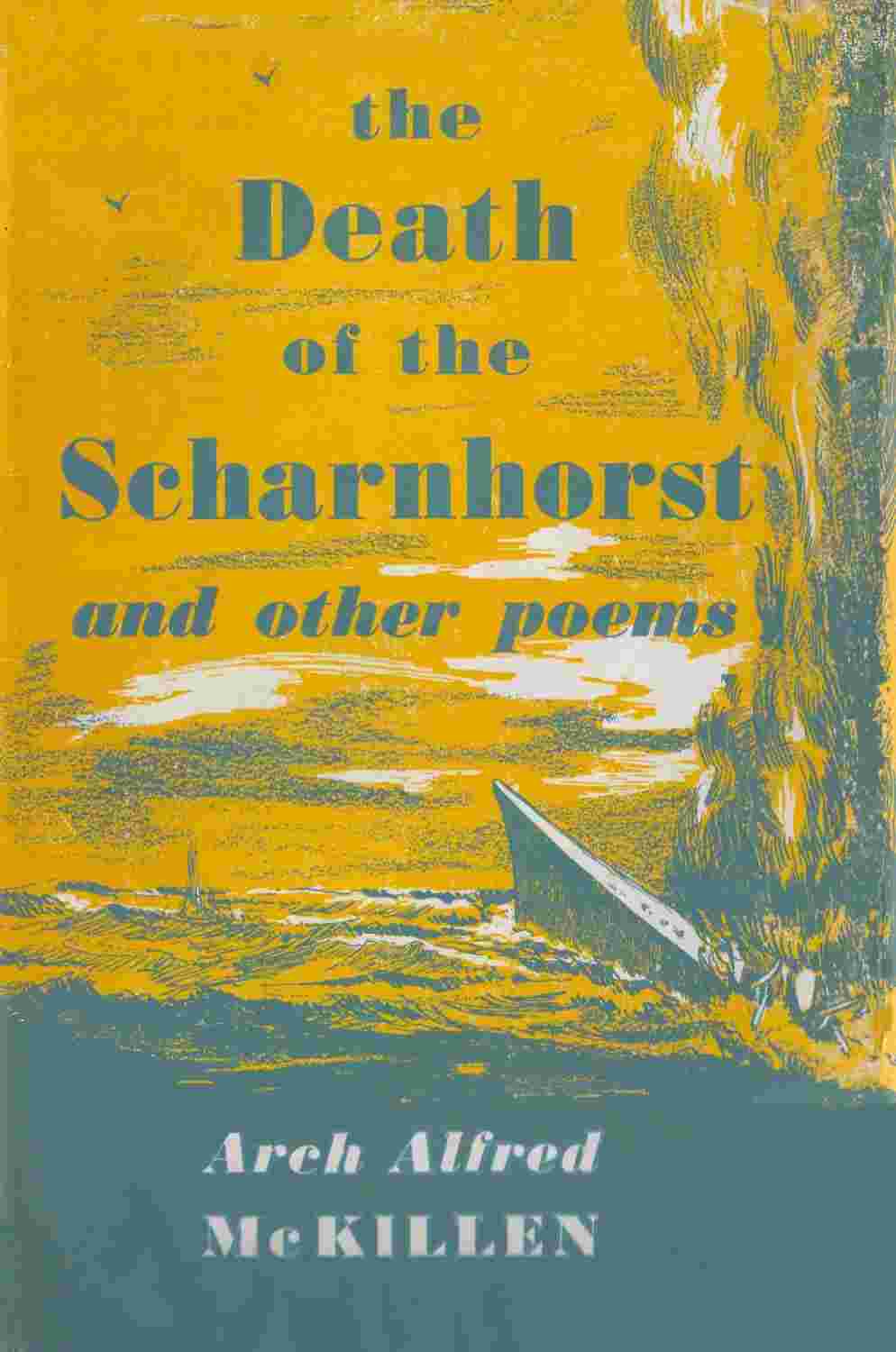
THE
DEATH
OF THE
SCHARNHORST
And Other Poems
by
Arch Alfred McKillen
In the powerful narrative poem which furnishes the title for this impressive first volume, Arch Alfred McKillen tells the dramatic story of the sinking of the German battleship Scharnhorst, during World War II—an important day for the Allied Forces.
These poems could have been written only by a man who has experienced deeply the emotions of which he writes. War is not the only subject of Mr. McKillen’s poems. He writes of love; and indignation prompts him to write strongly against racial prejudice. Sharpness and simplicity of style contribute greatly to the forceful effects which he achieves. Too often a reader’s enjoyment of poetry is marred by obscurity of meaning, but the clarity of thought and euphony of expression of the author, in this volume, leave no doubt in the reader’s mind of his intent.
Reading The Death of the Scharnhorst and Other Poems will be a memorable experience for poetry lovers.
A
VANTAGE
BOOK
About the Author ...
Arch Alfred McKillen was born in Chicago, in 1914. Upon completion of high school, he went to work in a wire-winding factory. Later he worked in a mail-order house, and as a bonded messenger.
In 1939, Mr. McKillen enlisted in the United States Navy. He was stationed aboard the U.S.S. Tennessee at Pearl Harbor, December 7, 1941, when the Japanese attacked. Later, he served aboard other battleships in both the Pacific and the Atlantic, and finally was transferred to a Logistic Support Company on Okinawa.
Mr. McKillen is now a bookseller. In his spare time he is doing research for his next book.
VANTAGE PRESS, INC., 230 W. 41 Street, New York 36.