
The Project Gutenberg eBook of The decay and the restoration of civilization
Title: The decay and the restoration of civilization
The philosophy of civilization, part 1
Author: Albert Schweitzer
Translator: C. T. Campion
Release date: April 25, 2025 [eBook #75958]
Language: English
Original publication: London: A. & C. Black, Ltd, 1923
Credits: Actonian Press
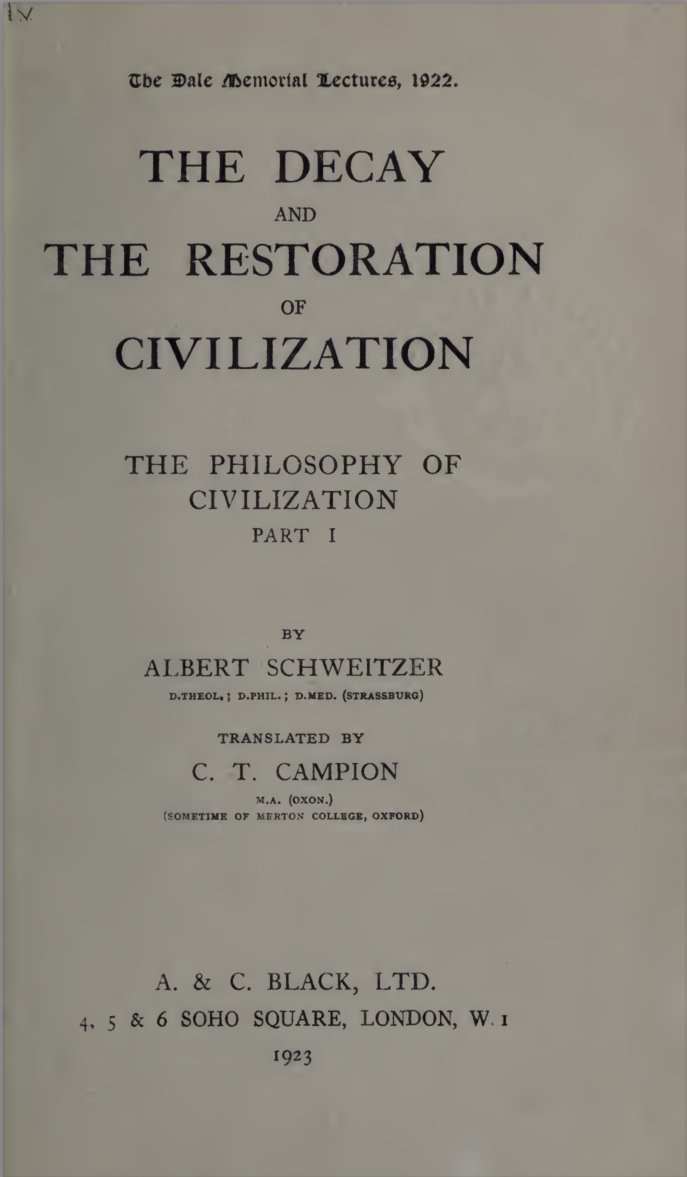
The Dale Memorial Lectures, 1922.
THE DECAY AND THE RESTORATION OF CIVILIZATION
THE PHILOSOPHY OF CIVILIZATION
PART I
BY
ALBERT SCHWEITZER
D.THEOL.; D.PHIL.; D.MED. (STRASSBURG)
TRANSLATED BY
C. T. CAMPION
M.A. (OXON.)
(SOMETIME OF MERTON COLLEGE, OXFORD)
A. & C. BLACK, LTD.
4, 5 & 6 SOHO SQUARE, LONDON, W. 1
1923
Printed in Great Britain by
THE WHITEFRIARS PRESS,LTD., LONDON AND TONBRIDGE.
To
ANNIE FISCHER
IN
DEEPEST GRATITUDE
AUTHOR’S PREFACE
“The Decay and the Restoration of Civilization” is the first part of a complete philosophy of civilization with which I have been occupied since the year 1900.
The second part, entitled “Civilization and Ethics”, will appear immediately. The third is called “The World-View* of Reverence for Life”. The fourth has to do with the civilized State.
That over which I have toiled since 1900 has been finally ripened in the stillness of the primeval forest of Equatorial Africa. There, during the years 1914-17, the clear and definite lines of this philosophy of civilization have been developed.
The first part, “The Decay and the Restoration of Civilization”, is a kind of introduction to the philosophy of civilization. It states the problem of civilization.
Entering on the question as to what is the real essential nature of civilization, I come to the pronouncement that this is ultimately ethical. I know that in thus stating the problem as a moral one I [pg viii] shall surprise and even disgust the spirit of our times, which is accustomed to move amidst æsthetic, historical and material considerations. I imagine, however, that I am myself enough of an artist and also of an historian to be able to comprehend the æsthetic and historical elements in civilization, and that, as a modern physician and surgeon, I am sufficiently modern to appreciate the glamour of the technical and material attainments of our age.
Notwithstanding this, I have come to the conviction that the æsthetic and the historical elements, and the magnificent extension of our material knowledge and power, do not themselves form the essence of civilization, but that this depends on the mental disposition of the individuals and nations who exist in the world. All other things are merely accompanying circumstances of civilization, which have nothing to do with its real essence.
Creative, artistic, intellectual, and material attainments can only show their full and true effects when the continued existence and development of civilization have been secured by founding civilization itself on a mental disposition which is truly ethical. It is only in his struggle to become ethical that man comes to possess real value as a personality; it is only under the influence of ethical convictions that the various relations of human society are formed in such a way that individuals and peoples can [pg ix] develop in an ideal manner. If the ethical foundation is lacking, then civilization collapses, even when in other directions creative and intellectual forces of the strongest nature are at work.
This moral conception of civilization, which makes me almost a stranger amidst the intellectual life of my time, I express clearly and unhesitatingly, in order to arouse amongst my contemporaries reflection as to what civilization really is. We shall not succeed in re-establishing our civilization on an enduring basis until we rid ourselves completely of the superficial concept of civilization which now holds us in thrall, and give ourselves up again to the ethical view which obtained in the eighteenth century.
The second point which I desire should obtain currency is that of the connection between civilization and our theory of the universe. At the present time no regard is paid to this connection. In fact, the period in which we are living altogether misses the significance of having a theory of the universe. It is the common conviction nowadays, of educated and uneducated alike, that humanity will progress quite satisfactorily without any theory of the universe at all.
The real fact is that all human progress depends on progress in its theory of the universe, whilst, conversely, decadence is conditioned by a similar [pg x] decadence in this theory. Our loss of real civilization is due to our lack of a theory of the universe.
Only as we again succeed in attaining a strong and worthy theory of the universe, and find in it strong and worthy convictions, shall we again become capable of producing a new civilization. It is this apparently abstract and paradoxical truth of which I proclaim myself the champion.
Civilization, put quite simply, consists in our giving ourselves, as human beings, to the effort to attain the perfecting of the human race and the actualization of progress of every sort in the circumstances of humanity and of the objective world. This mental attitude, however, involves a double predisposition: firstly, we must be prepared to act affirmatively toward the world and life; secondly, we must become ethical.
Only when we are able to attribute a real meaning to the world and to life shall we be able also to give ourselves to such action as will produce results of real value. As long as we look on our existence in the world as meaningless, there is no point whatever in desiring to effect anything in the world. We become workers for that universal spiritual and material progress which we call civilization only in so far as we affirm that the world and life possess some sort of meaning, or, which is the same thing, only in so far as we think optimistically.
Civilization originates when men become inspired by a strong and clear determination to attain progress, and consecrate themselves, as a result of this determination, to the service of life and of the world. It is only in ethics that we can find the driving force for such action, transcending, as it does, the limits of our own existence.
Nothing of real value in the world is ever accomplished without enthusiasm and self-sacrifice.
But it is impossible to convince men of the truth of world- and life-affirmation and of the real value of ethics by mere declamation. The affirmative and ethical mentality which characterizes these beliefs must originate in man himself as the result of an inner spiritual relation to the world. Only then will they accompany him as strong, clear, and constant convictions, and condition his every thought and action.
To put it in another way: world- and life-affirmation must be the products of thought about the world and life. Only as the majority of individuals attain to this result of thought and continue under its influence will a true and enduring civilization make progress in the world. Should the mental disposition towards world- and life-affirmation and towards ethics begin to wane, or become dim and obscured, we shall be incapable of working for true civilization, nay, more, we shall be unable even to [pg xii] form a correct concept of what such civilization ought to be.
And this is the fate which has befallen us. We are bereft of any theory of the universe. Therefore, instead of being inspired by a profound and powerful spirit of affirmation of the world and of life, we allow ourselves, both as individuals and as nations, to be driven hither and thither by a type of such affirmation which is both confused and superficial. Instead of adopting a determined ethical attitude, we exist in an atmosphere of mere ethical phrases or declare ourselves ethical sceptics.
How is it that we have got into this state of lacking a theory of the universe? It is because hitherto the world- and life-affirming and ethical theory of the universe had no convincing and permanent foundation in thought. We thought again and again that we had found such a basis for it; but it lost power again and again without our being aware that it was doing so, until, finally, we have been obliged, for more than a generation past, to resign ourselves more and more to a complete lack of any world-theory at all.
Thus, in this introductory part of my work, I proclaim two truths and conclude with a great note of interrogation. The truths are the following: The basic ethical character of civilization, and the connection between civilization and our theories of [pg xiii] the universe. The question with which I conclude is this: Is it at all possible to find a real and permanent foundation in thought for a theory of the universe which shall be both ethical and affirmative of the world and of life?
The future of civilization depends on our overcoming the meaninglessness and hopelessness which characterize the thoughts and convictions of men to-day, and reaching a state of fresh hope and fresh determination. We shall be capable of this, however, only when the majority of individuals discover for themselves both an ethic and a profound and steadfast attitude of world- and life-affirmation, in a theory of the universe at once convincing and based on reflection.
Without such a general spiritual experience there is no possibility of holding our world back from the ruin and disintegration towards which it is being hastened. It is our duty then to rouse ourselves to fresh reflection about the world and life.
In “Civilization and Ethics”, the second part of this philosophy of civilization, I describe the road along which thought has led me to world- and life-affirmation and to ethics. The root-idea of my theory of the universe is that my relation to my own being and to the objective world is determined by reverence for life. This reverence for life is given as an element of my will-to-live, and becomes clearly [pg xiv] conscious of itself as I reflect about my life and about the world. In the mental attitude of reverence for life which should characterize my contact with all forms of life, both ethics and world- and life-affirmation are involved. It is not any kind of insight into the essential nature of the world which determines my relation to my own existence and to the existence which I encounter in the world, but rather only and solely my own will-to-live which has developed the power of reflection about itself and the world.
The theory of the universe characterized by reverence for life is a type of mysticism arrived at by self-consistent thought when persisted in to its ultimate conclusion. Surrendering himself to the guidance of this mysticism, man finds a meaning for his life in that he strives to accomplish his own spiritual and ethical self-fulfilment, and, simultaneously and in the same act, helps forward all the processes of spiritual and material progress which have to be actualized in the world.
I do not know how many, or how few, will allow themselves to be persuaded to travel with me on the road indicated above. What I desire above all things—and this is the crux of the whole affair—is that we should all recognize fully that our present entire lack of any theory of the universe is the ultimate source of all the catastrophes and misery of [pg xv] our times, and that we should toil in concert for a theory of the universe and of life, in order that thus we may arrive at a mental disposition which shall make us really and truly civilized men.
It was a great joy to me to be afforded the opportunity of putting forward, in the Dale Lectures, delivered in Oxford, the views on which this philosophy of civilization is based.
I would tender my deepest thanks to my friends, Mr. C. T. Campion, M.A., now of Grahamstown, South Africa, and Dr. J. P. Naish, of Oxford. Mr. Campion is the translator of this first part of the “Philosophy of Civilization”. Dr. Naish has seen the book through the press and translated this preface.
ALBERT SCHWEITZER.
Strasbourg, Alsace.
February, 1923.
CONTENTS
- CHAPTER I
- How Philosophy is Responsible for the Collapse of Civilization [1]
- CHAPTER II
- Hindrances to Civilization in our Economic and Spiritual Life [15]
- CHAPTER III
- Civilization essentially Ethical in Character [35]
- CHAPTER IV
- The Way to the Restoration of Civilization [62]
- CHAPTER V
- Civilization and Theories of the Universe [80]
THE DECAY AND THE
RESTORATION OF
CIVILIZATION
CHAPTER I
HOW PHILOSOPHY IS RESPONSIBLE FOR THE COLLAPSE OF CIVILIZATION
Our self-deception as to the real conditions of our civilization. The collapse of the theory of the universe on which our ideals were based. The superficial character of modern philosophizing.
We are living to-day under the sign of the collapse of civilization. The situation has not been produced by the war; the latter is only a manifestation of it. The spiritual atmosphere has solidified into actual facts, which again react on it with disastrous results in every respect. This interaction of material and spiritual has assumed a most unhealthy character. Just below a mighty cataract we are driving along in a current full of formidable eddies, and it will need the most gigantic efforts to rescue the vessel of our fate from the dangerous side channel into which we have [pg 002] allowed it to drift, and bring it back into the main stream, if, indeed, we can hope to do so at all.
We have drifted out of the stream of civilization because there was amongst us no real reflection upon what civilization is. It is true that at the end of the last century and the beginning of this there appeared a number of works on civilization with the most varied titles; but, as though in obedience to some secret order, they made no attempt to settle and make clear the conditions of our intellectual life, but devoted themselves exclusively to its origin and history. They gave us a relief map of civilization marked with roads which men had observed or invented, and which led us over hill and dale through the fields of history from the Renaissance to the twentieth century. It was a triumph for the historical sense of the authors. The crowds whom these works instructed were filled with satisfied contentment when they understood that their civilization was the organic product of so many centuries of the working of spiritual and social forces, but no one worked out and described the content of our spiritual life. No one tested its value from the point of view of the nobility of its ideas, and its ability to produce real progress.
Thus we crossed the threshold of the twentieth century with an unshakable conceit of ourselves, [pg 003] and whatever was written at that time about our civilization only confirmed us in our ingenuous belief in its high value. Anyone who expressed doubt was regarded with astonishment. Many, indeed, who were on the road to error, stopped and returned to the main road again because they were afraid of the path which led off to the side. Others continued along the main road, but in silence; the understanding and insight which were at work in them only condemned them to isolation.
It is clear now to everyone that the suicide of civilization is in progress. What yet remains of it is no longer safe. It is still standing, indeed, because it was not exposed to the destructive pressure which overwhelmed the rest, but, like the rest, is built upon rubble, and the next landslide will very likely carry it away.
But what was it that preceded and led up to this loss of power in the innate forces of civilization?
The age of the Illuminati and of rationalism had put forward ethical ideals, based on reason, concerning the development of the individual to true manhood, his position in society, the material and spiritual problems which arose out of society, the relations of the different nations to each other, and their issue in a humanity which should be united in [pg 004] the pursuit of the highest moral and spiritual objects. These ideals had begun, both in philosophy and in general thought, to get into contact with reality and to alter the general environment. In the course of three or four generations there had been such progress made, both in the ideas underlying civilization and in their material embodiment, that the age of true civilization seemed to have dawned upon the world and to be assured of an uninterrupted development.
But about the middle of the nineteenth century this mutual understanding and co-operation between ethical ideals and reality began to break down, and in the course of the next few decades it disappeared more and more completely. Without resistance, without complaint, civilization abdicated. Its ideas lagged behind, as though they were too exhausted to keep pace with it. How did this come about?
The decisive element in the production of this result was philosophy’s renunciation of her duty.
In the eighteenth century and the early part of the nineteenth it was philosophy which led and guided thought in general. She had busied herself with the questions which presented themselves to mankind at each successive period, and had kept the [pg 005] thought of civilized man actively reflecting upon them. Philosophy at that time included within herself an elementary philosophizing about man, society, race, humanity and civilization, which produced in a perfectly natural way a living popular philosophy that controlled the general thought, and maintained the enthusiasm for civilization.
But that ethical, and at the same time optimistic, view of things in which the Illuminati and rationalism had laid the foundations of this healthy popular philosophy, was unable in the long run to meet the criticism levelled at it by pure thought. Its naïve dogmatism raised more and more prejudice against it. Kant tried to provide the tottering building with new foundations, undertaking to alter the rationalistic view of things in accordance with the demands of a deeper theory of knowledge, without, however, making any change in its essential spiritual elements. Goethe, Schiller and other intellectual giants of the age, showed, by means of criticism both kindly and malicious, that rationalism was rather popular philosophy than real philosophy, but they were not in a position to put into the place of what they destroyed anything new which could give the same effective support to the ideas about civilization which were current in the general thought of the time.
Fichte, Hegel, and other philosophers, who, for all their criticism of rationalism, paid homage to its ethical ideals, attempted to establish a similar ethical and optimistic view of things by speculative methods, that is by logical and metaphysical discussion of pure being and its development into a universe. For three or four decades they succeeded in deceiving themselves and others with this supposedly creative and inspiring illusion, and in doing violence to reality in the interests of their theory of the universe. But at last the natural sciences, which all this time had been growing stronger and stronger, rose up against them, and, with a plebeian enthusiasm for the truth of reality, reduced to ruins the magnificent creations of their imagination.
Since that time the ethical ideas on which civilization rests have been wandering about the world, poverty-stricken and homeless. No theory of the universe has been advanced which can give them a solid foundation; in fact, not one has made its appearance which can claim for itself solidity and inner consistency. The age of philosophic dogmatism had come definitely to an end, and after that nothing was recognized as truth except the science which described reality. General theories of the universe no longer appeared as fixed stars; they [pg 007] were regarded as resting on hypothesis, and ranked no higher than comets.
The same weapon which struck down the dogmatism of knowledge about the universe struck down also the dogmatic enunciation of spiritual ideas. The early simple rationalism, the critical rationalism of Kant, and the speculative rationalism of the great philosophers of the nineteenth century had all alike done violence to reality in two ways. They had given a position above that of the facts of science to the views which they had arrived at by pure thought, and they had also preached a series of ethical ideals which were meant to replace by new ones the various existing relations in the ideas and the material environment of mankind. When the first of these two forms of violence was proved to be a mistaken one, it became questionable whether the second could still be allowed the justification which it had hitherto enjoyed. The doctrinaire methods of thought which made the existing world nothing but material for the production of a purely theoretical sketch of a better future were replaced by sympathetic attempts to understand the historical origin of existing things for which Hegel’s philosophy had prepared the way.
With a general mentality of this description, a real combination of ethical ideals with reality was no [pg 008] longer possible; there was not the freedom from prejudice which that required, and so there came a weakening of the convictions which were the driving power of civilization. So, too, an end was put to that justifiable violence to human convictions and circumstances without which the reforming work of civilization can make no advance, because it was bound up with that other unjustifiable violence to reality. That is the tragic element in the psychological development of our spiritual life during the latter half of the nineteenth century.
Rationalism, then, had been dismissed; but with it went also the optimistic convictions as to the moral meaning of the universe and of humanity, of society and of man, to which it had given birth, though the conviction still exerted so much influence that no attention was paid to the catastrophe which had really begun.
Philosophy did not realize that the power of the ideas about civilization which had been entrusted to it was becoming a doubtful quantity. At the end of one of the most brilliant works on the history of philosophy which appeared at the close of the nineteenth century philosophy is defined as the process “by which there comes to completion, step by step, [pg 009] and with ever clearer and surer consciousness, that conviction about the value of civilization the universal validity of which it is the object of philosophy itself to affirm.” But the author has forgotten the essential point, viz., that there was a time when philosophy did not merely convince itself of the value of civilization, but also let its convictions go forth as fruitful ideas destined to influence the general thought, while from the middle of the nineteenth century onwards these convictions had become more and more of the nature of hoarded and unproductive capital.
Once philosophy had been an active worker producing universal convictions about civilization. Now, after the collapse in the middle of the nineteenth century, this same philosophy had become a mere drawer of dividends, concentrating her activities far from the world on what she had managed to save. She had become a mere science, which sifted the results of the historical and natural sciences, and collected from them material for a future theory of the universe, carrying on with this object in view a learned activity in all branches of knowledge. At the same time she became more and more absorbed in the study of her own past. Philosophy came to mean practically the history of philosophy, but the creative spirit had left her. She became more and [pg 010] more a philosophy which contained no real thought. She reflected, indeed, on the results achieved by the individual sciences, but she lost the power of thought about fundamental problems.
She looked back with condescending pity on the rationalism which she had outstripped. She prided herself on being able to trace her descent through Kant, on having been shown by Hegel the inner meaning of history, and on being at work to-day in close sympathy with the natural sciences. But for all that she was poorer than the poorest rationalism, because she now carried on in imagination only, and not in reality, the recognized work of philosophy, which the latter had practised so zealously. Rationalism, for all its simplicity, had been a working philosophy, but philosophy herself had now become, for all her insight, merely a pedantic philosophy of degenerates. She still played, indeed, some sort of rôle in schools and universities, but she had no longer any message for the great world.
In spite of all her learning, she had become a stranger to the world, and the problems of life which occupied men and the whole thought of the age had no part in her activities. Her way lay apart from the general spiritual life, and just as she derived no stimulus from the latter, so she gave none back. Refusing to concern herself with fundamental [pg 011] problems, she contained no fundamental philosophy which could become a philosophy of the people.
From this impotence came the aversion to all generally intelligible philosophizing which is so characteristic of her. Popular philosophy was for her merely a review, prepared for the use of the crowd, simplified, and therefore rendered inferior, of the results given by the individual sciences which she had herself sifted and put together in view of a future theory of the universe. She was wholly unconscious of several things, viz., that there is a popular philosophy which arises out of such a review; that it is just the province of philosophy to deal with the primary, deeper questions about which individuals and the crowd are thinking, or ought to be thinking, to apply to them more comprehensive and more thorough methods of thought, and then restore them to general currency; and, finally, that the value of any philosophy is in the last resort to be measured by its capacity, or incapacity, to transform itself into a living philosophy of the people.
Whatever is deep is also simple, and can be reproduced as such, if only its relation to the whole of reality is preserved. It is then something abstract, which secures for itself a many-sided life as soon as it comes into contact with facts.
Whatever of inquiring thought there was among the general public was therefore compelled to languish, because our philosophy refused either to acknowledge or to help it. It found in front of it a deep chasm which it could not cross.
Of gold coinage, minted in the past, philosophy had abundance; hypotheses about a soon to be developed theological theory of the universe filled her vaults like unminted bullion; but food with which to appease the spiritual hunger of the present she did not possess. Deceived by her own riches, she had neglected to plant any ground with nourishing crops, and therefore, ignoring the hunger of the age, she left the latter to its fate.
That pure thought never managed to construct a theory of the universe of an optimistic, ethical character, and to build up on that for a foundation the ideals which go to produce civilization, was not the fault of philosophy; it was a fact which became evident as thought developed. But philosophy was guilty of a wrong to our age in that it did not admit the fact, but remained wrapped up in its illusion, as though this were really a help to the progress of civilization.
The ultimate vocation of philosophy is to be the guide and guardian of the general reason, and it was her duty, in the circumstances of the time, to confess [pg 013] to our world that ethical ideals were no longer supported by any general theory of the universe, but were, till further notice, left to themselves, and must make their way in the world by their own innate power. She ought to have shown us that we have to fight on behalf of the ideals on which our civilization rests. She ought to have tried to give these ideals an independent existence by virtue of their own inner value and inner truth, and so to keep them alive and active without any extraneous help from a corresponding theory of the universe. No effort should have been spared to direct the attention of the cultured and the uncultured alike to the problem of the ideals of civilization.
But philosophy philosophized about everything except civilization. She went on working undeviatingly at the establishment of a theoretical view of the universe, as though by means of it everything could be restored, and did not reflect that this theory, even if it were completed, would be constructed only out of history and science, and would accordingly be unoptimistic and unethical, and would remain for ever an “impotent theory of the universe,” which could never call forth the energies needed for the establishment and maintenance of the ideals of civilization.
So little did philosophy philosophize about [pg 014] civilization that she did not even notice that she herself and the age along with her were losing more and more of it. In the hour of peril the watchman who ought to have kept us awake was himself asleep, and the result was that we put up no fight at all on behalf of our civilization.
CHAPTER II
HINDRANCES TO CIVILIZATION IN OUR ECONOMIC AND SPIRITUAL LIFE
The unfree economic position of the modern man. The undeveloped condition of the modern man. The modern man’s want of humanity. The lack of spiritual independence in the man of to-day.
Even if the abdication of thought has been, as we have seen, the decisive factor in the collapse of our civilization, there are yet a number of other causes which combine with it to hinder our progress in this regard. They are to be found in the field of spiritual as well as in that of economic activity, and depend, above all, on the interaction between the two, an interaction which is unsatisfactory and continually becoming more so.
The capacity of the modern man for progress in civilization is diminished because the circumstances in which he finds himself placed injure him psychically and stunt his personality.
The development of civilization comes about—to put it quite generally—by individual men thinking out ideals which aim at the progress of the whole, and then so fitting them to the realities of life that [pg 016] they assume the shape in which they can influence most effectively the circumstances of the time. A man’s ability to be a pioneer of progress, that is, to understand what civilization is and to work for it, depends, therefore, on his being a thinker and on his being free. He must be the former if he is to be capable of comprehending his ideals and putting them into shape. He must be free in order to be in a position to launch his ideals out into the general life. The more completely his activities are taken up in any way by the struggle for existence, the more strongly will the impulse to improve his own condition find expression in the ideals of his thought. Ideals of self-interest then get mixed up with and spoil his ideals of civilization.
Material and spiritual freedom are closely bound up with one another. Civilization presupposes free men, for only by free men can it be thought out and brought to realization.
But among mankind to-day both freedom and the capacity for thought have been sadly diminished.
If society had so developed that a continually widening circle of the population could enjoy a modest, but well-assured, condition of comfort, civilization would have been much more helped than it has been by all the material conquests which are lauded in its name. These do, indeed, make [pg 017] mankind as a whole less dependent upon nature, but at the same time they diminish the number of free and independent lives. The artisan who was his own master becomes the factory hand through the compulsion of machinery. Because in the complicated business world of to-day only undertakings with abundant capital behind them can maintain their existence, the place of the small, independent dealer is being taken more and more completely by the employee. Even the classes which still possess a larger or smaller amount of property or maintain a more or less independent activity get drawn more and more completely into the struggle for existence because of the insecurity of present conditions under the economic system of to-day.
The lack of freedom which results is made worse still because the factory system creates continually growing agglomerations of people who are thereby compulsorily separated from the soil which feeds them, from their own homes and from nature. Hence comes serious psychical injury. There is only too much truth in the paradoxical saying that abnormal life begins with the loss of one’s own field and dwelling-place.
Civilization is, it is true, furthered to a certain extent by the self-regarding ideals produced by the [pg 018] groups of people who unite and co-operate in defence of their similarly threatened interests in so far as they seek to obtain an improvement in their material, and thereby also in their spiritual, environment. But these ideals are a danger to the idea of civilization as such, because the form which they assume is either not at all, or very imperfectly, determined by the really universal interests of the community. The consideration of civilization as such is held back by the competition between the various self-regarding ideals which go under its name.
To the want of freedom we have to add the evil of overwork. For two or three generations numbers of individuals have been living as workers merely, not as human beings. Whatever can be said in a general way about the moral and spiritual significance of labour has no bearing on what they have to do. An excessive amount of labour is the rule to-day in every department of industry, with the result that the labourer’s spiritual element cannot possibly thrive. This overwork hits him indirectly even in his childhood, for his parents, caught in the inexorable toils of work, cannot devote themselves to his up-bringing as they should. Thus his development is robbed of something which can never be made good, and later in life, when he himself is the slave of over-long hours, he feels more and [pg 019] more the need of external distractions. To spend the time left to him for leisure in self-cultivation, or in serious intercourse with his fellows or with books, requires a mental collectedness and a self-control which he finds very difficult. Complete idleness, forgetfulness, and diversion from his usual activities are a physical necessity. He does not want to think, and seeks not self-improvement, but entertainment, that kind of entertainment, moreover, which makes least demand upon his spiritual faculties.
The mentality of this mass of individuals, spiritually relaxed and incapable of self-collectedness, reacts upon all those institutions which ought to serve the cause of culture, and therewith of civilization. The theatre takes a second place behind the pleasure resort or the picture show, and the instructive book behind the diverting one. An ever increasing proportion of periodicals and newspapers have to accommodate themselves to the necessity of putting their matter before their readers in the shape which lets it be assimilated most easily. A comparison of the average newspapers of to-day with those of fifty or sixty years ago shows how thoroughly such publications have had to change their methods in this respect.
When once the spirit of superficiality has penetrated [pg 020] into the institutions which ought to sustain the spiritual life, these exercise on their part a reflex influence on the society which they have brought to this condition, and force on all alike this state of mental vacuity.
How completely this want of thinking power has become a second nature in men to-day is shown by the kind of sociability which it produces. When two of them meet for a conversation each is careful to see that their talk does not go beyond generalities or develop into a real exchange of ideas. No one has anything of his own to give out, and everyone is haunted by a sort of terror lest anything original should be demanded from him.
The spirit produced in such a society of never-concentrated minds is rising among us as an ever growing force, and it results in a lowered conception of what man should be. In ourselves, as in others we look for nothing but vigour in productive work and resign ourselves to the abandonment of any higher ideal.
When we consider this want of freedom and of mental concentration, we see that the conditions of life for the inhabitants of our big cities are as unfavourable as they could be. Naturally, then, those inhabitants are in most danger on their spiritual side. It is doubtful whether big cities [pg 021] have ever been foci of civilization in the sense that in them there has arisen the ideal of a man well and truly developed as a spiritual personality; to-day, at any rate, the condition of things is such that true civilization needs to be rescued from the spirit that issues from them and their inhabitants.
But, besides the hindrance caused to civilization by the modern man’s lack of freedom and of the power of mental concentration, there is a further hindrance caused by his imperfect development. The enormous increase of human knowledge and power, in specialized thoroughness as well as in extent, necessarily leads to individual activities being limited more and more to well-defined departments. Human labour is organized and co-ordinated so that specialization may enable individuals to make the highest and most effective possible contribution. The results obtained are amazing, but the spiritual significance of the work for the worker suffers. There is no call upon the whole man, only upon some of his faculties, and this has a reflex effect upon his nature as a whole. The faculties which build up personality and are called out by comprehensive and varied tasks are ousted by the less comprehensive ones, which from this point of view are, in the [pg 022] general sense of the word, less spiritual. The artisan of to-day does not understand his trade as a whole in the way in which his predecessor did. He no longer learns, like the latter, to work the wood or the metal through all the stages of manufacture; many of these stages have already been carried out by men and machines before the material comes into his hands. Consequently his reflectiveness, his imagination, and his skill are no longer called out by ever varying difficulties in the work, and his creative and artistic powers are atrophied. In place of the normal self-consciousness which is promoted by work into the doing of which he must put his whole power of thought and his whole personality, there comes a self-satisfaction which is content with a fragmentary ability which, it may be admitted, is perfect, and this self-satisfaction is persuaded by its perfection in mastering details to overlook its imperfection in dealing with the whole.
In all professions, most clearly perhaps in the pursuit of science, we can recognize the spiritual danger with which specialization threatens not only individuals, but the spiritual life of the community. It is already noticeable, too, that education is carried on now by teachers who have not a wide enough outlook to make their scholars understand the interconnection of the individual sciences, and [pg 023] to be able to give them a mental horizon as wide as it should be.
Then, as if specialization and the organization of work, where it is unavoidable, were not already injurious enough to the soul of the modern man, it is pursued and built up where it could be dispensed with. In administration, in education, and in every kind of calling the natural sphere of activity is narrowed as far as possible by rules and superintendence. How much less free in many countries is the elementary school teacher of to-day compared with what he was once! How lifeless and impersonal has his teaching become as a result of all these limitations!
Thus through our methods of work we have suffered loss spiritually and as individuals just in proportion as the material output of our collective activity has increased. Here, too, is an illustration of that tragic law which says that every gain brings with it, somehow or other, a corresponding loss.