
PREFACE TO THE FIRST EDITION
The complete manuscript of this book—the outcome of three years’ work—was ready when the Great War broke out. By the spring of 1917 it had been worked over again and—in certain details—supplemented and cleared up, but its appearance in print was still delayed by the conditions then prevailing.
Although a philosophy of history is its scope and subject, it possesses also a certain deeper significance as a commentary on the great epochal moment of which the portents were visible when the leading ideas were being formed.
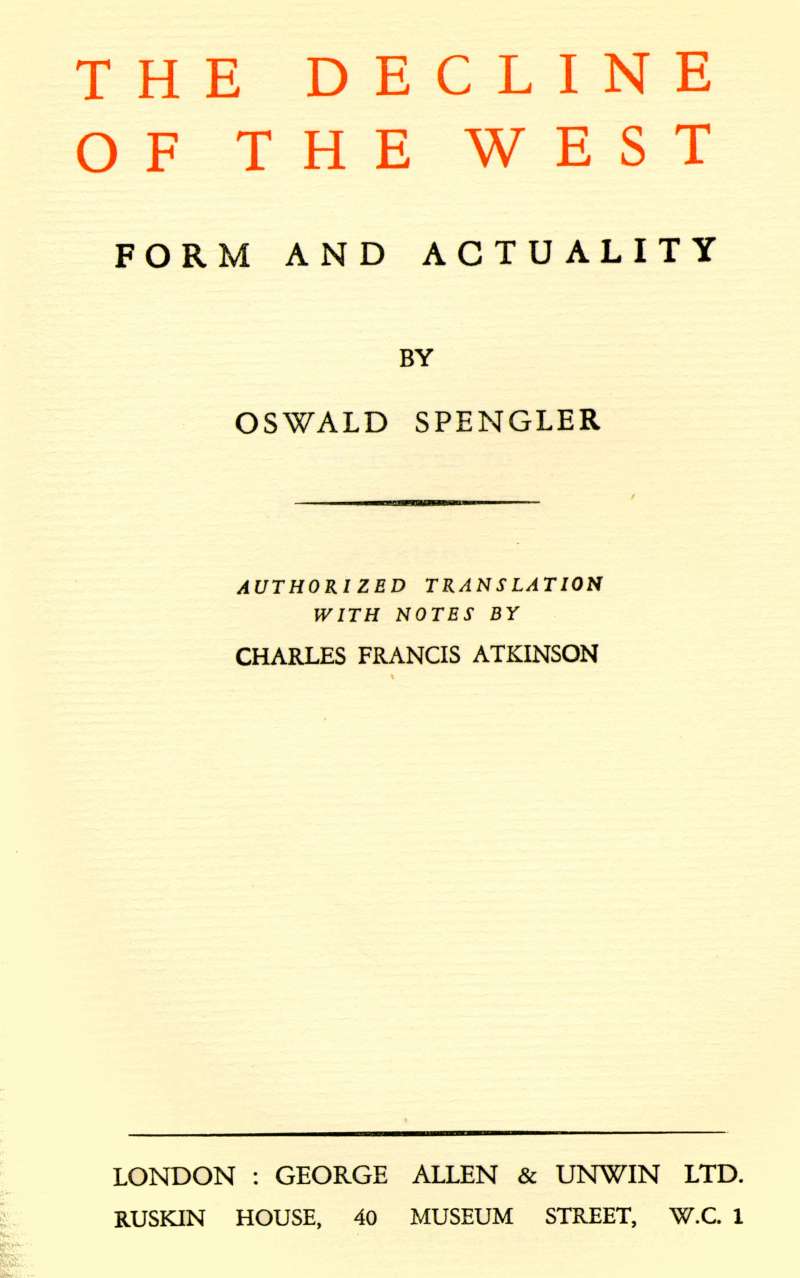
The title, which had been decided upon in 1912, expresses quite literally the intention of the book, which was to describe, in the light of the decline of the Classical age, one world-historical phase of several centuries upon which we ourselves are now entering.
Events have justified much and refuted nothing. It became clear that these ideas must necessarily be brought forward at just this moment and in Germany, and, more, that the war itself was an element in the premisses from which the new world-picture could be made precise.
For I am convinced that it is not merely a question of writing one out of several possible and merely logically justifiable philosophies, but of writing the philosophy of our time, one that is to some extent a natural philosophy and is dimly presaged by all. This may be said without presumption; for an idea that is historically essential—that does not occur within an epoch but itself makes that epoch—is only in a limited sense the property of him to whose lot it falls to parent it. It belongs to our time as a whole and influences all thinkers, without their knowing it; it is but the accidental, private attitude towards it (without which no philosophy can exist) that—with its faults and its merits—is the destiny and the happiness of the individual.