
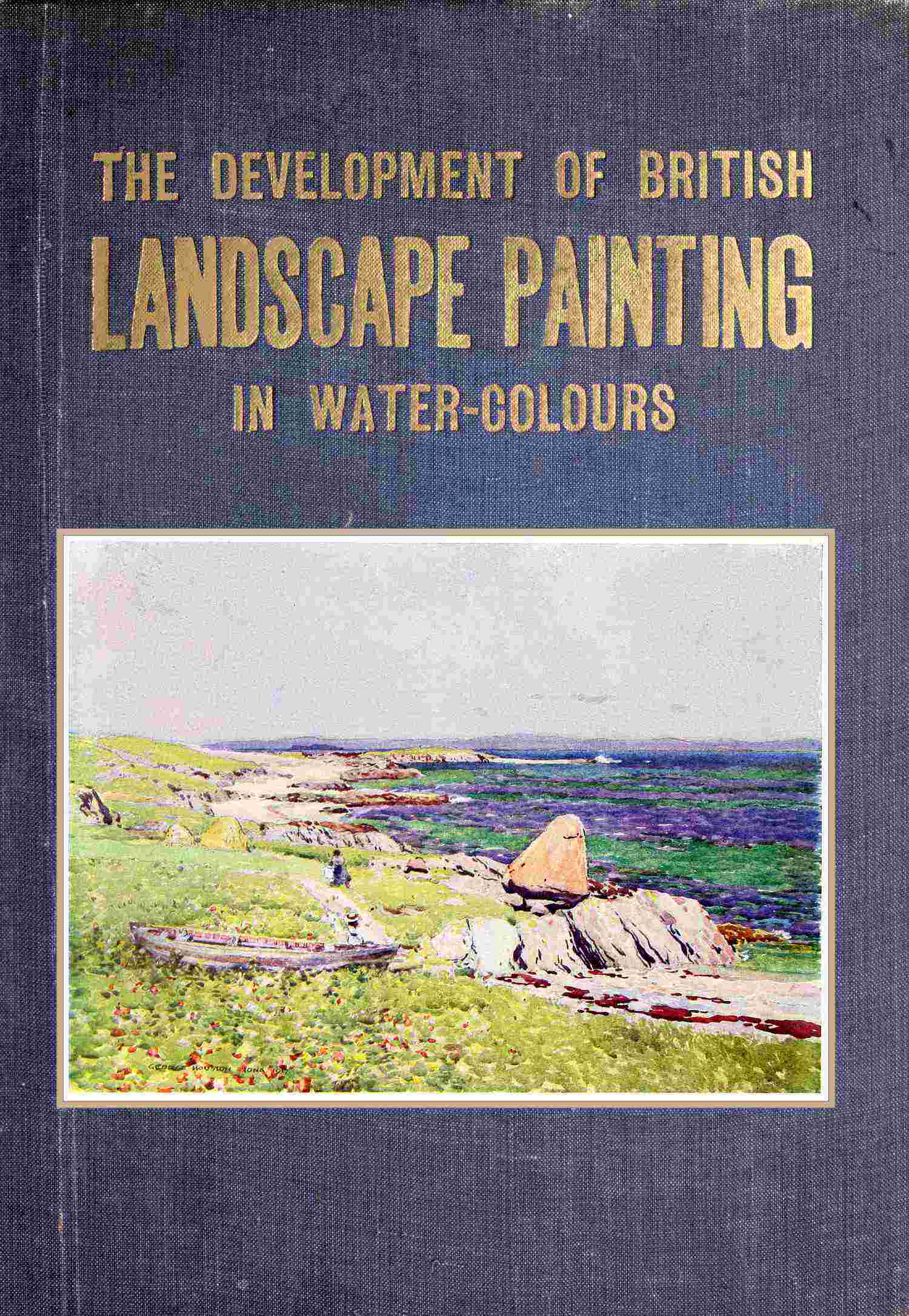
The Project Gutenberg eBook of The development of British landscape painting in water-colours
Title: The development of British landscape painting in water-colours
Author: A. J. Finberg
E. A. Taylor
Editor: Charles Holme
Release date: October 6, 2020 [eBook #63388]
Most recently updated: October 18, 2024
Language: English
Credits: Produced by Chuck Greif and the Online Distributed
Proofreading Team at http://www.pgdp.net (This file was
produced from images available at The Internet Archive)
THE DEVELOPMENT
OF BRITISH LAND-
SCAPE PAINTING
IN WATER-COLOURS
HOLME. TEXT BY
A L E X A N D E R J.
F I N B E R G & E. A.
TAYLOR
MCMXVIII “THE STUDIO” LTD.
LONDON PARIS NEW YORK
CONTENTS
PREFATORY NOTE
The Editor desires to acknowledge his indebtedness to the artists and owners who have kindly lent their drawings for reproduction in this volume
THE DEVELOPMENT OF BRITISH
LANDSCAPE PAINTING IN WATER-COLOURS.
BY
ALEXANDER J. FINBERG
(1) INTRODUCTORY REMARKS ON THE IDEA OF DEVELOPMENT AS APPLIED TO ART
THE idea of development has played, for considerably more than half a century, and still plays, a large part in all discussions about art. And it is obvious that it is a very useful and at the same time a very dangerous idea; useful, because with its aid you can prove anything you have a mind to, and dangerous, because it conceals all sorts of latent suggestions, vague presuppositions, and lurking misconceptions, and thus misleads and beguiles the unwary. The most insidious and dangerous of these suggestions is its connexion with the ideas of progress or advance. The dictionaries, indeed, give “progress” as one of the synonyms of “development,” and amongst the synonyms of “progress” I find “advance,” “attainment,” “growth,” “improvement,” and “proficiency.” So that as soon as we begin to connect the idea of development with the history of art we find ourselves committed, before we quite realize what we are doing, to the view that the latest productions of art are necessarily the best. If art develops, it necessarily grows, improves, and advances, and the history of art becomes a record of the steps by which primitive work has passed into the fully developed art of the present; the latest productions being evidently the most valuable, because they sum up in their triumphant complexity all the tentative variations and advances of which time and experience have approved.
Stated thus baldly the idea as applied to art seems perhaps too obviously at variance with our tastes, experience, and instinctive standards of artistic values to be worth a moment’s consideration. Yet we are all too well aware that this is the line of argument by which every freak, every eccentric, insane or immoral manifestation of artistic perversity and incompetence which has appeared in Europe within the last thirty or forty years has been commended and justified. Certainly in England every writer on art who calls himself “advanced” is an evolutionist of this crude and uncritical type. At one time it was Cézanne and Van Gogh who were supposed to have summed up in their triumphant complexity the less developed efforts of Titian, Rembrandt, Watteau, and Turner, and at the present moment Cézanne and Van Gogh are being superseded by Mr. Roger Fry and his young lions of “The New Movement.”
The worst of it is that the idea of development, of evolution, is a perfectly sound and useful one in certain spheres of activity. In science, for instance, the idea works and is helpful. The successive modifications and improvements by which the latest type of steam-engine has been evolved from Stevenson’s “Puffing Billy,” or the latest type of air-ship from the Montgolfier balloon, form a series of steps which are related and connected with each other, and they are so intimately connected that the latest step sums up and supersedes all the others. No one would travel with Stevenson’s engine who could employ a British or American engine of the latest type. There we have a definite system of development—of growth, improvement, and increased proficiency. And we find the same thing if we look at science as a whole, as a body of knowledge of a special kind. Its problems are tied together, subordinated and co-ordinated, unified in one vast system, so that we can represent its history as a single line of progress or retreat.
But art is not like science. Donatello’s sculpture is not a growth from the sculpture of Pheidias or Praxiteles in the same way that the London and North-Western engine is a growth from Stevenson’s model; nor was Raphael’s work developed from Giotto’s in the same way. Works of art are separate and independent things. That is why Donatello has not superseded Pheidias, nor Raphael Giotto; and that is why the world cherishes the earliest works of art quite as much as the later ones.
Yet we are bound to admit that we can find traces of an evolutionary process even in the history of art, if we look diligently for them. I remember to have seen a book by a well-known Italian critic in which the representations of the Madonna are exhibited from this point of view (A. Venturi, “La Madonna,” Milan, 1899). In it the pictures of the Madonna are treated as an organism which gradually develops, attains perfection, gets old, and dies. There is something to be said for this point of view. When you have a number of artists successively treating the same subject you naturally find that alterations and fresh ideas are imported into their work. These additions and modifications can quite fairly be regarded as developments of the subject-matter and its treatment. But such developments are always partial and one-sided, and they are accompanied with losses of another kind. If Raphael’s Madonnas are more correctly drawn and modelled than those of Giotto, these gains are balanced by a corresponding loss in the spiritual qualities of sincerity and earnestness of religious conviction. It depends, therefore, on what narrow and strictly defined point of view we adopt whether we find development or decay in any particular series of artistic productions. From one point of view the history of art from Giotto to Raphael can be regarded as a process of growth and advance, from another, the same series can be taken, as Ruskin actually took it, as an exhibition of the processes of death and decay. The enlightened lover and student of art will look at the matter from both, and other, points of view, but he will realize that the theory of development does not help him in any way to find a standard of value for works of art.
Art must be judged by its own standards, and those standards tell us
PLATE I.
(In the possession of C. Morland Agnew, Esq.)
“LAKE ALBANO AND CASTEL GANDOLFO.” BY J. R. COZENS.
that each individual masterpiece is perfect in its own marvellous way, whether it was produced like the Cheik el Beled or The Scribe, some five or six thousand years ago, or like the paintings of Reynolds, Gainsborough, and Turner within comparatively recent times.
(2) THE BEARING OF THESE REMARKS ON THE HISTORY OF BRITISH WATER-COLOUR PAINTING
THE direct bearing of these remarks on our immediate subject-matter will, I hope, be evident to all who are familiar with the literature of the history of British water-colour painting.
The first attempt to form an historical series of British water-colours for the public use was begun in 1857, by Samuel Redgrave for the Science and Art Department of what was then the Board of Education. Thanks to Redgrave’s knowledge and enthusiasm a worthy collection of examples of the works of the founders of the school was soon got together, and this nucleus was rapidly enlarged by purchases, gifts, and bequests. These drawings were housed and exhibited in what was then called the South Kensington Museum, and in 1877 Redgrave published an admirable “Descriptive Catalogue” of the collection. As an introduction to this catalogue he wrote a valuable account of the origin and historical development of the art. Both the official character of this publication as well as its intrinsic merits, literary and historical—for Redgrave and his brother Richard, who had assisted him in the work, were two of the best informed historians of English art in the last century—combined to make it at the time and for many years afterwards the standard and most authoritative book on this subject. But its historical part has one serious defect, due perhaps to some extent to the unfortunate association of science with art in the same museum. Redgrave’s conception of artistic development was evidently borrowed ready-made from the ideas of his scientific colleagues. He treats the chronological arrangement of the drawings in exactly the same way as the men of science treat the successive alterations and improvements which Stevenson’s first model steam-engine underwent; and as he found the earlier drawings approached very nearly to monochrome, while the later ones were highly coloured and fuller in the statement and realization of detail, he took it for granted that these changes marked the true line of progress and development in the art. The early “stained” drawings of Scott and Rooker were treated as the primitive and undeveloped models from which the later and more elaborate works of Turner, Copley Fielding, Sidney Cooper, John F. Lewis, Louis Haghe, and Carl Werner were developed. Every fresh complication of technique and elaboration of effect were hailed enthusiastically as signs of “progress,” and brilliance of colour, richness of effect, and fullness of realization were treated as the marks of “the full perfection” of which the art was capable. In this way water-colour “drawing” became “elevated” into the “perfected” art of painting in water-colours, and the beneficent cosmic process triumphantly produced paintings in water-colour which could actually “hold their own” in force and brilliancy of effect with oil paintings.
As a temporary measure Redgrave’s excursus into evolutionary theory must have been extraordinarily successful. No more specious doctrine could well have been invented to flatter and gratify all parties concerned at the moment; the presidents and leading members of the two water-colour societies must have found peace and comfort in Redgrave’s theory, and the general public must have felt that “enlightenment and progress” even in artistic matters were being duly fostered by an efficient “Committee Council on Education.” But the theory has serious defects. It sets up a false standard of artistic value, it withdraws attention from the higher beauties of art to focus it upon merely materialistic and technical questions, and, what is perhaps still more serious, it prejudges the efforts of subsequent artists, and closes the door to future changes and developments.
The importance of these latter considerations will be seen as soon as we turn our attention to the art of the present day and that of the period which has intervened between it and the date of the publication of Redgrave’s catalogue. Consider for one moment the water-colours of Whistler, Clausen, Wilson Steer, D. Y. Cameron, Anning Bell, Charles Sims, A. W. Rich, Charles Gere, and Romilly Fedden, and judge them in terms of Redgrave’s formula! If we do we are bound to confess that they one and all stand condemned. If Redgrave’s idea of the line of progress and advance is correct we are bound to believe that the works of these fine artists represent, not progress and advance, but decay and loss. Indeed, the two chief movements in art in the last quarter of the last century, the discovery of atmosphere as the predominant factor in pictorial representation—what may be called for the sake of brevity the whole Impressionistic movement, and the later deliberate search for simplicity of statement, either in the interests of decorative effect or emotional expression, were seriously thwarted and hindered by the demands for “exhibition finish,” so-called conscientious workmanship, and a standard of professional technique—“real painting, as such,” as Ruskin called it—set up and maintained by the erroneous theories of artistic progress of which Redgrave was only one of the exponents.
It is therefore of the utmost importance that any attempt to deal fairly and generously with the art of more recent times shall consciously and deliberately dissociate itself from such theories.
(3) THE DEVELOPMENT OF SUBJECT-MATTER AND TECHNIQUE
AFTER what has been written above it is to be hoped that the dangers attending the use of the word “development” have been exorcised. We intend to use the word merely as a synonym for chronological sequence, and we have been careful to point out that the historical order in which artists appear does not coincide or run parallel with any growth, advance, progress, or improvement in the artistic value of their work.
Shorn thus of its stolen finery of theoretical prejudice and philosophical imposture the naked course of chronological sequence presents few attractions to the enthusiastic lover of the beautiful. It has, however, its uses. These are mainly mnemonical, for it supplies the thread on which we string together in our memory the things strewn along the schedule of the years without apparent rhyme or reason. The dates will not help us to pick out the good from the bad, but they help us to place among their proper surroundings the good things which our sympathies and instincts find for us.
With this grudging apostrophe to the historical maid-of-all-work we will proceed with our survey of the brief tale of years during which our national school of water-colour painting has been in existence. The business of this chapter is to outline the development of form and content, of subject-matter and technique.
For the beginnings of British landscape painting we must look to the drawings and engravings connected with the study of topography, using this word in the ordinary sense of place-drawing, or the description of a particular building or spot. Generally speaking the designs of the earlier draughtsmen are now known only through the engravings which were made from them. Roget, in his “History of the Old Water-Colour Society” (chapters i and iii, Book I) gives a full and interesting account of these engravings. The earliest drawings we need refer to are those of Samuel Scott (1710-1772) and his pupil, William Marlow (1740-1813), Paul Sandby (1725-1809), William Pars (1742-1782), Michael Angelo Rooker (1743-1801), and Thomas Hearne (1744-1817).
Working alongside these artists was another group of men who produced “landscapes” which relied for their interest rather upon the sentiments evoked by their subject-matter and treatment than upon the purely topographical character of their work. These painters of poetical or sentimental landscape may be said to have begun with George Lambert (1710?-1765), Richard Wilson (1713-1782), and Thomas Gainsborough (1727-1788). Of these only the latter used water-colour as an independent medium. His Landscape with Waggon on a Road through a Wood (British Museum) reminds one somewhat of the landscape studies of Rubens and Van Dyck, at least as regards the colour-effect and the feeling for atmosphere. Through Gainsborough the influence of Rubens and that of the Flemish conception of landscape painting was brought to bear on British art, while Lambert and Richard Wilson familiarized the younger artists and their patrons with the style and aims of Poussin and Claude. The same influences are discernible in the works of Alexander Cozens (d. 1786) and his son, John Robert Cozens (1752-1799), both of whom worked almost entirely in water-colour.
The works of these painters of poetical landscape taught the public to demand something more emotional in feeling and more dignified and impressive in treatment than the prosaic transcripts and conventionally composed drawings of the topographers. Their example also taught the rising generation of artists, amongst whom we find Edward Dayes (1763-1804), John Glover (1767-1849), Joshua Cristall (1767?-1847), F. L. T. Francia (1772-1839), Thomas Girtin (1775-1802), J. M. W. Turner (1775-1851), John Constable (1776-1837), and John Sell Cotman (1782-1842), how to meet those demands.
In Turner’s Warkworth Castle (V. and A. Museum), exhibited in 1799, and Girtin’s Bridgnorth (British Museum), painted in 1802, we find these two streams of influence uniting. These drawings are at the same time both topographical and poetical; each represents a particular place with a good deal of accuracy, but in such a way that the drawing might just as correctly be called a poetical landscape as a topographical representation.
This combination of fact with emotion, of representation with poetry, has remained during the whole of the nineteenth century and down to the present day the dominant characteristic of British landscape painting. Sometimes the topographical factor was subdued or almost submerged, as in the water-colours of George Barret, junr. (1767-1842) and Francis Oliver Finch (1802-1862), but it is generally predominant, though always in combination with emotional or poetical expression, in the works of William Havell (1782-1857), David Cox (1783-1859), Peter De Wint (1784-1849), Copley Fielding (1787-1855), G. F. Robson (1788-1833), Samuel Prout (1783-1852), William Hunt (1790-1864), Clarkson Stanfield (1793-1867), David Roberts (1796-1864), J. D. Harding (1797 or 8-1863), R. P. Bonington (1802-1828), T. Shotter Boys (1803-1874), J. Scarlett Davis (1804?-1844), J. F. Lewis (1805-1876), W. J. Muller (1812-1845), William Callow (1812-1908), Birket Foster (1825-1899), A. W. Hunt (1830-1896), E. M. Wimperis (1835-1900), Tom Collier (1840-1891), and J. Buxton Knight (1842-1908).
The course of development of the subject-matter of British landscape painting in water-colour we may, therefore, say has been somewhat as follows: it started with the object of recording as clearly and accurately as was possible the appearance of buildings and places, and it did this, not for purely artistic reasons, but in the interests of antiquarian, archæological, historical, or geographical information; by the side of this place-recording activity there sprang up a series of painters who aimed at the production of landscapes as the means of artistic and emotional expression; we then find these two groups acting on each other, the poetical school teaching the topographers style, design, “atmosphere,” and emotion, and the topographers directing the attention of the poetical painters to the observation and study of nature and the expression of
their own personal emotions; and the outcome of this process is the present school of British landscape painters in water-colours, which attempts, both in its highest and in its lowest efforts, to do full justice to the progressive demands which the educated public has thus learned to make on the artist.
We turn now to the development of technique. The earliest topographers worked on white paper, on which, after the subject had been outlined in pencil—such outlines being sometimes enforced with pen and ink, the general system of light and shade was washed in monochrome; the local colours were then washed over this preparation. The method, so far as the colours were concerned, was somewhat similar to that of tinting or colouring an engraving. In drawings executed in this manner by Sandby, Rooker, and Hearne the brilliance of the colours is somewhat subdued by the grey underpainting. But this is probably due to the fact that the artists worked only with their washes of transparent colour, relying upon the white paper asserting itself through these washes. The luminous effects produced in this way—in drawings like Sandby’s Windsor: East View from Crown Corner (British Museum) and Rooker’s St. Botolph’s (V. and A. Museum)—have been so much admired that many living artists have deliberately gone back to this simple way of working.
The effect of the grey underpainting on the finished work is, however, largely dependent on the artist’s wishes. If he chooses to sacrifice the luminosity of the white paper he can paint over his preliminary washes with colour so heavily charged that it will practically annihilate them. This is what Girtin generally did in his later works, though it must be added that he also changed the colour of his preparatory washes from grey to brown. I am inclined to think, therefore, that Redgrave has exaggerated the importance of the use or disuse of these preliminary washes.
The earlier poetical painters, like Lambert, and Sandby in his larger compositions painted for exhibition purposes, worked in body-colour, i.e., opaque white was mixed with all the colours. In this way some approximation to the force of oil painting was obtained. Another way of getting a similar result was to work with the paper wet. A good example of this method is Turner’s Warkworth Castle. In this picture Turner tries to do in water-colour what Richard Wilson did in oils. He gets his effects of deep rich tone and force of colour by working with a heavily charged brush, sponging, and wiping out the lights with a dry brush or handkerchief or scraping them with a knife.
The methods of Warkworth Castle were practically those used by the younger Barret, Varley, Copley Fielding, Cox, and De Wint, but after about 1830 we find opaque white coming into general use, at first merely to give increased force to the high lights, but later it was mixed freely with all the transparent colours, and toned or tinted paper was used to give greater brilliance to the body-colour. John F. Lewis worked in this way, but the hardness and glitter to which it so easily conduced led to its abandonment by the later artists who set themselves to render the delicate gradations of the atmosphere. Yet one must admit that in the hands of a master technician like Turner all the unpleasant qualities so often apparent in body-colour work can be avoided, as the Rivers of France drawings prove. At the present time some artists, who aim especially at force and brilliance of colour, prefer to work in tempera, but it is doubtful whether this medium can rightly be regarded as a form of water-colour painting.
On the whole we may say that the technique of water-colour has changed very little during the last two centuries. The chief change has perhaps been connected with the introduction, about 1830, of moist colours put up in metal tubes, a great convenience to artists in search of bold effects without the expenditure of much time or trouble. But even this has proved a doubtful advantage, and many artists have now gone back to the use of hard cakes of colour, similar to those with which the earlier men obtained their delicate and luminous results.
(4) SOME FAMOUS WATER-COLOUR PAINTERS OF THE PAST
IN the previous section we have deliberately refrained from saying anything about the purely artistic qualities of the works we have referred to. This is because we have been engaged in a strictly historical survey, and to the eye of history there is no difference between the works of a great artist and those of a bungler. Both are equally patent and indubitable facts. It is the business of criticism to appraise the artistic beauty of works of art. And if in our historical survey we have kept our attention fixed generally on the works of the greater men, this is more the result of accident than design. Art criticism has already sifted much of the good from the bad in the work of the past, and it is more convenient, in a general survey of this kind, to deal with what is best known and valued. But because history can thus take advantage of what art criticism has done, that is no reason why we should confuse the two processes, and it cannot be repeated too often that historical importance or interest has nothing whatever to do with artistic value.
The aim of this section is to make good the defects of historical study, so far, at least, as the limited space at our disposal will permit. With this object in view we have selected a baker’s dozen of the more famous artists of the past, and we will endeavour to indicate some of the qualities which make their works a joy and delight to those who have the privilege of knowing them. In each case we will supply, in tabloid form, a certain amount of biographical information, as knowledge of the time and place in which an artist works and the conditions under which he produces helps us to understand what he has done; we shall also attempt to point out the chief public galleries where each artist’s works
PLATE III.
(In the possession of Messrs. J. Palser & Sons.)
“KIRKHAM ABBEY.” BY JOHN SELL COTMAN, R.W.S.
can be seen (when happier times bring about the reopening of our museums and art galleries), and the sources from which those who care for it can obtain fuller information and more authoritative criticism than we ourselves can supply. Such information as we can give will be as correct as we can make it, but it will make no claim whatever to be exhaustive.
PAUL SANDBY
[Born at Nottingham, 1725; entered military drawing office of the Tower of London, 1746; draughtsman to a survey of the Northern and Western Highlands, 1748-1751, during which time he published some etchings of Scottish views; worked at Windsor for some years from 1752, where his brother, Thomas, was Deputy Ranger; chief drawing-master, Royal Military Academy, Woolwich, 1768-1797; elected Director of the Society of Artists, October 18, 1766; original member of Royal Academy, 1768; introduced the aquatint method of engraving into England; published first set of twelve aquatints of views in South Wales, 1774, a second set of views in North Wales, 1776, and a third set in 1777; died 1809.
Exhibited: Society of Artists, 1760-’68; Royal Academy, 1769-’77, ’79-’82, ’86-’88, ’90-’95, ’97-1802, ’06-’09; Free Society, 1782, ’83.
Works in Public Galleries: National Gallery; V. and A. Museum (Water-Colours); British Museum; National Gallery of Ireland; Greenwich Hospital; Diploma Gallery, R.A.; Manchester Whitworth Institute; Norwich, Nottingham, Glasgow, etc., Art Galleries.
Biographical and Critical Sources: “Thomas and Paul Sandby,” by William Sandby, 1892; “D. N. B.”; Roget’s “History of the Old Water-Colour Society,” 1891.
Reproductions of Works: “The Earlier English Water-Colour Painters,” by Cosmo Monkhouse; “The English Water-Colour Painters,” by A. J. Finberg; “Early English Water-Colour,” by C. E. Hughes; “Water-Colour,” by the Hon. Neville Lytton; “Water-Colour Painting,” by A. W. Rich; “The Royal Academy” (The Studio Summer Number, 1904); The Studio, Jan. 1918.]
Sandby was one of the most prolific of the earlier topographical artists. His numberless drawings and the engravings he made from them did more than any one man had done before to familiarize Englishmen with the beauties of their native land. He was an indefatigable traveller, and he was the first artist to discover the artistic beauties of Wales.
He worked both in transparent colour and in gouache. His drawings in the latter medium, of which there are several in the V. and A. Museum, are distinctly inferior to his works in pure colour. They are scenic and conventional in design, feeble and pretentious in execution. His drawings in transparent colour, however, are delightfully fresh and vigorous; luminous in effect, and filled with proofs of keen and genial observation. They seem full of air and light, vivid human interest, and in their treatment of architecture and of all natural features they are at once careful, accurate and lucid without ever showing signs of labour or fatigue. In the abundance of his work and its variety Sandby approached nearer to Turner than any other artist. But he had not Turner’s subtlety of eye and hand, nor his exquisite sense of artistic form. His landscapes are well composed, but on conventional lines, and the whole material is never welded together into an original and impeccable design, as with Turner, Cozens, and Cotman.
Sandby’s Welsh aquatints with their many daring effects of light form the real forerunners of Turner’s “Liber Studiorum.” They display better than any single drawing the width and range of the artist’s powers.
As an engraver and water-colour painter Paul Sandby is a genial and inspiriting personality. He transformed topographical draughtsmanship into something new and living, instinct with life and emotion. “And if we may not call him a great artist, we may at least say that he was a topographical draughtsman of genius.”
ALEXANDER COZENS
[Born in Russia, date unknown; son of Peter the Great and an Englishwoman; sent by his father to study painting in Italy; said to have come to England in 1746; drawing-master at Eton School, 1763-1768; married a sister of Robert Edge Pine; elected Fellow of the Society of Artists, 1765; died in Duke Street, Piccadilly, April 23, 1786.