
"It was found beside the body of John Burrill."
Frank Lamotte's hands go up to his head, his pale face becomes livid, his eyes seem starting from their sockets; he gasps, staggers, falls heavily in a dead faint.
CHAPTER XLIII.
JUSTICE, SACRIFICE, DEATH.
And there is confusion in the court room.
Mr. Rand bounds angrily to his feet, then reseats himself suddenly, and without opening his lips.
As they bear Frank Lamotte from the room, O'Meara's voice rises and rings clear above the buzz and bustle:
"That witness must not be permitted to leave the court."
Then he stands gazing about him like a small, rampant lion; his eyes flashing, his nostrils quivering, his whole manner betokening that he is warming to his work.
Presently the room is quiet again, and O'Meara addresses the court:
"Your honor, and gentlemen; I have been successful beyond my expectations. You see what a guilty conscience can do. I wished to convince this court that my client has enemies in W——; powerful, unsuspected, enemies. I wished also to demonstrate to Mr. Rand, how easy it is to obtain circumstantial evidence. The witness may recover at his leisure. I have nothing more to say to him."
While he is speaking, Mr. Lamotte and Doctor Benoit, who had hastened out to attend upon Frank, re-enter, and resume their places, the former looking harassed and uneasy, the latter, bland as ever, and nodding an assurance that the patient is recovering safely.
"My next witness," says O'Meara, "is private detective Jerry Belknap; but, before this gentleman is sworn, I desire the clerk to read aloud, very loud, the testimony lately given by Mr. Jasper Lamotte. I want Mr. Lamotte's testimony to be fresh in the minds of the jury when they listen to Mr. Belknap."
Strive as he will, Jasper Lamotte can not wear a look of entire unconcern, although his self-control is marvellous.
What does Jerry Belknap know concerning this case? Why is he here as a witness? Mr. Lamotte is speedily enlightened.
While the clerk reads his recent testimony, Jerry Belknap takes his place upon the stand. Not the Belknap Jasper Lamotte has known; not the Belknap of Constance Wardour's recollection; but Jerry Belknap, in propria persona, shorn of all disguise.
He is a man well up in his thirties, medium in height, slender in person, with a dark, smooth shaven face, keen, restless eyes, black, closely cropped hair.
The clerk having finished the reading, Mr. O'Meara addresses the witness with marked courtesy.
"Mr. Belknap, you have heard the reading of Mr. Lamotte's testimony. You have heard Mr. Rand say that two important witnesses are absent, namely, a certain Brooks, and Mrs. Nance Burrill. You have heard Mr. Lamotte say that he knows nothing of the whereabouts of Nance Burrill, that he knows nothing of Brooks.
"Now, as Mr. Lamotte can not enlighten us, and as the attorney for the prosecution is very anxious about these two witnesses, will you just tell the court what you know of Mr. Brooks, and Nance Burrill, as connected with this case?"
Jerry Belknap bows to O'Meara, bows to the Court, wipes his mouth with a white silk handkerchief, and begins:
"I came to W—— on professional business, and, having obtained permission, through Mr. O'Meara, I may state here what that business was.
"I came on behalf of Miss Wardour, to investigate the noted diamond robbery. I have been in and about W—— for some time, but always in disguise, this being the first time my real face has been visible.
"Not long ago a stranger accosted me and put into my hands a letter. The letter bade me follow the instructions of the bearer of the same without fear, or question. Now Mr. Bathurst commands me at all times, and like a good soldier I obeyed my superior officer. I placed myself under the orders of Mr. Bathurst's deputy, who is himself a clever detective, and this is what he told me:
"Mr. Bathurst had been operating in W—— for weeks, under my very nose, and, although I knew him, and am called a tolerable detective, I never found him out. He knew me, however, from the first, knew me all along, although I, several times, changed my disguise. His disguise was too perfect, and he is too good an actor, ever to betray himself.
"That disguise having served his purpose, and having been thrown aside for good, I can safely comply with Mr. O'Meara's request and oblige the gentleman for the prosecution.
"The missing witness known as Brooks, the red-headed drunken mechanic, was officer Bathurst and none other."
Again there is a buzz in the court room.
The prisoner turns upon his counsel a look of profound wonder.
Constance clasps her hands delightedly and begins to brighten with hope.
Jasper Lamotte wears a look of consternation.
"Mr. Bathurst's instructions were brief," resumes Mr. Belknap after a moment's pause. "I was to present myself to Mr. Lamotte under some pretext of business. I am slightly known to Mr. Lamotte through my connection with the Wardour case and could approach him without creating suspicion. I was to accept any commissions he might wish me to execute.
"I presented myself to Jasper Lamotte; he had a piece of work for me. He told me that he had good reasons for wishing the woman Nance Burrill out of the town; he wished her no harm, but she was in his way. If I would get her away, on some pretext, he would pay me well. Acting under instructions, I approached the woman, making her acquaintance easily through her little boy. She is very ignorant and very foolish. I displayed a little money, offered her a profitable situation in New York, paid her a month's wages in advance and took her and her child to the city, where I hired a small furnished cottage, and installed her as housekeeper. Not being informed that her evidence was wanted on this occasion she is there still."
When Jerry Belknap began his story, Jasper Lamotte had drawn nearer to the prosecuting attorney, and, before the story was done, a slip of paper had made its way into the hands of the latter gentleman, bearing these words:
"For God's sake don't cross-examine that witness."
Consequently, in response to O'Meara's unnecessarily polite query, "Will the attorney for the prosecution be pleased to cross-examine this witness?"—Mr. Rand only scowled over at his antagonist, and shook his head savagely.
"This, I trust," begins O'Meara, before the last witness is fairly seated, "sufficiently explains the absence of these two important witnesses. It would seem that the absence of one at least was more important than her presence. Mr. Lamotte, at least, should be grateful. He desired Nance Burrill's absence; she is not here; and as no summons was issued for this woman—either by the prosecution or defense, no one can accuse me of hampering the progress of the law, and of this honorable court."
Mr. Rand bounds up, fire in his eye.
"It may not be rulable nor dignified," he begins hotly, "but I demand a moment's hearing. This whole trial has been irregular, from first to last.
"The gentleman brings forward an honorable witness from over the water; a witness who brings out the accused in a new character; covers him with a blaze of glory; this is very good, and very theatrical. Let us grant that the accused is Sir Clifford Heathercliffe. Does that alter the fact that John Burrill went straight to his door, straight to the door of his sworn enemy, and was never again seen alive. He seeks to implicate Frank Lamotte, and to impeach the integrity of Jasper Lamotte, an honorable gentleman, against whom there was never yet a breath of suspicion. It will not alter the facts in the case. Clifford Heath's enemy was found dead close by Clifford Heath's door! He has blackened the character of the dead; he has struck hard at the honorable living. He has flooded the court with the testimony of mysterious strangers; he has suppressed known witnesses; he has worked his will with us. But he has not disproved one item of evidence; he has not changed one fact or phase of the case. Let us grant all he has proven, what have we left? The unalterable facts, that the prisoner has repeatedly threatened his victim; that the murdered man set out to visit the prisoner, at night, through the darkness, and was found early the following morning, before the body could be removed to a safer hiding place, his face covered by the prisoner's own linen; his gaping wounds giving evidence of a practiced hand; the prisoner's knife buried with him; the key of the prisoner's office or house lying beside the shallow grave. Facts tell, gentlemen; these are facts."
These words rush from his lips torrent like.
He has turned to face the jury and so does not see that O'Meara has lounged back to his seat, with an air of perfect unconcern, and that he is actually signaling the judge not to stay this whirlwind; a proceeding which so astounds that official, that for full five minutes the tide of speech flows on, lava like.
On the audience, it has a startling effect. He is speaking the truth. He is reiterating facts, and facts are sure of instant recognition by our Yankee countrymen.
A thrill runs through the assembly; there comes one of those sudden revulsions of feeling, common to scenes like this. Sir Clifford Heathercliffe disappears from before their dazzled vision; what they see, in the light of stern facts, is Clifford Heath, the murderer.
"These are facts," reiterates Mr. Rand, excitedly. "Who has seen this wonderful Bathurst, with his bundle of testimony? Who knows the man? Why is he not here in court? Where is he?"
"Here!"
Clear and full the voice rings over the room, transfixing for one moment the entire court; then the gavel descends; order is commanded with double unction, because of the recent lapse. Mr. O'Meara is on his feet; Mr. Rand's impromptu speech is at an end.
"More theatricals," snarls Mr. Rand, flinging himself violently down into his seat.
But no one heeds him; all eyes are fixed upon the new comers.
Near the door of the court room they stand grouped close together.
Mr. Wedron, dignified and placid as usual.
Mrs. Lamotte, with head proudly poised, and eyes that seem wells of pent-up anguish.
Evan Lamotte, looking like a lost and almost disembodied spirit.
Frank Lamotte, who during the time Mr. Belknap has occupied in giving his testimony, has quietly re-entered the room, seeming to have recovered, and looking almost composed, looks with the rest, and is once more, for a moment, startled out of all semblance of calmness; he starts up from his seat, then sinks back weakly, a desperate hunted look in his eyes, his hands clenched and working nervously.
They came slowly forward—Evan Lamotte, supported on either side by his mother and the soi-disant Mr. Wedron, of the New York Bar.
They come slowly forward.
They pass so close that the lady's trailing silks brush against the feet of Jasper Lamotte, but she never vouchsafes a glance to husband or son, and Evan's eyes are set straight before him, fixed on vacancy—unseeing orbs of fire, set in a spectral face.
Presently, they are seated near the group gathered about the prisoner, and then Mr. Wedron confers with Mr. O'Meara.
As they talk, the little lawyer's face becomes grave, even to sadness, and when he rises to address the Court, his tone is subdued, his manner that of one performing a painful task.
"May it please the Court," he says, slowly, "the witnesses for whom I waited have come. As one of them is just recovering from a serious illness, Mr. Bathurst has thought it best that a reliable physician should certify to his perfect ability to testify at this time. Let Doctor Benoit be sworn."
It is done, and in the same grave and subdued manner Doctor Benoit bears witness, as follows:
"I have been in attendance at Mapleton for some weeks past. Evan Lamotte has been one of my patients. He has been very ill, and delirious almost constantly. It is less than a week since he entirely recovered his reasoning faculties. To-day, at the request of Mr. Wedron, I subjected him to various tests, and I freely pronounce him perfectly sane—as sane as any here in this court room. If any one is inclined to question my statement, I shall desire Professor Harrington and Doctor Gaylor to examine the witness."
There is profound silence for a moment, then O'Meara says, quietly:
"Will Detective Bathurst take the stand?"
The gentleman who has become known to many in W—— as Mr. Wedron, of the New York Bar, left his place near Evan Lamotte, and came quietly forward. Having been duly sworn, Mr. O'Meara said:
"Mr. Bathurst, you have been connected with this case from the first. Tell us what you have discovered, in your own way."
The detective bowed, took off a pair of gold-rimmed eye-glasses, and turned upon the court a pair of bright, piercing, handsome, dark blue eyes, that proved themselves capable of numberless expressions.
"My name is Neil J. Bathurst," he began, "and I am a detective. I came to W—— for the first time early in the summer—in June, I believe. I came on professional business. To my surprise, and quite by accident, I found Sir Clifford Heathercliffe here in the character of Doctor Heath. My business in W—— was in no way connected with Sir Clifford, but before I left the town, which was on the third day after my arrival, I became aware that he had an enemy here. I left W—— to return in a short time, and I figured among the factory people as Brooks, the drunken mechanic. Mr. Lamotte employed me twice and twice discharged me because of my intemperance. I became quite intimate and friendly with John Burrill, and succeeded in gaining his confidence. I was also on good terms with Nance Burrill, John Burrill's divorced wife, and I learned a good many things from her.
"Early in the autumn it came to my knowledge that Sir Clifford's enemies had begun to move, that a plan was on foot against him. About this time I discovered that several people needed looking after, and I sent for a boy shadower. He came, and did his work well. He is not here, because his testimony is not needed.
"You will understand that I had now more than one operation on my hands. I was still engaged upon the case which first brought me to W——, and I was intent upon frustrating the designs of Sir Clifford's enemies. He, Sir Clifford, was not aware of my presence in W——, and he was likewise ignorant of the plot against him.
"Early in November, I found it expedient to appear in W—— in a new character. Brooks had done his work. Accordingly, I, as Brooks, set out for the city one morning, leaving my shadower in charge of the field. Jasper Lamotte went to the city by the same train, and, singular coincidence, he came back on the train which brought me. I returned, as Mr. Wedron, an attorney, and I brought with me an assistant (for the plot was thickening fast), who assumed the character of a book peddler. I was absent only two days, but, during that time, the entire drama had undergone a transformation.
"Before I had been half an hour in W——, I had received the report of my shadower; it was startling. John Burrill had been murdered. Here was a disappointment. I had fully intended that Burrill should do some honest work in the State penitentiary, and was almost prepared to make some arrests. I attended the inquest, and was again discomfited. The enemies of Sir Clifford had abandoned their first infamous scheme for his ruin, and had succeeded in fastening this miserable crime upon him. Standing there in the presence of all the actors in the tragedy, and listening to the witnesses before the coroner, I decided what course to pursue. I would make my other operations a secondary affair, and devote myself to the task of finding John Burrill's murderer. I presented myself to Mr. O'Meara, and made known my identity; we decided to act together, and at once set to work.
"I knew that Francis Lamotte was Sir Clifford's secret enemy, and, naturally, I began to study him, and to watch him. You have heard his testimony to-day, and you know how easy it would have been for him, first to follow and to kill John Burrill, and next to cast suspicion upon an innocent man. I could prefer a charge against him, and bring some circumstantial evidence to back it; but this would not vindicate Sir Clifford, and would complicate affairs very much. What I wanted, was proof positive, absolute. So I waited, and studied the case. Of one thing I was assured; Francis Lamotte, whether guilty or innocent, knew more of that murder than he chose to tell.
"One day, while in conversation with Miss Wardour, I chanced to mention the name of Evan Lamotte, adding something not complimentary to that young gentleman. Miss Wardour took fire at once. She assured me that Evan Lamotte was not what people sought to make him; that in spite of his weaknesses, he had many noble and lovable qualities. She told me how he came to her when the first shock of his sister's flight was upon him; she described, vividly, his passion, his sorrow, his love for his sister. He spoke of her as the only being on earth whom he truly loved, the only one who had been unvaryingly kind to him. He cursed the destroyers of his sister's happiness, and implored Miss Wardour not to abandon that unfortunate sister. He said that he believed she would return, and he implored her to visit his parents, and intercede in behalf of the fugitive.
"Miss Wardour gave him the required promise, and then said that if the real reason for this strange elopement must remain a secret, she wished they could hit upon some explanation that would spare the fugitive as much as possible, and satisfy the gossips. Instantly he sprang up, declaring that he would furnish a reason, a reason that no one would question, and that would spare his sister.
"A few days later, the story was flying about W——, that to save her brother Evan from the consequences of some evil deed, Sybil Lamotte had sacrificed herself.
"When Miss Wardour heard of this, she knew that Evan Lamotte had allowed himself to be defamed for his sister's sake. She knew that the true reasons for her friend's mesalliance was hidden safely beneath a brother's sacrifice.
"Miss Wardour told me this, and much more, in praise of Evan Lamotte; and here, for his sake, let me say, that in studying John Burrill and Francis Lamotte, I had discovered that Sybil Lamotte had been made to believe, that the honor and safety of her father and elder brother, depended upon her sacrifice, when the truth is, that she was sold. Simply sold—for their convenience, and their gain.
"You have looked upon Jasper Lamotte as an honorable citizen. On the day of John Burrill's funeral, I resumed my old disguise, that of Brooks, and went to Mapleton; I told Mr. Lamotte that I had come as a friend of his, and of Burrill's, to warn him, that if Nance Burrill was allowed to remain in W——, she would be brought forward at this trial, and give damaging evidence against his dead son-in-law.
"I remained in the library with him some fifteen minutes. My errand was a trap, and he fell into it. What followed, Mr. Belknap has already told. In the presence of this court, Jasper Lamotte has perjured himself. Let the officers of the law keep this fact in mind.
"Now, to return to my witness. When I heard Miss Wardour's glowing vindication of Evan Lamotte, I said to myself, 'Here is the right person. Evan Lamotte is the one who can clear up this mystery.' It was clear as day to my eyes.
"It was necessary that I should see him, but I very soon learned that he was lying at his home dangerously ill, and quite out of his senses. There was nothing to do but to wait. I made the acquaintance of Doctor Benoit, and from him I obtained daily news of his patient.
"At the eleventh hour, when I had begun to despair of his recovery, the doctor reported the patient restored to his senses. I then told him, Doctor Benoit, that the very moment Evan Lamotte was able to listen, and to talk rationally, I must see him. That the case was one of life and death.
"This day, at the very hour when the trial was called, I set out for Mapleton; I saw Evan Lamotte; I told him that Clifford Heath was on trial for the murder of John Burrill; and that the chances were against him.
"It is not necessary to repeat all that passed between us, the result is, that Evan Lamotte comes into this court of his own free will and accord, and it is his desire that he be allowed to tell his own story.
"He comes here freely, willingly, asking nothing, hoping nothing, and when this audience has heard his testimony, they will join me in pronouncing him the noblest Lamotte of them all."
There is a look so weird, so unearthly, in the eyes of Evan Lamotte, as he comes forward and turns his face slowly upon the audience, so that all can see its ghastly contrast with those burning orbs, that a startled hush falls upon them all, a funereal silence pervades the room.
They seem to note for the first time, what a solemn thing is the oath, which Evan takes with voice, hollow and weak, but calm and fall of decision.
His breath comes in short gasps, his sentences are broken, the fatigue caused by his effort to speak is evident. But he goes on to the end, and this is what he says:
"When I learned that my sister's life had been ruined, I was a madman; I did not know for a time why she had thus thrown herself away, but I determined that I would know, and I set myself to spy upon my own family.
"If the detective had not told you this truth I should withhold it now, for we all have a sufficient burden of shame upon us.
"I watched and I listened and I learned why Sybil had been sacrificed.
"At first I thought I would openly assault Burrill, would compel him to resist and would make his life as uncomfortable as possible; I was a madman.
"Constance Wardour told me it was not the way to help Sybil; that such a course would only cause her added sorrow. When I grew calmer I saw that Conny was right. I promised her to do nothing that would add to my poor sister's unhappiness.
"By and by they came home, and I saw the misery in my sister's face; day by day it deepened, her eyes growing hollow and wild, and full of unutterable horror and fear, her face growing paler and thinner, and sadder, her hands so weak and tremulous, all appealed to me, all maddened me afresh. I resolved that in some way I would free her. But how?
"Day after day I brooded upon it. Burrill became more bestial, more besotted, more contemptible, every day. My sister's strength was almost gone, her reason was tottering.
"I began to cultivate Burrill. I flattered him; I caroused with him. I had sunk so low myself that he could feel at ease with me. But drunk or sober I never once forgot a resolve I had taken. Matters were going from bad to worse. It must be Sybil's life or his. I resolved that it should not be my sister who was sacrificed.
"When I found that no more time could be wasted, I laid my plans. I feigned illness and kept my room for several days.
"Burrill came daily to see me. I told him that I had some rare new fun in my head, and we planned that I should feign to be worse than usual. Burrill knew that our people had made efforts to stop our nocturnal expeditions, and he agreed with me that the thing should be kept secret. On that last night he left the house early, saying that he would spend a couple of hours at 'Old Forty's,' and then meet me at a place appointed.
"At nine o'clock I stole out, and no one at Mapleton discovered my absence. I did not intend that they should. I waited at the place appointed for our meeting until I grew impatient. The time came for him to appear; he did not come. I knew where I should find him, and set out for 'Forty Rods.' I was determined to let that night end Sybil's troubles.
"Half way between the saloon and Doctor Heath's I saw him. He passed close to me, as I came up from Mill avenue, and reeled across the road. He was not going toward our rendezvous, but away from it.
"I followed stealthily. I did not make my nearness known. I think he was too drunk to know where he was going or where to stop. He reeled past Doctor Heath's house, and was nearly opposite the gate of the empty lot before he discovered that he had gone too far.
"He turned, and while he leaned against the fence and seemed to ponder, I crept upon him, knife in hand; I struck him, once, again, a third time. He uttered one groan loud enough to have been heard some distance away, and then fell heavily. I had struck home. When I was sure that he was dead—I seemed to know just how to act—I ran to the gate of the Burns' lot and opened it wide. The body was twice my weight but I dragged it inside before my strength gave out.
"Then, for a while, I seemed panic stricken. What should I do with that body? By and by, I thought of a way to get help. I waited until midnight, then I made my way to Mapleton, all blood stained, and carrying the knife with me. Unseen I entered and gained Frank's room. He was up and pacing the floor; I told him to follow me. He saw my blood-stained hands and garments; I opened my coat and displayed the knife, and he obeyed me. I told him what I had done, and that he must help me conceal the body. For a moment he seemed stunned, and then he assisted me with surprising readiness; he planned everything; in fact, took the lead from that moment. I thought he was working to save his brother. The detective has told me the truth, and abjured me to tell all I know.
"Frank left me at the foot of the stairs leading to Heath's office. When he came down he seemed much excited, and hurried on very fast. We scooped out a grave in the cellar, as best we could in the dark, Frank working actively. He told me to take my knife and throw it into the old well—if you look you will find it there. While I was doing it, he must have put the other knife in the grave. When I came back he had covered the face with something white. I did not think about it at the time; now I know that it was Doctor Heath's handkerchief.
"Doctor Heath is an innocent man. I killed John Burrill; I am here to accept the consequences. I did the deed to save my sister. I do not regret it."
Then, turning toward the place where Frank Lamotte sits, cowering and panic stricken, he stretches out one spectral hand and says:
"Frank! Frank Lamotte, do the only thing left you to do; stand up and say that I have spoken the truth. Let us end this at once, Frank!"
Like one roused from some strange stupor, Frank staggers to his feet.
"It is all true!" he gasps. "Evan has told nothing but the truth." Then he falls back in his seat more dead than alive.
To describe the triumph of O'Meara; the mingled pity and gladness that fills the heart of Constance; the rejoicings of Clifford Heath's friends, one and all; the misery and the shame that overwhelmed the Lamottes, would be useless.
The excitement of the audience, judge and jury, can be imagined better than described.
The tragic farce is at an end. The case is given to the jury. Without quitting their places, they return their verdict. Clifford Heath is not guilty; is honorably acquitted.
Exhausted by his recent effort, Evan Lamotte is carried from the court room, closely attended by his mother; is carried to the cell where lately Clifford Heath has dwelt a prisoner, while the latter is escorted in triumph, to O'Meara's, by all his rejoicing friends.
As the procession of conquerors moves away from the entrance, an officer approaches Jasper Lamotte.
"Mr. Lamotte, I am very sorry, sir, but you must consider yourself my prisoner."
Jasper Lamotte bows coldly, and signals the man that he will follow him.
The officer turns to Frank, but before he can open his lips, the miserable young man steps back, makes one quick movement; there is a flash, a loud report, and Frank Lamotte falls forward, to be caught in the arms of a by-stander.
There is a flash—a loud report.
They lay him gently down, and Jasper Lamotte bids them send for a physician; there must be one very near.
But Frank beckons his father to come close, and when the others have drawn back, this is what the father hears, from the son's lips:
"There is another—pistol in—my pocket—I meant it for Evan,—you—had better—use it."
Horrible words from the lips of a dying son. They are his last. Before Doctor Benoit can turn back and reach his side, Frank Lamotte has finished his career of folly, and sin, and shame, dying as he had lived, selfishly, like a coward.
CHAPTER XLIV.
A SPARTAN MOTHER.
"I never before in all my career, brought to justice a criminal whom I both pitied unreservedly, and justified fully. Viewing all things from his standpoint, Evan Lamotte is less a murderer than a martyr."
It is the day after the trial with so strange an ending. They are seated in O'Meara's library; Constance, Mrs. Aliston, Mrs. O'Meara, Sir Clifford, his brother, the Honorable George Heathercliffe, Ray Vandyck, O'Meara, and Mr. Bathurst. Mr. Bathurst, who now appears what he is; a handsome gentleman, about thirty years of age, clever, vivacious, eminently agreeable. Mr. Wedron, like Brooks, has served out his day, and been set aside.
They have assembled at the detective's request, and while fully expecting a revelation of some sort, they look a serene, and not an apprehensive party.
"Poor Evan," sighs Constance; "I pity him most sincerely; I shall go and see him."
"We will go and see him," corrects Sir Clifford, and she smiles, and does not dispute the correction.
"Before I begin my other story," says the detective, "I may as well tell you of my visit yesterday, and how my news was received.
"From the moment when I heard Miss Wardour's description of Evan Lamotte, I knew he was our man. But I was determined to have no more mistakes. So I kept my opinion to myself. You can imagine how anxiously I hung upon the words of Doctor Benoit, knowing that upon this boy's chances for life hung Sir Clifford's life, liberty, and honor.
"When I saw that poor, pale, wreck of humanity, my heart almost failed me. How could I drag his secret from him? But no time was to be lost, and, as best I could, I told him everything. First, that his sister believed herself the guilty one; guilty, at least, in that she had instigated the deed, and next, that Sir Clifford was now the victim of this crime. His mind at once seemed to grasp the issue. He had listened to me intently, breathlessly almost; he now lifted himself suddenly from the bed, and said quickly:
"'Why, then, it seems I have not saved Sybil yet. Call my mother! let me see her alone.'
"I obeyed him without a question; they were alone together for a long half hour, then Mrs. Lamotte came to me with the same look upon her face that you saw in court.
"'Evan tells me that you know everything,' she said, her voice trembling in spite of herself. 'He tells me that you are a detective. Then you know that I have one son of whom I may be proud. Evan Lamotte has saved his sister's honor. Saved it doubly. My weak, my ill-used Evan, has proven the only man a man's pride, who bears the name of Lamotte, because he could not see his sister and his mother contaminated by the presence of the monster his father and brother had been so base as to force upon us; he has taken justice into his own hands. He has freed his sister; he has saved her from crime, and now he stands ready to put himself in the place of a wronged and innocent man. I shall go with him into court; I shall not leave him again.'
"She broke off with a dry sob and turned away to prepare for the drive.
"How I pitied that proud woman. How tender she was of her lost boy, and how he clung to her.
"Mr. O'Meara," turning suddenly toward the lawyer, "we must get that poor fellow out of that cell. Doctor Benoit says that he can live but a short time at best. He must not die there, and justice can not deal with a dying man."
"I think it can be managed," replied the lawyer. "All W—— will favor the scheme. Not a man or woman will raise their voice against that dying boy. He will have plenty of friends now."
"He shall find them strong friends, too," exclaimed Constance. "Mrs. O'Meara, we will stir up the whole town."
"Then you'll get your way," put in Bathurst. "And now. Miss Wardour, are you ready to hear the end of the mystery surrounding the Wardour robbery, and the Wardour diamonds?"
All eyes were turned at once upon the speaker.
"Because I have asked you all to meet me here to-day that I might tell it," he went on. "It will contain much that is new to you all, and it will interest you all. I know Miss Wardour will wish you all to hear the end of her diamond case, and the fate of her robbers."
"Of course! You are perfectly right, Mr. Bathurst," said Constance. "Doctor Heath cuts more of a figure than he knows in this business, and Ray has staid out in the cold long enough. Go on, Mr. Bathurst, expose me in all my iniquity. But have you really found the robbers?"
"Listen," said the detective, and while they all fixed upon him their gravest attention he began.
CHAPTER XLV.
TOLD BY A DETECTIVE.
"For several years past," began Mr. Bathurst, "the city and many of the wealthier suburban towns have been undergoing a systematic overhauling. Through the network of big thefts, and little thefts, petit larcenies and bank robberies, there has run one clear-cut burglarious specialty—a style of depredations noticeably similar in case after case; alike in 'design and execution,' and always baffling to the officers.
Bathurst telling the story.
"I allude to a series of robberies of jewelry and plate, a succession of provoking thefts, monstrous, enough to be easily traced, but executed with such exceeding finesse that, in no single instance, has the property been recovered, or the robbers run to earth.
"These fastidious thieves never took money in large amounts, only took plate when it was of the purest metal and least cumbersome sort; and always aimed for the brightest, the purest, the costliest diamonds. Diamonds indeed seemed their specialty.
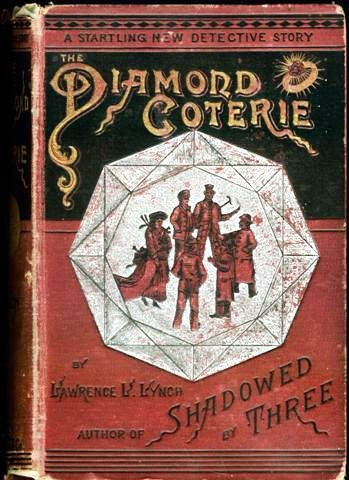
"This gang has operated in such a gingerly, gentlemanly, mysterious manner, and has raided for diamonds so long and so successfully, that they have come to be called, among New York detectives, The Diamond Coterie, although no man knew whether they numbered two, or twenty.
"They could always recognize their handiwork, however, and whenever the news came that some lady in the city, or suburbs, had lost her diamonds, and that the thieves had made a 'clean job' of it, the officers said, 'that's the work of the Diamond Coterie.'
"I have been much abroad of late, but every time I came back to New York the Coterie had gathered fresh jewels into its treasure box, and no man had found a clue to the sly fellows.
"I began to feel interested in the clique and resolved to take a hand at them, at the first opportunity. That opportunity came, with the news of the great Wardour robbery, and I came down to W——.
"I saw enough in this robbery to interest me, for various reasons.
"I believed I could see distinctly the handiwork of the Diamond Coterie, and I saw another thing; it was the first piece of work I had known them to bungle. And they had bungled in this.
"I made some of my conclusions known to Miss Wardour and her friends, but I kept to myself the most important ones.
"The story of the chloroform, so carefully administered, was one of the things over which I pondered much; I borrowed the chloroform bottle and the piece of linen that had been used to apply the drug, and that night I accepted the hospitality proffered me by Sir Clifford. I took a wax impression of the vial, at his house, and I made an important discovery while there.
"Sir Clifford found me half famished and ordered his housekeeper to bring in a lunch. Not wishing my identity known, I pretended to be a patient; and just as my host was leaving the room, he tossed me a handkerchief, which he took from a side table, bidding me make myself a bandage to partially conceal my face.
"Now my eyes are trained to see much at a glance, and the moment they fell upon that bit of white linen they were riveted there.
"The handkerchief was precisely like the mutilated one used with the chloroform. This might be a coincidence—plain white handkerchiefs with wide borders were not uncommon, but this handkerchief was marked!
"I could scarcely wait until Sir Clifford should show me to my room, so anxious was I to compare the two pieces of linen.
"The whole one bore the initials F. L., and on the raw, torn edge of the half square was a black dot that was undoubtedly the fragment of a letter, or name, that had been torn hastily off. It corresponded exactly with the lower end of the letter L. upon the whole handkerchief given me by Sir Clifford.
"This might be a coincidence, but it is one of my rules to suspect two coincidences coming close together; and I had already discovered three remarkable ones in this case.
"Sitting alone in my room, I reflected thus:
"Take it for granted that this robbery was perpetrated by the Diamond Coterie, what are the facts?
"The robbers knew where to enter, and where to look for plunder; ergo, they must have known the premises.
"They administered the deadly chloroform with nicest calculation; ergo, they must have known Miss Wardour.
"One of them was something of a dandy,—witness the superfine bit of cambric, and the print of jaunty boots where he leaped the garden fence.
"The next morning I took unceremonious leave of my host, and set out on my explorations. As I approached Wardour Place I met a man, who immediately drew my interest to himself.
"This man was Jerry Belknap. He wore a disguise quite familiar to me, and I recognized him easily. He entered at the Wardour gate, and I sauntered on, having found new food for thought.
"Now, a word concerning this man Belknap.
"At one time he was an honorable member of the best detective force in the city; but he had too much cupidity, and not enough moral firmness. Twice he allowed himself to be bribed into letting a case fall through, and finally I caught him in secret conclave with a gang of bank burglars, who were conspiring to raise a fortune for each, and escape with their booty through the connivance of our false detective.
"I exploded this little scheme, and compelled Belknap to withdraw from the force. Imagine my surprise when, a little later, Miss Wardour told me that Mr. Belknap was the detective sent down from the city by Mr. Lamotte!
"Well, Mr. Belknap went to work upon the case, and Miss Wardour concealed me near her dining room so that I might have the pleasure of listening to his first report.
"That was a fortunate ambush for me. Mr. Belknap's deductions were as diametrically opposite to mine as if he had purposely studied out the contrast; and I was shaking my sides with the thought of how all this plausibility must be puzzling Miss Wardour and her aunt, when a new element was introduced into the programme.
"Mr. Frank Lamotte, fresh from an amateur robber hunt, came into the room. It had been arranged that Mrs. Aliston should break to this young man the news that his sister had that day eloped with John Burrill; but first, he was to relate his adventures, and this he did.
"If I can hear a voice, before seeing the face, I can usually measure its truth or falsity. Now, I had not seen Mr. Frank Lamotte, but his voice told me that he was rehearsing a well studied part; and, furthermore, I was assured that Belknap knew this, and purposely helped him on.
"By and by Miss Wardour withdrew, and Mrs. Aliston fulfilled her mission. Then I was more than ever convinced of the fellow's insincerity. I heard how he received the news of his sister's flight; and when Mrs. Aliston went, in a panic, to call her niece, I heard him, when he fancied himself alone.
"It seems he had been the bearer of a note from his sister to Miss Wardour, and he was now intent upon learning if that note had contained any thing damaging to himself. This much I learned from his solitary mutterings, and then Miss Wardour re-entered the room. He was half wild, until she had assured him that the note contained nothing that could injure him; and then he became calmer, and went out into the air to recover his breath.
"Miss Wardour made haste to release me, and I came out of my concealment congratulating myself that I had been so lucky.
"And now I found myself compelled to leave W—— just as things were growing very interesting; I had made my flying visit in a moment of leisure, but my vacation had run out; duty, honor and interest, alike impelled me in another direction.
"I left my address with Miss Wardour, and I promised myself that at the first opportunity I would return to W—— and take up my abode here for a time.
"I had been in W—— not quite three days. I had not seen Jasper Lamotte, I had barely seen Frank, and I had added to my deductions made on the night of my arrival, until the case stood like this in my mind:
"1st. The robbers were familiar with Wardour, outside and in.
"2d. They knew Miss Wardour, and her sensitiveness to the effects of chloroform.
"3d. One of them was a man of gentlemanly propensities, and probably young.
"4th. They or a part of their number approached by the river, using a boat with muffled oars.
"So much for my deductions. Now for some coincidences.
"It was a coincidence that the handkerchief I got from Sir Clifford should bear Frank Lamotte's initials, and should be precisely like the one left behind by the robbers.
"It was a coincidence that Frank Lamotte should be a student of medicine, who might have been quite as capable of administering chloroform as was the burglar himself.
"It was a coincidence that Miss Sybil Lamotte should have eloped on the very day when her best friend was robbed, and that father, mother, and brother were all absent in behalf of the robbed friend, thus leaving the way open to the fugitives, and giving them plenty of time to escape.
"Now for some facts that looked strange.
"It was strange that Sybil Lamotte should leave her home to marry a man like John Burrill, when she was known to have bestowed her heart elsewhere.
"It was strange that Jasper Lamotte, going to the city to employ a detective, should so soon have stumbled upon Jerry Belknap, who was identified with no agency, and could only be reached through private means.
"It was strange that Frank Lamotte should set himself up as an amateur detective, and should bring back a report that tallied so perfectly with the deductions of Jerry Belknap.
"It was strange that Miss Wardour, having just been robbed of jewels to the amount of fifty thousand dollars, should be so little distressed, so little agitated by her loss.
"From deductions, coincidences and strange facts, I evolved the following theory, which certainly looked well from my standpoint, but might not hold water. You will see, that from the first I connected the Wardour robbery and the Lamotte elopement.
"Now, Sybil Lamotte's strange flight gave proof that there was a skeleton in the Lamotte closet. I said:
"If this unseen Mr. Lamotte had planned this robbery, and if for some reason it seemed good that his daughter should elope, how well all was arranged.
"His son assisting him, they could drop down from Mapleton in their row boat; come up from the river, and, with their plans all laid, and knowing their ground, could make quick headway. Frank Lamotte's boot heel would leave just such a print, as one of the robbers left in the loose dirt beside the garden fence. Frank Lamotte would know just how to administer the chloroform. Then, Mr. Lamotte, in going to the city, ostensibly to procure the services of a detective, could easily take the spoils along; and his wife also, that she might be well out of his daughter's way. Such a man would naturally select a fellow like Jerry Belknap, who would keep up a farce of investigation, and keep away all who might, perhaps, stumble upon the truth. Frank's eagerness to be absent on this day of his sister's flight, and to assist in the search for the robbers, would be thus explained; and his anxiety concerning the contents of his sister's letter might be easily traced to a guilty conscience.
"But my theories were doomed to be laid aside for a time. Other duties claimed me and it was four weeks before I could turn so much as a thought toward W——.
"Before leaving the city, however, I had placed my wax cast of the chloroform bottle in the hands of one of my best men, and had also given him a clue upon which to work.
"My agent was wonderfully successful. He found the counterparts to the chloroform bottle, and then he began shadowing the owner of said vials. It proved to be a young woman who had formerly lived in W——, as a factory hand, but who had been transplanted to the city by Frank Lamotte.
"It is not necessary to enlarge upon the story of this girl as connected with Lamotte; but this must be borne in mind. During the time that my agent had this girl under surveillance, Frank Lamotte visited her, and, it is supposed that he removed the remaining bottles of the set, for one was afterward exhumed, in fragments, from Doctor Heath's ash heap, by the industrious Jerry Belknap, and the others have disappeared."
At the mention of this factory girl Mrs. Aliston turned her face toward Constance, its expression saying as plainly as any language could, "I told you so." But Mr. Bathurst took no notice of this, and hurried on with his story.
CHAPTER XLVI.
THE STORY OF LUCKY JIM.
"From the moment when I appeared among you as Brooks, my work was double. I was bent upon posting myself thoroughly in regard to Jasper Lamotte, and day by day I became more interested in the career of this remarkable man.
"Step by step, I trod backward the path of his history, since his advent in W——, gathering my information from many sources.
"It would be tedious to enter into details; suffice it to say that while I worked here, two others, trained to such research, were beating up the past I was so anxious to become familiar with. And a third, across the water, was gathering up the history of John Burrill, another object of interest to me at that time.
"And now I will reverse the order in which we made our search, and, beginning where my men left off, give you, in brief, the history of a remarkable man.
"The man we know as Jasper Lamotte figured in various cities, twenty-five years ago, and still earlier, as Lucky Jim, a handsome, well educated, sharp witted, confidence man.
"He seldom gambled, and made his swindling operations of various sorts reap him a rich harvest; and, by his unvarying good luck, in escaping the dragons of the law, as well as because of his lucky ventures, he became known to his intimates as Lucky Jim.
"In these days, Miss Sybil Schuyler, the daughter of a wealthy old Maryland aristocrat, came to the city to reside with an aunt, while she completed her musical education. Lucky Jim saw her, and fell in love with her beautiful, haughty face.
"He contrived to make her acquaintance, and the rest was easy; it was a repetition of the old story; he was handsome and fascinating, she young and unsophisticated, with plenty of headstrong Southern blood and self will.
"After a brief courtship, Lucky Jim married the Maryland heiress. Her father, as may be supposed, repudiated the marriage, but she clung to her scamp, and so the old Maryland aristocrat sent her a small fortune, which was hers, inherited from her mother's mother, and beyond his control; and bade her consider herself no more a Schuyler, of the Schuylers.
"For a time, Lucky Jim rode smoothly on the top wave of prosperity; his wife easily duped, believed him a Wall street operator. Frank was born, and then Sybil, and the Maryland beauty queened it in an elegant and secluded little home.
"But the crisis came. The silver cloud turned its dark side.
"Lucky Jim played a losing game, one day, and his wife suddenly found herself face to face with the truth.
"They lived through stormy times, but Jim had, in his palmy days, left his wife's fortune intact, and now it proved an anchor to windward.
"They absented themselves from this country for more than two years; then they came back, and Lucky Jim brought his family, which now included Evan, to W——. The Maryland fortune enabled them to set up as aristocrats, and Lucky Jim seems to have aspired to become a power in the community.
"I don't think he often attempted any of his old confidence and swindling games; but, during his absences from home, which were frequent, during his earlier residence here, he made a study of fine burglary.
"I can fancy how carefully he put his new schemes in practice, and how he passed himself off upon W—— as a rising speculator.
"He probably spent years in gathering together that select society, known as the Diamond Coterie.
"At first, it consisted of four; himself, a city pawn-broker, known as Ezras, who received and negotiated the sale of the stolen goods, and who is as keen a rascal as ever escaped justice, and two noted cracksmen, who had headquarters in the city, and were famous in their day, but who were compelled to withdraw in the midst of their high career, one dying of a malignant fever, the other being killed by a woman.
"To replace these departed worthies, Ezras, who was always on the alert for pals, and who had had various crooked dealings with Jerry Belknap, brought this gentleman and Mr. Lamotte, or Lucky Jim together.
"Belknap proved the right man in the right place, and was soon admitted into the Coterie. Next to come under the favorable notice of Ezras, was John Burrill, who had come over from England, bringing with him some ill-gotten gains, and who set himself up in New York as a swell cracksman.
"Now, Burrill, the English boor, had an ambition. In this easy-going America, he hoped in some way to build himself into an aristocrat, and to shine as one of the lords of the land. To this end he hoarded his share of all the spoils, and, adding it to the sum brought from England, he began to find himself a rich man.
"Meantime, Mr. Lamotte had speculated a little too freely; he had built a mansion, and built his factories. He had been living like a prince, and some of his late ventures had failed. Something must be done. And then his eye fell upon Burrill; he coveted the Englishman's hoarded dollars.
"He found it easy to persuade Burrill to come to W——, ostensibly to take the position of overseer at the factories; really to be more readily duped by Lucky Jim. Burrill came; he saw how his comrade was respected and bowed down to by all W——. He had always admired Lucky Jim for his gentlemanly polish and his aristocratic manners; and he now concocted a scheme for his own aggrandisement. The Lamottes had made themselves aristocrats, they should make an aristocrat of him.
"You all know the result; John Burrill divorced his wife; Jasper Lamotte sold his daughter.
"While Frank Lamotte felt tolerably sanguine of winning the heiress of Wardour, the Wardour jewels were left unmolested. But when a rival came into the field, they determined to have the jewels, even if they lost the heiress.
"Accordingly they planned the robbery and the elopement, and you all know the afterpart.
"Miss Wardour, you once offered a reward for the arrest of the robbers who invaded Wardour Place, not to recover your diamonds, but for the sake of justice. It is for the sake of justice and for the future safety of peaceable citizens that I have run the Diamond Coterie to earth. For, be it known to you, ladies and gentlemen, that Miss Constance Wardour, like the wise young lady she is, took her jewels to an expert, one fine day, long ago, and had them all duplicated in paste; and while Jasper Lamotte and his clique were industriously carrying into safe hiding these paste diamonds, the real Wardour jewels were reposing safely in the vaults of a city bank, and they repose there safely still!
"When Jasper Lamotte went to the city, two days before the killing of Burrill, he went to dispose of some of those paste jewels; and, not until then, did he learn how the heiress of Wardour had outwitted him.
"Miss Wardour, the career of the Diamond Coterie is at an end.
"Old Ezras has long been under our eye. Last night I sent a telegram, which will cause his instant arrest; and there are enough charges against him to insure him a life sentence, had he yet seventy years to live.
"John Burrill has passed beyond our reach. The news of his murder frustrated my nicely laid plans for his arrest, and turned my mind for some time from the Diamond Coterie to the task of clearing Sir Clifford.
"Frank Lamotte, too, with all his sin and selfishness, has passed before a higher tribunal.
"There remains only Jerry Belknap and Jasper Lamotte.
"To Jerry Belknap, I have promised protection—not because he deserves the same, but because in no other way could I avail myself of his services; and, to make my chain of evidence complete, I needed his testimony. He will go out to the frontier, and never appear again in New York.
"And now, perhaps, you can comprehend why I brought that charge of perjury against Jasper Lamotte. For his wife's sake, for his unhappy daughter's sake, for the sake of Evan Lamotte, who implored me, while going to give himself up to save another, that I would not let further disgrace bow his mother's head to the dust. For the sake of these unfortunate victims, I would let Jasper Lamotte go free, so far as we are concerned. The charge of perjury is enough for W——. The officers have chosen not to place him in confinement, so, if Jasper Lamotte is suddenly missed from among us, who can be questioned or blamed?
"I have acted in this matter solely on my own responsibility.
"I have seen Jasper Lamotte, and I gave him two alternatives to choose from. He could remain and be arrested as the head and front of the Diamond Coterie, or he could take passage on board the first ship bound for Australia, to remain there the rest of his natural life. He chose the latter, and I have appointed my agent, 'Smith, the book peddler,' as his guardian, to see that he carries out his contract to the letter.
"And now there is one thing more:
"After Burrill's death, Jasper and Frank Lamotte made a search for certain papers supposed to have been upon the person of the dead man; they never found them, for the reason that I, as Brooks, had relieved Burrill of the care of these same papers, weeks before, substituting for them blanks, which no doubt, Burrill had hidden somewhere, in one of his fits of drunken caution.
"These papers define distinctly such portions of the Lamotte property as in reality belonged to Burrill; and if I am not mistaken in Mrs. Lamotte and her daughter, they will wish no share in it. I will put these papers into your hands, Mr. O'Meara, to be held for future action."
CHAPTER XLVII.
AFTER THE DRAMA ENDED.
"Clifford," says the heiress of Wardour, standing beside her lover, one winter day, not long after the extinction of the Diamond Coterie, "Clifford I have been to Mapleton to-day, for the first time since—"
She pauses abruptly, and her lover draws her closer to his side, with all his olden assurance shining in the eyes he bends down upon her.
"Since the drama ended," he finishes. "You have been to Mapleton, beloved! tell me about it."
"There's something I wish to tell you, Clifford; something that in full, Mr. Bathurst generously kept out of his story when he told us the rest; something that is known as it is only to Mrs. Lamotte, Sybil, Evan, Mr. Belknap, Mr. Bathurst, and myself, but which I think I had better tell you now."
"I am listening Conny."
"Well, you see when the robbers made off with my paste diamonds—think of its being the Lamottes, Clifford—when they robbed me of nothing, I felt quite relieved, for those diamonds had been a burden. I made up my mind to make the most of the business, and let everybody think me a loser, hoping thus to possess myself and my diamonds in peace and safety. But your Mr. Bathurst—"
"My Mr. Bathurst!"
"Well, my Mr. Bathurst, then; only you very well know that he has a wife. When my Mr. Bathurst had talked to me a second time—I believe that man can see straight through people—he had my secret at his tongue's end; and he warned me to be very cautious and not to tell any one the truth concerning the diamonds. In spite of this, one evening, when some imp possessed me, I told Sybil Lamotte; I shall never forget her strange manner, nor her wild words. Clifford, that awful mistake of mine almost made Sybil a murderess."
"Constance!"
"Listen, dear! Sybil had brooded over what I had told her. Trouble was unsettling her mind. She had some valuable jewels; she went with her mother to the city, and while there, had the real stones replaced by paste, as I had done, and received two thousand dollars for her diamonds.
"In some way she had found out that Jerry Belknap was a man to be bought; she obtained an interview with him, and offered him two thousand dollars if he would get John Burrill out of her way!"
"Good heavens!"
"Don't interrupt me. Belknap agreed to remove Burrill, and received five hundred dollars in advance. He sent to the city for a ruffian, one of his tools. The man came, but Mr. Bathurst had his eye upon him. On the night of the murder, this ruffian was hidden outside of the saloon, waiting to follow and waylay John Burrill when he should go home. The boy detective, George, was hidden and watching the ruffian. Do you follow?"
"Yes! yes!"
"When Burrill came out of the saloon, the ruffian, supposing of course that he was going home, hurried on ahead, crossed the bridge, and secreted himself in the hedge. The boy, George, was far enough behind to see that Burrill was not going home, but he was acting as directed by Mr. Bathurst, and so followed the ruffian. Think of it, Clifford! While Sybil's paid assassin lay in wait for his victim, Sybil's brother was saving her soul from guilt, by taking a crime upon his own. But for Evan's knife, poor half crazed Sybil would have been a murderess, and this I knew in part from the first, and that is why I said, that the true slayer must not be punished; until they brought Evan Lamotte into court, I believed that Sybil was the guilty one."
"And you could not betray your unfortunate friend? My true hearted Constance!"
"I had promised Mrs. Lamotte not to betray her, but was nerving myself to dare all and save you, when poor Evan threw himself into the breach, and saved us, all three. You must know, Clifford, that Mr. Belknap made a full confession to Mr. Bathurst, when he found he could do no better. And Mr. Bathurst, knowing that I was aware of Sybil's dealings with Belknap, told me everything."
"And this is what Bathurst meant when he said that Sybil believed herself guilty. I thought he referred to some of her insane ravings."
"So they all thought. But it is best as it is. There is no need to tell this sad story, unless—"
"Unless what?"
"Unless it seems best that Ray Vandyck should know it."
"Poor Ray. Conny, if the time ever comes when Ray and Sybil meet again, she will tell him her own story."
Constance bent over the glowing coals a moment, and then lifting her face, she said in a hushed voice:
"I saw Evan."
"And he—"
"He is just fading out of life. Oh! it was so fortunate that there was no resistance to the humane ones who sought to help him out of that gloomy prison. Sybil never leaves him for a moment. Oh, what must her feelings have been, when she learned that Evan had saved her from a life time of remorse. I could see by her face, oh, such a poor, pale, sad, utterly changed face! that she knew all; everything. She greeted me; so timidly, yet, with so much of thankfulness. But, she had eyes and ears for no one but Evan, although she is too weak to do more than sit beside him and hold his hand. But, Mrs. Lamotte's courage is wonderful. Old Mr. Schuyler, Sybil's grandfather, is dead; and he has left Mrs. Lamotte his property; but, so tied up that Mr. Lamotte could never touch a dollar. Mrs. Lamotte says that when it is over—Evan's life you know—she shall take Sybil and go to live in her old Maryland home. They will not touch a penny of John Burrill's money; it is all to be transferred to his first wife, to be held in trust for her little boy. The woman is going back to England as soon as the transfer is made. Mrs. Lamotte said to me to-day:
"'After all these years, Constance, I am to have an old age of peace, I trust. Mr. Lamotte and I have parted forever. My love for him died long since, so this gives me no pain. My keenest sorrow is that I never gave my poor Evan his full share of my mother love. He came with my sorrow, and bears the impress of my despair and madness. If we could only save and keep him! But it is best as it is. Mind and body seem dying together, and it is better so. When all is over, I shall take Sybil away, where there will be nothing to recall her wretched past; and there I shall trust her to Time, the Healer.'
"She never mentioned Frank's name, Clifford," bending forward to look in his face. "Do you know what I see in the future? I see poor Evan laid away under the snows; I see the memory of John Burrill sunk in oblivion. I see Sybil Lamotte coming slowly back to life and hope and happiness, under the kind blue Maryland skies. I see Mrs. Lamotte, her pride softened and chastened, and a look of serene content upon her face. And I see Ray Vandyck making his way southward some day, and standing before Sybil with his heart in his eyes. I see—"
"You see enough. Leave Ray and Sybil face to face; you and I can guess the rest. Do you see Doctor Clifford Heathercliffe resuming his practice in W——, as if nothing had happened? For that's what his newly appointed tyrant has bidden him do. Do you see a certain fair lady, transformed into Lady Heathercliffe by and by, and sailing away over the seas to bewilder the dwellers of Heathercliffe Towers, with the brightness of her eyes and, in spite of the Diamond Coterie, to blaze forth upon the 'nobility and gentry' of Hampshire, in all the splendor of the Wardour diamonds? All this shall come to pass, beloved; and, since it has gained me the fairest, bravest, truest wife in Christendom, I can even rejoice in the persecutions and the hatred of the Diamond Coterie.
"If John Burrill had not mistaken me for Herbert, on the night when the feud began, he might now be living, perhaps, and you and I be far apart; so, at the last, Herbert Heathercliffe, in his grave, has done me a service. I do look like him, Conny, and it's small wonder Burrill knew me for a Heathercliffe, and made capital out of my altered name. But all that is past. My darling, we have learned our hard lesson, now we have only to forgive the dead and the erring, to forget the shadows and sorrows of the past, and to say, 'God bless our friends in need; God bless Bathurst, king of his kind; God bless the O'Mearas—God bless the beautiful darling who outwitted the diamond Coterie, and who wears the Wardour diamonds, and the Wardour honor with regal grace.'"