
The Project Gutenberg eBook of The diary of a superfluous man, and other stories
Title: The diary of a superfluous man, and other stories
Author: Ivan Sergeevich Turgenev
Translator: Isabel Florence Hapgood
Release date: October 27, 2012 [eBook #41201]
Most recently updated: October 23, 2024
Language: English
Credits: Produced by Jana Srna, Paul Clark and the Online Distributed
Proofreading Team at http://www.pgdp.net (This file was
produced from images generously made available by The
Internet Archive/American Libraries.)
Transcriber's Note:
Every effort has been made to replicate this text as faithfully as possible. Some changes have been made. They are listed at the end of the text.
IVÁN TURGÉNIEFF
Volume XI
THE DIARY OF A
SUPERFLUOUS MAN
AND OTHER STORIES
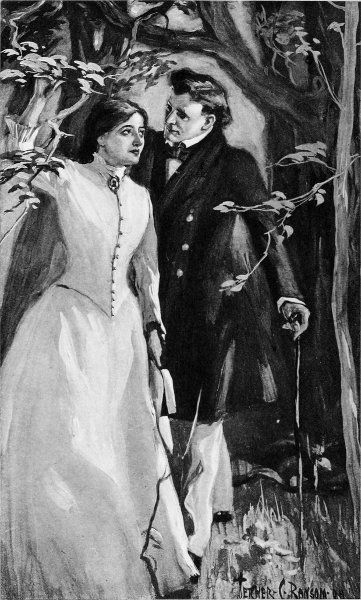
I cried out with rapture, and immediately turned to Liza.
From a drawing by FLETCHER C. RANSOM.
THE NOVELS AND STORIES OF IVÁN TURGÉNIEFF
THE DIARY OF A SUPERFLUOUS MAN AND OTHER STORIES
TRANSLATED FROM THE RUSSIAN BY ISABEL F. HAPGOOD
NEW YORK
CHARLES SCRIBNER'S SONS
1904
Copyright, 1904, by Charles Scribner's Sons
PREFACE
"In 'The Diary of a Superfluous Man,'" says one well-known Russian critic, "we have to deal with the end of the pathological process upon the body of Russian society. In Turgénieff's productions which followed it we have to deal with a crisis in Russian life, with the growth of a new order of things. Apart from the fundamental profundity of its tendency, the 'Diary' is extremely noteworthy for its artistic workmanship. In spite of a certain monotony of tone in its exposition, it produces a very strong impression by its abundance of poetical beauties, which are perfectly suited to the melancholy mood of the whole story... In creating his 'Superfluous Man' the author, evidently, aimed at making as powerful an impression as possible, and therefore employed the most brilliant pigments in depicting Tchulkatúrin. He attained his object. Russian society started back in horror at this portrait of itself, which was somewhat distorted yet a good likeness, and in its strong excitement vigorously repelled all community with the sickly figure of Tchulkatúrin. This horror showed that the time was ripe in Russian society for a different order of things, that it was tired of inertness and was seeking a wider field of activity in which it might freely develop its real forces."
Another critic, comparing the "Diary" with "Hamlet of Shshtchígry County," says that what the latter expressed with a convulsive laugh Tchulkatúrin gave vent to in sickly, complaining shrieks, both productions being a bitter confession of moral impotence, of mental insolvency. "There is one passage in the 'Diary,'" he says, "which—especially if one comes upon it after perusing all that precedes it—it is impossible to read without a strong nervous shock, if not without tears—a passage which always has the same identical effect; and it contains the key to the comprehension of Turgénieff's relations toward Nature. It is the end of the 'Diary.' This passage is noteworthy. The predominant characteristic of Turgénieff's talent is here revealed in a particularly brilliant manner: a profound impregnation with Nature,—an impregnation which reached the point almost of fusion with it. The breath of spring blows upon the reader, there is a scent of the upturned soil,—and nowhere else, possibly save in that chapter of Tolstóy's 'Youth,' which describes the removal of the double windows, and the reader is suddenly enveloped in the keen, fresh air of spring, is there anything which can be compared with this passage."
Still another critic says: "The ironical analysis of the moral feebleness of the Russian intellectual class, which constitutes the ruling motive of 'Hamlet of Shshtchígry County,' is converted into sickly complaint in 'The Diary of a Superfluous Man,' one of the most original and best-sustained of Turgénieff's stories, and one which is most profoundly imbued with feeling.
"Turgénieff's story 'Three Portraits,'" said the most famous of Russian critics, Byelínsky, "possesses, in addition to the cleverness and vividness of its presentation, all the fascination, not of a novel, but rather of a reminiscence of the good old times. A fitting motto for it would be: 'Deeds of days gone by.'"
All the critics admit that the type of Vasíly Lutchínoff had existed, and one says: "I attribute special importance to Turgénieff's Vasíly Lutchínoff because, in this character, the old type of Don Juan, of Lovelace, and so forth, assumed our own Russian, original form for the first time." This type (equally rapacious with that presented by the hero of "The Bully," which was written about the same time) is supposed to have prevailed in the eighteenth century, especially in the epoch of Katherine II. Although Turgénieff never wrote historical novels, this story, in company with passages from others of his works, is regarded as coming, practically, under the head of historical records faithful to the epochs dealt with by the author.
"The story 'Three Meetings,'" says one critic, "belongs entirely in the category of 'art for art's sake.' There can be no question here of any guiding idea. To speak figuratively, it is a fragrant flower, whose perfume one inhales with delight, but which presents no other essential qualities. Its whole point lies in its workmanship, and in paraphrase it loses its entire charm."
"This story," writes another critic, "may serve, in our opinion, as a curious monument of the ineptness of narrations in the first person. Turgénieff, who is such a complete master of the form of personal narration, was bound to exhibit also the weak side of it in its entirety. This has strutted forth in his 'Three Meetings' with such pride, independence, and, in a measure, with so much coquetry, that it has swallowed up its subject-matter. There are several brilliant pages in the story, but its fantastic, showy matter seems to be directed solely to the end of illuminating the person of the narrator in the most advantageous manner."
In discussing "The Memoirs of a Sportsman," a leading critic of the present day says:... "Another peculiarity which immediately won for him [Turgénieff] fame and sympathy among the public, is his entirely new manner of depicting figures from peasant life. Before the advent of Turgénieff the populace, even in the hands of Púshkin, even in those of Gógol, appeared either in the capacity of an operatic chorus, or in the quality of peasants of the ballet, or as an accessory, comic figure. Turgénieff was the first to look into the soul of the common people and demonstrate that that soul was exactly like the soul of the cultivated man, only with its own peculiar turn to conceptions and feelings. By thus bringing the peasant close to us, by exhibiting him in this form, as a being one with us in blood, with whom, therefore, one can sympathise instead of regarding him merely as a rare spectacle, Turgénieff deservedly earned the reputation of a champion of emancipation...... Two other tales are closely allied to 'The Memoirs of a Sportsman,' although they do not form a part of that collection: 'Mumú' and 'The Inn.'... One of them, 'Mumú,' is, perhaps, the most eloquent denunciation of serfdom which ever proceeded from Turgénieff's pen. It is the only one of his productions in which the central figure of the pig-headed[1] landed-proprietress is delineated with vivid and unconcealed hatred. But in this case also, the chief merit of the story does not lie in this arraignment,—in which are probably reflected the author's childish reminiscences,[2]—but in its warm, compassionate sympathy for the lot of the poor dumb man, whose whole life was concentrated in love for a creature equally ill-treated by Fate—for the little dog he had reared. In 'The Inn,' also, serfdom is set forth in an extreme and hateful light. But here again the chief gist of the author's idea does not lie in that direction...... It is evident that here Turgénieff has touched on the theme to which Dostoiévsky was so fond of reverting. That theme is—the accidental sin of a good and honest man, the crime of a pure mind atoned for by voluntary renunciation, and the reconciling power of repentance, humility and prayer. Evil remains unpunished in Turgénieff's story..... And yet the story produces a shattering moral effect, thanks to the humble grandeur of Akím's figure, and its combination of meekness and criminality. Mean as Naúm is in his triumph, repulsive as is landed-proprietress Elizavéta Prókhorovna with her cowardly and hypocritical greed, the story leaves on the reader a soothing impression."
I. F. H.
FOOTNOTES:
[1] The word used is, literally, "self-fool." It was invented by Ostróvsky, in one of his most famous comedies.—Translator.
[2] Some authorities assert positively that the incident narrated occurred in the Turgénieff household, and that Gerásim's mistress was the author's own mother.—Translator.
CONTENTS
| PAGE | |
| THE DIARY OF A SUPERFLUOUS MAN | 1 |
| THREE PORTRAITS | 93 |
| THREE MEETINGS | 147 |
| MUMÚ | 201 |
| THE INN | 255 |
THE DIARY OF A SUPERFLUOUS MAN
(1850)
Hamlet of Ovétchi-Vódy,[3]
March 20, 18 .
The doctor has just left me. At last I have obtained a categorical answer! Dodge as he might, he could not help saying what he thought, at last. Yes, I shall die soon, very soon. The streams are opening, and I shall float away, probably with the last snows .... whither? God knows! To the sea also. Well, all right! If I must die, then 't is better to die in the spring. But is it not ridiculous to begin one's diary perhaps a fortnight before one's death? Where 's the harm? And in what way are fourteen days less than fourteen years, fourteen centuries? In the presence of eternity, they say, everything is of no account—yes; but, in that case, eternity also is of no account. I am falling into speculation, I think: that is a bad sign—am not I beginning to turn coward?—It will be better if I narrate something. It is raw and windy out of doors,—I am forbidden to go out. But what shall I narrate? A well-bred man does not talk about his maladies; composing a novel, or something of that sort, is not in my line; reflections about exalted themes are beyond my powers; descriptions of life round about me do not even interest me; and to do nothing is tiresome; to read—is idleness. Eh! I will narrate to myself the story of my own life. A capital idea! When death is approaching it is proper, and can offend no one. I begin.
I was born thirty years ago, the son of a fairly wealthy landed proprietor. My father was a passionate gambler; my mother was a lady with character .... a very virtuous lady. Only, I have never known a woman whose virtue afforded less satisfaction. She succumbed under the burden of her merits, and tortured everybody, beginning with herself. During the whole fifty years of her life, she never once rested, never folded her hands; she was eternally bustling and fussing about, like an ant—and without any result whatever, which cannot be said of the ant. An implacable worm gnawed her day and night. Only once did I behold her perfectly quiet,—namely, on the first day after her death, in her coffin. As I gazed at her, it really seemed to me that her face expressed mild surprise; the half-open lips, the sunken cheeks, and the gently-motionless eyes seemed to breathe forth the words: "How good it is not to stir!" Yes, 't is good, 't is good to part at last from the fatiguing consciousness of life, from the importunate and uneasy sense of existence! But that is not the point.
I grew up badly, and not cheerfully. Both my father and my mother loved me; but that did not make things any the easier for me. My father had no power whatever in his own house, and no importance, in his quality of a man given over to a shameful and ruinous vice. He admitted his fall, and, without having the strength to renounce his favourite passion, he endeavoured, at least, by his constantly affectionate and discreet mien, by his submissive humility, to win the indulgence of his exemplary wife. My mamma, in fact, bore her misfortune with that magnificent and ostentatious long-suffering of virtue which contains so much of self-satisfied pride. She never reproached my father for anything, she silently surrendered to him her last penny, and paid his debts; he lauded her to her face and behind her back, but was not fond of staying at home, and petted me on the sly, as though he were himself afraid of contaminating me by his presence. But his ruffled features exhaled such kindness at those times, the feverish smirk on his lips was replaced by such a touching smile, his brown eyes, surrounded by fine wrinkles, beamed with so much love, that I involuntarily pressed my cheek to his cheek, moist and warm with tears. I wiped away those tears with my handkerchief, and they flowed again, without effort, like the water in an overfilled glass. I set to crying myself, and he soothed me, patted my back with his hand, kissed me all over my face with his quivering lips. Even now, more than twenty years after his death, when I recall my poor father, dumb sobs rise in my throat, and my heart beats—beats as hotly and bitterly, it languishes with as much sorrowful compassion, as though it still had a long time to beat and as though there were anything to feel compassion about!
My mother, on the contrary, always treated me in one way, affectionately, but coldly. Such mothers, moral and just, are frequently to be met with in children's books. She loved me, but I did not love her. Yes! I shunned my virtuous mother, and passionately loved my vicious father.
But enough for to-day. I have made a beginning, and there is no cause for me to feel anxious about the end, whatever it may be. My malady will attend to that.
March 21.
The weather is wonderful to-day. It is warm and bright; the sun is playing gaily on the slushy snow; everything is glittering, smoking, dripping; the sparrows are screaming like mad creatures around the dark, sweating hedges; the damp air irritates my chest sweetly but frightfully. The spring, the spring is coming! I am sitting by the window, and looking out across the little river to the fields. O Nature! Nature! I love thee so, but I came forth from thy womb unfitted even for life. Yonder is a male sparrow hopping about with outspread wings; he is screaming—and every sound of his voice, every ruffled feather on his tiny body breathes forth health and strength.
What is to be concluded from that? Nothing. He is healthy and has a right to scream and ruffle up his feathers; but I am ill and must die—that is all. It is not worth while to say any more about that. And tearful appeals to nature are comically absurd. Let us return to my story.
I grew up, as I have already said, badly and not cheerfully. I had no brothers or sisters. I was educated at home. And, indeed, what would my mother have had to occupy her if I had been sent off to boarding-school or to a government institute? That 's what children are for—to keep their parents from being bored. We lived chiefly in the country, and sometimes went to Moscow. I had governors and teachers, as is the custom. A cadaverous and tearful German, Riechmann, has remained particularly memorable to me,—a remarkably melancholy being, crippled by fate, who was fruitlessly consumed by an anguished longing for his native land. My man-nurse, Vasíly, nicknamed "The Goose," would sit, unshaved, in his everlasting old coat of blue frieze, beside the stove in the frightfully stifling atmosphere of the close anteroom, impregnated through and through with the sour odour of old kvas,—would sit and play cards with the coachman, Potáp, who had just got a new sheepskin coat, white as snow, and invincible tarred boots,—while Riechmann would be singing on the other side of the partition:
Was bekümmert dich so sehr?
'S ist ja schön im fremden Lande—
Herz, mein Herz, was willst du mehr?"
After my father's death, we definitively removed to Moscow. I was then twelve years of age. My father died during the night of a stroke of apoplexy. I shall never forget that night. I was sleeping soundly, as all children are in the habit of sleeping; but I remember, that even athwart my slumber I thought I heard a heavy, laboured breathing. Suddenly I felt some one seize me by the shoulder and shake me. I open my eyes: in front of me stands my man-nurse.—"What 's the matter?"—"Come along, come along, Alexyéi Mikhaílitch is dying...." I fly out of the bed like a mad creature, and into the bedroom. I look: my father is lying with his head thrown back, all red in the face, and rattling in his throat most painfully. The servants, with frightened faces, throng the doors; in the anteroom some one inquires in a hoarse voice: "Has the doctor been sent for?" In the courtyard, a horse is being led out of the stable, the gate is creaking, a tallow candle is burning in the room on the floor; mamma is there also, overwhelmed, but without losing either her decorum or the consciousness of her own dignity. I flung myself on my father's breast, embraced him, and stammered out: "Papa, papa!"... He lay motionless and puckered up his eyes in a strange sort of way. I looked him in the face—unbearable horror stopped my breath; I squeaked with terror, like a roughly-grasped bird. They dragged me from him and carried me away. Only the night before, as though with a foreboding of his approaching death, he had caressed me so fervently and so sadly.
They brought a dishevelled and sleepy doctor, with a strong smell of lovage vodka. My father died under his lancet, and on the following day, thoroughly stupefied with grief, I stood with a candle in my hand in front of the table on which lay the corpse, and listened unheeding to the thick-voiced intoning of the chanter, occasionally broken by the feeble voice of the priest; tears kept streaming down my cheeks, over my lips, and my collar and my cuffs; I was consumed with tears, I stared fixedly at the motionless face of my father, as though I were expecting him to do something; and my mother, meanwhile, slowly made reverences to the floor, slowly raised herself and, as she crossed herself, pressed her fingers strongly to her brow, her shoulders, and her body. There was not a single thought in my head; I had grown heavy all over, but I felt that something dreadful was taking place with me..... It was then that Death looked into my face, and made a note of me.
We removed our residence to Moscow, after the death of my father, for a very simple reason: all our estate was sold under the hammer for debt,—positively everything, with the exception of one wretched little hamlet, the very one in which I am now finishing my magnificent existence. I confess that, in spite of the fact that I was young at the time, I grieved over the sale of our nest; that is to say, in reality, I grieved over our park only. With that park are bound up my sole bright memories. There, on one tranquil spring evening, I buried my best friend, an old dog with a bob tail and crooked paws—Trixie; there, hiding myself in the tall grass, I used to eat stolen apples, red, sweet Nóvgorod apples; there, in conclusion, I for the first time beheld through the bushes of ripe raspberries, Klaudia the maid, who, despite her snub nose, and her habit of laughing in her kerchief, aroused in me such a tender passion that in her presence I hardly breathed, felt like swooning, and was stricken dumb. But one day, on the Bright Sunday,[4] when her turn came to kiss my lordly hand, I all but flung myself down and kissed her patched goatskin shoes. Great heavens! Can it be twenty years since all that happened? It does not seem so very long since I used to ride my shaggy, chestnut horse along the old wattled hedge of our park, and, rising in my stirrups, pluck the double-faced leaves of the poplars. While a man is living he is not conscious of his own life; like a sound, it becomes intelligible to him a little while afterward.
Oh, my park! Oh, my overgrown paths along the little pond! Oh, unhappy little spot beneath the decrepit dam, where I used to catch minnows and gudgeons! And you, ye lofty birch-trees, with long, pendulous branches, from behind which, from the country road, the melancholy song of the peasant used to be wafted, unevenly broken by the jolts of the rough cart—I send you my last farewells!... As I part with life I stretch out my hands to you alone. I should like once more to inhale the bitter freshness of the wormwood, the sweet scent of the reaped buckwheat in the fields of my natal spot; I should like once more to hear from afar the modest jangling of the cracked bell on our parish church; once more to lie in the cool shadow beneath the oak-bush on the slope of the familiar ravine; once more to follow with my eyes the moving trace of the wind, as it flew like a dark streak over the golden grass of our meadow....
Ekh, to what end is all this? But I cannot go on to-day. Until to-morrow.
March 22.
To-day it is cold and overcast again. Such weather is far more suitable. It is in accord with my work. Yesterday quite unseasonably evoked in me a multitude of unnecessary feelings and memories. That will not be repeated. Emotional effusions are like liquorice-root: when you take your first suck at it, it does n't seem bad, but it leaves a very bad taste in your mouth afterward. I will simply and quietly narrate the story of my life.
So then, we went to live in Moscow....
But it just occurs to me: is it really worth while to tell the story of my life?
No, decidedly it is not worth while.... My life is in no way different from the lives of a mass of other people. The parental home, the university, service in inferior positions, retirement, a small circle of acquaintances, downright poverty, modest pleasures, humble occupations, moderate desires—tell me, for mercy's sake, who does not know all that? And I, in particular, shall not tell the story of my life, because I am writing for my own pleasure; and if my past presents even to me nothing very cheerful, nor even very sorrowful, that means that there really can be nothing in it worthy of attention. I had better try to analyse my own character to myself.
What sort of a man am I?... Some one may remark to me that no one asks about that.—Agreed. But, you see, I am dying,—God is my witness, I am dying,—and really before death the desire to know what sort of a fellow I have been is pardonable, I think.
After having thoroughly pondered this important question, and having, moreover, no need to express myself bitterly on my own score, as do people who are strongly convinced of their merits, I must confess one thing: I have been an utterly superfluous man in this world, or, if you like to put it that way, an utterly useless bird. And I intend to prove that to-morrow, because to-day I am coughing like an aged sheep, and my nurse, Teréntievna, will give me no peace. "Lie down, dear little father mine," she says, "and drink your tea."... I know why she worries me: she wants some tea herself! Well! All right! Why not permit the poor old woman to extract, at the finish, all possible profit from her master?... The time for that has not yet gone by.
March 23.
Winter again. The snow is falling in large flakes.
Superfluous, superfluous.... That 's a capital word I have devised. The more deeply I penetrate into myself, the more attentively I scrutinise the whole of my own past life, the more convinced do I become of the strict justice of that expression. Superfluous—precisely that. That word is not appropriate to other people.... People are bad, good, clever, stupid, agreeable, and disagreeable; but superfluous.... no. That is to say, understand me: the universe could dispense with these people also .... of course; but uselessness is not their chief quality, is not their distinguishing characteristic, and when you are speaking of them, the word "superfluous" is not the first one that comes to your tongue. But I .... of me nothing else could possibly be said: superfluous—that is all. Nature had not, evidently, calculated on my appearance, and in consequence of this, she treated me like an unexpected and unbidden guest. Not without cause did one wag, a great lover of Swedish whist, say of me, that my mother had discarded.[5] I speak of myself now calmly, without any gall..... 'T is a thing of the past! During the whole course of my life I have constantly found my place occupied, possibly because I sought my place in the wrong direction. I was suspicious, bashful, irritable, like all invalids; moreover, probably owing to superfluous vanity,—or by reason of the deficient organisation of my person,—between my feelings and my thoughts and the expression of those feelings and thoughts there existed some senseless, incomprehensible and insuperable barrier; and when I made up my mind to overcome that impediment by force, to break down that barrier, my movements, the expression of my face, my entire being assumed the aspect of anguished tension: I not only seemed, but I actually became unnatural and affected. I was conscious of it myself and made haste to retire again into myself. Then a frightful tumult arose within me. I analysed myself to the last shred; I compared myself with other people; I recalled the smallest glances, the smiles, the words of the people before whom I would have liked to expand; I interpreted everything from its bad side, and laughed maliciously over my pretensions "to be like the rest of the world,"—and suddenly, in the midst of my laughter, I sadly relaxed utterly, fell into foolish dejection, and then began the same thing all over again; in a word, I ran round like a squirrel in a wheel. Whole days passed in this torturing, fruitless toil. Come now, tell me, pray, to whom and for what is such a man of use? Why did this happen with me, what was the cause of this minute fidgeting over myself—who knows? Who can say?
I remember, one day I was driving out of Moscow in the diligence. The road was good, but the postilion had hitched an extra trace-horse to the four-span. This unhappy, fifth, wholly unnecessary horse, fastened in rough fashion to the fore-end of a thick, short rope, which ruthlessly saws its haunches, rubs its tail, makes it run in the most unnatural manner, and imparts to its whole body the shape of a comma, always arouses my profound compassion. I remarked to the postilion that, apparently, the fifth horse might be dispensed with on that occasion..... He remained silent awhile, shook the back of his neck, lashed the horse half a score of times in succession with his whip across its gaunt back and under its puffed-out belly—and said, not without a grin: "Well, you see, it has stuck itself on, that 's a fact! What the devil 's the use?"
And I, also, have stuck myself on... But the station is not far off, I think.
Superfluous.... I promised to prove the justice of my opinion, and I will fulfil my promise. I do not consider it necessary to mention a thousand details, daily occurrences and incidents, which, moreover, in the eyes of every thoughtful man might serve as incontrovertible proofs in my favour—that is to say, in favour of my view; it is better for me to begin directly with one decidedly important event, after which, probably, no doubt will remain as to the accuracy of the word superfluous. I repeat: I have no intention of entering into details, but I cannot pass over in silence one decidedly curious and noteworthy circumstance,—namely, the strange manner in which my friends treated me (I also had friends) every time I chanced to meet them, or even dropped in to see them. They seemed to grow uneasy; as they came to meet me they either smiled in a not entirely natural manner, looked not at my eyes, not at my feet, as some people do, but chiefly at my cheeks, hastily ejaculated: "Ah! how do you do, Tchulkatúrin!" (Fate had favoured me with that name[6]) or, "Ah! so here 's Tchulkatúrin!" immediately stepped aside, went apart, and even remained for some time thereafter motionless, as though they were trying to recall something. I noticed all this, because I am not deficient in penetration and the gift of observation; on the whole, I am not stupid; decidedly amusing thoughts sometimes come into my head even, not at all ordinary thoughts; but, as I am a superfluous man with a dumbness inside me, I dread to express my thought, the more so, as I know beforehand that I shall express it very badly. It even seems strange to me, sometimes, that people can talk, and so simply, so freely.... "What a calamity!!" you think. I am bound to say that my tongue pretty often itched, in spite of my dumbness; and I actually did utter words in my youth, but in riper years I succeeded in restraining myself almost every time. I would say to myself in an undertone: "See here, now, 't will be better for me to hold my tongue awhile," and I quieted down. We are all experts at holding our tongues; our women in particular have that capacity: one exalted young Russian lady maintains silence so vigorously that such a spectacle is capable of producing a slight shiver and cold perspiration even in a man who has been forewarned. But that is not the point, and it is not for me to criticise other people. I will proceed to the promised story.
Several years ago, thanks to a concurrence of trivial but, for me, very important circumstances, I chanced to pass six months in the county town of O***. This town is built entirely on a declivity. It has about eight hundred inhabitants, remarkably poor; the wretched little houses are outrageously bad; in the main street, under the guise of a pavement, formidable slabs of unhewn limestone crop out whitely here and there, in consequence of which, even the peasant-carts drive around it; in the very centre of an astonishingly untidy square rises a tiny yellowish structure with dark holes, and in the holes sit men in large caps with visors, and pretend to be engaged in trade; there, also, rears itself aloft a remarkably tall, striped pole, and beside the pole, by way of order, at the command of the authorities, a load of yellow hay is kept, and one governmental hen stalks about. In a word, in the town of O*** existence is excellent.
During the early days of my sojourn in that town I nearly went out of my mind with ennui. I must say of myself that, although I am a superfluous man, of course, yet it is not of my own will; I am sickly myself, but I cannot endure anything sickly.... I would have no objections to happiness, I have even tried to approach it from the right and from the left.... And, therefore, it is not surprising that I can also feel bored, like any other mortal. I found myself in the town of O*** on business connected with the Government service....
Teréntievna is absolutely determined to kill me. Here is a specimen of our conversation:
Teréntievna. O-okh, dear little father! why do you keep writing? It is n't healthy for you to write.
I. But I 'm bored, Teréntievna.
She. But do drink some tea and lie down.
I. But I don't feel sleepy.
She. Akh, dear little father! Why do you say that? The Lord be with you! Lie down now, lie down: it 's better for you.
I. I shall die anyway, Teréntievna.
She. The Lord forbid and have mercy!... Well, now, do you order me to make tea?
I. I shall not survive this week, Teréntievna.
She. Ii-i, dear little father! Why do you say that?... So I 'll go and prepare the samovár.
Oh, decrepit, yellow, toothless creature! Is it possible that to you I am not a man!
March 24. A hard frost.
On the very day of my arrival in the town of O***, the above-mentioned governmental business caused me to call on a certain Ozhógin, Kiríll Matvyéevitch, one of the chief officials of the county; but I made acquaintance with him, or, as the saying is, got intimate with him, two weeks later. His house was situated on the principal street, and was distinguished from all the rest by its size, its painted roof, and two lions on the gate, belonging to that race of lions which bear a remarkable likeness to the unsuccessful dogs whose birthplace is Moscow. It is possible to deduce from these lions alone that Ozhógin was an opulent man. And, in fact, he owned four hundred souls of serfs;[7] he received at his house the best society of the town of O***, and bore the reputation of being a hospitable man. The chief of police came to him, in a broad carroty-hued drozhky drawn by a pair of horses—a remarkably large man, who seemed to have been carved out of shop-worn material. Other officials visited him also: the pettifogger, a yellowish and rather malicious creature; the waggish surveyor, of German extraction, with a Tatár face; the officer of Ways of Communication, a tender soul, a singer, but a scandal-monger; a former county Marshal of Nobility, a gentleman with dyed hair, and rumpled cuffs, trousers with straps, and that extremely noble expression of countenance which is so characteristic of people who have been under trial by the courts. He was visited also by two landed proprietors, inseparable friends, both no longer young, and even threadbare with age, the younger of whom was constantly squelching the elder, and shutting his mouth with one and the same reproach: "Come, that will do, Sergyéi Sergyéitch! What do you know about it? For you write the word próbka [cork] with the letter b.... Yes, gentlemen,"—he was wont to continue, with all the heat of conviction, addressing those present:—"Sergyéi Sergyéitch writes not próbka, but bróbka." And all present laughed, although, probably, not one of them was particularly distinguished for his skill in orthography; and the unhappy Sergyéi Sergyéitch held his peace, and bowed his head with a pacific smile. But I am forgetting that my days are numbered, and am entering into too great detail. So then, without further circumlocution: Ozhógin was married and had a daughter, Elizavéta Kiríllovna, and I fell in love with that daughter.
Ozhógin himself was a commonplace man, neither good nor bad; his wife was beginning to look a good deal like an aged hen; but their daughter did not take after her parents. She was very comely, of vivacious and gentle disposition. Her bright grey eyes gazed good-naturedly, and in a straightforward manner from beneath childishly-arched brows; she smiled almost constantly, and laughed also quite frequently. Her fresh voice had a very pleasant ring; she moved easily, swiftly, and blushed gaily. She did not dress very elegantly; extremely simple gowns suited her best.
As a rule, I have never made acquaintance quickly, and if I have felt at ease with a person on first meeting,—which, however, has almost never been the case,—I confess that that has spoken strongly in favour of the new acquaintance. I have not known how to behave to women at all, and in their presence I either frowned and assumed a fierce expression, or displayed my teeth in a grin in the stupidest way, and twisted my tongue about in my mouth with embarrassment. With Elizavéta Kiríllovna, on the contrary, I felt myself at home from the very first moment. This is how it came about. One day I arrive at Ozhógin's before dinner, and ask: "Is he at home?" I am told: "Yes, and he is dressing; please come into the hall."[8] I go into the hall; I see a young girl in a white gown standing by the window, with her back toward me, and holding a cage in her hands. I curl up a little, according to my habit; but, nevertheless, I cough out of propriety. The young girl turns round quickly, so quickly that her curls strike her in the face, catches sight of me, bows, and with a smile shows me a little box, half-filled with seed.
"Will you excuse me?"
Of course, as is customary in such circumstances, I first bent my head, and, at the same time, crooked and straightened my knees (as though some one had hit me from behind in the back of my legs, which, as everybody knows, serves as a token of excellent breeding and agreeable ease of manner), and then smiled, raised my hand, and waved it twice cautiously and gently in the air. The girl immediately turned away from me, took from the cage a small board, and began to scrape it violently with a knife, and suddenly, without changing her attitude, gave utterance to the following words:
"This is papa's bull-finch.... Do you like bull-finches?"
"I prefer canary-birds,"—I replied, not without a certain effort.
"And I am fond of canary-birds also; but just look at him, see how pretty he is. See, he is not afraid."—What surprised me was that I was not afraid.—"Come closer. His name is Pópka."
I went up, and bent over.
"He 's very charming, is n't he?"
She turned her face toward me; but we were standing so close to each other that she was obliged to throw her head back a little, in order to look at me with her bright eyes. I gazed at her: the whole of her rosy young face was smiling in so friendly a manner that I smiled also, and almost laughed aloud with pleasure. The door opened; Mr. Ozhógin entered. I immediately went to him, and began to talk with him in a very unembarrassed way; I do not know myself how I came to stay to dinner; I sat out the whole evening, and on the following day, Ozhógin's lackey, a long, purblind fellow, was already smiling at me, as a friend of the house, as he pulled off my overcoat.
To find a refuge, to weave for myself even a temporary nest, to know the joy of daily relations and habits,—that was a happiness which I, a superfluous man, without domestic memories, had not experienced up to that time. If there were anything about me suggestive of a flower, and if that comparison were not so threadbare, I would decide to say that, from that hour, I began to blossom out in spirit. Everything in me and round about me underwent such an instantaneous change! My whole life was illuminated by love,—literally my whole life, down to the smallest details,—like a dark, deserted chamber into which a candle has been brought. I lay down to sleep and I rose up, dressed myself, breakfasted, and smoked my pipe in a way different from my habit; I even skipped as I walked,—really I did, as though wings had suddenly sprouted on my shoulders. I remember that I was not in doubt even for a minute, as to the feeling with which Elizavéta Kiríllovna had inspired me; and from the very first day, I fell in love with her passionately, and from the very first day, too, I knew that I was in love. I saw her every day for the space of three weeks. Those three weeks were the happiest time of my life; but the remembrance of them is painful to me. I cannot think of them alone: that which followed them involuntarily rises up before me, and venomous grief slowly grips the heart which had just grown soft.
When a man is feeling very well, his brain, as every one knows, acts very little. A calm and joyous feeling, a feeling of satisfaction, permeates his whole being; he is swallowed up in it; the consciousness of individuality vanishes in him—he is in a state of bliss, as badly educated poets say. But when, at last, that "spell" passes off, a man sometimes feels vexed and regretful that, in the midst of happiness, he was so unobservant of himself that he did not redouble his thoughts, his reflections, and his memories, that he did not prolong his enjoyment .... as though a "blissful" man had any time, and as though it were worth while to reflect about his own emotions! The happy man is like a fly in the sunshine. That is why, when I recall those three weeks, I find it almost impossible to retain in my mind an accurate, definite impression, the more so, as in the whole course of that time, nothing of particular note took place between us..... Those twenty days present themselves to me as something warm, young, and fragrant, as a sort of bright streak in my dim and grey-hued life. My memory suddenly becomes implacably faithful and clear, only dating from the moment when the blows of Fate descended upon me, speaking again in the words of those same ill-bred writers.
Yes, those three weeks.... However, they did not precisely leave no images behind in me. Sometimes, when I happen to think long of that time, certain memories suddenly float forth from the gloom of the past—as the stars unexpectedly start forth in the evening sky to meet attentively-riveted eyes. Especially memorable to me is one stroll in a grove outside the town. There were four of us: old Madame Ozhógin, Liza, I, and a certain Bizmyónkoff, a petty official of the town of O***, a fair-haired, good-natured, and meek young man. I shall have occasion to allude to him again. Mr. Ozhógin remained at home: his head ached, in consequence of his having slept too long. The day was splendid, warm, and calm. I must remark that gardens of entertainment and public amusement are not to the taste of the Russian. In governmental towns, in the so-called Public Gardens, you will never encounter a living soul at any season of the year; possibly some old woman will seat herself, grunting, on a green bench baked through and through by the sun, in the neighbourhood of a sickly tree, and that only when there is no dirty little shop close to the gate. But if there is a sparse little birch-grove in the vicinity of the town, the merchants, and sometimes the officials, will gladly go thither on Sundays and feast-days, with their samovár, patties, water-melons, and set out all those good gifts on the dusty grass, right by the side of the road, seat themselves around, and eat and drink tea in the sweat of their brows until the very evening. Precisely that sort of small grove existed then two versts distant from the town of O***. We went thither after dinner, drank tea in due form, and then all four of us set off for a stroll through the grove. Bizmyónkoff gave his arm to old Madame Ozhógin; I gave mine to Liza. The day was already inclining toward evening. I was then in the very ardour of first love (not more than a fortnight had elapsed since we had become acquainted), in that condition of passionate and attentive adoration, when your whole soul innocently and involuntarily follows every motion of the beloved being; when you cannot satiate yourself with its presence, or hear enough of its voice; when you smile and look like a convalescent child, and any man of a little experience must see at the first glance, a hundred paces off, what is going on in you.
Up to that day, I had not once chanced to be arm in arm with Liza. I walked by her side, treading softly on the green grass. A light breeze seemed to be fluttering around us, between the white boles of the birch-trees, now and then blowing the ribbon of her hat in my face. With an importunate gaze I watched her, until, at last, she turned gaily to me, and we smiled at each other. The birds chirped approvingly overhead, the blue sky peered caressingly through the fine foliage. My head reeled with excess of pleasure. I hasten to remark that Liza was not in the least in love with me. She liked me; in general, she was not shy of any one, but I was not fated to disturb her childish tranquillity. She walked arm in arm with me, as with a brother. She was seventeen years old at the time.... And yet, that same evening, in my presence, there began in her that quiet, inward fermentation, which precedes the conversion of a child into a woman..... I was witness to that change of the whole being, that innocent perplexity, that tremulous pensiveness; I was the first to note that sudden softness of glance, that ringing uncertainty of voice—and, oh, stupid fool! oh, superfluous man! for a whole week I was not ashamed to assume that I, I was the cause of that change!
This is the way it happened.
We strolled for quite a long time, until evening, and chatted very little. I held my peace, like all inexperienced lovers, and she, in all probability, had nothing to say to me; but she seemed to be meditating about something, and shook her head in a queer sort of way, pensively nibbling at a leaf which she had plucked. Sometimes she began to stride forward in such a decided way ... and then suddenly halted, waited for me and gazed about her with eyebrows elevated and an absent-minded smile. On the preceding evening, we had read together "The Prisoner of the Caucasus."[9] With what eagerness had she listened to me, with her face propped on both hands, and her bosom resting against the table! I tried to talk about our reading of the evening before; she blushed, asked me whether I had given the bull-finch any hemp-seed before we started, began to sing loudly some song, then suddenly ceased. The grove ended on one side in a rather steep and lofty cliff; below flowed a small, meandering river, and beyond it, further than the eye could see, stretched endless meadows, now swelling slightly like waves, now spreading out like a table-cloth, here and there intersected with ravines. Liza and I were the first to emerge on the edge of the grove; Bizmyónkoff remained behind with the old lady. We came out, halted, and both of us involuntarily narrowed our eyes: directly opposite us, in the midst of the red-hot mist, the sun was setting, huge and crimson. Half the sky was aglow and flaming; the red rays beat aslant across the meadows, casting a scarlet reflection even on the shady side of the ravine, and lay like fiery lead upon the river, where it was not hidden under overhanging bushes, and seemed to be reposing in the lap of the ravine and the grove. We stood there drenched in the blazing radiance. It is beyond my power to impart all the passionate solemnity of that picture. They say that the colour red appeared to one blind man like the sound of a trumpet; I do not know to what degree that comparison is just; but, actually, there was something challenging in that flaming gold of the evening air, in the crimson glow of sky and earth. I cried out with rapture, and immediately turned to Liza. She was gazing straight at the sun. I remember, the glare of the sunset was reflected in her eyes in tiny, flaming spots. She was startled, profoundly moved. She made no answer to my exclamation, did not stir for a long time, and hung her head.... I stretched out my hand to her; she turned away from me, and suddenly burst into tears. I gazed at her with secret, almost joyful surprise.... Bizmyónkoff's voice rang out a couple of paces from us. Liza hastily wiped her eyes, and with a wavering smile looked at me. The old lady emerged from the grove, leaning on the arm of her fair-haired escort; both of them, in their turn, admired the view. The old lady asked Liza some question, and I remember that I involuntarily shivered when, in reply, her daughter's broken voice, like cracked glass, resounded in reply. In the meanwhile, the sun had set, the glow was beginning to die out. We retraced our steps. I again gave Liza my arm. It was still light in the grove, and I could clearly discern her features. She was embarrassed, and did not raise her eyes. The flush which had spread all over her face did not disappear; she seemed still to be standing in the rays of the setting sun.... Her arm barely touched mine. For a long time I could not start a conversation, so violently was my heart beating. We caught glimpses of the carriage far away, through the trees; the coachman was driving to meet us at a foot-pace over the friable sand of the road.
"Lizavéta Kiríllovna,"—I said at last,—"why did you weep?"
"I don't know,"—she answered after a brief pause, looking at me with her gentle eyes, still wet with tears,—their glance seemed to me to have undergone a change,—and again fell silent.
"I see that you love nature...." I went on.—That was not in the least what I had meant to say, and my tongue hardly stammered out the last phrase to the end. She shook her head. I could not utter a word more.... I was waiting for something .... not a confession—no, indeed! I was waiting for a confiding glance, a question.... But Liza stared at the ground and held her peace. I repeated once more, in an undertone: "Why?" and received no reply. She was embarrassed, almost ashamed, I saw that.
A quarter of an hour later, we were all seated in the carriage and driving toward the town. The horses advanced at a brisk trot; we dashed swiftly through the moist, darkening air. I suddenly began to talk, incessantly addressing myself now to Bizmyónkoff, now to Madame Ozhógin. I did not look at Liza, but I could not avoid perceiving that from the corner of the carriage her gaze never once rested on me. At home she recovered with a start, but would not read with me, and soon went off to bed. The break—that break of which I have spoken—had been effected in her. She had ceased to be a little girl; she was already beginning to expect ... like myself .... something or other. She did not have to wait long.
But that night I returned to my lodgings in a state of utter enchantment. The confused something, which was not exactly a foreboding, nor yet exactly a suspicion, that had arisen within me vanished: I ascribed the sudden constraint in Liza's behaviour toward me to maidenly modesty, to timidity.... Had not I read a thousand times in many compositions, that the first appearance of love agitates and alarms a young girl? I felt myself very happy, and already began to construct various plans in my own mind....
If any one had then whispered in my ear: "Thou liest, my dear fellow! that 's not in store for thee at all, my lad! thou art doomed to die alone in a miserable little house, to the intolerable grumbling of an old peasant-woman, who can hardly wait for thy death, in order that she may sell thy boots for a song...."
Yes, one involuntarily says, with the Russian philosopher: "How is one to know what he does not know?"—Until to-morrow.
March 25. A white winter day.
I have read over what I wrote yesterday, and came near tearing up the whole note-book. It seems to me that my style of narrative is too protracted and too mawkish. However, as my remaining memories of that period present nothing cheerful, save the joy of that peculiar nature which Lérmontoff had in view when he said that it is a cheerful and a painful thing to touch the ulcers of ancient wounds, then why should not I observe myself? But I must not impose upon kindness. Therefore I will continue without mawkishness.
For the space of a whole week, after that stroll outside the town, my position did not improve in the least, although the change in Liza became more perceptible every day. As I have already stated, I interpreted this change in the most favourable possible light for myself.... The misfortune of solitary and timid men—those who are timid through self-love—consists precisely in this—that they, having eyes, and even keeping them staring wide open, see nothing, or see it in a false light, as though through coloured glasses. And their own thoughts and observations hinder them at every step.
In the beginning of our acquaintance Liza had treated me trustingly and frankly, like a child; perhaps, even, in her liking for me there was something of simple, childish affection.... But when that strange, almost sudden crisis took place in her, after a short perplexity, she felt herself embarrassed in my presence, she turned away from me involuntarily, and at the same time grew sad and pensive.... She was expecting .... what? She herself did not know .... but I .... I, as I have already said, rejoiced at that crisis.... As God is my witness, I almost swooned with rapture, as the saying is. However, I am willing to admit that any one else in my place might have been deceived also.... Who is devoid of self-love? It is unnecessary to say that all this became clear to me only after a time, when I was compelled to fold my injured wings, which were not any too strong at best.
The misunderstanding which arose between Liza and me lasted for a whole week,—and there is nothing surprising about that: it has been my lot to be a witness of misunderstandings which have lasted for years and years. And who was it that said that only the true is real? A lie is as tenacious of life as is the truth, if not more so. It is a fact, I remember, that even during that week I had a pang now and then .... but a lonely man like myself, I will say once more, is as incapable of understanding what is going on within him as he is of comprehending what is going on before his eyes. Yes, and more than that: is love a natural feeling? Is it natural to a man to love? Love is a malady; and for a malady the law is not written. Suppose my heart did contract unpleasantly within me at times; but, then, everything in me was turned upside down. How is a man to know under such circumstances what is right and what is wrong, what is the cause, what is the significance of every separate sensation?
But, be that as it may, all these misunderstandings, forebodings, and hopes were resolved in the following manner.
One day,—it was in the morning, about eleven o'clock,—before I had contrived to set my foot in Mr. Ozhógin's anteroom, an unfamiliar, ringing voice resounded in the hall, the door flew open, and, accompanied by the master of the house, there appeared on the threshold a tall, stately man of five-and-twenty, who hastily threw on his military cloak, which was lying on the bench, took an affectionate leave of Kiríll Matvyéevitch, touched his cap negligently as he passed me—and vanished, clinking his spurs.
"Who is that?"—I asked Ozhógin.
"Prince N***,"—replied the latter, with a troubled face;—"he has been sent from Petersburg to receive the recruits. But where are those servants?"—he went on with vexation:—"there was no one to put on his cloak."
We entered the hall.
"Has he been here long?"—I inquired.
"They say he came yesterday evening. I offered him a room in my house, but he declined it. However, he seems to be a very nice young fellow."
"Did he stay long with you?"
"About an hour. He asked me to introduce him to Olympiáda Nikítichna."
"And did you introduce him?"
"Certainly."
"And did he make acquaintance with Lizavéta Kiríllovna?...."
"Yes, he made her acquaintance, of course."
I said nothing for a while.
"Has he come to remain long, do you know?"
"Yes, I think he will be obliged to stay here more than a fortnight."
And Kiríll Matvyéevitch ran off to dress.
I paced up and down the hall several times. I do not remember that Prince N***'s arrival produced any special impression on me at the time, except that unpleasant sensation which usually takes possession of us at the appearance of a new face in our domestic circle. Perhaps that feeling was mingled with something in the nature of envy of the timid and obscure Moscow man for the brilliant officer from Petersburg.—"The Prince,"—I thought,—"is a dandy of the capital; he will look down on us."... I had not seen him for more than a minute, but I had managed to note that he was handsome, alert, and easy-mannered.
After pacing the hall for a while, I came to a halt, at last, in front of a mirror, pulled from my pocket a tiny comb, imparted to my hair a picturesque disorder and, as sometimes happens, suddenly became engrossed in the contemplation of my own visage. I remember that my attention was concentrated with particular solicitude on my nose; the rather flabby and undefined outline of that feature was affording me no special gratification—when, all of a sudden, in the dark depths of the inclined glass, which reflected almost the entire room, the door opened, and the graceful figure of Liza made its appearance. I do not know why I did not stir and kept the same expression on my face. Liza craned her head forward, gazed attentively at me and, elevating her eyebrows, biting her lips, and holding her breath, like a person who is delighted that he has not been seen, cautiously retreated, and softly drew the door to after her. The door creaked faintly. Liza shuddered, and stood stock-still on the spot.... I did not move.... Again she pulled at the door-handle, and disappeared. There was no possibility of doubt: the expression of Liza's face at the sight of my person denoted nothing except a desire to beat a successful retreat, to avoid an unpleasant meeting; the swift gleam of pleasure which I succeeded in detecting in her eyes, when she thought that she really had succeeded in escaping unperceived,—all that said but too clearly: that young girl was not in love with me. For a long, long time I could not withdraw my gaze from the motionless, dumb door, which again presented itself as a white spot in the depths of the mirror; I tried to smile at my own upright figure—hung my head, returned home, and flung myself on the divan. I felt remarkably heavy at heart, so heavy that I could not weep .... and what was there to weep about?.... "Can it be?"—I kept reiterating incessantly, as I lay, like a dead man, on my back, and with my hands folded on my breast:—"Can it be?".... How do you like that "Can it be?"
March 26. A thaw.
When, on the following day, after long hesitation and inward quailing, I entered the familiar drawing-room of the Ozhógins', I was no longer the same man whom they had known for the space of three weeks. All my former habits, from which I had begun to wean myself under the influence of an emotion which was new to me, had suddenly made their appearance again, and taken entire possession of me like the owners returning to their house.
People like myself are generally guided not so much by positive facts, as by their own impressions; I, who, no longer ago than the previous evening, had been dreaming of "the raptures of mutual love," to-day cherished not the slightest doubt as to my own "unhappiness," and was in utter despair, although I myself was not able to discover any reasonable pretext for my despair. I could not be jealous of Prince N***, and whatever merits he might possess, his mere arrival was not sufficient instantly to extirpate Liza's inclination for me.... But stay!—did that inclination exist? I recalled the past. "And the stroll in the forest?" I asked myself. "And the expression of her face in the mirror?"—"But," I went on,—"the stroll in the forest, apparently.... Phew, good heavens! What an insignificant being I am!" I exclaimed aloud, at last. This is a specimen of the half-expressed, half-thought ideas which, returning a thousand times, revolved in a monotonous whirlwind in my head. I repeat,—I returned to the Ozhógins' the same mistrustful, suspicious, constrained person that I had been from my childhood....
I found the whole family in the drawing-room; Bizmyónkoff was sitting there also, in one corner. All appeared to be in high spirits: Ozhógin, in particular, was fairly beaming, and his first words were to communicate to me that Prince N*** had spent the whole of the preceding evening with them.—"Well," I said to myself, "now I understand why you are in such good humour." I must confess that the Prince's second call puzzled me. I had not expected that. Generally speaking, people like me expect everything in the world except that which ought to happen in the ordinary run of things. I sulked and assumed the aspect of a wounded, but magnanimous man; I wanted to punish Liza for her ungraciousness; from which, moreover, it must be concluded, that, nevertheless, I was not yet in utter despair. They say, in some cases when you are really beloved, it is even advantageous to torture the adored object; but in my position, it was unutterably stupid. Liza, in the most innocent manner, paid no attention whatever to me. Only old Madame Ozhógin noticed my solemn taciturnity, and anxiously inquired after my health. Of course I answered her with a bitter smile that "I was perfectly well, thank God." Ozhógin continued to dilate on the subject of his visitor; but, observing that I answered him reluctantly, he addressed himself chiefly to Bizmyónkoff, who was listening to him with great attention, when a footman entered and announced Prince N***. The master of the house instantly sprang to his feet, and rushed forth to welcome him! Liza, on whom I immediately darted an eagle glance, blushed with pleasure, and fidgeted about on her chair. The Prince entered, perfumed, gay, amiable....
As I am not composing a novel for the indulgent reader, but simply writing for my own pleasure, there is no necessity for my having recourse to the customary devices of the literary gentlemen. So I will say at once, without further procrastination, that Liza, from the very first day, fell passionately in love with the Prince, and the Prince fell in love with her—partly for the lack of anything to do, but also partly because Liza really was a very charming creature. There was nothing remarkable in the fact that they fell in love with each other. He, in all probability, had not in the least expected to find such a pearl in such a wretched shell (I am speaking of the God-forsaken town of O***), and she, up to that time, had never beheld, even in her dreams, anything in the least like this brilliant, clever, fascinating aristocrat.
After the preliminary greetings, Ozhógin introduced me to the Prince, who treated me very politely. As a rule, he was polite to every one, and despite the incommensurable distance which existed between him and our obscure rural circle, he understood not only how to avoid embarrassing any one, but even to have the appearance of being our equal, and of only happening to live in St. Petersburg.
That first evening.... Oh, that first evening! In the happy days of our childhood, our teachers used to narrate to us and hold up to us as an example of manly fortitude the young Lacedæmonian who, having stolen a fox and hidden it under his cloak, never once uttered a sound, but permitted the animal to devour all his entrails, and thus preferred death to dishonour.... I can find no better expression of my unutterable sufferings in the course of that evening, when, for the first time, I beheld the Prince by Liza's side. My persistent, constrained smile, my anguished attention, my stupid taciturnity, my painful and vain longing to depart, all this, in all probability, was extremely noticeable in its way. Not one fox alone was ravaging my vitals—jealousy, envy, the consciousness of my own insignificance, and impotent rage were rending me. I could not but admit that the Prince was really a very amiable young man.... I devoured him with my eyes; I really believe that I forgot to wink as I gazed at him. He did not chat with Liza exclusively, but, of course, he talked for her alone. I must have bored him extremely..... He probably soon divined that he had to do with a discarded lover, but, out of compassion for me, and also from a profound sense of my perfect harmlessness, he treated me with extraordinary gentleness. You can imagine how that hurt me!
I remember that, in the course of the evening, I tried to efface my fault; I (do not laugh at me, whoever you may be under whose eyes these lines may chance to fall, especially as this was my final dream) .... I suddenly took it into my head, God is my witness, among the varied torments, that Liza was trying to punish me for my arrogant coldness at the beginning of my visit; that she was angry with me, and was flirting with the Prince merely out of vexation at me. I seized a convenient opportunity, and approaching her with a meek but caressing smile, I murmured: "Enough, forgive me ... however, I do not ask it because I am afraid"—and without awaiting her answer, I suddenly imparted to my face an unusually vivacious and easy expression, gave a wry laugh, threw my hand up over my head in the direction of the ceiling (I remember that I was trying to adjust my neckcloth), and was even on the point of wheeling round on one foot, as much as to say: "All is over, I 'm in fine spirits, let every one be in fine spirits!" but I did not wheel round, nevertheless, because I was afraid of falling, owing to an unnatural stiffness in my knees... Liza did not understand me in the least, looked into my face with surprise, smiled hurriedly, as though desirous of getting rid of me as promptly as possible, and again approached the Prince. Blind and deaf as I was, I could not but inwardly admit that she was not at all angry nor vexed with me at that moment; she simply was not thinking about me. The blow was decisive, my last hopes crumbled to ruin with a crash—as a block of ice penetrated with the spring sun suddenly crumbles into tiny fragments. I had received a blow on the head at the first assault, and, like the Prussians at Jena, in one day I lost everything. No, she was not angry with me!...