
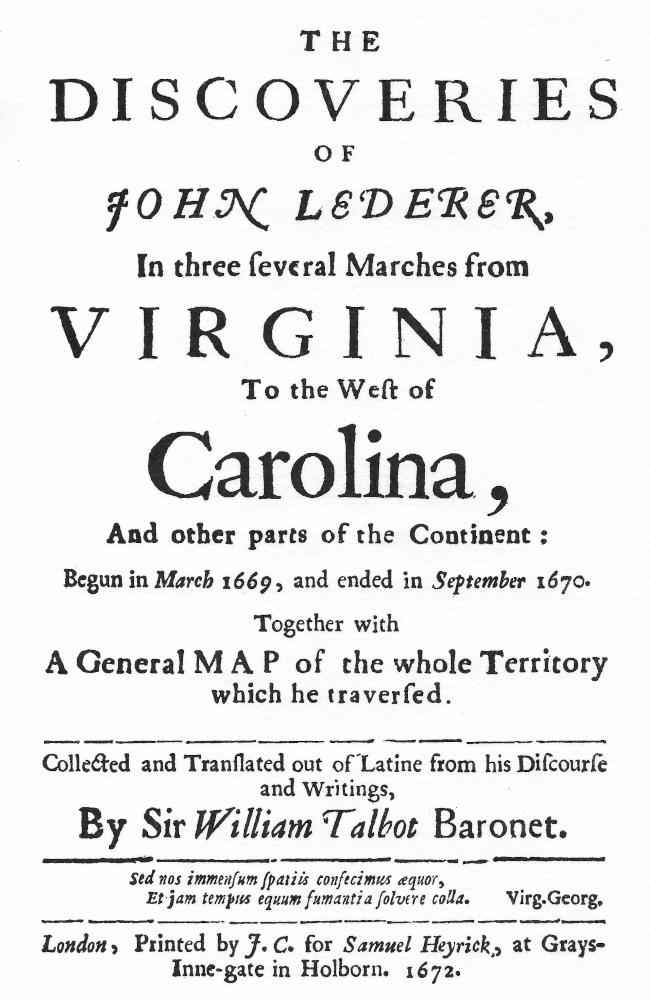
The First Expedition,
From the head of Pemæoncock, aliàs York-River
(due West) to the top of the Apalatæan
Mountains.
Upon the ninth of March 1669 (with three Indians whose names were Magtakunh, Hopottoguoh, and Naunnugh) I went out at the falls of Pemæoncock, aliàs York-River in Virginia, from an Indian Village called Shickehamany, and lay that night in the Woods, encountring nothing remarkable, but a Rattle-snake of an extraordinary, length and thickness, for I judged it two yards and a half or better from head to tail, and as big about as a mans arm: by the distention of her belly, we believed her full with young; but having killed and opened her, found there a small Squirrel whole; which caused in me a double wonder: first, how a Reptile should catch so nimble a creature as a Squirrel; and having caught it, how she could swallow it entire. The Indians in resolving my doubts, plunged me into a greater astonishment, when they told me that it was usual in these Serpents, when they lie basking in the Sun, to fetch down these Squirrels from the tops of trees, by fixing their eye stedfastly upon them; the horrour of which strikes such an affrightment into the little beast, that he has no power to hinder himself from tumbling down into the jaws of his enemy, who takes in all his sustenance without chewing, his teeth serving him onely to offend withal. But I rather believe what I have heard from others, that these Serpents climb the trees, and surprise their prey in the nest.
The next day falling into Marish grounds between Pemæoncock and the head of the River Matapeneugh, the heaviness of the way obliged me to cross Pemæoncock, where its North and South-branch (called Ackmick) joyn in one. In the Peninsula made by these two branches, a great Indian King called Tottopottoma was heretofore slain in Battel, fighting for the Christians against the Mahocks and Nahyssans, from whence it retains his name to this day. Travelling thorow the Woods, a Doe seized by a wild Cat crossed our way; the miserable creature being even spent and breathless with the burden and cruelty of her rider, who having fastned on her shoulder, left not sucking out her bloud until she sunk under him: which one of the Indians perceiving, let flie a luckie Arrow, which piercing him thorow the belly, made him quit his prey already slain, and turn with a terrible grimas at us; but his strength and spirits failing him, we escaped his revenge, which had certainly ensued, were not his wound mortal. This creature is something bigger then our English Fox, of a reddish grey colour, and in figure every way agreeing with an ordinary Cat; fierce, ravenous and cunning: for finding the Deer (upon which they delight most to prey) too swift for them, they watch upon branches of trees, and as they walk or feed under, jump down upon them. The Fur of the wilde Cat, though not very fine, is yet esteemed for its vertue in taking away cold Aches and Pains, being worn next to the body: their flesh, though rank as a Dogs, is eaten by the Indians.
The eleventh and twelfth, I found the ways very uneven, and cumbred with bushes.
The thirteenth, I reached the first Spring of Pemæoncock, having crossed the River four times that day, by reason of its many windings; but the water was so shallow, that it hardly wet my horses pasterns. Here a little under the surface of the earth, I found flat pieces of petrified matter, of one side solid Stone, but on the other side Isinglas, which I easily peeled off in flakes about four inches square: several of these pieces, with a transparent Stone like Crystal that cut Glass, and a white Marchasite that I purchased of the Indians, I presented to Sir Wiliam Berkley Governour of Virginia.
The fourteenth of March, from the top of an eminent hill, I first descried the Apalatæan Mountains, bearing due West to the place I stood upon: their distance from me was so great, that I could hardly discern whether they were Mountains or Clouds, until my Indian fellow travellers prostrating themselves in Adoration, howled out after a barbarous manner, Okée pœze, i. e. God is nigh.
The fifteenth of March, not far from this hill, passing over the South-branch of Rappahanock-river, I was almost swallowed in a Quicksand. Great herds of Red and Fallow Deer I daily saw feeding; and on the hill-sides, Bears crashing Mast like Swine. Small Leopards I have seen in the Woods, but never any Lions, though their skins are much worn by the Indians. The Wolves in these parts are so ravenous, that I often in the night feared my horse would be devoured by them, they would gather up and howl so close round about him, though Tether’d to the same tree at whose foot I my self and the Indians lay: but the Fires which we made, I suppose, scared them from worrying us all. Beaver and Otter I met with at every River that I passed; and the Woods are full of Grey Foxes.
Thus I travelled all the sixteenth; and on the seventeenth of March I reached the Apalatæi. The Air here is very thick and chill; and the waters issuing from the Mountain-sides, of a Blue colour, and Allumish taste.
The eighteenth of March, after I had in vain assayed to ride up, I alighted, and left my horse with one of the Indians, whilst with the other two I climbed up the Rocks, which were so incumbred with bushes and brambles, that the ascent proved very difficult: besides, the first precipice was so steep, that if I lookt down, I was immediately taken with a swimming in my head; though afterwards the way was more easie. The height of this Mountain was very extraordinary: for notwithstanding I set out with the first appearance of light, it was late in the evening before I gained the top, from whence the next morning I had a beautiful prospect of the Atlantick-Ocean washing the Virginian-shore; but to the North and West, my sight was suddenly bounded by Mountains higher than that I stood upon. Here did I wander in Snow, for the most part, till the Four and twentieth day of March, hoping to finde some passage through the Mountains; but the coldness of the Air and Earth together, seizing my Hands and Feet with numbness, put me to a ne plus ultra; and therefore having found my Indian at the foot of the Mountain with my Horse, I returned back by the same way that I went.