
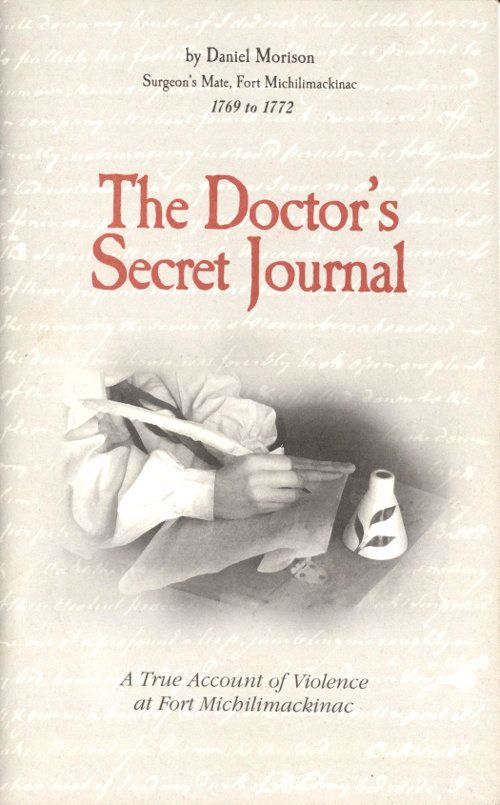
The Project Gutenberg eBook of The Doctor's Secret Journal
Title: The Doctor's Secret Journal
Author: Daniel Morison
Editor: George S. May
Release date: August 30, 2018 [eBook #57817]
Language: English
Credits: Produced by Stephen Hutcheson and the Online Distributed
Proofreading Team at http://www.pgdp.net
PAGES FROM THE ORIGINAL MANUSCRIPT AS WRITTEN BY DANIEL MORISON, SURGEON’S MATE 2ND BATTALION, 60TH REGIMENT FORT MICHILIMACKINAC 1769-1772
“... swore by a bloody oath he would come with a Hatchet and pull down my house.”
the DOCTOR’S
Secret Journal
by DANIEL MORISON, Surgeon’s Mate
Edited by George S. May
Illustrated by Dirk Cringhuis
Mackinac State Historic Parks
Mackinac Island, Michigan
ISBN-0911872-05-1
Private
BRITISH 60th FOOT ROYAL AMERICANS
Copyright © 1960 by The Fort Mackinac Division Press
Printed in the United States of America by Harlo Printing Co., Detroit Michigan
Third Printing, 1969 15,000 copies
Fourth Printing, 1974 15,000 copies
Fifth Printing, 1984 10,000 copies
Sixth Printing, 1993 5,000 copies
Seventh Printing, 2001 3,000 soft cover—1,500 hard bound
Introduction
On September 28, 1761, a year after France’s vast North American empire had been surrendered to the British at Montreal, Canada, the flag of Great Britain was raised over Fort Michilimackinac, far to the west at what is now Mackinaw City, Michigan. A force under Major Robert Rogers, leader of the almost legendary Rogers’ Rangers, had reached Detroit in 1760 and had taken control of that post, but the coming of winter had compelled the British to wait until the following year to take over the other French outposts in the upper Great Lakes.
Although Major Rogers later was to serve as commanding officer at Michilimackinac, the red-coated troops who marched into the little stockaded fort on the south shore of the straits connecting Lake Huron and Lake Michigan were commanded by Captain Henry Balfour. He found that the French garrison had departed for the west months before, leaving the fort in charge of Charles Langlade, a native of the area who had fought brilliantly on the French side during the French and Indian War. Balfour was greeted by several enterprising Englishmen who had gotten a head start in the race to gain control of the lucrative fur trade which for so long had been monopolized by French traders at Michilimackinac.
After accepting the fort’s formal surrender and before leaving for the west, Balfour detailed a small force from the famous Royal American or 60th Regiment to remain as the garrison. Two years later, during the great Indian uprising of 1763, fierce Chippewa warriors massacred over half of the soldiers and temporarily drove the British out. But within a year they returned in greater numbers, and from then until 1781, when it was abandoned for a new, more easily defended post on Mackinac Island, Fort Michilimackinac was one of the key links in the chain of military and trading posts which Great Britain maintained on the western frontier of its American colonies.
Among those who came to the fort in the late 1760’s was a Scotsman, Daniel Morison, surgeon’s mate in the Royal Americans’ Second Battalion. Of his life before and after his tour of duty at Fort Michilimackinac we know nothing. Under ordinary circumstances we would agree with one of Morison’s commanding officers who told him bluntly, “You are not worth my Notice.” But Morison is worth our attention because between 1769 and 1772 he kept a journal in which he set down in language that is often unintentionally hilarious and at other times brutally frank the best account that we have of life at this outpost of European civilization.
This important historical document, now published for the first time in its entirety, was purchased in 1914 by the great collector of materials relating to the history of Michigan and the Old Northwest, Clarence M. Burton, who bought it from a book seller in London, England, for $55. He brought the journal back to the state in which it was written where it now rests in the Burton Historical Collection of the Detroit Public Library.
Dr. Morison’s journal provides us with a picture of the English population of the fort, a people beset by violence, lawlessness, tyrannical officers, petty bickering, and assorted other problems. A reading of the journal should dispel any romantic notions of what conditions were like at an eighteenth-century frontier fort.
The inhabitants of Michilimackinac consisted of several groups. There were the soldiers, numbering around a hundred men. A few of them, we learn from Morison, had brought out their wives. The commanding officer’s house was the most impressive of the thirty-odd wooden buildings located within the stockade. The other officers lived in various cabins in the fort, as did the rank and file of the troops until 1769 when a large barracks was constructed in the center of the fort. Dr. Morison’s complaints about the poor quality of the housing are supported by statements of others who commented on the ramshackle construction which necessitated constant repairs and made the danger of fire an ever-present fear.
As a military fort Michilimackinac was scarcely adequate even to withstand the attacks of Indians. The post was maintained, however, because it was a convenient center of the fur trade. The small garrison, with its six-pound and nine-pound cannon mounted on the bastions, was enough to impress the Indians who lived in the vicinity and those who gathered here each summer with the reality of British armed might. This symbol of military power protected the English fur traders who made up the second, and most important, segment of the fort’s population.
By 1767 Michilimackinac had become for the British as it had been for the French the headquarters for the fur trade of a fourth of the continent. Canoes were sent out from here loaded with trade goods to be exchanged for furs at distant Indian villages located in the uncharted wilderness north and west of Lake Superior, westward across the Mississippi, and southward to the Illinois country. For two or three months in the summer hundreds of voyageurs and traders came back from the west, bringing in the furs they had gathered during the previous year or two. Like the lumberjacks of a later era, these men were bent on enjoying to the fullest degree their brief contact with the comforts of civilization before they returned to the west to barter for more furs.
A few traders who had acquired sufficient means to enable them to hire others to do the actual trading remained here the year round and occupied cabins in the fort. These Michilimackinac traders, men like Benjamin Frobisher, Isaac Todd, George McBeath, and others not mentioned by Morison, together with their agents or partners in Montreal who obtained the trade goods and sold the furs, dominated the fur trade for decades.
From Morison’s narrative we see that the officers and the traders permanently in residence at the fort formed an elite group. It is obvious that the French habitants and half-breeds who comprised a third part of the fort’s population, not to mention the Indians of the area, were not admitted to this exclusive social club. That the strain of being cooped up in the small fort, cut off from all contact with the outside world for over half the year, proved too much for some of the members of this clique, especially the bachelors, is also obvious.
Equally apparent is the fact that Dr. Morison, poor man, was unsuited to withstand the rigors of life at this post. He was apparently an educated man who could quote accurately from Virgil’s Aeneid, and a man of refinement and sensitivity. To some of the cruder members of the English set he must have seemed an easy target and a source of amusement when life became too dull and the bowls of toddy ran dry. Feeling himself much persecuted, as he certainly was, and outraged by the injustices of which he and others were the victims, Dr. Morison fumed, but, with a few exceptions, as when he refused to permit the whipping of a soldier to continue, he lacked the courage necessary to stand up to his oppressors. So, like Lieutenant Maryk in The Caine Mutiny, who kept a secret log on the activities of his sick captain, Dr. Morison recorded in his journal the evidence which he no doubt hoped would some day enable him to bring Ensign Robert Johnson, Captain George Turnbull, and his other tormentors to justice.
Actually, Dr. Morison probably was not a doctor at all. He was a surgeon’s mate, which means that he may once have been an apprentice to a surgeon and that he may have taken a course or two at a medical school but that it is unlikely he ever graduated since had he done so he would not have been simply a mate. The professional ability of the British army surgeon’s mate was of a notoriously low order, and, if we may believe one of the Royal Americans’ regimental surgeons, Daniel Morison was no exception in this respect. Surgeons were scarce, however, and a small frontier garrison, even when, as at Michilimackinac, it had been plagued by much sickness, had to be satisfied with the services of a mate. Unlike the surgeon, who was commissioned by the king, the surgeon’s mate was only a warrant officer appointed by the colonel of the regiment. The mate, therefore, was inferior in rank even to the ensign, the lowest of the commissioned officers. This was undoubtedly the source of many of Morison’s problems. He claimed the title of doctor and demanded equal status with the officers, who, for their part, treated him as they would a common soldier.
Comments added at the end of the manuscript in a different handwriting indicate that someone in England who possessed Morison’s journal in the nineteenth century intended to publish it in a magazine. No evidence has been found that this was done. In preparing the journal for publication we have ignored the numerous changes that this earlier editor made in the document and have retained Morison’s own phraseology at all times, including the misspelled words and grammatical construction so typical of his age. The narrative has been broken into five parts, and paragraphing and punctuation has been supplied at some places in the interest of easier reading. Material within brackets has been inserted by the present editor.
GEORGE S. MAY
Lansing, Michigan
March 6, 1960
“Doctor, damn your blood, get up & give us a bowl of Toddy!”
I
An Entertainment and a Violent Assault
Dr. Morison begins his journal innocently enough with an account of a party which he and others gave in the fall of 1769. Among the other hosts was Isaac Todd, who later helped found the great Canadian fur-trading firm, the North West Company, and whose long-time partner, James McGill, endowed McGill University in Montreal. The party began to get out of hand with the arrival of a couple of rowdy traders—John Chinn, who is best remembered as a partner in an unsuccessful copper-mining venture in Michigan’s Upper Peninsula, and Forrest Oaks, who was a prominent fur trader at Michilimackinac and later at Montreal for a number of years after 1769.
Morison, who seems to have been something of a name-dropper, mentions as he goes along other men who are familiar to students of the fur trade and British military history. But all of them are dwarfed by Ensign Robert Johnson, who crashed Morison’s party and soon turned the evening into a nightmare. Johnson (which is apparently how he spelled his name, although Morison insists on calling him Johnstone) is the villain of Morison’s journal, a scoundrel and bully whom we come almost to admire for the infinite variety of ways in which he gave vent to his evil nature.
He had been deeply involved in the Robert Rogers affair which had rocked the little community at Michilimackinac two years before. Johnson was in Detroit in the fall of 1767 where he had gone for the treatment of an injury when a messenger from British military headquarters for North America arrived with orders to place Major Rogers, commandant at Michilimackinac, under arrest on suspicion of treason. Johnson brought these orders back to the Straits, and it was Lieutenant John Christie, an officer who also figures prominently in Morison’s journal, who arrested Rogers. Johnson later asked to be given charge of the detail that took Rogers to Montreal for trial, boasting that he would foil any attempt that might be made to set Rogers free. However, when Rogers was acquitted, those who had hoped to see him convicted charged that the prosecution’s case had been fatally weakened by Johnson’s testimony which had enabled the defense to show that Rogers had been mistreated while he was a prisoner. Such mistreatment would be in keeping with the picture of Johnson’s character which emerges from a reading of Dr. Morison’s journal.
Narrative of an Action of Burglary and felony perpetrated on the Dwelling House & person of Daniel Morison, Surgeon’s mate of the 2d. Battn. 60th Regt. at Michilamackinac the Seventh day of November (about 5 Oclock in the morning) in the Year one thousand seven hundred & sixty nine, Vizt:
That the evening before being the sixth of November, Isaac Todd, merchant, William Maxwell, commissary of provisions & I proposed to give an Entertainment at Sergt. [Thomas] MacMurrays to which we Severally invited such people as we thought (in such a remote corner) qualified to make the evening pass agreeably. Accordingly we met, and everything was carryed on with the greatest Decency & innocent Mirth till John Chinn & Forrest Oaks, traders, joined us.
After drinking a glass round, John Chinn (who appeared to be the worse of liquor) before & at supper began to be troublesome, opened upon me with Volleys of ragged raillery (without the least provocation on my side) and that blended with Opprobrious Expressions, namely, that I was an officer in the Rebellion &c. in the Year 1745 [the abortive Scottish attempt to place Bonnie Prince Charlie on the British throne], which tho’ I knew was an arrant untruth, did not think it prudent to make the proper answer his wrongious Assertions deserved, [but] waved it off in the smoothest manner, lest the Company should be disturbed. Notwithstanding, our merriment was in a great measure unhinged, as the said John Chinn’s only pleasure consisted chiefly in being officious, by hobb or nobbing with everyone [who] would chuse to drink with him, & indeed importunely pouring perpetually in upon those who did not chuse to drink more than would do them good.
About the hour of eleven o’clock, Ens. Robert Johnstone (who for ought I know invited himself) came in, accompanied by Ens. John Strickland & Mr. [George] Main. We continued thus till about one O’clock in the morning, when Numbers of our Company thought proper to retire. I proposed retiring also, but Isaac Todd insisted upon my spending one hour or two more with them. Rather than disoblige I consented.
About half one hour after, Ens. Johnstone asked the Company how their punch pleased them. They answered, well enough. Then he, the said Ens. Johnstone, blabbed out publickly, Vauntingly & wantonly, he had mingled four ounces of Jallap [a purgative] with the water that was a boiling for proportioning the Punch & Sangary [wine spiced and diluted with water]. This giddy Declaration, instead of meeting with approbation, occasioned the interjection of one universal sneer. I said nothing tho’ I perfectly knew such irregular proceedings could not be intended for good. Therefore I silently winked over it, as others did; at the same time took particular notice that Ens. Johnstone drank nothing but wine all the night over.
John Chinn and Forrest Oaks, who left the Company about one o’clock, seemingly fuddled, returned to the charge one hour & one half thereafter. The abovesaid John Chinn appeared to be as unruly as ever. In short, conversation became very insipid. Drinking was the principal amusement, varnished over with various inconsistencys. At length time dragged on very heavily. Consequently [I] excused myself to be away, pleading the part I had to act in regard to my department. Upon which John Chinn swore by a bloody Oath he would come with a Hatchet and pull down my house, if I did not stay a little longer. To palliate this foolish menace, I thought it prudent to humour, [rather] than exasperate [him] on that Occasion.
[I] continued in [his] company till about four o’clock, then sheered off quietly not imagineing he would persist in his folly. [I] went to bed without dread or fear, as I gave no other plausible offense except what my absence suggested to them. But the Sequel will evidently discover the Maliciousness of their perverse intentions, for about five o’clock in the morning the seventh of November abovesaid, the door of my house was forcibly broke open, one plank of the Door-leaf, bars, bolt &c. pulled down to the floor. Upon entering my Room they also broke down my stove which was strongly made of bricks, clay & lime. This unwarrantable deed was principally perpetrated by Ens. Robert Johnstone of the 2d Battn. & Oaks the trader.
So fast was I asleep [that I] knew nothing of these violent proceedings untill Oaks Surprized me out of a profound sleep, tumbling in roughly in my bed [and] bawling loudly, “Doctor, Doctor, damn your blood, get up & give us a bowl of Toddy, other wise You’ll repent it.”
I wakened as out of a dream. He, the said Oaks’ next question was if I had my durk by my bed-side. I answered, “Never in time of peace.” Upon this I called to my servant John Forbes to light a candle, which was no sooner done, & set upon the table at my bed side after my servant retired to the kitchen, then the said Ens. Johnstone kicked down & overturned the table, candle, candlestick, &c., topsy turvy in great wrath.
“Is this You, Ens. Johnstone,” says I, “who behaves so rudely.”
“You ly,” he says, “I am a gentleman.”
I made answer that his rude behavior betrayed the contrary in the eyes of good men.
Then he swore bloodily in the height of Rage, he would shew me that he was a gentleman & immediately fell upon, attacked & pelted me violently in my naked bed, he & his abbettor Oaks. The room being dark all my attempts of defence were rendered ineffectual by Oaks’s exerting his outmost strength to entangle me in my sheets & bed-Cloathes out of which I struggled to extricate myself like a fish entangled in a net. They pelted me pell-mell with incessant blows repeatedly, on the face, left breast, &c., to the Effusion of my blood. Before I could recover myself out of the jeopardy into which I was involved, my shirt, sheets & pillowcase [were] all bespattered with gore & blood in my naked bed untill Sergt. McMurray & Arthur Ross, soldier, with the assistance of my servant, John Forbes, turned them out of the Room. Otherwise it is [hard] to know where the consequences would end. William Maxwell, the Commissary, & Christian Burgy, trader, came in who saw my face bruised all over, besmeared [with] Blood.
In the meantime Forrest Oaks had the impudence to come back again, & upon a rehearsal of my bad useage, very unmannerly gave me the ly twice or thrice, in my own house. To this Sergt. MacMurray, Mr. Maxwell & the abovesaid Christian Burgy was present, who can testify in this, as well as other Circumstances. I imagined he intended this insult as a provocation to stirr me up to do something rash, of which he might make a handle to invalidate my pretensions to Justice on account of his being accessory to the violent attack upon my person as abovesaid.
Whether there were more accomplices [who] acted in conjunction with Ens. Johnstone & Forrest Oaks at the breakeing of my house &c., I cannot positively determine (the room being dark) except what may be inferred from a chain of Circumstances. For John Chinn (whose mind it seems was so replete with the dregs of his former menaces abovesaid, as if he intended to make his menace good) he, the said John Chinn, was met by Isaac Todd on his way to my house, with a great Hatchet in his hand. Mr. Todd asked where he was going. The said John Chinn answered, to break down the Doctor’s house. Upon which Mr. Todd, partly by persuasion, & partly by dint of strength, brought him home to his lodgeing.
Whether it was before this, or after, I cannot say, my servant John Forbes catched the said John Chinn at the porch before my broken door, with a large Hatchet, while the assailants abovesaid, to wit, Ens. Johnstone & Oaks, were perpetrating their malicious designs against me. He, the said John Forbes, asked the said John Chinn what was he going to do with that Hatchet. John Chinn replyed, to break down the Doctor’s house. After a little altercation my servant persuaded him to deliver up the Hatchet.
No sooner the assailants abovesaid was expelled the house, as above mentioned, then the said John Chinn entered my house abruptly, as straight as a rush, & with an air of authority, impudently (tho’ he saw my face &c. all over with blood besmeared) minding his belly more than my hard treatment asked if I should give him a bowl of Toddy, in presence of Mr. Maxwell & Mr. Burgy.
When these irregular proceedings perspired [sic!] the most considerable gentlemen in the Garrison came to see me, to wit, Capt. [Beamsley] Glazier [commandant, 1768-70], Lieut. Nordberg, Lieut. [John] Christie, Ens. Strickland, Mr. Todd, Mr. Main, Mr. [Charles?] Morison, Mr. Maxwell & Christian Burgy, who can all & one of them attest they plainly saw that the door of my house &c. were forcibly broke open as abovesaid, & that my face &c. was all over besmeared with blood & gore, & my shirt, sheets, pillowcase, were plentifully bespattered with blood also.
John Chinn, upon Recollecting what he had done, [realized he had] forgot his Hatchet, which he was very impatient to have in his possession once more, as it was then in custody of my servant John Forbes for about half one hour. The said John Chinn employed Christian Burgy, abovesaid, to bring it back to him. I did not chuse to give it, but upon the said Christian Burgy’s earnest Expostulations I complyed, & ordered my servant to deliver it. At the same time [I] told Christian Burgy it was to the same purpose, as he & my servant could testify with Isaac Todd, [to] the maliciousness of his [Chinn’s] unwarrantable intentions as abovesaid.
Soon after Ens. Johnstone & his abbettor Forrest Oaks had been expelled my house, he, the said Ens. Johnstone, went to Ens. Strickland’s. The abovesaid Isaac Todd happened to be there, who upon Johnston’s appearing, observed blood upon his hands &c. [Isaac Todd] asked him, where he had been. The said Ensign Johnstone replyed Vauntingly, he was giveing some knocks to the Doctor.
About half one hour after seven the evening before, Ens. Johnstone with some other accomplices were discovered scaling up a ladder opposite to which there was a half door, up the loft, at the lower end of my house. My servant John Forbes & another soldier observing a noise, as if the half door was thrown down upon the loft, [started out] but before my servant & the other soldier could get out to make a real discovery, the attempters were scattered about different ways. What their intentions were in regard to this little Enterprise depends upon them to explain but the judicious may readily conclude it a prelude to their malicious perpetrations before daylight next morning.
Before, at, or about six weeks preceeding the 7th November abovesaid, there was a strong report prevailed in [the] Garrison (which I am now persuaded was not without foundation) that the said Ens. Johnstone, being in company with some gentlemen in the fort, had breathed out menaceing and malevolent expressions against me, threatening he would use me ill.
Ens. Johnstone’s reasons for this extravagant Declaration I am yet a stranger to, as it is conscious to myself I never did in word or deed give him any just grounds of provocation. Notwithstanding this surmise, I took no further notice of [it] than studying to evade his Company, excepting behaveing with common civility on general terms, as I knew his Character among the public to be of a turbulent & troublesome, meddling [and] loquacious Disposition.
Upon the whole, I believe, it will not be attended with much Difficulty to investigate sufficient evidences, who will attest to the Veracity of the above, when they are legally called upon to declare their Sentiments, Solemnly without the least partiality or mental reservation in presence of any competent Tribunal, by which it will evidently appear (to the Judicious) with other concurring Circumstances that the forcibly breaking up of my house &c., together with the violent assault upon my person as above specifyed, may be justly attributed to premeditated & malicious intentions. Authentick witnesses to prove the last assertion are Isaac Todd, Benjiman Roberts, late Lieut. in the 46th Regt., Benjiman Frobbisher, merchant, & William Maxwell, Commissary of Provisions in this Fort.
N. B.: When Sergt. McMurray & Arthur Ross came into my house they found Ens. Johnstone holding my servant by the hair of his head & pelting at him with several knocks altennarly [alternately?] for attempting to force him out of the house, which he got accomplished with the assistance of Sergt. MacMurray & Arthur Ross.
N. B.: That in the month of March 1766, he [Johnson] threatened he would break my head. No sooner [did] I put myself in a position of Defence, but he desisted from his insolent menaces. Proof: Lieut. Allan Grant of the 2d. Battn., Lieut. Varingon & Adjutant Biron [John Burrent], both of the 1st. Battn. 60th Regt.
II
Concerning the Most Irregular Proceedings
Daniel Morison was so incensed by the events related in the preceding narrative that he wrote out two versions, which, however, with the exception of an occasional difference in wording are the same. Following these events, from time to time he recorded some of the “irregular proceedings” which transpired at the fort, largely as a result of the actions of the irrepressible Ensign Johnson.
Morison’s journal illustrates vividly how completely the military authorities dominated the lives of the fort’s inhabitants. Not only were the soldiers at the mercy of their officers, but civilians, such as Morison’s nephew, William Morison, were helpless in the face of military indifference to their problems since there was no civil authority at Michilimackinac or anywhere else in what is now Michigan to which they might appeal during this period. Traders constantly complained at the high-handed actions of the fort’s commanders who, these traders charged, used their position to gain great material benefits for themselves and imposed ruinous regulations on those traders who would not give them a cut of their profits. The royal government sought to correct these abuses, but throughout the period of British rule Michilimackinac is said to have had a reputation as a center of corruption and misrule.
“Ensign Johnstone (who was there with his wife) saluted him with innumberable knocks & kicks.”
Remarks December 1769.
[1stly.] That a few days after this unwarrantable Outrage perpetrated against my dwelling House & person, John Chinn & Forrest Oaks were so conscious of their Enormous guilt [and] struck with such a Remorse, that they declared that they would upon their knees publickly on the Parade beg to be pardoned if that would satisfy for the Errors they were conscious of haveing committed. This they expressed in the Audience of William Maxwell, Commissary, Sergt. McMurray, George McBeath, [and] Henry Williams, traders.
2dly. That a certain gentleman heard it surmised among them that if the above Submission would not take place, they might have another Resolve which was to tamper with my Servant & advance him one hundred pounds by way of bribe, as they looked on him as the most Material witness in my intended process against them.
3rdly. Such is the depraved disposition of this profligate Garrison at this Juncture (as well as now degenerateing into the most irregular proceedings dayly) they had recourse to calumnious aspersions contriveing to patch up false invective & ignominous Reports (as under the Necessity of keeping my room, on account of the Severe [bruises] I had sustained from such a rough handleing, that I wore Boots with Creepers in my Room & [was] found lying down in my bed with them); with this additional & abominable connivance that I kept so long close in my Room to embrace one opportunity to drive away Sorrow & get drunk privately. Such are the Diabolical dispositions of many in this remote garrison who make a perpetual habit of murdering time in excesses of Debauchery & most Licentious practices. These false aspersions I had communicated to me by George Main and Charles Morison, trader, the 10th December, 1769.
4thly. Upon the 11th do. Ens. Johnstone assumed to encroach upon my Province by visiting Sergt. McPherson of the Colonel’s Company, who says he never sent for him Directly or indirectly. He immediately insisted upon seeing his wound, tho’ he was but newly dressed one hour before, [and] took off the dressings, &c. After inspection he told my patient for his comfort, it looked very bad, & that he knew nothing better for him than to bathe it with brandy. [He] set off directly, & left the tumefyed wound exposed to the Open air, till my servant was obliged to go & dress him a second time. This among the rest is one specimen of the Ens. Johnstone’s activity to interfere in matters which did not concern him. That at the same time he told Sergt. McPherson if he belonged to the Company, he [would give] commands. He would immediately confine Dr. Morison in the common guard house.
N. B.: That in a few days after this Violent Assault, John Chinn and Forrest Oaks were observed conjointly & severally, loading their guns & pistoles, which I dare say were intended for bad purposes which they would in all appearance have prosecuted had not their proceedings been disapproved of by a certain gentleman in the Garrison.
One night the ensueing spring, when they carroused heartily at their Bowl, John Chinn proposed to pay another Visit to the Doctor, which being disapproved of by one of the principals in the Assault, was dropped.
The 25th. December 1769. Ens. Johnstone with his irregular associates, contrived among them, about day set in the evening, to send a frenchman, who served Isaac Todd merchant, upon a false Message to me two different times in great haste, acquainting me that his master was very sick, & that he earnestly, in the most pressing manner, demanded my immediate assistance. Upon which I Repaired directly to wait upon Mr. Todd, & upon due enquiry, found the Message to be a mere bubble, very like the triffling projectors, Isaac Todd declareing himself well, & took it highly amiss that they should take such libertys with his name, or give me such Unnecessary trouble.
Some time in Summer 1770, Ens. Johnstone Knocked down a soldier of the general’s Company, called Walker by name, in presence of the Commanding officer, Capt. [George] Turnbull. The poor soldier applyed to me, & told me he was afraid his cheek bone was broke, which did not happen to be the case, tho’ it was prodigiously swelled. Which cost me five or six days attendance and applications, before he recovered so as to be fit for Duty.
Sunday evening at 11 O’clock, 2d. December 1770, a frenchman knocked at the door of my house very hard, when I was abed. Imagining it Might be from some sick soldier, [I] called to my servant to open the Door, & there appeared a frenchman with a card in his hand, charged with Mr. Chinn’s Compliments to Doctor Morison, begging the favour of his Company to take a dance with them at Christian Burge’s house. This I rejected with outmost derision & Contempt, as I never did prostitute my judgement so low as to join Company of any Denomination to break the Lord’s day in such a publick [and] infamous manner; & indeed I looked upon the Company so mean that I should be very scrupulous to join them even on a Weekly day. I doubt not but Ens. Johnstone might be at the head of such a Heathenish proposition as there is no irregularitys committed here, wherein he is not either a prompter or a ready Countenancer if not a perpetrator.
Sunday the 9th December 1770. Betwixt the hours of 11 & 12 o’Clock forenoon, when the Garrison was at Church, Sergt. [Thomas] Carlile of the general’s company had the guard that day, & being thirsty stepped over to his own house (which was adjacent & directly opposite to his guard) for a drink of spruce beer. He no sooner opened the Door of his room than Ens. Johnstone (who was there with his wife) saluted him with innumberable knocks & kicks till (almost in his own words to me) he had knocked his head into blubber, then kicked him in the private parts (from which Violence his private parts, particularly one of his testicles, are greatly Swelled, of a hue black as his Hat). [Johnson gave him] many bumps upon his head, [and] his jaw bones, as he himself says, [are] so painful that he can scarce open his mouth, but with great difficulty.
The poor Sergt. immediately returned to his guard & the next day applyed to the commanding officer Capt. Turnbull of this Fort for his Protection in regard to his most grievious situation, from the Attrocious and barbarous usage he had sustained by the violent proceedings of Ens. Johnstone whom he was determined to prosecute to the outmost for the Violence done to his person, in his own house.
N. B.: Ens. Johnstone confined two or three soldiers in the black-hole for being absent from Divine service, where they were in durance while he himself was pounding & kicking the poor Sergt. in this barbarous manner.
Late in the evening Sunday above said, Ens. Johnstone was swaggering away upon the Parade with a naked sword, or Dagger, in his hand, & when it seems he could not meet a Humane [sic] Subject to Use ill, he wrecked his Vengeance on a dog (belonging to one of the Soldiers of the Garrison) by cutting him to the back-bone. The poor brute made such a hideous noise, his wound being beyond Remedy, [that] his master was obliged out of Pity to put him out of pain by shooting him thro’ the head.
Wednesday 12th December 1770. A little before Roll-Call Ens. Johnstone struck my servant, John Forbes, by giveing him several blows, which hurt him prodigiously, for attempting to ridd some Dogs that were a fighting & make[ing] a terrible Noise at the Door of my house. He struck Sergt. McMurray, acting Sergt. Major in the fort, with a severe blow, at the same time knocked down flat [on] the ground Henry Adams of the Collonel’s Company, so that the dogs of this garrison are so Usefull, Sergents & Soldiers must be knocked down for attempting to hinder them from fighting & makeing a noise.
Ens. Johnstone kicked Sergt. McPherson of the Collonel’s Company in presence of the Commanding officer, a little before he went down to Detroit last fall. Wednesday 26th December 1770, upon the evening of that day Ens. Johnstone knocked down Sergt. May upon the Parade, by giveing him two severe blows on the neck & Jawbones, after which he confined him, brought him to a tryal, & sentenced [him] to be reduced to the ranks.
On Saturday 29th, Do., Ens. Johnstone wrangled with my nephew, William Morison, erroneously & threatened to confine him in the common guard-house.
Sunday evening 30th Do., Mrs. [George] McBeath invited me to walk into her house. I was no sooner seated than she entered a grieveous Complaint to me against Ens. Johnstone, affirming that he used uncommon libertys with her Character, upon which she wrote him the evening before a very spirited Letter of which she shewed me a Copy. She actually pronounced him a very bad man. As a strong instance of which, among many she could adduce, she declared he had frequently tampered with her by many stratagems to destroy her peace with her husband, which she looked upon as such a vile insinuation she was determined never to admit of his Company for the future.
Tuesday evening the 1st. Jan’y 1771. John Savage, Taylor & Soldier in the general’s Company, twixt 11 & 12, had the Door of his house forced open [and was] committed to the guard-house for not suffering his wife to comply with obscene proposit[ions made] to her. At this Exploit Ens. Johnstone was one of the chief witnesses. The prisoner was set at liberty next morning without any crime given against him.
Monday the 7th Jan’y 1771. Ens. Johnstone decoyed away Sergt. Carlile’s wife, which he has been contriveing to accomplish many months before this finishing stroake, & tho’ her husband was like to break his Heart, and crying out his Eyes on the occasion, Yet no Remonstrances would be payed the least attention to. Ens. Johnstone quitted his Room in the officer’s barracks that evening which he exchanged with Mr. Main for his. [He] sleeped with her that night in his new room where he lives with her still, without dread or shame, while the poor Husband is left in such a disconsolate situation that is not easy to describe. He next morning (poor man) applyed to the Commanding Officer, who gave him no satisfactory redress, as he did not chuse to interfere either pro or con. Yet the next day after her Elopement from her husband she had the honnour of dining with the commanding officer and his mess, who drank tea with her that evening at her new lodgeings.
Sergt. Carlile had the mortification to see his wife dayly conducted by one of the mess to dine with the commanding officer, Capt. Turnbul, & the good Company with him, at which the poor Sergt. was like to go distracted but could not help himself.
Ens. Johnstone in the month [of December?] 1770, haveing crossed on a party of pleasure in company with Capt. Turnbull & William Maxwell, Commissary, flogged Knight, Soldier in the general’s Company, with his own hand, without any regular tryal for his crime. Proof: William Maxwell, Commissary, Rogers & McLean, soldiers.
As Ens. Johnstone thought proper to turn trader by selling of common rum to the soldiers & all others by whom he might gain a penny in this clandestine Manner, in the month of October 1767, he was observed to have filled up several Barrels of common rum with boiling water to make up the Leakage. Afterwards [he] sold this at 18. sh. York currency pr. gallon to Sergeants & Soldiers &c. in the Garrison. Proof: Sergeants McMurray & Carlile with his own servant Arthur Ross, who assisted him by his own self in the deceitfull operation.
Upon friday the 8th febry. 1771, Ens. Johnstone in presence of the Commanding officer, Capt. Turnbull, Ens. Strickland, George Main, William Maxwell, Commissary, [and] George McBeath, trader, attacked William Morison, my nephew, in a most rude and Violent manner, without any evident cause, in the billiard Room in the presence of six witnesses. The Young man (who is sometimes liable to a fainting Disposition) in the Scuffle he fell down & cryed Murder! William Maxwell, Commissary of provisions, interposed, by which he received some knocks from Ens. Johnstone without returning one blow, after which Johnstone passed by [the] Commissary in a furious manner, & the young man was flat down in a swoon. Ens. Johnstone raised up his left arm & gave him repeated thumps opposite to the heart, by which it would appear he intended to murder the young man.
He is now under care & it is a chance if ever he can get the better of it. The commanding officer with all those of their Club was present to all this. Some of them I am told stood firm with their backs to the room door, I suppose to hinder any from comeing in to the assistance of the ill-used Young man. At length the noise brought in Mr. Harise, who can attest to everything he saw. Mr. Harise with one or two more carryed him for dead to his room, where after untying his stock he gradually recovered from his trance.
In the evening I went with my Nephew to wait on Capt. Turnbull to enter a Complaint of his hard usage. After all the remonstrances he could suggest, the Commanding Officer would give him no Redress, tho’ he himself was personally present to the crime committed by Johnstone. Upon which I myself made application to Capt. Turnbull in the humblest manner to put Ens. Johnstone under arrest & that there was no possibility of maintaining peace in the Garrison while Johnstone was at liberty, nor could I think myself safe in the Execution of my Office if my Remonstrances to him on that score did not take place, which Capt. Turnbull Absolutely refused to do by saying, with some warmth, he would not put Johnstone under arrest, tho’ there [were] as many crimes against him as words on his Commission.
The 23d. feby. 1771. Ens. Johnstone quarrelled with William Maxwell, Commissary, & revilled [him] (if not gave him a few blows) with exasperating expressions, both in company of the commanding officer, who, when words became too high, ordered Ens. Johnstone to his room, wherein he did not continue above twenty four hours, for reasons best known to the Commanding Officer & himself.
“... a woman who I have the greatest regard for distracted me by her imprudent behaviour.”