
The Project Gutenberg eBook of The Dog
This ebook is for the use of anyone anywhere in the United States and
most other parts of the world at no cost and with almost no restrictions
whatsoever. You may copy it, give it away or re-use it under the terms
of the Project Gutenberg License included with this ebook or online
at www.gutenberg.org. If you are not located in the United States,
you will have to check the laws of the country where you are located
before using this eBook.
Title: The Dog
Author: William Youatt
Editor: Elisha J. Lewis
Release date: December 1, 2005 [eBook #9478]
Most recently updated: January 2, 2021
Language: English
Credits: Produced by Clytie Siddall, Joshua Hutchinson and Distributed Proofreaders
*** START OF THE PROJECT GUTENBERG EBOOK THE DOG ***
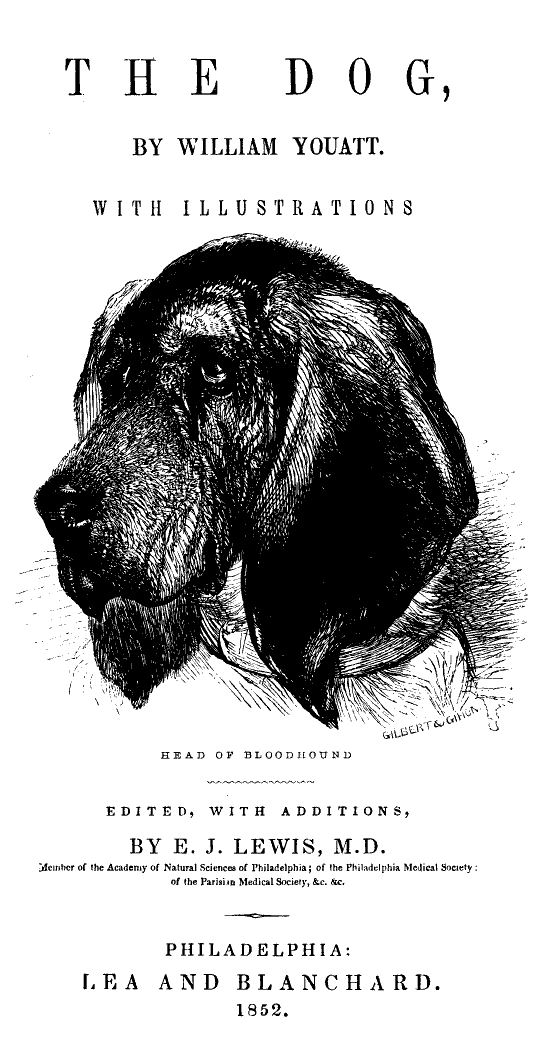
The Dog
by William Youatt
with illustrations
edited, with additions
by E. J. Lewis. M. D.
1852
with illustrations
edited, with additions
by E. J. Lewis. M. D.
1852
- Preface of the Editor
- Chapter I — The Early History and Zoological Classification of the Dog
- Chapter II — The Varieties of the Dog. — First Division
- Chapter III — The Varieties of the Dog — Second Division
- Chapter IV — The Varieties of the Dog — Third Division
- Chapter V — The Good Qualities of the Dog and Cruelties
- Introduction to Canine Pathology. by the Editor.
- Chapter VI — Description of the Skeleton. Diseases of the Nervous System
- Chapter VII — Rabies
- Chapter VIII — The Eye and its Diseases
- Chapter IX — The Ear and its Diseases
- Chapter X — Anatomy of the Nose and Mouth; and Diseases of the Nose and other parts of the Face
- Chapter XI — Anatomy and Diseases of the Chest
- Chapter XII — Anatomy of the Gullet, Stomach, and Intestines
- Chapter XIII — Bleeding; Torsion; Castration; Parturition;
and some Diseases Connected with the Organs of Generation - Chapter XIV — The Distemper
- Chapter XV — Small-pox; Mange; Warts; Cancer; Fungus Haematodes;
Sore Feet - Chapter XVI — Fractures
- Chapter XVII — Medicines used in the Treatment of the Diseases of the Dog
- Appendix — New Laws of Coursing
- Alphabetical Index
Note: in folllowing Contents, breeds of dog or items printed in italics feature illustrations.
- Chapter II — The Varieties of the Dog. — First Division
-
- Wild Dogs
- Domesticated Dogs of The First Division
-
- The Hare Indian Dog
- The Albanian Dog
- The Great Danish Dog, called also the Dalmatian or Spotted Dog
- The French Matin
- The Greyhound
- The Scotch Greyhound
- The Highland Greyhound, or Deer-hound
- The Irish Greyhound
- The Gasehound
- The Irish Wolf-dog
- The Russian Greyhound
- The Grecian Greyhound
- The Turkish Greyhound
- The Persian Greyhound
- The Italian Greyhound
- Chapter III — The Varieties of the Dog — Second Division
-
- The Spaniel
- The Cocker
- The King Charles's Spaniel
- The Springer
- The Black and Tan Spaniel
- The Blenheim Spaniel
- The Water-Spaniel
- The Poodle
- The Barbet
- The Maltese Dog
- The Lion Dog
- The Turkish Dog
- The Alpine Spaniel, or Bernardine Dog
- The Newfoundland Dog
- The Esquimaux Dog
- The Lapland Dog
- The Sheep-dog
- The Scotch Sheep-Dog
- The Drover's Dog
- The Italian or Pomeranian Wolf-dog
- The Cur
- The Lurcher
- The Beagle
- The Harrier
- The Fox Hound
- The Commencement of the Season
- Hunting-Kennels
- Kennel Lameness
- Lord Fitzhardinge's Management
- Management Of The Pack
- Goodwood Kennels
- The Stag-hound
- Southern Hound
- The Blood-Hound
- The Setter
- The Merits of the Setter Compared with Those of the Pointer
- The Pointer
- The Spanish Pointer
- The Portugese Pointer
- The French Pointer
- The Russian Pointer
- The Early Training of the Dog
- The Otter Hound
- The Turnspit
- Chapter VIII — The Eye and its Diseases
-
- The Nictitating Membrane
- Opthamalia — Simple Inflammation of the Eye
- Chronic Ophthalmia
- Traumatic Ophthalmia
- Sympathetic Ophthalmia
- Hydrophthalmia
- Congenital Blindness
- Cataract
- Ulcerations on the Cornea
- Spots on the Cornea
- Amaurosis — Gutta Serena or Glass Eye
- Extirpation Of The Eye
- Ulcerations of the Eyelids
- Warts on the Eyelids
- Entropium — Inversion of the Eyelids (and operation for)
- Protrusion of the Eye
- Weak Eyes
- Fistula Lachrymalis
- Caruncula Lachrymalis and Plica Semilunaris, or Haw
- Chapter IX — The Ear and its Diseases
-
- Canker in the Ear (1)
- Vegetating Excrescences in the Ear
- Eruptions in the Ear
- Violent Affection of the Ear
- Cropping
- Polypi in the Ears
- Polypi in Other Orifices
- Simple Otorrhœa
- Tumors of the Flap
- Canker in the Ear (2)
- Wounds of the ear
- Warts
- Canker of the Edge of the Flap
- Polypus of the Ear (2)
- Diseases of the Ear — Mangy Edges
Preface
The Editor, having been called upon by the American publishers of the
present volume to see it through the press, and add such matter as he
deemed likely to increase its value to the sportsman and the lover of
dogs in this country, the more readily consented to undertake the task,
as he had previously, during the intervals of leisure left by
professional avocations, paid much attention to the diseases, breeding,
rearing, and peculiarities of the canine race, with a view to the
preparation of a volume on the subject.
His design, however, being in a great measure superseded by the enlarged
and valuable treatise of Mr. Youatt, whose name is a full guarantee as
to the value of whatever he may give to the world, he found that not
much remained to be added. Such points, however, as he thought might be
improved, and such matter as appeared necessary to adapt the volume more
especially to the wants of this country, he has introduced in the course
of its pages. These additions, amounting to about sixty pages,
are printed in brown
, with the initial of the Editor appended. He
trusts they will not detract from the interest of the volume, while he
hopes that its usefulness may be thereby somewhat increased.
With this explanation of his connexion with the work, he leaves it in
the hope that it may prove of value to the sportsman from its immediate
relation to his stirring pursuits; to the general reader, from the large
amount of curious information collected in its pages, which is almost
inaccessible in any other form; and to the medical student, from the
light it sheds on the pathology and diseases of the dog, by which he
will be surprised to learn how many ills that animal shares in common
with the human race.
The editor will be satisfied with his agency in the publication of this
volume, if it should be productive of a more extended love for this
brave, devoted, and sagacious animal, and be the means of improving his
lot of faithful servitude. It is with these views that the editor has
occasionally turned from more immediate engagements to investigate his
character, and seek the means of ameliorating his condition.
Philadelphia
,
October
, 1846.
Contents/Detailed Contents/Index
Chapter I —the Early History and Zoological Classification of the Dog.
The Dog, next to the human being, ranks highest in the scale of
intelligence, and was evidently designed to be the companion and the
friend of man. We exact the services of other animals, and, the task
being performed, we dismiss them to their accustomed food and rest; but
several of the varieties of the dog follow us to our home; they are
connected with many of our pleasures and wants, and guard our sleeping
hours.
The first animal of the domestication of which we have any account, was
the sheep. "
was a keeper of sheep."
It is difficult to believe
that any long time would pass before the dog — who now, in every country
of the world, is the companion of the shepherd, and the director or
guardian of the sheep — would be enlisted in the service of man.
From the earliest known history he was the protector of the habitation
of the human being. At the feet of the
lares
, those household
deities who were supposed to protect the abodes of men, the figure of a
barking dog was often placed. In every age, and almost in every part of
the globe, he has played a principal part in the labours, the dangers,
and the pleasures of the chase.
In process of time, man began to surround himself with many servants
from among the lower animals, but among them all he had only one
friend — the dog; one animal only whose service was voluntary, and who
was susceptible of disinterested affection and gratitude. In every
country, and in every time, there has existed between man and the dog a
connection different from that which is observed between him and any
other animal. The ox and the sheep submit to our control, but their
affections are principally, if not solely, confined to themselves. They
submit to us, but they can rarely be said to love, or even to recognise
us, except as connected with the supply of their wants.
The horse will share some of our pleasures. He enjoys the chase as much
as does his rider; and, when contending for victory on the course, he
feels the full influence of emulation. Remembering the pleasure he has
experienced with his master, or the daily supply of food from the hand
of the groom, he often exhibits evident tokens of recognition; but that
is founded on a selfish principle — he neighs that he may be fed, and his
affections are easily transferred.
The dog is the only animal that is capable of disinterested affection.
He is the only one that regards the human being as his companion, and
follows him as his friend; the only one that seems to possess a natural
desire to be useful to him, or from a spontaneous impulse attaches
himself to man. We take the bridle from the mouth of the horse, and turn
him free into the pasture, and he testifies his joy in his partially
recovered liberty. We exact from the dog the service that is required of
him, and he still follows us. He solicits to be continued as our
companion and our friend. Many an expressive action tells us how much he
is pleased and thankful. He shares in our abundance, and he is content
with the scantiest and most humble fare. He loves us while living, and
has been known to pine away on the grave of his master.
It is stated that the favourite lap-dog of Mary, Queen of Scots, that
accompanied her to the scaffold, continued to caress the body after the
head was cut off, and refused to relinquish his post till forcibly
withdrawn, and afterwards died with grief in the course of a day or two.
The following account is also an authentic instance of the inconsolable grief displayed by a small cur-dog at the death of his master: — A poor tailor in the parish of St. Olave, having died, was attended to the grave by his dog, who had expressed every token of sorrow from the instant of his master's death, and seemed unwilling to quit the corpse even for a moment. After the funeral had dispersed, the faithful animal took his station upon the grave, and was with great difficulty driven by the sexton from the church ground; on the following day he was again observed lying on the grave of his master, and was a second time expelled from the premises. Notwithstanding the harsh treatment received on several succeeding days by the hands of the sexton, this little creature would persist in occupying this position, and overcame every difficulty to gain access to the spot where all he held most dear was deposited. The minister of the parish, learning the circumstances of the case, ordered the dog to be carried to his house, where he was confined and fed for several days, in hopes of weaning him by kind treatment to forget his sorrow occasioned by the loss of his master. But all his benevolent efforts were of no utility, as the dog availed himself of the first opportunity to escape, and immediately repaired to his chosen spot over the grave.
This worthy clergyman now allowed him to follow the bent of his own inclinations; and, as a recompense for true friendship and unfeigned sorrow, had a house built for him over this hallowed spot, and daily supplied him with food and water for the space of two years, during which time he never wandered from his post, but, as a faithful guardian, kept his lonely watch day and night, till death at last put an end to his sufferings, and laid him by the side of his long-expected master. — L.
The following account is also an authentic instance of the inconsolable grief displayed by a small cur-dog at the death of his master: — A poor tailor in the parish of St. Olave, having died, was attended to the grave by his dog, who had expressed every token of sorrow from the instant of his master's death, and seemed unwilling to quit the corpse even for a moment. After the funeral had dispersed, the faithful animal took his station upon the grave, and was with great difficulty driven by the sexton from the church ground; on the following day he was again observed lying on the grave of his master, and was a second time expelled from the premises. Notwithstanding the harsh treatment received on several succeeding days by the hands of the sexton, this little creature would persist in occupying this position, and overcame every difficulty to gain access to the spot where all he held most dear was deposited. The minister of the parish, learning the circumstances of the case, ordered the dog to be carried to his house, where he was confined and fed for several days, in hopes of weaning him by kind treatment to forget his sorrow occasioned by the loss of his master. But all his benevolent efforts were of no utility, as the dog availed himself of the first opportunity to escape, and immediately repaired to his chosen spot over the grave.
This worthy clergyman now allowed him to follow the bent of his own inclinations; and, as a recompense for true friendship and unfeigned sorrow, had a house built for him over this hallowed spot, and daily supplied him with food and water for the space of two years, during which time he never wandered from his post, but, as a faithful guardian, kept his lonely watch day and night, till death at last put an end to his sufferings, and laid him by the side of his long-expected master. — L.