
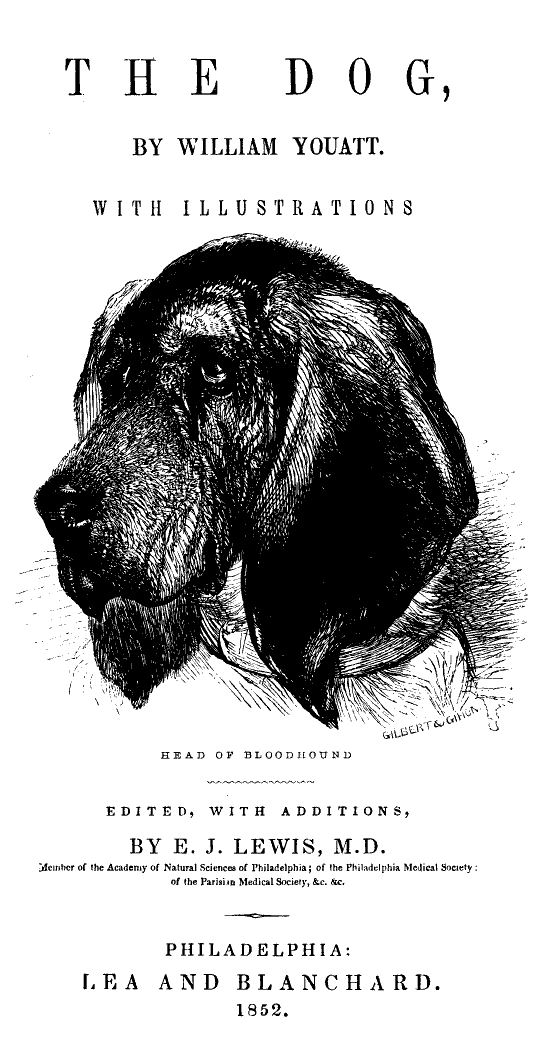
Mr. John Lawrence says, that a servant, discharged by a sporting country
gentleman, broke into his stables by night, and cut off the ears and
tail of a favourite hunter. As soon as it was discovered, a blood-hound
was brought into the stable, who at once detected the scent of the
miscreant, and traced it more than twenty miles. He then stopped at a
door, whence no power could move him. Being at length admitted, he ran
to the top of the house, and, bursting open the door of a garret, found
the object that he sought in bed, and would have torn him to pieces, had
not the huntsman, who had followed him on a fleet horse, rushed up after
him.
Somerville thus describes the use to which he was generally put, in
pursuit of the robber:
"Soon the sagacious brute, his curling tail
Flourished in air, low bending, plies around
His busy nose, the steaming vapour snuffs
Inquisitive, nor leaves one turf untried,
Till, conscious of the recent stains, his heart
Beats quick. His snuffing nose, his active tail,
Attest his joy. Then, with deep opening mouth,
That makes the welkin tremble, he proclaims
Th' audacious felon. Foot by foot he marks
His winding way. Over the watery ford,
Dry sandy heaths, and stony barren hills,
Unerring he pursues, till at the cot
Arrived, and seizing by his guilty throat
The caitiff vile, redeems the captive prey."
Contents/Detailed Contents, p. 3/Index
As this old document may prove interesting to the curious, we take the
liberty of inserting it, knowing full well, that Mr. Daniel's work is
quite rare in this country, and copies of it are not easily obtained
even in England.
Ribbesford, Oct. 7, 1685,
"I, John Harris, of Willdon, in the parish of Hastlebury, in the county of Worcester, yeoman, for and in consideration of ten shillings of lawful English money this day received of Henry Herbert of Ribbesford, in the said county, Esqr., and of thirty shillings more of like money by him promised to be hereafter pay'd me, do hereby covenant and promise to and with the said Henry Herbert, his exôrs and admôrs, that I will, from the day of the date hereof, untill the first day of March next, well and sufficiently mayntayne and keepe a Spanile Bitch named Quand, this day delivered into my custody by the said Henry Herbert, and will, before the first day of March next, fully and effectually traine up and teach the said Bitch to sitt Partridges, Pheasants, and other game, as well and exactly as the best sitting Doggers usually sett the same. And the said bitch, so trayned and taught, shall and will delivere to the said Henry Herbert, or whom he shall appoint to receive her, att his house in Ribbesford aforesaid, on the first day of March next. And if at anytime after the said Bitch shall, for want of use or practice, or orwise, forgett to sett Game as aforesaid, I will, at my costes and charges, maynetayne her for a month, or longer, as often as need shall require, to trayne up and teach her to sett Game as aforesaid, and shall and will, fully and effectually, teach her to sett Game as well and exactly as is above mentyon'd.
Witness my hand and seal the day and year first above written,
John Harris, his X mark.
Sealed and delivered in presence of
H. Payne, his X mark."
L.
The first person, however, who systematically broke-in setting dogs is
supposed to have been Dudley Duke of Northumberland in 1335.
A singular dog-cause was tried in Westminster, in July, 1822. At a
previous trial it was determined that the mere possession of a dog,
generally used for destroying game, was sufficient proof of its being
actually so used. Mr. Justice Best, however, determined that a man might
be a breeder of such dogs without using them as game-dogs; and Mr.
Justice Bailey thought that if a game-dog was kept in a yard, chained up
by day, and let loose at night, and, being so trained as to guard the
preimises, he was to be considered as a yard-dog, and not as a game-dog.
setter is used for the same purpose as the pointer, and there is
great difference of opinion with regard to their relative value as
sporting-dogs. Setters are not so numerous; and they are dearer, and
with great difficulty obtained pure. It was long the fashion to cross
and mix them with the pointer, by which no benefit was obtained, but the
beauty of the dog materially impaired; many Irish sportsmen, however,
were exceedingly careful to preserve the breed pure. Nothing of the
pointer can be traced in them, and they are useful and beautiful dogs,
altogether different in appearance from either the English or Scotch
setter. The Irish sportsmen are, perhaps, a little too much prejudiced
with regard to particular colours. Their dogs are either very red, or
red and white, or lemon-coloured, or white, patched with deep chestnut;
and it was necessary for them to have a black nose, and a black roof to
the mouth. This peculiar dye is supposed to be as necessary to a good
and genuine Irish setter as is the palate of a Blenheim spaniel to the
purity of his breed. A true Irish setter will obtain a higher price than
either an English or Scotch one. Fifty guineas constituted no unusual
price for a brace of them, and even two hundred guineas have been given.
It is nevertheless, doubtful whether they do in reality so much exceed
the other breeds, and whether, although stout and hard-working dogs, and
with excellent scent, they are not somewhat too headstrong and unruly.
The
is more active than the pointer. He has greater spirit and
strength. He will better stand continued hard work. He will generally
take the water when necessary, and, retaining the character of the
breed, is more companionable and attached. He loves his master for
himself, and not, like the pointer, merely for the pleasure he shares
with him. His somewhat inferior scent, however, makes him a little too
apt to run into his game, and he occasionally has a will of his own. He
requires good breaking, and plenty of work; but that breaking must be of
a peculiar character: it must not partake of the severity which too
often accompanies, and unnecessarily so, the tuition of the pointer. He
has more animal spirit than the pointer, but he has not so much patient
courage; and the chastisement, sometimes unnecessary and cruel, but
leaving the pointer perfect in his work, and eager for it too, would
make the setter disgusted with it, and leave him a mere
blinker
.
It is difficult, however, always to decide the claim of superiority
between these dogs. He that has a good one of either breed may be
content, but the lineage of that dog must be pure. The setter, with much
of the pointer in him, loses something in activity and endurance; and
the pointer, crossed with the setter, may have a degree of wildness and
obstinacy, not a little annoying to his owner. The setter may be
preferable when the ground is hard and rough; for he does not soon
become foot-sore. He may even answer the purpose of a springer for
pheasants and woodcocks, and may be valuable in recovering a wounded
bird. His scent may frequently be superior to that of the pointer, and
sufficiently accurate to distinguish, better than the pointer, when the
game is sprung; but the steadiness and obedience of the pointer will
generally give him the preference, especially in a fair and tolerably
smooth country. At the beginning of a season, and until the weather is
hot, the pointer will have a decided advantage.
We beg leave to finish this history of the setter by referring to our
essay on this dog, published in vol. xv, No. 47, of the New York Spirit
of the Times, or as lately transferred to the pages of an interesting
and valuable sporting work, about being published by our esteemed
friend, Wm. A. Porter, and from which we now abstract our remarks upon
Contents/Detailed Contents/Index
The Merits of the Setter Compared with Those of the Pointer.
It cannot for a moment be doubted that the setter has superior
advantages to the pointer, for hunting over our uncleared country,
although the pointer has many qualities that recommend him to the
sportsman, that the setter does not possess. In the first place, the
extreme hardiness and swiftness of foot, natural to the setter, enables
him to get over much more ground than the pointer, in the same space of
time. Their feet also, being more hard and firm, are not so liable to
become sore from contact with our frozen ground. The ball pads being
well protected by the spaniel toe-tufts, are less likely to be wounded
by the thorns and burs with which our woods are crowded during the
winter season. His natural enthusiasm for hunting, coupled with his
superior physical powers, enables him to stand much more work than the
pointer, and oftentimes he appears quite fresh upon a long continued
hunt, when the other will be found drooping and inattentive.
The long, thick fur of the setter, enables him to wend his way through briary thickets without injury to himself, when a similar attempt on the part of a pointer, would result in his ears, tail, and body being lacerated and streaming with blood.
On the other hand, the pointer is superior to the setter in retaining his acquired powers for hunting, and not being naturally enthusiastic in pursuit of game, he is more easily broken and kept in proper subjection.
The setter frequently requires a partial rebreaking at the commencement of each season, in his younger days, owing to the natural eagerness with which he resumes the sport. The necessity of this, however, diminishes with age, as the character and habits of the dog become more settled, and then we may take them into the field, with a perfect assurance of their behaving quite as well on the first hunt of the season, as the stanchest pointer would.
The extreme caution, and mechanical powers of the pointer in the field, is a barrier to his flushing the birds, as is often witnessed in the precipitate running of the setter, who winds the game and frequently overruns it in his great anxiety to come up with it. But this occasional fault on the part of the setter, may be counterbalanced by the larger quantity of game that he usually finds in a day's hunt, owing to his enthusiasm and swiftness of foot. Setters require much more water while hunting than the pointer, owing to their thick covering of fur, encouraging a greater amount of insensible perspiration to fly off than the thin and short dress of the pointer. Consequently they are better calculated to hunt in the coldest seasons than early in our falls, which are frequently quite dry and warm.
A striking instance of this fact came under our own immediate observation this fall, when shooting in a range of country thinly settled and uncommonly dry. The day being warm and the birds scarce, the dogs suffered greatly from thirst, in so much that a very fine setter of uncommon bottom, was forced to give up entirely, completely prostrated, foaming at the mouth in the most alarming manner, breathing heavily, and vomiting from time to time a thick frothy mucus.
His prostration of both muscular and nervous powers was so great, that he could neither smell nor take the slightest notice of a bird, although placed at his nose. He could barely manage to drag one leg after the other, stopping to rest every few moments, and we were fearful that we should be obliged to shoulder and carry him to a farm-house, a considerable distance off. However, he succeeded, with much difficulty, in reaching the well, where he greedily drank several pints of water administered to him with caution.
He recovered almost immediately, gave me a look of thanks, and was off to the fields in a few moments, where he soon found a fine covey of birds.
The pointer, his associate in the day's work, and a much less hardy dog, stood the hunt remarkably well, and seemed to suffer little or no inconvenience from the want of water. The setter has natural claims upon the sportsman and man generally, in his affectionate disposition and attachment to his master, and the many winning manners he exhibits towards those by whom he is caressed.
The pointer displays but little fondness for those by whom he is surrounded, and hunts equally as well for a stranger as his master. — L.
The long, thick fur of the setter, enables him to wend his way through briary thickets without injury to himself, when a similar attempt on the part of a pointer, would result in his ears, tail, and body being lacerated and streaming with blood.
On the other hand, the pointer is superior to the setter in retaining his acquired powers for hunting, and not being naturally enthusiastic in pursuit of game, he is more easily broken and kept in proper subjection.
The setter frequently requires a partial rebreaking at the commencement of each season, in his younger days, owing to the natural eagerness with which he resumes the sport. The necessity of this, however, diminishes with age, as the character and habits of the dog become more settled, and then we may take them into the field, with a perfect assurance of their behaving quite as well on the first hunt of the season, as the stanchest pointer would.
The extreme caution, and mechanical powers of the pointer in the field, is a barrier to his flushing the birds, as is often witnessed in the precipitate running of the setter, who winds the game and frequently overruns it in his great anxiety to come up with it. But this occasional fault on the part of the setter, may be counterbalanced by the larger quantity of game that he usually finds in a day's hunt, owing to his enthusiasm and swiftness of foot. Setters require much more water while hunting than the pointer, owing to their thick covering of fur, encouraging a greater amount of insensible perspiration to fly off than the thin and short dress of the pointer. Consequently they are better calculated to hunt in the coldest seasons than early in our falls, which are frequently quite dry and warm.
A striking instance of this fact came under our own immediate observation this fall, when shooting in a range of country thinly settled and uncommonly dry. The day being warm and the birds scarce, the dogs suffered greatly from thirst, in so much that a very fine setter of uncommon bottom, was forced to give up entirely, completely prostrated, foaming at the mouth in the most alarming manner, breathing heavily, and vomiting from time to time a thick frothy mucus.
His prostration of both muscular and nervous powers was so great, that he could neither smell nor take the slightest notice of a bird, although placed at his nose. He could barely manage to drag one leg after the other, stopping to rest every few moments, and we were fearful that we should be obliged to shoulder and carry him to a farm-house, a considerable distance off. However, he succeeded, with much difficulty, in reaching the well, where he greedily drank several pints of water administered to him with caution.
He recovered almost immediately, gave me a look of thanks, and was off to the fields in a few moments, where he soon found a fine covey of birds.
The pointer, his associate in the day's work, and a much less hardy dog, stood the hunt remarkably well, and seemed to suffer little or no inconvenience from the want of water. The setter has natural claims upon the sportsman and man generally, in his affectionate disposition and attachment to his master, and the many winning manners he exhibits towards those by whom he is caressed.
The pointer displays but little fondness for those by whom he is surrounded, and hunts equally as well for a stranger as his master. — L.
Of the difference between the old English setter and the setters of the
present day, we confess that we are ignorant, except that the first was
the pure spaniel improved, and the latter the spaniel crossed too
frequently with the pointer.
It must be acknowledged, that of companionableness, and disinterested
attachment and gratitude, the pointer knows comparatively little. If he
is a docile and obedient servant in the field, it is all we want. The
setter is unquestionably his superior in every amiable quality. Mr.
Blaine says, that a large setter, ill with the distemper, had been
nursed by a lady more than three weeks. At length he became so ill as to
be placed in a bed, where he remained a couple of days in a dying state.
After a short absence, the lady, re-entering the room, observed him to
fix his eyes attentively on her, and make an effort to crawl across the
bed towards her. This he accomplished, evidently for the sole purpose of
licking her hand, after which he immediately expired.
Daniel Lambert celebrated for his enormous magnitude, weighing seven
hundred and thirty-nine pounds, had a very superior breed of setters,
which were publicly sold, at the following prices; after his death,
which forcibly illustrates the immense value placed on this dog in
England; whereas, many American sportsmen considers it a great hardship
to be obliged to give thirty or forty dollars for a well-bred setter in
this country.
| dog's name | breed | Guineas |
| Peg | a black Setter Bitch | 41 |
| Punch | a Setter Dog | 26 |
| Brush | do. | 17 |
| Bob | do. | 30 |
| Bell | do. | 32 |
| Bounce | do. | 22 |
| Sam | do. | 26 |
| Charlotte | a Pointer Bitch | 22 |
| Lucy | do. | 12 |
| ____ | ||
| 218 [—L]. |
| The pointer is evidently descended from the hound. We beg leave to make the following extracts from our essay on this subject, published in No. 1, vol. xvi, of the Spirit of the Times: The origin of the pointer, like that of the setter, is involved in much obscurity; he is of mixed blood, and no doubt largely indebted to both hound and spaniel for his distinct existence. Many sportsmen are under the erroneous idea that the pointer is contemporary with, if not older than, the Setter. Such, however, is not the case; and we are led to believe that the Pointer is of quite modern origin; at all events, the production of a much later date than the spaniel. |
Strut, in his Sports and Pastimes, chap. 1, sects. xv. and xvi.,
mentions a MS. in the Cotton Library, originally written by William
Twici, or Twety, Grand Huntsman to Edward II, who ascended the throne in
1307.
This manuscript contains the earliest treatise on hunting that the English possess, and enumerates the various kinds of game and different species of dogs then in existence, as also the modes of taking the former and using the latter.
After describing, in the usual minute manner, the specific employment of each dog, he finishes by stating:
This manuscript contains the earliest treatise on hunting that the English possess, and enumerates the various kinds of game and different species of dogs then in existence, as also the modes of taking the former and using the latter.
After describing, in the usual minute manner, the specific employment of each dog, he finishes by stating:
"The spaniel was for use in hawking, hys crafte is for the perdrich or partridge, and the quail; and when taught to couch, he is very serviceable to the fowler, who takes these birds with nets."
No mention is made in this treatise of the pointer, and we naturally
infer that he did not exist, or he would have been noticed in connexion
with the spaniel, who, it appears, even at this early period, was taught
to couch on and point out game to those employed in netting it.
In the early portion of the sixteenth century, we have another enumeration of dogs, then in use, in a book entitled — A Jewel for Gentrie; which, besides the dogs already descanted upon by Twici, we find added to the list,
In the early portion of the sixteenth century, we have another enumeration of dogs, then in use, in a book entitled — A Jewel for Gentrie; which, besides the dogs already descanted upon by Twici, we find added to the list,
"bastards and mongrels, lemors, kenets, terrours, butchers' hounds, dung-hill dogs, trindel-tailed dogs, prychercard curs, and ladies' puppies."
(Chap. 1st., Sec. XVI. — Strut.)
The pointer being the offspring of the fox-hound and spaniel, is
consequently sprung from the two ancient races known as Sagaces
and Pugnaces or Bellicosi. He certainly evinces a larger
share of the Bellicosi blood than the setter, being ever ready
for fight when assailed, while the latter generally exhibits a
conciliatory disposition under the most trying circumstances. — L.
It is the fox-hound searching for game by the scent, but more perfectly
under the control of the sportsman, repressing his cry of joy when he
finds his game, and his momentary pause, and gathering himself up in
order to spring upon it artificially, converted into a steady and
deliberate point. There still remains a strong resemblance, in
countenance and in form, between the pointer and the fox-hound, except
that the muzzle is shorter, and the ears smaller, and partly pendulous.
or eighty years ago, the breed of pointers was nearly white, or
varied with liver-coloured spots; some, however, belonging to the Duke
of Kingston, were perfectly black. This peculiarity of colour was
supposed to be connected with exquisite perfection of scent. That is not
the case with the present black pointers, who are not superior to any
others.
. Daniel relates an anecdote of one of his pointers. He had a dog that
would always go round close to the hedges of a field before he would
quarter his ground. He seemed to have observed that he most frequently
found his game in the course of this circuit.
Mr. Johnson gives the following characteristic sketches of the different
breeds of pointer:
Contents/Detailed Contents, p. 3/Index
The Spanish Pointer,
originally a native of Spain, was once considered to be a valuable dog.
He stood higher on his legs, but was too large and heavy in his limbs,
and had widely spread, ugly feet, exposing him to frequent lameness. His
muzzle and head were large, corresponding with the acuteness of his
smell. His ears were large and pendent, and his body ill-formed. He was
naturally an ill-tempered dog, growling at the hand that would caress
him, even although it were his master's. He stood steadily to his birds;
but it was difficult to break him of chasing the hare. He was deficient
in speed. His redeeming quality was his excellent scent, unequalled in
any other kind of dog.
To convince our readers of the value of this particular breed, we may
mention the very singular sale of Colonel Thornton's dog Dash, who was
purchased by Sir Richard Symons for one hundred and sixty pounds worth
of champagne and burgundy, a hogshead of of claret, and an elegant gun
and another pointer, with a stipulation that if any accident befell
the dog, he was to be returned to his former owner for fifty guineas.
Dash unfortunately broke his leg, and in accordance with the agreement
of sale was returned to the Colonel, who considered him a fortunate
acquisition as a stallion to breed from. (See Blaine or Daniel). — L.
Contents/Detailed Contents, p. 3/Index
The Portugese Pointer,
although with a slighter form than the Spanish one, is defective in the
feet, often crooked in the legs, and of a quarrelsome disposition. He
soon tires, and is much inclined to chase the hare. The tail is larger
than that of the spaniel, and fully fringed.
Contents/Detailed Contents, p. 3/Index
The French Pointer
is distinguished by a furrow between his nostrils, which materially
interferes with the acuteness of smell. He is better formed and more
active than either the Spanish or Portugese dog, and capable of longer
continued exertion; but he is apt to be quarrelsome, and is too fond of
chasing the hare.
We will close this account of the Pointer by transferring from the
pages of the Spirit of the Times our remarks upon this particular
breed.
The French variety, as described by English authors, is much smaller than either of the above breeds; and although possessed of great beauty, acute scent, and other qualifications that would render him valuable in their eyes, still is considered much inferior, not being able to cope with their dogs in hunting, owing to a want of physical power of endurance.
Youatt states, that he is distinguished by a furrow in his nose, which materially interferes with his acuteness of smell.
These accounts do not agree with the French writers, to whom, it is very true, the English should not look for any particular information respecting hunting or shooting. Nevertheless, all must admit that they are quite as capable of describing their particular breeds of animals as other nations; and, in fact, we might go farther, and say that they are much more competent to the task than English writers, judging from their extensive knowledge in comparative anatomy, and their long array of celebrated writers on natural history — the Cuviers, Buffon, &c.
Baudrillart, in his Dictionnaire des Chases, describes the French Pointer as having endurance and great industry, and of their being used oftentimes solely for la grande chasse. In the atlas of plates accompanying this interesting work, will be found two distinct and extremely correct drawings of the English Pointer, and also an engraving of the French variety, which latter, certainly, is represented as being equally, if not more muscular and and hardy, than the English.
As for the furrow in the nose, as mentioned by Youatt, no reference is made to it in connection with this species, and in the engraving the nose is square. But in describing another variety, known in France as coming from Spain, Baudrillart states, that they are vulgarly called "à deux nez, parceque ce chien a les narines separées par une gouttiere."
As for Mr. Youatt's declaration in reference to the furrow in the nose "materially interfering with the acuteness of smell," I cannot understand how, or on what principle of reasoning, this slight deviation from nature should affect the properties of the olfactory apparatus. That these furrow-nosed dogs are inferior to the English in scenting powers, as stated by Mr. Youatt, we do not question; but that their deficiency depends upon this furrow, remains to be proved.
This furrow in the nose is merely a deformity, and like many others in various breeds of animals, was solely the result of accident in the first place; and as we often see, even in the human species, the deformities and infirmities of our ancestors entailed upon their progeny, so has this 'cut in the nose' been so extensively inherited by succeeding generations, that it has now become a distinctive mark of a whole class of dogs.
The French Pointer, as known in this country, is a beautiful, well-shaped, compact, square-nosed dog; not so long or high as the English, but extremely well built, full-chested, large head, pendent ears, projecting eyes, large feet, and thickish tail. His colour, seldom white, but generally intermingled with small spots of brown or chocolate over the body, and more particularly over the head and ears. Such a dog is in the possession of the writer, who knows nothing of his ancestry; but is convinced from those he saw in France, that they must have been imported from that country.
The English Pointer will now claim more particularly our attention. It is quite useless to go into a general description of an animal of whom we have already said much, and with whom we are all familiar; but we will endeavour to mention the most striking points of the species, which marks can be referred to as guides in the purchase of a dog.
It is a difficult matter to put on paper, in a manner satisfactory either to the reader or writer, the peculiarities of any animal, whereby he may be judged pure or mixed. However, there are, generally, some few points in each species, that can be selected as proofs of their genuineness and ability to perform certain actions peculiar to the race.
But, after all, more reliance must be placed upon the good faith of the seller, or the previous knowledge of the strain from which the purchaser selects — and what is better than either, from actual observation in the field; all of which precautions may, nevertheless, prove abortive, and our dog be worthless.
As regards the size of the English Pointer, we may say, that he averages in length about 3 feet from the tip of the muzzle to the base of the tail, and from 22 to 26 inches high. His head not bulky nor too narrow, the frontal sinuses largely developed.
The muzzle long and rather tapering, the nostrils large and well open, the ear slightly erect, not over long, and the tip triangular; if too pendent, large and rounded at the tip, there is too much of the hound present. The eyes lively, but not too prominent; the neck rather long and not over thick, ihe chest broad, the limbs large and muscular; the paws strong, hard and wide. The body and loins thin, rather than bulky, the hind quarters broad, and the limbs in the same proportion with the fore members; the tail long and tapering. — L.
The French variety, as described by English authors, is much smaller than either of the above breeds; and although possessed of great beauty, acute scent, and other qualifications that would render him valuable in their eyes, still is considered much inferior, not being able to cope with their dogs in hunting, owing to a want of physical power of endurance.
Youatt states, that he is distinguished by a furrow in his nose, which materially interferes with his acuteness of smell.
These accounts do not agree with the French writers, to whom, it is very true, the English should not look for any particular information respecting hunting or shooting. Nevertheless, all must admit that they are quite as capable of describing their particular breeds of animals as other nations; and, in fact, we might go farther, and say that they are much more competent to the task than English writers, judging from their extensive knowledge in comparative anatomy, and their long array of celebrated writers on natural history — the Cuviers, Buffon, &c.
Baudrillart, in his Dictionnaire des Chases, describes the French Pointer as having endurance and great industry, and of their being used oftentimes solely for la grande chasse. In the atlas of plates accompanying this interesting work, will be found two distinct and extremely correct drawings of the English Pointer, and also an engraving of the French variety, which latter, certainly, is represented as being equally, if not more muscular and and hardy, than the English.
As for the furrow in the nose, as mentioned by Youatt, no reference is made to it in connection with this species, and in the engraving the nose is square. But in describing another variety, known in France as coming from Spain, Baudrillart states, that they are vulgarly called "à deux nez, parceque ce chien a les narines separées par une gouttiere."
As for Mr. Youatt's declaration in reference to the furrow in the nose "materially interfering with the acuteness of smell," I cannot understand how, or on what principle of reasoning, this slight deviation from nature should affect the properties of the olfactory apparatus. That these furrow-nosed dogs are inferior to the English in scenting powers, as stated by Mr. Youatt, we do not question; but that their deficiency depends upon this furrow, remains to be proved.
This furrow in the nose is merely a deformity, and like many others in various breeds of animals, was solely the result of accident in the first place; and as we often see, even in the human species, the deformities and infirmities of our ancestors entailed upon their progeny, so has this 'cut in the nose' been so extensively inherited by succeeding generations, that it has now become a distinctive mark of a whole class of dogs.
The French Pointer, as known in this country, is a beautiful, well-shaped, compact, square-nosed dog; not so long or high as the English, but extremely well built, full-chested, large head, pendent ears, projecting eyes, large feet, and thickish tail. His colour, seldom white, but generally intermingled with small spots of brown or chocolate over the body, and more particularly over the head and ears. Such a dog is in the possession of the writer, who knows nothing of his ancestry; but is convinced from those he saw in France, that they must have been imported from that country.
The English Pointer will now claim more particularly our attention. It is quite useless to go into a general description of an animal of whom we have already said much, and with whom we are all familiar; but we will endeavour to mention the most striking points of the species, which marks can be referred to as guides in the purchase of a dog.
It is a difficult matter to put on paper, in a manner satisfactory either to the reader or writer, the peculiarities of any animal, whereby he may be judged pure or mixed. However, there are, generally, some few points in each species, that can be selected as proofs of their genuineness and ability to perform certain actions peculiar to the race.
But, after all, more reliance must be placed upon the good faith of the seller, or the previous knowledge of the strain from which the purchaser selects — and what is better than either, from actual observation in the field; all of which precautions may, nevertheless, prove abortive, and our dog be worthless.
As regards the size of the English Pointer, we may say, that he averages in length about 3 feet from the tip of the muzzle to the base of the tail, and from 22 to 26 inches high. His head not bulky nor too narrow, the frontal sinuses largely developed.
The muzzle long and rather tapering, the nostrils large and well open, the ear slightly erect, not over long, and the tip triangular; if too pendent, large and rounded at the tip, there is too much of the hound present. The eyes lively, but not too prominent; the neck rather long and not over thick, ihe chest broad, the limbs large and muscular; the paws strong, hard and wide. The body and loins thin, rather than bulky, the hind quarters broad, and the limbs in the same proportion with the fore members; the tail long and tapering. — L.
Contents/Detailed Contents, p. 3/Index
The Russian Pointer
is a rough, ill-tempered animal, with too much tendency to stupidity,
and often annoyed by vermin. He runs awkwardly, with his nose near the
ground, and frequently springs his game. He also has the cloven or
divided nose.
Contents/Detailed Contents, p. 3/Index
The Early Training of the Dog.
The education of these dogs should commence at an early period, whether
conducted by the breeder or the sportsman; and the first lesson — that on
which the value of the animal, and the pleasure of its owner, will much
depend — is a habit of subjection on the part of the dog, and kindness on
the part of the master. This is a
sine quâ non
. The dog must
recognise in his owner a friend and a benefactor. This will soon
establish in the mind of the quadruped a feeling of gratitude, and a
desire to please. All this is natural to the dog, if he is encouraged by
the master, and then the process of breaking-in may commence in good
earnest.
No long time probably passes ere the dog commits some little fault. He
is careless, or obstinate, or cross. The owner puts on a serious
countenance, he holds up his finger, or shakes his head, or produces the
whip, and threatens to use it. Perhaps the infliction of a blow, that
breaks no bones, occasionally follows. In the majority of cases nothing
more is required. The dog succumbs; he asks to be forgiven; or, if he
has been self-willed, he may be speedily corrected without any serious
punishment.
A writer, under the signature of "Soho," in
The New Sporting Magazine
for 1833, gives an interesting account of the schooling of the pointer
or setter, thus commenced. A short abstract from it may not be
unacceptable:
"The first lesson inculcated is that of passive obedience, and this enforced by the infliction of severity as little as the case will admit. We will suppose the dog to be a setter. He is taken into the garden or into a field, and a strong cord, about eighteen or twenty yards long, is tied to his collar. The sportsman calls the dog to him, looks earnestly at him, gently presses him to the ground, and several times, with a loud, but not an angry voice, says, 'Down!' or 'Down charge!' The dog knows not the meaning of this, and struggles to get up; but, as often as he struggles, the cry of 'Down charge!' is repeated, and the pressure is continued or increased.
"This is repeated a longer or shorter time, until the dog, finding that no harm is meant, quietly submits. He is then permitted to rise; he is patted and caressed, and some food is given to him. The command to rise is also introduced by the terms 'Hie up!' A little afterwards the same process is repeated, and he struggles less, or perhaps ceases altogether to struggle.
"The person whose circumstances permit him occasionally to shoot over his little demesne, may very readily educate his dog without having recourse to keepers or professional breakers, among whom he would often be subject to imposition. Generally speaking, no dog is half so well broken as the one whose owner has taken the trouble of training him. The first and grand thing is to obtain the attachment of the dog, by frequently feeding and caressing him, and giving him little hours of liberty under his own inspection; but, every now and then, inculcating a lesson of obedience, teaching him that every gambol must be under the control of his master; frequently checking him in the midst of his riot with the order of 'Down charge!' patting him when he is instantly obedient; and rating, or castigating him, but not too severely, when there is any reluctance to obey. Passive obedience is the first principle, and from which no deviation should be allowed.1
"Much kindness and gentleness are certainly requisite when breaking-in the puppy, whether it be a pointer or a setter. There is heedlessness in the young dog which is not readily got rid of until age has given him experience. He must not, however, be too severely corrected, or he may be spoiled for life. If considerable correction is sometimes necessary, it should be followed, at a little distance of time, by some kind usage. The memory of the suffering will remain; but the feeling of attachment to the master will also remain, or rather be increased. The temper of a young dog must be almost as carefully studied as that of a human being. Timidity may be encouraged, and eagerness may be restrained, but affection must be the tie that binds him to his master, and renders him subservient to his will.
"The next portion of the lesson is more difficult to learn. He is no longer held by his master, but suffered to run over the field, seemingly at his pleasure, when, suddenly, comes the warning 'Down!' He perhaps pays no attention to it, but gambols along until seized by his master, forced on the ground, and the order of 'Down!' somewhat sternly uttered.
"After a while he is suffered again to get up. He soon forgets what has occurred, and gallops away with as much glee as ever. Again the 'Down!' is heard, and again little or no attention is paid to it. His master once more lays hold of him and forces him on the ground, and perhaps inflicts a slight blow or two, and this process continues until the dog finds that he must obey the command of 'Down charge!'
"The owner will now probably walk from him a little way backward with his hand lifted up. If the dog makes the slightest motion, he must be sharply spoken to, and the order peremptorily enforced.
"He must then be taught to 'back,' that is, to come behind his master when called. When he seems to understand all this, he is called by his master in a kindly tone, and patted and caressed. It is almost incredible how soon he will afterwards understand what he is ordered to do, and perform it.
"It will be seen by this that no one should attempt to break-in a dog who is not possessed of patience and perseverance. The sportsman must not expect to see a great deal of improvement from the early lessons. The dog will often forget that which was inculcated upon him a few hours before; but perseverance and kindness will effect much: the first lessons over, the dog, beginning to perceive a little what is meant, will cheerfully and joyfully do his duty.
"When there is much difficulty in teaching the dog his lesson, the fault lies as often with the master as with him; or they are, generally speaking, both in fault. Some dogs cannot be mastered but by means of frequent correction. The less the sportsman has to do with them the better. Others will not endure the least correction, but become either ferocious or sulky. They should be disposed of as soon as possible. The majority of dogs are exceedingly sagacious. They possess strong reasoning powers; they understand, by intuition, almost every want and wish of their master, and they deserve the kindest and best usage.
"The scholar being thus prepared, should be taken into the field, either alone, or, what is considerably better, with a well-trained, steady dog. When the old dog makes a point, the master calls out, 'Down!' or 'Soho!' and holds up his hand, and approaches steadily to the birds; and, if the young one runs in or prepares to do so, as probably he will at first, he again raises his hand and calls out, 'Soho!' If the youngster pays no attention to this, the whip must be used, and in a short time he will be steady enough at the first intimation of game.
"If he springs any birds without taking notice of them, he should be dragged to the spot from which they rose, and, 'Soho!' being cried, one or two sharp strokes with the whip should be inflicted. If he is too eager, he should be warned to 'take heed.' If he rakes or runs wilh his nose near the ground, he should be admonished to hold up, and, if he still persists, the muzzle-peg may be resorted to. Some persons fire over the dog for running at hares: but this is wrong; for, besides the danger of wounding or even killing the animal, he will for some time afterwards he frightened at the sound, or even at the very sight of a gun. The best plan to accustom dogs to the gun, is occasionally to fire one off when they are being fed.
"Some persons let their dog fetch the dead birds. This is very wrong. Except the sportsman has a double-barrelled gun, the dog should not be suffered to move until the piece is again charged. The young one, until he is thoroughly broken of it, is too apt to run in whether the bird is killed or not, and which may create much mischief by disturbing the game.
"Although excessive punishment should not be administered, yet no fault, however small, should pass without reproof: on the other hand, he should be rewarded, but not too lavishly, for every instance of good conduct.
"When the dog is grown tolerably steady, and taught to come at the call, he should also learn to range and quarter his ground. Let some clear morning, and some place where the sportsman is likely to meet with game, be selected. Station him where the wind will blow in his face; wave your hand and cry, 'Heigh on, good dog!' Then let him go off to the right, about seventy or eighty yards. After this, call him in by another wave of the hand, and let him go the same distance to the left. Walk straight forward with your eye always upon him; then, let him continue to cross from right to left, calling him in at the limit of each range.
"This is at first a somewhat difficult lesson, and requires careful teaching. The same ground is never to be twice passed over. The sportsman watches every motion, and the dog is never trusted out of sight, or allowed to break fence. When this lesson is tolerably learned, and on some good scenting morning early in the season, he may take the field, and perhaps find. Probably he will be too eager, and spring his game. Make him down immediately, and take him to the place where the birds rose. Chide him with 'Steady!' 'How dare you!' Use no whip; but scold him well, and be assured that he will be more cautious. If possible, kill on the next chance. The moment the bird is down, he will probably rush in and seize it. He must be met with the same rebuff, 'Down charge!' If he does not obey, he deserves to have, and will have, a stroke with the whip. The gun being again charged, the bird is sought for, and the dog is suffered to see it and play with it for a minute before it is put into the bag.
"He will now become thoroughly fond of the sport, and his fondness will increase with each bird that is killed. At every time, however, whether he kills or misses, the sportsman should make the dog 'Down charge.' and never allow him to rise until he has loaded.
"If a hare should be wounded, there will, occasionally, be considerable difficulty in preventing him from chasing her. The best broken and steadiest dog cannot always be restrained from running hares. He must be checked with 'Ware chase,' and, if he does not attend, the sportsman must wait patiently. He will by-and-by come slinking along with his tail between his legs, conscious of his fault. It is one, however, that admits of no pardon. He must be secured, and, while the field echoes with the cry of 'Ware chase,' he must be punished to a certain but not too great extent. The castigation must be repeated as often as he offends; or, if there is much difficulty in breaking him of the habit, he must be got rid of."