
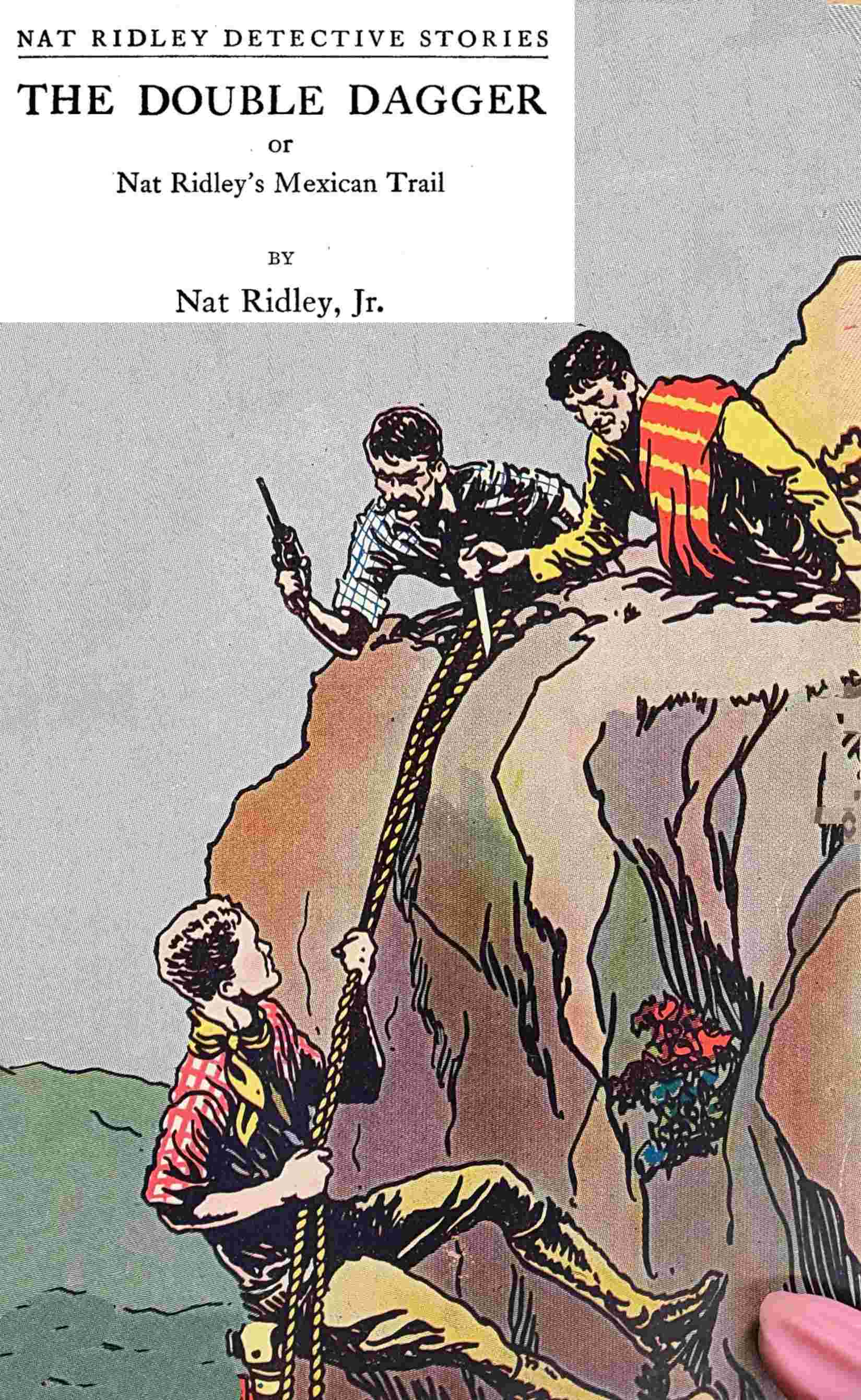
CHAPTER XXIV
OVER THE LINE
Late into the night, yes, almost until the red sun was ready to rise and shine down into the village of Paz amid the Mexican hills, did El Capitan, Don Castro, Pedro and the "killers" hold conference in the back room of the adobe saloon. Now the voices were high pitched and now they were low, and all the while the deaf mute sat in his corner, nodding, sleeping, and sometimes smiling.
At last a plan was agreed upon and certain men of the company girded their pistol belts tighter about them. They were given money by El Capitan and then they went out into the gray and reddening dawn to where their horses awaited.
"Fail not!" ordered the big chief. "The son of Gringo pig must die!"
"He shall die!" promised Latro, with a cruel smile on his face. "We shall meet with our comrades in Paloma and it will be strange if, between us, we shall not find him."
"In Paloma, then, I will join you on the day agreed," said El Capitan.
Again the brown and wrinkled deaf mute in his corner smiled. Then the leader seemed to remember the mute messenger with the double dagger, for he turned to Don Castro and said:
"Now we shall see what he wants. A pest upon him for coming at such a time! It is money he desires, I doubt not."
And money was just what the aged member of the Tola gang had come for. It appeared, from what he wrote down on dirty pieces of paper, that he was a member of a distant branch of the gang that had its headquarters in the mountains. It was composed of poor peons, but they had been promised a share in the oil wells, the profits of which were to be divided among the Tolas.
It further appeared that El Capitan, Don Castro and the others, not having sufficient funds of their own to wrest back from the Lemberg family the wonderfully profitable wells, had levied contributions from every member of the gang, rich and poor, promising in return money when the wells should once more be owned by the ancient society.
"And this fellow says he and his fellow villagers are so poor from the failure of their crops and because of the money they have given us to get back our wells that they are starving," said El Capitan when he had read what the deaf mute wrote. "A pest upon them! Why could they not wait?" He walked the floor in anger.
"What is to be done?" asked Don Castro.
"What would you have?" retorted El Capitan. "We cannot afford disaffection. These mountain members, though they add little to our success, must still be considered. But I am tired of this pencil scratching, Castro. You deal with this mute. Write him that if he will wait a few days he shall have money to take to his friends. By that time we shall have our wells back."
"If we get the girl and kill that devil of a detective—maybe," added Don Castro, with a shrug of his shoulders.
"We will!" declared the leader. "Deal you, Castro, with our member from the mountains. Pacify him—tell him to wait and all will be well."
"I suppose he is a member," suggested the other.
"Did he not have the double dagger? Who else but a member would dare show it? He is a true Tola. Treat him well. And now we shall hope for the best. I am weary—I would sleep!"
So while El Capitan staggered off to his room, Don Castro wrote more messages to the deaf mute who read them slowly—and smiled.
It was several days after this, during which time El Capitan, together with several of his most trusted men, had departed on a mission, that Don Castro, sauntering one day into the café headquarters of the Tola gang, inquired for Zenna, which, the deaf mute had written, was his name.
"He is gone," the café proprietor answered.
"Gone?"
"Yes. He left in the night. Someone came to him with a note and he departed hurriedly. Why? Was I supposed to detain him? Is all not right?"
"I don't know about the last," said Don Castro slowly. "I hope so. Certainly you had no orders to detain him. I wonder if he was a Tola."
"He had the double dagger," replied the café owner, who was also one of the ruthless gang. "I saw him springing the blades in and out as he sat here early in the evening."
"Yes, he had the double dagger," agreed Don Castro. "But I wonder—I wonder!" Then, with a shrug of his shoulders he added: "But El Capitan said he was one of us, and El Capitan should know."
Meanwhile the bent and aged deaf mute was making good time over the mountain trails on the mule that had brought him to the village of Paz. And, as he hastened forward, now and then he took out the double dagger and looked at it. Ever and anon he smiled, wrinkling his bronzed face.
In a little adobe hut, long and narrow, several men were gathered one hot, sultry evening. Two of the party were cowboys, by their dress. One spoke in slow, drawling tones and moved but seldom. The other was tall and slim.
Two others of the party were evidently Easterners, as their pale faces, in contrast to the bronzed complexions of their companions, plainly showed.
"Well, Baldy," remarked one of these latter, "we're a long, long way from Times Square."
"You said it, Berry!" responded the other. "But this is the place the chief told us to report to, isn't it?"
"You got it right, gentlemen," said the tall, thin cowboy. "Me an' Lazy Ike doped this out as the best place to pull off the party; didn't we, Ike?" he asked his companion who had gone into another part of the long, low building which was divided in the middle by a partition containing a door. "Where's Ike?" he asked, looking at Baldy and Berry.
"I crossed over into Mexico to get me a match for my cigarette," answered Lazy Ike, coming through the door. "Now I'm in the U. S. A. once more," he went on as he sat down with the others.
"Is it true?" asked Baldy Stoler of Slim Burke, "that this building is right over the line between the United States and Mexico?"
"You got it right, buddy," was the answer. "It was built for a saloon, after prohibition started, so liquor could be sold to thirsty United Staters who didn't want to go into Mexico. They could come in here and imbibe and still be on Uncle Sam's land. In case of a raid the red-eye and forty-rod could be hustled over to the other side of the saloon, on to Mexican territory, and the prohibition people couldn't do a thing. It got so, after a while, that the United States authorities and the Mexican government made an agreement and this place was wiped out by a joint raid. Since then this shack is in charge of the military authorities of both countries."
"And when Nat telephoned Baldy and me to come here," said Berry, "and when we met you two cowboys, you said this was the best place for the trick."
"It is," asserted Slim Jim. "It's just over the line, you see."
Others in the crowd listened to this talk. Hard-fisted men they were, and ready with their guns. Baldy looked at his watch and remarked:
"It's about time he was here if he's coming."
At that moment a door in the Mexican end of the building opened and an old man shuffled in. Bent and wrinkled he was, and stained and dusty from long travel.
"What do you want?" called Ike sharply. "Who are you?"
"Excuse me, señor, but I am deaf and dumb," was the reply.
For a moment this remarkable statement seemed to shock them all into silence, and then Berry Todd laughed and cried:
"It's the chief himself—Nat Ridley!"
"Hush!" cautioned the detective, for he it was. "They are on the way. They will soon be here. Into the other room with you—the United States side and wait for my whistle. Have your guns ready."
"That's something we won't have nothin' else but," declared Lazy Ike with his characteristic drawl.
A little later the aged Mexican seemed to be alone in the long, narrow building that straddled the international line. He sat in a chair, waiting, waiting, with a queer smile on his brown face.
Presently he heard the sound of horses ambling along the road, and the smile changed to a stern expression. He rose as several men opened the door and came in, El Capitan and Don Castro among them.
"He is here!" exclaimed the leader, glancing at the Mexican. "I thought he was one of us, though you doubted him, Don Castro. Now then, somebody, write and ask him where he has the girl and that pig of a detective. I must have a drink," and El Capitan drew out a flask while Don Castro wrote the questions of his chief on a piece of paper which he handed the old Mexican, who had appointed this rendezvous after his sudden flight from Paz.
But the deaf mute seemed to have some difficulty in reading the writing. He held it up beneath a candle spluttering in a wall sconce. And, as he raised his arms, Don Castro gave a cry of alarm.
"What is it?" cried El Capitan, nearly choking himself as he stopped his drink half taken. "What is it?"
"We are betrayed!" shouted Don Castro. "See! This man is no peon! He is in disguise! His skin is stained! I doubted him from the first. Now I am sure!"
With a quick motion Don Castro pulled back the sleeve from the upraised arm of the man reading the note. And while the hand and wrist were stained a mahogany brown, the remainder of the arm was glistening white skin.
"Son of a pig!" hissed El Capitan as, from an inner pocket, he drew his double dagger and sprang toward Nat Ridley.