
“Just come with me as far as the studio,” said Paxton, “and having seen that all’s well I’ll let you out by the garden door.”
Accordingly, we donned our coats and hats, and followed our host to the end of the garden, where his studio was situated. The door unlocked, we all three stepped inside the place and gazed upon the figure of Nicris—the pallid face and arms seeming almost unearthly in the cold moonlight, wherein each jewel of the girdle and headdress glittered strangely.
“Of course,” muttered Coram, “the thing’s altogether irregular—a fact which the critics will not fail to impress upon you; but it is unquestionably very fine, Paxton. How uncannily human it is! I don’t entirely envy you your bedchamber, old man!”
“Oh, I sleep well enough,” laughed Paxton. “No luxury, though; just this corner curtained off and a camp bedstead.”
“A truly Spartan couch!” I said. “Well, good-night, Paxton. We shall probably see you to-morrow—I mean later to-day!”
With that we parted, leaving the sculptor to his lonely vigil at the shrine of Nicris, and as my rooms were no great distance away, some half-hour later I was in bed and asleep.
I little suspected that I had actually witnessed the commencement of one of the most amazing mysteries which ever cried out for the presence of Moris Klaw.
II
Some few minutes subsequent to retiring—or so it seemed to me; a longer time actually had elapsed—I was aroused by the ringing of my telephone bell. I scrambled sleepily out of bed and ran to the instrument.
Coram was the caller. And now, fully awake, I listened with an ever-growing wonder to his account of that which had prompted him to ring me up. Briefly, it amounted to this: some mysterious incident, particulars of which he omitted, had aroused Paxton from his sleep. Seeking the cause of the disturbance, the artist had unlocked the studio door and gone out into the garden. He was absent but a moment and never out of earshot of the door; yet, upon his return, the statue of Nicris had vanished!
“I have not hesitated to ’phone through to Wapping,” concluded Coram, “and get a special messenger sent to Moris Klaw. You see, the matter is urgent. If the statue cannot be recovered, its loss may spell ruin for Paxton. He had heard me speak of Moris Klaw and of the wonders he worked in the Greek Room mysteries, and, accordingly, called me up. I knew, if Klaw came, you would be anxious to be present.”
“Certainly,” I replied, “I wouldn’t miss one of his inquiries for anything. Shall I meet you at Paxton’s?”
“Yes.”
I lost little time in dressing. From Coram’s brief account, the mystery appeared to be truly a dark one. Would Moris Klaw respond to this midnight appeal? There was little chance of a big fee, for Paxton was not a rich man; but in justice to the remarkable person whom it is my privilege to present to you in these papers, I must add that monetary considerations seemingly found no place in Klaw’s philosophy. He acted, I believe, from sheer love of the work; and this affair, with its bizarre details—the ancient girdle of the dancing girl—the fear of the model, who had declared that the statue moved—was such, I thought, as must appeal to him.
Ten minutes later I was at Paxton’s house. He and Coram were in the hall, and Coram admitted me.
“Do you mean,” he asked of Paxton, pursuing a conversation which my advent had interrupted, “that the statue melted into the empty air?”
“The double doors opening on to the street were securely locked and barred; that of the garden was also locked; I was in the garden and not ten yards from the studio,” was Paxton’s reply. “Nevertheless, Nicris had vanished, leaving no trace behind!”
Incredible though the story appeared, its confirmation was to be found in the speaker’s face. I was horrified to see how haggard he looked.
“It will ruin me!” he said, and reiterated the statement again and again.
“But, my dear fellow,” I cried, “surely you have not given up hope of recovering the statue? After all, such a robbery as this can scarcely have been perpetrated without leaving some clue behind.”
“Robbery!” repeated Paxton, looking at me strangely; “you would be less confident that it is a case of robbery, Searles, if you had heard what I heard!”
I glanced at Coram, but he merely shrugged his shoulders.
“What do you mean?” I said.
“Then Coram has not told you?”
“He has told me that something aroused you in the night and that you left the studio to investigate the matter.”
“Correct, so far. Something did arouse me; and the thing was a voice!”
“A voice?”
“It would be, I suppose, about two hours after you had gone, and I was soundly asleep in the studio, when I suddenly awoke and sat up to listen, for it seemed to me that I heard a cry immediately outside the door.”
“What kind of cry?”
“Of that I was not, at first, by any means certain; but after a brief interval the cry was repeated. It sounded more like the voice of a boy than that of a man and it uttered but one word: ‘Nicris!’ ”
“And then?”
“I sprang on to the floor and stood for a moment in doubt—the thing seemed so uncanny. The electric light is not, as you know, installed in the studio, or I should have certainly switched it on. For possibly a minute I hesitated, and then, as I pulled the curtains aside and stood by the door to listen, for the third time the cry was repeated and was now coming indisputably from immediately outside.”
“You refer to the door that opens on to the garden?”
“Exactly—close to which stands my bed. This, then, decided me. Taking up the small revolver which I have always kept handy since Nicris was completed, I unlocked the door and stepped out into the garden——”
A vehicle, cab or car, was heard to draw up outside the house. Came the sound of a rumbling voice. Coram sprang to the door.
“Moris Klaw!” I cried.
“Good morning, Mr. Coram!” said the strange voice, from the darkness outside. “Good morning, Mr. Searles!”
Moris Klaw entered.
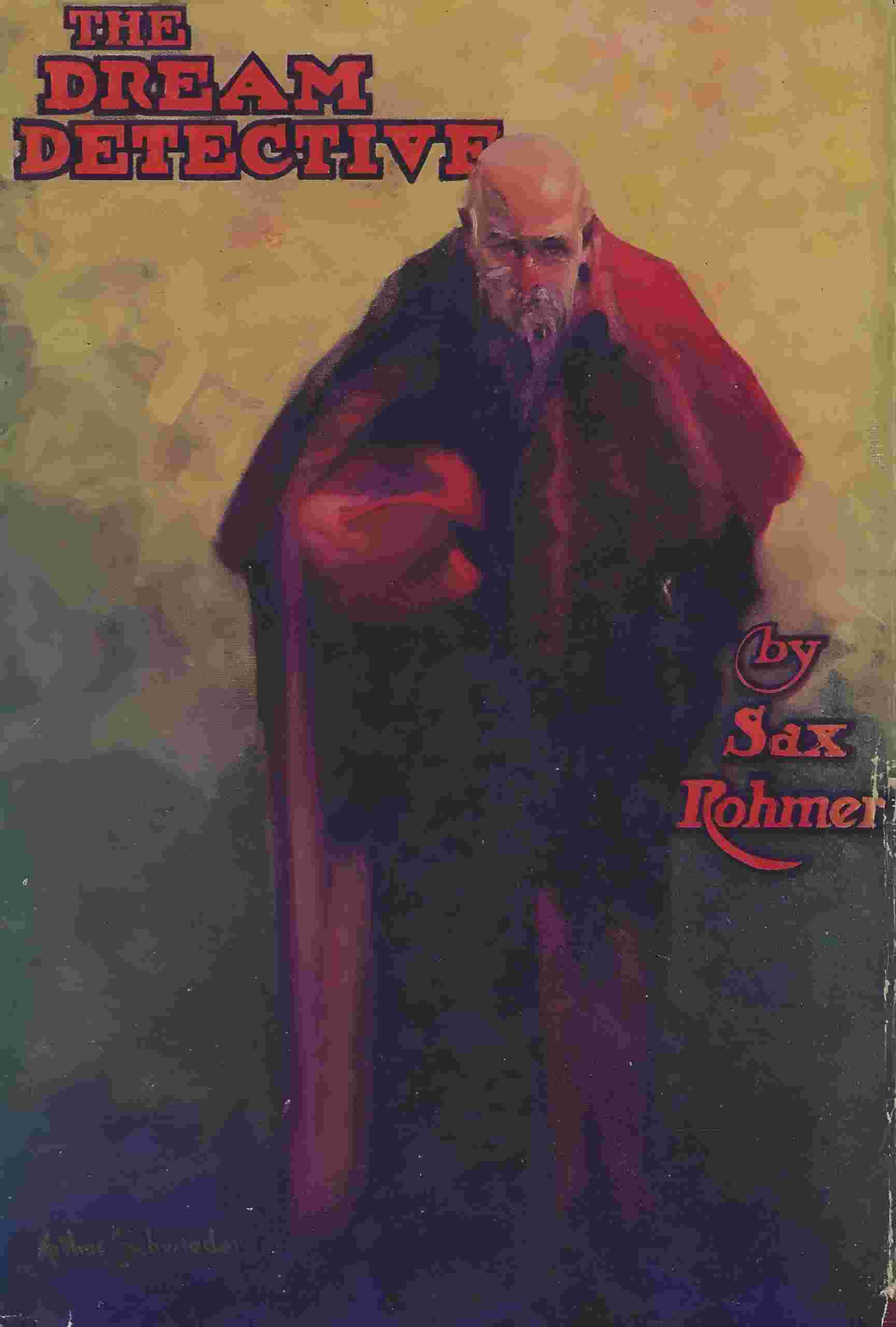
He wore his flat-topped brown bowler of effete pattern; he wore his long, shabby, caped coat; and from beneath it gleamed the pointed glossy toe-caps of his continental boots. Through his gold-rimmed glasses he peered into the shadows of the hall. His scanty, colourless beard appeared less adequate than ever to clothe the massive chin. The dim light rendered his face more cadaverous and more yellow even than usual.
“And this,” he proceeded, as the anxious sculptor came forward, “is Mr. Paxton, who has lost his statue? Good morning, Mr. Paxton!”
He bowed, removing the bowler and revealing his great high brow. Coram was about to reclose the door.
“Ah, no!” Moris Klaw checked him. “My daughter is to come yet with my cushion!”
Paxton stared, not comprehending, but stared yet harder when Isis Klaw appeared, carrying a huge red cushion. She was wrapped in a cloak which effectually concealed her lithe figure, and from the raised hood her darkly beautiful face looked out with bewitching effect. She divided between Coram and myself one of her dazzling smiles.
“It is Mr. Paxton,” said her father, indicating the sculptor. Then, indicating the girl, “It is my daughter, Isis. Isis will help us to look for Nicris. Why am I here, an old fool who ought to be asleep? Because of this girdle your statue wore. I so well remember when it was dug up. I cannot know its history, but be sure it is evil. From the beginning, please, Mr. Paxton!”
“I’m awfully indebted to you! Won’t you come in and sit down?” said Paxton, glancing at the girl in bewilderment.
“No, no!” replied Klaw, “let us stand. It is good to stand, and stand upright; for it is because he can do this that man is superior to the other animals!”
Coram and I knew Klaw’s mannerisms, but I could see that Paxton thought him to be a unique kind of lunatic. Nevertheless, he narrated something of the foregoing up to the point reached at Moris Klaw’s arrival.
“Proceed slowly, now,” said Klaw. “You left the door open behind you?”
“Yes; but I was never more than ten yards from it. It would have been physically impossible for any one to remove the statue unknown to me. You must remember that it was no light weight.”
“One moment,” I interrupted. “Are you sure that the statue was in its place before you came out?”
“Certain! There was a bright moon, and the figure was the first thing my eyes fell upon when I pulled the curtain aside.”
“Did you touch it?” rumbled Moris Klaw.
“No. There was no occasion to do so.”
“How much to be regretted, Mr. Paxton! The sense of touch is so exquisite a thing!”
We all wondered at his words.
“Stepping just outside the door,” Paxton resumed, “I looked to right and left. There was no one in sight. Then I walked to the wall—a matter of some ten yards—and, pulling myself up by my hands, looked over into the street. It was deserted, save for a constable on the opposite corner. I know him, slightly, and his presence convinced me that no one could either have come into or gone out of the garden by way of the wall. I did not call him, but immediately returned to the studio door.”
“In all, you were absent from the studio about how long?” asked Moris Klaw.
“Not a second over half a minute!”
“And on returning once more to the door?”
“A single glance showed me that the statue had gone!”
“Good Heavens!” I said; “it sounds impossible. Was the constable on point duty?”
“He was; there is always an officer there. He stood in sight of the double doors opening on to the street during the whole time, so that ‘Nicris’ unquestionably came out by way of the garden or melted into thin air. Since the only exit from the garden also opens on to the street, how, but by magic, can the statue have been removed from the premises?”
“Ah, my friend,” said Moris Klaw, “you talk of magic as one talks of onions! How little you know”—he swept wide his arms, looking upward—“of the phenomena of the two atmospheres! Proceed!”
“The throne,” continued Paxton, who was becoming impressed as was evident by the uncanny sense of power which emanated in some way from Moris Klaw, “remains.”
“And the statue—it was attached to it?”
“As to the figure being attached, I may say that it was only partially so. Materials for completing the work were to have arrived to-day.”
“How long would it have taken to detach it?” growled Klaw.
“Granting some knowledge of the nature of the work, not long—for, as I have said, in this respect it was incomplete. Half an hour or so, I should have believed!”
“Then,” I said, “the matter, in brief, stands thus: In the course of thirty seconds, during which time a constable was in view of one entrance and you were ten yards from the other, someone detached the statue from the throne—an operation involving half an hour’s skilled labour—and, unseen by yourself or the officer, removed it from the premises.”
“Oh, the thing is impossible!” groaned Paxton. “There is something unearthly in the affair. I wish I had never set eyes upon that accursed girdle!”
“Curse not the girdle,” rumbled Moris Klaw. “Curse instead its wearer, and inform us, on finding Nicris to be missing, what did you do?”
“I hastily searched the studio. A brief investigation convinced me that neither statue nor thief was concealed there. I then came out, locked the door, and, having examined the garden, hailed the constable. He had been on duty for four hours at that point and had observed absolutely nothing of an unusual nature. He saw you fellows come out by the garden entrance, and from that time until I hailed him, nothing, he declared, had come in or gone out!”
“He heard no cry?”
“No; it was not loud enough to be audible from the corner.”
“Lastly,” said Klaw, “have you informed Scotland Yard?”
“No,” answered the sculptor; “nor will the constable lodge information; moreover, I withheld from him the object of my inquiries. If this business gets into the papers I shall be a ruined man!”
“I have hopes,” Klaw assured him, “that it will get in no papers. Let us proceed now to the scene of these wonderful happenings. It is my custom, Mr. Paxton, to lay my old head down upon the scene of a mystery, and from the air I can sometimes recover the key to the labyrinth!”
“So I have heard,” said Paxton.
“You have heard so, yes? You shall see! Lead on, Mr. Paxton! No time must be wasted. I am another like Napoleon, and can sleep on an instant. I do not know insomnia! Lead on. Isis, my child, be careful that it brushes against no object in passing—my odically sterilized cushion!”
We proceeded to the studio.
“I feel that I am responsible for dragging you here at this unearthly hour,” said Paxton to Isis Klaw.
She turned her fine eyes upon him.
“My father is indebted for the opportunity,” she replied; “and since he has need of me, I am here. I, too, am indebted.”
Her supreme self-possession and tone of finality silenced the artist. So far as I could see, everything in the studio was exactly as before, save that Nicris’s throne was vacant. The top of the studio was partially glazed, and Moris Klaw peered up at it earnestly.
“From above,” he rumbled, “I should wish to look down into below. How do I reach it?”
“The only stepladder is that in the studio,” answered Paxton. “I will bring it out.”
He did so. The gray light of dawn was creeping into the sky, and against that sombre background we watched Moris Klaw crawling about the roof like some giant spider.
“Did you find anything?” asked Paxton, anxiously, as the investigator descended.
“I find what I look for,” was the reply; “and no man is entitled to find more. Isis, my child, place that cushion in the ebony chair.”
The girl stepped on to the dais, and disposed the red cushion as directed.
“You see,” explained Morris Klaw, “whoever has robbed you, Mr. Paxton, runs some one great danger, however clever his plans. There is, in every criminal scheme, one little point that only Fate can decide—either to hitch or to smooth out—to bring success and riches or whistling policemen and Brixton Gaol! Upon that so critical point his or her mind will concentrate at the critical moment. The critical moment, here, was that of getting Nicris out of your studio.
“I sleep upon that throne where she reclined—the ivory dancer. This sensitive plate”—he tapped his brow—“will reproduce a negative of that critical moment as it seemed in the mind of the one we look for. Isis, return in the cab that waits and be here again at six o’clock.”
He placed his quaint bowler upon a table and laid beside it his black cloak. Then, a ramshackle figure in shabby tweed, reclined upon the big ebony chair, his head against the cushion.
“Place my cloak about me, Isis.”
The girl did so.
“Good morning, my child! Good morning, Mr. Searles! Good morning, Mr. Coram and Mr. Paxton!”
He closed his eyes.
“Excuse me,” began Paxton.
Isis placed her finger to her lips, and signed to us to withdraw silently.
“Ssh!” she whispered. “He is asleep!”
III
At five minutes to six sounded Isis Klaw’s ring upon the door bell. Paxton, Coram, and I had spent the interval in discussing the apparently supernatural happening which threatened to wreak the artist’s ruin. Again and again he had asked us, “Should I call in the Scotland Yard people? If Moris Klaw fails, consider the priceless time lost!”
“If Moris Klaw fails,” Coram assured him, “no one else will succeed!”
We admitted Isis, who wore now a smart tweed costume and a fashionable hat. Beyond doubt, Isis Klaw was strikingly beautiful.
At the door of the studio stood her father, staring straight up to the morning sky, as though by astrological arts he hoped to solve the mystery.
“What time does your model come?” he asked, ere Paxton could question him.
“Half-past ten. But, Mr. Klaw——” began our anxious friend.
“Where does it lead to,” Klaw rumbled on, “that lane behind the studio?”
“Tradesmen’s entrance to the next house.”
“Whose house?”
“Doctor Gleason.”
“M.D.?”
“Yes. But tell me, Mr. Klaw—tell me, have you any clue?”
“My mind, Mr. Paxton, records for me that Nicris was not stolen away, but walked! Plainly, I feel her go tiptoe, tiptoe, so silent and cautious! She is concerned, this barbaric dancing girl who escapes from your studio, with two things. One is some very big man. She thinks, as she tiptoes, of one very tall: six feet and three inches at least! So it is not of you she thinks, Mr. Paxton. We shall see of whom it is. Tell me the name of your acquaintance, the point-policeman.”
We were all staring at Moris Klaw, spellbound with astonishment. But Paxton managed to mumble:
“James—Constable James.”
“We shall seek him, this James, at the section house of the police depot,” rumbled Klaw. “Be silent, Mr. Paxton; let no one know of your loss. And hope.”
“I can see no ground for hope!”
“No? But I? I recognize the clue, Mr. Paxton! What a great science is that of mental photography!”
What did he mean? None of us could surmise, and I could see that poor Paxton reposed no faith whatever in the eccentric methods of the investigator. He would have voiced his doubts, I think, but he met a glance from the dark eyes of Isis Klaw which silenced him.
“My child,” said Klaw to his daughter, “take the cushion and return. My negative is a clear one. You understand?”
“Perfectly,” replied Isis, with composure.
“Breakfast——” began Paxton, tentatively.
But Moris Klaw waved his hands and enveloped himself in the big cloak.
“There is no time for such gross matters!” he said. “We are busy.”
From the brown bowler he took out a scent spray and bedewed his high, bald forehead with verbena.
“It is exhausting, that odic photography!” he explained.
Shortly afterward he and I walked around to the local police depot. Something occurred to me, en route.
“By the way,” I said, “what was the other thing of which you spoke? The thing that you declared Nicris to be thinking of, though I don’t understand in the least how one can refer to the ‘thoughts’ of an ivory statue!”
“Ah,” rumbled my companion, “it is something I shall explain later—that other fear of the missing one.”
Arriving at the police depot, “Shall I ask for Constable James?” I said.
“Ah, no,” replied Klaw. “It is for the constable that he relieved at twelve o’clock I am looking.”
Inquiry showed that the latter officer—his name was Freeman—had just entered the section house. Moris Klaw’s questions elicited the following story, although its bearing upon the matter in hand was not evident to me.
Toward twelve o’clock, that is, shortly before Freeman was relieved, a man, supporting a woman, came down the street and entered the gate of Doctor Gleeson’s house. The woman was enveloped in a huge fur cloak which entirely concealed her face and figure, but from her feeble step the constable judged her to be very ill. Considering the lateness of the hour, also, he concluded that the case must be a serious one; he further supposed the sick woman to be resident in the neighbourhood, since she came on foot.
He had begun to wonder at the length of the consultation, when, nearly an hour later, the man appeared again from the shadows of the drive, still supporting the woman. Pausing at the gate he waved his hand to the policeman.
Constable Freeman ran across the road immediately.
“Fetch me a taxicab, officer!” said the stranger, supporting his companion and exhibiting much solicitude.
Freeman promptly ran to the corner of Beira Road and returned with a cab from the all-night rank.
“Open the door!” directed the man, who was a person of imposing height—some six-feet-three, Freeman averred.
“Ha, ha!” growled Moris Klaw, “six-feet-three! What a wondrous science!”
He seemed triumphant; but I was merely growing more nonplussed.
With that, carefully wrapping the cloak about the woman’s figure, the big man took her up in his arms and placed her inside the cab—the only glimpse of her which the constable obtained being that of a small foot clad in a silk stocking. She had apparently dropped her shoe.
Tenderly assisting her to a corner of the vehicle, the man, having bent and whispered some word of encouragement in her ear, directed the cabman to drive to the Savoy.
“Did you give him your assistance?” asked Moris Klaw.
“No. He did not seem to require it.”
“And the number of the cabman?”
Freeman fetched his notebook and supplied the required information.
“Thank you, Constable Freeman,” said Klaw. “You are a very alert constable. Good morning, Constable Freeman!”
Again satisfaction beamed from behind my companion’s glasses. But to my eyes the darkness grew momentarily less penetrable. For these inquiries bore upon matters which had occurred prior to twelve o’clock; and, Coram, myself, and Paxton had seen the statue in its usual place considerably after midnight! My brain was in a turmoil.
Said Moris Klaw: “That cab was from the big garage at Brixton. We shall ring up the Brixton garage and learn where the man may be found. Perhaps, if Providence is with us—and Providence is with the right—he has not yet again left home.”
From a public call office we rang up the garage, and learned that the man we wanted was not due to report for duty until ten o’clock. We experienced some difficulty in obtaining his private address, but finally it was given to us. Thither we hastened, and aroused the man from his bed.
“A big gentleman and a sick lady,” said Moris Klaw, “they hired your cab from Doctor Gleeson’s, near Beira Road, at about twelve o’clock last night, and you drove them to the Savoy Hotel.”
“No, sir. He changed the address afterward. I’ve been wondering why. I drove him to Number 6A, Rectory Grove, Old Town, Clapham.”
“Was the lady by then recovered—no? Yes?”
“Partly, sir. I heard him talking to her. But he carried her into the house.”
“Ah,” said Moris Klaw, “there is much genius wasted; but what a great science is the science of the mind!”
IV
Many times Moris Klaw knocked upon the door of the house in Clapham Old Town, a small one, standing well back from the roadway. Within we could hear someone coughing.
Then the door was suddenly thrown open, and a man appeared who must have stood some six feet three inches. He had finely chiselled features, was clean-shaven, and wore pince-nez.
Klaw said a thing that had a surprising effect.
“What!” he rumbled, “has Nina caught cold?”
The other glared, with a sudden savagery coming into his eyes, fell back a step, and clenched his great fists.
“Enough, Jean Colette!” said Morris Klaw, “you do not know me, but I know you. Attempt no tricks, or it is the police and not a meddlesome, harmless old fool who will come. Enter, Jean! We follow.”
For a moment longer the big man hesitated, and I saw the shadows of alternate resolves passing across his fine features. Then clearly he saw that surrender was inevitable, shrugged his shoulders, and stared hard at my companion.
“Enter, messieurs,” he said, with a marked French accent.
He said no more, but led the way into a long, bare room at the rear of the house. To term the apartment a laboratory would be correct but not inclusive; for it was, in addition, a studio and a workshop. Glancing rapidly around him, Moris Klaw asked, “Where is it?”
The man’s face was a study as he stood before us, looking from one to the other. Then a peculiar smile, indescribably winning, played around his lips. “You are very clever, and I know when I am beaten,” he remarked; “but had you come four hours later it would have been one hour too late.”
He strode up the room to where a tall screen stood, and, seizing it by the top, hurled it to the ground.
Behind, on a model’s dais, reclined the statue of Nicris, in a low chair!
“You have already removed the girdle and one of the anklets,” rumbled Klaw.
This was true. Indeed, it now became evident that the man had been interrupted in his task by our arrival. Opening a leather case that stood upon the floor by the dais, he produced the missing ornaments.
“What action is to be taken, messieurs?” he asked, quietly.
“No action, Jean,” replied Moris Klaw. “It is impossible, you see. But why did you delay so long?”
The other’s reply was unexpected.
“It is a task demanding much time and care, if the statue is not to be ruined; otherwise I should have performed it in Mr. Paxton’s studio instead of going to the trouble of removing the figure—and—— Nina’s condition has caused me grave anxiety throughout the night.” He stared hard at Moris Klaw. We could hear the sound of coughing from some room hard by. “Who are you, m’sieur?” he asked, pointedly.
“An old fool who knew Nina when she posed at Julien’s, Jean,” was the reply, “and who knew you, also, in Paris.”
V
Paxton, Coram, myself, and Moris Klaw sat in the studio, and all of us gazed reflectively at the recovered statue.
“It was so evident,” explained Klaw, “that, since you were absent from here but thirty seconds, for any one to have removed the statue during that time was out of the question.”
“But someone did——”
“Not during that time,” rumbled Moris Klaw. “Nicris was removed whilst you all made merry within the house!”
“But, my dear Mr. Klaw, Searles, Coram, and I saw the statue long after that—some time about one o’clock!”
“Wrong, my friend! You saw the model!”
“What! Nina?”
“Madame Colette, whom you knew in Paris as Nina—yes! Listen—when I drop off to sleep here and dream that I am afraid for what may happen to some very large man, I dream, also, that I fear to be touched! I look down at myself, and I am beautiful! I am ivory of limb and decked with gold! I creep, so cautiously, out of the studio (in my dream—you would call it a dream), and I know, when I wake, that I must have been Nicris! Ah, you wonder! Listen.
“At about midnight, whilst your party is amiable together, comes one, Jean Colette, a clever scamp from that metropolis of such perverted genius—Paris. Into Doctor Gleeson’s he goes, supporting Madame—your model. This is seen by Constable Freeman. When the trees hide them they climb over the fence into the lane and over the wall into your garden. Nina has a cast of the studio key. How easy for her to get it!
“Jean, a clever rogue with his hands, and a man who promised to be, once, a great artist, detaches the figure from the throne and arrays it as Madame—in Madame’s outer garb! Beneath her cloak, Madame is Nicris—with copies of the jewels and all complete. He is clever, this Jean! He is, too, a man of vast strength—a modern Crotonian Milo. Not only does he carry that great piece of ivory from the studio, he lifts it over the wall—did Madame assist?—and into Doctor Gleeson’s drive. He bears it to the gate, wrapped in Nina’s furs. He calls a policeman! Ah, genius is here! He gives the wrong address. He is as cool as an orange!
“Do they escape now? Not so! He sees that you, finding Nicris missing, will apply to the point-policeman and get hold upon a thread. He says, ‘I will make it to appear that the robbery took place at a later time. I will thus gain hours! Another policeman will be on duty when the discovery is made; he will know nothing.’ He leaves Nina to pretend to be Nicris!
“Ah! she has courage, but her fears are many. Most of all she dreads that you will touch her! You do not. And Jean, the ivory statue safe at Clapham, returns for Nina. He comes into the doctor’s drive by the farther gate—where the point-policeman cannot see him. He wears rubber shoes. He mounts to the studio roof. He lies flat upon the ledge above the door. His voice is falsetto. He calls, ‘Nicris!’
“Presently, you come out. You peep over the wall. Ah! out, also, is Madame! She stretches up her white arms—so like the real ivory!—he stretches down his steel hands. He raises her beside him! Name of a dog, he is strong!
“Why to the roof and not over the wall? The path is of gravel and her feet are bare. On the roof, to prove me correct, upon the grime are marks of small bare feet; are marks of men’s rubber shoes; are, halfway along, marks of smaller rubber shoes—which he had brought for Nina. He has forethought. They retire by the farther gate of your neighbour’s drive.
“No doubt he bring her furs as well—no doubt. But she contracts a chill, no wonder! Ah! he is cool, he is daring, he is a great man——”
A maid entered the studio.
“A gentleman to see you, sir.”
“Ask him to come along here.”
A short interval—and Jean Colette entered, hat in hand!
“These two wedges, m’sieur”—he bowed to Paxton—“which help to attach the girdle. I forgot to return them. Adieu!”
He placed the wedges on a table and, amid a dramatic silence, withdrew.
Moris Klaw took out the cylindrical scent spray from the lining of the brown bowler.
“A true touch of Paris!” he rumbled. “Did I not say he was a great man?”
FIFTH EPISODE.
CASE OF THE BLUE RAJAH
I
Inspector Grimsby called upon me one evening, wearing a great glumness of countenance.
“Look here,” said he, “I’m in a bit of a corner. You’ll have heard that a committee of commercial magnates has been formed to buy, and on behalf of the City of London to present to the Crown, the big Indian diamond?”
I nodded and pushed the box of cigarettes toward him.
“Well,” he continued, thoughtfully selecting one, “they are meeting in Moorgate Street to-morrow morning to complete the deal and formally take over the stone. Sir Michael Cayley, the Lord Mayor, will be present, and he’s received a letter, which has been passed on to me.”
He fumbled for his pocket-case. Grimsby is a man who will go far. He is the youngest detective-inspector in the service, and he has that priceless gift—the art of using other people for the furtherance of his own ends. I do not intend this criticism unkindly. Grimsby does nothing dishonourable and seeks to rob no man of the credit that may be due. There is nothing underhand about Grimsby, but he is exceedingly diplomatic. He imparts official secrets to me with an ingenuousness entirely disarming—but always for reasons of his own.
“Here you are,” he said, and passed a letter to me.
It read as follows:
“To the Right Hon. the Lord Mayor of London.
“My Lord:
“Beware that the Blue Rajah is not stolen on Wednesday the 13th inst. Do not lose sight of it for one moment.
“Your Lordship’s obedient servant,
“Moris Klaw.”
“You see,” continued Grimsby, “Wednesday the thirteenth is to-morrow, when the thing is being brought to Moorgate Street. Naturally, Sir Michael communicated with the Yard, and as I’m in the know about Moris Klaw, I got the job of looking into the matter. I was at the Mansion House this morning.”
“I suppose Sir Michael regards this note with suspicion?”
“Well, he’s not silly enough to suppose that anybody who thought of stealing the diamond would drop him a line advising him of the matter! But he’d never heard of Moris Klaw until I explained about him. When I told him that Klaw had a theory about the Cycle of Crime, and his letter probably meant that, according to said theory, on Wednesday the thirteenth the Blue Rajah was due to be lifted, so to speak, he laughed. You’ll have noticed that people mostly laugh at first about Moris Klaw?”
“Certainly. You did, yourself!”
“I know it—and I’m suffering for it! Klaw won’t lift his little finger when I ask him; and as for his daughter, she giggles as though she was looking at a comedian when she looks at me! She thinks I’m properly funny!”
“You’ve been to Wapping, then?”
“Yes, this afternoon. The Lord Mayor wanted a lot of convincing that Moris Klaw was on the straight after I’d told him that the old gentleman was a dealer in curios in the East End. Finally, he suggested that I should find out what the warning meant exactly. But I couldn’t get to see Klaw; his daughter said he was out.”
“I suppose every precaution will be taken?”
“To-morrow morning we have arranged that I and two other C.I.D. men are to accompany the party to the safe deposit vaults to fetch the diamond and we shall guard it on the way back afterward.”
“Who’s going to fetch it?”
“Sir John Carron, representing the India Office, Mr. Mark Anderson—the expert—representing the city, and Mr. Gautami Chinje, representing the Gaekwar of Nizam. I was wondering”—he surveyed the burning end of his cigarette—“if you had time to run down to Wapping yourself and find out from what direction we ought to look for trouble?”
“Sorry, Grimsby,” I replied; “I would do it with pleasure, but my evening is fully taken up. Personally, it appears to me that Moris Klaw’s warning was a timely one. You seem to be watching the stone pretty closely.”
“Like a cat watches a mouse!” he rapped. “If any one steals the Blue Rajah to-morrow, he’ll be a clever fellow.”
II
Basinghall House, Moorgate Street, is built around a courtyard. You enter under an archway, and find offices before you, offices to right and offices to left. As a matter of fact, Basinghall House was designed for a hotel, but subsequently let off in suites of chambers. The offices of Messrs. Anderson & Brothers are on the left, as you enter, and from the window of the principal’s sanctum you may look down into the courtyard.
The room chosen for the meeting on Wednesday morning, however, was one opening off this. In common with the adjoining office—as I have said, that of the principal—it had a second door, opening on a corridor. This latter door, however, was never used and was always kept double-locked. Thus, the doorway from the other office was really its only means of entrance or egress. A large window offered a prospect of the courtyard.
At a quarter to eleven on Wednesday morning, Mr. Anderson (one of the City Aldermen) entered his own private office from the corridor. He was accompanied by Sir John Carron, Mr. Gautami Chinje, and Inspector Grimsby. These three had come with him from the safe deposit vaults. Mr. Anderson had possession of the case containing the diamond.
In the office, already awaiting the party, were Sir Michael Cayley (the Lord Mayor); Mr. Morrison Dell, of the Goldsmiths & Silversmiths Company; Sir Vernon Rankin (ex-Lord Mayor); Mr. Werner, of the great engineering firm; and Mr. Anderson, junior. These constituted the Presentation Committee duly appointed by the City of London (excluding, of course, Sir John Carron, of the India Office; Mr. Chinje, representing the vendor of the jewel; and Mr. Grimsby, representing New Scotland Yard).
“We are all present, gentlemen,” said Mr. Anderson. “But before we proceed to the business which brings us here, we will enter the inner room, where we shall be quite private.”
Accordingly the party of eight passed through the doorway; and Mr. Anderson, senior, entering last, relocked the door behind him. Inspector Grimsby remained alone in the private office.
Eight oaken chairs and a small oaken table bearing a pewter inkpot, two pens, and a blotting pad represent, with a square of red carpet and a framed photograph bearing the legend: “Jagersfontein Diamond Workings, Orange Free State, 1909,” an inventory of the furniture.
The company being seated, Mr. Anderson, by the table, rose and said:
“Gentlemen, our business this morning can be briefly dealt with. I have here”—he produced a leather case, opened it, and placed it on the table before him—“the diamond known as the Blue Rajah. Its history may be summarized thus: It appeared in the year 1680 and is supposed to have been found in the Kollur Mine, on the Kostna. It had a weight of 254½ carats in the rough, but was reduced to 132 carats in the cutting. It has been successively owned by Nadîr Shah, Princess de Lambelle, the Sultan Abdúl Hámid, Mr. Simon Rabstein of New York, and, finally, the Gaekwar of Nizam. It has no flaws; in fact, two of the original facets were retained when the stone passed through the cutter’s hands. It is rose cut and its colour is of the finest water, having the rare blue tint.”
He paused, raising the diamond from its receptacle, and holding it in his hand. The sunlight, pouring in through the window, struck flame-spears from the wonderful thing.
“In fact, gentlemen,” he concluded, “the Blue Rajah is a fitting offering for the City of London to make to the Crown.”
“Hear, hear!” chorused the others; and the diamond was passed from hand to hand. The formal business of making over the stone to the Committee was then transacted. A huge check was placed in the pocket-case of Mr. Gautami Chinje, autographs were affixed to two formidable documents; and the Blue Rajah became the property of the loyal City of London.
“You see,” said Sir John Carron, holding the stone daintily between thumb and forefinger, and pointing, lecturer-fashion, “the diamond is perfectly proportioned, being a full three fifths as deep as it is broad.”
“Quite so,” agreed Mr. Morris Dell, looking over his shoulder.
“It is the most perfectly proportioned stone I have ever handled, Sir John,” said the younger Mr. Anderson—and he stood back surveying the gem with the caressing glance of a connoisseur.
Sir John turned and tenderly laid the diamond in its case. At which moment, exactly, arose a blood-curdling scream in the courtyard below.
“Good Lord!” cried Mr. Werner. “What is that?”
There was a crowded rush to the window—those in the second rank peering over the heads and shoulders of those in the first. The horrid cries continued, in a choking yet shrill crescendo.
“Ah! God in Heaven! You are killing me! No! No! Mercy! … Mercy! … Mercy! …”
“It is someone in the archway,” said Sir Vernon Rankin, excitedly. “Can any of you see him?”
No one could, though all craned necks vigorously.
“Unfortunately, the window cannot be opened,” cried Mr. Anderson. “The catch has jammed in some way. I am having it removed immediately.”
The cries ceased. People were running about below, and the blue uniform of a city constable showed among the group in the archway.
“I’ll run down and see what has happened,” said Mr. Chinje, stepping to the door which opened on the corridor. “Hullo! it is locked!”
Young Mr. Anderson turned to him with a smile.
“Both doors are locked, Mr. Chinje,” he said. “For the time being we are virtually prisoners.”
“Give me the case,” said his father, selecting the key of the door communicating with his private office. “There is no occasion for further delay.”
The Lord Mayor turned from the window, through which he had still been vainly peering, and stepped to the table.
“Mr. Anderson!”
“Yes?” said the latter, glancing back, keys in hand.
“Have you the diamond?”
“Certainly not!”
“Then who has it?”
No one had it. But the case was empty!
III
Mr. Anderson replaced the keys in his pocket. His ruddy face suddenly had grown pale. Sir Michael Cayley, the empty case in his hand, stood staring across the room like a man dazed. Then he forced speech to his lips.
“Gentlemen,” he said, “since it is physically impossible for the diamond to have left this room, in this room it must be searched for—and found. First, is it by any chance upon the floor?”
A brief examination showed that it was not.
“Then,” continued Sir Michael, “the painful conclusion is unavoidable that it is upon someone’s person!”
An angry murmur arose. Mr. Anderson raised his hand.
“Gentlemen,” he said, “Sir Michael states no more than the fact.”
And, his face remaining very pale, he removed his coat and waistcoat and threw them upon the table, emptied his trouser pockets and turned out the linings.
“Be good enough to examine them, gentlemen,” he said.
There was a momentary hesitation; but the Lord Mayor stepped forward and in a businesslike way examined the contents of the several pockets. He turned to Mr. Anderson.
“Thank you,” he said. “If the others are satisfied, I am.”
There was a murmur of assent; and as the owner of the office picked up his property, Sir Michael, in turn, submitted himself to examination. All the others followed suit, without further hesitation. And the result of the inquiry was nil.
Eight anxious faces surrounded the little table.
“I suggest,” said Mr. Anderson, quietly, “that we admit the detective who is in my office. His experience may enable him to succeed where we have failed.”
All agreeing, the communicating door was opened. Mr. Anderson, without quitting the room, called to Inspector Grimsby. The inspector entered. The door was relocked.
“Inspector,” said Mr. Anderson, “the diamond is missing!”
Whereupon Grimsby’s eyes opened widely in amazement.
“Are you sure, sir?”
“Unfortunately, I cannot doubt it.”
“When did you last see it?”
“At the moment when that uproar broke out below,” said Mr. Dell.
“Ah,” murmured Grimsby, thoughtfully. “You all rushed to the window, I expect?”
“Exactly.”
“Leaving the diamond on the table?”
“Yes.”
“That’s when it was stolen!”
“Very possibly, Inspector,” said the Lord Mayor, a stoutly built man with an imperious manner. “But who took it and where did he conceal it?”
“You must all submit to be searched, gentlemen!”
“We have already done so.”
“I am more used to that sort of thing. Do you all agree to being searched by me?”
All did. The previous performance was repeated. Grimsby not only searched the garments but passed his hands all over the persons of the eight, even making them open their mouths and tapping at their teeth with a lead pencil!
“I did some I.D.B. work in South Africa,” he explained. “It’s wonderful where a clever man can hide a diamond.”
But no diamond was found!
The better to bring home to those who read these records the truly amazing nature of this circumstance, I will explain again, here, the construction and furniture of the apartment.
It was a small room, some fourteen feet by eighteen. It contained eight oak chairs and an oak table; a red carpet; its walls were distempered and bare, save for the framed photograph previously mentioned. The one window was closed and fastened. The door opening on the corridor was double-locked. Save when it had been opened to admit Grimsby, the door communicating with the next office had also been locked throughout the course of the meeting. There was no fireplace. Ventilation was provided for by a small, square ventilator above the corridor door.
Having convinced himself that the diamond was not upon the person of any one present, Inspector Grimsby took but two or three minutes to satisfy himself that it was not concealed elsewhere.
“Gentlemen,” he said, slowly, “the Blue Rajah is not in this room!”
The Lord Mayor glared. He was a director of the company with which the diamond was insured.
“My good man,” he said, “it isn’t humanly possible for anything—anything—to have gone out of this room since we entered it!”
“I’m disposed to agree with you, sir,” replied Grimsby. “But at the same time I’ll stake my reputation that the diamond isn’t inside these four walls! Although my search of you gentlemen was a mere formality, I assure you it was thorough. I’ve searched a few score Kaffirs and I know my business. As to the room itself, it’s as bare as a drawing board. A child could find the smallest bead in it inside twenty seconds. You can take it from me as a stone certainty that the diamond has gone!”
“Then we are wasting precious time!” cried Sir Michael. “Commence the pursuit at once, Inspector!”
Grimsby’s jaw shot out doggedly.
“If you could give me a hint where to begin, sir,” he said, “I shouldn’t waste another second!”
“Hang it all, that’s your business, my man!”
“I know it is, sir. But I’m only a poor human policeman, after all. We sha’n’t gain anything by getting angry, shall we? This room, to all intents and purposes, is a locked box from which something has been abstracted without lifting the lid. That’s a conjuring trick, and as puzzling to me as it is to you.”
Sir Michael softened. Inspector Grimsby is not a man who can be browbeaten.
“Quite right, Inspector,” he said; “I recognize the difficulties. But this loss is horrible. It reflects upon all of us—all of us. If the news of this theft leaks out—if the stone cannot be recovered—a certain stigma—I cannot blind myself to the fact—a certain stigma will attach to our personal integrity. Clean as our records may be, we cannot hope to escape it. For God’s sake, Inspector, set your wits to work.”
Indeed, those were anxious faces that surrounded the detective. Suddenly—
“Ah!” cried the Lord Mayor, “the man Klaw! On his own showing he knows something of this matter! Mr. Grimsby——”
Grimsby held up his hand and nodded.
“With your permission, gentlemen,” he said, “I will try to get into communication with Moris Klaw at once.”
“Good,” said Mr. Anderson; “and meanwhile, whilst we await the result of your efforts, Inspector, I suggest, in the interests of all, that we lunch in my office. It may be inconvenient for many of you, but for my own part I am anxious to remain on these premises until we have news of the whereabouts of the diamond.”
The proposal was carried unanimously. No one of those substantial men of affairs was anxious to lay himself open to the suspicion of having removed the great Blue Rajah from the office! For, as Sir Michael quite justly had pointed out, where a diamond worth an emperor’s ransom is concerned, reputations melt like ice beneath a tropical sun.
In this way, then, I found myself concerned in the case; for Grimsby hastened to call me up, begging me to urge the retiring Moris Klaw to quit his Wapping haunt, to which he clung like Diogenes to his wooden cavern, and to journey to Moorgate Street. Fortunately, I was in my rooms, and, willing enough to enjoy an opportunity of studying Klaw at work, I despatched a district messenger to him, trusting that he would be at his shop.
Since evidently he had apprehended that an attempt would be made this morning, I did not doubt that he would be at home. Indeed, he rang me up less than half an hour later and arranged to meet me at Mr. Anderson’s office.
“I warned him—that Lord Mayor,” came his rumbling continental tones along the wire, “how he must not let it out of his sight. He ignored me. So! Ring him up immediately, and tell him to have ready for me hot black coffee. It stimulates the inner perception when green tea is not obtainable.”
Without delay I followed Moris Klaw’s instructions, and then hurried out and into a cab. My duties, as Klaw’s biographer—self-appointed—forbade my delaying.
We arrived at Basinghall House simultaneously. Our cabs drew up one behind the other. Except for the presence of Inspector Grimsby at the entrance, there was nothing to show that a stupendous robbery had been committed there less than an hour before. As I descended, Grimsby ran and opened the door of the other cab. He offered his hand to the beautiful girl who was within, according her all the nervous deference due to a queen.
And indeed no queen of ancient times could have looked more queenly than Isis Klaw—no Hatshepsu could have carried herself more regally. She wore a dark, close-fitting costume and ermine furs. In contrast to the snowy peltry, her large black eyes and perfect red lips rendered her a study for the brush of a painter, but, like her Oriental grace, defied the pen of the scribe.
Moris Klaw’s daughter, her dazzling beauty enhanced by all the feminine arts of Paris, was a rare exotic one would not have sought in the neighbourhood of Wapping Old Stairs. But her father afforded a contrast at least as singular as her residence.
Behind this seductive vision he appeared, enveloped in his caped coat, his yellow bearded face crowned by the brown bowler of Early Victorian pattern—indeed, apparently of Early Victorian manufacture. He peered at the taximeter through his gold-rimmed pince-nez.
“Two and tenpence,” he rumbled, hoarsely. “That meter requires inspection, my friend. I have watched it popping up those two pennies, and I have perceived that it does so every time the cab bumps upon a drain-hole. I am to pay, then, for all the drains between Wapping and Moorgate Street. Here it is—three shillings. One and fourpence for the company and one and eightpence for yourself.”
He turned aside, raising his hat.
“Good morning, Mr. Searles! Good morning, Mr. Grimsby! I shall charge the City of London one and sixpence for drains. Let us walk on as far as the courtyard I see yonder, and you shall tell me all the facts before I interview those others, who will be, of course, so prejudiced by their misfortune.”
We passed on, and many a clerkly glance followed the furry figure of Isis beneath the archway. Hemmed in by offices, a certain quietude prevailed in the courtyard.
“It is a chilly morning,” said Moris Klaw; “but here we will stop and talk.”
Accordingly Grimsby related the known facts of the case, more often addressing his story to the girl than to her father.
“Yes, yes,” growled the latter, when the tale was told; “and this crying out—this screaming of murder—what occasioned it?”
“That’s the mystery!” explained the detective. “I wish I had run out at once. I might have learned something. As it is, all I can find out amounts to nothing. The clerks and porters and other people who came flocking to the scene found no one here who knew anything about it!”
“The screamer was missing, eh?”
“Vanished! I can’t help thinking it was a ruse; though what anybody profited by it isn’t clear.”
“It is not clear, you say?” rumbled Moris Klaw. “Ah! you have a fog of the mentality, my friend!” Grimsby flushed.
“Of course,” he added, hurriedly, “I can see that it served to divert the attention of the people who ought to have been guarding the diamond. But as both the doors and the window were locked, how did it help to get the stone out of the office?”
Moris Klaw pulled reflectively at his scanty beard.
“We shall see,” he rumbled. “Let us ascend.”
We entered the lift and went up to the office of Messrs. Anderson & Brothers. The Presentation Committee were awaiting the mysterious Moris Klaw but had not anticipated a visit from a pretty woman. They were prepared to adopt toward the man who would seem to have had some foreknowledge of the robbery a certain attitude of suspicion. It was amusing to note the change of front when Isis entered. Moris Klaw singled out the Lord Mayor and the owner of the office with unerring instinct. He removed his hat.
“Good morning, Mr. Anderson!” he said. “Good morning, Sir Michael! Good morning, gentlemen!”
“This is Mr. Moris Klaw,” explained Grimsby, “and Miss Klaw. Mr. Searles.”
Mr. Anderson hastened to place chairs. We became seated. Following a short interval, Sir Michael Cayley cleared his throat.
“We are—er—indebted to you, Mr. Klaw,” he began, “for taking this trouble. But, in view of your note to me——”
Moris Klaw raised his hand.
“So simple,” he said, whilst the Committee watched him, puzzled and surprised—that is, those who were not watching Isis did so. “I have a library, you understand, of records dealing with such historic gems. To show you that I have made some study of these matters I will tell you that the diamond called the Blue Rajah was discovered on the morning of April the thirteenth, 1680, in the Kollur Mine, and stolen the same evening!”
“What is your authority for the exact date, Mr. Klaw?” asked Anderson, with interest; “and for the statement that the diamond was stolen on the day of its discovery?”
“Fact, Mr. Anderson, is my authority,” was the rumbling reply, “and I can tell you more. The diamond is the birth stone of the month of April, and this diamond was itself born on the thirteenth of that month. To illustrate how its history is associated with April, I shall only tell you of the beautiful and unhappy Marie de Lamballe. This great diamond was presented to her on the ninth of April, 1790, and taken from her on the twelfth of April, 1792, after her return from England, and only six months before her fair head was stuck upon a pike and held up to the Queen’s window!”
He paused impressively, waving his long hands in the air.
“I could recount to you,” he resumed, “many such incidents in the history of the Blue Rajah—and all took place within a week of its birthday! What day is to-day?”
“Why, it’s the thirteenth of April!” said Sir Michael Cayley, with a start.
“The thirteenth of April,” rumbled Moris Klaw. “For many years the diamond has been too closely guarded for any new incident to occur, but when I learn how to-day it is to be brought here, how many hands will touch it, how many eyes will look upon it, I know that there is danger! Its history repeats. These incidents”—again he waved his hands—“proceed in cycles. I warned you. But it was perhaps inevitable. The Cycle of Crime is as inevitable and immutable as the cycle of the ages. Man’s will has no power to check it.”
Everyone in the room was deeply impressed. Indeed, no one could have failed to recognize in the speaker a man of powerful mind, one of penetrating and unusual intellect.
“Had I had the good fortune to meet you, Mr. Klaw,” said the Lord Mayor, “I should have attached a greater, and—er—a different, significance to your note. Your theories are strange ones, but to-day they have received strange and ample substantiation. I can only hope—and I do so with every confidence in your great ability”—Moris Klaw rose and bowed—“that you will be able to recover the diamond whose loss you so truly predicted.”
“I will ask you,” replied Moris Klaw, “to have sent in to me the black coffee. Myself, my daughter, Mr. Searles, and Mr. Grimsby will view the room from which the robbery took place.”
“You would wish us to remain here?” asked Mr. Anderson, glancing at the others.
“I would so wish it, yes.”
“I hope, Mr. Klaw,” said Sir Michael Cayley, “that you will not hesitate to send me an account of your fee and expenditures.”
“I shall not so hesitate,” replied Moris Klaw.
IV
We entered the small room from which the Blue Rajah had been spirited away. Grimsby, who was badly puzzled, was evidently glad of Klaw’s coöperation. Moris Klaw’s letter of warning, leading to the request for Moris Klaw’s attendance, had enabled the Scotland Yard man to summon that keen intellect to his aid without compromising his professional reputation. He would lose no credit that might accrue if the gem were recovered and, in short, was congratulating himself upon a diplomatic move.
“It’s beyond me,” he said, “how the thing was got out of the room. With this door shut, the window fastened, and the other door double-locked, as it always is, practically the place is a box.”
Moris Klaw, from its hiding place in the lining of his hat, took out the scent spray and squirted verbena upon his face.
“A box—yes,” he rumbled; “and so stuffy. No air.”
“There’s no ventilation,” explained Grimsby. “That square hole over the door is intended for ventilation, but as there’s no corresponding aperture over the window or elsewhere it’s useless. Anyway, it only opens on the passage.”
“Ah. You searched them all quite thoroughly?”
“Certainly; like Kaffirs. But I didn’t expect to find it.”
“Blessed is he who expecteth little. Isis, my child, there is someone knocking.”
Isis opened the door communicating with Mr. Anderson’s office, and a boy entered carrying a tray with a coffee pot and cup upon it.
“Good,” said Moris Klaw. “I shall not sleep in this room, Mr. Searles. It is difficult to sleep in the morning and I cannot wait for night. I shall sit here at this table for one hour with my mind a perfect blank. I shall think of nothing. That is a great art, Mr. Searles—to think of nothing. Few people but ascetics can do it. Try it for yourself, and you will find that thinking of trying not to think is the nearest you will get to it! I shall expose my mind, a sensitive blank, to the etheric waves created here by mental emotion.
“I shall secure many alien impressions of horror at finding the Blue Rajah to be missing. That is unavoidable. But I hope, amongst all these, to find that other thought-thing—the fear of the robber at the critical moment of his crime! That should be a cogent and forceful thought—keener and therefore stronger to survive, because a thought of danger but of gain, than the thoughts of loss with which this atmosphere is laden.”
He stood up, removing his caped coat and revealing the shabby tweed suit which he wore. A big French knot of black silk looked grotesquely out of place beneath his yellow face with its edging of toneless beard.
“Isis,” he said, “lay my cloak carefully upon that chair by the window. I will sit there.”
Grimsby stepped forward to assist.
“No, no!” said Isis, but smiled enchantingly. “No hand but mine must touch it until my father has secured his impression!”
She laid the coat upon the chair, completely covering it; and Moris Klaw sat down.
“Another cup of coffee,” he said; and his daughter poured one out and handed it to him. “This is Java coffee and truly not coffee at all. There is no coffee but Mocha—a thing you English will never learn. Return in an hour, gentlemen. Isis, ask that no disturbing sound is allowed within or without. That Committee, it can go home. None of it has the diamond.”
“And the other gentlemen?” asked Grimsby. “They’ll be anxious to get about their business, too. There’s Sir John Carron from the India Office and Mr. Gautami Chinje—the Gaekwar’s representative.”
“Of course—certainly,” mused Moris Klaw. “But, of course, too, they will all be anxious to know immediately the result of my inquiries. Listen—Mr. Anderson will remain; he can represent the city. Mr. Chinje, you will perhaps ask him to remain, to represent the Gaekwar—the vendor; and Sir John Carron, he might be so good. Make those arrangements, Mr. Grimsby, and let nothing again disturb me.”
We left him, returning to the outer office.
Sir John Carron expressed himself willing to remain.
“If I may use your telephone for a moment, Mr. Anderson,” he said, “I can put off an engagement.”
Mr. Chinje had no other engagement, and Mr. Anderson’s duties had detained him in any event. There was some general, but subdued, conversation before the rest of the party left; but finally Sir John, Chinje, Grimsby, Isis Klaw, and myself found ourselves in a waiting room on the opposite side of the corridor, provided with refreshments, and the gentlemen of the party with cigars, whilst the hospitable and deeply anxious Messrs. Anderson piled the table with periodical literature for our entertainment.
It was a curious interlude, which I shall always remember.
Sir John Carron, a tall, bronzed military man, middle-aged and perfectly groomed, surveyed Isis Klaw through his monocle with undisguised admiration. She bore this scrutiny with the perfect composure which was hers, and presently engaged the admiring baronet in some conversation about India, in which Mr. Chinje presently joined. Chinje had all the quiet self-possession of a high-caste Hindu, and his dark handsome face exhibited no signs of annoyance when Sir John adopted that tone of breezy patronage characteristic of some Anglo-Indian officers who find themselves in the company of a well-bred native. Grimsby, with recognition of his social inferiority written large upon him, smoked, for the most part, in silence—Isis having given him permission to light up. Seeing his covert glances at this intimate trio, I ultimately succeeded in making the conversation a general one, thereby earning the Scotland Yard man’s evident gratitude.
“You know, Inspector Grimsby,” said Sir John, “I never was searched before to-day! But, by Jove, you did it very efficiently! I was dreadfully tempted to strike you when you calmly turned out my purse! Your method was far more workmanlike than Sir Michael Cayley’s a few minutes earlier. He forgot to look in my watch case, but you didn’t!”
Grimsby smiled.
“There’s more in a simple thing like searching a man than most people take into consideration,” he replied. “I’ve known a Kaffir in the mines who—excuse me, Miss Klaw—wore no more than Adam, to walk off with stones worth my year’s wages.”
“I’m prepared to accept your assurance, Inspector,” said Sir John, “that none of us had the diamond about our persons.”
“My father has accepted it,” added Isis Klaw; “and that is conclusive.”
Which brought us face to face again with the amazing problem that we were there to solve. How, by any known natural law, had the Blue Rajah been taken out of the room? None of us could conjecture. That the detective was hopelessly mystified, his inaction, awaiting the result of Moris Klaw’s séance, was sufficient proof. I wondered if the Commissioner would have approved of his passive attitude and entire dependence upon the efforts of an amateur, yet failed to perceive what other he could adopt. One thing was certain: if the diamond was recovered, its recovery would be recorded among Detective-Inspector Grimsby’s successful cases! And there he sat placidly smoking one of Mr. Anderson’s habanas.
At the expiration of the hour specified, Isis Klaw rose and walked across to Mr. Anderson’s office. Mr. Anderson, his ruddy face—typically that of a lowland Scot—a shade paler than was its wont, I fancy, was glancing from his watch to the clock.
Isis knocked on the inner door, opened it, and entered. Sir John Carron was watching with intense interest. Mr. Chinje met my glance and smiled a little sceptically.
Moris Klaw came out with his caped coat on and carrying his bowler in his hand.
“Gentlemen,” he said, “I have secured a mental negative, somewhat foggy, owing to those other thought forms with which the atmosphere is laden. But I have identified him—the thief!”
A sound like a gasp repressed came from somewhere immediately behind me. I turned. Mr. Anderson and Mr. Anderson, junior, stood at my elbow; close by were Mr. Chinje, Grimsby, and Sir John Carron.