
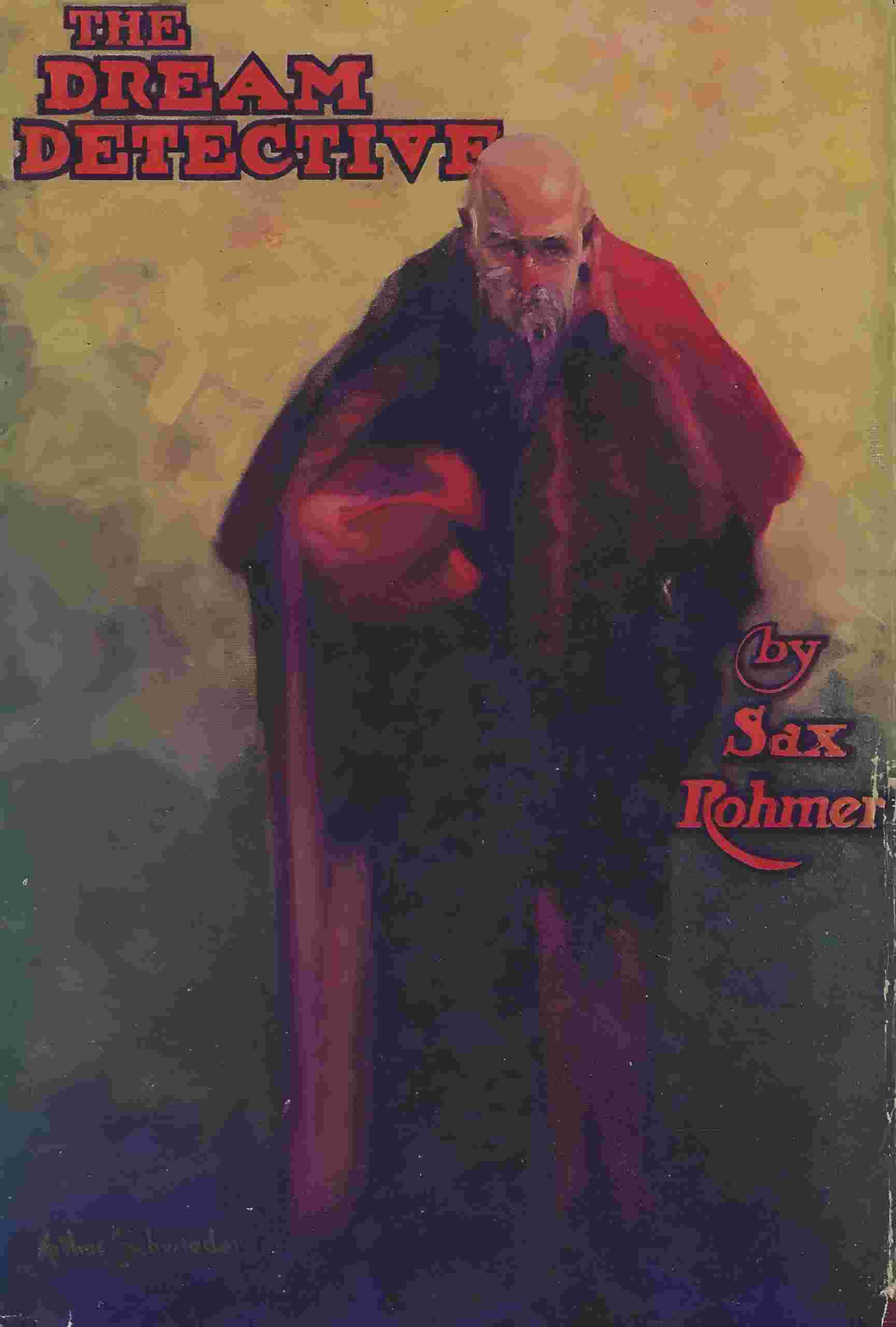
“Who snorts?” rumbled Moris Klaw, peering through his pince-nez.
“Not I,” said Sir John, staring about him.
We all, in turn, denied having uttered the sound.
“Then there is in this office a ghost,” declared Klaw, “or a liar!”
“Excuse me, Mr. Klaw,” began Mr. Anderson, with some heat.
Moris Klaw raised his hand. His daughter’s magnificent eyes blazed defiance at us all.
“No anger,” implored the rumbling voice. “No anger. Anger is a misuse of the emotions. There are present eight persons here. Someone snorted. Eight persons deny the snort. It is a ghost or a liar. Am I evident to you?”
“Your logic is irrefutable,” admitted the younger Mr. Anderson, glancing from face to face. “It pains me to have to admit that you are right!”
In turn, I examined the faces of those present. Grimsby was a man witless with wonder. Both the Andersons were embarrassed and angry. Isis Klaw was scornfully triumphant; her father was, as ever, nonchalant. Sir John Carron looked ill at ease; Mr. Chinje appeared to have changed his opinion of the eccentric investigator and now studied him with the calm interest of the cultured Oriental.
“I shall now make you laugh,” said Moris Klaw. “I shall tell you what he was thinking of at the psychological instant—that mysterious thief. He was thinking of two things. One was a very pretty, fair young lady, and the other was a funny thing. He was thinking of throwing twelve peanuts into a parrot’s cage!”
V
There are speeches so entirely unexpected that their effect is unappreciable until some little time after the utterance. This speech of Moris Klaw’s was of that description. For some moments no one seemed to grasp exactly what he had said, simple though his words had been. Then, it was borne home to us—that grotesque declaration; and I think I have never seen men more amazed.
Could he be jesting?
“Mr. Klaw——” began Sir John Carron. But—
“One moment, Sir John,” interrupted Klaw. “Let all remain here for one moment. I shall return.”
Whilst we stared, like so many fools, he shuffled from the office with his awkward gait. During his brief absence no one spoke. We were restrained, undoubtedly, by the presence of Isis Klaw, who, one hand upon her hip and with the other swinging her big ermine muff, smiled at us with a sort of pitying scorn for our stupidity.
Moris Klaw returned.
“Let me see,” he rumbled, reflectively, “have you, Sir John Carron or Mr. Chinje, a specimen of the handwriting of the Gaekwar of Nizam?”
Chinje and Sir John stared.
“At the office—possibly,” replied Sir John.
“I have my instructions, signed by him,” said Mr. Chinje. “But not here.”
“At your hotel, yes?”
“Yes,” replied Chinje, shortly.
He gave me the impression that he resented Moris Klaw’s catechizing as that of a fool and an incompetent meddler with affairs of great importance.
“Then, gentlemen,” said Klaw, “we must adjourn to examine that signature.”
“Really,” the younger Mr. Anderson burst out, “I must protest against this! You will pardon me, Mr. Klaw; I believe you to be sincere in your efforts on our behalf, but such an expedition can be no more than a wild-goose chase! What can the Gaekwar’s signature have to do with the theft of the diamond?”
“I will tell you something, my feverish friend,” said Moris Klaw, slowly. “The Blue Rajah is not on these premises. It is gone! It went before I came. If it is ever to come back you will put on your hat and accompany me to examine the signature to Mr. Chinje’s instructions.”
“I must add my protest to Mr. Anderson’s,” remarked Chinje. “This is mere waste of time.”
“Mr. Grimsby,” resumed Klaw, placidly, “it is a case to be hushed up, this. There must be no arrests!”
“Eh?” cried Grimsby.
“Sir John Carron will ring up the Commissioner and he will say that Detective-Inspector Grimsby has traced the Blue Rajah, which was stolen, but that, for reasons of state, Detective-Inspector Grimsby will make a confidential report and no arrest!”
“Really——” began Sir John.
“Mr. Klaw,” cried Anderson, interrupting excitedly. “You are jesting with men who are faced by a desperate position! I ask you, as man to man, if you know who stole the Blue Rajah and where it is?”
“I reply,” rumbled Moris Klaw, “that I suspect who stole it, that I am doubtful how it was stolen, and that when I have examined the Gaekwar’s signature I may know where it is!”
His reply had a tone of finality quite unanswerable. His attitude was that of a stone wall; and he had, too, something of the rugged strength of such a wall—of a Roman wall, commanding respect.
Sir John got into communication with the Commissioner, as desired by Klaw, and we all left the office and went down in the lift to the hall.
“Two cabs will be needful,” said Moris Klaw; and two cabs were summoned.
Sir John Carron, the Andersons, and Moris Klaw entered one; Isis Klaw, Grimsby, Chinje, and I the other.
“The Hotel Astoria,” directed Chinje.
Throughout the drive to the Strand, Isis chatted to Grimsby, to his great delight. Mr. Chinje contented himself with monosyllabic replies to my occasional observations. He seemed to be disgusted with the manner in which the inquiry was being conducted. When the two cabs drove into the courtyard of the hotel, the one in which I was seated followed the other. Mr. Chinje, on my left, descended first, and Moris Klaw also descended first from the cab in front. As he did so he stumbled on the step and clutched at Chinje for support. Isis leapt forward to his assistance.
“Ah,” growled Klaw, hobbling painfully, and resting one hand upon Chinje’s shoulder and the other upon his daughter’s. “That foolish ankle of mine! How unfortunate! An accident, Mr. Chinje, which I met with in Egypt. I fell quite twenty feet in the shaft of a tomb and broke my ankle. At the least strain, I suffer yet.”
“Allow me, Mr. Chinje,” said Grimsby, stepping forward.
“No, no!” rumbled Klaw. “If you will hand me my hat which I have dropped, and see that my verbena has not fallen out—thank you—Mr. Chinje and Isis will be so good as to walk with me to the lift. A few moments’ rest in Mr. Chinje’s apartments will restore me.”
This arrangement accordingly was adopted, and we presently came to the rooms occupied by the Gaekwar’s representative, upon the fourth floor of the hotel. At the door, Mr. Chinje asked me to take his place whilst he found his key.
I did so and Chinje opened the door. To my great surprise he entered first. To my greater surprise, Moris Klaw, scorning my assistance and apparently forgetting his injury, rapidly followed him in. The rest of us flocked behind, possessed with a sense of something impending. We little knew what impended.
One thing, as I entered the little sitting room, struck my vision with a sensation almost of physical shock. It was a large, empty parrot cage standing on the table!
I had an impression that Chinje dashed forward in a vain attempt to conceal the cage ere Moris Klaw entered. I saw, as one sees figures in a dream, a pretty, fair-haired girl in the room. Then the Hindu had leapt to an inner door—and was gone!
“Quick!” cried Klaw, in a loud voice. “The door! The door!”
He brushed the girl aside with a sweep of his arm and hurled himself against the locked door.
“Mr. Grimsby! Mr. Searles! Someone! Help with this door. Isis! hold her back, this foolish girl!”
The inner meaning of the scene was a mystery to us all, but the urgency of Moris Klaw’s instructions brooked no denial. With a shrill scream the girl threw herself upon him, but Isis, exhibiting unsuspected strength, drew her away.
Then Sir John Carron joined Klaw at the door and they applied their combined weights to the task of forcing it open.
Once they put their shoulders to it; twice—and there was a sound of tearing woodwork; a third time—and it flew open, almost precipitating them both into the room beyond. Hard on the din of the opening rang the crack of a pistol shot. A wisp of smoke came floating out.
“Ah, just God!” said Moris Klaw, hoarsely, “we are too late!”
And, at his words, with a leap like that of a wild thing, the fair girl broke from Isis, and passing us all, entered the room beyond. Awed and fearful, we followed and looked upon a pitiful scene.
Gautami Chinje lay dead upon the floor, a revolver yet between his nerveless fingers and a red spot in his temple. Beside him knelt the girl, plucking with both hands at her lower lip, her face as white as paper and her eyes glaring insanely at the distorted features.
“Dearest,” she kept whispering, in a listless way, “my dearest—what is the matter? I have the diamond—I have it in my bag. What is it, my dearest?”
We got her away at last.
“He had only been in London six months,” Moris Klaw rumbled in my ear, “and you see, she adored him—helped him to steal. It is wonderful, snake-like, the power of fascination some Hindus have over women—and always over blondes, Mr. Searles, always blondes. It is a psychological problem.”
So ended the case of the Blue Rajah robbery, one of the most brief in the annals of Moris Klaw. The great diamond we found in the girl’s handbag, wrapped in a curious little rubber covering, apparently made to fit it.
“You see,” explained Moris Klaw, later, to his wondering audience, “this girl—I have yet to find out who she is—was perhaps married to Mr. Chinje. He would, of course, have deserted her directly he returned to India. But here at the Astoria she was known as Mrs. Chinje. Who would have been the losers by the robbery? The insurance company, if I do not mistake the case. For the Gaekwar, through his representative, Chinje, had the diamond insured for all the time it was his property and in England, and the Committee had it insured from the time it became their property. It had become their property. The Gaekwar would have got his check. He gets it now; it is in Chinje’s pocket-case. The city would have lost its Blue Rajah, and the insurance company would have paid the city for the loss!
“The next office along the corridor from Mr. Anderson’s is the Central London Electric Lighting Company. Many consumers call. Mrs. Chinje was not suspected of any felonious purpose when she was seen in that corridor—and she was seen by a clerk and by an engineer. After my mental negative had told me of a pretty young lady of whom the thief thinks at the moment of his theft, I went to inquire—you recall?—if such a one had been seen near the office.
“From the first my suspicions are with Chinje. The emotions have each a note, distinct, like the notes of a piano, though only audible to the trained mind. Both Isis and myself detect from Chinje the note of fear. I arrange, then, that he remains. My talk of examining the Gaekwar’s writing is a ruse. It is Chinje’s apartment and the fair lady I expect to find there that I am anxious to see.
“Then, in spite that he is the most cool of us all, I see that he suspects me and I have to hold him fast; for, if he could have got first to his room and hidden the parrot cage, where had been our evidence? Indeed, only that I have the power to secure the astral negative, there had been no evidence at all. There is a third accomplice—him who howled in the courtyard; but I fear, as he so cleverly vanished, we shall never know his name.
“And how was it done, and why did this someone howl?”
Moris Klaw paused and looked around. We awaited his next words in tense silence.
“He howled because Chinje had looked out from the window (which, though hidden, the howler was watching) and made him some signal. The signal meant: ‘The Blue Rajah has been placed upon the table—howl!’
“The one below obeyed, and the Committee, like foolish sheep—yes, gentlemen, like no-headed cattle things!—flocked to the window. But Chinje did not flock with them! Like a deft-handed conjurer he was at the table, the diamond was in the little rubber purse held ready, and Mrs. Chinje, with her large handbag open, was waiting outside the door, in the corridor, like some new kind of wicket-keeper. Chinje tossed the diamond through the little square ventilator!
“He had been practising for weeks—ever since he knew that the Committee would meet in that room—tossing peanuts into the square opening of a parrot cage, placed at the same height from the floor as the ventilator over Mr. Anderson’s doorway! He had practised until he could do it twelve times without missing. He had nerves like piano wires, yet he was a deadly anxious man; and he knew that a woman cannot catch!
“But she caught—or, if she dropped it, no one saw her pick it up.
“Gentlemen, these Hindus are very clever, but talking of their cleverness makes one very thirsty. I think I heard Mr. Anderson make some cooling speech about a bottle of wine!”
SIXTH EPISODE.
CASE OF THE WHISPERING POPLARS
I
One afternoon Moris Klaw walked into my office and announced that “owing to alterations” he had temporarily suspended business at the Wapping emporium, and thus had found time to give me a call. I always welcomed a chat with that extraordinary man, and although I could conceive of no really useful “alteration” to his unsavoury establishment other than that of setting fire to it, I made no inquiries, but placed an easy chair for him and offered a cigar.
Moris Klaw removed his caped overcoat and dropped it upon the floor. Upon this sartorial wreckage he disposed his flat-topped brown bowler and from it extracted the inevitable scent spray. He sprayed his dome-like brow and bedewed his toneless beard with verbena.
“So refreshing,” he explained; “a custom of the Romans, Mr. Searles. It is a very warm day.”
I admitted that this was so.
“My daughter Isis,” continued Klaw, “has taken advantage of the alterations and decorations to run over so far as Paris.”
I made some commonplace remark, and we drifted into a conversation upon a daring robbery which at that time was flooding the press with copy. We were so engaged when, to my great surprise (for I had thought him at least a thousand miles away), Shan Haufmann was announced. As my old American friend entered, Moris Klaw modestly arose to depart. But I detained him and made the two acquainted.
Haufmann hailed Klaw cordially, exhibiting none of the ill-bred surprise which so often greeted my eccentric acquaintance of singular aspect. Haufmann had all that bonhomie which overlooks the clothes and welcomes the man. He glanced apologetically at his right hand which hung in a sling.
“Can’t shake, Mr. Klaw,” said the big American, a good-humoured smile on his tanned, clean-shaven face. “I stopped some lead awhile back and my right is still off duty.”
Naturally I was anxious at once to know how he had come by the hurt; and he briefly explained that in the discharge of certain official duties he had run foul of a bad gang, two of whom he had been instrumental in convicting of murder, whilst the third had shot him in the arm and escaped.
“Three dagoes,” he explained, in his crisply picturesque fashion, “—been wanted for years. Helped themselves to a bunch of my colts this fall; killed one of the boys and left another for dead. So I went after them hot and strong. We rounded them up on the Mexican border and got two—Schwart Sam and one of the Costas; but the younger Costa—we call him Corpus Chris—broke away and found me in the elbow with a lump of lead!”
“So you’ve come for a holiday?”
“Mostly,” replied Haufmann. “Greta hustled me here. She got real ill when I said I wouldn’t come. So we came! I’m centring in London for six months. Brought the girls over for a look round. I’m not stopping at a hotel. We’ve rented a house a bit outside; it’s Lal’s idea. Settled yesterday. All fixed. Expect you to dinner to-night! You, too, Mr. Klaw! Is it a bet?”
Moris Klaw was commencing some sort of a reply, but what it was never transpired, for Haufmann, waving his sound hand cheerily, quitted the office as rapidly as he had entered, calling back:
“Dine seven-thirty. Girls expecting you!”
That was his way; but so infectious was his real geniality that few could fail to respond to it.
“He is a good fellow, that Mr. Haufmann,” rumbled Moris Klaw. “Yes, I love such natures. But he has forgotten to tell us where he lives!”
It was so! Haufmann in his hurry and impetuosity had overlooked that important matter; but I thought it probable that he would recall the oversight and communicate, so prevailed upon Klaw to remain. At last, however, I glanced at my watch, and found it to be nearly six o’clock, whereupon I looked blankly at Moris Klaw. That eccentric shrugged his shoulders and took up the caped coat. Then the ’phone bell rang. It was Haufmann.
I was glad to hear his familiar accent as he laughingly apologized for his oversight. Rapidly he acquainted me with the whereabouts of The Grove—for so the house was called.
“Come now,” he said. “Don’t stop to dress; you’ve only just got time,” and rang off.
I thought Moris Klaw stared oddly through his pince-nez when I told him the address, but concluded, as he made no comment, that I had been mistaken. There was just time to catch our train, and from the station where we alighted it was only a short drive to the house. Haufmann’s car was waiting for us, and in less than three quarters of an hour from our quitting the Strand, we were driving up to The Grove, through the most magnificent avenue of poplars I had ever seen.
“By Jove!” I cried, “what fine trees!”
Moris Klaw nodded and looked around at the towering trunks with a peculiar expression, which I was wholly at a loss to account for. However, ere I had leisure to think much about the matter, we found ourselves in the hall, where Haufmann and his two fascinating daughters were waiting to greet us. I do not know which of the girls looked the more charming: Lilian with her bright mass of curls and blue eyes dancing with vivacity, or Greta in her dark and rather mystic beauty. At any rate, they were dangerous acquaintances for a susceptible man. Even old Moris Klaw showed unmistakably that his mind was not so wholly filled with obscure sciences as to be incapable of appreciating the society of a pretty woman.
Greta I noticed looking thoughtfully at him, and during dinner she suddenly asked him if he had read a book called “Psychic Angles.”
Rather unwillingly, as it seemed to me, Klaw admitted that he had, and the girl displayed an immediate and marked interest in psychical matters. Klaw, however, though usually but too willing to discuss this, his pet subject, foiled her attempt to draw him into a technical discussion and rather obviously steered the conversation into a more general channel.
“Don’t let her get away on the bogey tack, Mr. Klaw,” said Haufmann, approvingly. “She’s a perfect demon for haunted chambers and so on.”
Laughingly the girl pleaded guilty to an interest in ghostly subjects. “But I’m not frightened about them!” she added, in pretended indignation. “I should just love to see a ghost.”
“Oh, Greta!” cried her sister. “What a horrid idea.”
“You have perhaps investigated cases yourself, Mr. Klaw?” asked Greta.
“Yes,” rumbled Klaw, “perhaps so. Who knows?”
Since he thus clearly showed his wish to drop the subject, the girl made a little humorously wry face, whereat her father laughed boisterously; and no more was said during the evening about ghosts. I could not well avoid noticing two things, however, in regard to Moris Klaw: one, his evident interest in Greta; and the other, a certain preoccupation which claimed him every now and again.
We left at about ten o’clock, declining the offer of the car, as we had ample time to walk to the station. Haufmann wanted to come along, but we dissuaded him, with the assurance that we could find the way without any difficulty. Klaw, especially, was very insistent on the point, and when at last we swung sharply down the avenue and, rounding the bend, lost sight of the house, he pulled up and said:
“For this opportunity, Mr. Searles, I have been waiting. It may not, of course, matter, but this house where the good Haufmann resides was formerly known as The Park.”
“What of that?” I asked, turning on him sharply.
“It is,” he replied, “celebrated as what foolish people call a haunted house. No doubt that is the reason why the name has been changed. As The Park it has been dealt with many times in the psychical journals.”
“The Park,” I mused. “Is it not included in that extraordinary work on the occult—‘Psychic Angles’—of which Miss Haufmann spoke to-night—the place where the monk was supposed to have been murdered, where an old antiquary died, and some young girl, too, if I remember rightly?”
“Yes,” replied Moris Klaw, “yes. I will tell you a secret. ‘Psychic Angles’ is a little book of my own, and so, of course, I know about this place.”
His words surprised me greatly, for the book was being generally talked about. He peered around him into the shadows and seemed to sniff the air suspiciously.
“Setting aside the question of any supernatural menace,” I said, “directly the servants find out, as they are sure to do from others in the neighbourhood, they will leave en bloc. It is a pleasant way servants have in such cases.”
“We must certainly tell him, the good Haufmann,” agreed Klaw, “and he will perhaps arrange to quit the place without letting the ladies to know of its reputation. That Miss Greta she has the sympathetic mind”—he tapped his forehead—“the plate so sensitive, the photo film so delicate! For her it is dangerous to remain. There is such a thing, Mr. Searles, as sympathetic suicide! That girl she is mediumistic. From The Park she must be removed.”
“There is no time to lose,” I said. “We must decide what to do to-night. Suppose you come along to my place?”
Moris Klaw agreed, and we resumed our walk through the poplar grove.
Although the night was very still, an eerie whispering went on without pause or cessation along the whole length of the avenue. Against the star-spangled sky the tall trees reared their shapes in a manner curiously suggestive of dead things. Or this fancy may have had birth in the associations of the place. It was a fatally easy matter mentally to fashion one of the poplars into the gaunt form of a monk; and no one, however unimaginative, being acquainted with the history of The Grove, could fail to find, in the soft and ceaseless voices of the trees, something akin to a woman’s broken sighs. In short, I was not sorry when the gate was passed, and we came out upon the high road.
Later, seated in my study, we discussed the business thoroughly. From my bookcase I took down “Psychic Angles” and passed it to Moris Klaw.
“There we are,” he rumbled, turning over the leaves. I read: “On August 8, 1858, a Fra Giulimo, of a peculiar religious brotherhood who occupied this house from 1851 to 1858, was found strangled at the foot of a poplar close by the entrance gate.” “I could never find out much about them, this brotherhood,” he added, looking up; “but they were, I believe, decent people. They left the place almost immediately after the crime. No arrest was ever made. Then”—referring to the book—“ ‘about the end of February or early in the March of 1863, a Mr. B—— J—— took the house. He was an antiquarian of European repute and a man of retired habits. With only two servants—an old soldier and his wife—he occupied The Park’—that is The Grove—‘from the spring of ’63 to the autumn of ’65.’ Then follow verbatim reports by the well-known Pepley of interviews with people who had heard Mr. J—— declare that a hushed voice sometimes called upon him by name in the night, from the poplar grove. Also, an interview with his manservant and with wife of latter, corroborating other statements. Mr. B—— J—— was found one September morning dead in the grove. Cause of death never properly established. The house next enters upon a period of neglect. It is empty; it is shunned. From ’65 right up to ’88 it stood so empty. It was then taken by a Mr. K——; but he only occupied it for two months, this K——. Three other tenants subsequently rented the place. Only one of them actually occupied it—for a week; the other, hearing, we presume, of its evil repute, never entered into residence. Seventeen years ago the last tragedy connected with the unpleasant Grove took place. An eccentric old bachelor took the house, and, in the summer of ’03, had a niece there to stay with him. The evidence clearly indicates to me that this unhappy one was highly neurotic—oh, clearly; so that the tragedy explains itself. She fell, or sprang, from her bedroom window to the drive one night in June, and was picked up quite dead at the foot of the first poplar in the grove. Sacré! it is a morgue, that house!”
He returned the book and sat watching me in silence for some moments.
“Did you spend any time in the house, yourself?” I asked.
“On four different occasions, Mr. Searles! It is only from certain of the rooms that the whispering is audible, and then only if the windows are open. You will notice, though, that all the tragedies occurred in the warm months when the windows would be so open.”
“Did you note anything supernormal in this whispering?”
“Nothing. You have read my explanation.”
II
Haufmann looked rather blank when we told him.
“Just my luck!” he commented. “Greta’s read your book, Mr. Klaw, and if she hasn’t fixed it yet she’s sure to come to it that The Park and The Grove are one and the same. It was largely because of her I arranged this trip,” he added. “The trouble I’ve told you about got on her nerves and she had the idea some guy was tracking her around. The medicos said it was a common enough symptom and ordered a change. Anyhow, I quitted, to give her a chance to tone up. Confound this business!”
He ultimately left quite determined to change his place of residence. But so averse was his practical mind from the idea of inconveniencing oneself on such ghostly grounds, that two weeks slipped by, and still the Haufmanns occupied The Grove. The decoration of Moris Klaw’s establishment being presumably still in progress, Klaw accompanied me on more than one other occasion to visit Shan Haufmann and the girls. At last, one afternoon, Greta asked him point-blank if he thought the house to be that dealt with in “Psychic Angles.”
Of course, he had to admit that it was so; but far from exhibiting any signs of alarm, the girl appeared to be delighted.
“How dense I have been!” she cried. “I should have known it from the description! As a matter of fact, I might never have found out, but this morning the servants resigned unanimously!”
Klaw looked at me significantly. All was befalling as we had foreseen.
“They told you, then!” he said. “Yes? No?”
“They said the house was haunted,” she replied, “but they didn’t seem to know much more about it. That simple fact was enough for them!”
Haufmann came in and in answer to our queries declared himself helpless.
“Lal and Greta won’t quit,” he declared; “so what’s to do? I’ve cabled for servants from home. Meanwhile, we’re at the mercy of day girls and charwomen!”
The concern evinced by Moris Klaw was very great. He seized an early opportunity of taking Haufmann aside and questioning him relative to the situation of the rooms occupied by the family.
“My room overlooks the avenue,” replied Haufmann, “and so does Greta’s. Lal’s is on the opposite side. Come up and see them!”
Klaw and I accompanied him. It was a beautiful clear day, and from his window we gazed along the majestic ranks of poplars, motionless as a giant guard, in the still summer air. It was difficult to conjure up a glamour of the uncanny, with the bright sunlight pouring gladness upon trees, flowers, shrubs, and lawn.
“This is the room from which the whisper is the most clearly audible!” said Moris Klaw. “I could tell you—ah! I spent several nights here!”
“The devil you did,” rapped Haufmann. “I must sleep pretty soundly. I’ve never heard a thing. Greta’s room is next on the right. She has said nothing.”
Klaw looked troubled.
“There is no sound unusual to hear,” he answered. “I quite convinced myself of that. But it is the tradition that speaks, Mr. Haufmann! In those silent watches, even so insensible an old fool as I can imagine almost anything, aided by such gruesome memories. Excepting the monk, who probably fell foul of a prowler thief, the tragedies are easily to be explained. The old antiquarian died of syncope, and the poor girl, in all probability, fell from the balcony in her sleep. She had a tremendously neurotic temperament.”
“It’s bad, now Greta knows,” mused Haufmann. “Her nerves are all unstrung. It’s just the thing I wanted to avoid!”
“Can’t you induce her at any rate to change her room?” I suggested.
“No! She’s as obstinate as a pony! Her poor mother was the same. It’s the Irish blood!”
Such was the situation when we left. No development took place for a couple of days or so, then that befell which we had feared and half expected.
Haufmann walked into my office with:
“It’s started! Greta says she hears it every night!”
Prepared though I had been for the news, his harshly spoken words sent a cold shudder through me.
“Haufmann!” I said, sternly. “There must be no more of this. Get the girls away at once. On top of her previous nerve trouble this morbid imagining may affect her mind.”
“You haven’t heard me out,” he went on, more slowly than was his wont. “You talk of morbid imagining. What about this: I’ve heard it!”
I stared at him blankly.
“That’s one on you!” he said, with a certain grim triumph. “After Greta said there was something came in the night that wasn’t trees rustling, I sat up and smoked. First night I read and nothing happened. Next night I sat in the dark. There was no breeze and I heard nothing for my pains. Third night I stayed in the dark again, and about twelve o’clock a breeze came along. All mixed up with the rustling and sighing of the leaves I heard a voice calling as plain as I ever heard anything in my life! And it called me!”
“Haufmann!”
“It blame-well called me! I’d take my oath before a jury on it!”
“This is almost incredible!” I said. “I wish Moris Klaw were here.”
“Where is he?”
“He is in Paris. He will be away over the week-end.”
“I met a man curiously enough,” continued Haufmann, “just outside the Charing Cross Tube, on my way here, who’s coming down to have a look into the business—a hot man on mysteries.” He mentioned the name of a celebrated American detective agency. “I’m afraid it’s right outside his radius, but he volunteered and I was glad to have him. I’d like Klaw down though.”
“What about the girls?”
“I was going to tell you. They’re at Brighton for a while. Greta didn’t want to quit, but poor Lal was dead scared! Anyway, I got them off.”
The uncanny business claimed entire possession of my mind, and further work was out of the question. I accordingly accompanied Haufmann to the hotel where the detective was lodged and made the acquaintance of Mr. J. Shorter Ottley. He was a typical New Yorker, clean-shaven and sallow complexioned with good gray eyes and an inflexible mouth.
“We don’t deal in ghosts!” he said, smilingly; “I never met a ghost that couldn’t stop a bullet if it came his way!”
“I’ll make a confession to you,” remarked Haufmann. “When I heard that soft voice calling, I hadn’t the sand to go and look out! How’s that for funk?”
“Not funk at all,” replied Ottley, quietly. “Maybe it was wisdom!”
“How do you mean?”
“I’ve got an idea about it, that’s all. Did Miss Haufmann hear it the same night?”
“Not the same night I did—no. She seems to have dozed off.”
“When she did hear it, was it calling you?”
“She couldn’t make out what it called!”
“Did she go to the window?”
“Yes, but she only looked out from behind the blind.”
“See anything?”
“No.”
“I should have very much liked an interview with her,” said Ottley, thoughtfully.
“She could tell you no more than I have.”
“About that, no! There’s something else I would like to ask her.”
That evening we all three dined at The Grove, dinner being prepared by a woman who departed directly we were finished. A desultory game of billiards served to pass the time between twilight and darkness, and the detective and I departed, leaving Haufmann alone in the house. This was prearranged by Ottley, who had some scheme in hand. Side by side we tramped down the poplar avenue, went out by the big gate, and closed it behind us. We then skirted the grounds to a point on the side opposite the gate, and, scaling the wall, found ourselves in a wilderness of neglected kitchen garden. Through this the American cautiously led the way toward the house, visible through the tangle of bushes and trees in sharp silhouette against the sky. On all fours we crossed a little yard and entered a side door which had been left ajar for the purpose, closing it softly behind us. So, passing through the kitchen, we made our way upstairs and rejoined Haufmann.
A post had been allotted to me in the room next to his and I was enjoined to sit in the dark and watch for anything moving among the trees. Haufmann departed to a room on the west front with similar injunctions, and the detective remained in Haufmann’s room.
As I crept cautiously to the window, avoiding the broad moonbeam streaming in, I saw a light on my left. Ottley was acting as Haufmann would have done if he had been retiring for the night. Three minutes later the light vanished, and the nervous vigil was begun.
There was very little breeze, but sufficient to send up and down the poplar ranks waves of that mysterious whispering which Klaw and I had previously noted. The moon, though invisible from that point, swam in an absolutely cloudless sky, and the shadow of the house lay black beneath me, its edge tropically sharp. A broad belt of moon-bright grass and gravel succeeded, and this merged into the light-patched gloom of the avenue. On the right of the poplars lay a shrubbery, and beyond that a garden stretching to the east wall. Just to the left, an outbuilding gleamed whitely. Some former occupant had built it for a coach house and it now housed Haufmann’s car. The apartments above were at present untenanted.
I cannot say with certainty when I first detected, mingled with the whistling of the branches, something that was not caused by the wind. But ultimately I found myself listening for this other sound. With my eyes fixed straight ahead and peering into the shadows of the poplars I crouched, every nerve at high tension. A slight sound on my left told of a window softly opened. It was Ottley creeping out on to the balcony. He, too, had heard it!
Then, with awful suddenness, the inexplicable happened.
A short, shrill cry broke the complete silence, succeeding one of those spells of whispering. A shot followed hot upon it—then a second. Somebody fell with a muffled thud upon the drive—and I leapt to the window, threw it widely open, and stepped out on the balcony.
“Ottley!” I cried. “Haufmann!”
A door banged somewhere and I heard Haufmann’s muffled voice:
“Downstairs! Come down!”
I ran across the room, out on to the landing, and down into the hall. Haufmann was unfastening the bolts. His injured arm was still stiff, and I hastened to assist him.
“My God!” he cried, turning a pale face toward me. “It’s Ottley gone! Did you see anything?”
“No! Did you?”
“Curse it! No! I had just slipped away from the window to get my repeater! You heard the voice?”
“Clearly!”
The door was thrown open and we ran out into the drive.
There was no sign of Ottley, and we stood for a moment, undecided how we should act. Then, just inside the shadow belt we found the detective lying.
Thinking him dead, we raised and dragged him back to the house. Having refastened the door, we laid him on a sofa in the morning room. His face was deathly and blood flowed from a terrible wound on his skull. Strangest of all, though, he had a gaping hole just above the right wrist. The skin about it was discoloured as if with burning. Neither of us could detect any sign of life, and we stood, two frankly frightened men, looking at each other over the body.
“It’s got to be done!” said Haufmann, slowly. “One of us has to stay here and do what he can for him, and one has to go for a doctor! There’s no telephone!”
“Where’s the nearest doctor?” I asked.
“There’s one at the corner of the first road on the right.”
“I’ll go!” I said.
Without shame I confess that from the moment the door closed behind me, I ran my hardest down the poplar avenue until I had passed the gate! And it was not anxiety that spurred me, for I did not doubt that Ottley was dead, but stark fear!
III
Moris Klaw deposited a large grip and a travelling rug upon the veranda.
“Good day, Mr. Haufmann! Good day, Mr. Searles!” At an open window the white-aproned figure of a nurse appeared. “Good day, Nurse! I am direct from Paris. This is a case which cannot be dealt with under the head of the Cycle of Crime, and I do not think it has any relation with the history of The Park. But thoughts are things, Mr. Haufmann. How helpful that is!”
Forty-eight hours had elapsed since Haufmann and I had picked up Ottley for dead in the poplar avenue. Now he lay in a bed made up in the billiard room hovering between this world and another. I had a shrewd suspicion that the doctor who attended him was mystified by some of the patient’s symptoms.
Haufmann stared oddly at Moris Klaw, not altogether comprehending the drift of his words.
“If only Ottley could tell us!” he muttered.
“He will tell us nothing for many a day,” I said; “if, indeed, he ever speaks again.”
“Ah,” interrupted Moris Klaw, “to me he will speak! How? With the mind! Something—we have yet to learn what—struck him down that night. The blow, if it was a blow, made so acute an impression upon his brain that no other has secured admittance yet! Good! That blow, it still resides within his mind. To-night I shall sleep beside his bed. I shall be unable odically to sterilize myself, but we must hope. From amid the phantasms which that sick brain will throw out upon the astral film—upon the surrounding ether—I must trust that I find the thought, the last thought before delirium came!”
Haufmann looked amazed. I had prepared him, to some extent, for Klaw’s theories, but, nevertheless, he was tremendously surprised. Klaw, however, paid no attention to this. He looked around at the trees.
“I am glad,” he rumbled, impressively, “that you managed to hush up. Distinctly, we have now a chance.”
“A chance of what?” I cried. “The thing seems susceptible of no ordinary explanation! How can you account for what happened to Ottley and for his condition? What incredible thing came out from the poplars?”
“No thing!” answered Moris Klaw. “No thing, my good friend!”
“Then what did he fire at?”
“At the coach house!”
I met the gaze of his peculiar eyes, fixed upon me through the pince-nez.
“If you will look at the coach-house chimney,” he continued, “you will see it—the hole made by his bullet!”
I turned quickly, and even from that considerable distance the hole was visible; a triangular break on the red-tiled rim.
“What on earth does it mean?” I asked, more hopelessly mystified than ever.
“It means that Ottley is a clever man who knows his business; and it means, Mr. Searles, that we must take up this so extraordinary affair where the poor Ottley dropped it!”
“What do you propose?”
“I propose that you invite yourself to a few days’ holiday, as I have done. You stay here. Do not allow even the doctor to know that you are in the house. The nurse you will have to confide in, I suppose. Mr. Haufmann”—he turned to the latter—“you will occupy your old room. Do not, I beg of you, go outside after dusk upon any consideration. If either of you shall hear it again—the evil whispering—come out by the front door, and keep in the shadow. Carry no light. Above all, do not come out upon the balcony!”
“Then you,” I said, “will be unable to stay?”
“I shall be so unable,” was the reply; “for I go to Brighton to secure the interview with Miss Greta which the poor Ottley so much required!”
“You don’t suggest that she knows——”
“She knows no more than we do, Mr. Searles! But I think she holds a clue and does not know that she holds a clue! For an hour I shall slumber—I who, like the tortoise, know that to sleep is to live—I shall slumber beside the sick man’s bed. Then, we shall see!”
IV
It was a quarter to seven when Moris Klaw entered the sick room. Ottley lay in a trance-like condition, and the eccentric investigator, of whose proceedings the nurse strongly disapproved, settled himself in a split-cane armchair by the bedside, and waving his hand in dismissal to Haufmann and myself, placed a large silk handkerchief over his sparsely covered skull and composed himself for slumber.
We left him and tiptoed from the room.
“If you hadn’t told me what he’s done in the past,” whispered Haufmann, “I should say our old friend was mad a lot!”
The great empty house was eerily silent, and during the time that we sat smoking and awaiting the end of Moris Klaw’s singular telepathic experiment, neither of us talked very much. At eight o’clock the man whose proceedings savoured so much of charlatanism, but whom I knew for one of the foremost criminologists of the world, emerged, spraying his face with verbena.
“Ah, gentlemen,” he said, coming in to us, “I have recovered some slight impression”—he tapped his moist forehead—“of that agonizing thought which preceded the unconsciousness of Ottley. I depart. Sometime to-night will come Sir Bartram Vane from Half-Moon Street, the specialist, to confer with the physician who is attending here. Mr. Searles, remain concealed. Not even he must know of your being here; no one outside the house must know. Remember my warnings. I depart.”
Behind the thick pebbles his eyes gleamed with some excitement repressed. By singular means, he would seem to have come upon a clue.
“Good-night, Mr. Haufmann,” he said. “Good-night, Mr. Searles. To the nurse I have said good-night and she only glared. She thinks I am the mad old fool!”
He departed, curtly declining company, and carrying his huge plaid rug and heavy grip. As his slouching footsteps died away along the avenue, Haufmann and I looked grimly at each other.
“Seems we’re left!” said my friend. “You won’t desert me, Searles?”
“Most certainly I shall not! You are tied here by the presence of poor Ottley, in any event, and you can rely upon me to keep you company.”
At about ten o’clock Sir Bartram Vane drove up, bringing with him the local physician who was attending upon Ottley. I kept well out of sight, but learnt, when the medical men had left, that the course of treatment had been entirely changed.
Thus commenced our strange ordeal; how it terminated you presently shall learn.
Moris Klaw, in pursuit of whatever plan he had formed, never appeared on the scene, but evidence of his active interest reached us in the form of telegraphic instructions. Once it was a wire telling Haufmann to detain the American servants in London should they arrive and to go on living as we were. Again it was a warning not to go out on the balcony after dusk; and, again, that we should not desert our posts for one single evening. On the fourth day the doctor pronounced a slight improvement in Ottley’s condition, and Haufmann determined to run down to Brighton on the following morning, returning in the afternoon.
That night we again heard the voice.
The house was very still, and Haufmann and I had retired to our rooms, when I discerned, above the subdued rustling whisper of the leaves, that other sound that no leaf ever made. In an instant I was crouching by the open window. A lull followed. Then, again, I heard the soft voice calling. I could not detect the words, but in obedience to the instructions of Klaw, I picked up the pistol which I had brought for the purpose, and ran to the door. The idea that the whispering menace was something that could be successfully shot at robbed it of much of its eerie horror, and I relished the prospect of action after the dreary secret sojourn in the upper rooms of the house.
I groped my way down to the hall. As we had carefully oiled the bolts, I experienced no difficulty in silently opening the door. Inch by inch I opened it, listening intently.
Again I heard the queer call.
Now, by craning my neck, I could see the moon-bright front of the house; and looking upward, I was horrified to see Shan Haufmann, a conspicuous figure in his light pajama suit, crouching on the balcony! The moonlight played vividly on the nickelled barrel of the pistol he carried as he rose slowly to his feet.
Though I did not know what danger threatened, nor from whence it would proceed, I knew well that Klaw’s was no idle warning. I could not imagine what madness had prompted Haufmann to neglect it, and was about to throw wide the door and call to him, when a series of strange things happened in bewildering succession.
An odd strumming sound came from somewhere in the outer darkness. Haufmann dropped to his knees (I learnt, afterward, that the loose slippers he wore had tripped him). The glass of the window behind him was shattered with a great deal of noise.
A shot! … a spurt of flame in the black darkness of the poplar avenue! … a shriek from somewhere on the west front… and I ran out on to the drive.
With a tremendous crash a bulky form rolled down the sloping roof of the coach house, to fall with a sickening thud to the ground!
Then, out into the moonlight, Moris Klaw came running, his yet smoking pistol in his hand!
“Haufmann!” he cried, and again, “Haufmann!”
The big American peered down from the balcony, hauling in something which seemed to be a line, but which I was unable to distinguish in the darkness.
“Good boy!” he panted. “I was a fool to do it! But I saw him lying behind the chimney and thought I could drop him!”
Moris Klaw ran, ungainly, across to the coach house and I followed him. The figure of a tall, lithe man, wearing a blue serge suit, lay face downward on the gravel. As we turned him over, Haufmann, breathing heavily, joined us. The moonlight fell on a dark saturnine face.
“Gee!” came the cry. “It’s Corpus Chris!”
V
“Where did I get hold upon the clue?” asked Moris Klaw, when he, Haufmann, and I sat, in the gray dawn, waiting for the police to come and take away the body of Costa. “It was from the brain of Ottley! His poor mind”—he waved long hands circularly in the air—“goes round and round about the thing that happened to him on the balcony.”
“And what was that?” demanded Haufmann, eagerly. “Same as happened to me?”
“It was something—something that his knowledge of strange things tells him is venomous—which struck his wrist as he raised his revolver! What did he do? I can tell you; because he is doing it over and over again in his poor feverish mind. He clapped to the injured wrist the barrel of his revolver and fired! Then, swooning, he toppled over and fell among the bushes. The wound that so had puzzled all becomes explained. It was self-inflicted—a precaution—a cauterizing; and it saved his life. For I saw Sir Bartram Vane to-day and he had spoken with the other doctor on the telephone. The new treatment succeeds.”
“I am still in the dark!” confessed Haufmann.
“Yes?” rumbled Moris Klaw. “So? Why do I go to Brighton? I go to ask Miss Greta what Ottley would have asked her.”
“And that is?”
“What she feared that made her so very anxious to get you away from your home. To me she admitted that she had received from the man Costa impassioned appeals, such as, foolish girl, she had been afraid to show to you—her father!”
“Good heavens! the scamp!”
“The canaille! But no matter, he is dead canaille! After you got the brother hanged, this Corpus Chris (it was Fate that named him!) sent to your daughter a mad letter, swearing that if she does not fly with him, he will kill you if he has to follow you around the world! Yes, he was insane, I fancy; I think so. But he was a man of very great culture. He held a Cambridge degree! You did not know? I thought not. He tracked you to Europe and right to this house. Its history he learned in some way and used for his own ends. Probably, too, he had no opportunity of getting at you otherwise, without leaving behind a clue or being seen and pursued.”
Moris Klaw picked up an Indian bow which lay upon the floor beside him.
“A bow of the Sioux pattern,” he rumbled, impressively.
He stooped again, picking up a small arrow to which a length of thin black twine was attached.
“One standing on the balcony in the moonlight,” he continued, “what a certain mark if the wind be not too high! And you will remember that on gently blowing nights the whispering came!”
He raised the point of the arrow. It was encrusted in some black, shining substance. Moris Klaw lowered his voice.
“Curari!” he said, hoarsely, “the ancient arrow poison of the South American tribes! This small arrow would make only a tiny wound, and it could be drawn back again by means of the twine attached. Costa, of course, mistook Ottley for you, Mr. Haufmann. Ah, a clever fellow! I spent three evenings up the second tree in the avenue waiting for him. I need not have shot him if you had followed my instructions and not come out on the balcony. We could have captured him alive!”
“I’m not crying about it!” said Haufmann.
“Neither do I weep,” rumbled Moris Klaw, and bathed his face with perfume. “But I loathe it, this curari—it smells of death. Ah! the canaille!”
SEVENTH EPISODE.
CASE OF THE CHORD IN G
I
It has been suggested to me more than once that the extraordinary crime which became known throughout the press as the Chelsea studio murder was the Waterloo of my eccentric friend, Moris Klaw; to which I reply that, on the contrary, it was his Austerlitz. This prince of criminologists, some of whose triumphs it has been my privilege to chronicle, never more dramatically established his theory of what he termed “Odic negatives” than in his solution of the mystery of the death of Pyke Webley, the portrait painter.
His singular power, which I can only term post-telepathy, of recovering thought-forms from the atmosphere, earned him the derision of the ignorant, as I have shown, but the grateful appreciation of the better informed—not least among these, Detective-Inspector Grimsby, of New Scotland Yard.
I cannot doubt that the recent experiments of Professor Gilbert Murray were based upon that law of “psychic angles” laid down by the strange genius of Wapping Old Stairs.
During lunch, I had been reading an account of the Chelsea tragedy in an early edition of the Evening Standard, and on returning to my chambers I found Inspector Grimsby waiting for me. A preamble was unnecessary. Simple deduction told me why he had come.
He was in charge of the Chelsea mystery—and out of his depth.
By several years the youngest detective inspector in the Service, Grimsby is a man earmarked by nature for constant promotion. He possesses a gift more precious than genius—the art of using genius; allied to which he has that knack indispensable to any man who would succeed—the knack of finding the limelight. Although he may have done no more than stand in the wings throughout the performance, Detective-Inspector Grimsby invariably takes the last curtain.
This is as it should be, and I accord him my respectful admiration. Therefore, on seeing him:
“The murder of Pyke Webley?” I said, interrogatively.
“Well, that’s wonderful!” he declared, trying to look surprised. “I shall begin to think you are Moris Klaw’s only rival if you spring things like this on me.”
“I see,” said I, tossing my paper on the table. “The case is not so simple as it appears.”
“Simple!” cried Grimsby. He threw the stump of a vicious-looking cheroot into my hearth. “Simple? It’s too simple. By which I mean that there is nothing to work upon—nothing I can see.”
He stood, his back to the hearth, looking at me appealingly; and:
“Have you ’phoned to Wapping?” I asked.
Grimsby nodded.
“I could get no reply,” he answered gloomily.
“Then what do you suggest?”
“Well”—he hesitated—“I know your time is of value, Mr. Searles, but I was wondering—I have a taxi outside—if you had time to run down to Moris Klaw’s place with me for a chat?”
“Why not go alone?”
“Ah!” He selected a fresh cheroot and made it crackle between finger and thumb. “His daughter is the snag. She thinks I waste his time. I doubt if she’d let me see him.”
“Your own fault,” I said. “She’s a charming girl. You don’t handle her properly.”
“Ah!” he repeated, and became silent, fumbling for matches. Finally, taking pity upon him:
“Very well,” I agreed, “I have a couple of hours to spare, and if Klaw takes up the case my time will not be wasted.”
II
“You see,” said Grimsby, plaintively, as the cab threaded dingy highways, “there is absolutely no motive. Pyke Webley seems to have been a decent, clean-living man, with absolutely no vices as far as I can gather. Of course, I have tried to find a woman in the case, but the only women I’ve found are heartbroken about his death. A most popular chap. Revenge is out of the question; robbery is out of the question; and I’d take my oath that jealousy is out of the question. So what am I to make of it?”
“He was strangled?”
“Yes.” Grimsby nodded. “By a very powerful man. His face is horrible to see, and there are blue weals on his neck where the strangler’s fingers bit into the flesh.”
“Who saw him last, alive?”
“The door-keeper of the Ham Bone Club,” came the answer, promptly. “He dined there, stayed an hour talking to friends and then went out, saying that he had work to do at his studio. The studio is separated from the house by a small garden and can be entered direct from a side entrance. There are only two servants—he was a bachelor—a cook general and a man who has been with him for years. Neither of them heard him come into the house, so that we presume he went straight into the studio. Early this morning a charwoman, who comes daily, finding the studio door locked (I mean the one that opens on the garden) reported this to Parker (that’s the man’s name) and he came down with the key.”
“But,” I interrupted, “Parker must surely have known before this that his master was not in the house?”
“No!” Grimsby shook his head emphatically. “Mr. Webley often worked late and Parker had orders never to disturb him until his bell rang.”
“I see,” said I. “So they unlocked the studio——”
“Yes,” Grimsby went on, “and found him there—lying strangled on the floor.”
“How long had he been dead?”
“Well, the police surgeon says several hours. Everything points to the fact that it happened shortly after he entered the place.”
“Someone may have been concealed there,” I suggested.
“God knows!” Grimsby muttered. “I can’t find a thing to work upon. And in a case like this the first twelve hours are important. But here we are,” he added, nervously.
At the head of that blind alley which shelters the all-but-indescribable establishment of Moris Klaw, we directed the taxi man to wait. This was a foggy afternoon and only dimly could we discern the lights in front of the shop. A chill in the atmosphere told of the nearness of old Father Thames, and as we approached that stacked-up lumber which represented the visible stock-in-trade of the proprietor, a singular piece of human flotsam was revealed propped against the door-post, a fragment of cigarette adhering to the corner of his mouth and threatening at any moment to ignite the stained and walrus-like moustache which distinguished William, Moris Klaw’s salesman.
“Good afternoon,” I said; “will you tell Mr. Moris Klaw that I have called?”
“Certainly, sir,” wheezed the inebriate. “Great pleasure, sir, I’m sure, sir.”
William paused, turned, and looked back.
“Do you mind a-waitin’ outside?” he added. “There’s a boy with red ’air ’angin’ about somewhere as ’as got ’is eye on this ’ere golf club”—indicating a dilapidated niblick. “If we all goes in ’e’ll nip orf with it.”
Accordingly we lingered, and:
“Moris Klaw! Moris Klaw! The devil’s come for you!” screeched the parrot who mounted guard within.
Presently came Klaw’s unmistakable deep, rumbling voice from the interior gloom:
“Ah! Good afternoon, Mr. Searles! Is it Detective-Inspector Grimsby you have with you? Good afternoon, Mr. Grimsby.”
He advanced through the odorous shadows, a strange, a striking figure and—
“Behold!” he said, “I have my hat and you have your cab. It is to Chelsea you take me? Yes?”
From the lining of the flat-topped hat he took out his cylindrical scent spray and played its contents upon his high, bald crown.
“Verbena,” he rumbled. “My guinea-pigs, they detest it, but I find it so refreshing.” He replaced the spray in the hat, the hat on his crown. “I have recently bought a fine pair of armadillos,” he explained, “and they have an odour peculiar which, to me, is objectionable.”
He regarded William, who was glancing suspiciously up and down the narrow alley.
“William,” he admonished, “cease to dwell upon the youth with red hair. He becomes with you an obsession. Give the sheldrake some fresh seaweed, and if the hedgehogs continue to refuse apples, they may have each a small piece of raw steak.”
He approached the waiting taxi cab, and on the step he paused.
“Mr. Searles, I shall buy no more hedgehogs. They are not only delicate in captivity but one was in my bed last night.”
We all entered the cab; and:
“Now, Mr. Grimsby,” Moris Klaw continued, “tell me all about this poor fellow who is murdered. I am expecting you. I see it is not simple. I say, ‘The old fool from Wapping is wanted here.’ ”
III
“You are squeamish, Mr. Searles,” said Moris Klaw, wagging a long finger at me. “You squeam. You are not yet recovered from the blue face of the murdered. Ah, well! it is horrible.”
The body had been removed and we had been to view it. Now we stood in the studio where the crime had taken place, and although some time had elapsed since we had left the mortuary, I confess that I was not entirely myself. Dusk was come and we had turned up the studio lights. A faint mist hung in the place, for the fog had grown denser.
I looked about me at half-completed pictures: groups; studies for magazine jackets; portraits of children and of women—and the ghastly face seemed to rise up before me, the distorted face of the man whose hand would never touch again the brushes of his craft.
“It isn’t the first time I’ve seen a strangling case,” said Grimsby, “but it’s the first time I’ve seen marks like that.”
“Ah! really!” Moris Klaw rumbled, turning to him. “Never before, eh, like that? You interest me, my friend; you begin to notice. Your intellect it expands like a sunflower in the sun. What is it that you see different in those marks?”
Grimsby stared hard, painfully uncertain whether to regard the words as a compliment or a joke, but finally:
“The pressure was greater,” he replied. “The murderer must have had amazing strength.”
“Ah, yes!” Moris Klaw removed his hat and stared reflectively into the crown thereof. “Amazing strength? And the surgeon, what does he think?”
“He thinks the same.”
“Ah! but no more, eh? Amazing strength only?”
Grimsby figuratively pricked up his ears.
“I don’t quite follow you, Mr. Klaw,” he said. “Did you notice something else?”
Moris Klaw placed his hat upon a little table.
“I did take notice of some other thing, Mr. Grimsby,” he replied, “and for a moment I had dreams that you synchronize with me. It is a complimentary mistake which I make. Please forgive me. This ashtray”—he took up an ashtray from the table beside his hat—“is of great interest. You are agreeable, Mr. Searles”—turning to me—“that it is of great interest?”
I stared rather helplessly. It was a common brass ashtray containing match sticks and cigarette ends. I could see nothing unusual about it, and so presently I shook my head.
“Ah!”
Moris Klaw inserted two long yellow fingers gingerly and plucked out a cigarette stump. He replaced the tray and held up the stump.
“Behold!” he said, “what I find!”
Grimsby now was frankly amazed and not a little angry. As for myself, familiar though I was with Klaw’s peculiar methods, I could not divine at what he was driving.
“My friends,” he continued, looking from one to the other of us, and holding up the cigarette stump as a lecturer holds up a specimen, “the cigarette, a vice which has killed many men. I have known a woman to hang because of a hairpin, but men and women, too, many of them, because of a cigarette.”
He opened a bulging pocket-case and tenderly deposited the stump inside. As he was about to close the case:
“One moment, Mr. Klaw!” said Grimsby. “If that is evidence—though I can’t for the life of me see how it can be…”
“But I see!” cried Moris Klaw—“I, the old foolish from Wapping, behold in this the hangman’s rope!”
He closed the case.
“But——” Grimsby began again.
“But me no buts!” Moris Klaw implored. “In my hands it is the evidence, in your hands it is the cigarette stump. But listen!” A bell rang. “It is Isis. I had arranged with her to meet me here. Perhaps, Mr. Grimsby, you would be so good as to open the door?”
Grimsby obeying with alacrity, the beautiful Isis presently entered, exquisitely gowned. She gave me smiling greeting, this lovely daughter of a singular father, and whilst Grimsby deferentially held the door wide open, managed to introduce into the studio, without brushing it against the sides of the door, a large brown paper bag.
“Ah!” Moris Klaw exclaimed, “it is my odically sterilized cushion. Place it here, my child.” He indicated a spot upon the floor. “My other engagements do not allow of my sleeping here for more than two hours, but, in that time, I shall hope to recapture the etheric storm in the mind of the slayer or the last great emotion in the brain of the slain. Something, certainly, I shall get, for this was no common crime.”
From its paper wrappings Isis Klaw took a red silk cushion and placed it upon the spot where the dead man had been found.
I turned aside, shuddering. That any human being, having seen what we had seen that day, could lie down and, above all, could sleep upon that haunted spot, was almost more than I could believe. Yet such was Moris Klaw’s intention, and that he would carry it out I did not doubt.
“Isis, my child,” he said, “awake me in two hours.”
Removing his caped coat and revealing the shabby tweed suit which he wore beneath it, he spread the garment on the carpet, stretched his gaunt shape upon it, and rested his head on the red cushion.
“Gentlemen,” he said in his queer, rumbling tones, “leave me to my slumber. When I awake, I perhaps shall know something more about the man who smoked”—he tapped long fingers upon his breast pocket—“this cigarette.”