
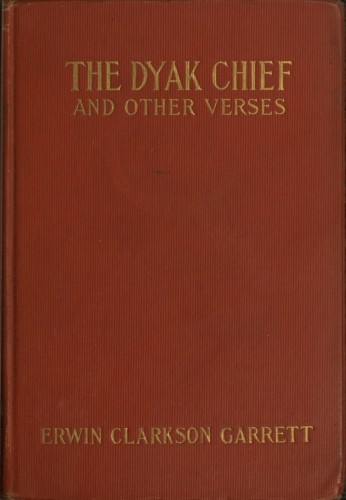
The Project Gutenberg eBook of The Dyak chief, and other verses
Title: The Dyak chief, and other verses
Author: Erwin Clarkson Garrett
Release date: September 26, 2016 [eBook #53149]
Most recently updated: October 23, 2024
Language: English
Credits: Produced by Chuck Greif, MWS, Bryan Ness and the Online
Distributed Proofreading Team at http://www.pgdp.net (This
file was produced from images generously made available
by The Internet Archive/Canadian Libraries)
THE DYAK CHIEF
AND OTHER VERSES
The Dyak Chief
and Other Verses
BY
ERWIN CLARKSON GARRETT
Author of
“My Bunkie and Other Ballads”
NEW YORK
BARSE & HOPKINS
PUBLISHERS
Copyright, 1914
By BARSE & HOPKINS
To My Mother
And some Ye bid to learn;
And some Ye bid to triumph—
And some to yearn and yearn:
And some Ye bid to conquer
In blood by land and sea;
And some Ye bid to tarry here—
To prove the love of Thee.
PREFACE
Neither desiring to plagiarize Cæsar nor to compare my book to Gaul, I wish to mention briefly that this volume as a whole is divided into three parts, of which one is occupied by the single poem, “The Dyak Chief,” the verses that give title to the book; another, the second, is occupied by American army ballads, and yet another, the third, is occupied by various verses on miscellaneous subjects.
However, if recollections of my personal campaigns against Cæsar—armed only with a Latin vocabulary and grammar—serve me rightly, the old Roman was not merely a worthy foe, but one who might well be held up as a worthy example; who dealt with his chronicles as he dealt with his enemies on the field, in a simple, direct, forcible manner, bare of circumlocution, tautology or ambiguity—that he who runs may read—and reading, know his Gaul and Gallic chieftains, his Cæsar and his Cæsar’s legionaries, even as Cæsar knew them.
The initial poem, “The Dyak Chief,” forming Part One, is a romance of Central Borneo, that I visited in July, 1908, during a little trip around the World.
Coming over from Java, which I had just finished touring, I arrived at Bandjermasin, in southeastern Borneo, near the coast, and from whence I took a small steamer up the Barito River to Poeroek Tjahoe, pronounced “Poorook Jow,” deep in the interior of the island.
Poeroek Tjahoe was the last white (Dutch) settlement, and from there I went with three Malay coolies five days tramp on foot through the jungle, northwest, penetrating the very heart of Borneo, sleeping the first three nights in the houses of the Dyaks, some nomadic tribes of whom still roam the jungle as head-hunters, and the last two nights upon improvised platforms out in the open, till I reached Batoe Paoe, a town or kampong in the geographical center of the island.
I also visited a nearby village, Olong Liko, afterwards returning by the Moeroeng and Barito Rivers to Poeroek Tjahoe, and from thence back to Bandjermasin on the little river-steamer and then by boat to Singapore, which was the radiating headquarters for my trips to Sumatra, Java, Borneo and Siam.
Having thus reached the very center of Borneo on foot, I had an excellent opportunity to study the country, the people and the general conditions, so that the reader of “The Dyak Chief” need feel no hesitancy in accepting as accurate and authentic, all descriptions, details and touches of “local color” or “atmosphere” contained in the poem.
Full notes on “The Dyak Chief” will be found at the end of the volume.
Part Two contains a number of new American army ballads, gathered mostly as a result of my personal observations and experiences when serving as a private in Companies “L” and “G,” 23rd U. S. Infantry (Regulars) and Troop “I,” 5th U. S. Cavalry (Regulars), during the Philippine Insurrection of 1899-1902.
As I have just mentioned, the army verses are all new ones, and consequently not to be found among those contained in my previous volume, “My Bunkie and Other Ballads.”
Part Three consists of individual poems on various subjects without any interrelation.
It is sincerely hoped that the reader will make full use of the notes appended at the end of the book, which addenda I have endeavored to treat with as much brevity as may be compatible with succinctness.
E. C. G.
Philadelphia, February 1st, 1914.
CONTENTS
PART ONE
THE DYAK CHIEF
THE DYAK CHIEF
Where the Moeroeng leaps in wild cascades,
And the endless green of the jungle fades,
And night shuts down on the fern-choked glades
Where the kampong hearth-fires glow.
The words of a Dyak chief,
Till ye learn the weight of the Dyak hate
And the depth of the Dyak grief.
I loved a kampong maid,
And very old was the tale I told
’Neath the lace of the jungle shade.
Though born year by year;
Till I thought of the headless waist I bore—
And I drew the maiden near:
Where the rippling shadows flee,
“None but the skull of a kampong chief
Shall hang at my belt for thee.”
II
First broke the golden day,
The taintless breeze in the highest trees
Laughed as I swung away.
Or skirted the river’s bank,
And the great lianes sung to me
As on my knees I drank.
And twisted in snake-like guise,
Till I lost their sight in the leafy height
Where peeped the purple skies.
I leapt from clod to clod,
O’er fallen trunk and lifted root
And the ooze of the sunken sod—
Where the tiny trees stand tall and straight,
A mass of mossy green,
And lighting all like a fairy hall
The sunlight sifts between.
I pressed my marches through;
Day by day through strain and stress
The weary hours flew.
As swept my hurrying tread,
The little waiting leeches rose
And caught me as I sped.
But I let them clinging stay,
And they swelled to seven times their size
And glutted and fell away.
And so they sucked their fill,
As I splashed through the knee-deep rivers
And clambered the jungle hill.
And the stars in their proud parade,
They bade me look to the fray before,
And back to the kampong maid.
III
That showed a fertile glade,
Where the bending trees of the river brink
Leaned out o’er a wild cascade.
The towering giants rose high,
And tossed their heads in hauteur,
Full-plumed across the sky.
A hundred feet in air,
And shook their clinging vine-leaves
As a Dyak maid her hair.
The river rock rose sheer,
And out of the cracks the tasseled palms
Like mighty plumes hung clear.
Where the little ripples gleam,
A fisher sat in his sunken proa
In the midst of the gliding stream.
Told where a hunter sped,
And I caught the glint of the morning sun
On the blow-spear’s glittering head.
Felling the little trees,
And the murmuring call of a water-fall
That echoed the jungle breeze.
The fisher and stream and hill—
Was the kampong deep in the hollow,
Nestling dark and still.
A single house and strong;
Perched on piles two warriors high
And a hundred paces long.
The mighty chief poles rose,
And seemed to shake their tasseled tops
In warning to their foes—
Once did, when in their might—
With shining steel and sinews—
Full-armed they sprang to fight.
The water women go
Back and forth to the river bank,
Chattering to and fro.
Till—straight as the windless flame—
With spear and shield and mandauw,
The kampong chieftain came.
Where hung each shriveled head.
Full well I saw the eyes of awe
That followed in his tread.
The quick obedience fanned—
And I felt the trance of the royal glance
Of the Lord of the Jungle-land.
As he strode the upland grade,
And softly I drew my mandauw
And fingered the sharpened blade.
To the hills in the golden morn?
But little I cared as the heavens stared
On the day that my hope was born.
As I slunk from tree to tree—
“None but the head of a kampong chief
Shall hang at my belt for thee.”
For you my belt shall grace,
Taken by right in fairest fight—
Full-fronted—face to face.)
That lay across his path,
And I stood to wait his coming—
The chieftain in his wrath.
That breaks across the night,
Were the rhythmic, muffled foot falls
Of the war-lord come to fight.
The branches pushed away—
And the Scourge of the Moeroeng Valley
Sprang straight to the waiting fray.
They told of his fearful fame,
As through my shield a hand’s-length
His hurtling spearhead came.
To the shock of the blinding blow,
But I rose again at the stinging pain
And the wet of the warm blood’s flow.
And I swept my mandauw high—
But ere my stroke descended
He smote me athwart the thigh.
As the stricken game in the dell—
As a bird on the wing at the blow-spear’s sting,
To the reddened earth I fell.
He knelt and held me fast;
And I looked on high at the fleecy sky—
And I thought the look was the last.
I wrenched my right hand free,
And I drove my mandauw’s gleaming point
A hand’s-breadth in his knee.
And a moment bared his breast,
And like the dash of the lightning flash
My weapon sought its rest.
The mighty chieftain rolled,
And I pinned him fast for the head-stroke,
In the reek of the blood-stained mold.
But the glare of the dying eyes
Gleamed forth to show the worthy foe
And the heart that never dies.
. . . . . . . . . .
A moment toward a kampong,
And toward a kampong maid,
I looked ... and a head rolled helpless
To the crash of a falling blade.
IV
I bound my arm and thigh,
And I headed back o’er the leafy track
With hope and spirits high.
All Nature seemed to sing;
And my legs ran red where trickling bled
The head of the Jungle King.
The fleecy clouds rolled by—
And the forest green was a sun-shot sheen,
And the sky was a laughing sky.
And the stars in their proud parade,
They bade me look to the path before
That led to the kampong maid.
At last I reached the hill,
Whence each hearth-light in the falling night
Was a welcome bright and still.
Cut clear through the growing gloam—
Of all brave things the best that brings
The weary Wanderer home.
And met me as I ran;
And they saw the head of the chieftain,
And they hailed me man and man.
I felt the anxious gaze,
And over my brain like a pall was lain
The weight of the Doubter’s craze.
For I quailed at the story stayed—
And I asked them if aught had happened
To the head of the kampong maid.
Where the stars lit one by one,
They told me the tale at my homing—
And I felt the passions run—
Shame as the burning bar—
Grief as the poisoned arrow—
Revenge as the salted scar:
Rising and ebbing low;
Till overhead the skies burst red,
And I tottered beneath the blow.
And the weapon that carries far;
And his love for the Maid—but over it laid
The hush of the falling star.
Weakness and love and fear—
Oh very old was the tale they told,
Though born year by year.
But they sprang and held me fast:
And they promised me there by the dead chief’s hair,
My hate should be filled to the last.
To the base of a splintered tree,
Stripped to the sun and spat upon
And taunted—awaiting me.
But ... I might not know her, then—
A sneer for the kampong women—
And a jest for the kampong men.
. . . . . . . . . .
And thus in the days of my strength and pride,
From over the distant sea,
The White Man came in his open shame
And stole my love from me.
V
The tom-toms roared their fill,
And echoed like rolling thunder
From hill to farthest hill.
And lifted and soared away,
And we dragged the fettered prisoner forth
To blink at the blinding day.
We staked him foot and hand,
And we laughed in glee as we watched to see
The pest of the jungle-land.
The little leeches swing,
End on end till they reached the flesh
Of the prostrate, struggling Thing.
They covered the White Man o’er—
Body and legs and arms and face,
Till the whole was a bleeding sore.
And crimsoned the leafy ground,
And the scent of gore but brought the more
As the smell of game to the hound.
Slowly day by day,
Hour by hour I watched the flesh
Sinking and turning gray:
To the skies and the White Man’s God—
But only the gluttons came again
And reddened the reeking sod.
Paled to an ashen dun—
And the clotted blood turned black as mud
And stunk in the midday sun.
A shining, yellow sheen—
And the flies that helped the leeches work
In the stagnant pools between.)
. . . . . . . . . .
Till the fourth day broke in a blaze of gold—
And I knew the end was nigh—
And I called the tribes from near and far,
To watch the White Man die.
Where the broad Barito winds—
From every kampong of the east
The murmuring hill-wind finds—
Where the Djoeloi falls and leaps—
From every kampong of the north
Where the great Mohakkam sweeps—
The mighty warriors came,
To prove the weight of the Dyak hate
And the shame of the naked shame.
They scanned the victim there,
Except that when an Elder spake
To mock at his despair.
Where loosened footboards creaked—
A woman leaned in frenzy
And tore her hair and shrieked.
The answering echoes came,
Till all our far-flung wilderness
Stooped down to curse his name.
They watched the streamlets flow:
In savage, sullen silence—
The war-lords—row on row—
Oh goodly was the sight,
Square shouldered—spare—with muscles bare
Coiled in their knotted might—
In glittering, primal hate,
Like adders, that beneath the leaves
The coming foot falls wait.
Stared with senseless grin,
As though in voiceless mummery
They mocked him in his sin.
To make his entry good
To th’ lost and leering legion
Of the martyred brotherhood.
. . . . . . . . . .
We rubbed his lips with costly salt—
(You know how far it comes)—
And when he called for drink—we laughed—
And rolled the Sick-man’s Drums.
. . . . . . . . . .
They beckoned me unto his side—
The blood-stench filled the dell—
They asked me—“Ye are satisfied?”
And I answered—“It is well.”
The weary struggles ceased—
And on his breath was the moan of death
That prayed for life released.
With a knob of rotten vine,
And the leeches entered greedily
As white men to their wine.
They gushed in rivers gay—
And gasping—his own blood choked him—
And his Spirit passed away.
When the western gold-belt dies,
And the jungle trees in the evening breeze
Tower against the skies,
And the good-wife bakes the greasy cakes
Where the kampong hearth-fires rise.