
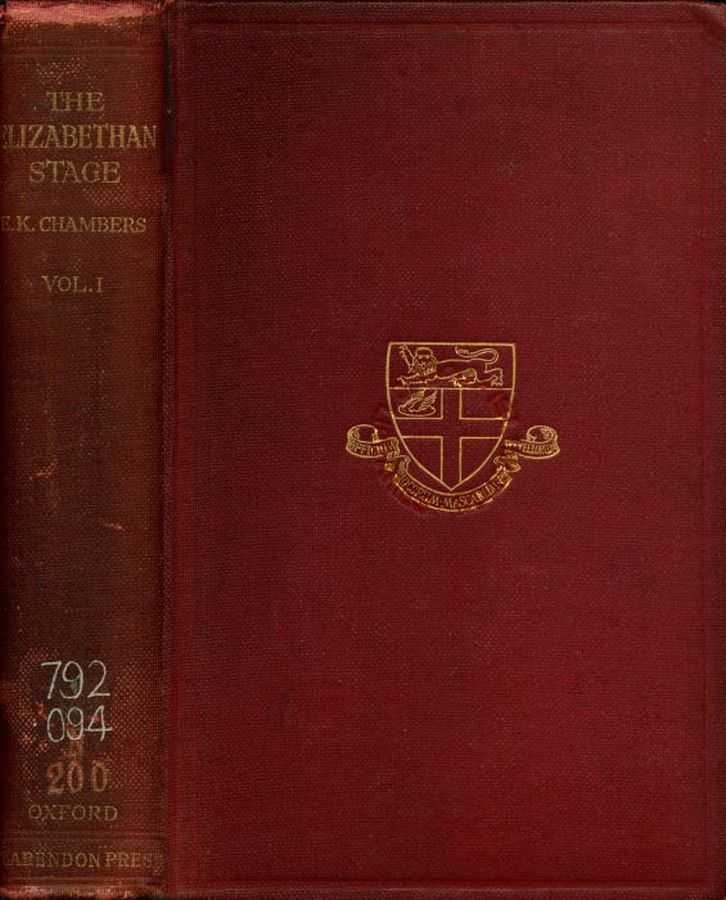
The Project Gutenberg eBook of The Elizabethan Stage, Vol. 1
Title: The Elizabethan Stage, Vol. 1
Author: E. K. Chambers
Release date: August 7, 2021 [eBook #66003]
Most recently updated: October 18, 2024
Language: English
Credits: Tim Lindell, Jane Robins and the Online Distributed Proofreading Team at https://www.pgdp.net
THE ELIZABETHAN STAGE
VOL. I
Oxford University Press
London Edinburgh Glasgow Copenhagen
New York Toronto Melbourne Cape Town
Bombay Calcutta Madras Shanghai
Humphrey Milford Publisher to the UNIVERSITY
Emery Walker ph. sc.
Wedding Mask of Sir Henry Unton
National Portrait Gallery
THE ELIZABETHAN STAGE
BY E. K. CHAMBERS. VOL. I
OXFORD: AT THE CLARENDON PRESS
M.CMXXIII
Printed in England
PREFACE
In 1903 I explained the origin of The Mediaeval Stage out of preliminary investigations for a little book on Shakespeare. That little book is still unwritten, and perhaps it was only a mirage, since working days have their term, and all that I can now offer, after an interval of twenty years, is another instalment of prolegomena. It has been in hand, more or less, throughout that period, which now ends felicitously with the tercentenary of the First Folio. But it has often been laid aside for other literary diversions, and still more often through the preoccupations of a life mainly concerned with activities remote from letters. As a result, I have constantly had to take account of new material furnished by the research or the speculations of others; and I only hope that in the process of revision I have succeeded in achieving a reasonable completeness of statement and a reasonable consistency in the conclusions of chapters drafted at very different dates.
Much in these volumes is of course mere archaeology, but the historian may find some interest in the development of the stage as an institution, and in the social and economic conditions which made such a development possible. My First Book is devoted to a description, perhaps disproportionate, of the Elizabethan Court, and of the ramifications in pageant and progress, tilt and mask, of that instinct for spectacular mimesis, which the Renaissance inherited from the Middle Ages, and of which the drama is itself the most important manifestation. The Second Book gives an account of the settlement of the players in London, of their conflict, backed by the Court, with the tendencies of Puritanism, and of the place which they ultimately found in the monarchical polity. To the Third and Fourth belong the more pedestrian task of following in detail the fortunes of the individual playing companies and the individual theatres, with such fullness as the available records permit. The Fifth deals with the surviving plays, not in their literary aspect, which lies outside my plan, but as documents helping to throw light upon the history of the institution which produced them. I have not for the most part carried my investigations beyond the death of Shakespeare, and although I have sometimes regretted that I did not push on to the closing of the theatres, the decision not to do so has long been irretrievable.
Obviously I am treading a region far more carefully charted by predecessors than that of The Mediaeval Stage; but the progress of Elizabethan scholarship during recent years has been so great as to render a fresh attempt at a synthesis justifiable. I am conscious of a deeper debt than I can express to many fellow-workers, notably to my friends Dr. W. W. Greg and Mr. A. W. Pollard and Professor Feuillerat of Rennes, and to a growing band of American students, of whom I may name Professor C. W. Wallace and Mr. J. T. Murray as examples.
E. K. C.
January, 1923.
CONTENTS
| VOLUME I | ||
|---|---|---|
| PAGE | ||
| PREFACE | vii | |
| LIST OF AUTHORITIES | xv | |
| BOOK I. THE COURT | ||
| I. | ELIZABETH AND JAMES | 1 |
| II. | THE ROYAL HOUSEHOLD | 27 |
| III. | THE REVELS OFFICE | 71 |
| IV. | PAGEANTRY | 106 |
| V. | THE MASK | 149 |
| VI. | THE MASK (continued) | 175 |
| VII. | THE COURT PLAY | 213 |
| BOOK II. THE CONTROL OF THE STAGE | ||
| VIII. | HUMANISM AND PURITANISM | 236 |
| IX. | THE STRUGGLE OF COURT AND CITY | 269 |
| X. | THE ACTOR'S QUALITY | 308 |
| XI. | THE ACTOR'S ECONOMICS | 348 |
LIST OF ILLUSTRATIONS
Wedding Mask of Sir Henry Unton. From picture in National Portrait Gallery Vol. i, frontispiece
NOTE ON SYMBOLS
I HAVE found it convenient, especially in Appendix A, to use the symbol <, following a date, to indicate an uncertain date not earlier than that named, and the symbol >, followed by a date, to indicate an uncertain date not later than that named. Thus 1903 <> 23 would indicate the composition date of any part of this book. I have sometimes placed the date of a play in italics, where it was desirable to indicate the date of production rather than publication.
LIST OF AUTHORITIES
[General Bibliographical Note. The few books here named are mainly those whose range is sufficiently wide to cover the greater part of my own ground. Others, more limited in their scope, are reserved for mention in the preliminary notes to the chapters upon whose subject-matter they directly bear; and in particular the bibliography of the drama, as distinct from the stage, receives full treatment in Book V. The scanty Restoration notices of the pre-Restoration stage are to be found in R. Flecknoe, A Short Discourse of the English Stage (1664), the anonymous Historia Histrionica (1699) ascribed to James Wright, and J. Downes, Roscius Anglicanus (1708). W. R. Chetwood's General History of the Stage (1749) is of no value, and its honesty is suspect. The first scholar to attempt a systematic history was E. Malone, in his Account of our Ancient Theatres (1790) and Historical Account of the Rise and Progress of the English Stage (1790), of which a revised version, with much fresh matter, was included by J. Boswell in the Third Variorum Shakespeare (1821). Something was added by G. Chalmers in the Account of the Rise and Progress of the English Stage which forms part of his Apology for the Believers in the Shakspeare-Papers (1797), and in an enlarged shape of his Supplemental Apology (1799). The first edition of J. P. Collier's History of English Dramatic Poetry and Annals of the Stage appeared in 1831. Thereafter Collier made many further contributions to the subject, in the publications of the Shakespeare Society, and in his New Facts regarding the Life of Shakespeare (1835), New Particulars regarding the Works of Shakespeare (1836), and Farther Particulars regarding Shakespeare and his Works (1839). These abound in forgeries, of which some are analysed in C. M. Ingleby, A Complete View of the Shakspere Controversy (1861), and which have not all been excluded from the current edition of the History (1879). Some new ground was broken by F. G. Fleay, who gave real stimulus to investigation by the series of hasty generalizations and unstable hypotheses contained in his On the Actor Lists, 1578-1642 (R. H. Soc. Trans. ix. 44), On the History of Theatres in London, 1576-1642 (R. H. Soc. Trans. x. 114), Shakespeare Manual (1876, 1878), Introduction to Shakespearian Study (1877), Life and Work of Shakespeare (1886), Chronicle History of the London Stage (1890), and Biographical Chronicle of the English Drama (1891). Little is added to or corrected in Fleay by H. Maas, Äussere Geschichte der englischen Theatertruppen (1907). Some useful documents were brought together by W. C. Hazlitt, The English Drama and Stage under the Tudor and Stuart Princes (1869). An interesting account from the French point of view is given of the earlier part of the period by J. J. Jusserand, Le Théâtre en Angleterre depuis la Conquête jusqu'aux prédécesseurs immédiats de Shakespeare (1878, 1881). R. A. Small, The Stage-quarrel between Ben Jonson and the So-called Poetasters (1899), and G. P. Baker, The Development of Shakespeare as a Dramatist (1907), are also valuable studies. Light is thrown upon stage-history by other specialist books about Shakespeare, particularly J. O. Halliwell-Phillipps, Outlines of the Life of Shakespeare (1881, 1890), and S. Lee, Life of William Shakespeare (1898, 1915, 1922). In recent years fresh material has been brought together by various researchers, notably by J. T. Murray in English Dramatic Companies (1910) and by C. W. Wallace in The Children of the Chapel at Blackfriars (1908), The Evolution of the English Drama up to Shakespeare (1912), and in a number of papers in the Nebraska University Studies and elsewhere. The Dulwich documents originally published by J. P. Collier in Memoirs of Edward Alleyn (1841), Alleyn Papers (1843), and Henslowe's Diary (1845) have been more scientifically edited by W. W. Greg in Henslowe's Diary (1904-8) and Henslowe Papers (1907), and the Extracts from Accounts of Revels at Court (1842) by P. Cunningham have been superseded and supplemented by A. Feuillerat, Documents relating to the Office of the Revels in the Time of Queen Elizabeth (1908) and Documents relating to the Revels at Court in the Time of King Edward VI and Queen Mary (1914). The work of gathering together miscellaneous documents and studies passed from The Shakespeare Society's Papers (1844-9) to the Transactions of the New Shakspere Society (1874-92), and is now carried on by the Collections (1907-13) of the Malone Society. A summary of both the older and the recent learning will be found in A. H. Thorndike, Shakespeare's Theater (1916), and a full account of the theatres in J. Q. Adams, Shakespearean Playhouses (1917). Little importance need be attached to H. B. Baker, The London Stage (1889, 1904), or to C. Hastings, The Theatre: its Development in France and England (1901), or to R. F. Sharp, A Short History of the English Stage (1909), or to M. Jonas, Shakespeare and the Stage (1918). But J. Genest, Some Account of the English Stage (1832), is still valuable on the Restoration period, of which a modern account is given in R. W. Lowe, Thomas Betterton (1891), while W. J. Lawrence, The Elizabethan Playhouse (1912, 1913), and A. Thaler, Shakspere to Sheridan (1922), help to trace the connexion with Elizabethan days.—The chief histories of the Elizabethan drama are A. W. Ward, History of English Dramatic Literature to the Death of Queen Anne (1875, 1899), J. A. Symonds, Shakspere's Predecessors in the English Drama (1884, 1900), F. E. Schelling, Elizabethan Drama (1908), C. F. T. Brooke, The Tudor Drama (1912). A special aspect is dealt with in F. S. Boas, University Drama in the Tudor Age (1914), and a daughter period in G. H. Nettleton, English Drama of the Restoration and Eighteenth Century (1914). The drama of modern Europe generally is treated in J. Klein, Geschichte des Dramas (1865-75), and R. Prölss, Geschichte des neueren Dramas (1881-3), both of which are now of less value than the comprehensive Geschichte des neueren Dramas (1893-1916) of W. Creizenach, from which part of the English section has been translated as The English Drama in the Age of Shakespeare (1916). Treatises on contemporary foreign stages are A. d'Ancona, Origini del Teatro italiano (1891), E. Rigal, Le Théâtre français avant la période classique (1901), and H. A. Rennert, The Spanish Stage in the Time of Lope de Vega (1909).—Of general histories of English literature the most important are Hazlitt-Warton, History of English Poetry, from the Twelfth to the close of the Sixteenth Century (1871), H. A. Taine, History of English Literature (1890), H. Morley, English Writers (1887-95), J. J. Jusserand, Histoire littéraire du peuple anglais (1894-1904), G. Körting, Grundriss der Geschichte der englischen Literatur (1910, mainly of bibliographical value), W. J. Courthope, History of English Poetry (1895-1910), and The Cambridge History of English Literature (1907-16), of which vols, v and vi are wholly devoted to the pre-Restoration drama. The social conditions of the period may be best studied in Shakespeare's England (1916). The most valuable bibliographical data are in W. W. Greg, A List of English Plays (1900) and A List of Masques, Pageants, &c. (1902), and in the Transcript of the Registers of the Company of Stationers, edited by E. Arber (1875-94), for 1554-1640, and by G. E. B. Eyre (1913-14) for 1640-1708. The Dictionary of National Biography is a standard work of reference. Of the periodicals in which dissertations on the stage and drama have been published, the most important are, in England, The Modern Language Quarterly (1896-1902) and its successor The Modern Language Review (1905-22), Notes and Queries (1850-1922), and The Library (1889-1922); in America, Modern Philology (1903-22), Modern Language Notes (1886-1922), The Publications of the Modern Language Association of America (1886-1922), The Journal of English and Germanic Philology (1897-1921), and Studies in Philology (1915-22); and in Germany, the Jahrbuch der Deutschen Shakespeare-Gesellschaft (1865-1921), Englische Studien (1877-1922), Anglia (1878-1922), and Archiv für das Studium der neueren Sprachen und Literaturen (1848-1922).
The following list of books is mainly intended to elucidate the references in the foot-notes, and has no claim to bibliographical completeness or accuracy.]