
The Preface to the Reader.
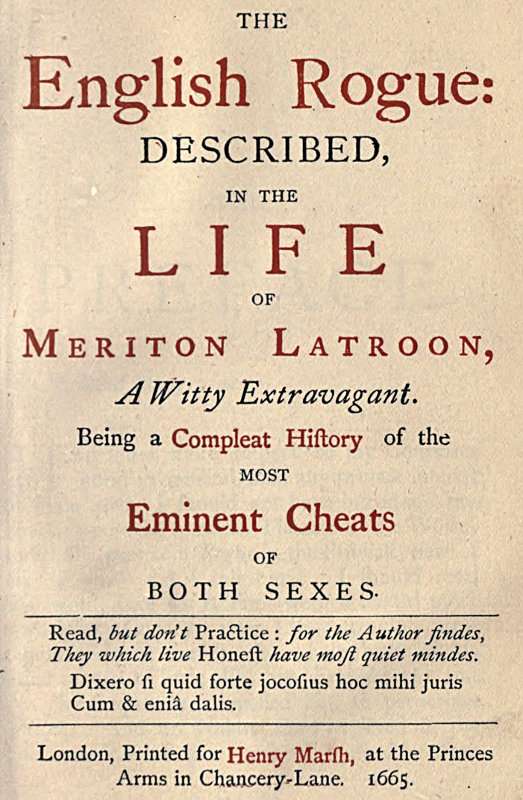
When this piece was first published it was ushered into the World with the usual ceremony of a Preface, and that a large one, whereby the Authour intended and endeavoured to possess the Reader with a belief, that what was written was the Life of a Witty Extravagant, the Authours Friend and Acquaintance. This was the intent of the Writer, but the Readers could not be drawn to this belief, but in general concurred in this opinion, that it was the Life of the Authour, and notwithstanding all that hath been said to the contrary many still continue in this opinion. Indeed the whole story is so genuine and naturally described without any forcing or Romancing that all contained in it seems to be naturally true, and so i’le assure you it is, but not acted by any one single person, much less by the Authour, who is well known to be of an inclination much different from the foul debaucheries of the Relations, & if the Readers had read the Spanish Rogue, Gusman; the French Rogue, Francion; and several other by Forraign Wits, and have upon examination found that the Authors were persons of great eminency and honour, and that no part of their own writings were their own lives; they had happily changed their opinion of the Authour of this; but they holding this opinion caused him to desist from prosecuting his story in a Second Part, and he having laid down the Cudgels I took them up, and my design in so doing was out of three considerations, the first and chiefest was to gain ready money, the second I had an itch to gain some Reputation by being in Print, and thereby revenge my self on some who had abused me, and whose actions I recited, and the third was to advantage the Reader and make him a gainer by acquainting him with my experiences. This were the reasons for my engaging in the Second part, and the very same reason induced me to joyn with the Authour in composing and Writing a third and fourth Part, in which we have club’d so equally, and intermixt our stories so joyntly, that it is some difficulty for any at first sight to distinguish what we particularly Writ and now having concluded the Preface, which should never have been begun but that I had a blank page, and was unwilling to be so ill a husband for you, but that you should have all possible content for your money, and withal to tell you that I would not have you as yet to expect any more parts of the book, for although a fifth and last part is design’d, yet i’le assure you there is never a stitch amiss, nor one line Written of it, and if you desire that, you must give me encouragement by your speedy purchasing of what is already Written; and thereby you will ingage
The Epistle to the Reader.
Gentlemen,
It hath been too much the humour of late, for men rather to adventure on the Forreign crazy stilts of other mens inventions, then securely walk on the ground-work of their own home-spun fancies. What I here present ye with, is an original in your own Mother-tongue; and yet I may not improperly call it a Translation, drawn from the Black Copy of mens wicked actions; such who spared the Devil the pains of courting them, by listing themselves Volunteers to serve under his Hellish Banners; with some whereof I have heretofore been unhappily acquainted, and am not ashamed to confess that I have been somewhat soiled by their vitious practices, but now I hope cleansed in a great measure from those impurities. Every man hath his peculiar guilt, proper to his constitution and age: and most have had (or will have) their exorbitant exiliencies, erronious excursions, which are least dangerous when attended by Youthfulness.
This good use I hope the Reader will make with me of those follies, that are so generally and too frequently committed every where, by declining the commission of them (if not for the love of virtue, yet to avoid the dismal effects of the most dangerous consequences that continually accompany them.) And how shall any be able to do this, unless they make an introspection into Vice? which they may do with little danger; for it is possible to injoy the Theorick, without making use of the Practick.
To save my Country-men the vast expence and charge of such experimental Observations, I have here given an accompt of my readings, not in Books, but Men; which should have been buried in silence, (fearing lest its Title might reflect on my Name and Reputation) had not a publick good interceded for its publication, far beyond any private interest or respect.
When I undertook this Subject, I was destitute of all those Tools (Books, I mean) which divers pretended Artists make use of to form some Ill-contrived design. By which ye may understand, that as necessity forced me, so a generous resolution commanded me to scorn a Lituanian humour or Custom, to admit of Adjutores tori, helpers in a Marriage-bed, there to engender little better than a spurious issue. It is a legitimate off-spring, I’ll assure yee, begot by one singly and soly, and a person that dares in spight of canker’d Malice subscribe himself
On the approvedly-ingenious, and his loving Friend, Mr. Richard Head, the Author of this book.