
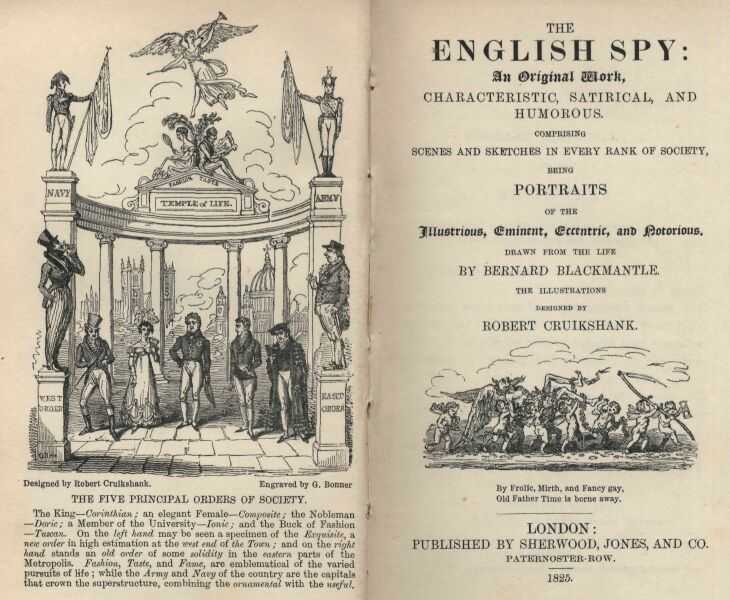
1. The Gate House, Highgate, Citizens toiling up the Hill
to the Sunday Ordinary 109
2. A Lame Duck waddling out of the Stock Exchange 139
3. The Dandy Candy Man, a Cheltenham Vignette 283
4. The Floating Harbour and Welsh Back, Bristol. 292
5. Bath Market-place, with Portraits of the celebrated
Orange Women 295
6. The Sporting Club at the Castle Tavern. Portraits of
Choice Spirits 300
7. The Battle of the Chairs 306
8. Vignette. Portraits of Blackmantle the English Spy,
and Transit 343
THE ENGLISH SPY.
Imperial, lowly, or patrician,
Shall, when they see this volume, cry,
"The satirist has pass'd us by:"
But, with good humour, view our page
Depict the manners of the age.
Vide Work.
INTRODUCTION TO THE SECOND VOLUME.
BERNARD BLACKMANTLE TO THE PUBLIC.
To please, improve, instruct, reform mankind."
—Churchill.
Readers!—friends, I may say, for your flattering support has enabled me to continue my Sketches of Society to a second volume with that prospect of advantage to all concerned which makes labour delightful—accept this fresh offering of an eccentric, but grateful mind, to that shrine where alone he feels he owes any submission—the tribunal of Public Opinion. In starting for the goal of my ambition, the prize of your approbation, I have purposely avoided the beaten track of other periodical writers, choosing for my subjects scenes and characters of real life, transactions of our own times, characteristic, satirical, and humorous, confined to no particular place, and carefully avoiding every thing like personal ill-nature or party feeling. My associates, the Artists and Publishers, are not less anxious than myself to acknowledge their gratitude; and we intend to prove, by our united endeavours, how highly we appreciate the extensive patronage we have already obtained.
BERNARD BLACKMANTLE,
ODE, CONGRATULATORY AND ADVISIORY,
TO BERNARD BLACKMANTLE, ESQ.
ON THE COMPLETION OF HIS FIRST VOLUME OF THE SPY.
"More sinned against than sinning."—William Shakspeare.
"The very Spy o' the time."—Ibid.
Well done, my lad, you've run on strong
Amidst the bustle of life's throng,
Nor thrown a spavin yet;
You've gone at score, your pace has told;
I hope, my boy, your wind will hold—
You've others yet to fret.
You've told the town that you are fly To cant, and rant, and trickery;
And that whene'er you doze,
Like Bristol men, you never keep
But one eye closed—so you can tweak
E'en then a scoundrel's nose.
Pull up, and rinse your mouth a bit;
It is hot work, this race of wit,
And sets the bellows piping;
Next Vol. you'll grind the flats again,
And file the sharps unto the grain,
Their very stomachs griping.
That we Reviewers scorn the cream{1}
Arising from your jokes?
Upon my soul, we love some fun
As well as any 'neath the sun,
Although we fight in cloaks.
Heav'n help thee, boy, we are not they
Who only go to damn a play,
And cackle in the pit;
Like good Sir William Curtis{2} we
Can laugh at nous and drollery,
Though of ourselves 'twere writ.
Was yours but sky blue milk and water,
We'd hand you over to the slaughter
Of cow committee-men{3};
For butterflies, and "such small deer,"
Are much beneath our potent spear—
The sharp gray goose-wing'd pen.
1 See my friend Bernard's cracker to the reviewers in No.
12, a perfect fifth of November bit of firework, I can
assure you, good people. But it won't go off with me without
a brand from the bonfire in return. "Bear this bear all."
2 Have you ever dared the "salt sea ocean," my readers, with
the alderman admiral? If not, know that he has as pretty a
collection of caricatures in his cabin, and all against his
own sweet self, as need be wished to heal sea-sickness. Is
not this magnanimity? I think so. The baronet is really "a
worthy gentleman."
3 Vide advertisements of "Alderney Milk Company." What
company shall we keep next, my masters? Mining companies, or
steam brick companies, or washing companies? How many of
them will be in the suds anon? Pshaw! throw physic to the
projectors—I prefer strong beer well hopped.
But yours we feel is sterner stuff,
And though perchance too much in huff,
More natural you will swear;
It really shows such game and pluck,
That we could take with you "pot luck,"
And deem it decent fare.
But, 'pon our conscience, bonny lad,
(We've got some, boy), it is too bad
So fiercely to show fight;
Gadzooks, 'tis time when comes the foe
To strip and sport a word and blow,
My dear pugnacious wight!
'Tis very wise, T own, to pull
Fast by the horns some butting bull,
When 'gainst yourself he flies;
But to attack that sturdy beast,
When he's no thoughts on you to feast,
Is very otherwise.
But we'll forgive your paper balls,
Which on our jackets hurtless falls,
Like hail upon a tower:
Pray put wet blankets on your ire;
Really, good sir, we've no desire
To blight so smart a flower.
Well, then, I see no reason why
There should be war, good Mister Spy
So, faith! we'll be allies;
And if we must have fights and frays,
We'll shoot at pride and poppinjays,
And folly as it flies.
There's field enough for both to beat Employment for our hands, eyes, feet,
To mark the quarry down,
Black game and white game a full crop,
Fine birds, fine feathers for to lop,
In country and in town.
New gas-blown boots, new steam-curl'd wigs,
New fashionable schools,
New dandies, and new Bond-street dons,
And new intrigues, and new crim cons,
New companies of fools.{4}
Maria Foote and Edmund Kean,
The "lions" just now of the scene,
Shall yield to newer fun;
For all our wonders at the best
Are cast off for a newer vest,
After a nine days' run.
Old beaux at Bath, manoeuvring belles,
And pump-room puppies, Melsom swells,
And Mr. Heaviside,{5}
And Cheltenham carders,{6} every runt,
4 See note 3, page 6.
5 Mr. Heaviside, the polite M. C. of Bath. He has the finest
cauliflower head of hair I over remember; but it covers a
world of wit, for all that, and therefore however it may
appear, it certainly is not the heavy side of him.
6 Cards, cards, cards, nothing but cards from "rosy morn to
dewy eve" at the town of Cheltenham. Whist, with the sun
shining upon their sovereigns, one would think a sovereign
remedy for their waste of the blessed day—écarte, whilst
the blue sky is mocking the blue countenances of your thirty
pound losers in as many seconds. Is it not marvellous?
Fathers, husbands, men who profess to belong to the Church.
By Jupiter! instead of founding the new university they talk
about, they had better make it for the pupilage of perpetual
card-players, and let them take their degrees by the
cleverness in odd tricks, or their ability in shuffling. "No
offence, Gregory." "No wonder they have their decrepit ones,
their ranters."
With Marshall{7} by their side.
All these and more I should be loth
To let escape from one or both,
So saddle for next heat:
The bell is rung, the course is cleared,
Mount on your hobby, "nought afear'd,"
Black-jacket can't be beat.
"Dum spiro spero" shout, and ride
Till you have 'scalp'd old Folly's hide,
And none a kiss will waft her;
Bind all the fools in your new book,
That "I spy!" may lay my hook,
And d—n them nicely after.
An Honest Reviewer.{8}
Given at my friend, "Sir John Barleycorn's"
Chambers, Tavistock, Covent Garden, this the
19th, day of February, 1825, "almost at odds
with morning."
7 Mr. Marshall, the M. C. of Cheltenham. "Wear him in your
heart's core, Horatio." I knew him well, a "fellow of
infinite jest." A long reign and a merry one to him.
8 My anonymous friend will perceive that I estimate his wit
and talent quite as much as his honesty: had he not been
such a rara avis he would have been consigned to the "tomb
of all the Capulets."
CYTHEREAN BEAUTIES.
May turn uncensured to his way;
Polluted streams again are pure,
And deepest wounds admit a cure;
But woman no redemption knows—
The wounds of honour never close."
—Moore.
Tremble not, ye fair daughters of chastity! frown not, ye moralists! as your eyes rest upon the significant title to our chapter, lest we should sacrifice to curiosity the blush of virtue. We are painters of real life in all its varieties, but our colouring shall not be over-charged, or our characters out of keeping. The glare of profligacy shall be softened down or so neutralized as not to offend the most delicate feelings. In sketching the reigning beauties of the time, we shall endeavour to indulge the lovers of variety without sacrificing the fair fame of individuals, or attempting to make vice respectable. Pleasure is our pursuit, but we are accompanied up the flowery ascent by Contemplation and Reflection, two monitors that shrink back, like sensitive plants, as the thorns press upon them through the ambrosial beds of new-blown roses. In our record of the daughters of Pleasure, we shall only notice those who are distinguished as belles of ton—stars of the first magnitude in the hemisphere of Fashion; and of these the reader may say, with one or two exceptions, they "come like shadows, so depart." We would rather excite sympathy and pity for the unfortunate, than by detailing all we know produce the opposite feelings of obloquy and detestation.
Exposed to trials, made too frail to bear."
Then, oh! ye daughters of celestial Virtue, point not the scoffing glance at these, her truant children, as ye pass them by—but pity, and afford them a gleam of cheerful hope: so shall ye merit the protection of Him whose chief attribute is charity and universal benevolence. And ye, lords of the creation! commiserate their misfortunes, which owe their origin to the baseness of the seducer, and the natural depravity of your own sex.
LADIES OF DISTINCTION,
"DANS LE PARTERRE DES IMPURES."
"Nought is there under heav'n's wide hollowness
That moves more dear, compassion of the mind,
Than beauty brought t' unworthy wretchedness."
If ever there was a fellow formed by nature to captivate and conquer the heart of lovely woman, it is that arch-looking, light-hearted Apollo, Horace Eglantine, with his soul-enlivening conversational talents, his scraps of poetry, and puns, and fashionable anecdote; his chivalrous form and noble carriage, joined to a mirth-inspiring countenance and soft languishing blue eye, which sets half the delicate bosoms that surround him palpitating between hope and fear; then a glance at his well-shaped leg, or the fascination of an elegant compliment, smilingly overleaping a pearly fence of more than usual whiteness and regularity, fixes the fair one's doom; while the young rogue, triumphing in his success, turns on his heel and plays off another battery on the next pretty susceptible piece of enchanting simplicity that accident may throw into his way. "Who is that attractive star before whose influential light he at present seems to bow with adoration?" "A fallen one," said Crony, to whom the question was addressed, as he rode up the drive in Hyde Park, towards Cumberland-gate, accompanied by Bernard Blackmantle. "A fallen one" reiterated the Oxonian—"Impossible!" "Why, I have marked the fair daughter of Fashion myself for the last fortnight constantly in the drive with one of the most superb equipages among the ton of the day." "True," responded Crony, "and might have done so for any time these three years." In London these daughters of Pleasure are like physicians travelling about to destroy in all sorts of ways, some on foot, others on horseback, and the more finished lolling in their carriages, ogling and attracting by the witchery of bright eyes; the latter may, however, very easily be known, by the usual absence of all armorial bearings upon the panel, the chariot elegant and in the newest fashion, generally dark-coloured, and lined with crimson to cast a rich glow upon the occupant, and the servants in plain frock liveries, with a cockade, of course, to imply their mistresses have seen service. I know but of one who sports any heraldic ornament, and that is the female Giovanni, who has the very appropriate crest of a serpent coiled, and preparing to spring upon its prey, à la Cavendish. The elegante in the dark vis, to whom our friend Horace is paying court, is the ci-devant Lady Ros—b—y, otherwise Clara W——.
By the peer she has a son, and from the plebeian a pension of two hundred pounds per annum: her origin, like most of the frail sisterhood, is very obscure; but Clara certainly possesses talents of the first order, and evinces a generosity of disposition to her sisters and family that is deserving of commendation. In person, she is plump and well-shaped, but of short stature, with a fine dark eye and raven locks that give considerable effect to an otherwise interesting countenance. A few years since she had a penchant for the stage, and played repeatedly at one of the minor theatres, under the name of "The Lady;" a character Clara can, when she pleases, support with unusual gaieté: instance her splendid parties in Manchester-street, Manchester-square, where I have seen a coruscation of beauties assembled together that must have made great havoc in their time among the hearts of the young, the gay, and the generous. Like most of her society, Clara has no idea of prudence, and hence to escape some pressing importunities, she levanted for a short time to Scotland, but has since, by the liberal advances of her present delusive, been enabled to quit the interested apprehensions of the Dun family. The swaggering belle in the green pelisse yonder, on the pavé, is the celebrated courtezan, Mrs. St*pf**d, of Curzon-street, May-fair. How she acquired her present cognomen I know not, unless it was for her stopping accomplishment in the polite science of pugilism and modern patter, in both of which she is a finished proficient, as poor John D———, a dashing savoury chemist, can vouch for.
On a certain night, she followed this unfaithful swain, placing herself (unknown to him) behind his carriage, to the house of a rival sister of Cytherea, Mrs. St**h**e, and there enforced, by divers potent means, due submission to the laws of Constancy and Love; but as such compulsory measures were not in good taste with the protector's feelings, the contract was soon void, and the lady once more liberated to choose another and another swain, with a pension of two hundred pounds per annum, and a well-furnished house into the bargain. She was formerly, and when first she came out, the chère amie of Tom B——-, who had, in spite of his science recently, in a short affair at Long's hotel, not much the Best of it. (See plate).
[Please click on any of the Color Plates to enlarge them to full size]
From him she bolted, and enlisted with an officer of the nineteenth Lancers; but not liking the house of Montague, she obtained the Grant of a furlough, and has since indulged in a plurality of lovers, without much attention to size, age, persons, or professions. Of her talent in love affairs, we have given some specimens; and her courage in war can never be doubted after the formidable attack she recently made upon General Sir John D***e, returning through Hounslow from a review, from which rencontre she has obtained the appropriate appellation of the Brazen Bellona. A pretty round face, dark hair, and fine bushy eyebrows, are no mean attractions; independent of which the lady is always upon good terms with herself. The belle whip driving the cabriolet, with a chestnut horse and four white legs, is the Edgeware Diana Mrs. S***h, at present engaged in a partnership affair, in the foreign line, with two citizens, Messrs O. R. and S.; the peepholes at the side of her machine imply more than mere curiosity, and are said to have been invented by General Ogle, for the use of the ladies when on active service. The beautiful little Water Lily in the chocolate-coloured chariot, with a languishing blue eye and alabaster skin, is Mrs. Ha****y, otherwise K**d***k, of Gr—n-street, a great favourite with all who know her, from the elegance of her manners and the attractions of her person (being perfect symmetry); at present she is under the special protection of a city stave merchant, and has the reputation of being very sincere in her attachments.
"You must have been a desperate fellow in your time, Crony," said I, "among the belles of this class, or you could never have become so familiar with their history." "It is the fashion," replied the veteran, "to understand these matters; among the bons vivants of the present day a fellow would be suspected of chastity, or regarded as uncivilized, who could not run through the history of the reigning beauties of the times, descanting upon their various charms with poetical fervor, or illuminating, as he proceeds, with some choice anecdotes of the Paphian divinities, their protectors and propensities; and to do the fair Citherians justice, they are not much behindhand with us in that respect, for the whole conversation of the sisterhood turns upon the figure, fortune, genius, or generosity of the admiring beaux. To a young and ardent mind, just emerging from scholastic discipline, with feelings uncontaminated by fashionable levities, and a purse equal to all pleasurable purposes, a correct knowledge of the mysteries of the Citherian principles of astronomy may be of the most essential consequence, not less in protecting his morals and health than in the preservation of life and fortune. One half the duels, suicides, and fashionable bankruptcies spring from this polluted source. The stars of this order rise and fall in estimation, become fixed planets or meteors of the most enchanting brilliancy, in proportion not to the grace of modesty, or the fascination of personal beauty, but to the notoriety and number of their amours, and the peerless dignity of their plurality of lovers.
"Place the goddess of Love on the pedestal of Chastity, in the sacred recesses of the grove of Health, veiled by virgin Innocence, and robed in celestial Purity, and who among the cameleon race of fashionable roués would incur the charge of Vandalism, or turn aside to pay devotion at her shrine? but let the salacious deity of Impurity mount the car of Profligacy, and drive forth in all the glare of crimson and gold, and a thousand devotees are ready to sacrifice their honour upon her profligate altars, or chain themselves to her chariot wheels as willing slaves to worship and adore."
"Let us take another turn up the drive," said I, "for I am willing to confess myself much interested in this new system of astronomy, and perhaps we may discover a few more of the terrestrial planets, and observe the stars that move around their frail orbits." "I must first make you acquainted with the signs of the Paphian zodiac," said Crony; "for every one of these attractions have their peculiar and appropriate fashionable appellations. I have already introduced you to the Bang Bantum, Mrs Bertram; the London Leda, Moll Raffles; the Spanish Nun, St. Margurite; the Sparrow Hawk, Augusta C****e{1}; the Golden
Pippin, Mrs. C.; the White Crow, Clara W****; the Brazen Bellona, Mrs. St**f**d; the Edgeware Diana, Mrs. S**th; and the Water Lily Symmeterian, Ha**l*y—all planets of the first order, carriage curiosities. Let us now proceed to make further observations. The jolie dame yonder, in the phaeton, drawn by two fine bays, is called the White Doe, from her first deer protector; and although somewhat on the decline, she is yet an exhibit of no mean attraction, and a lady of fortune. Thanks to the liberality of an old hewer of stone, and the talismanic powers of the golden Ball, deserted by her last swain since his marriage, she now reclines upon the velvet cushion of Independence, enjoying in the Kilburn retreat, her otium cum dignitate, secure from the rude winds of adversity, and in the occasional society of a few old friends. The lovely Thais in the brown chariot, with a fine Roman countenance, dark hair, and sparkling eyes, is the favourite elect of a well-known whig member; here she passes by the name of the Comic Muse, the first letter of which will also answer for the leading initial of her theatrical cognomen. Her, private history is well-known to every son of old Etona who has taken a toodle over Windsor-bridge on a market-day within the last fifteen years, her parents being market gardeners in the neighbourhood; and her two unmarried sisters, both fine girls, are equally celebrated with the Bath orange-women for the neatness of their dress and comeliness of their persons. There is a sprightliness and good-humour about the Comic Muse that turns aside the shafts of ill-nature; and had she made her selection more in accordance with propriety, and her own age, she might have escaped our notice; but, alas!" said Crony, "she forgets that
Its bloom, the pledge of its decay,
Sweet in scent, in colour bright,
It blooms at morn and fades at night.
At this moment a dashing little horsewoman trotted by in great style, followed by a servant in blue and gold livery; her bust was perfection itself, but studded with the oddest pair of ogles in the world, and Crony assured me (report said) her person was supported by the shortest pair of legs, for an adult, in Christendom. "That is the queen of the dandysettes," said my old friend, "Sophia, Selina, or, as she is more generally denominated, Galloping W****y, from a long Pole, who settled the interest of five thousand upon her for her natural life; she is since said to have married her groom, with, however, this prudent stipulation, that he is still to ride behind her in public, and answer all demands in propria persona. She is constantly to be seen at all masquerades, and may be easily known by her utter contempt for the incumbrance of decent costume." "How d'ye do? How d'ye do?" said a most elegant creature, stretching forth her delicate white kid-covered arm over the fenêtre of Lord Hxxxxxxx*h's vis à vis. "Ah! bon jour, ma chère amie," said old Crony, waving his hand and making one of his best bows in return. "You are a happy dog," said I, "old fellow, to be upon such pleasant terms with that divinity. No plebeian blood there, I should think: a peeress, I perceive, by the coronet on the panels." "A peine cognoist, ou la femme et le melon," responded Crony, "you shall hear. Among the ton she passes by the name of Vestina the Titan, from her being such a finished tactician in the campaigns of Venus;. her ordinary appellation is Mrs. St—h—pe: whether this be a nom de guerre or a nom de terre, I shall not pretend to decide; if we admit that la chose est toute, et que la nom n'y fait rien, the rest is of no consequence. It would be an intricate task to unravel the family web of our fashionable frail ones, although that of many frail fashionables stands high in heraldry. The lady in question, although in 'the sear o' the leaf,' is yet in high request; 'fat, fair, and forty' shall I say?
Alas! that would have been more suitable ten years since; but, n'importe, she has the science to conceal the ravages of time, and is yet considered attractive. No one better understands the art of intrigue; and she is, moreover, a travelled dame, not deficient in intellect, full of anecdote; and as conjugation and declension go hand in hand with some men of taste, she has risen into notice when others usually decline. A sporting colonel is said to have formerly contributed largely to her comforts, and her tact in matters of business is notorious; about two hundred per annum she derived from the Stock Exchange, and her present peerless protector no doubt subscribes liberally. To be brief, Laura has money in the funds, a splendid house, carriage, gives her grand parties, and lives proportionably expensive and elegant; yet with all this she has taken care that the age of gold may succeed to the age of brass, that the retirement of her latter days may not be overclouded by the storms of adversity. She had two sisters, both gay, who formerly figured on the pavé, Sarah and Louisa; but of late they have disappeared, report says, to conjugate in private. Turn your eyes towards the promenade," said Crony, "and observe that constellation of beauties, three in number, who move along le verd gazon: they are denominated the Red Rose, the Moss Rose, and the Cabbage Rose. The first is Rose Co*l**d, a dashing belle, who has long figured in high life; her first appearance was in company with Lord William F***g***ld, by whom she has a child living; from thence we trace her to the protection of another peer, Lord Ty*****], and from him gradually declining to the rich relative of a northern baronet, sportive little Jack R*****n, whose favourite lauda finem she continued for some time; but as the law engrossed rather too much of her protector's affairs, so the fair engrossed rather too much of the law; whether she has yet given up practice in the King's Bench I cannot determine, but her appearance here signifies that she will accept a fee from any side; Rose has long since lost every tint of the maiden's blush, and is now in the full blow of her beauty and maturity, but certainly not without considerable personal attractions; with some her nom de guerre is Rosa longa, and a wag of the day says, that Rose is a beauty in spite of her teeth. The Moss Rose has recently changed her cognomen with her residence, and is now Mrs. F**, of Beaumout-street; she was never esteemed a planet, and may be now said to have sunk into a star of the second order, a little twinkling light, useful to assist elderly gentlemen in finding their way to the Paphian temple. The Cabbage Rose is one of your vulgar beauties, ripe as a peach, and rich in countenance as the ruby: if she has never figured away with the peerage, she has yet the credit of being entitled to three balls on her coronet, and an old uncle to support them: she has lately taken a snug box in Park-place, Regent's-park, and lives in very good style. The belle in the brown chariot, gray horses, and blue liveries is now the lady of a baronet, and one of three graceless graces, the Elxxxxx's, who, because their father kept a livery stable, must needs all go to rack: she has a large family living by Mr. V*l*b***s, whom she left for the honour of her present connexion. That she is married to the baronet, there is no doubt; and it is but justice to add, she is one among the many instances of such compromises in fashionable life who are admitted into society upon sufferance, and falls into the class of demi-respectables. Among the park beaux she is known by the appellation of the Doldrums her two sisters have been missing some time, and it is said are now rusticating in Paris." My friend Eglantine had evidently fled away with the white crow, and the fashionables were rapidly decreasing in the drive, when Crony, whose scent of dinner hour is as staunch as that of an old pointer at game, gave evident symptoms of his inclination to masticate. "We must take another opportunity to finish our lecture on the principles of Citherian astronomy," said the old beau, "for as yet we are not half through the list of constellations. I have a great desire to introduce you to Harriette Wilson and her sisters, whose true history will prove very entertaining, particularly as the fair writer has altogether omitted the genuine anecdotes of herself and family in her recently published memoirs." At dinner we were joined by Horace Eglantine and Bob Transit, from the first of whom we learned, that a grand fancy ball was to take place at the Argyll Rooms in the course of the ensuing week, under the immediate direction of four fashionable impures, and at the expense of General Trinket, a broad-shouldered Milesian, who having made a considerable sum by the commissariat service, had returned home to spend his Peninsular pennies among the Paphian dames of the metropolis. For this entertainment we resolved to obtain tickets, and as the ci-devant lady H***e was to be patroness, Crony assured us there would be no difficulty in that respect, added to which, he there promised to finish his sketches of the Citherian beauties of the metropolis, and afford my friend Transit an opportunity of sketching certain portraits both of Paphians and their paramours.
THE WAKE;
OR,
TEDDY O'RAFFERTY'S LAST APPEARANCE. A SCENE IN THE HOLY LAND.
Just to comfort ould Judy, his wife,
The lads of the hod had a frake.
And kept the thing up to the life.
There was Father O'Donahoo, Mr. Delany,
Pat Murphy the doctor, that rebel O'Shaney,
Young Terence, a nate little knight o' the hod,
And that great dust O'Sullivan just out o' quod;
Then Florence the piper, no music is riper,
To all the sweet cratures with emerald fatures
Who came to drink health to the dead.
Not Bryan Baroo had a louder shaloo
When he gave up his breath, to that tythe hunter death,
Than the howl over Teddy's cowld head:
'Twas enough to have rais'd up a saint.
All the darlings with whiskey so faint,
And the lads full of fight, had a glorious night,
When ould Teddy was wak'd in his shed.
—Original.
He who has not travelled in Ireland should never presume to offer an opinion upon its natives. It is not from the wealthy absentees, who since the union have abandoned their countrymen to wretchedness, for the advancement of their own ambitious views, that we can form a judgment of the exalted Irish: nor is it from the lowly race, who driven forth by starving penury, crowd our more prosperous shores, that we can justly estimate the true character of the peasantry of that unhappy country. The Memoirs of Captain Rock may have done something towards removing the national prejudices of Englishmen; while the frequent and continued agitation of that important question, the Emancipation of the Catholics, has roused a spirit of inquiry in every worthy bosom that will much advantage the oppressed, and, eventually, diffuse a more general and generous feeling towards the Irish throughout civilized Europe. I have been led into this strain of contemplation, by observing the ridiculous folly and wasteful expenditure of the nobility and fashionables of Great Britain; who, neglecting their starving tenantry and kindred friends, crowd to the shores of France and Italy in search of scenery and variety, without having the slightest knowledge of the romantic beauties and delightful landscapes, which abound in the three kingdoms of the Rose, the Shamrock, and the Thistle. How much good might be done by the examples of a few illustrious, noble, and wealthy individuals, making annual visits to Ireland and Scotland! what a field does it afford for true enjoyment! how superior, in most instances, the accommodations and security; and how little, if at all inferior, to the scenic attractions of foreign countries. Then too the gratification of observing the progress of improvement in the lower classes, of administering to their wants, and consoling with them under their patient sufferings from oppressive laws, rendered perhaps painfully necessary by the political temperature of the times or the unforgiving suspicions of the past. But I am becoming sentimental when I ought to be humorous, contemplative when I should be characteristic, and seriously sententious when I ought to be playfully satirical. Forgive me, gentle reader, if from the collapse of the spirit, I have for a moment turned aside from the natural gaiety of my style, to give utterance to the warm feelings of an eccentric but generous heart. But, allons to the wake.
"Plaze ye'r honor," said Barney O'Finn (my groom of the chambers), "may I be axing a holiday to-night?" "It will be very inconvenient, Barney; but———" "But, your honor's not the jontleman to refuse a small trate o' the sort," said Barney, anticipating the conclusion of my objection. There was some thing unusually anxious about the style of the poor fellow's request that made me hesitate in the refusal. "It's not myself that would be craving the favor, but a poor dead cousin o' mine, heaven rest his sowl!" "And how can the granting of such a request benefit your departed relation, Barney?" quoth I, not a little puzzled by the strangeness of the application. "Sure, that's mighty dare of comprehension, your honor. Teddy O'Rafferty was my own mother's brother's son, and devil o' like o' him there was in all Kilgobbin: we went to ould Father O'Rourke's school together when we were spalpeens, and ate our paraters and butter-milk out o' the same platter; many's the scrape we've been in together: bad luck to the ould schoolmaster, for he flogged all the larning out o' poor Teddy, and all the liking for't out of Barney O'Finn, that's myself, your honor—so one dark night we took advantage of the moon, and having joined partnership in property put it all into a Limerick silk handkerchief, with which we made the best of our way to Dublin, travelling stage arter stage by the ould-fashioned conveyance, Pat Adam's ten-toed machine. Many's the drap we got on the road to drive away care. All the wide world before us, and all the fine family estate behind,—pigs, poultry, and relations,—divil a tenpenny did we ever touch since. It's not your honor that will be angry to hear a few family misfortins," said Barney, hesitating to proceed with his narration, "Give me my hat, fellow," said I, "and don't torture me with your nonsense."— "May be it an't nonsense your honor means?" "And why not, sirrah?"—"Bekase it's not in your nature to spake light o' the dead." Up to this point, my attention had been divided between the Morning Chronicle which lay upon my breakfast table, and Barney's comical relation; a glance at the narrator, however, as he finished the last sentence, convinced me that I ought to have treated him with more feeling. He was holding my hat towards me, when the pearly drop of affliction burst uncontrollably forth, and hung on the side of the beaver, like a sparkling crystal gem loosed from the cavern's roof, to rest upon the jasper stone beneath. I would have given up my Mastership of Arts to have recalled that word nonsense: I was so touched with the poor fellow's pathos.—" Shall I tell your onor the partikilars?" "Ay, do, Barney, proceed."—"Well, your onor, we worked our way to London togither—haymaking and harvesting: 'Taste fashions the man' was a saw of ould Father O'Rourke's; 'though divil a taste had he, but for draining the whiskey bottle and bating the boys, bad luck to his mimory! 'Is it yourself?' said I, to young squire O'Sullivan, from Scullanabogue, whom good fortune threw in my way the very first day I was in London.—'Troth, and it is, Barney,' said he: 'What brings you to the sate of government?' 'I'm seeking sarvice and fortune, your onor,' said I. 'Come your ways, then, my darling,' said he; and, without more to do, he made me his locum tenens, first clerk, messenger, and man of all work to a Maynooth Milesian. There was onor enough in all conscience for me, only it was not vary profitable. For, altho' my master followed the law, the law wouldn't follow him, and he'd rather more bags than briefs:—the consequence was, I had more banyan days than the man in the wilderness. Divil a'care, I got a character by my conduct, and a good place when I left him, as your govonor can testify. As for poor Teddy, divil a partikle of taste had he for fashionable life, but a mighty pratty notion of the arts, so he turned operative arkitekt; engaged himself to a layer of bricks, and skipped nimbly up and down a five story ladder with a long-tailed box upon his shoulder—pace be to his ashes! He was rather too fond of the crature—many's the slip he had for his life—one minute breaking a jest, and the next breaking a joint; till there wasn't a sound limb to his body. Arrah, sure, it was all the same to Teddy—only last Monday, he was more elevated than usual, for he had just reached the top of the steeple of one of the new churches with a three gallon can of beer upon his knowledge-box, and, perhaps a little too much of the crature inside o! it. 'Shout, Teddy, to the honour of the saint,' said the foreman of the works (for they had just completed the job). Poor Teddy's religion got the better of his understanding, for in shouting long life to the dedicatory saint, he lost his own—missed his footing, and pitched over the scaffold like an odd chimney-pot in a high wind, and came down smash to the bottom with a head as flat as a bump. Divil a word has he ever spake since; for when they picked him up, he was dead as a Dublin bay herring—and now he lies in his cabin in Dyot-street, St. Giles, as stiff as a poker,—and to-night, your onor, we are going to wake him, poor sowl! to smoke a pipe, and spake an horashon over his corpse before we put him dacently to bed with the shovel. Then, there's his poor widow left childless, and divil a rap to buy paraters wid—bad luck to the eye that wouldn't drap a tear to his mimory, and cowld be the heart that refuses to comfort his widow!" Here poor Barney could no longer restrain his feelings, and having concluded the family history, blubbered outright. It was a strange mixture of the ludicrous and the sorrowful; but told with such an artless simplicity and genuine traits of feeling, that I would have defied the most volatile to have felt uninterested with the speaker. "You shall go, by all means, Barney," said I: "and here is a trifle to comfort the poor widow with." "The blessings of the whole calendar full on your onor!" responded the grateful Irishman. What a scene, thought I, for the pencil of my friend Bob Transit!"Could a stranger visit the place," I inquired, without molestation or the charge of impertinence, Barney?" "Divil a charge, your onor; and as to impertinence, a wake's like a house-warming, where every guest is welcome." With this assurance, I apprised Barney of my intention to gratify curiosity, and to bring a friend with me; carefully noted down the direction, and left the grateful fellow to pursue his course.
The absurdities of funeral ceremonies have hitherto triumphed over the advances of civilization, and in many countries are still continued with almost as much affected solemnity and ridiculous parade as distinguished the early processions of the Pagans, Heathens, and Druids. The honours bestowed upon the dead may inculcate a good moral lesson upon the minds of the living, and teach them so to act in this life that their cold remains may deserve the after-exordium of their friends; but, in most instances, funeral pomp has more of worldly vanity in it than true respect, and it is no unusual circumstance in the meaner ranks of life, for the survivors to abridge their own comforts by a wasteful expenditure and useless parade, with which they think to honour the memory of the dead. The Egyptians carry this folly perhaps to the most absurd degree; their catacombs and splendid tombs far outrivalling the habitations of their princes, together with their expensive mode of embalming, are with us matters of curiosity, and often induce a sacrilegious transfer of some distinguished mummy to the museums of the connoisseur. The Athenians, Greeks, and Romans, had each their peculiar funeral ceremonies in the exhumation, sacrifices, and orations performed on such occasions; and much of the present customs of the Romish church are, no doubt, derivable from and to be traced to these last-mentioned nations. In the present times, no race of people are more superstitious in their veneration for the ancient customs of their country and funeral rites, than the lower orders of the Irish, and that folly is often carried to a greater height during their domicile in this country than when residing at home.
It was about nine o'clock at night when Eglantine, Transit, and myself sallied forth to St. Giles's in search of the wake, or, as Bob called it, on a crusade to the holy land. Formerly, such a visit would have been attended with great danger to the parties making the attempt, from the number of desperate characters who inhabited the back-slums lying in the rear of Broad-street: where used to be congregated together, the most notorious thieves, beggars, and bunters of the metropolis, amalgamated with the poverty and wretchedness of every country, but more particularly the lower classes of Irish, who still continue to exist in great numbers in the neighbourhood. Here was formerly held in a night-cellar, the celebrated Beggars' Club, at which the dissolute Lord Barrymore and Colonel George Hanger, afterwards Lord Coleraine, are said to have often officiated as president and vice-president, attended by their profligate companions, and surrounded by the most extraordinary characters of the times; the portraits and biography of whom may be seen in Smith's 'Vagabondiana,' a very clever and highly entertaining work. It was on this spot that George Parker collected his materials for 'Life's Painter of Variegated Characters,' and among its varieties, that Grose and others obtained the flash and patter which form the cream of their humorous works. Formerly, the Beggars' ordinary, held in a cellar was a scene worthy of the pencil of a Hogarth or a Cruikshank; notorious impostors, professional paupers, ballad-singers, and blind fiddlers might here be witnessed carousing on the profits of mistaken charity, and laughing in their cups at the credulity of mankind; but the police have now disturbed their nightly orgies, and the Mendicant Society ruined their lucrative calling. The long table, where the trenchers consisted of so many round holes turned out in the plank, and the knives, forks, spoons, candle-sticks, and fire-irons all chained to their separate places, is no longer to be seen. The night-cellar yet exists, where the wretched obtain a temporary lodging and straw bed at twopence per head; but the Augean stable has been cleansed of much of its former impurities, and scarce a vestige remains of the disgusting depravity of former times.