
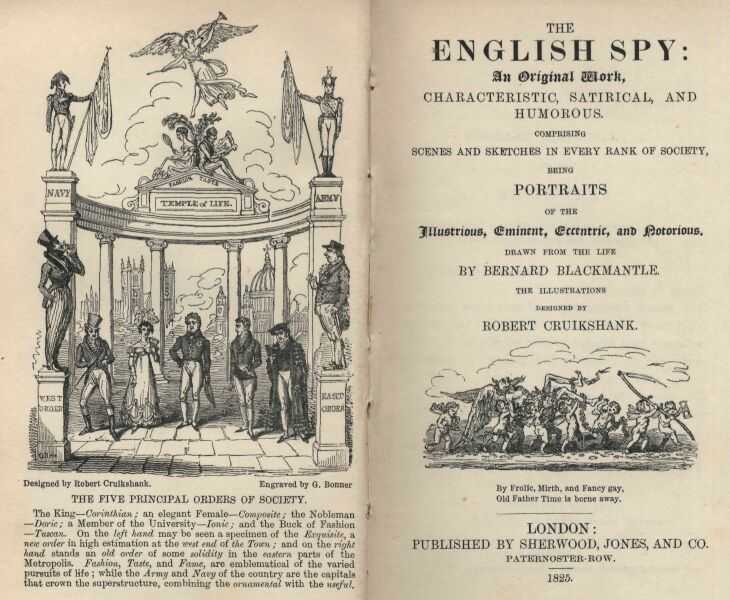
We hope it will be generally admitted that few volumes have
a more decided claim upon the public patronage, in respect
to the novelty and variety of design, as well as the number
of illustrations, than the one here presented to the reader.
To speak of the choice humorous talent engaged in the work
would only be to re-echo the applauding sentiments of the
reviewers and admirers of rich graphic excellence.
Cruikshank and Rowlandson are names not unworthy a space
upon the same roll with Hogarth, Gilray, and Bunbury: to
exhibit scenes of character in real life, sketched upon the
spot, was an undertaking of no mean importance;
particularly, when it is remembered how great the difficulty
must have been in collecting together accurate portraits.
The work, it will be perceived, contains thirty-six Copper-
Plates, etched, aquainted, and coloured, by and under the
direction of the respective artists whose names appear to
the different subjects, the principal part of which are the
sole production of Mr. Robert Cruikshank. The Wood
Engravings, twenty-eight in number, besides the Vignettes,
(which are numerous), are equally full of merit; and will be
found, upon examination, to be every way worthy the superior
style of typographical excellence which characterises the
volume,
I.
THE FRONTISPIECE
Is intended to convey a general idea of the nature of the
work; combining, in rich classic taste, a variety of
subjects illustrative of the polished as well as the more
humble scenes of real life. It represents a Gothic Temple,
into which the artist, Mr. Robert Cruikshank, has introduced
a greater variety of characteristic subject than was ever
before compressed into one design. In the centre
compartment, at the top, we have a view of a Terrestrial
Heaven, where Music, Love, and gay Delight are all united to
lend additional grace to Fashion, and increase the splendour
of the revels of Terpsichore. In the niches, on each side,
are the twin genii, Poetry and Painting; while the
pedestals, right and left, present the protectors of their
country, the old Soldier and Sailor, retired upon pensions,
enjoying and regaling themselves on the bounty of their
King. In the centre of the Plate are three divisions
representing the King, Lords, and Commons in the full
exercise of their prerogatives. The figures on each side are
portraits of Bernard Blackmantle (the English Spy), and his
friend, Robert Transit (the artist), standing on projecting
pedestals, and playing with the world as a ball; not
doubting but for this piece of vanity, the world, or the
reviewers for them, will knock them about in return. On the
front of the pedestals are the arms of the Universities of
Oxford and Cambridge; and in the centre armorial shields of
the Cities of London and Westminster. The picture of a
modern Hell, in the centre, between the pedestals, has the
very appropriate emblems of Misery and Death, in the niches
on each side. Crowning the whole, the Genius of Wit is seen
astride of an eagle, demonstrative of strength, and wielding
in his hand the lash of Satire; an instrument which, in the
present work, has been used more as a corrective of we than
personal ill-nature.
THE FIVE PRINCIPAL ORDERS OF SOCIETY.
The King-Corinthian; an elegant Female-Composite; the
Nobleman-Doric; a Member of the University-Ionic; and the
Buck of Fashion-Tuscan. On the left hand may be seen a
specimen of the Exquisite, a new order in high estimation at
the west end of the Town; and on the right hand stands an
old order of some solidity in the eastern parts of the
Metropolis. Fashion, Taste, and Fame, are emblematical of
the varied pursuits of life; while the Army and Navy of the
country are the capitals that crown the superstructure,
combining the ornamental with the useful.
FIRST ABSENCE, OR THE SONS OF OLD ETONA
ANSWERING MORNING MUSTER-ROLL. 25
A view of the school-yard, Eton, at the time first Absence
is called, and just when the learned Doctor Keat is reviewing
the upper school. (Portraits.)
THE OPPIDAN'S MUSEUM, OR ETON COURT OF
CLAIMS AT THE CHRISTOPHER. 49
Bernard Blackmantle and Robert Transit sitting in judge-
ment after Election Saturday, apportioning the remuneration
money to the different claimants of the surrounding trophies.
ETON MONTEM, AND THE MOUNT, SALT HILL. 96
An accurate sketch of this ancient customary procession
made upon the spot.
THE FIRST BOW TO ALMA MATER. 113
Bernard Blackmantle's Introduction to the Big Wig on his
Arrival at Oxford.
FLOORING OF MERCURY, OR BURNING THE OAKS. 131
A scene in Tom Quadrangle, Oxford.
"If wits aright their tale of terror tell,
A little after great Mercurius fell,
***
Gownsmen and Townsmen throng'd the water's edge
To gaze upon the dreadful sacrilege:
***
———there with drooping mien a silent band
Canons and Bedmaker together stand:—
***
In equal horror all alike were seen,
And shuddering scouts forgot to cap the Dean."
COLLEGE COMFORTS. 151
Taking possession of your rooms. Bernard Blackmantle
taking possession of his rooms in Brazennose. Scout's list of
wants. Standing the quiz of the Togati Visible propensities
of your predecessor. The day of purification.
CAP-ING A PROCTOR, OR OXFORD BULL-DOGS
DETECTING BRAZENNOSE SMUGGLERS. 152
Tom Echo and Horace Eglantine lowering the plate-basket,
after the College-gates are closed, to obtain a supply of fresh
provision, are detected by the Proctor and Town Marshal with
their Bull-Dogs: in their alarm the basket and its contents are
suddenly let fall upon the Proctor, who is not able to under-
stand the joke.
THE ARRIVAL, OR WESTERN ENTRANCE INTO
COCKNEY LAND. 164
Portrait of high and low life Dandies and Dandysettes.
THE GREEN-ROOM OF THE KING'S THEATRE, R
NOBLE AMATEURS VIEWING FOREIGN CURIOSITIES. 198
Portraits of ten noble and distinguished patrons of the
opera, with those of certain daughters of Terpsichore.
THE ROYAL SALOON IN PICCADILLY, OR AN HOUR
AFTER THE OPERA. 205
Heartly, Lionise, and Transit in search of Character—The
gambling Parsons—Legs and Leg-ees-Tats men and touters—
Moll Raffle and Bang.
OXFORD TRANSPORTS, OR UNIVERSITY EXILES. 235
Albanians doing penance for past offences. A Scene sketched
from the Life. Horace Eglantine is proposing "the Study of
the Fathers," a favourite College toast, while Tom Echo is
enforcing Obedience to the President's proposition by finishing
off a Shirker. Dick Gradus having been declared absent, is
taking a cool nap with the Ice-pail in his arms and his head
resting upon a Greek Lexicon: in the left hand corner may
be seen a Scout bearing off a dead Man, (but not without hope
of Resurrection). Bob Transit and Bernard Blackmantle
occupy the situation on each side of Dick Gradus; in the
right-hand corner, Horace's servant is drawing the last Cork
from the parting bottle, which is to welcome in the peep o' day.
Injustice to the present authorities it should be stated,
that this is a Scene of other limes.—Vide A.
SHOW SUNDAY, A VIEW IN THE BROAD WALK,
CHRIST CHURCH MEADOWS, OXFORD. 244
Portraits of the Togati and the town, including big wigs,
nobs, and dons. Among the more conspicuous are Dr. Kett,
Lord G. Grenville, Dr. Grovesnor, Alderman Fletcher, and
Mr. Swan.
TOWN AND GOWN. 246
Battle of the Togati and Town Raff of Oxford, a night scene.
—Bernard and his Friends, Horace and Tom, distributing
among the Bargees of St. Clement's.
BLACK MATINS, OR THE EFFECTS OF LATE
DRINKING UPON EARLY RISERS. 269
A Most Imposing Scene.-Time seven o'clock in the Morn-
ing, the last bell has just tolled, and the University Men have
just turned out, while the hunting-frock, boots, and appear-
ance of some of the party, proclaim that they have just turned
in; all are eager to save fine and imposition, and not a few are
religiously disturbed in their Dreams. The admirable disorder
of the party is highly illustrative of the Effect produced by an
Evening Wine Party in College Rooms.
GOLGOTHA, OR THE PLACE OF SCULLS. 272
Tom Echo receiving sentence of Rustication. The Big Wigs
in a Bustle. Lecture on disobedience and chorus of the
Synod. Reports from the Isle of Bull dogs. Running foul
of the Quicksands of Rustication after having passed Point
Failure and The Long Hope. Nearly blown up at Point
Nonplus, and obliged to lay by to refit.
THE EVENING PARTY AT THE PAVILION,
BRIGHTON. (BY O. M. BRIOHTY.) 296
Interior of the Yellow Room—Portraits of His Majesty,
the Duke of York, and Princess Augusta, Marquis and
Marchioness of Conyngham, Earl of Arran, Lord Francis
Conyngham, Lady Elizabeth and Sir H. Barnard, Sir H.
Turner, Sir W. Knighton, Sir E. Nagle, and Sir C. Paget,
sketched from the Life.
THE KING AT HOME, OR MATHEWS AT CARLTON
HOUSE. 298
A scene founded on fact; including Portraits of the King,
Mathews, and other celebrated persons.
A FROLIC IN HIGH LIFE, OR, A VISIT TO BILLINGS-
GATE. 303
A very extraordinary whim of two very distinguished
females, whose Portraits will be easily recognised.
CHARACTERS ON THE STEYNE, BRIGHTON. 309
Portraits of illustrious, noble, and wealthy Visitors—The
Banker's Widow—A Bathing Group—The Chain Pier, &c.
TOM ECHO LAID UP WITH THE HEDDINGTON
FEVER, OR AN OXONIAN VERY NEAR THE
WALL. 323
Symptoms of having been engaged too deeply in the study
of Hie fathers. Portrait of a well-known Esculapian chief.
MONDAY AFTER THE GREAT ST. LEGER, OR
HEROES OF THE TURF PAYING AND RECEIVING
AT TATTERSALL'S. 329
This sketch was made upon the spot by my friend Transit,
on the Monday following the result of the last Great St. Leger
in 1823, when the Legs were, for the most part, in mourning
from the loss of their favourite Sherwood. Some long faces
will be easily recognized, and some few round ones, though
Barefoots, not easily be forgotten. The Tinkers were many
of them Levanters. Here may be seen the Peer and the Prig,
the Wise one and the Green one, the Pigeon and the Rook
amalgamated together. It is almost unnecessary to say, the
greater part of the characters are portraits.
EXTERIOR OF FISHMONGERS'-HALL, ST. JAMES'S
STREET, WITH A VIEW OF A REGULAR BREAKDOWN. 331
Portraits of the Master Fishmonger, and many well-
known Greeks and Pigeons.
INTERIOR OF A MODERN HELL. (Vide the affair of
the cogged dice.) 334
Portraits of upwards of twenty well-known Punters and
Frequenters—Greeks and Pigeons, noble and ignoble—The
Fishmonger in a fright, or the gudgeon turned shark—Expose
of Saint Hugh's Bones—Secrets worth knowing. (See work.)
THE DAFFY CLUB, OR A MUSICAL MUSTER OF
THE FANCY. 339
Interior of Tom Belcher's Parlour. Heartly and Bob in
search of Character. Striking likenesses of Boxers, Betters,
&c.—with a pen and ink Sketch of a Noted—one—a fine
School for Practical Experience. (For key to Portraits-
see work.)
PEEP 0' DAYS AND FAMILY MEN AT THE FINISH. 342
A Night Scene near Covent Garden—Coffee and comical
company.
FAMILY MEN AT FAULT, OR AN UNEXPECTED
VISIT FROM THE BISHOP AND HIS CHAPLAINS. 345
A Scene near Covent Garden, in which are introduced
certain well-known Characters and Bow-street Officers: in-
cluding Messrs. Bishop, Smith, Ruthven, and Townshend.
THE HALL OF INFAMY, ALIAS OYSTER SALOON,
IN BRYDGES-STREET, OR NEW COVENT GARDEN HELL. 354
Portraits of the old Harridan and her Flask man Tom.
Sketches of Sharps and Flats, Green ones and Impures.
Done from the Life.
WESTMINSTER HALL. 361
Portraits of well-known Worthies of the Bar.—The Maiden
Brief.—Dick Gradus examining a Witness.
SURREY COLLEGIANS GIVING A LIFT TO A LIMB
OF THE LAW. 364
Interior of the King's Bench Prison—Rough-drying a Lawyer.
R-A-YS OF GENIUS REFLECTING ON THE TRUE
LINE OF BEAUTY AT THE LIFE ACADEMY,
SOMERSET HOUSE. (BY T. ROWLANDSON.) 365
Bob Transit's first appearance as a student. Sketching
from the Life. Outlines of character. How to grow rich but
not great. Secrets worth knowing, and Portraits of all the
Well-known.
BERNARD BLACKMANTLE READING HIS PLAY IN
THE GREEN-ROOM OF COVENT GARDEN THEATRE. 366
Portraits of Messrs. C. Kemble, Fawcett, Farley, Jones,
Farren, Grimaldi, Macready, Young, T. P. Cooke, Chapman,
Blanchard, Abbott, Cooper, Yates, and the English Spy;
Mrs. Davenport, Miss Chester, Miss M. Tree, Miss Love, and
Mrs. Davison.
BERNARD BLACKMANTLE READING HIS FARCE IN
THE GREEN ROOM OF THE THEATRE ROYAL,
DRURY LANE. (by T. Wageman.) 367
Portraits of Elliston, Dowton, Harley, Munden, Knight,
Liston, Oxberry, Sherwin, Gattie, Wallack, Terry, G. Smith,
and Barnard, Miss Stephens, Mrs. Orger, Madame Vestris,
Mrs. Harlowe, and the English Spy. The Likenesses are all
studies from the life.
THE CITY BALL AT THE MANSION HOUSE. 368
Portraits of the Duke of Sussex, the Lord Mayor (Waith-
man) and Lady Mayoress, the Sheriffs Laurie and Whittaker,
Aldermen Wood and Curtis, Sir Richard Phillips, Messrs.
Hone, Patten, with other well-known Characters.
JEMMY GORDON'S FROLIC. 369
A Cambridge tale. Vide Peter House.
FROM ORIGINAL DESIGNS BY CRUIKSHANK, ROWLANDSON,
GILRAY, AND FINLAY, ENGRAVED BY BONNER AND HUGHES.
Old Father Time borne away on the shoulders of the Genii,
Frolic, Mirth, and Fancy.
nard Blackmantle, projecting a new work
2. Horatio Heartly reading the "English Spy" to Lady
Mary Oldstyle 17
3. A correct view of Eton College from the playing-fields 32
4. The five principal orders of Eton—Doctor, Dame,
Colleger, Oppidan, and Cad. A Sketch taken opposite the
Long Walk 42
5. The Cloisters, Eton College 58
6. Herbert Stockhore, the Montem Poet Laureate, a Sketch
from the Life as he appeared in the Montem Procession of
May, 1823 59
7. Accurate View of the Interior of Eton College Hall 96
8. Interior of Eton School Room 105
9. The Oxonian reclining, an emblematical design 111
10. Five characteristic orders of Oxford 113
11. Portrait of Mr. B—the classical Alma Mater Coachman
of Oxford 128
12. View of Christchurch College 129
13. A Bachelor of Arts drinking of the Pierian Spring 136
14. View of Bagley Wood with the Gipsy party. An
extraordinary fine specimen of art, by Bonner. 157
15. Mother Goose, a portrait 162
16. Kensington Gardons, Sunday Evening. Portraits of
well-known fashionable eccentricities 164
17. Vignette.—he Subject and the Resurrection Jarvey,
or "Kill him when you want him" 220
18. Albanians starting for a spree, or Tom Tick on the road
to Jericho 233
19. Waiting for bail 240
20. The Don and the fair of St. Clement's. An Oxford
scene 243
21. The University Rake's Progress 273
22. The newly invented Steam Coach 274
23. View of the Pavilion, Brighton, from the London Road 286
24. A Night Scene, or, a rum start near B—— H——l 304
25. The Widow's ultimatum. A cutting joke, with a most
affecting catastrophe 313
26. College Frolics, or catching Urals at Ch. Ch. 325
27. Roues rusticating in Surrey, or, the first glimpse of
Banco Regis 363
28. Term, ends—Adieu to fagging—The High-street, Oxford
—The Togati in a bustle—The merry good bye 370
THE ENGLISH SPY.
Imperial, lowly, or patrician,
Shall, when they see this volume, cry,
"The satirist has pass'd us by:"
But, with good humour, view our page
Depict the manners of the age.
INTRODUCTION.
A RHAPSODY.
Life's busy scene I sing! Its countenance, and form, and varied hue, drawn within the compass of the eye. No tedious voyage, or weary pilgrimage o'er burning deserts, or tempestuous seas, my progress marks, to trace great nature's sources to the fount, and bare her secrets to the common view.
From lordly Elgin, to lamented Park,
To find out what I perhaps some river's course,
Or antique fragments of a marble horse;
While I, more humble, local scenes portray,
And paint the men and manners of the day.
Life's a theatre, man the chief actor, and the source from which the dramatist must cull his choicest beauties, painting up to nature the varied scenes which mark the changeful courses of her motley groups. Here she opes her volume to the view of contemplative minds, and spreads her treasures forth, decked in all the variegated tints that Flora, goddess of the flowery mead and silvery dell, with many coloured hue, besprinkles the luxuriant land.
Here, reader, will we travel forth, and in our journey make survey of all that's interesting and instructive. Man's but the creature of a little hour, the phantom of a transitory life; prone to every ill, subject to every woe; and oft the more eccentric in his sphere, as rare abilities may gild his brow, setting form, law, and order at defiance. His glass a third decayed 'fore reason shines, and ere perfection crowns maturity, he sinks forgotten in his parent dust. Such then is man, uncertain as the wind, by nature formed the creature of caprice, and as Atropos wills, day by day, we number to our loss some mirth-enlivening soul, whose talents gave a lustre to the scene.-Serious and solemn, thoughts be hence away! imagination wills that playful satire reign:—by sportive fancy led, we take the field.
PREFACE, IN IMITATION OF THE FIRST SATIRE OF PERSIUS.
DIALOGUE BETWEEN THE AUTHOR AND HIS FRIEND.
Author. However dangerous, or however vain, I am resolved.
Friend. You'll not offend again?
Author. I will, by Jove!
Friend. Take my advice, reflect; Who'll buy your sketches?
Author. Many, I expect.
Friend. I fear but few, unless, Munchausen-like, You've something strange, that will the public strike: Men with six heads, or monsters with twelve tails, Who patter flash, for nothing else prevails In this dull age.
Author. Then my success is certain; I think you'll say so when I draw the curtain, And, presto! place before your wond'ring eyes A race of beings that must 'cite surprise; The strangest compound truth and contradiction Owe to dame Nature, or the pen of Action; Where wit and folly, pride and modest worth, Go hand in hand, or jostle at a birth; Where prince, peer, peasant, politician meet, And beard each other in the public street; Where ancient forms, though still admired, Are phantoms that have long expired; Where science droops 'fore sovereign folly, And arts are sick with melancholy; Where knaves gain wealth, and honest fellows, By hunger pinch'd, blow knav'ry's bellows; Where wonder rises upon wonder—
Friend. Hold! Or you may leave no wonders to be told. Your book, to sell, must have a subtle plot—Mark the Great Unknown, wily ***** ****: Print in America, publish at Milan; There's nothing like this Scotch-Athenian plan, To hoax the cockney lack-brains.
Author. It shall be: Books, like Madeira, much improve at sea; 'Tis said it clears them from the mist and smell Of modern Athens, so says sage Cadell, Whose dismal tales of shipwreck, stress of weather, Sets all divine Nonsensia mad together; And, when they get the dear-bought novel home, "They love it for the dangers it has overcome."
Friend. I like your plan: "art sure there's no offence?"
Author. None that's intended to wound common-sense. For your uncommon knaves who rule the town, Your M.P.'s, M.D.'s, R.A.'s and silk gown, Empirics in all arts, every degree, Just Satire whispers are fair game for me.
Friend. The critic host beware!
Author. Wherefore, I pray? "The cat will mew, the dog will have his day." Let them bark on! who heeds their currish note Knows not the world—they howl, for food, by rote.
REFLECTIONS, ADDRESSED TO THOSE WHO CAN THINK.
Magister artis ingeniique largitor Venter—Choice of Subject
considered—Advice of Index, the Book-seller—Of the Nature
of Prefaces—How to commence a new Work.
Author (solus). I must write—my last sovereign has long since been transferred to the safe keeping of mine hostess, to whom I have the honor to be obliged. I just caught a glance of her inflexible countenance this morning in passing the parlour door; and methought I could perceive the demon aspect of suspicion again spreading his corrosive murky hue over her furrowed front. The enlivening appearance of my golden ambassador had for a few days procured me a faint smile of complacency; but the spell is past, and I shall again be doomed to the humiliation of hearing Mrs Martha Bridget's morning lectures on the necessity of punctuality. Well, she must be quieted, (i.e.) promise crammed, (satisfied, under existing circumstances, is impossible): I know it will require no little skill to obtain fresh supplies from her stores, without the master-key which unlocks the flinty heart; but nil desperandum, he who can brave a formidable army of critics, in pursuit of the bubble fame, may at least hope to find wit enough to quiet the interested apprehensions of an old woman. And yet how mortifying is the very suspicion of inattention and disrespect. I have rung six times for my breakfast, and as many more for my boots, before either have made their appearance; the first has indeed just arrived, with a lame apology from mine hostess, that the gentleman on the first floor is a very impetuous fellow, requires prompt attention, gives a great deal of trouble—but—then he pays a great deal of money, and above all, is very punctual: here is my quietus at once; the last sentence admits of no reply from a pennyless author. My breakfast table is but the spectre of former times;—no eggs on each side of my cup, or a plate of fresh Lynn shrimps, with an inviting salt odour, that would create an appetite in the stomach of an invalid; a choice bit of dried salmon, or a fresh cut off the roll of some violet-scented Epping butter;—all have disappeared; nay, even the usual allowance of cream has degenerated into skimmed milk, and that is supplied in such cautious quantities, that I can scarce eke it out to colour my three cups of inspiring bohea.
(A knock at the door.) That single rap at the street door is very like the loud determined knock of a dun. The servant is ascending the stairs—it must be so—she advances upon the second flight;—good heavens, how stupid!—I particularly told her I should not be in town to any of these people for a month. The inattention of servants is unbearable; they can tell fibs enough to suit their own purposes, but a little white one to serve a gentleman lodger, to put off an impertinent tradesman, or save him from the toils of a sheriffs officer, is sure to be marred in the relation, or altogether forgotten. I'll lock my chamber door, however, by way of precaution. (Servant knocking.) "What do you want?" "Mr. Index, sir, the little gentleman in black." "Show him up, Betty, directly." The key is instantly turned; the door set wide open; and I am again seated in comfort at my table: the solicitude, fear, and anxiety, attendant upon the apprehensions of surprise, a bailiff, and a prison, all vanish in a moment.
"My dear Index, you are welcome; the last person I expected, although the first I could have wished to have seen: to what fortunate circumstance am I to attribute the honor of this friendly visit?"
"Business, sir; I am a man of business: your last publication has sold pretty well, considering how dreadfully it was cut up in the reviews; I have some intention of reprinting a short edition, if you are not too exorbitant in your demands; not that I think the whole number will be sold, but there is a chance of clearing the expenses. A portrait by Wageman, the announcement of a second edition, with additions, may help it off; but then these additional costs will prevent my rewarding your merits to the extent I am sensible you deserve."
"Name your own terms, Index, for after all you know it must come to that, and I am satisfied you will be as liberal as you can afford." Put in this way, the most penurious of the speculating tribe in paper and print would have strained a point, to overcome their natural infirmity: with Index it was otherwise; nature had formed him with a truly liberal heart: the practice of the trade, and the necessary caution attendant upon bookselling speculations, only operated as a check to the noble-minded generosity of the man, without implanting in his bosom the avarice and extortion generally pursued by his brethren.
The immediate subject of his visit arranged to our mutual satisfaction, I ventured to inquire what style of work was most likely to interest the taste of the town. 'The town itself—satire, sir, fashionable satire. If you mean to grow rich by writing in the present day, you must first learn to be satirical; use the lash, sir, as all the great men have done before you, and then, like Canning in the Cabinet, or Gifford and Jeffery as reviewers, or Byron and Southey as poets, you will be followed more from the fear of your pen than from the splendour of your talents, the consistency of your conduct, or the morality of your principles. Sir, if you can but use the tomahawk skilfully, your fortune is certain. 'Sic itur ad astra.' Read Blackwood's Noctea Ambrosiance. Take the town by surprise, folly by the ears; 'the glory, jest, and riddle of the world' is man; use your knowledge of this ancient volume rightly, and you may soon mount the car of fortune, and drive at random wherever your fancy dictates. Bear in mind the Greek proverb, 'Mega biblion, mega kakon.' In your remarks, select such persons who, from their elevated situations in society, ought to be above reproof, and whose vices are, therefore, more worthy of public condemnation:
Fortius ac melius magnas plerumque secat res.'
By this means you will benefit the state, and improve the morals of society. The most wholesome truths may be told with pleasantry. Satire, to be severe, needs not to be scurrilous. The approval of the judicious will always follow the ridicule which is directed against error, ignorance, and folly."
How long little Index might have continued in this strain I know not, if I had not ventured to suggest that the course he pointed out was one of great difficulty, and considerable personal hazard; that to arrive at fortune by such means, an author must risk the sacrifice of many old connexions, and incur no inconsiderable dangers; that great caution would be necessary to escape the fangs of the forensic tribe, and that in voluntarily thrusting his nose into such a nest of hornets, it would be hardly possible to escape being severely stung in retaliation. "Pulchrum est accusari ah accusandis," said my friend, the bookseller, "who has suffered more by the fashionable world than yourself? Have you not dissipated a splendid patrimony in a series of the most liberal entertainments? Has not your generous board been graced with the presence of royalty? and the banquet enriched by the attendant stars of nobility, from the duke to the right honorable knight commander. And have you not since felt the most cruel neglect from these your early associates, and much obliged friends, with no crime but poverty, with no reproach but the want of prudence? Have you not experienced ingratitude and persecution in every shape that human baseness could find ingenuity to inflict? And can you hesitate to avail yourself of the noble revenge in your power, when it combines the advantages of being morally profitable both to yourself and society?
Virg.
'When Vice the shelter of a mask disdain'd,
When Folly triumph'd, and a Nero reign'd,
Petronius rose satiric, yet polite,
And show'd the glaring monster full in sight;
To public mirth exposed the imperial beast,
And made his wanton court the common jest.'"
With this quotation, delivered with good emphasis, little Index bade me good morning, and left me impressed with no mean opinion of his friendship, and with an increased admiration of his knowledge of the world.
But how (thought I) am I to profit by his advice? In what shape shall I commence my eccentric course? A good general at the head of a large army, on the eve of a general battle, with the enemy full in view, feels less embarrassment than a young author finds in marshalling his crude ideas, and placing the raw recruits of the brain in any thing like respectable order. For the title, that is quite a matter of business, and depends more upon the bookseller's opinion of what may be thought attractive than any affinity it may possess to the work itself. Dedications are, thanks to the economy of fashion, out of date: great men have long since been laughed into good sense in that particular. A preface (if there be one) should partake something of the spirit of the work; for if it be not brief, lively, and humorous, it is ten to one but your reader falls asleep before he enters upon chapter the first, and when he wakes, fears to renew his application, lest he should be again caught napping. Long introductions are like lengthy prayers before meals to hungry men, they are mumbled over with unintelligible rapidity, or altogether omitted, for the more solid gratifications of the stomach, or the enjoyments of the mind. In what fantastic shape and countenance then shall an author appear to obtain general approbation? or in what costume is he most likely to insure success?
If he assumes a fierce and haughty front, his readers are perhaps offended with his temerity, and the critics enraged at his assurance. If he affects a modest sneaking posture, and humbly implores their high mightinesses to grant him one poor sprig of laurel, he is treated slightingly, and despised, as a pitiful fellow who wants that essential ingredient in the composition of a man of talent and good breeding, ycleped by the moderns confidence. If he speaks of the excellence of his subject, he creates doubts both with his readers and reviewers, who will use their endeavours to convince him he has not a correct knowledge of his own abilities. But if, like a well bred man at court, he enters the drawing-room of literature in good taste, neither too mean nor too gaudy, too bold or too formal, makes his bow with the air and finish of a scholar and a gentleman, and passes on to his place, unheedful of remark (because unconscious of offence), he is sure to command respect, if he does not excite admiration.
Accept then, reader, this colloquial chapter, as the author's apology for a preface, an imaginary short conference, or letter of introduction, which brings you acquainted with the eccentric writer of this volume; and as in all well regulated society a person is expected to give some account of himself before he is placed upon terms of intimacy with the family, you shall in the next page receive a brief sketch of the characteristics of the author.
A FEW THOUGHTS ON MYSELF.
The early biography of a man of genius is seldom, if ever, accurately given to the public eye, unless, indeed, he is one of those rara avis who, with the advantages of great qualifications, inherits high ancestral distinctions. But if, as is generally the case, from obscurity of birth and humble life he rises into notice by the force and exertion of his talents, the associates of his brighter fortunes know but little of the difficulties which have obstructed his progress, or the toils and fatigues he has endured, to arrive at that enviable point from which the temple of Fame, and the road to fortune, may be contemplated with some chance of enjoyment and success. Unwilling to speak of himself, lest he should incur the charge of vanity or egotism, he modestly trusts to the partial pen of friendship, or the conjectural pen of the commentator, to do justice to events which no quill could relate so well as his own, and which, if impartially and sensibly written, must advance him in the estimation of society, and convince the world that with the mastery of the great secret in his power, he was not more capable of appreciating the characters of the age than familiar with the lights and shadows of his own.
Act well your part, there all the honour lies."
The reader will, no doubt, anticipate that the name of Bernard Blackmantle is an assumed quaint cognomen, and perhaps be not less suspicious of the author's right and title to the honorary distinction annexed: let him beware how he indulges in such chimeras, before he has fully entered into the spirit of the volume before him, lest, on perusal, conviction should compel him to retract the ungracious thought. To be plain, he is not desirous of any higher honorary distinction than the good opinion of his readers. And now, sons and daughters of Fashion! ye cameleon race of giddy elves, who flutter on the margin of the whirlpool, or float upon the surface of the silvery stream, and, hurried forwards by the impetus of the current, leave yourselves but little time for reflection, one glance will convince you that you are addressed by an old acquaintance, and, heretofore, constant attendant upon all the gay varieties of life; of this be assured, that, although retired from the fascinating scene, where gay Delight her portal open throws to Folly's throng, he is no surly misanthrope, or gloomy seceder, whose jaundiced mind, or clouded imagination, is a prey to disappointment, envy, or to care. In retracing the brighter moments of life, the festive scenes of past times, the never to be forgotten pleasures of his halcyon days, when youth, and health, and fortune, blest his lot, he has no tongue for scandal—no pen for malice—no revenge to gratify, but is only desirous of attempting a true portraiture of men and manners, in the higher and more polished scenes of life. If, in the journey through these hitherto unexplored regions of fancy, ought should cross his path that might give pain to worthy bosoms, he would sooner turn aside than be compelled to embody the uncandid thought.