
- Abstraction, a positive operation, 2;
- a process of secondary formation, 216 et seq.;
- has followed three principal directions: practical, speculative, scientific, 220 et seq.;
- higher forms of, 111 et seq.;
- implies a dissociative process, 8;
- intermediate forms of, 86 et seq.;
- prior to speech, 1 et seq.;
- stages of, 10 et seq.
- Abstract thought, a skeleton, 135.
- Acoustic space, 148.
- Adjective, the, 76.
- Agassiz, 7, 105, 107, 211.
- Ampère, 219.
- Analogy, 27, 84.
- Animals, causality in, 184;
- counting of, 19;
- language of, 58;
- psychology of, 11 et seq.;
- reasoning of, 30;
- time-sense of, 169.
- Antecedent and consequent, 180, 183 et seq.
- Ants, intelligence of, 12 et seq., 27, 55.
- Arabic, 76.
- Archimedes, 190.
- Architecture, 28.
- Aristotle, 45, 105 et seq.
- Arithmogenesis, 139.
- Articulation, 63.
- Artists, 134.
- Association of images, 18;
- by similarity, 24.
- Astronomers, the first, 173.
- Attention, 134, 217.
- Auditory types, 112, 121 et seq.
- Aztec language, 73.
- Baer, Von, 108.
- Bain, 7.
- Barter, 109.
- Bees, intelligence of, 14, 56.
- Belief in a universal law of causality, 185 et seq.
- Belt, Mr., 13.
- Bergson, 178.
- Binet, 37.
- Blainville, 206.
- Boole, 38.
- Boutroux, 203.
- Bradley, 25.
- Bréal, 70, 71.
- Brehm, 170.
- Brown, 205, 206.
- Buffon, 206, 207.
- Cases, grammatical, 81.
- Causality, belief in a universal law of, 185 et seq.
- Cause, empirical origin of, 181;
- history of concept of, 180 et seq.;
- universalisation of the concept of, 185 et seq.
- Chaldæans, 173.
- Chance, idea of, 187 et seq.
- Charcot, 127.
- Chess-players, 40.
- Child, numeration in the, 35;
- general ideas of, 31 et seq.;
- time-sense of, 171.
- Chinese, 62, 69.
- Class, 211.
- Classification, biological, history of, 103 et seq., 204.
- Cognition, cardinal operations of, 1.
- Communication, 55 et seq.
- Compositors, 121.
- Concepts, 11, 92, 135;
- hierarchy of, 109, 213;
- relatively empty, 225;
- the inferior, 88;
- ultimate nature of, 113.
- Concrete type, 115.
- Condillac, 31, 77.
- Consciousness, the condition of any notion of time, 175 et seq.
- Convertibility, 192.
- Cope, 212.
- Copernicus, 197.
- Counting, 35, 99, 143.
- Cournot, 134, 146, 187, 188.
- Couturat, 144.
- Cross-breeding, 208.
- Cuvier, 107, 108.
- Czermak, 160.
- D’Alembert, 201.
- Damaras, 99.
- Darmesteter, 84.
- Darwin, 12, 18, 34, 63.
- Deaf-mutes, psychology of, 39;
- language of, 41;
- syntax of, 43;
- numeration in, 45;
- religious notions of, 46.
- Decimal system, 143.
- Declensions, 81.
- Delambre, 173.
- De Jussieu, 206.
- De Quincy, 150.
- Descartes, 197.
- Determinism, 188, 193.
- Dewey, 139.
- Dietze, 161.
- Differences, 90.
- Dissociation, 27.
- Dogs, intelligence of, 17, 20, 29.
- Dual, the, 77.
- Duck, 34.
- Dugas, 136.
- Duke of Argyle, 40.
- Duration, concrete, 159 et seq.;
- perception of, 161 et seq.;
- reproduction of, 162.
- Ebbels, 40.
- Economy of thought, 202.
- Effort, sense of, 182 et seq.
- Elephant, intelligence of, 15.
- Ellendorf, Dr., 13.
- Empirical laws, 198.
- Empiricists, 149.
- Energy, conservation of, 192.
- Esquimaux, 74.
- Euclidean geometry, 156 et seq.
- Evolution in our ideas, 195.
- Exchange, 110.
- Expectation, in reasoning, state of, 25.
- Extension, concrete, feeling of, 147 et seq.;
- characterised, 158.
- Extracts, 70.
- Facultas signatrix, 55.
- Family, 211.
- Ferrero, 220.
- First causes, 190.
- Fouillée, 177.
- Fox, ruses of, 18.
- Franklin, 55.
- Function, notion of mathematical, 190.
- Galileo, 190.
- Galton, 10, 40, 99.
- Gauss, 148, 156, 218, 220.
- Geese, time-sense of, 170.
- Geiger, 63.
- Genera, 210 et seq.
- General ideas, thinking by, 9;
- their grades distinguished, 101;
- likened to mental habits, 131, 225;
- meaning of, 135;
- observations on, 114 et seq.
- Generalisation, 9, 185.
- Generic image, 10, 87 et seq., 93, 169, 183, 196;
- an almost passive condensation of resemblances, 18;
- a spontaneous fusion of images, 22;
- comes half way between individual representation and abstraction properly so called, 23.
- Genii, 95.
- Geometry, born of practical needs, 148 et seq.;
- non-Euclidean, 156 et seq.
- Gérando, 40, 41, 51.
- Gesture, language of, 48 et seq., 66.
- Glass, 163.
- Goethe, 109, 134.
- Guyau, 166, 178.
- Habere, 79.
- Haeckel, 108.
- Hare, ruses of, 18.
- Hebrew, 69.
- Heinicke, 64.
- Helmholtz, 62.
- Heredity of acquired characters, 218.
- Hoeffding, 4, 136.
- Horwicz, 165, 166.
- Houzeau, 17, 18, 36.
- Huber, 55.
- Hume, 187, 190.
- Huxley, 10, 22, 212.
- Hybrids, 208.
- Hysterics, 127.
- Idealogues, 68.
- Idées-forces, 177.
- Identity, sense of, 6.
- Ideography, 53.
- Images, logic of, 26 et seq., 40;
- also 5 et seq., 111.
- Imagination, forms of, 112.
- Indifferent point, 163.
- Individual, notion of the, 204.
- Inference, 24, 26, 30.
- Infinity, 144.
- Intelligence, 87.
- Inventors, rôle of, 219.
- Iroquois, 74.
- Isolates, 17.
- James, W., 6, 9, 29, 30, 46, 80, 140, 149, 162, 175, 176, 194.
- Janet, 163.
- Kant, 137, 158, 175, 190.
- Kepler, 197, 202.
- Kirby, 55.
- Kleinpaul, 52.
- Kussmaul, 45, 46.
- Ladd, 7.
- Lamarck, 206.
- Language, origin of, 31 et seq., 54 et seq.
- Languages, natural organisms, 83;
- savage, 95 et seq.
- Laplace, 218.
- Lapp, 76.
- Law, origin of concept of, 194 et seq.;
- theoretical or ideal, 200.
- Laws, defined, 197;
- called by the names of their inventors, 198;
- vary in the course of evolution, 213.
- Lefèvre, A., 61.
- Leibnitz, 31, 129, 140, 214.
- Leroy, G., 18, 19, 30, 57.
- Lewes, 180.
- Liard, 142.
- Linnæus, 106, 210.
- Lobachévski, 156.
- Locke, 31.
- Lotze, 150, 151, 178.
- Lubbock, 20, 50, 55, 96.
- Mach, E., 148, 163, 164, 178, 202.
- Maclellan, 139.
- Magpie, 20, 21.
- Maine de Biran, 181.
- Mallery, Colonel, 49, 50, 51.
- Mariotte, 202.
- Mathematical faculty, the, 217.
- Mathematicians, 126.
- Mathematics, originated in observation, 148.
- Mayer, R., 191.
- Measure of quantity, 100.
- Memory, 132.
- Mill, John Stuart, 24, 25, 26, 34, 138, 151, 154, 155, 181, 191.
- Mimicry, language of, 52.
- Mind, the, 9, 216.
- Miracles, 186.
- Mivart, St. George, 48.
- Monkeys, intelligence of, 19.
- Montesquieu, 197.
- Morgan, C. Lloyd, 16, 30.
- Motion, psychology of, 182.
- Motor types, 112.
- Müller, Fr., 60.
- Müller, Max, 28, 39, 40, 59, 60, 69, 71, 74, 79, 80, 92.
- Münsterberg, 148, 163, 166, 167, 177.
- Muscular types, 112.
- Mussels, 84.
- Names, individual, appellative or general?, 32.
- Nativists, 149.
- Neanderthal anthropoid, 61.
- Neo-geometers, 157.
- Neretina, 7.
- Newton, 218, 219.
- Nichols, 139, 161, 164, 175.
- Noiré, L., 60.
- Nomenclature, 105 et seq.
- Nominalists, 122, 128.
- Normal time, 167.
- Nothing, the answer, 127 et seq.
- Number, concept of, history and theories of its origin, 137 et seq.
- Numbers, sequence of, 142 et seq.;
- nature of, 146.
- Numeration, in animals, 19;
- in the child, 35;
- its development, 98.
- Observations on general terms, 114 et seq.
- Oken, 108.
- Onomatopœia, 71, 72.
- Order, 211.
- Owen, Richard, 109.
- Painter, 117.
- Parallels, axiom of, 157.
- Pascal, 219.
- Paul, Hermann, 69, 71.
- Paulhan, 90, 136.
- Perception, utility its mainspring, 4.
- Percepts, 111.
- Pérez, B., 36.
- Performing animals, 15.
- Perrier, E., 105.
- Physiologist, 119.
- Phonogram, 71.
- Photographs, composite, 10, 22.
- Plato, 222.
- Plurality, 139.
- Poincaré, 202.
- Poinsot, 146.
- Polymorphism, 207.
- Practical judgments, 93.
- Present, the, its nature, 160 et seq.
- Preyer, 33, 38, 72, 139.
- Progress, 219.
- Quack, 34.
- Quantity, measure of, 100.
- Quatrefages, 205, 206.
- Ratiocination, 25.
- Realism, 128.
- Reasoning, signification of, 23;
- prior to speech, 38.
- Réaumur, 14.
- Recepts, 10, 26, 89.
- Reflexion, 94.
- Regnaud, P., 71, 78, 79.
- Regularity, conception of, 196.
- Relations, 80, 81.
- Renan, 59, 69, 71, 76.
- Renouvier, 145, 146, 175, 181.
- Representation, 5.
- Representative faculty, 112.
- Reproduction, 207.
- Resemblances, 6, 90.
- Respiration, 166.
- Rhythm, 164, 165.
- Ribot, his observations on general ideas, 135.
- Riemann, 156, 158.
- Romanes, 10, 13, 14, 19, 34, 35, 40, 43, 46, 55, 57, 63, 66, 89, 93, 170, 184.
- Roots, 69 et seq., 75.
- Rousseau, J. J., 77.
- Rubicon, passage of the, 92.
- Sanskrit, 69.
- Savage languages, 95 et seq.
- Savage races, time-sense of, 171.
- Sayce, 67, 70, 73, 75, 77, 96.
- Schelling, 108.
- Schleicher, 83.
- Schmidkunz, 2, 3.
- Schneider, 7.
- Sciences, origin of the, 221.
- Scientists, 135.
- Scott, 43.
- Semi-circular canals, 149.
- Sensation-limits, 166.
- Sequence of numbers, 142 et seq.
- Siamese, 62.
- Sicard, Abbé, 44.
- Sidgwick, Prof., 125.
- Sigismund, 33.
- Signs, logic of, 27;
- imitative, 43;
- language of, 49;
- development of, 92;
- the importance of, 144 et seq.
- Sigwart, 199.
- Similarities, 90, 195.
- Simplification, 135.
- Skeleton, abstract thought a, 135.
- Smith, Adam, 31.
- Song, speech is derived from, 62.
- Space, origin of the concept of, 146 et seq.;
- acoustic, 148;
- sense of, 148;
- abstract notion of, 151 et seq.;
- n-dimensional, 156;
- Euclidean, 157;
- characterised, 158.
- Species, origin and growth of the concept of, 203 et seq.;
- fixity of, 205;
- constituent elements of the concept of, 206;
- defined, 206;
- vary in the course of evolution, 213.
- Specific characters, 205 et seq.
- Speech, origin of, 54 et seq., 59 et seq.;
- development of, 67.
- Spence, 55.
- Spencer, Herbert, 7, 62, 80, 137, 150, 165, 175.
- Stallo, 153, 158, 222.
- Steinthal, 59.
- Stern, 26.
- Stewart, Dugald, 31, 51.
- Substantive, the, 76.
- Substitution, 27, 110, 226.
- Sully, J., 25, 160, 175.
- Sylvester, 148.
- Symbolic thought, 132, 226.
- Symbolism, complete, 109.
- Symbols, 145.
- Taine, 33, 34, 73, 87, 129.
- Temporal signs, 178.
- Ten, the most convenient arithmetical basis, 143.
- Thermodynamics, 192.
- Time, origin of the concept of, 159;
- consciousness of, 164 et seq.;
- sense of, 164;
- conception of infinite, 174;
- measure of, 174 et seq.;
- psychological process by which its primitive notion is constituted in consciousness, 175 et seq.
- Time-perception, simple repetition the elements of, 176;
- the work of attention, 178.
- Tracy, Destutt de, 80.
- Tylor, 43, 50, 67, 71, 99, 142, 143.
- Unconscious activity, 132.
- Unconscious, the, 224;
- psychology of the, 226.
- Unity, idea of, 138;
- abstract, 141.
- Unity-type, 143.
- Utility, 218, 219;
- law of, 5.
- Van Ende, 170.
- Venn, J., 188.
- Vera causa, 181.
- Verb, the, 78, 97.
- Vierordt, 163.
- Visual types, 112, 119 et seq.
- Vital force, 193.
- Vocalisation, 61.
- Vogt, 208.
- Waitz, 178.
- Wallace, 217.
- Ward, 178.
- Wasps, intelligence of, 14.
- Weismann, 218.
- Whitney, 69, 71, 75, 80.
- Wilks, Dr., 58.
- Will, the type of causality, 181 et seq.
- Wizel, Adam, 126.
- Words, do we think without them?, 40;
- they pass to autocracy, 102.
- Writing, 53.
- Wundt, 103, 149, 161, 162, 163, 176, 189, 196.
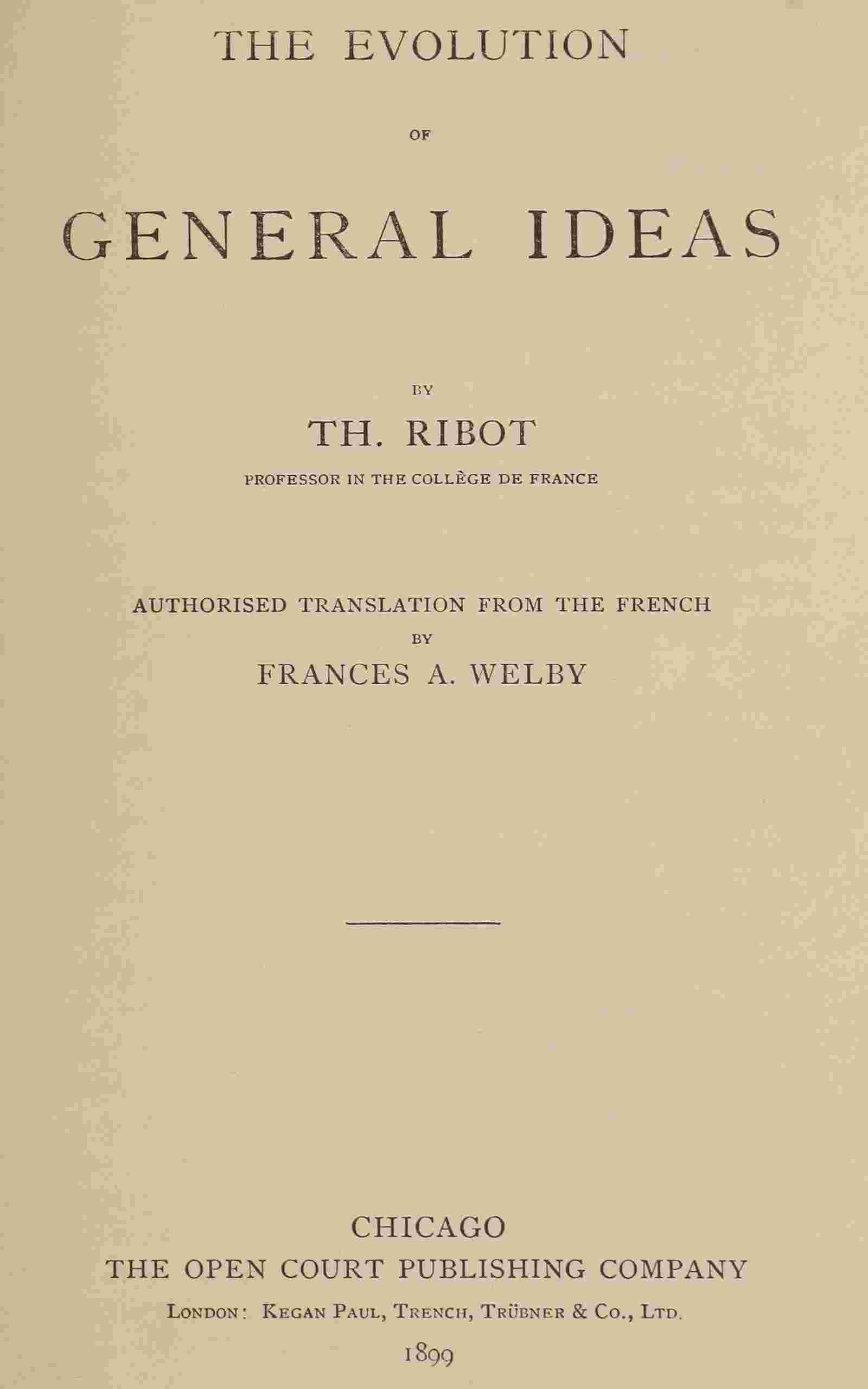
About This Book
The author traces how abstraction and generalization arise from perception and develop through three main stages: pre-linguistic operations observable in animals, children, and deaf-mutes; an intermediate phase in which words progressively accompany and transform thought; and a superior stage where linguistic symbols alone support complex conceptual systems. Abstraction is presented as an attention-driven strengthening of some aspects of experience while others are attenuated. The study analyzes generic images, numerical perception, analogical reasoning, the origin and formation of speech and grammatical categories, and the comparative role of gestures and phonetic language in the ascending evolution of symbolic thought.