
About This Book
A sequence of lectures surveys astronomical evidence and theories about the origin and lifecycle of planetary systems, proposing that planets arise from dark nebulous material and frequently involve energetic events that give rise to bodies and satellites. It brings together observations—nebulae, stellar and planetary spectra, meteorites, orbital tilts, and surface features—to describe accretion, collision, capture, and differentiation processes. The text contrasts inner rocky and outer gaseous worlds, traces atmospheric and climatic development, outlines stages from self-sustained to sun-supported existence, and considers mechanisms of planetary decline, while appendices address technical topics such as meteoric orbits, planetary densities, and the circularization of orbits.
About the Author
More Books by This Author


You May Also Like
 A Brief Account of Radio-activity
by F. P. Venable
A Brief Account of Radio-activity
by F. P. Venable
 A Brief History of Element Discovery, Synthesis, and Analysis
by Glen W. Watson
A Brief History of Element Discovery, Synthesis, and Analysis
by Glen W. Watson
 A Budget of Paradoxes, Volume I
by Augustus De Morgan
A Budget of Paradoxes, Volume I
by Augustus De Morgan
 A Color Notation / A measured color system, based on the three qualities Hue, Value and Chroma
by A. H. Munsell
A Color Notation / A measured color system, based on the three qualities Hue, Value and Chroma
by A. H. Munsell
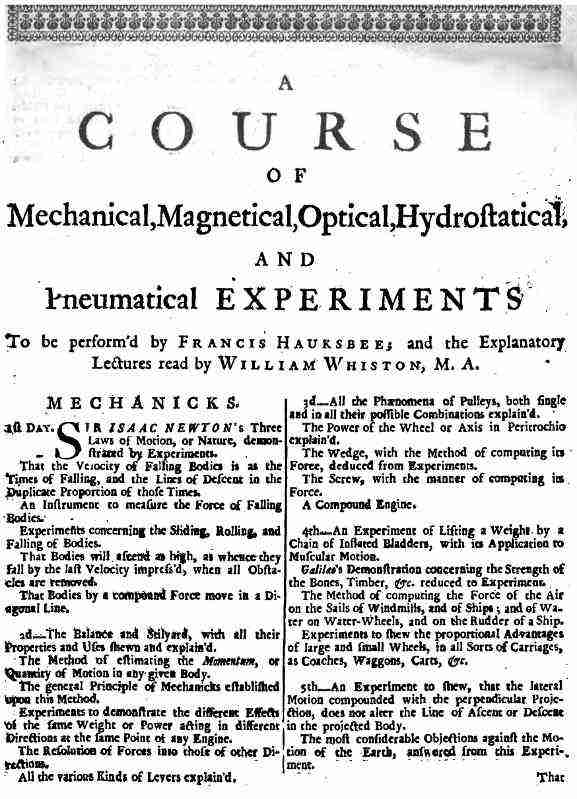 A Course of Mechanical, Magnetical, Optical, Hydrostatical and Pneumatical Experiments / perform'd by Francis Hauksbee, and the Explanatory Lectures read by William Whiston, M.A.
by William Whiston
A Course of Mechanical, Magnetical, Optical, Hydrostatical and Pneumatical Experiments / perform'd by Francis Hauksbee, and the Explanatory Lectures read by William Whiston, M.A.
by William Whiston
 A Discourse Presented to the Most Serene Don Cosimo II., Great Duke of Tuscany, Concerning the Natation of Bodies Vpon, and Submersion In, the Water.
by Galileo Galilei
A Discourse Presented to the Most Serene Don Cosimo II., Great Duke of Tuscany, Concerning the Natation of Bodies Vpon, and Submersion In, the Water.
by Galileo Galilei