
FOOTNOTES:
[A] Described in Little Henry and his Bearer as "an intoxicating mixture of opium and sugar."
[B] The huge fan, hanging from the ceiling, by which the air of houses in India is kept moving.
[C] The "tatta" is a blind, or screen, woven of sweet-smelling grass, which is kept constantly wet by the water-carriers.
| PAGE | ||
| Introduction | ix | |
| PART I | ||
| The Birthday Walk | 3 | |
| Mrs. Fairchild's Story | 9 | |
| On Envy | 19 | |
| Story of the Apples | 25 | |
| Story of an Unhappy Day | 34 | |
| Story of Ambition; or, The Wish to be Great | 45 | |
| The All-Seeing God | 59 | |
| Emily's Recovery, and the Old Story of Mrs. Howard | 67 | |
| Sad Story of a Disobedient Child | 84 | |
| The Two Books | 87 | |
| The History of the Orphan Boy | 92 | |
| The History of Little Henri | 107 | |
| A Story of Besetting Sins | 131 | |
| A Visit to Mary Bush | 143 | |
| PART II | ||
| Story of Miss Crosbie's Presents | 150 | |
| A Visit to Mrs. Goodriche | 159 | |
| Story of the Last Days of Mrs. Howard | 162 | |
| The Fair Little Lady | 181 | |
| Story of a Holiday | 184 | |
| Little Edwy and the Echo | 189 | |
| Further Story of a Holiday | 203 | |
| The Happy Evening | 216 | |
| Breakfast at Mr. Burke's | 222 | |
| The Unruly Family | 228 | |
| Story of Henry's Adventure | 238 | |
| The Story in Emily's Book. (Part I.) | 245 | |
| The Story in Emily's Book. (Part II.) | 258 | |
| Guests at Mr. Fairchild's | 286 | |
| More about Bessy | 300 | |
| Bessy's Misfortunes | 313 | |
| History of Little Bernard Low. (Part I.) | 326 | |
| History of Little Bernard Low. (Part II.) | 341 | |
| History of Little Bernard Low. (Part III.) | 354 | |
| The Birthday Feast | 382 | |
| Grandmamma Fairchild | 400 | |
| Great Changes | 408 | |
| Grandmamma and the Children | 416 | |
| History of Evelyn Vaughan. (Part I) | 421 | |
| History of Evelyn Vaughan. (Part II.) | 446 | |
| Farewell to the Old Home | 464 | |
| PAGE | |
|
Frontispiece—Mr. and Mrs. Fairchild had three children, Lucy, Emily and Henry. |
|
| Good children | 3 |
| They ran on before | 5 |
| Here were abundance of flowers | 8 |
| "I sat down on one of the branches to eat cherries" | 9 |
| Mrs. Grace taught me to sew, and Mrs. Penelope taught me to read | 11 |
| "How lovely! How beautiful!" | 19 |
| She saw that it was a ring | 24 |
| Henry stood under the apple-tree | 25 |
| There was one he could just reach | 27 |
| Behind the stable | 33 |
| Lucy and Emily | 34 |
| Away he ran into the garden, followed by Lucy and Emily | 37 |
| They went along the great gallery | 45 |
| Emily and Lucy had never seen such fine clothes before | 53 |
| Dressed | 58 |
| At last she fell asleep | 59 |
| She took two or three damsons, which she ate in great haste | 61 |
| "What sound is that I hear?" said Emily | 67 |
| Emily and her brother and sister went to play in the garden | 69 |
| "I'll see now if I can't spoil Miss Patty's smart silk slip" | 75 |
| Looking in the glass, with a candle in her hand | 84 |
| "Please choose a book for me" | 87 |
| Henry reads the story | 91 |
| Marten behaved well at breakfast | 92 |
| A little old lady, dressed in a gray silk gown, came into the kitchen | 99 |
| Marten goes to school | 106 |
| Henri stood at the window | 107 |
| "Do you remember anything of the sermon?" | 131 |
| Miss Betsy | 142 |
| The children looked at the kittens | 143 |
| Drinking tea at the door of the cottage, round the little table | 147 |
| Miss Crosbie spoke kindly to her | 150 |
| In the summer parlour | 159 |
| When Betty returned, Mrs. Howard was well satisfied | 162 |
| The happy little girls went with the dolls into the bow-window | 175 |
| The coach came in sight | 181 |
| Henry looked along the road | 184 |
| He turned away from the terrible bird | 189 |
| Could it be her own—her Edwy? She could hardly be sure of her happiness | 199 |
| "Oh Papa! Mamma! Come to Edwy!" | 202 |
| "She will get amongst the shrubs," said Emily | 203 |
| Emily and Henry gave their supper to the little children | 213 |
| The magpie on the stile | 215 |
| Preparing the peas for supper | 216 |
| A sturdy boy of four, roaring and blubbering | 222 |
| They had a game at marbles | 228 |
| The noise continued till the two brothers were fairly out of the house | 231 |
| Lucy and Emily had now each a doll | 245 |
| Going gaily down the hill | 258 |
| Margot rose and made a curtsey | 263 |
| Meeta offered to carry the honey | 285 |
| "She does not know that I made a slit in my frock" | 286 |
| Cutting off faded flowers, and picking up the dead leaves | 297 |
| Off she ran after him | 299 |
| She saw Bessy amongst some gooseberry bushes | 300 |
| "What! what!" cried Mrs. Goodriche | 303 |
| Bessy was crying most piteously | 313 |
| "At four I shall hope to call for Mrs. Goodriche and Miss Lucy" | 319 |
| Bessy was very sorry to leave her young friends | 326 |
| But when Bernard was actually to go there was such a to-do | 333 |
| "Let us sit here under the shade of a tree" | 341 |
| He took up a slip of wood | 353 |
| There was no end of the indulgences given in private to the boy | 354 |
| Bernard rushed to meet Lucilla | 381 |
| She only seemed anxious that Lucy and Emily should look well | 382 |
| For a long time they were all very still with their toys | 387 |
| In their neatest morning dress | 399 |
| "Will Lucy love me?" said the old lady | 400 |
| "Here, ma'am, you can gather any you like" | 408 |
| It was Emily's step | 415 |
| Grandmamma was very much pleased with Lucy's stories | 416 |
| A hundred years ago | 420 |
| To teach little Francis his letters | 421 |
| "I cannot tell what the child's head is running on" | 431 |
| To hang flowers round its neck | 445 |
| Miss Anne Vaughan led her niece by the hand | 446 |
| "What a bustle there is to get ready on a dancing day" | 451 |
| Henry reminded her of the robin | 464 |
| Someone was waving something white | 470 |
The
History of the Fairchild Family
Part I
Mr. and Mrs. Fairchild lived very far from any town; their house stood in the midst of a garden, which in the summer-time was full of fruit and sweet flowers. Mr. Fairchild kept only two servants, Betty and John: Betty's business was to clean the house, cook the dinner, and milk the cow; and John waited at table, worked in the garden, fed the pig, and took care of the meadow in which the cow grazed.
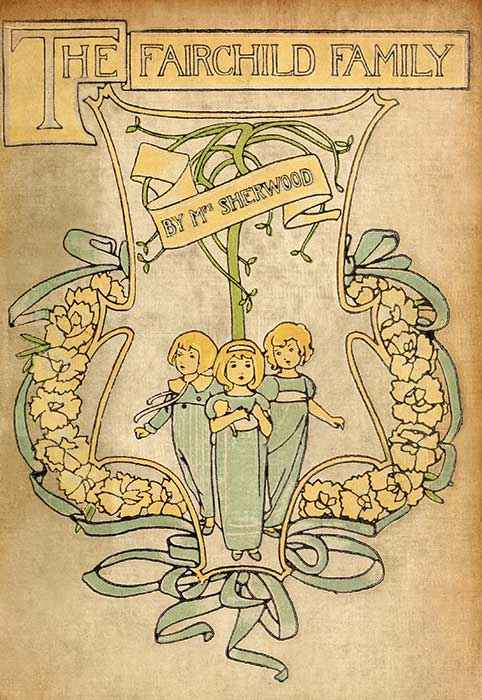
Mr. and Mrs. Fairchild had three children: Lucy, who was about nine years old when these stories began; Emily, who was next in age; and Henry, who was between six and seven. These little children did not go to school: Mrs. Fairchild taught Lucy and Emily, and Mr. Fairchild taught little Henry. Lucy and Emily learned to read, and to do various kinds of needlework. Lucy had begun to write, and took great pains with her writing; their mother also taught them to sing psalms and hymns, and they could sing several very sweetly. Little Henry, too, had a great notion of singing.
Besides working and reading, the little girls could do many useful things; they made their beds, rubbed the chairs and tables in their rooms, fed the fowls; and when John was busy, they laid the cloth for dinner, and were ready to fetch anything which their parents might want.
Mr. Fairchild taught Henry everything that was proper for little boys in his station to learn; and when he had finished his lessons in a morning, his papa used to take him very often to work in the garden; for Mr. Fairchild had great pleasure in helping John to keep the garden clean. Henry had a little basket, and he used to carry the weeds and rubbish in his basket out of the garden, and do many such other little things as he was set to do.
I must not forget to say that Mr. Fairchild had a school for poor boys in the next village, and Mrs. Fairchild one for girls. I do not mean that they taught the children entirely themselves, but they paid a master and mistress to teach them; and they used to take a walk two or three times a week to see the children, and to give rewards to those who had behaved well. When Lucy and Emily and Henry were obedient, their parents were so kind as to let them go with them to see the schools; and then they always contrived to have some little thing ready to carry with them as presents to the good children.