
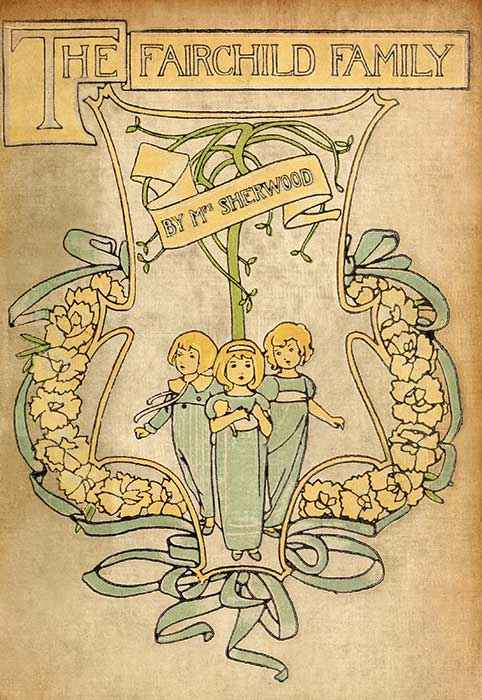
"To hang flowers round its neck."—Page 435.
Grandmamma's History of Evelyn Vaughan. Part II.
When they were all seated, the next day, in the shade of Henry's arbour, grandmamma began her story without more delay.
"I am now," she said, "come to the time when I became acquainted with Evelyn Vaughan myself."
"I was left early without parents, my dear children; for my father died when I was a baby, and my mother when I was ten years of age. I was sent, after her death, being of course in deep mourning, to the school kept in the old Abbey at Reading, and there was then a very full school, above sixty girls. It was a large old house, added to a gateway which was older still; and it was called The Abbey, because it lay within the grounds of the ancient monastery, the ruins of which still remain, the gateway itself being a part of this very ancient establishment."
"The school was kept by certain middle-aged unmarried sisters; and we had many teachers, and among these a Miss Latournelle, who taught us English after a fashion, and presided over our clothes. I was under her care, and slept in her room, which was one of those in the gateway; and though she was always scolding me about some untidiness, she was very kind to me. She was young then, but always in my eyes looked old, having a limping gait, and a very ordinary person.
"I cannot say what we were taught in that house beyond a few French phrases and much needlework. I was not there many years, but my school-days passed happily, for we were not exhausted with our learning, which in these days often destroys the spirit of children. We spent much time in the old and pleasant garden; and I had several dear friends, all of whom are now dead.
"The first time that I saw Miss Evelyn was on the first Sunday I went to church with the school. We went to St. Lawrence's, which is near The Abbey, and we sat in the gallery, from which we had a full view of the pew then occupied by the Vaughans. They always came there, though not the nearest church, because they could not please themselves in seats in any other church in the town, and regularly came in their coach-and-four, and a grand footman went before them to open the door. Their pew was square and lined with crimson, and they always came rustling in, and making a knocking sound with their high heels on the pavement; they walked according to their ages, with this difference only, that the eldest Mistress Vaughan present always brought Evelyn in her hand.
"We sat in the gallery just opposite to this pew, and I was in the first row; and as there was no teacher nor governess near us, I could whisper to the little girls near me about these ladies. 'Don't you know,' my next neighbour in the pew answered, 'that those are the Mistresses Vaughan, who live in the house beyond the lodges on the Bath road; and that little one is Miss Vaughan, and she will have the largest fortune of any lady in England—and see how beautifully she is dressed?' We could not see her face, as she stood, but we could see her fine clothes."
"Do tell us how she was dressed, grandmamma," said Emily.
"She wore a pink silk slip, with small violet flowers, or spots, and a laced apron, with a bonnet and tippet of violet silk. Oh, we did admire it! If she had not a hoop, her skirts were well stiffened with whalebone."
"How curious!" said Lucy. "She must have looked like a little old woman."
"The delicate fairness of her neck, and her lovely auburn curls, prevented that mistake, Lucy," replied grandmamma; "and then her way of moving, and her easy, child-like manner, showed her youth, if nothing else would have done so.
"I had heard of Miss Evelyn before, but I had never seen her so near; and all the rest of that day I could think and talk of nothing but Miss Vaughan; and how I did long for a pink slip with violet spots.
"The Sunday on which I saw Miss Vaughan for the first time at church was the first day of that week in which little Francis Barr was killed.
"We did not see her again for many weeks. We were told of the sad accident, and of the severe illness of Evelyn which followed; and we all entered into the feelings of the little lady with much warmth.
"It was late in the autumn when she appeared again at church; but, though we did not see her face, we could observe that she sat very still, and seemed once, whilst the psalm was being sung, to be crying, for she stooped her head, and had her handkerchief to her eyes. We were very sorry again for her, but our French teacher, when we came home, said, 'Let her weep; she will console herself presently.'
"It was, maybe, ten days after we had seen Miss Evelyn the second time at church, as some of us were sitting, on the eve of a half-holiday, on a locker in a window of the old gateway, that we saw the coach-and-four, with the Vaughan liveries, wheeling along the green open space before The Abbey gate; half a dozen of us at least were standing the next minute on the locker to see this wonder better.
"Nearer and nearer came the carriage, with the horses' heads as if they were a-going through the arch; and when we were expecting to hear the rolling of the wheels beneath our feet, the carriage suddenly stopped right in front of the garden-gate.
"Next came loud knockings and ringings without, and the running of many feet within the house, one calling to another, to tell that the Mistresses Vaughan were come, and had asked to see our governess.
"We strained our necks to see, if we could, the ladies get out, but we were too directly above them to get a good view; and if we could, we were not allowed, for our French teacher came up, and made us all get down from the locker, shutting the window which we had opened, and saying a great deal about 'politesse' and the great vulgarity of peeping.
"The house was as still as the mice in the old wainscot when they smelt Miss Latournelle's cat, whilst the ladies were in the parlour, for our teachers insisted on our being quiet; but as soon as we saw the coach bowling away, we all began to chatter, and to speak our thoughts concerning the occasion of this visit, which was considered a very great honour by our governesses."
"Did the Mistresses Vaughan come to speak about putting Evelyn to your school, grandmamma?" asked Emily.
"Not exactly so, my dear," replied the old lady; "I will tell you what they came for. Poor Evelyn had never recovered her quiet, happy spirits since the fright and the shock of her little favourite's death. Her mother had had a very delicate constitution, and had died early of consumption. Perhaps Evelyn had inherited the tendency to consumption from her mother, though neither her aunts nor Mrs. Harris had thought her otherwise than a strong child till after her long illness.
"After she recovered from this illness, however—or rather seemed to be recovered—her spirits were quite gone; and she was always crying, often talking of death and dying, and brooding over sad things. When the family physician who attended her was told how it was, he advised that she should go to school, and mix with other children, and he recommended The Abbey.
"The Mistresses Vaughan thought his advice good, so far as that Evelyn might be the better for the company of other children. But they said that no Miss Vaughan had ever been brought up at a school, for there were sure to be some girls of low birth, and that they could not think of their niece being herded with low people.
"After a long discussion, however, the old ladies yielded so far to the opinion of the physician, that they determined to ask our governess to permit Miss Vaughan to come to them every dancing day, and to join in the dancing with the other girls.
"It was to ask this favour that the four old ladies came to the Abbey; and it was then settled that Miss Vaughan was to come on every Friday evening to dance with us, and to take her tea in the parlour with the mistress.
"This high honour was made known through the house immediately after the ladies were gone. Miss Evelyn was to be brought the first time by her aunts, and afterwards by Mrs. Harris; and she was to come the very next Friday.
"From that day, which was Wednesday, until the Friday afternoon, what a bustle were all in; what trimming, and plaiting, and renewing, and making anew, went forward! I was in deep mourning; and as Miss Latournelle kept my best bombazine, and crapes, and my round black cap, in her own press, I had nothing to think of; but our governess insisted that all the other young ladies should have new caps on the occasion; and as these were to be made in the house, there was enough to do.
"I could smile to think of the caps we wore at that time; our common caps fitted the head exactly, and were precisely in the shape of bowls. They were commonly made of what is called Norwich quilt, such as we now see many bed-quilts made of, with a little narrow plaiting round the edge. My common black caps were made of silk quilted in the same way. Our best caps were of the same form: the foundation being of coloured silk or satin, with gauze puffed over it, and in each puff either a flower or a bit of ribbon, finished off to the fancy, with a plaited border of gauze, and larger bunches of flowers peaked over each ear."
"Oh, grandmamma!" cried Emily, "how strange! Did not the children look very odd then?"
"The eye was used to the fashion," said the old lady; "there is no fashion, however monstrous, to which the eye does not become used in a little while.
"By the time that all the caps were made, and all the artificial roses, and lilacs, and pansies duly disposed, it was time to dress. You have never been at school, or you would know what a bustle there is to get all the little misses ready on a dancing day.
"What a bustle there is to get ready on a dancing day."—Page 453.
"It was time to light the candles long before Miss Latournelle mustered us and led us down into the dancing-room. This was a long, low room, having a parlour at one end of it, and at the other a kind of hall, from which sprang a wide staircase, leading to the rooms over the gateway; the balustrades of the staircase still showed some remains of gilding.
"We were ranged on forms raised one above another, at the lowest end of the room, and our master was strutting about the floor, now and then giving us a flourish on his kit, when our youngest governess put her head in at the door, and said:
"'Ladies, are you all ready? You must rise and curtsey low when the company appears, and then sink quietly into your places.'
"She then retreated; and a minute afterwards the door from the parlour was opened, and our eldest governess appeared ushering in the four Mistresses Vaughan, followed by other visitors invited for this grand occasion. There was awful knocking of heels and rustling of long silk trains; and every person looked solemn and very upright.
"Miss Anne Vaughan, who came in first, led her niece in her hand, and went sweeping round with her to the principal chair, for there was a circle of chairs set for the company. When she had placed the little lady at her right hand, and when the rest of the company were seated, we on the forms had full leisure to look at this much envied object. There was not one amongst us who would not have gladly changed places with the little lady.
"Evelyn Vaughan was an uncommonly beautiful girl; she was then nearly eleven years of age, and was taller than most children of her age, for she had shot up rapidly during her illness. Her complexion was too beautiful, too white, and too transparent; but she wanted not a soft pink bloom in her cheeks, and her lips were of a deep coral. She had an oval face and lovely features; her eyes were bright, though particularly soft and mild; her hair of rich auburn, hanging in bright, natural ringlets; whilst even her stiff dress and formal cap could not spoil the grace and ease of her air.
"Indeed, persons always accustomed to be highly dressed are not so put out of their way by it as those who are only thus dressed on high occasions; and dressed she was in a rich silk, with much lace, with a chain of gold and stud of jewels, silken shoes, and artificial flowers. We on the forms thought that we had never seen anything so grand in our whole lives, nor any person so pretty, nor any creature so to be envied.
"The ladies only stayed to see a few of our best dancers show forth in minuets before tea, and then they withdrew: and as the dancing-master, who had always taught Miss Vaughan, was invited to join the tea-party, we went into the schoolroom to our suppers, and to talk over what we had seen. After a little while, we all returned to the dancing-room to be ready for the company, who soon appeared again.
"We were then called up, and arranged to dance cotillons, and whilst we were standing waiting for the order to take our places, we saw our master go bowing up to Evelyn, to ask her to join our party. I saw her smile then for the first time, and I never had seen a sweeter smile; it seemed to light up her whole face. She consented to dance, and being asked if she would like any particular partner, she instantly answered:
"'That young lady in black, sir, if you please.'
"There was but one in black, and that was myself. The next moment I was called, and told that Miss Vaughan had done me the honour to choose me for a partner; and it was whispered in my ear by my governess, when she led me up, that I must not forget my manners, and by no means take any liberty with Miss Vaughan. This admonition served only to make me more awkward than I might have been if it had not been given to me.
"Evelyn had chosen me because she had heard it said in the parlour that the little girl in black was in mourning for the last of her parents. And I had not begun the second cotillon with her before she told me that she had chosen me for a partner because, like herself, I had no father or mother.
"After this I was shy no longer; I talked to her about my mother, and burst into tears when so doing, for my sorrows were fresh.
"Evelyn soon made herself acquainted with my name—Mary Reynolds—and we found out that we had been born the same year; and she said that it was very odd that she should have chosen a partner who was of her own age.
"I remember no more of that evening; but the next Friday Miss Vaughan came again, accompanied by Mrs. Harris.
"Harris played the great lady quite as well as the Mistresses Vaughan had done, acting in their natural characters; as she always, at home, took her meals with her young lady when in their own rooms, she was invited to tea in the parlour; and to please Evelyn, I was also asked, for I had been again chosen as her partner.
"Our friendship was growing quickly; it was impossible to love Miss Vaughan a little, if one loved her at all. She was the sweetest, humblest child I had ever known; and she talked of things which, although I did not understand them, greatly excited my interest.
"It was in October that Evelyn first came to dance at the Abbey, and she came every Friday till the holidays. We thought she looked very unwell the last time she came; and she said she was sorry that some weeks would pass before she saw me again; she repeated the same to Mrs. Harris.
"All the other children went home for Christmas, but I had no home to go to; and I saw them depart with much sorrow, and was crying to find myself alone, having watched the last of my school-fellows going out with her mother through the garden-gate, when Miss Latournelle came up all in a hurry.
"'Miss Reynolds,' she said, 'what do you think? You were born, surely, with a silver spoon in your mouth. But there is a letter come, and you are to go from church on Christmas Day in the coach to spend the holidays with Miss Vaughan. It is all settled; and you are to have a new slip, and crape tucker and apron, and a best black cap. Come, come, we must look up your things, and we have only two days for it; come away, fetch your thimble; and don't let me see any idleness.'
"The kind teacher was as pleased for me as I was for myself; though she drove me about the next two days, as if I had been her slave.
"When I found myself in the coach, on Christmas Day, all alone, and driving away with four horses to the great house at the end of the avenue, I really did not know what to make of myself. I tried all the four corners of the coach, looked out at every window, nodded to one or two schoolfellows I saw walking in the streets, and made myself as silly as the daw in borrowed feathers."
The children laughed, and the old lady went on:
"When I got to the lodge and the avenue, however, I became more thoughtful and steady. Even in that short drive, the idea of riding in a coach-and-four was losing some of its freshness, and deeper thoughts had come. I was a little put out, too, at the sight of the fine man-servant who opened the doors for me and led me upstairs. The moment I entered Miss Evelyn's sitting-room, she ran up to me, and put her arms around my neck, kissing me several times.
"'Dear, dear Mary,' she said, 'how very glad I am to see you! I shall be so happy! I have got a cough; I am not to go out till warm weather comes; and it is so sad to be shut up and see nothing but the trees waving, and hear nothing but the wind whistling and humming. But now you are come I shall be so happy!'
"'I hope you will, Miss Vaughan,' said Mrs. Harris; 'and that your head will not always be running, as it has been lately, upon all manner of dismal things. Miss Reynolds, you must do your best to amuse Miss Evelyn; you must tell her all the news of the school, and the little misses; I dare say you can tell her many pretty stories.'
"Evelyn did not answer Harris, though she gave her a look with more scorn in it than I had ever seen her give before.
"Miss Vaughan had shown symptoms of great weakness in the chest—that is, Henry, in the part where people breathe. She had been directed by the physician to be kept, for some weeks to come, in her own rooms; and when this order was given, she had begged to have me with her.
"I believe that I was a comfort to her, and a relief to Harris; and Fanny, also, rejoiced to see me. I was with Evelyn several weeks, and the days passed pleasantly. I had every indulgence, and the use of all sorts of toys; dolls I had partly put aside; but there were books, and pictures, and puzzles; and when I went back to school I was loaded with them; not only for myself, but for my schoolfellows.
"Evelyn seemed to be pleased to see me delighted with them, but she had no pleasure in them herself, any more than I have now; and once, when Harris said: 'Come, Miss Vaughan, why can't you play with these things as Miss Reynolds does?' she answered: 'Ah, Harris! what have I to do with these? I know what is coming.'
"'What is it?' I inquired.
"'Don't ask her, Miss Reynolds,' said Harris hastily; 'Miss Vaughan knows that she should not talk of these things.'
"'Oh, let me talk of them, and then I shall be more easy!' Evelyn answered. 'It is because I must not that I am so unhappy. Why have you put away my Bible and the other good books?'
"'Because your aunts and the doctors say you read them till you have made yourself quite melancholy, Miss Vaughan; and so they have been taken away, but not by me. I have not got them. You must not blame me for what others have done; you know my foolish fondness, and that I can deny you nothing in my power to grant.'
"We had two or three conversations of this kind; but Harris watched us so closely, that Miss Vaughan never had an opportunity of talking to me by ourselves; so that we never renewed, during those holidays, the subjects we had sometimes talked of at the Abbey.
"I stayed at that time about six weeks with Miss Vaughan; and as she appeared to be much better and more cheerful, I was sent back to school, with a promise from my governesses that, if Miss Vaughan desired it, I was to go to her again at the shortest notice.
"The spring that year was early, and some of the days in March were so fine, that the Mistresses Vaughan presumed to take their niece out in the coach without medical advice. Deeply and long did the old ladies lament their imprudence; but probably this affliction was the first which ever really caused them to feel.
"About six days after the last of these airings, the coach came to the school, bringing a request that I should be sent back in it instantly.
"Miss Vaughan had been seized with a violent inflammation in the chest, attended with dreadful spasms. She had called for poor dear Mary, as if Mary could help her; and I was told that she was in a dying state. I sobbed and cried the whole way, for where were the delights then to me of a coach-and-four? I was taken immediately up to her bedroom, for she had called again for poor dear Mary. But, oh, how shocked was I when I approached the bed! Fanny was sitting at the pillow, holding her up in her arms: she was as pale as death itself; her eyes were closed, her fair hands lay extended on the counterpane, her auburn ringlets hanging in disorder. She was enjoying a short slumber after the fatigue of acute pain, for she then breathed easily. Near the bed stood Harris, with the look of a person at once distressed and offended. Miss Vaughan had preferred, in her anguish, to be held by Fanny rather than by her. She had often suspected Evelyn of not liking her, and the truth had come out that morning during her sufferings.
"In the next room I could see the figures of the four Mistresses Vaughan, all in their morning dresses. The physician was with them; and when he saw me he arose, and came and stood by the bed.
"I know not how long it was before Evelyn opened her eyes.
"'Thank God,' she said, in a low, weak voice, 'it is gone for this time;' then added, as she saw me, 'Mary, Mary dear, don't go again. Fanny, is it you? but you will be tired. Might not nurse come, poor dear nurse?'
The physician asked Harris what the young lady said. Harris pretended not to have heard. Fanny looked to me to speak, and I said:
"'She wants her nurse, sir, her own nurse.'
"'And where does this nurse live?' he inquired.
"I told him, on the London road; I told him also her name. I spoke out boldly, though I felt the eyes of Harris upon me.
"'I know the woman,' the doctor answered: 'she is a worthy person; she must be sent for.'
"When Harris heard this she left the bedside and went to the ladies, to prevent, if possible, this sending for nurse. The reason she gave for its not being right to have the poor woman brought there was, that she was the first to put melancholy thoughts in the head of Miss Evelyn, and would be quite sure to bring the same things forward again. Mrs. Harris would have got her own way, if the physician had not insisted that Evelyn ought to see her nurse if she desired it; and he himself undertook to send for her. He had not far to send. Nurse had heard of her child's violent attack, and was no further off than the lodge.
"From the time that Evelyn had mentioned her nurse, she had lain quite still, with her eyes closed, till the worthy woman came in. At the sound of the soft step with which the nurse came forward, she opened them and saw the person she loved best on earth. A sweet bright glow arose in her cheeks, and she extended both her arms as if she would have risen to meet her.
"Though poor nurse, at the first glance, had seen death in the sweet features of her child, yet she commanded herself.
"'I am come, my love,' she said; 'and rejoice to find you easy.'
"'Yes, it is gone—the pain is gone,' replied Evelyn: 'when it comes again I shall die. I know it, nurse; but come, and never go away. Take poor Fanny's place, and lay my head there—there,' she added.
"'On my bosom,' said the nurse, 'where you used so often to sleep;' and she placed herself on the bed and raised her child so that she rested on her arm.
"At this moment Harris, whose eyes were flashing with every evil passion, brought a vial containing a draught which had been ordered.
"Evelyn took it without a word, and then, laying her sweet head on nurse's bosom, fell into a long deep sleep—long, for it lasted some hours, and during that time only nurse and I were with her; nurse holding her in her arms, and I seated at the foot of the bed.
"I had many thoughts during these hours of stillness—thoughts more deep than I had ever had before, on the vanity of earthly things and the nature of death.
"The sun was descending behind the groves when Evelyn stirred, and began to speak. I arose to my feet; she still lay with one side of her face upon the nurse's bosom—that side, when she stirred her head a little, was warm and flushed; the other cheek was pale and wan.
"'Nurse, nurse,' were the words she uttered.
"'I am here, my child,' was the good woman's answer.
"'You will not go,' said Evelyn; 'and Mary must not go, and Fanny must not go.'
"The nurse raised her a little, still supporting her, whilst she asked me to ring the bell, and gave notice that Miss Evelyn was awake and was to have some nourishment which had been ordered.
"Harris came in with something on a salver, Evelyn received it in silence, but did not forget to thank Harris, though even whilst taking it she whispered, 'Don't go, nurse.' Mrs. Harris heard the whisper, as I could see by the manner in which she went out of the room.
"I was called away just then, to take some refreshment, and for this purpose I was taken to the room of Mistress Catherine. She was there, and had been crying bitterly; she spoke kindly to me, and said she hoped that the sight of me would be a comfort to Miss Vaughan; but she seemed to be unable to talk much.
"When I returned to Evelyn's room, I found that she had fallen again into a doze, and it was thought best for me to go to bed. I slept, by my own desire, with Fanny; but Fanny left me about midnight, to take her turn in attending the little lady.
"She died at last somewhat suddenly, and very peacefully, like one falling asleep. The last word which she was heard to utter distinctly was the name of her Saviour.
"I was present when she died, and went with her aunts to the funeral, where I cried till I was quite ill.
"A few days before her death, she had asked to be left with her Aunt Catherine, and got her to write down several things which she wished to be done after her death. It was found, when the paper written by Mistress Catherine was read, that she had remembered everyone, and desired that Harris, and Fanny, and nurse's son, should all have something very handsome. All her toys and gayest dresses, and many ornaments and books, were to be given to me: and the poor whom she had loved and visited were all remembered.
"That death was the cutting up of all the worldly prospects of the old ladies, for Evelyn was the last of that branch of the family. At the death of the youngest Mistress Vaughan, who lived to a very great age, the estates went into other hands, and The Grove was sold, and purchased by a gentleman whose son parted with it to your uncle. The very name of Vaughan is now nearly forgotten in that part of the world, excepting it may be by a few very old persons like myself."
Farewell to the Old Home
Michaelmas was the time fixed for their all moving to The Grove, and leaving that sweet place which was the only one the children had learned to love. Mrs. Fairchild had let August pass without saying much to her children about the moving, though she and Mr. Fairchild had been busy with many settlements.
Mr. Fairchild had been at The Grove again, and come back again. He had settled that John was to have a part of the large garden under his care, and that no one was to meddle with him; and that he was to take charge of the old horse and carriage, and to go out with the children when they went abroad in it. Henry was to have leave to go to John, when he wished to work in the garden.
Mrs. Fairchild fixed on Betty to wait upon the children; she knew that they must have a maid, and she soon settled who that maid should be.
"I know Betty," she said; "and I know I may trust her with my children."
Miss Tilney was very angry when she heard of this.
"Well, to be sure," she said, "so Betty is turned into a young lady's governess; who could have thought it? How very ridiculous some people are!"
When September came, Mrs. Fairchild reminded her children how near the time was come, and that they must think of preparing to move. When Lucy and Emily heard this, which they did one morning at breakfast, they could not help shedding a few tears.
Their mother sent them out into the fresh air, saying she would have no lessons that morning, but giving no particular reason. The little girls were glad to be left to themselves, and they put on their bonnets and walked out, taking their way to the hut in the wood.
It may be supposed what they talked of; they talked of the change that was coming, and the time which was gone. They made each other cry more by trying to remember things which had happened in every place they passed through. They went as far back as the time when Mr. Fairchild used to carry Henry in his arms when they went out, and only now and then set him down to walk. They had a story belonging to almost every tree, to the brook and the bridge, to each little path, and many for the hut at the end of their walk.
In this hut they sat down and began to ask each other what neither could answer, whether it was likely they should ever come back to that dear place.
"It is papa's, we know," said Lucy; "but then he will let the house, and we don't know who will have it; people always let houses which they don't live in. He said, one day, that he should let it. But," said Lucy, with a deep sigh, "I do not think we ought to cry so much; if grandmamma sees our eyes red, and asks the reason, we shall be obliged to tell her, and then she will think we do not like going with her."
"Henry does not mind going," said Emily; "he likes it now John is to go."
They were talking in this way, and had not yet succeeded in quite stopping themselves from crying, when they thought they heard a voice from the wood on the other side of the brook. They listened again, and plainly heard these words: "Lucy! Emily! where are you?"
They came out to the mouth of the hut, and listened, but could not hear the voice again. Then there came the sound of steps, and they were frightened and ran back into the hut. The steps were heard more plainly as they pattered over the bridge, and, not a minute afterwards, who should appear before the hut but Bessy Goodriche! She was quite out of breath and all in a glow with running; her hair all in disorder, and her bonnet at the very back of her head. She could not speak for a moment, but her face was bright with joy. Lucy and Emily ran to her and kissed her, and said how she had frightened them.
"Poor little things!" she answered: "you would not do to be lost in a wood on a dark night. But I am come to tell you it is all settled, though, to be sure, you know it already; I am so glad and my aunt is so glad. No more chimneys to come down and clatter over our heads;—and then, you know, you can come whenever you like, the oftener the more welcome, and stay as long as you like, the longer the better. Aunt will have such pleasure in taking care of your poor old women—the pin-cushion and the housewife woman, I mean. But I am much afraid that I shall not make up your loss, good little things as you are, I shall never manage it; but I must try. I hope I have got the goodwill, though I have nothing else."
In this place Bessy stopped for actual want of breath.
"What is it?" said Lucy; "what do you mean, dear Bessy?"
"What is it? don't you know? How strange—no, it is not, neither; Mr. Fairchild said he should not tell you till it was settled; and so there can be no harm in telling it. And are you not delighted?—you don't look delighted. Your papa said that there could be nothing which would please you so much."
"But what is it?" asked the little girls; "how can we be delighted, when we do not know what it is?"
"Have not I told you?" asked Bessy; "I thought I told you at first. Why, we are to live in this place, and take care of it, and see that everything is kept in order; every tree, and every bench, and everything you love. How you stare!" added Bessy; "how round your eyes are! I don't mean this hut; did you think I meant that my aunt and I were to live in it, and take care of the benches?"
"The house, the house?" answered Lucy, with a cry of joy; "are you and Mrs. Goodriche to have the house and the garden; and to take care of the poor people, and the school, and the hut, and the arbour, and the benches, and our little room, and the parlour, and the roses? Oh, Bessy, Bessy, dear Bessy, now am I glad indeed! and we will come to you here, and you shall come to us there. Oh, Emily, Emily, I am so happy!"
The gentle eyes of Emily sparkled as brightly as Lucy's did, when she heard this news, though she said little; but she whispered to her sister, the next minute: "Now, Lucy, we should not have cried so much, it was not right."
Lucy answered aloud: "No, Emily, we should not; but I hope that we shall cry no more. If the whole world had been picked, we could not have found any people we like so well to live here as Mrs. Goodriche and Bessy."
"Aunt is at the house, she is come to spend the day here; and Mr. Fairchild sent me here to look for you; and we shall come in when you go out; and things are to be left as they are now, only a few to be moved. Aunt will sell her rubbish furniture, and we are to be so tidy, and I am to have your little room and bed."
"And you will feed our poor robin," said Emily; "he has come every winter for a great many years, and he knows that window; but you must shut it after you have put out the crumbs, for fear of the cat. He knows us, and he will soon know you."
As the three girls walked back to the house, they were quite busy in telling and hearing what things were to be attended to. Lucy and Emily felt like people who have had a tight cord bound over their hearts, and that cord had been suddenly cut, and they were loose.
The three weeks which followed that day were a time of great bustle. On one evening all the children of the school came and had tea in the field behind the barn; and Mrs. Goodriche and Bessy came, that they might get acquainted with them.
Another day all the old people whom the children loved were invited to dinner; and Mrs. Goodriche came also to make their acquaintance. No one went away without some useful gift; but these meetings and partings were sad, and made some wish they were in that blessed state in which there shall be no more sorrow, nor any more tears.
Mary Bush, and nurse, and Margery, however, said that if Mr. and Mrs. Fairchild must go, they could not have chosen anyone they should have liked so well as Mrs. Goodriche.
All this bustle caused the few last days in the home of their childhood to pass more easily with the little girls; but when they rose for the last time, from that bed in which they had slept so long as they could remember, they both felt a sadness which they could not overcome.
The breakfast was to be at an early hour, but, early as it was, Mrs. Goodriche and Bessy had come before it was ready. They were to return again to their old house for a day or two, but they wished to see the last of their dear friends before their departure. Mr. Somers also came in immediately after breakfast.
The coach from The Grove also arrived at the same time with Mr. Somers, for the horses and coachman had rested during the night in the village. Old Mrs. Fairchild always liked to be driven by the man she knew, and drawn by the horses she had often proved; and they were to travel slowly, and be three days on the road. Henry came flying in when the coach arrived; and Lucy and Emily ran up once more to their little room to cry again. Bessy followed them to comfort them, though she herself was very sad.
John Trueman, who was at the house with his wife to take care of it till Mrs. Goodriche took possession, now brought out the old horse and carriage, in which John and Betty were to travel; and there was a great deal of packing and settling before anybody got in, for there were nine persons to go. The two Mrs. Fairchilds, and the two little girls, went inside the coach; Mr. Fairchild sat with Henry in an open seat in the back; and Mrs. Johnson was to go with Betty, John, and the magpie, in the old carriage. It was large and of the old fashion. When the old lady had taken her place, Lucy and Emily were called: they kissed Bessy again, and Henry reminded her of the robin. Then they ran down and kissed Mrs. Goodriche, and without looking round at any dear tree or window, or garden-seat or plot of flowers, they sprang into the coach, and felt for the first time that riding in their father's carriage was no cure for an aching heart. Their hearts ached, and their eyes continued to flow with tears, till they had passed the village and left it at some distance behind them; but as they were dragged slowly up the steep hill, beyond the village, they took courage and looked out, and could just see a number of persons standing beneath the beech-trees on the top of the round hill. Someone was waving something white, and Henry was answering it by waving his handkerchief. Tears soon blinded the eyes of the little girls, and they drew back again into the coach, and did not look out again till they had got beyond the places which they had been well acquainted with in the young happy days which were now shut up in the past.
When we leave a place which we have long lived in and much loved, how very soon do all the things which have passed begin to seem like dreams and visions; and how will this life, with all its pains and pleasures, troubles and distresses, seem to us when death is swallowed up in victory, and we shall be with the Saviour where sorrow never more can come?
"Someone was waving something white."
Wells Gardner, Darton and Co., 3, Paternoster Buildings, London
Transcriber's Note
Inconsistent hyphenation of words such as band-box, play-ground, school-room, maid-servant, farm-house, bed-time, play-room, post-boy, school-fellow, corn-field, store-room, tea-cup, and work-bag has been retained. Minor typographical corrections are documented in the source code—search for "<!--TN:"