
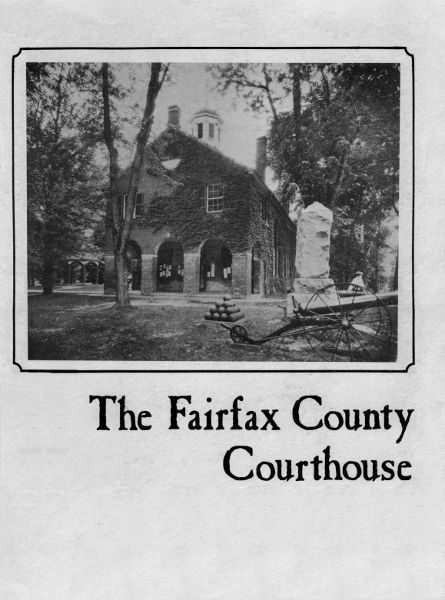
An initial problem connected with the exterior alterations was that of securing bricks and mortar to match those of the original courthouse. Bricks secured from a manufacturer of specialty bricks turned out to be a close match for the originals which were thought to have been fired from clay dug in Fairfax County.[164] Specially mixed mortar made from sand, lime and white cement also closely simulated the color and texture of the older mortar. Bricks were laid in Flemish bond which matched the courthouse and part of the old jail building.
Using these new materials, broken and crumbling bricks were replaced throughout the building, and the three long windows on both the north and south sides of the courthouse were altered to form two rows of smaller windows, with the space between the first and second-floor rows filled with new brickwork. This change in the fenestration restored the building to its appearance as shown in Civil War photographs of the courthouse. Shutters similar to those shown in the same pictures were added to the windows on both floors.
On the roof, some repairs were needed to restore the slate shingles. In the cupola, wooden louvres were repaired, the cupola was painted, and a weathervane restored to the top. An existing galvanized sheet metal roof was allowed to remain unchanged.
For the inside of the building there were no photographs or drawings of the earlier periods, and reconstruction was influenced largely by physical evidence disclosed as the interior was systematically dismantled down to the building's outer shell. When woodwork, hardware, plaster and flooring were removed, it was found that much of the framing timber was infested by termites, and had to be replaced. In this process numerous signs of earlier workmanship were revealed.
Beneath the existing tin-plate ceiling was a plastered ceiling and remnants of a painted frieze of red, yellow, blue and green. Behind this ceiling were laths laid over hand-hewn oak rafters. A few of the original hand-split laths and hand-made nails remained in this ceiling. In its reconstruction, the ceiling was furred and replastered without any decoration. No lathwork was found on the side walls, and in the reconstruction fresh plaster was applied directly to the bricks.[165]
| Interior of the gutted courthouse during restoration in 1966. Photo by Lee Hubbard. | |
The flooring which was removed from the central section of the courtroom sloped from the back (east end) of the room toward the judge's bench (at the west end). Beneath this floor was an older floor of brick. It was not determined whether this brick work had been the original floor of the courtroom or whether another wooden floor had overlaid it prior to the one just removed. In its reconstruction, however, the architect specified that a flat floor of polished pine should be laid over the bricks.[166]
In one part of the main floor the older brick work was allowed to remain exposed. This was in the vicinity of the fireplaces in the two corners of the open area at the rear (east end) of the courtroom. These two fireplaces were reopened and restored and their brickwork was extended to form spacious hearthstones.
The corner fireplaces showed signs of a three-stage evolution. They were originally used as open fireplaces. Holes in the brickwork above them suggested, however, that at some later time the open fireplaces were replaced by wood-burning or coal-burning stoves standing on the brick hearths with their stovepipes fitted into the chimneys. Finally, when the stoves were replaced by central heating and hot water radiators, the entire fireplace wall was sealed with brick and plastered over. In their restoration the corner fireplaces were reopened and refurbished as they were thought to have appeared in their original condition.
As the side walls were cleared of plaster, they showed signs of staircases from the ground level to the balcony along the north as well as the south side of the courtroom. Thus when the stairs along the south wall were replaced, a similar set of stairs was built and installed on the north side of the courtroom. No dates for the original installation or removal of these staircases were determined, and it was presumed that the dual staircases were part of the original design of the courthouse.
A more difficult puzzle was presented by a series of holes in the outer wall aligned at the level of the balcony and about the size used for beams. Speculation by the architect suggested that these holes might have been intended for use in extending the balcony along three sides of the courtroom instead of merely along the back end, or in covering the entire room and creating a full second story for the courthouse. No determination of their use was made, and they were disregarded in the reconstruction of the courtroom.
Still another mystery which was not solved in the restoration concerned the two chimneys located in the corners at the west end of the old courtroom. No fireplaces or hearthstones were found in the courtroom floor, and when the interior was dismantled it was discovered that the chimneys rested on beams above the courtroom ceiling. These chimneys were not utilized in reconstructing the courtroom, and the only suggestion offered was that they probably had been connected by long pipes to stoves in the room below.[167]
Two doors in the west wall of the courtroom on either side of the judge's bench presented a further problem since they were not part of the original 1800 building, but had been part of the addition built in 1929. One of these doors led into a set of judge's chambers and the other (in one corner) opened into a corridor leading to the main portion of the addition running south from the old courthouse. In the restoration these doors were retained, but fitted inconspicuously into the panelling behind the judge's bench. Above the doors, the architect restored two windows which he felt had been part of the original building.[168]
Restoration of the judge's bench brought still more difficulties to maintaining the original design of the courtroom. As plaster was removed from the wall behind the judge's bench, the bricks showed marks of an arch. The judge's bench which ultimately was constructed and installed at the west end of the courtroom was, like the other woodwork, created by the architect "according to patterns used in colonial times."[169]
Other details of the interior were handled the same way. Hardware used by the architect was all new, but used old designs. Since the original colors used in the interior were not determined, the architect used white and gray shades of paint similar to those in colonial buildings. From the ceiling in the center of the courtroom were hung chandeliers found in the courthouse attic. While not of "colonial" design, they were used because they were considered appropriate due to former association with the courthouse. And, as noted earlier, the pews which possibly had been obtained from the Jerusalem Baptist Church were retained in the restored courtroom.[170]
General Setting and Building Site. The original Fairfax County courthouse today comprises the north end section of the courthouse building. Together with its immediately adjacent grounds, the present courthouse complex occupies almost the entire four-acre tract which was the original site. This tract still forms a square near the center of the City of Fairfax, at the intersections of two main roads, Routes 236 (Little River Turnpike) and 123 (Chain Bridge Road). The general setting is gently rolling terrain, and the courthouse site is on a slightly higher elevation than the surrounding area, with stone retaining walls on the two sides facing the turnpike and road. On the west side of the courthouse building is a parking lot occupying approximately two acres. The twelve-story county office building (Massey Building) completed in 1969 is located approximately 200 yards south and west of the courthouse.
The Exterior
Overall Dimensions. The restored, original courthouse building is a plain rectangle, 61 feet long by 32 feet wide. It is oriented with the long sides facing north and south, with the main entrance at the east end of the building. A portico extends across the entire east end of the building, covering an area 12 by 32 feet. The height of the building at the gable ends is 32 feet; and the height of the eaves from the ground is 21 feet.
Foundations. As originally built, the courthouse rested on brick foundation walls, anchored at the corners in brick piers, with a crawl space of approximately 11/2 to 2 feet in height beneath all but the front (east) quarter of the floor space. Additional brick bases, approximately 18 inches square and resting on the ground, were located in the crawl space beneath the two columns supporting the courthouse balcony. In the late nineteenth century, a partial basement was dug beneath the central section of the courtroom.[171]
As reconstructed, the exterior foundation walls were pointed up and repaired, and were strengthened by the addition of several new footings. Across the back (west end) of the building, the crawl space was deepened to a uniform 3 feet, and four 12 × 12 inch brick piers were placed on concrete footings. In the center section of the courthouse, the basement walls were extended 1 foot to carry the joists of the new floor, the outside entrance was closed up, and a new staircase for the interior entrance was built at the south end of the basement. Next to the basement toward the front (east end) of the building, another crawl space (measuring 81/2 × 251/2 feet) was deepened to a uniform 3 feet, and a new wall was built on the east side, extending the full width of the building. This new wall was 8 inches thick, and constructed of cinder block and brick, anchored with 16 × 16 × 12 inch concrete footings. Beneath both crawl spaces and the basement a 3-inch thick concrete slab was laid. The crawl space did not extend to the front exterior wall of the building. A space of 13 × 30 feet across the front of the building, consisting of the area beneath the open entrance foyer of the courtroom, originally had been covered only by a layer of bricks resting on the bare ground. As reconstructed, this brick was taken up and re-laid on a 4-inch thick slab of concrete which had been poured on a base of 4 inches of crushed stone covered by polyethylene film.
Walls. The exterior walls of the courthouse are constructed of red brick, with new bricks specially selected during the 1967 restoration to match the remaining original materials, and laid in Flemish bond, 11/2 feet thick. Across the front of the building, the portico is entered through a series of arches supporting the second-floor front section of the building. The three arches across the front of the building are 7 feet wide and 11 feet high at the center of the arch. The arches at the north and south ends of the portico are 61/2 feet wide by 11 feet high. The brick columns supporting the arches are 11/2 feet square. The arches and columns are plain except for white marble keystones and white marble slabs, 6 inches thick, placed at the foot of each arch and serving as bases for the columns.
Chimneys. All five of the chimneys which the courthouse had in the early nineteenth century were retained in the reconstruction. The two chimneys on each of the north and south sides stand at points which correspond to the four corners of the courtroom, and rise 111/2 feet above the roofline at the eaves. In the center of the table end at the front of the building, the fifth chimney stands, extending 5 feet above the ridge of the roof. All five chimneys are corbelled with two courses of brick at the top, and with a single course of brick 11/2 feet below the chimney top. All of the chimneys measure 2 feet by 1 foot 9 inches.
Doors and Windows. In the 1967 reconstruction of the courthouse, the fenestration was changed to resemble the appearance of the building in about 1861. Accordingly the three tall (141/2 foot) existing windows on the north and south sides of the building were converted into two sets of smaller windows, one above the other, and regularly spaced along the sides of the courtroom. In the upper row, a fourth window was located over the arch in the portico, and serves the rooms in the second-floor chamber at the front of the building. The chamber also has two windows on the front of the building.
The upper row windows are of a double-hung sash design, with 12 over 8 panes (9 inches × 103/4 inches) set in wooden frames and sills. Overall dimensions of these windows are 4 × 51/2 feet. The three windows on the lower level are slightly larger—4 feet × 6 feet 9 inches, and have 12 over 12 panes. Both rows of windows are shuttered; those of the upper row are louvred, and those in the lower row have solid panels.[172]
On the ground level at the front of the building, the main doorway of the courthouse is located in the center of the wall, and flanked by one window on each side. The door is panelled, and 81/2 × 41/2 feet in size.
In the reconstruction, new window sashes and a new door were installed, but the existing jambs were used wherever possible. All shutters, glazing materials and hardware used in the reconstruction were new.
Roof. The original roof of the courthouse was covered with slate shingles, and the reconstruction of the building merely applied repairs to these shingles as needed. Little of the slate which remained in 1967 was thought to have dated from the original construction, however, because of the extensive repairs and renovations carried out after the Civil War.
Cupola. The cupola, located at the ridge of the roof, 91/2 feet from the gable end at the front, was part of the original design of the courthouse and houses a bell once used to announce the convening of the court sessions. The cupola was constructed of white pine, and consists of a square box in which is mounted an octagonal compartment with louvred sides. Topping the panelled portion of the cupola is an onion-shaped dome, culminating in a ball which, according to photographs over the years, served as a base for a weathervane or flagpole. In reconstruction, a weathervane found in the courthouse attic was installed on the cupola's top. The roofing of the cupola dome is sheet metal.
Ornamentation. The overall appearance of the courthouse is plain, and, with the possible exception of the cupola, there is only one feature which shows the intention to combine ornamentation with functionalism in the architectural design. This feature is a round "fan window" framed by a circle of bricks in the center of the gable end of the building's front wall. The lower half of this window consists of four pie-shaped wooden panels. The upper half of the window consists of louvres.
The Interior
Foyer. The double doors in the center of the portico at the east end of the courthouse open inward into a foyer at the rear of the courtroom. This area is 29 feet long, the full width of the building. The width of the area varies, however, because of the fireplaces across each of the front corners and the curving rear edge of the central (or spectator) portion of the courtroom. At its narrowest point in front of the double doors the foyer is 10 feet 4 inches wide, and at its widest points on either end of the room, it is 12 feet wide. The foyer space is entirely open, with flooring composed of bricks (8 × 31/2 inches) varying in color from deep red to charcoal gray. These bricks are laid with three-quarter inch seams and white mortar.
The fireplaces in the corners at each end of the foyer have square (2 foot-8 inch) openings, with brick lining and a 5 inch facing surrounding the opening and painted flat black. The fireplaces are entirely framed with plain architraves and friezes, and are topped with simple mantels. Each fireplace measures 3 feet 11 inches wide by 4 feet 3 inches high.
Along the walls of the foyer, panelled wainscotting, painted white, is installed. Because of the unevenness of the floor, the height of this wainscotting varies from 4 feet 2 inches to 4 feet 3 inches. Its panels are of varying width, from 3 to 6 inches, and are beaded. At the base of the wainscotting is a 5-inch baseboard.
Above the wainscotting, the walls and ceiling are finished in plain plaster with walls painted mauve and the ceiling white. Lighting needs are minimal because of four outside windows located in the foyer, and because of light received from the central section of the courtroom. On each side of the double door and at each end of the foyer lanterns are mounted on the wall. These fixtures are of the type commonly used as carriage gate or guardhouse lanterns, and are 9 × 61/2 × 5 inches, with glass panels on three sides set in dark metal frames. The tops are of curved metal designed to shield the lanterns from the wind. Inside the lanterns, light comes from a single candle-shaped light bulb, set inside a small hurricane lamp chimney.
The hardware on the double door consists of a box lock with the brass knob polished and the lock-box and keeper painted flat black. At the top and bottom of the door black metal shot bolts of designs commonly found in eighteenth century buildings are installed.
Central Section. Space for the seating of spectators is provided in the central section of the courtroom. The floor level of this section is raised 73/4 inches above the floor of the foyer, and free-standing wainscotting of the same style and height as are around the foyer walls separate the foyer from the central section. The floor of this section is constructed of 51/4 inch dark-stained pine boards.
Entry into this section is along two aisles at the sides, running between the spectator seats in the center of the room and the balcony staircases set against the walls on the north and south sides of the room. Spectator seating is provided in five rows of benches of pine, with natural finish on the seats and back rests, white painted sides and bases, and natural cherry moldings along the top of the back rests and arms. Along the base at the front of each bench, is a 6 inch strip painted black. The back of the back rest is painted white down to a point 6 inches above the floor, where a foot rest of dark-stained pine is installed, and below this the base is painted black.
The five rows of benches in the center section are curved, generally following the arc of the edge of the raised flooring, and measure 17 feet 9 inches from end to end. Each bench seats about twelve people.
The walls of the center section are painted mauve, and the ceiling is white. There are no lighting fixtures in this section of the courtroom. At the rear of the central section, two lightly stained solid oak pillars support the balcony.
Staircases. Staircases to the balcony are located along the north and south walls of the central section. The initial plans for reconstruction of the courtroom in 1967 called for only one staircase, on the south wall. The decision to add a staircase on the north side came during the reconstruction when evidence of an earlier staircase on that side was revealed as the plaster was removed. From this it was conjectured that the courthouse of the early nineteenth century had had two staircases, but that one had been abandoned in reconstructing the building after the Civil War.
The present stairways each have 18 steps with 8 inch risers and treads 2 feet 11 inches wide by 10 inches deep. They form a single flight, open style stairs, with no brackets and plain balusters, 1 inch square, painted white and supporting a cherry handrail. Newel posts at the top and foot of the stairway have turned shafts with cube bases and capitals. A flat sphere of solid wood tops the capital of the newel post.
Beneath the staircase on the north side of the building is a closet, and on the south side is a stairway leading into the basement. The doors to this closet and stairway are made of vertical beaded boards similar to the wainscotting, each equipped with two "H" hinges of black metal having a pebble finish and black metal box locks with small polished brass doorknobs.
Balcony. The courtroom balcony contains three rows of wooden benches similar to those on the ground floor, except that they are straight instead of curved. The rows are arranged so the two rear benches are on daises raised 9 inches above the one in front. Solid-panelled free-standing wainscotting is set along the back of the rearmost bench. The first two rows of benches are 17 feet 73/4 inches long, while the rear bench is 22 feet long, allowing space at each end for the steps of the raised dais.
In front of these benches, across the full width of the balcony between the two staircases, is a railing of plain white spokes (matching the balusters of the staircase) and a plain cherry handrail 2 feet 11 inches in height.
The ceiling of the balcony is painted flat white and the walls are mauve. White beaded board wainscotting standing 3 inches high is around the sides and rear wall of the balcony similar to that on the ground level. Three recessed lights provide light for the balcony.
Jury Room. At the rear of the balcony an aisle 3 feet wide runs the full width of the building, allowing passage behind the rows of balcony benches and access to the jury room through doors near each end of the aisle. The jury room uses the space above the first-floor portico, an area 12 × 19 feet. The doors to the room are 2 feet 10 inches by 6 feet 10 inches, with 4 panels. Doors and frames are painted white, with brass doorknobs and modern locks set in the doors. The wall between the jury room and balcony is a new stud partition which is finished with white plaster, as is the ceiling. Lighting is provided by 3 recessed lights set in the ceiling and equally spaced. The walls of the room have a 3-inch baseboard, but no wainscotting.
Centered in the exterior (east) wall of the room is a fireplace, reopened in the 1967 reconstruction. This fireplace measures 4 feet 61/2 inches by 4 feet 73/4 inches, and is framed with a plain white architrave and mantel. A hearth of brick extends 18 inches out from the fireplace. Opposite the fireplace is a 12 by 18 inch plastered masonry pier extended up from the exterior wall at the rear of the portico on the first floor below. In the ceiling next to the pier is located a 30 by 36 inch opening into the attic, with a ladder built into the partition wall immediately below.
Bench, Bar and Jury Box. Across the front of the courtroom is a railing separating the judges bench, jury box, and space for counsel tables from the central section of the courtroom. This railing, similar to those of the staircases and balcony, stands 2 feet 81/2 inches high. Gates 3 feet wide and mounted on double spring hinges are placed in the railing at the head of each side aisle in the central section. Each gate has an S-curve wooden support built into it for added support.
The enclosure formed by the railing or bar is raised 71/2 inches above the floor level of the central section, and is floored with yellow pine, tongue-and-groove, 3-inch wide flooring. In the center of this enclosure, against the west wall of the courtroom is the judge's bench, flanked on its right by the witness stand. The bench itself is relatively small, measuring 6 feet 5 inches across and 4 feet 7 inches from back to front. Three steps on each side permit access from both directions, and have balustrades on the front side similar to the railings and other balustrades in the courtroom.
On the wall behind the judge's bench, there are two, high 12-over-8 pane windows, backed by closed, full-louvred shutters. Behind the shutters is the solid plaster wall of the present courthouse's main corridor. Between and below these windows is a wooden raised-panel screen serving as a back for the judge's bench. Two 6-panelled sections at each end of this screen are flanked by fluted pilasters with modified capitals supporting a plain entablature. Between these sections are 3 panels, the two on either end being composed of 3 tiers of panels edged with fluted pilasters. The center element of this panel consists of two large raised rectangular panels topped by a semi-circular louvred wooden fan design, then a round keystone arch, the whole portion of the composition topped by a high monumental pediment. At its center point, the height of this composition is 8 feet 6 inches.
This ornamental panelling also covers the space where doorways previously had been cut for passage between the courtroom and other portions of the courthouse as they were built from 1930 onward. Prior to the 1967 reconstruction, a doorway in the west wall was located on the judge's left side as he sat on the bench. As presently reconstructed, this doorway has been closed and covered by panelling, but a new door was cut through on the judge's right-hand side, and the inside of the door is constructed and fitted so as to serve as the end piece of the ornamental woodwork behind the judge's bench.
The jury box is in the southwest corner of the courtroom. Across the front of the box is a panelled solid railing, standing 2 feet 8 inches from the floor of the west end of the courtroom. The jury box contains 2 rows of benches, each raised an 8-inch step above the one in front. The front row is 9 feet 3 inches long, with aisles 18 inches wide at each end allowing passage from the second row to the front, and openings in the railing. Not having this function of access, the back row of the jury benches is 14 feet 1 inch in length. Benches in the jury box are designed and constructed similar to those of the balcony.
The witness box is located between the judge's bench and the jury box. This box is constructed of solid wooden screen, painted white and topped with a cherry handrail. The screen forming the back of the box is plain; the screen at the front is in the shape of half of an octagon, and the face of each element contains a single recessed panel similar to those on the front of the judge's bench. The side of the witness box facing the jury is open to allow entry into the box, and the side next to the judge's bench is formed by the side of that fixture. The flooring of the box is made of 3-inch wide, yellow pine boards, finished naturally, and the flooring is raised one step (71/2 inches) from the courtroom floor. The dimensions of the box are 2 feet 10 inches across and 3 feet 8 inches from back to front.
Illumination of the area of the bench and jury box is provided by a variety of fixtures. On the wall at the rear of the jury box two carriage gate or guardhouse lanterns are attached. Opposite these, on the wall at the north side of the room, two other, similar lanterns are located. In the ceiling above the area enclosed by the bar, 10 recessed lights are installed in two rows of 4 lights across the front and rear sections, and a pair are located equidistant between these rows. Hanging from the ceiling over the central area are chandeliers which were found in the attic of the courthouse during the 1967 reconstruction, and refurbished and wired for electric lights. The lighting fixtures consist of six 24-inch arms, made of hollow brass tubing, extending out from a central hub. The hub, in the shape of a cup and decorated with a series of radial ridges, is on the lower end of a 38-inch hollow brass shaft, equipped at the top with a hook for suspension from the ceiling. As installed in the courthouse, each chandelier hangs from a fixture in the ceiling by a metal chain approximately 5 feet long. At the end of each arm of the chandelier are plain disc-shaped bases (3 inches in diameter) which holds one candle-shaped electric socket and a glass hurricane lamp chimney.
Basement. A small basement measuring 11 feet in width lies across the center section of the courthouse. An interior entrance to this basement is provided by a staircase located at its south end. This stairway, 3 feet 6 inches wide with 73/4 inch risers, has 10 steps, and is not panelled or painted. At the present time, the basement is used to house heating and air conditioning equipment.
Small windows are located at both the north and south ends of the basement. Approximately square, these windows measure 2 feet 2 inches by 2 feet 9 inches, with 3-over-2 panes (6 by 12 inches). Both have sills composed of a single slab of stone 2 inches thick. Both also are below ground level, and open into brick-lined spaces for light and air dug out by the wall's foundations. The space for the window on the north side of the building measures 4 feet 1 inch by 3 feet 3 inches. On the south side of the building, however, the dug-out space measures 7 feet 8 inches by 2 feet 9 inches and suggests that this was, at an earlier date, the point where an outside entrance to the basement was located. This is corroborated by markings on the inside of the basement wall which show that a doorway in the north end of the basement has been bricked up, and also that a second window similar to the existing one has been closed up with bricks, leaving the sill slab in place. From the basement, galvanized steel ducts covered with insulating material are run through the crawl spaces beneath the courtroom floor to outlets and intakes for circulation of air. These openings are located in the sills of the recessed windows of the courtroom and in the bases of the benches for spectators and jurors, and are covered with steel grilles painted to blend with the fixtures in which they are set.
3. RESTORATION OF THE ORIGINAL WING OF THE COURTHOUSE, 1967
[161] Other members of the Special Committee were Edward D. Gasson, James Keith, John T. Hazel, Jr.; W. Franklin Gooding, Assistant Clerk of the Courts; Senior Circuit Judge Paul E. Brown; and Bayard Evans, Chairman of the Fairfax Historical Landmarks Preservation Commission.
[162] The cost of restoration was originally estimated at $74,488, exclusive of architect's fee, which was to be 12 per cent of the total cost. Ultimately, the cost of the work was slightly in excess of $84,500, including the architect's fee, according to the architect's records; Fairfax County Board of Supervisors Minute Book #45, pp. 192, 301, 406; Cost Sheet, Walter M. Macomber.
[163] The building contractor for this work was E. L. Daniels.
[164] Interview with Thomas Chapman, former Clerk of the Circuit Court.
[165] The frieze was disregarded because it was not considered part of the original courtroom interior, and no drawings, photographs or descriptions of it were preserved.
[166] The sloping floor which was replaced was not dated, but probably was installed when the courthouse was renovated following the Civil War.
[167] On this matter the following statement in the Northern Virginia Sun, January 8, 1966, 1, is of interest: "Anyone familiar with the old courthouse will have noticed that it has five chimneys. The two closest to the bench are resting on wood above the ceiling, Macomber discovered. This, he said 'confused' him. He thinks that they probably were connected by long pipes to stoves in the courtroom. Yet he is not sure. It appears to Macomber that they were added at some later time, but he will not know until he examines them more closely during the restoration. If ... [there] are post-1800 andirons [in these fireplaces], out they will go in the restoration."
In an interview on March 2, 1970, however, Macomber stated he felt that these chimneys had been connected to stoves after the fireplaces which they served were blocked up.
[168] The architect expressed the opinion that the addition to the west end of the courthouse dated from about 1900; Northern Virginia Sun, January 8, 1966, 1. However, no documentary evidence from the county records supports this date; Fairfax County Free Press, August 25, 1966.
[169] Transcript of interview with Walter Macomber, March 2, 1970. As to the arch marks, Mr. Macomber said: "On the front wall I found a semi-circle deeply incised in the brick wall. I concluded there had been an original arched design there and I reproduced such an arch as it might have looked based on my studies of colonial architecture."
[170] Transcript of interview with Walter Macomber, March 2, 1970, contains the following:
Question: Do you know what the original color of the room was?
Macomber: No. But since most of the buildings of that period were either white or light gray, I used these colors.
Question: Was any of the original ironwork left?
Macomber: No. The ones installed are new but made from old designs used in the colonial period.
Question: Where did the old chandeliers you installed in the ceiling come from?
Macomber: They were discovered in storage. They are not colonial, but since they were probably used at some time I thought it appropriate to use them.
Question: Where did you get your ideas for the woodwork?
Macomber: I created it according to patterns used in colonial times. The benches were brought in after the Civil War and had come from the Payne [Jerusalem] Baptist Church. I thought it appropriate to use them.
[171] Fairfax County Free Press, August 25, 1966; The basement measured 11 × 251/2 feet and was located across the midsection of the building. At the north end of the basement a stairway led to an outside entrance, and at the south end another stairway provided interior access. The basement was lined with 8-inch thick brick walls, and was divided into two rooms of approximately equal size connected by a doorway 21/2 feet wide.
[172] Prior to the reconstruction of the courthouse in 1967, the shutters at the windows on the first floor of the front of the building were louvred in the top half and solid panel in the lower half. In the reconstruction, these shutters were replaced using shutters with solid panels.
APPENDIX A
FAIRFAX COUNTY CLERKS OF THE COURT
1742–1976
Sources: Frederick Johnston, Memorials of Old Virginia Clerks; Fairfax County Court Order Books.
| Catesby Cocke | 1742–46 |
| John Graham | 1746–52 |
| Peter Wagener | 1752–72 |
| Peter Wagener, Jr. | 1772–98 |
| George Deneale | 1798–1801 |
| William Moss | 1801–33 |
| F. D. Richardson, pro tem | 1833–35 |
| Thomas Moss | 1835–39 |
| Alfred Moss, pro tem | Oct.-Nov., 1839 |
| S. M. Ball | 1839–52 |
| Alfred Moss | 1852–61 |
| Henry T. Brooks (military) | 1861–65 |
| W. B. Gooding (military) | 1865–66 |
| William M. Fitzhugh (military) | 1866–67 |
| F. D. Richardson, pro tem | 1866–69 |
| D. F. Dulany (military) | 1869–70 |
| F. D. Richardson | 1870–80 |
| F. W. Richardson, pro tem | 1880–81 |
| F. W. Richardson | 1881–87 |
| W. E. Graham | 1887–1903 |
| F. W. Richardson | 1904–35 |
| John M. Whalen | 1936–45 |
| Thomas P. Chapman, Jr. | 1945–67 |
| W. Franklin Gooding | 1967–75 |
| James E. Hoofnagle | 1976– |
APPENDIX B
JUSTICES AND JUDGES OF THE FAIRFAX COUNTY, CIRCUIT AND DISTRICT COURTS
1742–1976
Lists Compiled By E. Sprouse, P. Howe, V. Peters, A. Lewis, and N. Netherton.
(Because of missing books and records, this listing is incomplete.)
First Commission for Fairfax County, 1742
- William Fairfax
- John Colvill
- Richard Osborne
- Jeremiah Bronaugh
- Lewis Elzey
- William Payne
- Thomas Pearson
- John Minor
- William Henry Terrett
- John Gregg
- Gerard Alexander
- Edward Barry
- Daniel Jennings
- Thomas Arbuthnot
(1742–1748 Fairfax County Court Order Books are missing.)
1749
- John Minor
- William H. Terrett
- Daniel Jennings
- John Carlyle
- William Ramsay
- Charles Broadwater
- Daniel McCarty
- John Colvill
- Moses Linton
- Lewis Ellzey
- William Payne
- Richard Osborn
- George W. Fairfax
- Anthony Russell
- Joseph Watkins
- George Mason
- Jeremiah Bronaugh
- Thomas, sixth Lord Fairfax
- Chief Justice
- Stephen Lewis
1750
- John West
- Lawrence Washington
- Catesby Cocke
1752
- Fielding Turner
1753
- Thomas Colvill
1754
- Hugh West
1755
- John West, Jr.
- Sampson Turley
- Sampson Darrell
- James Hamilton
- Oneas Campbell
1757
- Henry Gunnell
1758
- John Hunter
- Robert Adam
- William Bronaugh
- William Payne, Jr.
1759
1762
- Hector Ross
1764
- George William Fairfax
- William Ellzey
- John West
- George Mason
- Daniel McCarty
- John Carlyle
- William Ramsay
- Charles Broadwater
- Thomas Colvill dead
- John West, Junior
- Bryan Fairfax
- Sampson Dorrell Sher.
- Townshend Dade Quo:
- Henry Gunnell
1767
- Marmaduke Beckwith
- Robert Adam
- John Hunter dead
- Richard Sanford
- Wm. Payne
- Benjamin Grayson
- William Adams
- Edward Blackburn
- Hector Ross &
- Alexander Henderson Gent.
- George William Fairfax
- Lewis Ellzey
- John West
- George Mason
- Daniel McCarty
- John Carlyle
- Wm. Ramsay
- Charles Broadwater
- John West, Junr
- Bryan Fairfax
- Sampson Dorrell Quo:
- Townshend Dade
- Henry Gunnell
- Wm. Adams
- George Washington &
- Daniel French Gent:
1768
- George W Fairfax
- Lewis Ellzey
- John West
- George Mason
- Daniel McCarty
- John Carlyle
- Wm. Ramsey
- Charles Broadwater
- John West Junior
- Bryan Fairfax
- Sampson Darrel
- Townshend Dade Quorum
- Henry Gunnell
- Marmaduke Beckwith
- Robert Adam
- Richard Sanford
- Wm. Payne
- Benjamin Grayson dead
- Wm. Adams
- Hector Ross
- Alexander Henderson
- George Washington
- Daniel French &
- Edward Payne Gent:
1770
- John West
- George Mason
- Daniel McCarty
- John Carlyle
- William Ramsay
- Charles Broadwater
- John West Junr
- Bryan Fairfax
- Sampson Darrell Quor.
- Henry Gunnell
- Robert Adam
- William Payne
- William Adams
- Hector Ross
- Alexander Henderson
- George Washington and
- Edward Payne Gent.
(1774–1782 Fairfax County Court Order Books are missing.)
1783
- John Gibson
- George Gilpin
- Richard Chichester
- Robert McCrea
- Charles Little
- James Hendricks
- Josiah Watson
- Henry Darne
- Thomas Lewis
- Robert T. Hooe
1784
- James Wren
- David Stuart
- David Arell
- Charles Alexander
1785
- William Deneale
- John Moss
1786
- George Minor
- William Herbert
1787
- Roger West
- Richard Conway
- Thomas Gunnell
- John Fitzgerald
- William Brown
- Benjamin Dulany
- Thomas Pollard
- James Waugh
- John Potts
1788
- Martin Cockburn
- William Lyles
(1793–1796 Fairfax County Court Order Books are missing.)
1797
- Thompson Mason
- James Keith, Jr.
1798
- Francis Adams
- John Stewart Alexander
- James Coleman
- Elisha C. Dick
- Charles Eskridge
- John Gunnell
- William Gunnell
- John Jackson
- William Lane, Jr.
- Ludwell Lee
- Richard Bland Lee
- Samuel Love
- John Potts, Jr.
- Richard Ratcliffe
- William Stanhope
- George Summers
- William H. Washington
1801
- Francis Adams
- Charles Alexander
- John S. Alexander
- Charles Broadwater
- James Coleman
- Richard Conway
- William Deneale
- Elisha C. Dick
- Benjamin Dulany
- Charles Eskridge
- John Fitzgerald
- George Gilpin
- John Gunnell
- Thomas Gunnell
- William Gunnell
- William Herbert
- Robert T. Hooe
- John Jackson
- William Lane, Jr.
- Ludwell Lee
- Richard B. Lee
- Charles Little
- Samuel Love
- Daniel McCarty
- Thompson Mason
- George Minor
- John Moss
- William Payne
- John Potts, Jr.
- Richard Ratcliffe
- William Stanhope
- David Stewart (sic.)
- George Summers
- William H. Washington
- James Waugh
- John West
- Roger West
- James Wren
- Now dead:
- Love, Fitzgerald, T. Gunnell, R. West, J. Gunnell, J. S. Alexander, D. McCarty
- Now moved:
- Ludwell Lee
- Now refuses to qualify:
- Summers
- Now in D. C.:
- Gilpin, Hooe, Alexander, Conway, Herbert, Potts, Dick, Washington
- Now disqualified:
- Adams
1802
- Augustine J. Smith
- Humphrey Peake
- John Keene
- James H. Blake
1803
- Samuel Adams, Jr.
1804
- Richard Coleman
- Spencer Jackson
- George Graham
1807
- Present:
- William Gunnell, Jr.
- William Payne
- Wm. Deneale
- Augustine J. Smith
- Hancock Lee
- Humphrey Peake
- Spencer Jackson
- Absent:
- George Summers, Gentleman
- Persons to be recommended
to the Governor as proper
persons to be commissioned
by him as Justices of
the Peace, or added to the
Commission of the Peace
for the County:
- John C. Hunter
- John C. Scott
- Daniel McCarty Chichester
- Joseph Powell
- Edward Dulin
- James L. Triplett
- John Y. Ricketts
- George Mason
1808
- Present:
- William Gunnell, Jr.
- James Waugh
- William Lane, Jr.
- Thomson Mason
- George Summers
- Humphrey Peake
- George Graham
- James L. Triplett
- Absent:
- James Coleman
- William Gunnell, Jr.
- David Stuart
- William Payne
- William Deneale
- Thompson Mason
- Richard Ratcliffe
- George Summers
- Augustine J. Smith
- James Waugh
- Hancock Lee
- Humphrey Peake
- George Graham
- John Coleman
Acting in 1816–17
- James Coleman
- Wm. Lane, Jr.
- Thompson Mason
- Rich. Ratcliffe
- John Jackson
- Augustine J. Smith
- Rich. M. Scott
- Humphrey Peake
- Rich. Coleman
- Spencer Jackson
- John C. Hunter
- James L. Triplett
- John T. Ricketts
- Lawrence Lewis
- Wm. H. Terrett
- Henry Gunnell, Jr.
- Alex'r Waugh
- Geo. Minor
- Geo. Gunnell
- Francis L. Lee
- John W. Ashton
- Dan'l M. Chichester
- Geo. Taylor
- Wm. H. Foote
- James Waugh
- James Sangster
- Thomas Moss
- Dan'l Dulany
- Chas. G. Broadwater
- Wm. H. Fitzhugh
1819–1826
- William A. G. Dade
Acting in 1824
- Rich. Ratcliffe
- Rich. M. Scott
- Lawrence Lewis
- Spencer Jackson
- John C. Hunter
- James L. Triplett
- Alex'r Waugh
- Geo. Gunnell
- Geo. Mason
- Augst. J. Smith
- John W. Ashton
- Geo. Taylor
- Wm. H. Foote
- James Sangster
- Thos. Moss
- Dan'l Dulany
- Chas. L. Broadwater
- Wm. H. Fitzhugh
- Chas. F. Ford
- Benedict M. Lang
- Eli Offutt
- John Jackson
- Robt. Ratcliffe
- Chas. Ratcliffe
- Wm. E. Beckwith
- John Geanit
- Mottrom Ball
- Rich. C. Mason
- Joshua Hutchison
- Sam'l Summers
1831–1838
- John Scott
Acting between 1825–42
- Geo. Millan
- Silas Burke
- Rich. H. Cockerille
- Rich. C. Mason
- Dennis Johnston
- John D. Bell
- John Gunnell
- Frederick Carper
- Spencer M. Ball
- Edward Sangster
- James Millan
- Thomas Nevett
- John H. Halley
- Wm. Ball
- John Millan
- Geo. Mason
- John B. Hunter
- Henry Fairfax
- Wm. H. Alexander
- Frederick A. Hunter
- Wm. A. Chichester
- Alfred Moss
- Chas. C. Stuart
- James Hunter
- Benj. F. Rose
- James Cloud
- Fred. M. Ford
- Wm. R. Selectman
- Nelson Conrad
- W. W. Ball
- Jno. Powell
- Jno. A. Washington
- Wm. H. Wren
1839–52
- John Scott
- John W. Tyler
1852–55
- Silas Burke
- William Ball
- Wm. R. Selectman
- W. W. Ball
- John Millan
- Nelson Conrad
- William H. Wrenn
- James Hunter
- Ira Williams
- Thomas Suddath
- George H. Padgett
- James M. Benton
- John R. Dale
- Thos. A. Davis
- S. T. Stuart
- Levi Burke
- James Fox
- Robert M. Whaley
- Abner Brush
- John Cowling
- F. W. Flood
- Francis E. Johnston
- John W. Hickey
- R. C. Mason
- R. McC. Throckmorton
- W. W. Elzey
- Willis B. McCormick
- William Barker
- F. M. Ford
- Francis C. Davis
- John W. Hickey
- Spencer Jackson
- John N. Taylor
- John B. Farr
- J. C. Gunnell
- John R. Grigsby
1858–60
- John C. Gunnell
- Tenley S. Swink
- Richard L. Nevitt
- Daniel Kincheloe
- Francis C. Davis
- Richard Johnson
- W. B. McCormick
- F. C. Davis
- Ira Williams
- Francis E. Johnston
- Geo. H. Padgett
- George Burke
- John Burke
- John Dole
- John A. Washington
- Alfred Leigh
- Francis C. Davis
- James Hunter
- W. B. McCormick
- William L. Lee
- Wm. W. Ellzey
- John Cowling
- Benjamin F. Shreve
- William S. Seitz
- James P. Machen
- George Padgett
- James Simpson
- —— Mann
- W. W. Ball
- Richard Johnston
- B. D. Utterback
- F. M. Ford
- Cyrus Hickey
- A. S. McKenzie
- R. C. Mason
- Henry Jenkins
1863–1867
- Thomas P. Brown
- James H. Rice
- Wm. Terry
- Andrew Sagar
- Herain Cockrill
- Samuel Pullman
- Reuben Ives
- Daniel W. Lewis
- E. E. Mason
- Levi Dening
- Harry Bready
- William A. Ferguson
- William Walters
- William T. Rumsey
- Talmadege Thorne
- Courtland Lukens
- Metrah Makely
- John B. Troth
- George B. Ives
- Josiah B. Bowman
- Job Hawxhurst
- George F. M. Walters
- J. W. Barcroft
- George W. Millan
- Cyrus Hickey
- James C. Dentz
- B. D. Utterback
- Thomas E. Carper
1866
- John Powell
- Lewis George
- Francis Davis
1867
- T. Wm. Barcroft
- W. B. Bowman
- Thomas E. Carper
- Francis C. Davis
- James C. Dentz
- M. E. Fora
- Wm. E. Ford
- John B. Troth
- Job Hawxhurst
- George B. Ives
- Richard Johnson
- William Lee
- Alfred Leigh
- Courtland Lukens
- Metrah Makely
- E. E. Mason
- Samuel Pullman
- James H. Rice
- W. T. Rice
- Jonathan Roberts
- Silas Simpson
- Daniel Sims
- Cyrus Stickey
- B. D. Utterback
- Wm. F. McWalters
1868
- T. Wm. Barcroft
- W. B. Bowman
- Thomas C. Carper
- N. P. Dennison
- Francis C. Davis
- James C. Dentz
- Wm. E. Ford
- John B. Troth
- Job Hawxhurst
- Richard Johnson
- George B. Ives
- Alfred Leigh
- Courtland Lukens
- Metrah Makely
- E. E. Mason
- Sam Pullman
- W. T. Rice
- Silas Simpson
- Daniel W. Sims
- Cyrus Stickey
- R. D. Utterback
- Geo. F. M. Walters
1869
- T. Wm. Barcroft
- W. B. Bowman
- Jacob Brooks
- Carter Burton
- John L. Detwiler
- Wm. E. Ford
- John B. Troth
- George B. Ives
- Job Hawxhurst
- Richard Johnson
- Alfred Leigh
- Daniel W. M. Lewis
- Courtland Lukens
- E. E. Mason
- Samuel Pullman
- James H. Rice
- T. W. Rice
- Samuel Shaw
- Silas Simpson
- D. Sims
- Cyrus Stickey
- B. D. Utterback
- E. W. Wakefield
- Wm. Walters
1870
- T. Wm. Barcroft
- W. B. Bowman
- Jacob Brooks
- Carter Burton
- George B. Ives
- Job Hawxhurst
- Courtland Lukens
- Samuel Pullman
- E. W. Wakefield
- Geo. F. W. Walters
1870–1874
- Richard H. Cockerille
1874–1885
- James Sangster
1886–1899
- D. M. Chichester
1897–1903
- James M. Love
Virginia Circuit Court Judges
County General District Court
| Robert Fitzgerald, | 1951–1955 |
| John Corboy, | 1954–1955 |
| John A. Rothrock, Jr., | 1955– |
| J. Mason Grove, | 1955– |
| Martin E. Morris, | 1965– |
| Donald C. Crounse, | 1966–1974 |
| Robert M. Hurst, | 1972– |
| Lewis Hall Griffith, | 1974– |
| G. William Hammer, | 1976– |
Juvenile Court Judges
| Frank L. Deierhoi, | 1965– |
| Richard J. Jamborsky, | 1968–1976 |
| Philip N. Brophy, | 1973– |
| Arnold B. Kassabian, | 1976– |
| Raymond O. Kellam, | 1976–1977 |