
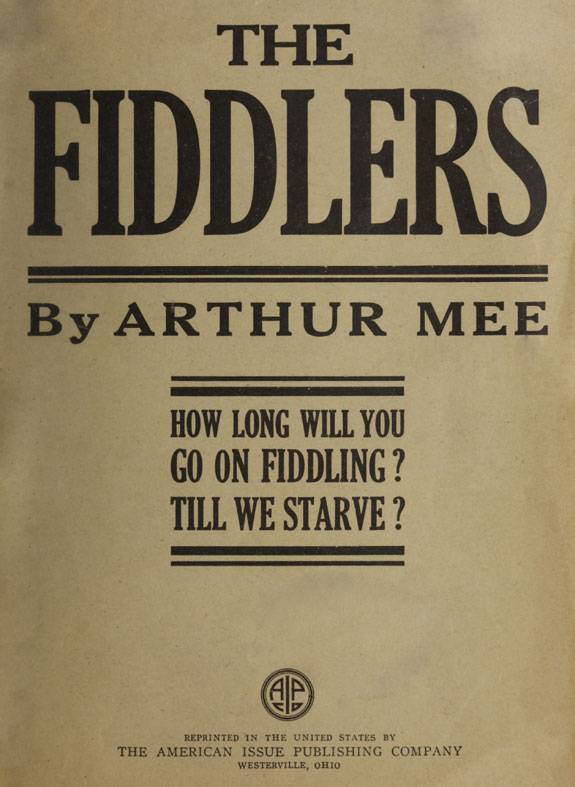
The Fiddlers
Drink in the
Witness Box
By ARTHUR MEE
If thou forbear to deliver them that are drawn unto death, and those that are ready to be slain;
If thou sayest, “Behold, we knew it not;” doth not he that pondereth the heart consider it?
And shall not He render to every man according to his works?
Published by MORGAN & SCOTT, Ltd
12 Paternoster Buildings, London, E. C. 4
| First Hundred Thousand | May 15, 1917 |
| Second Hundred Thousand | June 1, 1917 |
Reprinted in the United States by
THE AMERICAN ISSUE PUBLISHING COMPANY
Westerville, Ohio
DRINK LEADING FAMINE IN
The Drink Trade gave Germany her greatest weapon in the war by helping to make the bread famine.
It was the wilful destruction of 4,800,000 tons of food, depriving the nation of her reserves, that led to the appalling gravity of the submarine menace.
Drink, What did You do in the Great War?
This impressive picture of Britannia is from
the splendid 1916 issue of Bibby’s Annual
THE ALLIES AND PROHIBITION—STOPPING DRINK TO WIN THE WAR
The Drink Map before the War and on the 1000th day of the War
CANADA—Prohibition almost from Sea to Sea
FRANCE—Total Prohibition of Absinthe
RUSSIA—Prohibition Everywhere
BRITAIN—120,000 Drink shops open daily