
The Project Gutenberg eBook of The fields of France
Title: The fields of France
with twenty illustrations in color
Author: A. Mary F. Robinson
Illustrator: W. B. Macdougall
Release date: May 15, 2023 [eBook #70768]
Language: English
Original publication: United Kingdom: Chapman and Hall, 1905
Credits: Turgut Dincer, Chuck Greif and the Online Distributed Proofreading Team at https://www.pgdp.net (This file was produced from images generously made available by The Internet Archive)
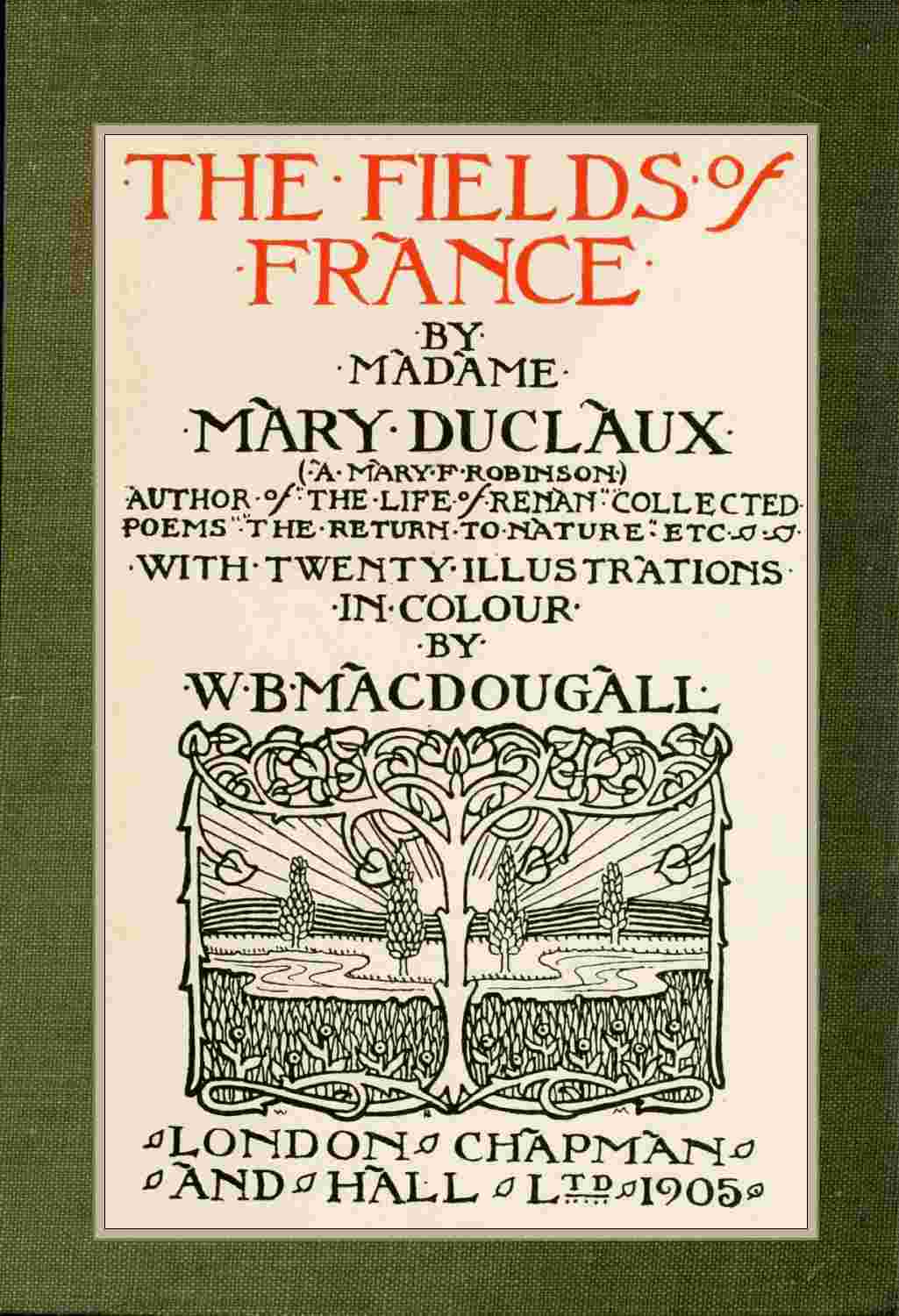
THE FIELDS of
FRANCE
BY
MADAME
MARY DUCLAUX
(A MARY F ROBINSON)
AUTHOR of “THE LIFE of RENAN” “COLLECTED
POEMS” “THE RETURN TO NATURE” ETC
WITH TWENTY ILLUSTRATIONS
IN COLOUR
BY
W B MACDOUGALL
LONDON CHAPMAN
AND HALL LTD 1905
| First published in Crown 8vo | September, | 1903 |
| Reprinted | December, | 1903 |
| Reprinted | February, | 1904 |
| Reprinted | October, | 1904 |
| New Edition, in Crown Quarto, with numerous additions, and Illustrations by W. B. Macdougall |
September, | 1905 |
To
MY DEAR
M O T H E R
LIKE ME, A LOVER OF
THE FIELDS OF FRANCE
CONTENTS
LIST OF ILLUSTRATIONS
| I. | LOCHES | Frontispiece | |
| II. | PUY MARY | Facing page | 6 |
| III. | THE FARM AT OLMET | ” | 14 |
| IV. | THE CÈRE AT VIC | ” | 22 |
| V. | THE OLD HOUSE AT OLMET | ” | 30 |
| VI. | TRÉMOULET | ” | 38 |
| VII. | THE COMMANDERIE AT BALLAN | ” | 50 |
| VIII. | TOURS | ” | 64 |
| IX. | AMBOISE | ” | 80 |
| X. | CHENONCEAUX | ” | 96 |
| XI. | AZAY-LE-RIDEAU | ” | 112 |
| XII. | LUYNES | ” | 126 |
| XIII. | SENLIS | ” | 136 |
| XIV. | VIEW FROM LA MONTAGNE DE LA VERBERIE | ” | 142 |
| XV. | VIEUX MOULIN | ” | 148 |
| XVI. | THE LAKES OF LA ROUILLIE | ” | 154 |
| XVII. | PIERREFONDS | ” | 160 |
| XVIII. | THE PALACE OF THE POPES AT AVIGNON | ” | 174 |
| XIX. | THE CASTLE OF BEAUCAIRE AT TARASCON | ” | 182 |
| XX. | THE ALISCAMPS AT ARLES | ” | 192 |
A FARM IN THE CANTAL A FARM IN THE CANTAL
(Haute-Auvergne)
1902
I
THE farm lies in a wonderful country.
Every landscape has a basis of geology: in order to seize the features of the Cantal, you should stand, if possible, on the pointed crest of the Puy Mary. Before you, where once yawned a crater, rises an ash-grey cone of clinkstone: the Puy de Griou, a perfect sugarloaf. Here was the centre of volcanic force; and from this pile of long-dead lava some twelve or fifteen deep valleys radiate like the beams of a star. Down every valley runs a river. The rocky fissures of these river-beds separate, by a series of wooded gorges, the group of hills that mark the crater’s rim; and these, on their further flank, roll down towards the plain in immense wavy plateaux, attaining at their highest point an altitude of some 6000 feet. These rolling pastures on the mountain-tops are the wealth of our country and the condition of our agriculture. I have never climbed higher than the long cliff behind our house, which bounds on the south the lovely valley of the Cère; even that is an ascent of some thousand feet. Green at its base with pastures, our hillside is crowned with a cornice of fluted rocks, andesite and basalt, which tower above the serried beech woods, mantled on its breast. When at last you reach Les Huttes (the first village on the plateau), you see that our valley—wide, romantic, irregular as it appears—is, none the less, a sort of cañon or ravine sunk between two high table-lands, whose basalt floor is covered with pasture and dotted here and there with odd little huts or cabins, which in fact are cheese-farms; for the people of the valleys send their herds to pasture on the mountain-tops from May till after Michaelmas. This plateau is not flat; it rolls and undulates like the sea, and any of its higher points affords a marvellous view. To the north, the Puy de Griou rises sheer, as fine and as sharp as the Fusiyama in a Japanese print. The long-backed ridges of the Plomb du Cantal and Puy Mary, each with its double hump, crouch beside it, like great dragons, with lean, grey, ravined flanks, while the endless blue of the rolling plains stretches in the distance.
The Plomb is an old friend; with the black peaks of the Lioran, it closes our horizon in the valley, as you look to the north-east. Although the highest of our mountains (1858 metres)—and quite a respectable summit, for it is eight metres higher than the Righi—yet the Plomb is less effective than the frail ash-grey peak of Griou (1694 metres). From Olmet, these bound our view to the right. In front of us rises the long saddle-shaped back of the Courpou-Sauvage, strewn with rocks which simulate fantastic ruins. Out of sight, but close at hand, are Peyre-Arse, L’Usclade, Peyroux, Bataillouze, Puy Violent, Chavaroche, le Roc des Ombres. Their names preserve the image of a terror long forgotten. The Wild Creature, with Burnt Rock and Rock Ruddy; their neighbour, the Scorched Mountain, together with Rock Warful, Mount Violent and the Rock of Shadows, all rest in peace these many thousand years; the woods wave, the pasture flowers, the herds feed upon their rocky sides. Only the black stones, rolled smooth so long ago, fallen among our fields of flowering buckwheat; only these, and the veins of lava, which burst their veil of mountain-pink and heather, remain and tell of that enormous upheaval, still apparent, of an elder world.
It is astonishing with what personality an accustomed eye invests a mountain. We say: “The Lioran is darker than usual this morning,” as we should say: “Emilia has a headache.” And what a pleasure when, towards September, the Courpou-Sauvage begins to blush with the blossoming heather! No mountains have ever seemed to me so friendly as these. They are not very high above our valley, which is situate some 2000 feet above sea-level, so that we behold a scant two-thirds of their real height. But their forms are lovely in their infinite variety. Time cannot wither them, nor custom stale. Woods cling to them; cliffs and rocks jut from them in peak or turret; cascades and fountains and innumerable streams gush from their hearts of fire; pasture, fern or heather robe them higher than the girdle; only the peaks are bare and take a thousand colours in the changing lights.
The hills do not rise sheer from the bottom, as in Switzerland. Innumerable landslips have torn their sides which, at periods of great distance, have fallen away from the cliff, heaping the ground with vast swellings and ridges, in much romantic confusion. Even to-day, these landslips continue, and the aspect of the country is slowly but continually transformed. Covered with beechwood or heather near the heights, green with pasture lower down, these ledges and terraces lead the eye to the valley bottom, which itself is never flat, but cradle-shaped. And therein lies the small winding river of the Cère.
My husband’s old house of Olmet stands on one such ledge, some way up the southern bank of the valley, with the farm at its feet. Farm and house no longer belong to each other, but they are still on cordial terms; which is as well, since from our hinder terrace our eye drops involuntarily on all the life and business of our neighbours. The farm has been recently rebuilt by its new owner, and is no longer the picturesque hovel we used alternately to admire and deplore. But our tiny mountain manor, or moorland cottage, still bears the stamp of three hundred years on its thick solid walls and tower. The roof is beautiful, very steep, as befits a land of six months’ snow, and a soft ash-grey in colour, being covered with thick heart-shaped tiles of powdery mica-schist, which surmount with a pyramid either tiny solid turret: a balcony starts out from the tower, whence you could sling a stone into the bottom of the valley, for Olmet stands on a jutting rock, to the great advantage of our view. The house is stunted from the front, where the garden is on the level of the first floor; but, seen from below, there is about the place a look at once austere and peaceful, rustic and dignified, as befits this land of hay and lava, of mountain peak and cream.
Of the four wishes of Horace, three are in our possession. Alas! we have not the little wood, so necessary in a southern August; an orchard of gnarled apple trees is all that we can boast. But we have the modest country place, the fountain near the door, the garden of flowers and fruit. “Quand on a vu l’enclos d’Olmet!” cries Madame Langeac, at the farm below (as though Marly or Versailles could not compete with our little garden), yet it is merely a bare hilly field or orchard, running to hay, with a flower patch here and there; but loud with the murmur of the rippling water which sparkles from the rocks, and noble with the vast and
various beauty of the view. To the south rise the ravined foot-hills, clothed in woods, crowned with cornices and organ-pipes of rock, their green hummocks swelling and rising to the east, ever larger and ever higher, till they reach the black cone of the Lioran, to which the valley ascends in a series of rugged steps, narrowing as it goes. To the west, on the other hand, it opens like a fan. The precipitous walls of cliff soften into downs of limestone, which die in the rolling plain beyond Arpajon, where, thirteen miles away, one lovely hill, broken from the chain, and larger and more lovely than its fellows, rises soft and blue, shaped like the breast of Ceres. To the one hand, the scene is full of grandeur and melancholy; while the western landscape smiles, most tranquil and noble in its dreamy peace. The mountains cease there, but long leagues beyond, in the vaporous blue of the distance, the plain still heaves and swells as with the movement of a sea: such an ocean of calm and space in which to bathe and renew one’s self from the troubles of the town!
II
From early June to Michaelmas our valley and half our hills are deep in flowering hay, or busy with haymaking, or studded with haycocks. As a poet says, with whom I hope to acquaint my readers—
Coumo oquelo sentour des prats seguats de frès
Que porfumo, l’estiou, l’Oubergno tout entièiro!”
No one has ever invented anything like the smell of the new-mown hayfields, which, in summer, perfumes the whole of Auvergne! Hay is our wealth, and—when it has suffered a transmutation into cheese and cattle—our only export and exchange with the valleys below. It is in order that we may grow our hay all summer for the winter’s needs, that our cattle are sent in troops to feed on the mountain-tops, leaving behind only the draught-oxen and the cows for milking. We need plenty of hay, for, in the stables during the five months of snow that follow All Saints, you may roughly calculate four cartloads of it to every cow. On the higher slopes, we cut it once in July and again in September; while June, August, Michaelmas, and early October are haymaking time for the water-meadows in the bottoms, which yield four crops a year.
So, the summer long, the hay is out on hill or valley, and at night the cattle pull through the narrow roads the primitive hay-wains—two mighty ladders set a tilt on a plank above two wheels. After the wains, the herds come tramping. I love to watch them, and pass an hour most evenings seated upon our garden wall—a low stone bench above the orchard, which drops on the other side some thirty feet to the rocky lane below. Here come the cows, a score at most (for half a hundred of the herd are on the mountain), beautiful kine of Salers, small and neatly made, of a bright deep-red colour all over, all alike, with thick curly coats and branching horns above their deer-like heads. They are herded by a tiny cow-boy of seven; a few black goats loiter in the rear. The finely toned bells tinkle faintly across the silence. The beasts low as they pass the open door of the huge two-storied barn, into which a cow and an ox, yoked together, are backing a great toppling wain of hay. Old Gaffer Langeac, the farmer’s father, has come out to view the crop. He is five and eighty, and, being past work, he wears out all the week his long-treasured Sunday garments—a sleeved waistcoat of black cloth, the full sleeves buttoned into a tight wristband, a white shirt of coarse hemp-linen, and dark trousers of thick homespun rase or frieze. His blue eyes, still bright, and his straggling white locks gleam under a huge soft sombrero of black felt. He is a fine old fellow—but is not this the very valley of green old age? An ancient goatherdess comes down the lane, twirling the distaff set with coarse grey hemp, as she follows her flock; and as she stops to pass the time of day with her neighbour, her youngest grandchild runs out to meet her from the red-gabled cottage by the village bakehouse. The cows low to the calves in the byre; the kid in the orchard springs to its mother; the brown long-tailed sheep follow the shepherd. One handsome haymaker leans against the wall and whispers soft nothings in the ear of Annotou, the blonde little maid at the farm. A scent of cabbage-soup and hot buckwheat comes up from the cottage kitchens. ’Tis the hour of rest and general home-coming, not greatly changed since Sappho of old used to watch it in her Ionian isle—
ϕέρεις οἶν, φέρεις αἶγα, φέρεις ματέρι παῖδα.
There are empty places to-night at the vast table in Langeac’s kitchen; for the Vacher, or chief cowherd and dairy-master, with two bouviers, or cowboys, and a little lad, the pâtre (whose business is to watch the cattle that pasture on the moor), are up on the mountain with some fifty cows, half as many young calves, a young bull or two, a score of swine to fatten on the buttermilk, and some dozen goats. At the end of May, one mild afternoon, the troop set out from the valley under the farmer’s care and marched the whole night through, till the next day, in the morning, they reached the mountain farm, some thirty miles away. Every farm in our valley has thus its Sennenhütte, sometimes quite near at hand, sometimes at a considerable distance. Langeac, the farmer, rode back on the morrow; but every fortnight he repeats the journey, to inspect his herds, and to count the increasing number of the cheeses. Often we meet him on the mountain roads; he sits astride a solid roan cob, a grey linen blouse on his shoulders; a sack half-filled swings on either side his saddle, in which he carries a store of blackbread, fresh cabbage, news and letters (with sometimes an old newspaper or so) to the exiles who, all summer long, see neither rose nor fruit, nor face of wife or child, on the great green pasture of the mountain-top.
While the herds are afar, we are busy in the valleys, where the recent advent of the railroad has little changed the ancestral mode of life. The farm grows almost all the necessaries of our table. Our soil is too poor for wheat, but rye and buckwheat flourish on the mountain-sides; whole slopes and ledges, too dry for hay, are a garden of tall, crisp, white flowers, where the buckwheat (sarrazin) waves through August until mid-September. A little before Michaelmas the flowers die, the seed turns gradually black, the stems coral-red; and then the farm-hands come and reap the harvest, bringing great sheets of linen, which they spread in the field, and thrash thereon the grain with high-dancing flails. Ground into meal, the buckwheat yields the staple of our diet; the bourriol—a large, thin, soft, round crumpet, which, eaten hot with butter, or cold with clotted cream, or a nugget of cheese, or dipped in new milk, is not to be despised. Every morning, the housewife’s earliest care is to fill the pail of bourriols which stands in every kitchen; next she warms the milk until the cream clots and rises. Besides the buckwheat, we grow oats for the cattle and rye for bread and straw. The rye-bread, very black, at once sweet and sour (which makes, to my thinking, the most delicious bread and butter in the world), is shaved into large thin slices in the two-handled porringers, or écuelles, “pour tremper la soupe.” Four times a day, and five at midsummer, the farm-hands gather in Madame Langeac’s kitchen and take their bowl of cabbage-soup, where the bacon, potatoes, black bread and cabbage make a mess so thick that the spoon stands up in it; they eat also a crumpet of buckwheat, and a noggin of Cantal cheese; and often a dish of curds and whey, when a cheese is in progress; a sausage if the pig has been lately killed; a fry of mushrooms in September; a tart of wild-cherries in July; or carrots sliced and fried with snippets of bacon; sometimes a queer stew of potatoes and curds called truffado; or some other homely treat which, at mid-day, serves to mark the importance of dinner, always washed down with a glass of the strong bluish-red wine they call Limousin, brought from the neighbouring departments of the Lot and the Corrèze. Fine brawny men and buxom maids, who work hard and live long, are grown upon this sober fare. With their open expression, frank brown eyes, upturned noses, abundant hair and vigorous frames, the Auvergnats, so ridiculed in France (“ni hommes, ni femmes, tous Auvergnats,” as Daumier’s legend has it), would be, if but a shade or so less dirty, a wholly pleasant-looking race, obviously Celtic, kind, frank, genial, and free.
The Auvergnat has some of the characters of the Yorkshireman. He is jovial, independent, frank, and shrewd. No man is keener at a bargain, and neither Greek, Jew, nor Armenian ever got the better of him; yet he is not sordid, as, for instance, the peasants of Maupassant’s Normandy are sordid. The broken old grandfather, long past work, is here surrounded with every care and attention; the doctor is sent for when he ails; medicine, wine, and broth are his in plenty; those terrible stories of the old and useless who are left to starve, when they can no longer take their share in the work of the fields, could never have been told of the poorest among our uplands. Notwithstanding his overweening love of money, there is something simple, candid, and kind, which mellows the heart of the child of Auvergne. His naïveté is legendary, and forms the subject of a hundred stories and farces, ever since the days of the Queen of Navarre. I will give none of them here, being anxious in this little book to set down chiefly the things I have seen for myself, or which have come under my own knowledge. But here is an example in point. A cousin of my husband’s, whose country place is about fifteen miles from Aurillac, prefers spending her winters in town, and has hired for this purpose the top floor of a friend’s house. One December morning, the farmer of La Romiguière, her small estate, brought her in to town a cart-load of wood for fuel. As he was going upstairs he met an old gentleman in a smoking-cap and plaid dressing-gown—in point of fact, the landlord. A minute later the farmer was in my cousin’s lobby, very red and flustered.
“I fear, madam, my manners have not been all they ought!”
“Your manners!” said my cousin, astounded.
“Yes, ma’am. On the stairs I met a foreign priest, and I just bowed. It comes over me that I ought to have fallen on my knees, and perhaps kissed his ring.”
“A foreign priest!” cried my cousin, more and more bewildered.
“Yes, madam, with a gold thing round his head, most beautiful, and a gown all over checks—uno raubo touto corrolado. Certainly, I ought to have dropped on my knees!”
This naïveté does not exclude a shrewd and kindly humour, which is, in fact, a sort of glorified good sense. One of the members of my husband’s family was a nun in the Convent of Aurillac—a recluse—who was, however, permitted to spend a few weeks every summer at her mother’s country place. One day she was walking there with the old lady, when they met the farmer driving his harrow.
“Good morning, farmer,” says she. “Is that an ox or a cow?”
“It’s a cow, madam.”
“And how do you know the difference?”
The farmer hesitated an instant, and then, with an indescribable look of roguish respect, he answered the nun—
“By the horns, madam!”
I give the little dialogue in patois, in case my book should stray into the hands of a philologist.
“Oquel es un biòu o uno baco, Bouriaïré?”
“Co’s (oco es), uno baco.”
“Cossì lou counessès?”
“Ò los couornos, Modomo!”
Another farmer of our acquaintance answered an amateur agriculturist (it was not I!), who advised him to irrigate a particularly arid hayfield, “I’ll put the water-course, if you’ll find the water!” (Ièu forai lou truel se me fosès benì l’aigo.)
These genial and kindly peasants live in farms roomy and solid, built of blocks of grey volcanic stone; the steep roof has several tiers of windows; one would suppose it from outside a comfortable home. But in name and in fact the attics are granaries, and all the household crowd together in one or two rooms on the ground-floor. A huge chimney, with a hospitable mantle, shelters a couple of comfortable salt-box settles, reserved for the old; one stands on either side the cavernous hearth, where, winter or summer, smoulders the half-trunk of a tree; a tall grandfather’s clock by the dresser, is bright with painted earthenware dishes and pewter tankards; the best bed, high as a catafalque, stands, warmly curtained, in the corner under the stairs; a linen cupboard of walnut or cherry-wood, a huge massive table of unstained oak, flanked by two benches, a straw-bottomed chair or so, a few rough stools: such is the furniture of a kitchen in our parts, seldom clean. Here all the cooking is done, and the eating; here the other day I saw, in a box-bed, like a ship’s berth, built into the wall, a young mother and her baby one day old, perfectly happy, while the farm-hands lunched at the table, and the fowls strolled in and out; here the masters sleep, in sickness and health; here visitors are received and farm-hands paid—it is, as they say in Yorkshire, the house-place. With its one window, its floor of dark unsmoothed volcanic stone (swept every day, but rarely washed), with its ceiling hung with herbs and sausages and huge sides of bacon, it is a warm and homely refuge, but not, as a rule, a bright or a pleasant place.
Sometimes I think the beasts have the best of it. The barns here are as large as churches. Built against the side of the mountain, they have two entrances, each on the level of the ground: the higher story forms the barn, the lower the byre. I have sometimes counted as many as twenty windows, set some two metres apart, along one side of those huge stone structures. Here from mid-November till mid-May the cattle live under cover, chew the cud and see in memory, no doubt, the meadows hard by with their delicious grass and the aromatic pastures on the mountain-top. Here in February and March the calves are born. Nothing is quainter than to see their wild delight, their leaps, their bounds, their joy, their tearing races, their frantic gambols,
when, for the first time in their lives, they come forth into the green fields and balmy air of May.
The pigsties, airy, spacious, comfortable, form a long line near the farm. The swine, too, are kept close in winter, but in summer they roam all over the hillsides and munch the grass like sheep. The pigs here are, I think, the ugliest and perhaps the wittiest in the world—great long-backed, long-legged creatures, far larger than a sheep. They climb the rocky fells, scamper down the smooth sides of the combes, trot all night after the herds to the mountain farm in summer, are hardy, inquisitive, and sociable, beyond belief. With their coal-black heads and pink, naked bodies, my sister says they remind her of the famous Dame au Masque. But they have no shame of their ugliness, and, when they hear a friendly voice on the other side the hedge, come trooping down from the top of the field to pass the time of day, with all the ease and assurance of an honoured acquaintance. A natural humour enlivens their indecent countenance—for, in France, a cochon is always indecent, and Madame Langeac, when she speaks to her social superiors, seldom forgets to call the pigs “les habillés de soie.” (One day I asked her the destination of a cool, stone-floored room: “Sauf votre respect, madame,” she replied, “elle sert pour saler les habillés de soie.”) Clad in silk or clad in bristles (the two words are the same in French), at least during their lifetime our wide-wandering mountain-swine have a good time of their own; and, though it is natural in humans to esteem them chiefly in their ulterior form of ham, I believe we should miss them from the landscape. We have a proverb in our parts which says of a pair of friends that they are “Camarades comme cochons”—or sochons, as we say in Auvergne. In vain, a learned professor of Clermont has sought to explain away the unseemly word as a corruption of the Latin socius. Why should we say, “Camarades comme socius?” There’s no meaning in it. Glance at the hills, my good Don, and see the friendly creatures ambling about, in pairs or little troops, knocking their heads together, grunting out their gossip or their confidences, complaining about that last dish at dinner, grazing and grunting over all the green volcanoes of Auvergne, and then you may hope to understand the people’s wit.
But listen! What unearthly noise is that which rises at this very moment from the farm? No pigsticking, for we are in summer still. There goes Madame Langeac, followed by her two maids and a small boy; each of them holds high a copper saucepan, warming-pan, or kettle (serving as a cymbal), on which she clatters with a key or fork. The three dogs and old Gaffer Langeac look on and grin. Slowly in calm procession they move down the lane till they reach the old walnut-tree in the field beneath our wall. And now I see a sort of fruit on a bough of the tree, like a black hanging pear or melon. It is a swarm of bees. From field to field, its owners have followed it with this infernal symphony, which serves, as they suppose, to attract the bees, or in any case to advertise the owner of the land on which they settle, whose property they are. See, a woman brings the hive. To-morrow, the swarm will be busy in its straw-clad home on the sunny bench beneath the south-east wall. And the bees will take rank as friends. On feast-days the children will deck their hive with flowers or coloured ribbons; a bow of crape will be tied to it in times of mourning. So, deeming themselves beloved and associate, the bees will work and supply their masters with the sweet, dark honey of Auvergne, so pungently perfumed, so luscious and aromatic, filled with the scent of the heather and the savour of the sarrazin.
III
Jean-Irénée, our gardener at the lodge, does little work for us save plant and tend the kitchen-garden, whose produce he shares, and mow the lawns and orchard—when he deems the grass long enough to feed his cows. He labours for us until noon; after midday he is on his own account a busy man, and a small farmer in his way, with four cows, a cart, and four tiny fields of his own well chosen, scattered in different folds and hollows of the mountain. We give him his house, an acre of grass or two, his garden, and stabling for his cows and pigs; in addition, he has something less than £20 of wages and étrennes, so that he is well off, for Olmet, where even a bouvier-grand, that important person and mainstay of a farm, the head-cowboy, earns barely £17 a year. His cows are tended (for here the cows are always watched and tended) by his stepdaughter Florentine, a child of eight years old. Florentine’s childhood has been sad enough. Her father died before her birth, and, after her mother’s second marriage, the successive birth of two little sisters soon left her out in the cold. She is happier now that she is some one in the household, with a place of her own, and worth her salt. There is nothing unusual in her position. Here the flocks and herds are always minded by tiny shepherds of from five to eleven, who herd the bull past frightened ladies with much air and grace. Alone on the mountain all day long with their charges, they gain an incomparable knowledge of animal nature, of the virtues of herbs and plants, the changes in the skies and winds, and such unwritten lore. The other day, a farmer’s son, the head of a large dairy farm at Badailhac, told me that he had learned half he knew as he tended the cows on the hillside in his childhood. “A gentleman,” he said, “a monsieur, could never understand them. No, a dairyman must be taken young.” But, during their unconscious education, the poor mites sometimes find time hang heavy on their hands. I know a little shepherd girl at Aris, demurely dressed in black; whenever I pass her she is seated beneath a tree, telling her beads, or reading in a book. But Florentine is barely eight. Her coal-black eyes and laughing gipsy face bespeak her of a more adventurous cast. She is even now in disgrace because, the other day, when Jean-Irénée went up the hill, he found her in a field with little Guiralou, the farmer’s herd-boy, roasting, in the ashes of a mighty bonfire, a score of potatoes freshly torn from the field. Fortunately, the cows, compassionate to their little guardian, had continued to conduct themselves with propriety, despite her absence.
A greater calamity—a real one—happened last autumn, and then I thought that Florentine—such an anxious, sobered Florentine!—would never play the truant any more. She was not at fault, or I tremble to think of her punishment. Happily the day was a Sunday; Jean-Irénée himself was seated in the field beside the child, when suddenly the cow stepped on a rolling stone, fell down a precipitous bank, and broke her leg. It was a fine beast, in full milk, having weaned its first calf. Even at Olmet, such a beast is worth from twelve to fifteen pounds. I shall not forget the consternation of the man, the white despair of the child, as they came back that afternoon supporting the patient animal, whose russet foreankle dropped pending. The poor beastie munched cheerfully a handful of clover and a crust, and lay in the stable, in no great pain apparently, not ill-content.
But at Olmet we have not learned how to set a cow’s leg. To make butcher’s meat of poor Corrado, before any fever set in, was her master’s only thought, and indeed his duty. In vain he visited Vic and Polminhac, Thiézac and Carlat. At last an army butcher, from Aurillac, consented to buy the cow for a matter of sixty francs. The loss was heavy, and for many a day Jean-Irénée saw the sunshine black. It is to avert such dangers that, on our rocky hillsides, a tiny guardian is always sent with the cows. One of these little shepherds became (as we all know) so great a man of science that his contemporaries deemed him a sorcerer; he invented the pendulum (I think) in clockwork, and finally ascended the throne of St. Peter as Pope Sylvester II. Having shepherded lambs, the little pâtre of Aurillac knew how to shepherd nations. I know not that any other of our Cantal shepherds has shown the genius of a Gerbert (such was Sylvester’s name), of a Giotto, a Burns, a Joan of Arc. But such a life, one would imagine, must predispose a thoughtful mind to reflection and observation.
Sometimes, as we come home at nightfall from our walk, I hear, high up in the bracken and the broom, a small keen voice singing shrilly, some large and doleful verse maybe of lou Grondo (la Grande), the endless patois chant our peasants sing; or perhaps a stanza of the Marseillaise. Some poor child up there is growing frightened in the dusk! Ours is a Celtic country, full of phantoms, elves, and fairies. Who knows but the huntsman with his spectral rout may dash out of yonder hollow? There is also, and especially, the Drac, a subtle spirit whose dear delight it is to play pranks at twilight on the little herds—a Proteus imp who can change into any shape, who plaits the cattle’s tails and manes into inextricable mats, who pulled Touéno’s ears only last November, one evening as he sat upon the hill, leaving the child half-dead with fear. Who but the Drac misleads the baby cowherds when they and their cattle take a wrong turning, when nights are dark? ’Twas he, most likely, who placed the stone on which our Corrado slipped and broke her leg. It is scant comfort, so far afield and quite alone, to remember that he is no respecter of persons; or how, one chilly winter’s night, he pulled the farmer’s wife herself right out of bed. Nothing is sacred to the Drac! More cause for fear! Sing louder, little shepherd, and I’ll join in, down here in the lane, to hearten up your courage!
IV
Yesterday, we drove to the buron on the mountain. Buron is a local word, which we fondly believe to be derived from the Greek, a relic perhaps of antique settlers, in the south, near Marseilles; however this may be, it is not patois: in our dialect, we call the buron, lou mosut—“the little house.” Has not Vermenouze sung the little red-tiled hut, on the summit of the mountain, “like a young cock, red and small, reared up there in his glory, in the middle of the blue sky.”