
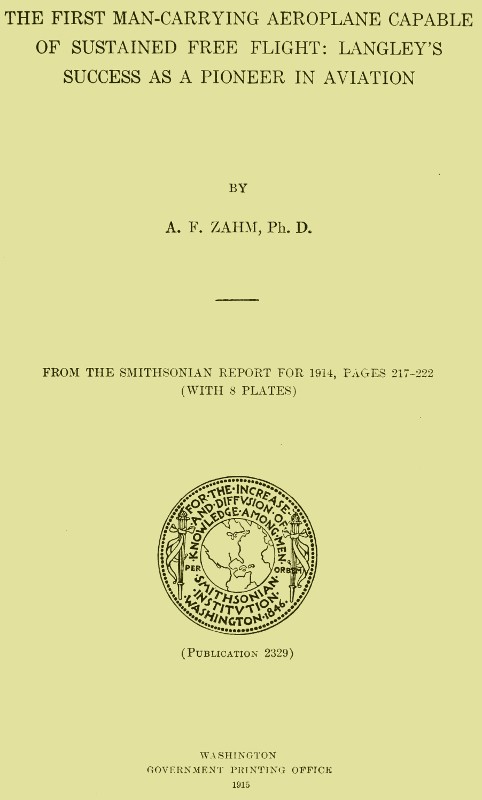
The First Man-Carrying Aeroplane Capable of Sustained Free Flight: Langley's Success as a Pioneer in Aviation / From the Smithsonian Report for 1914, pages 217-222, Publication 2329, 1915
Explore more books like this:
About This Book
The report traces early efforts to achieve sustained manned flight, recounting systematic model experiments and the building of a full-size tandem monoplane, the launch accident that halted trials, and the resulting public skepticism and suspension of work. It then describes later investigators who examined, repaired, and adapted the original machine for renewed trials, fitting hydroaeroplane floats and a more recent engine, testing several launching methods, and achieving powered flights. Technical discussion summarizes control arrangements and stability—reliance on wing dihedral and rudder placement—evaluates the tandem layout, and considers whether the craft should be preserved for display or used for further scientific study.
About the Author

More Books by This Author
You May Also Like
 "Puffing Billy" and the Prize "Rocket" / or, the story of the Stephensons and our Railways.
by Helen C. Knight
"Puffing Billy" and the Prize "Rocket" / or, the story of the Stephensons and our Railways.
by Helen C. Knight
 40 years / 40 años / 40 ans
by Marie Lebert
40 years / 40 años / 40 ans
by Marie Lebert
 A boy's text book on gas engines
by Fay Leone Faurote
A boy's text book on gas engines
by Fay Leone Faurote
 A Catechism of the Steam Engine
by C. E. John Bourne
A Catechism of the Steam Engine
by C. E. John Bourne
 A Course In Wood Turning
by Archie Seldon Milton
A Course In Wood Turning
by Archie Seldon Milton
 A few secrets of the metallurgist simply told
by Gerald Watson Hinkley
A few secrets of the metallurgist simply told
by Gerald Watson Hinkley