
But perhaps no one was more rejoiced over the fact of America's entrance into the war than was Penfield Butler. From the moment when he heard the news of the President's message he seemed to take on new life. And as each day's paper recorded the developing movements, and the almost universal sentiment of the American people in sustaining the government at Washington, his pulses thrilled, color came into his blanched face, and new light into eyes that not long before had looked for many weeks at material things and had seen them not.
He was sitting up in his bed that morning, and had seen his grandfather come up the aisle amid the forest of little flags and the sound of cheering voices.
Grouped around him were' his mother, his Aunt Millicent, the médecin-chef, and his devoted nurse, the American girl, Miss Byron. She was waving a small, silk American flag that had long been one of her cherished possessions.
"We are so proud of America to-day, Colonel Butler," she exclaimed, "that we can't help cheering and waving flags."
And the médecin-chef shouted joyously:
"À la bonne heure, mon Colonel!"
Pen, looking on with glowing eyes and cheeks flushed with enthusiasm, called out:
"Grandfather, isn't it glorious? If I could only fight it all over again, now, under my own American flag!"
Colonel Butler's face had never before been so radiant, his eyes so tender, or his voice so vibrant with emotion as when standing on the raised edge of the alcove, he replied:
"On behalf of my beloved country, ladies and gentlemen, I thank you. She has taken her rightful place on the side of humanity. Her flag, splendid and spotless, floats, to-day, side by side with the tri-color and the Union Jack, over the manhood of nations united to save the world from bondage and barbarism."
He faced the médecin-chef and continued: "Your cry to us to 'come over into Macedonia and help' you, shall no longer go unheeded. Our wealth, our brains, our brawn shall be poured into your country as freely as water, to aid you in bringing the German tyrant to his knees, and, as our great President has said: 'To make the world safe for democracy.'"
He turned toward the rapt faces of the listening scores who lined the wards: "And men, my brothers, I say to you that you have not fought and suffered in vain. We shall win this war; and out of our great victory shall come that thousand years of peace foretold by holy men of old, in which your flag, and yours, and yours, and mine, floating over the heads of freemen in each beloved land, will be the most inspiring, the most beautiful, the most splendid thing on which the sun's rays shall ever fall."
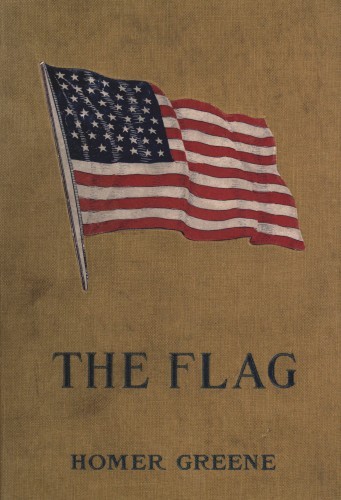
Short Historical Sketch of the United States Flag
After the war of the Revolution, it became necessary for the newly formed United States of America to devise a symbol, representing their freedom. During the war the different colonies had displayed various flags, but no national emblem had been selected. The American Congress, consequently, on the 14th of June, 1777, passed the following Resolution:
"Resolved, That the flag of the thirteen united states shall be thirteen stripes, alternate red and white, that the union be thirteen stars, white in a blue field, representing a new constellation."
Betsy Ross, an upholsterer, living at 239 Arch Street, Philadelphia, Pa., had the honor of making the first flag for the new republic. The little house where she lived is still standing, and preserved as a memorial. This flag contained the thirteen stripes as at present, but the stars were arranged in a circle. This arrangement was later changed to horizontal lines, and the flag continued to have thirteen stars and thirteen stripes until 1795. When Vermont and Kentucky were added to the Union, two more stripes, as well as two more stars, were added. In 1817, it was seen that it would not be practicable to add a new stripe for each new state admitted to the Union, so after deliberation, Congress, in 1818, passed the following Act:
"An Act to establish the flag of the United States.
"Sec. 1. That from and after the 4th of July next, the flag of the United States be thirteen horizontal stripes, alternate red and white—that the Union have twenty stars, white in a blue field.
"Sec. 2. Be it further enacted, that on the admission of every new State into the Union, one star be added to the Union of the flag, and that such addition shall take effect on the 4th of July next succeeding such admission."
Since the passing of this Act, star after star has been added to the blue field until it now contains forty-eight, each one representing a staunch and loyal adherent.
Boy Scouts Pledge to the Flag
"I pledge allegiance to my flag and to the Republic for which it stands; one nation indivisible, with liberty and justice for all."