
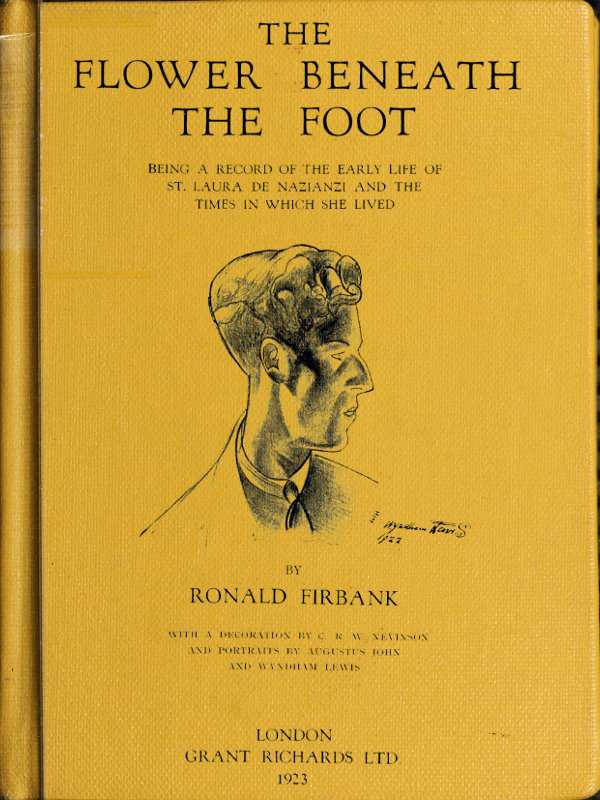
The Project Gutenberg eBook of The flower beneath the foot
Title: The flower beneath the foot
being a record of the early life of St. Laura de Nazianzi and the times in which she lived
Author: Ronald Firbank
Illustrator: Augustus John
Wyndham Lewis
Release date: April 11, 2019 [eBook #59249]
Language: English
Credits: Produced by Tim Lindell, Wayne Hammond and the Online
Distributed Proofreading Team at http://www.pgdp.net (This
file was produced from images generously made available
by The Internet Archive/Canadian Libraries)
THE FLOWER BENEATH
THE FOOT
Printed in Great Britain by the Riverside Press Limited Edinburgh
THE
FLOWER BENEATH
THE FOOT
BEING A RECORD OF THE EARLY LIFE OF
ST. LAURA DE NAZIANZI AND THE
TIMES IN WHICH SHE LIVED
BY
RONALD FIRBANK
WITH A DECORATION BY C. R. W. NEVINSON
AND PORTRAITS BY AUGUSTUS JOHN
AND WYNDHAM LEWIS
LONDON
GRANT RICHARDS LTD.
1923
Madame Mathieu and
Mademoiselle Dora Garnier-Pagès
St Laura de Nazianzi.
Ibid.
I
Neither her Gaudiness the Mistress of the Robes, or her Dreaminess the Queen were feeling quite themselves. In the Palace all was speculation. Would they be able to attend the Fêtes in honour of King Jotifa, and Queen Thleeanouhee of the Land of Dates?—Court opinion seemed largely divided. Countess Medusa Rappa, a woman easily disturbable, was prepared to wager what the Countess of Tolga “liked” (she knew), that another week would find the Court shivering beneath the vaulted domes of the Summer-Palace.
“I fear I’ve no time (or desire) now, Medusa,” the Countess answered, moving towards the Royal apartments, “for making bets,” though turning before the ante-room door she nodded: “Done!”
She found her sovereign supine on a couch piled with long Tunisian cushions, while a maid of honour sat reading to her aloud :
“Live with an aim, and let that aim be high!” the girl was saying as the Countess approached.
“Is that you, Violet?” her Dreaminess enquired without looking round.
“How is your condition, Madam?” the Countess anxiously murmured.
“Tell me, do, of a place that soothes and lulls one——?”
The Countess of Tolga considered.
“Paris,” she hazarded.
“Ah! Impossible.”
“The Summer-Palace, then,” the Countess ejaculated, examining her long slender fingers that were like the tendrils of a plant.
“Dr Cuncliffe Babcock flatly forbids it,” the Royal woman declared, starting slightly at the sound of a gun: “That must be the Dates!” she said. And in effect, a vague reverberation, as of individuals cheering, resounded fitfully from afar. “Give me my diamond anemones,” the Queen commanded, and motioning to her Maid: “Pray conclude, mademoiselle, those lofty lines.”
With a slight sigh, the lectress took up the posture of a Dying Intellectual.
“Live with an aim, and let that aim be high!” she reiterated in tones tinged perceptibly with emotion.
“But not too high, remember, Mademoiselle de Nazianzi....”
There was a short pause. And then—
“Ah Madam! What a dearest he is!”
“I think you forget yourself,” the Queen murmured with a quelling glance. “You had better withdraw.”
“He has such strength! One could niche an idol in his dear, dinted chin.”
“Enough!”
And a moment later, the enflamed girl left the room warbling softly: Depuis le Jour.
“Holy Virgin,” the Countess said, addressing herself to the ceiling. “Should his Weariness, the Prince, yield himself to this caprice....”
The Queen shifted a diamond bangle from one of her arms to the other.
“She reads at such a pace,” she complained, “and when I asked her where she had learnt to read so quickly, she replied ‘On the screens at Cinemas.’”
“I do not consider her at all distinguished,” the Countess commented turning her eyes away towards the room.
It was a carved-ceiled, and rather lofty room, connected by tall glass doors with other rooms beyond. Peering into one of these the Countess could see reflected the “throne,” and a little piece of broken Chippendale brought from England, that served as a stand for a telephone, wrought in ormolu and rock-crystal, which the sun’s rays at present were causing to emit a thousand playful sparks. Tapestry panels depicting the Loves of Mejnoun and Leileh half concealed the silver boisèries of the walls, while far down the room, across old rugs from Chirvan that were a marvellous wonder, showed fortuitous jardinières, filled with every flowering-kind of plant. Between the windows were canopied recesses, denuded of their statues by the Queen’s desire, “in order that they might appear suggestive,” while through the windows themselves, the Countess could catch across the fore-court of the castle, a panorama of the town below, with the State Theatre and the Garrisons, and the Houses of Parliament, and the Hospital, and the low white dome, crowned by turquoise-tinted tiles of the Cathedral, which was known to all churchgoers as the Blue Jesus.
“It would be a fatal connexion,” the Queen continued, “and it must never, never be!”
By way of response the Countess exchanged with her sovereign a glance that was known in Court circles as her tortured-animal look: “Their Oriental majesties,” she observed, “to judge from the din, appear to have already endeared themselves with the mob!”
The Queen stirred slightly amid her cushions.
“For the aggrandisement of the country’s trade, an alliance with Dateland is by no means to be depreciated,” she replied, closing her eyes as though in some way or other this bullion to the State would allow her to gratify her own wildest whims, the dearest, perhaps, of which was to form a party to excavate (for objects of art) among the ruins of Chedorlahomor, a faubourg of Sodom.
“Am I right, Madam, in assuming it’s Bananas?...” the Countess queried.
But at that moment the door opened, and his Weariness the Prince entered the room in all his tinted Orders.
Handsome to tears, his face, even as a child had lacked innocence. His was of that magnolia order of colouring, set off by pleasantly untamed eyes, and teeth like flawless pearls.
“You’ve seen them? What are they like.... Tell Mother, darling?” the Queen exclaimed.
“They’re merely dreadful,” his Weariness, who had been to the railway-station to welcome the Royal travellers, murmured in a voice extinct with boredom.
“They’re in European dress, dear?” his mother questioned.
“The King had on a frock coat and a cap....”
“And she?”
“A tartan-skirt, and checked wool-stockings.”
“She has great individuality, so I hear, marm,” the Countess ventured.
“Individuality be ——! No one can doubt she’s a terrible woman.”
The Queen gently groaned.
“I see life to-day,” she declared, “in the colour of mould.”
The Prince protruded a shade the purple violet of his tongue.
“Well, it’s depressing,” he said, “for us all, with the Castle full of blacks.”
“That is the least of my worries,” the Queen observed. “Oh, Yousef, Yousef,” she added, “do you wish to break my heart?”
The young man protruded some few degrees further his tongue.
“I gather you’re alluding to Laura!” he remarked.
“But what can you see in her?” his mother mourned.
“She suits my feelings,” the Prince simply said.
“Peuh!”
“She meets my needs.”
“She’s so housemaid.... I hardly know...!” the Queen raised beautiful hands bewildered.
“Très gutter, ma’am,” the Countess murmured dropping her voice to a half-whisper.
“She saves us from cliché,” the Prince indignantly said.
“She saves us from nothing,” his mother returned. “Oh, Yousef, Yousef. And what cerné eyes, my son. I suppose you were gambling all night at the Château des Fleurs?”
“Just hark to the crowds!” the Prince evasively said. And never too weary to receive an ovation, he skipped across the room towards the nearest window, where he began blowing kisses to the throng.
“Give them the Smile Extending, darling,” his mother beseeched.
“Won’t you rise and place your arm about him, Madam,” the Countess suggested.
“I’m not feeling at all up to the mark,” her Dreaminess demurred, passing her fingers over her hair.
“There is sunshine, ma’am ... and you have your anemones on ...” the Countess cajoled, “and to please the people, you ought indeed to squeeze him.” And she was begging and persuading the Queen to rise, as the King entered the room preceded by a shapely page (of sixteen) with cheeks fresher than milk.
“Go to the window, Willie,” the Queen exhorted her Consort fixing an eye on the last trouser button that adorned his long, straggling legs.
The King, who had the air of a tired pastry-cook, sat down.
“We feel,” he said, “to-day, we’ve had our fill of stares!”
“One little bow, Willie,” the Queen entreated, “that wouldn’t kill you.”
“We’d give perfect worlds,” the King went on, “to go, by Ourselves, to bed.”
“Get rid of the noise for me. Quiet them. Or I’ll be too ill,” the Queen declared, “to leave my room to-night!”
“Should I summon Whisky, Marm?” the Countess asked, but before there was time to reply the Court physician, Dr Cuncliffe Babcock was announced.
“I feel I’ve had a relapse, Doctor,” her Dreaminess declared.
Dr Babcock beamed: he had one blind eye—though this did not prevent him at all from seeing all that was going on with the other.
“Leave it to me, Madam,” he assured, “and I shall pick you up in no time!”
“Not Johnnie, doctor?” the Queen murmured with a grimace. For a glass of Johnnie Walker at bed-time was the great doctor’s favourite receipt.
“No; something a little stronger, I think.”
“We need expert attention, too,” the King intervened.
“You certainly are somewhat pale, sir.”
“Whenever I go out,” the King complained, “I get an impression of raised hats.”
It was seldom King William of Pisuerga spoke in the singular tense, and Doctor Babcock looked perturbed.
“Raised hats, sir?” he murmured in impressive tones.
“Nude heads, doctor.”
The Queen commenced to fidget. She disliked that the King should appear more interesting than herself.
“These earrings tire me,” she said, “take them out.”
But the Prince, who seemed to be thoroughly enjoying the success of his appearance with the crowd, had already begun tossing the contents of the flower vases into the street.
“Willie ... prevent him! Yousef ... I forbid you!” her Dreaminess faintly shrieked. And to stay her son’s despoiling hand she skimmed towards him, when the populace catching sight of her, redoubled their cheers.
Meanwhile Mademoiselle de Nazianzi had regained again her composure. A niece of her Gaudiness the Mistress of the Robes (the Duchess of Cavaljos), her recent début at Court, had been made under the brightest conceivable of conditions.
Laura Lita Carmen Etoile de Nazianzi was more piquant perhaps than pretty. A dozen tiny moles were scattered about her face, while on either side of her delicate nose, a large grey eye surveyed the world with a pensive critical glance.
“Scenes like that make one sob with laughter,” she reflected, turning into the corridor where two of the Maids of Honour, like strutting idols, were passing up and down.
“Is she really very ill? Is she really dying?” they breathlessly enquired.
Mademoiselle de Nazianzi disengaged herself from their solicitously entwining arms.
“She is not!” she answered, in a voice full of eloquent inflections.
But beguiled by the sound of marching feet, one of the girls had darted forward towards a window.
“Oh Blanche, Blanche, Blanchie love!” she exclaimed, “I could dance to the click of your brother’s spurs.”
“You’d not be the first to, dear darling!” Mademoiselle de Lambèse replied, adjusting her short shock of hair before a glass.
Mademoiselle de Lambèse believed herself to be a very valuable piece of goods, and seemed to think she had only to smile to stir up an Ocean of passion.
“Poor Ann-Jules,” she said: “I fear he’s in the clutches of that awful woman.”
“Kalpurnia?”
“Every night he’s at the Opera.”
“I hear she wears the costume of a shoe-black in the new ballet,” Mademoiselle de Nazianzi said, “and is too strangely extraordinary!”
“Have you decided, Rara,1 yet, what you’ll wear for the ball?”
“A black gown and three blue flowers on my tummy.”
“After a Shrimp-tea with the Archduchess, I feel I want no dinner,” Mademoiselle Olga Blumenghast, a girl with slightly hunched shoulders said, returning from the window.
“Oh? Had she a party?”
“A curé or two, and the Countess Yvorra.”
“Her black bordered envelopes make one shiver!”
“I thought I should have died it was so dull,” Mademoiselle Olga Blumenghast averred, standing aside to allow his Lankiness, Prince Olaf (a little boy wracked by all the troubles of Spring), and Mrs Montgomery, the Royal Governess, to pass. They had been out evidently among the crowd, and both were laughing heartily at the asides they had overheard.
“’Ow can you be so frivolous, your royal ’ighness?” Mrs Montgomery was expostulating: “for shame, wicked boy! For shame!” And her cheery British laugh echoed gaily down the corridors.
“Well I took tea at the Ritz,” Mademoiselle de Lambèse related.
“Anybody?”
“Quite a few!”
“There’s a rumour that Prince Yousef is entertaining there to-night.”
Mademoiselle Blumenghast tittered.
“Did you hear what he called the lanterns for the Fête?” she asked.
“No.”
“A lot of ‘bloody bladders’!”
“What, what a dearest,” Mademoiselle de Nazianzi sighed beneath her breath. And all along the almost countless corridors as far as her bedroom door, she repeated again and again: “What, what a dearest!”
II
Beneath a wide golden ceiling people were dancing. A capricious concert waltz, drowsy, intricate, caressing, reached fitfully the supper-room, where a few privileged guests were already assembled to meet King Jotifa and Queen Thleeanouhee of the Land of Dates.
It was one of the regulations of the Court, that those commanded to the King’s board, should assemble some few minutes earlier than the Sovereigns themselves, and the guests at present were mostly leaning stiffly upon their chair-backs, staring vacuously at the olives and salted almonds upon the table-cloth before them. Several of the ladies indeed had taken the liberty to seat themselves, and were beguiling the time by studying the menu or disarranging the smilax, while one dame went as far as to take, and even to nibble, a salted almond. A conversation of a non-private kind (carried on between the thin, authoritative legs of a Court Chamberlain) by Countess Medusa Rappa and the English Ambassadress, was being listened to by some with mingled signs of interest.
“Ah! How clever Shakespere!” the Countess was saying: “How gorgeous! How glowing! I once knew a speech from ‘Julia Sees Her!...’ perhaps his greatest œuvre of all. Yes! ‘Julia Sees Her’ is what I like best of that great, great master.”
The English Ambassadress plied her fan.
“Friends, Comrades, Countrymen,” she murmured, “I used to know it myself!”
But the lady nibbling almonds was exciting a certain amount of comment. This was the Duchess of Varna, voted by many to be one of the handsomest women of the Court. Living in economical obscurity nearly half the year round, her appearances at the palace were becoming more and more infrequent.
“I knew the Varnas were very hard up, but I did not know they were starving,” the Countess Yvorra, a woman with a would-be indulgent face, that was something less hard than rock, remarked to her neighbour the Count of Tolga, and dropping her glance from the Count’s weak chin she threw a fleeting smile towards his wife, who was looking “Eastern” swathed in the skin of a blue panther.
“Yes, their affairs it seems are almost desperate,” the Count returned, directing his gaze towards the Duchess.
Well-favoured beyond measure she certainly was, with her immense placid eyes, and bundles of loose, blonde hair. She had a gown the green of Nile water, that enhanced to perfection the swan-like fairness of her throat and arms.
“I’m thinking of building myself a Villa in the Land of Dates!” she was confiding to the British Ambassador, who was standing beside her on her right: “Ah, yes! I shall end my days in a country strewn with flowers.”
“You would find it I should say too hot, Duchess.”
“My soul has need of the sun, Sir Somebody!” the Duchess replied, opening with equanimity a great black ostrich fan, and smiling up at him through the sticks.
Sir Somebody Something was a person whose nationality was written all over him. Nevertheless, he had despite a bluff, and somewhat rugged manner, a certain degree of feminine sensitiveness, and any reference to the soul at all (outside the Embassy Chapel), invariably made him fidget.
“In moderation, Duchess,” he murmured, fixing his eyes upon the golden head of a champagne bottle.
“They say it is a land of love!” the Duchess related, raising indolently an almond to her sinuously-chiselled lips.
“And even, so it’s said, too,” his Excellency returned: “of licence!” when just at this turn of things the Royal cortège entered the supper-room, to the exhilarating strains of King Goahead’s War-March.
Those who had witnessed the arrival of King Jotifa and his Queen earlier in the afternoon, were amazed at the alteration of their aspect now. Both had discarded their European attire for the loosely-flowing vestments of their native land, and for a brief while there was some slight confusion among those present as to which was the gentleman, or which the lady of the two. The king’s beard long and blonde, should have determined the matter outright, but on the other hand the Queen’s necklet of reeds and plumes was so very misleading.... Nobody in Pisuerga, had seen anything to compare to it before. “Marvellous, though terrifying,” the Court passed verdict.
Attended by their various suites, the royal party gained their places amid the usual manifestation of loyal respect.
But one of the Royal ladies as it soon became evident was not yet come.
“Where’s Lizzie, Lois?” King William asked, riveting the Archduchess’ empty chair.
“We’d better begin without her, Willie,” the Queen exclaimed, “you know she never minds.”
And hardly had the company seated themselves when, dogged by a lady-in-waiting and a maid-of-honour, the Archduchess Elizabeth of Pisuerga rustled in.
Very old and very bent, and (even) very beautiful, she was looking as the Grammar-books say, ‘meet’ to be robbed, beneath a formidable tiara, and a dozen long strands of pearls.
“Forgive me Willie,” she murmured, with a little high shrill tinkling laugh: “but it was so fine, that after tea I, and a Lady, went paddling in the Basin of the Nymphs.”
“How was the water?” the King enquired.
The Archduchess repressed a sneeze: “Fresh,” she replied, “but not too....”
“After sunset, beware dear Aunt, of chills.”
“But for a frog, I believe nothing would have got me out!” the august lady confessed as she fluttered bird-like to her chair.
Forbidden in youth by parents and tutors alike the joys of paddling under pain of chastisement, the Archduchess Elizabeth appeared to find a zest in doing so now. Attended by a chosen lady-in-waiting (as a rule the dowager Marchioness of Lallah Miranda) she liked to slip off to one of the numerous basins or natural grottos in the castle gardens, where she would pass whole hours in wading blissfully about. Whilst paddling, it was her wont to run over those refrains from the vaudevilles and operas (with their many shakes and rippling cadenzi), in favour in her day, interspersed at intervals by such cries as: “Pull up your skirt, Marquise, it’s dragging a little my friend below the knees ...” or, “A shark, a shark!” which was her way of designating anything that had fins, from a carp to a minnow.
“I fear our Archduchess has contracted a slight catarrh,” the Mistress of the Robes, a woman like a sleepy cow, observed, addressing herself to the Duke of Varna upon her left.
“Unless she is more careful, she’ll go paddling once too often,” the Duke replied, contemplating with interest, above the moonlight-coloured daffodils upon the table board, one of the button-nosed belles of Queen Thleeanouhee’s suite. The young creature, referred to cryptically among the subordinates of the Castle, as ‘Tropical Molly,’ was finding fault already it seemed with the food.
“Take it away,” she was protesting in animated tones: “I’d as soon touch a foot-squashed mango!”
“No mayonnaise, miss?” a court-official asked, dropping his face prevailingly to within an inch of her own.
“Take it right away.... And if you should dare sir! to come any closer...!”
The Mistress of the Robes fingered nervously the various Orders of Merit on her sumptuous bosom.
“I trust there will be no contretemps,” she murmured, glancing uneasily towards the Queen of the Land of Dates, who seemed to be lost in admiration of the Royal dinner-service of scarlet plates, that looked like pools of blood upon the cloth.
“What pleases me in your land,” she was expansively telling her host, “is less your food, than the china you serve it on; for with us you know there’s none. And now,” she added, marvellously wafting a fork, “I’m for ever spoilt for shells.”
King William was incredulous.
“With you no china?” he gasped.
“None, Sir, none!”
“I could not be more astonished,” the king declared, “if you told me there were fleas at the Ritz,” a part of which assertion Lady Something, who was blandly listening, imperfectly chanced to hear.
“Who would credit it!” she breathed, turning to an attaché, a young man all white and pensieroso, at her elbow.
“Credit what?”
“Did you not hear what the dear king said!”
“No.”
“It’s almost too appalling ...” Lady Something replied, passing a small, nerveless hand across her brow.
“Won’t you tell me though,” the young man murmured gently, with his nose in his plate.
Lady Something raised a glass of frozen lemonade to her lips.
“Fleas,” she murmured, “have been found at the Ritz.”
“.............! .............? .......! ..... !!!”
“Oh and poor Lady Bertha! And poor good old Mrs Hunter!” And Lady Something looked away in the direction of Sir Somebody, as though anxious to catch his eye.
But the British Ambassador and the Duchess of Varna were weighing the chances of a Grant being allowed by Parliament for the excavation of Chedorlahomor.
“Dear little Chedor,” the Duchess kept on saying, “I’m sure one would find the most enthralling things there. Aren’t you, Sir Somebody?”
And they were still absorbed in their colloquy when the King gave the signal to rise.
Although King William had bidden several distinguished Divas from the Opera House to give an account of themselves for the entertainment of his guests, both King Jotifa and Queen Thleeanouhee with disarming candour declared that, to their ears, the music of the West was hardly to be borne.
“Well I’m not very fond of it either,” her Dreaminess admitted, surrendering her skirts to a couple of rosy boys, and leading the way with airy grace towards an adjacent salon, “although,” she wistfully added across her shoulder, to a high dignitary of the Church, “I’m trying, it’s true, to coax the dear Archbishop to give the first act of La Tosca in the Blue Jesus.... Such a perfect setting, and with Desiré Erlinger and Maggie Mellon...!”
And as the Court now pressed after her the rules of etiquette became considerably relaxed. Mingling freely with his guests, King William had a hand-squeeze and a fleeting word for each.
“In England,” he paused to enquire of Lady Something, who was warning a dowager, with impressive earnestness, against the Ritz, “have you ever seen two cooks in a kitchen-garden?”
“No, never, sir!” Lady Something simpered.
“Neither,” the King replied moving on, “have we.”
The Ambassadress beamed.
“My dear,” she told Sir Somebody, a moment afterwards, “my dear, the King was simply charming. Really I may say he was more than gracious! He asked me if I had ever seen two cooks in a kitchen-garden, and I said no, never! And he said that neither, either, had he! And oh isn’t it so strange how few of us ever have?”
But in the salon, one of Queen Thleeanouhee’s ladies had been desired by her Dreaminess to sing.
“It seems so long,” she declared, “since I heard an Eastern voice, and it would be such a relief.”
“By all means,” Queen Thleeanouhee said, “and let a darbouka or two be brought! For what charms the heart more, what touches it more,” she asked, considering meditatively her babouched feet, “than a darbouka?”
It was told that, in the past, her life had been a gallant one, although her adventures, it was believed, had been mostly with men. Those however, who had observed her conduct closely, had not failed to remark how often her eyes had been attracted in the course of the evening towards the dimpled cheeks of the British Ambassadress.
Perceiving her ample form not far away, Queen Thleeanouhee signalled to her amiably to approach.
Née Rosa Bark (and a daughter of the Poet) Lady Something was perhaps not sufficiently tactful to meet all the difficulties of the rôle in which it had pleased life to call her. But still, she tried, and did do her best, which often went far to retrieve her lack of savoir faire. “Life is like that, dear,” she would sometimes say to Sir Somebody, but she would never say what it was that life was like. ‘That,’ it seemed....
“I was just looking for my daughter,” she declared.
“And is she as sympathetic,” Queen Thleeanouhee softly asked, “as her mamma?”
“She’s shy—of the Violet persuasion, but that’s not a bad thing in a young girl.”
“Where I reign, shyness is a quality which is entirely unknown...!”
“It must be astonishing, ma’am,” Lady Something replied, caressing a parure of false jewels, intended, indeed, to deceive no one, “to be a Queen of a sun-steeped country like yours.”
Queen Thleeanouhee fetched a sigh.
“Dateland—my dear, it’s a scorch!” she averred.
“I conclude, ma’am, it’s what we should call ‘conservatory’ scenery?” Lady Something murmured.
“It is the land of the jessamine-flower, the little amorous jessamine-flower,” the Queen gently cooed with a sidelong smiling glance, “that twines itself sometimes to the right-hand, at others to the left, just according to its caprices!”
“It sounds I fear to be unhealthy, ma’am.”
“And it is the land also, of romance, my dear, where shyness is a quality which is entirely unknown,” the Queen broke off, as one of her ladies, bearing a darbouka, advanced with an air of purposefulness towards her.
The hum of voices which filled the room might well have tended to dismay a vocalist of modest powers, but the young matron known to the Court as ‘Tropical Molly,’ and whom her mistress addressed as Timzra, soon shewed herself to be equal to the occasion.
I am sitting waiting,
Under the blue gum-tree
I am waiting all alone!”
Her voice reached the ears of the fresh-faced ensigns and the beardless subalterns in the Guard Room far beyond, and startled the pages in the distant dormitories, as they lay smoking on their beds.
And then, the theme changing, and with an ever-increasing passion, fervour and force:
Wailing, wailing ...
Why is the watch-dog wailing?
He is wailing for the Moon!”
“That is one of the very saddest songs,” the King remarked, “that I have ever heard. ‘Why is the watchdog wailing? He is wailing for the Moon!’” And the ambitions and mortifications of kingship, for a moment weighed visibly upon him.
“Something merrier, Timzra!” Queen Thleeanouhee said.
And throwing back her long love-lilac sleeves, Timzra sang:
Thinking of all the little things that she had left undone ...
With a hey, hey, hey, hey, hi, hey ho!”
“She has the air of a cannibal!” the Archduchess murmured behind her fan to his Weariness, who had scarcely opened his lips except to yawn throughout the whole of the evening.
“She has the air of a ——” he replied, laconically, turning away.
Since the conversation with his mother earlier in the day, his thoughts had revolved incessantly around Laura. What had they been saying to the poor wee witch, and whereabouts was she to be found?
Leaving the salon, in the wake of a pair of venerable politicians, who were helping each other along with little touches and pats, he made his way towards the ballroom, where a new dance known as the Pisgah Pas was causing some excitement, and gaining a post of vantage, it was not long before he caught a glimpse of the agile, boyish figure of his betrothed. She passed him, without apparently noticing he was there, in a whirlwind of black tulle, her little hand pressed to the breast of a man like a sulky eagle; and he could not help rejoicing inwardly, that, once his wife, it would no longer be possible for her to enjoy herself exactly with whom she pleased. As she swept by again he succeeded in capturing her attention, and nodding meaningly towards a deserted picture-gallery, wandered away towards it. It was but seldom he set foot there, and he amused himself by examining some of the pictures to be seen upon the walls. An old shrew with a rose ... a drawing of a man alone in the last extremes ... a pink-robed Christ ... a seascape, painted probably in winter, with cold, hard colouring....
“Yousef?”
“Rara!”
“Let us go outside, dear.”
A night so absolutely soft and calm, was delicious after the glare and noise within.
“With whom,” he asked, “sweetheart, were you last dancing?”
“Only the brother of one of the Queen’s Maids, dear,” Mademoiselle de Nazianzi replied. “After dinner, though,” she tittered, “when he gets Arabian-Nighty, it’s apt to annoy one a scrap!”
“Arabian-Nighty?”
“Oh, never mind!”
“But (pardon me dear) I do.”
“Don’t be tiresome, Yousef! The night is too fine,” she murmured glancing absently away towards the hardly moving trees, from whose branches a thousand drooping necklets of silver lamps palely burned.
Were those the “bladders” then?
Strolling on down hoops of white wisteria in the moon they came to the pillared circle of a rustic-temple, commanding a prospect on the town.
“There,” she murmured smiling elfishly, and designating something, far below them, through the moonmist, with her fan: “is the column of Justice and,” she laughed a little, “of Liberty!”
“And there,” he pointed inconsequently, “is the Automobile Club!”
“And beyond it ... The Convent of the Flaming-Hood....”
“And those blue revolving lights; can you see them, Rara?”
“Yes, dear ... what are they, Yousef?”
“Those,” he told her, contemplating her beautiful white face against the dusky bloom, “are the lights of the Café Cleopatra!”
“And what,” she questioned, as they sauntered on, pursued by all the sweet perfumes of the night, “are those berried-shrubs, that smell so passionately?”
“I don’t know,” he said: “Kiss me, Rara!”
“No, no.”
“Why not?”
“Not now!”
“Put your arm about me, dear.”
“What a boy he is!” she murmured, gazing up into the starry clearness.
Overhead a full moon, a moon of circumstance, rode high in the sky, defining phantasmally far off, the violet-farded hills beyond the town.
“To be out there among the silver bean-fields!” he said.
“Yes, Yousef,” she sighed, starting at a Triton’s face among the trailing ivy on the castle wall. Beneath it, half concealed by water-flags, lay a miniature lake: as a rule now, nobody went near the lake at all, since the Queen had called it ‘appallingly smelly,’ so that, for rendezvous, it was quite ideal.
“Tell me, Yousef,” she presently said, pausing to admire the beautiful shadow of an orange-tree on the path before them: “tell me, dear, when Life goes like that to one—what does one do!!”
He shrugged. “Usually nothing,” he replied, the tip of his tongue (like the point of a blade) peeping out between his teeth.
“Ah, but isn’t that being strong?” she said half-audibly, fixing her eyes as though fascinated upon his lips.
“Why,” he demanded with an engaging smile that brought half-moons to his hollow cheeks: “What has the world been doing to Rara?”
“At this instant, Yousef,” she declared, “it brings her nothing but Joy!”
“You’re happy, my sweet, with me?”
“No one knows, dearest, how much I love you.”
“Kiss me, Rara,” he said again.
“Bend, then,” she answered, as the four quarters of the twelve strokes of midnight rang out leisurely from the castle clock.
“I’ve to go to the Ritz!” he announced.
“And I should be going in.”
Retracing reluctantly their steps they were soon in earshot of the ball, and their close farewells were made accompanied by selections from The Blue Banana.
She remained a few moments gazing as though entranced at his retreating figure, and would have, perhaps, run after him with some little capricious message, when she became aware of someone watching her from beneath the shadow of a garden vase.
Advancing steadily and with an air of nonchalance, she recognised the delicate, sexless silhouette and slightly hunched shoulders of Olga Blumenghast, whose exotic attraction had aroused not a few heartburnings (and even feuds) among several of the grandes dames about the court.
Poised flatly against the vases’ sculptured plinth, she would have scarcely have been discernible, but for the silver glitter of her gown.
“Olga? Are you faint?”
“No; only my slippers are torture.”
“I’d advise you to change them, then!”
“It’s not altogether my feet, dear, that ache....”
“Ah, I see,” Mademoiselle de Nazianzi said, stooping enough to scan the stormy, soul-tossed eyes of her friend: “you’re suffering, I suppose on account of Ann-Jules?”
“He’s such a gold-fish, Rara ... any fingers that will throw him bread....”
“And there’s no doubt, I’m afraid, that lots do!” Mademoiselle de Nazianzi answered lucidly, sinking down by her side.
“I would give all my soul to him, Rara ... my chances of heaven!”
“Your chances, Olga——” Mademoiselle de Nazianzi murmured, avoiding some bird-droppings with her skirt.
“How I envy the men, Rara, in his platoon!”
“Take away his uniform, Olga, and what does he become?”
“Ah what——!”
“No.... Believe me, my dear, he’s not worth the trouble!”
Mademoiselle Blumenghast clasped her hands brilliantly across the nape of her neck.
“I want to possess him at dawn, at dawn,” she broke out: “Beneath a sky striped with green....”
“Oh, Olga!”
“And I never shall rest,” she declared, turning away on a languid heel, “until I do.”
Meditating upon the fever of Love, Mademoiselle de Nazianzi directed her course slowly towards her room. She lodged in that part of the palace known as ‘The Bachelors’ Wing,’ where she had a delicious little suite just below the roof.
“If she loved him absolutely,” she told herself, as she turned the handle of her door, “she would not care about the colour of the sky—; even if it snowed, or hailed!”
Depositing her fan upon the lid of an old wedding-chest that formed a couch, she smiled contentedly about her. It would be a wrench abandoning this little apartment that she had identified already with herself, when the day should come to leave it for others more spacious in the Keep. Although scarcely the size of a ship’s cabin, it was amazing how many people one could receive together at a time merely by pushing the piano back against the wall, and wheeling the wedding-chest on to the stairs, and once no fewer than seventeen persons had sat down to a birthday fête, without being made too much to feel like herrings. In the so-called salon, divided from her bedroom by a folding lacquer screen, hung a few studies in oils executed by herself, and which, except to the initiated, or the naturally instinctive, looked sufficiently enigmatic against a wall-paper with a stealthy design.
Yes it would be a wrench to quit the little place, she reflected, as she began setting about her toilet for the night. It was agreeable going to bed late without anybody’s aid, when one could pirouette interestingly before the mirror in the last stages of déshabille, and do a thousand (and one) things besides2 that one might otherwise lack the courage for. But this evening being in no frivolous mood, she changed her ball-dress swiftly for a robe-de-chambre bordered deeply with ermins, that made her feel nearer somehow to Yousef, and helped her to realise, in its various facets, her position as future Queen.
“Queen!” she breathed, trailing her fur flounces towards the window.
Already the blue revolving lights of the Café Cleopatra were growing paler with the dawn, and the moon had veered a little towards the Convent of the Flaming-Hood. Ah ... how often as a lay boarder there had she gazed up towards the palace wondering half-shrinkingly what life “in the world” was like; for there had been a period indeed, when the impulse to take the veil had been strong with her—more, perhaps, to be near one of the nuns whom she had idolised than from any more immediate vocation.
She remained immersed in thoughts, her introspectiveness fanned insensibly by the floating zephyrs that spring with morning. The slight sway-sway of the trees, the awakening birds in the castle eaves, the green-veined bougainvilleas that fringed her sill—these thrilled her heart with joy. All virginal in the early dawn what magic the world possessed! Slow speeding clouds like knots of pink roses came blowing across the sky, sailing away in titanic bouquets above the town.
Just such a morning should be their wedding-day! she mused, beginning lightly to apply the contents of a jar of Milk of Almonds to her breast and arms. Ah, before that Spina Christi lost its leaves, or that swallow should migrate ... that historic day would come!
Troops ... hysteria ... throngs.... The Blue Jesus packed to suffocation.... She could envisage it all.
And there would be a whole holiday in the Convent, she reflected falling drowsily at her bedside to her knees.
“Oh! help me heaven,” she prayed, “to be decorative and to do right! Let me always look young, never more than sixteen or seventeen—at the very outside, and let Yousef love me—as much as I do him. And I thank you for creating such a darling, God (for he’s a perfect dear), and I can’t tell you how much I love him; especially when he wags it! I mean his tongue.... Bless all the sisters at the Flaming-Hood—above all Sister Ursula ... and be sweet, besides, to old Jane.... Shew me the straight path! And keep me ever free from the malicious scandal of the Court: Amen.”
And her orisons (ending in a brief self-examination) over, Mademoiselle de Nazianzi climbed into bed.
III
In the Salle de Prince or Cabinet d’Antoine, above the Café Cleopatra, Madame Wetme the wife of the proprietor, sat perusing the Court gazettes.
It was not often that a cabinet particulier like Antoine was disengaged at luncheon time, being as a rule reserved many days in advance, but it had been a ‘funny’ season, as the saying went, and there was the possibility that a party of late-risers might look in yet (officers, or artistes from the Halls), who had been passing a night on the ‘tiles.’ But Madame Wetme trusted not. It was pleasant to escape every now and again from her lugubrious back-drawing-room that only faced a wall, or to peruse the early newspapers without having first to wait for them. And to-day precisely was the day for the hebdomadal causerie in the Jaw-waws’ Journal on matters appertaining to society, signed by that ever popular diarist “Eva Schnerb.”
“Never,” Madame Wetme read, ”was a gathering more brilliant than that which I witnessed last night! I stood in a corner of the Great ball room and literally gasped at the wealth of jewels.... Beauty and bravery abounded but no one, I thought, looked better than our most-gracious Queen, etc.... Among the supper-guests I saw their Excellencies Prince and Princess Paul de Pismiche,—the Princess impressed me as being just a trifle pale: she is by no means strong, and unhappily our nefarious climate does not agree with everybody! Their Excellencies, Sir Somebody and Lady Something (Miss Ivy Something charming in cornflower charmeuse danced indefatigably all the evening, as did also one of the de Lambèse girls). The Count and Countess of Tolga—she all in blue furs and literally ablaze with gorgeous gems (I hear on excellent authority she is shortly relinquishing her post of Woman of the Bedchamber which she finds is really too arduous for her). The Duchess of Varna, looking veritably radiant (by the way where has she been?) in the palest of pistachio-green mashlaks, which are all the rage at present.
“Have you a Mashlak?
“Owing to the visit of King Jotifa and Queen Thleeanouhee, the Eastern mashlak is being worn by many of the smart women about the Court. I saw an example at the Opera the other night in silver and gold lamé that I thought too——”
Madame Wetme broke off to look up, as a waiter entered the room.
“Did Madame ring?”
“No!...”
“Then it must have been ‘Ptolomy’!” the young man murmured, bustling out.
“I daresay. When will you know your bells?” Madame Wetme retorted, returning with a headshake to the gazette: Her beloved Eva was full of information this week and breathlessly she read on:
“I saw Minnie, Lady Violetrock (whose daughter Sonia is being educated here) at the garden fête the other day, at the Château des Fleurs, looking chic as she always does, in a combination of petunia and purple ninon raffling a donkey.
“I hear on the best authority that before the Court goes to the Summer-Palace later on, there will be at least one more Drawing-room. Applications, from those entitled to attend, should be made to the Lord Chamberlain as soon as possible.”
One more Drawing-room—! the journal fell from Madame Wetme’s hand.
“I’m getting on now,” she reflected, “and if I’m not presented soon, I never will be....”
She raised imploring eyes to the mural imagery—to the “Cleopatra couchant,” to the “Arrival of Anthony,” to the “Sphinx,” to the “Temple of Ra,” as though seeking inspiration: “Ah my God!” she groaned.
But Madame Wetme’s religion, her cruel God, was the Chic: The God Chic.
The sound of music from below reached her faintly. There was not a better orchestra (even at the Palace) than that which discoursed at the Café Cleopatra—and they played, the thought had sometimes pleased her, the same identical tunes!
“Does it say when?” she murmured, reopening the gazette. No: But it would be “before” the Court left.... And when would that be?
“I have good grounds for believing,” she continued to read: “that in order to meet his creditors, the Duke of Varna is selling a large portion of his country estate.”
If it were true ... Madame Wetme’s eyes rested in speculation on the Oleanders in the great flower-tubs before the Café, if it were true, why the Varnas must be desperate, and the Duchess ready to do anything. “Anything—for remuneration,” she murmured, rising and going towards a table usually used for correspondence. And seating herself with a look of decision, she opened a leather writing-pad, full of crab-coloured ink-marked blotting paper.
In the fan-shaped mirror above the writing-table she could see herself in fancy, all veils and aigrettes, as she would be on “the day” when coiffed by Ernst.
“Among a bevy of charming débutantes, no one looked more striking than Madame Wetme, who was presented by the Duchess of Varna.” Being a client of the house (with an unpaid bill) she could dictate to Eva.... But first, of course, she must secure the Duchess. And taking up her pen she wrote: “Madame Wetme would give the Duchess of Varna fifty thousand crowns to introduce her at Court.” A trifle terse perhaps?? Madame Wetme considered. How if the Duchess should take offence.... It was just conceivable! And besides, by specifying no fixed sum, she might be got for less.
“Something more mysterious, more delicate in style....” Madame Wetme murmured with a sigh, beginning the letter anew:
“If the Duchess of Varna will call on Madame Wetme this afternoon, about five, and partake of a cup of tea, she will hear of something to her advantage.”
Madame Wetme smiled: “That should get her!” she reflected, and selecting an envelope, she directed it boldly to the Ritz. “Being hard up, she is sure to be there!” she reasoned, as she left the room in quest of a page.
The French maid of the Duchess of Varna was just putting on her mistress’s shoes, in a private sitting-room at the Ritz, when Madame Wetme’s letter arrived.
The pleasure of being in the capital once more, after a long spell of the country, had given her an appetite for her lunch and she was feeling braced after an excellent meal.
“I shall not be back, I expect, till late, Louison,” she said to her maid, “and should anyone enquire where I am, I shall either be at the Palace, or at the Skating-Rink.”
“Madame la Duchesse will not be going to her corsetier’s?”
“It depends if there’s time. What did I do with my shopping-list?” the Duchess replied, gathering up abstractedly a large, becoroneted vanity-case and a parasol. She had a gown of khaki and daffodil and a black tricorne hat trimmed with green. “Give me my other sunshade, the jade—and don’t forget—: On me trouvera, Soit au Palais Royal, soit, au Palais de Glace!” she enjoined sailing quickly out.
Leaving the Ritz by a side door, she found herself in a quiet, shady street, bordering the Regina Gardens. Above a sky so blue, so clear, so luminous seemed to cry out: “Nothing matters! Why worry? Be sanguine! Amuse yourself! Nothing matters!”
Traversing the gardens, her mind preoccupied by Madame Wetme’s note, the Duchess branched off into a busy thoroughfare, leading towards the Opera, in whose vicinity lay the city’s principal shops. To learn of anything to one’s advantage was, of course, always welcome, but there were various other claims upon her besides that afternoon, which she was unable, or loath to ignore—the palace, a thé dansant or two, and then her favourite rink ... although the unfortunate part was, most of the rink instructors were still unpaid, and, on the last occasion she had hired a man to waltz with her, he had taken advantage of the fact by pressing her waist with greater freedom than she felt he need have done.
Turning into the Opera Square with its fine arcades, she paused, half furtively, before a Florist’s shop. Only her solicitors and a few in the secret were aware that the premises known as Haboubet of Egypt were her own; for fearful lest they might be occupied one day by sheriffs’ officers, the little business venture had been kept the closest mystery. Lilies “from Karnak,” Roses “from the Land of Punt” (all grown in the gardens of her country house, in the purlieus of the capital) found immediate and daily favour among amateurs of the choice. Indeed as her gardener frequently said, the demand for Roses from the Land of Punt, was more than he could possibly cope with without an extra man.
“I may as well run in and take whatever there’s in the till,” she reflected—“not that, I fear, there’s much....”
The superintendent, a slim Tunisian boy, was crouching pitcher-posture upon the floor, chanting languidly to himself, his head supported by an osier pannier lately arrived from “Punt.”
“Up, Bachir!” the Duchess upbraided. “Remember the fresh consignments perish, while you dream there and sing.”
The young Tunisian smiled.
He worshipped the Duchess, and the song he was improvising as she entered, had been inspired by her. In it (had she known) he had led her by devious tender stages to his Father’s fondouk at Tifilalet “on the blue Lake of Fetzara,” where he was about to present her to the Cheikh, and the whole assembled village, as his chosen bride.
The Duchess considered him. He had a beautiful face spoiled by a bad complexion, which doubtless (the period of puberty passed) he would outgrow.
“Consignment him come not two minute,” the youth replied.
“Ah Bachir? Bachir!”
“By the glorious Koran, I will swear it.”
“Be careful not to shake those Alexandrian Balls,” the Duchess peremptorily enjoined pointing towards some Guelder-roses—“or they’ll fall before they’re sold!”
“No matter at all. They sold already! An American lady this morning, she purchase all my Alexandrian-Balls; two heavy bunch.”
“Let me see your takings.”...
With a smile of triumph, Bachir turned towards the till. He had the welfare of the establishment at heart as well as his own, and of an evening often he would flit, garbed in his long gandourah, through the chief Cafés and Dancings’ of the city, a vast pannier heaped high with flowers upon his head, which he would dispose of to dazzled clients for an often exorbitant sum. But for these excursions of his (which ended on occasion in adventure) he had received no authority at all.
“Not so bad,” the Duchess commented: “And, as there’s to be a Court again soon, many orders for bouquets are sure to come in!”
“I call in outside hands to assist me: I summon Ouardi! He an Armenian boy. Sympathetic. My friend. More attached to him am I than a branch of Jessamine is about a Vine.”
“I suppose he’s capable?” the Duchess murmured, pinning a green-ribbed orchid to her dress.
“The garlands of Ouardi would make even a jackal look bewitching!”
“Ah: he has taste?”
“I engage my friend. Much work always in the month of Redjeb!”
“Engage nobody,” the Duchess answered as she left the shop, “until I come again.”
Hailing one of the little shuttered cabs of the city in the square she directed the driver to drop her at the palace gates, and pursued by an obstreperous newsboy with an evening paper, yelling: “Chedorlahomor! Sodom! Extra Special!” the cab clattered off at a languid trot. Under the plane-trees, near the Houses of Parliament, she was overtaken by the large easy-stepping horses of the Ambassadress of England, and acknowledged with a winning movement of the wrist, Lady Something’s passing acceuil. It was yet not quite the correct hour for the Promenade, where beneath the great acacias Society liked best to ride or drive, but, notwithstanding, that zealous reporter of social deeds, the irrepressible Eva Schnerb, was already on the prowl and able with satisfaction to note: “I saw the Duchess of Varna early driving in the Park, all alone in a little one-horse shay, that really looked more elegant than any Delaunay-Belleville!”
Arriving before the palace gates, the Duchess perceived an array of empty carriages waiting in the drive, which made her apprehensive of a function. She had anticipated an intimate chat with the Queen alone, but this it seemed was not to be.
Following a youthful page with a resigned face, down a long black rug woven with green and violet flowers, who left her with a sigh (as if disappointed of a tip) in charge of a couple of giggling colleagues, and who, in turn, propelled her towards a band of sophisticated-looking footmen and grim officials, she was shewn at last into a vast white drawing-room whose ceiling formed a dome.
Knowing the Queen’s interest in the Chedorlahomor Excavation Bill, a number of representative folk, such as the wives of certain Politicians or Diplomats, as well as a few of her own more immediate circle, had called to felicitate her upon its success. Parliament had declared itself willing to do the unlimited graceful by all those concerned, and this in a great measure was due to the brilliant wire pulling of the Queen.
She was looking singularly French in a gold helmet and a violet Vortniansky gown, and wore a rope of faultless pearls, clasped very high beneath the chin.
“I hope the Archbishop will bless the Excavators’ tools!” she was saying to the wife of the Premier, as the Duchess entered. “The picks at any rate....”
That lady made no reply: In presence of royalty she would usually sit and smile at her knees, raising her eyes from time to time to throw, beneath her lashes, an ineffable expiring glance.
“God speed them safe home again!” the Archduchess Elizabeth who was busy knitting said. An ardent philanthropist she had begun already making “comforts” for the men, as the nights in the East are cold. The most philanthropic perhaps of all the Royal Family, her hobby was designing, for the use of the public, sanitary, but artistic, places of Necessity on a novel system of ventilation. The King had consented to open (and it was expected appropriately) one of these in course of construction in the Opera Square.
“Amen,” the Queen answered, signalling amiably to the Duchess of Varna, whose infrequent visits to court disposed her always to make a fuss of her.
But no fuss the Queen could make of the Duchess of Varna, could exceed that being made by Queen Thleeanouhee, in a far-off corner, of her Excellency, Lady Something. The sympathy, the entente indeed that had arisen between these two ladies was exercising considerably the minds of certain members of the diplomatic corps, although had anyone wished to eavesdrop, their conversation upon the whole must have been found to be anything but esoteric.
“What I want,” Queen Thleeanouhee was saying, resting her hand confidentially on her Excellency’s knee: “what I want is an English maid with Frenchified fingers—— Is there such a thing to be had?”
“But surely——” Lady Something smiled: for the servant-topic was one she felt at home on.
“In Dateland, my dear, servant girls are nothing but sluts.”
“Life is like that, ma’am, I regret indeed, to have to say: I once had a housemaid who had lived with Sarah Bernhardt, and oh, wasn’t she a terror!” Lady Something declared, warding off a little black bat-eared dog who was endeavouring to scramble on to her lap.
“Teddywegs, Teddywegs!” the Archduchess exclaimed jumping up and advancing to capture her pet: “He arrived from London not later than this morning,” she said: “from the Princess Elsie of England.”
“He looks like some special litter,” Lady Something remarked.
“How the dear girl loves animals!”
“The rumour of her betrothal it seems is quite without foundation?”
“To my nephew: ah alas....”
“Prince Yousef and she are of an equal age!”
“She is interested in Yousef I’m inclined to believe; but the worst of life is, nearly everyone marches to a different tune,” the Archduchess replied.
“One hears of her nothing that isn’t agreeable.”
“Like her good mother, Queen Glory,” the Archduchess said, “one feels, of course, she’s all she should be.”
Lady Something sighed.
“Yes ... and even more!” she murmured, letting fall a curtsy to King William who had entered. He had been lunching at the Headquarters of the Girl Guides, and wore the uniform of a general.
“What is the acme of nastiness?” he paused of the English Ambassadress to enquire.
Lady Something turned paler than the white candytuft that is found on ruins. “Oh la, sir,” she stammered, “how should I know!”
The King looked the shrinking matron slowly up and down: “The supreme disgust——”
“Oh la, sir!” Lady Something stammered again.
But the King took pity on her evident confusion: “Tepid potatoes,” he answered, “on a stone-cold plate.”
The Ambassadress beamed.
“I trust the warmth of the girls, sir, compensated you for the coldness of the plates?” she ventured.
“The inspection, in the main, was satisfactory! Although I noticed that one or two of the guides, seemed inclined to lead astray,” the King replied, regarding Teddywegs, who was inquisitively sniffing his spurs.