
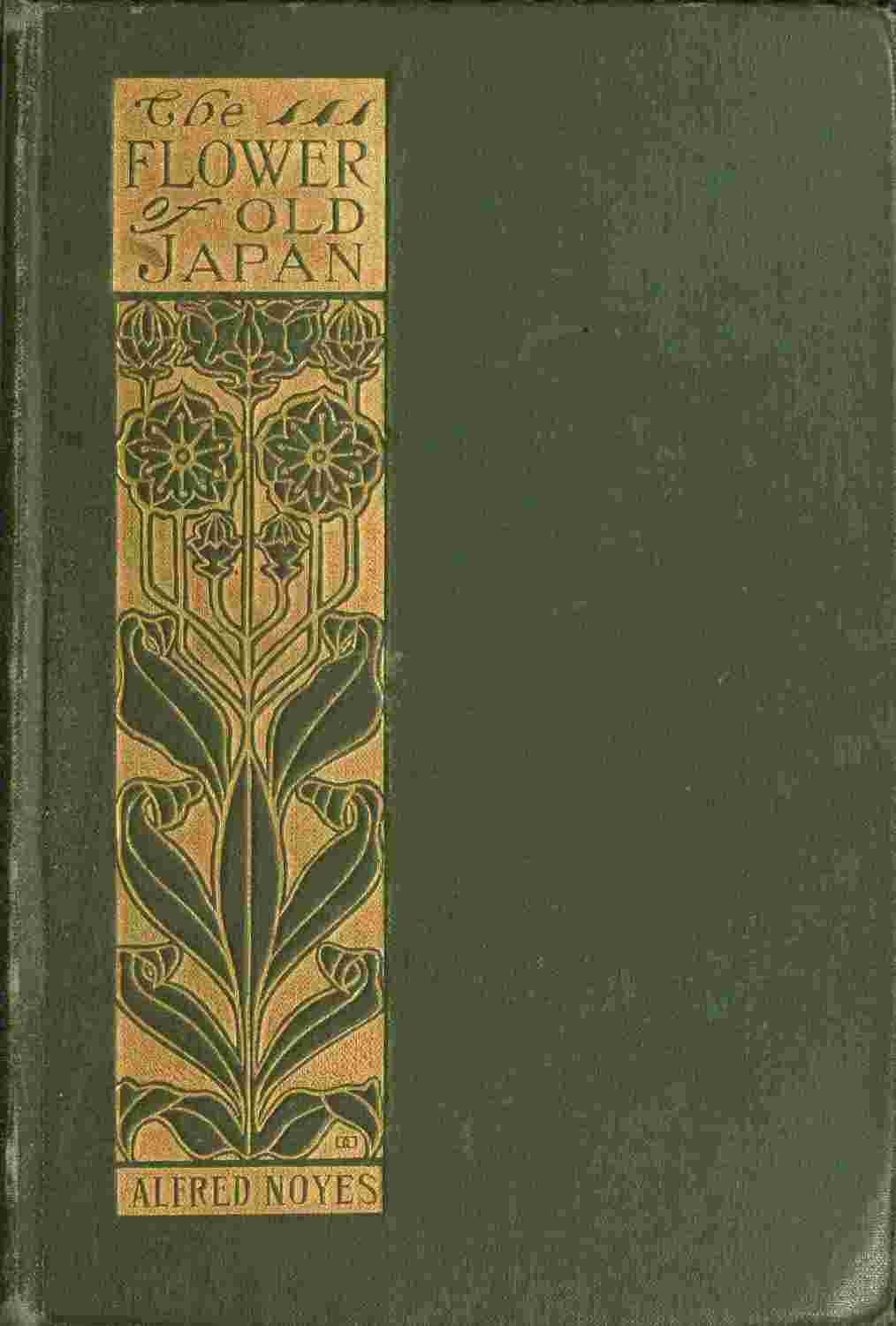
The Project Gutenberg eBook of The Flower of Old Japan, and Other Poems
Title: The Flower of Old Japan, and Other Poems
Author: Alfred Noyes
Release date: June 11, 2021 [eBook #65592]
Most recently updated: October 18, 2024
Language: English
Credits: Tim Lindell, Chuck Greif and the Online Distributed Proofreading Team at https://www.pgdp.net (This file was produced from images generously made available by The Internet Archive/American Libraries.)
THE FLOWER OF OLD JAPAN
THE FLOWER OF OLD
JAPAN
AND OTHER POEMS
BY
ALFRED NOYES
New York
THE MACMILLAN COMPANY
LONDON: MACMILLAN & CO., Ltd.
1907
All rights reserved
Copyright, 1907,
By THE MACMILLAN COMPANY.
Set up and electrotyped. Published June, 1907.
Norwood Press
J. S. Cushing & Co.—Berwick & Smith Co.
Norwood, Mass., U.S.A.
Ce vase pâle et doux comme un reflet des eaux,
Couvert d’oiseaux, de fleurs, de fruits, et des mensonges
De ce vague idéal qui sort du bleu des songes,
Ce vase unique, étrange, impossible, engourdi,
Gardant sur lui le clair de lune en plein midi,
Qui paraissait vivant, où luisait une flamme,
Qui semblait presque un monstre et semblait presque une âme.’
—Victor Hugo (Le Pot Cassé).
PREFACE
It is a perilous adventure—the writing of a preface, however brief, to one’s own poems. For one may be tempted to re-state matters that could find their full elucidation only in the verses themselves. Tennyson once remarked that poetry is like shot silk, glancing with many colours; and any attempt to define its meanings is as great a mistake as the attempt of nineteenth-century materialism to enclose the infinite universe in its logical nut-shells. Through poetry alone, whether of deeds or words, thought or colour, passion or marble, is it possible to approach the Infinite, or as Blake did:—
A heaven in a wild flower;
Hold Infinity in the palm of your hand,
And Eternity in an hour.’
But this revelation is the sole end and object of all true art; and I hope it may not be thought presumptuous to say here simply that—whether the attempt be a success or a failure—it was especially my own aim in the two following poems. If the feet of childhood are set dancing in them, it was because as children we are best able to enter into that Kingdom of Dreams which is also the only true, the only real, Kingdom. The first tale, for instance, must not be taken to have any real relation to Japan. It belongs—as the Spectator put it—to the kind of dreamland which an imaginative child might construct out of the oddities of a willow-pattern plate, and it differs chiefly from Wonderlands of the Lewis Carrol type in a certain seriousness behind its fantasy. It is astonishing to me that these things require comment; but undoubtedly they do. For, on the one hand, the first tale has been praised enthusiastically as a vivid picture of Japan, and the author has not only had to correspond with Tokyo on the subject, but was also invited to meetings of the Japan Society in London! On the other hand, because the child-voices are allowed to declare that Tusitala lies asleep in that distant country of dreams, a prosaic English critic once wrote a lengthy review in an important paper to point out my gross ignorance of the fact that Stevenson was really buried in Samoa! The tales are ‘such stuff as dreams are made on’; but—as a kinder critic has remarked—‘we ourselves are made of that stuff.’ It is perhaps because these poems are almost light enough for a nonsense-book that I feel there is something in them more elemental, more essential, more worthy of serious consideration, than the most ponderous philosophical poem I could write. They are based on the fundamental and very simple mystery of the universe—that anything, even a grain of sand, should exist at all. If we could understand that, we could understand everything! Set clear of all irrelevancies, that is the simple problem that has been puzzling all the ages; and it is well sometimes to forget our accumulated ‘knowledge’ and return to it in all its childish naïveté. It is well to face that inconceivable miracle, that fundamental impossibility which happens to have been possible, that contradiction in terms, that fundamental paradox, for which we have at best only a cruciform symbol, with its arms pointing in opposite directions and postulating, at once, an infinite God.
The inscription on the “Wisdom Looking-Glass”; the discovery by the children that the self-limitation of their little wishes was necessary not only to their own happiness, but to the harmony of the whole world; the development of the same idea in the passages leading up to the song—What does it take to make a rose?—where a divine act of loving self-limitation, an eternal self-sacrifice, an everlasting passion of the Godhead, such as perhaps was shadowed forth on Calvary, is found to be at the heart of the Universe, and to be—as it were—the highest aspect of the Paradox aforesaid, the living secret and price of our very existence; these things are only one twisted strand of the ‘shot silk’ out of which the two tales are woven. It is no new wisdom to regard these things through the eyes of little children; and I know—however insignificant they may be to others—these two tales contain as deep and true things as I, personally, have the power to express. I hope, therefore, that I may be pardoned, in these hurried days, for pointing out that the two poems are not to be taken merely as fairy-tales, but as an attempt to follow the careless and happy feet of childhood back into the kingdom of those dreams which, as we said above, are the sole reality worth living and dying for; those beautiful dreams, or those fantastic jests—if any care to call them so—for which mankind has endured so many triumphant martyrdoms that even amidst the rush and roar of modern materialism they cannot be quite forgotten.
PERSONS OF THE TALE
| Ourselves. |
| The Tall Thin Man. |
| The Dwarf behind the Twisted Pear-tree. |
| Creeping Sin. |
| The Mad Moonshee. |
| The Nameless One. |
| Pirates, Mandarins, Bonzes, Priests, Jugglers, Merchants, Ghastroi, Weirdrians, etc. |
PRELUDE
Of islands far away;
You that have heard the dinky bird
And roamed in rich Cathay;
You that have sailed o’er unknown seas
To woods of Amfalula trees
Where craggy dragons play:
Oh, girl or woman, boy or man,
You’ve plucked the Flower of Old Japan!
The bridge of pale bamboo;
The path that seemed a twisted dream
Where everything came true;
The purple cherry-trees; the house
With jutting eaves below the boughs;
The mandarins in blue,
With tiny, tapping, tilted toes,
And curious curved mustachios?
And is it far or near?
Some never find it till they die;
Some find it everywhere;
The road where restful Time forgets
His weary thoughts and wild regrets
And calls the golden year
Back in a fairy dream to smile
On young and old a little while.
And some with old blue plates;
Some with a miser’s golden hoard;
Some with a book of dates;
Some with a box of paints; a few
Whose loads of truth would ne’er pass through
The first, white, fairy gates;
And, oh, how shocked they are to find
That truths are false when left behind!
That Tusitala told,
When first we plunged thro’ purple vales
In quest of buried gold?
Do you remember how he said
That if we fell and hurt our head
Our hearts must still be bold,
And we must never mind the pain
But rise up and go on again?
You must remember still:
He left us, not so long ago,
Carolling with a will,
Because he knew that he should lie
Under the comfortable sky
Upon a lonely hill,
In Old Japan, when day was done;
“Dear Robert Louis Stevenson.”
The hills that haunt us now;
The whaups that cried upon the wind
His heart remembered how;
And friends he loved and left, to roam
Far from the pleasant hearth of home,
Should touch his dreaming brow;
Where fishes fly and birds have fins,
And children teach the mandarins.
PART I
EMBARKATION
Flutters in the black wet pane,
It is very good to hear
Howling winds and trotting rain:
It is very good indeed,
When the nights are dark and cold,
Near the friendly hearth to read
Tales of ghosts and buried gold.
We were dreaming, just like you;
Till we thought of palmy lands
Coloured like a cockatoo;
All in drowsy nursery nooks
Near the clutching fire we sat,
Searching quaint old story-books
Piled upon the furry mat.
Like a half-remembered name;
Worn old pages in that light
Seemed the same, yet not the same:
Curling in the pleasant heat
Smoothly as a shell-shaped fan,
O! they breathed and smelt so sweet
When we turned to Old Japan!
Someone tapping on the wall,
Tapping, tapping like a bird,
Till a panel seemed to fall
Quietly; and a tall thin man
Stepped into the glimmering room,
And he held a little fan,
And he waved it in the gloom.
Danced before our startled eyes,
Birds from painted Indian screens,
Beads, and shells, and dragon-flies;
Wings, and flowers, and scent, and flame,
Fans and fish and heliotrope;
Till the magic air became
Like a dream kaleidoscope.
Far across a fairy sea;
And he waved his thin white hand
Like a flower, melodiously;
While a red and blue macaw
Perched upon his pointed head,
And as in a dream, we saw
All the curious things he said.
Magically swinging there,
Flowery-kirtled mandarins
Floated through the scented air;
Wandering dogs and prowling cats
Grinned at fish in painted lakes;
Cross-legged conjurers on mats
Fluted low to listening snakes.
Watched where singing, faint and far,
Boys in long blue garments bore
Roses in a golden jar.
While at carven dragon ships
Floating o’er that silent sea,
Squat-limbed gods with dreadful lips
Leered and smiled mysteriously.
Watched by secret oval eyes,
Where the ruby wishing-stone
Smouldering in the darkness lies,
Anyone that wanted things
Touched the jewel and they came:
We were wealthier than kings
If we could but do the same.
We might use it if we could;
To be happy all our days
As an Indian in a wood;
No more daily lesson task,
No more sorrow, no more care;
So we thought that we would ask
If he’d kindly lead us there.
And he vanished through the wall;
Yet as in a dream, we ran
Tumbling after, one and all;
Never pausing once to think,
Panting after him we sped;
For we saw his robe of pink
Floating backward as he fled.
Under roofs of spidery stairs,
Where the bat-winged nightmares creep,
And a sheeted phantom glares
Rushed we; ah! how strange it was
Where no human watcher stood;
Till we reached a gate of glass
Opening on a flowery wood.
Borne by swifter feet than ours,
On to Wonder-Wander town,
Through the wood of monstrous flowers;
Mailed in monstrous gold and blue
Dragon-flies like peacocks fled;
Butterflies like carpets, too,
Softly fluttered overhead.
Where the broad-limbed giants lie
Snoring, as when long ago
Jack on a bean-stalk scaled the sky;
Slowly, softly towards the town
Stole we past old dreams again,
Castles long since battered down,
Dungeons of forgotten pain.
Evening caught us ere we crept
Where a twisted pear-tree stood,
And a dwarf behind it slept;
Round his scraggy throat he wore,
Knotted tight, a scarlet scarf;
Timidly we watched him snore,
For he seemed a surly dwarf.
He could hardly hurt us much;
We were nearly twice as tall,
So we woke him with a touch
Gently, and in tones polite,
Asked him to direct our path;
O! his wrinkled eyes grew bright
Green with ugly gnomish wrath.
And gruffly spoke,
“You’re lost: deny it, if you can!
You want to know
The way to go?
There’s no such place as Old Japan.
No, no, don’t speak!
You mean you want to steal a fan.
You want to see
The fields of tea?
They don’t grow tea in Old Japan.
Perhaps you’d smell
The cherry bloom: that’s if you ran
A million miles
And jumped the stiles,
And never dreamed of Old Japan.
And mandarins?
And, what d’you say, a blue divan?
And what? Hee! hee!
You’ll never see
A pig-tailed head in Old Japan.
The ruby, hey?
I never heard of such a plan!
Upon my word
It’s quite absurd
There’s not a gem in Old Japan!
You’d better go
Straight home again, my little man:
Ah, well, you’ll see
But don’t blame me;
I don’t believe in Old Japan.”
O’er our startled heads he cast,
Spider-like, a webby grey
Net that held us prisoned fast;
How we screamed, he only grinned,
It was such a lonely place;
And he said we should be pinned
In his human beetle-case.
Song
Over the silky silver sea;
Purple veils of the dark withdrawn;
Heavens of pearl and porphyry;
Purple and white in the morning light
Over the water the town we knew,
In tiny state, like a willow-plate,
Shone, and behind it the hills were blue.
All day long like dreams in the night;
There, in the meadows of dim blue grass,
Crimson daisies are ringed with white;
There the roses flutter their petals,
Over the meadows they take their flight,
There the moth that sleepily settles
Turns to a flower in the warm soft light.
Everyone buys at wonderful stalls
Toys and chocolates, guns and sweets,
Ivory pistols, and Persian shawls:
Everyone’s pockets are crammed with gold;
Nobody’s heart is worn with care,
Nobody ever grows tired and old,
And nobody calls you “Baby” there.
Upside down on each pig-tailed head,
Jugglers offer you snakes and fish,
Dreams and dragons and gingerbread;
Beautiful books with marvellous pictures,
Painted pirates and streaming gore,
And everyone reads, without any strictures,
Tales he remembers for evermore.
Listening, and the West grows holy,
Singers crouch with their long white fingers
Floating over the zithern slowly:
Paper lamps with a peachy bloom
Burn above on the dim blue bough,
While the zitherns gild the gloom
With curious music! I hear it now!
Holding out his magic fan,
Through the waving flowers appeared,
Suddenly, the tall thin man:
And we saw the crumpled dwarf
Trying to hide behind the tree,
But his knotted scarlet scarf
Made him very plain to see.
Passed the webby net away;
While its owner squealing loud
Down behind the pear-tree lay;
For the tall thin man came near,
And his words were dark and gruff,
And he swung the dwarf in the air
By his long and scraggy scruff.
But our rescuer touched the box,
Open with a sudden spring
Clashed the four-and-twenty locks;
Then he crammed the dwarf inside,
And the locks all clattered tight:
Four-and-twenty times he tried
Whether they were fastened right.
Showed us Wonder-Wander town;
Then he fled: behind him flowed
Once again the rose-pink gown:
Down the long deserted street,
All the windows winked like eyes,
And our little trotting feet
Echoed to the starry skies.
Where the Wonder-Wander sea
Whispers to the wistful shore
Purple songs of mystery,
Down the shadowy quay we came—
Though it hides behind the hill
You will find it just the same
And the seamen singing still.
And her milky silken sail
Seemed by magic to unfurl,
Puffed before a fairy gale;
Shimmering o’er the purple deep,
Out across the silvery bar,
Softly as the wings of sleep
Sailed we towards the morning star.
Yet we never needed light;
Softly shone our tiny bark
Gliding through the solemn night;
Softly bright our moony gleam,
Glimmered o’er the glistening waves,
Like a cold sea-maiden’s dream
Globed in twilit ocean caves.
PART II
THE ARRIVAL
Drew back the silver veils,
Till lilac shimmered into lawn
Above the satin sails;
And o’er the waters, white and wan,
In tiny patterned state,
We saw the streets of Old Japan
Shine, like a willow plate.
The purple cherry crops,
The mottled miles of pearly domes,
And blue pagoda tops,
The river with its golden canes
And dark piratic dhows,
To where beyond the twisting vanes
The burning mountain glows.
Beyond that magic world,
We saw the great volcano rise
With incense o’er it curled,
Whose tiny thread of rose and blue
Has risen since time began,
Before the first enchanter knew
The peak of Old Japan.
The pinnace to the painted pier,
Except one pig-tailed mandarin,
Who sat upon a chest of tea
Pretending not to hear or see!...
His hands were very long and thin,
His face was very broad and white;
And O, it was a fearful sight
To see him sit alone and grin!
Timidly we passed him by!
He did not seem at all to care:
So, thinking we were safely past,
We ventured to look back at last.
O, dreadful blank!—He was not there!
He must have hid behind his chest:
We did not stay to see the rest.
We came upon the tall thin man,
Who called to us and waved his fan,
And offered us his palanquin:
He said we must not go alone
To seek the ruby wishing-stone,
Because the white-faced mandarin
Would dog our steps for many a mile,
And sit upon each purple stile
Before we came to it, and smile
And smile; his name was Creeping Sin.
And stuck them full of poisoned darts
And long green thorns that stabbed and stung:
He’d watch until we tried to speak,
Then thrust inside his pasty cheek
His long, white, slimy tongue:
And smile at everything we said;
And sometimes pat us on the head,
And say that we were very young:
He was a cousin of the man
Who said that there was no Japan.
Would follow the path of the palanquin;
Yet if we still were fain to touch
The ruby, we must have no fear,
Whatever we might see or hear,
And the tall thin man would take us there;
He did not fear that Sly One much,
Except perhaps on a moonless night,
Nor even then if the stars were bright.
We swung along in state between
Twinkling domes of gold and green
Through the rich bazaar,
Where the cross-legged merchants sat,
Old and almond-eyed and fat,
Each upon a gorgeous mat,
Each in a cymar;
Each in crimson samite breeches,
Watching his barbaric riches.
Whispered o’er the dim blue street
Where with fierce uncertain feet
Tawny pirates walk:
All in belts and baggy blouses,
Out of dreadful opium houses,
Out of dens where Death carouses,
Horribly they stalk;
Girt with ataghan and dagger,
Right across the road they swagger.
We saw the maids of Miyako,
Swaying softly to and fro
Through the dimness of the dance:
Like sweet thoughts that shine through dreams
They glided, wreathing rosy gleams,
With stately sounds of silken streams,
And many a slim kohl-lidded glance;
Then fluttered with tiny rose-bud feet
To a soft frou-frou and a rhythmic beat
As the music shimmered, pursuit, retreat,
“Hands across, retire, advance!”
And again it changed and the glimmering throng
Faded into a distant song.
Song
Dance in the sunset hours,
Deep in the sunset glow,
Under the cherry flowers.
Floating like butterflies,
Dimly the dancers whirl
As the rose light dies;
Upbound with curious pins,
Fade thro’ the darkening air
With the dancing mandarins.
Explained the manners of Old Japan;
If you pitied a thing, you pretended to sneer;
Yet if you were glad you ran to buy
A captive pigeon and let it fly;
And, if you were sad, you took a spear
To wound yourself, for fear your pain
Should quietly grow less again.
The mystic City that enshrined
The stone so few on earth had found,
We must be very brave; it lay
A hundred haunted leagues away,
Past many a griffon-guarded ground,
In depths of dark and curious art,
Where passion-flowers enfold apart
The Temple of the Flaming Heart,
The City of the Secret Wound.
We saw beside the twisted way
A blue-domed tea-house, bossed with gold;
Hungry and thirsty we entered in:
How should we know what Creeping Sin
Had breathed in that Emperor’s ear who sold
His own dumb soul for an evil jewel
To the earth-gods, blind and ugly and cruel?...
We drank sweet tea as his tale was told,
In a garden of blue chrysanthemums,
While a drowsy swarming of gongs and drums
Out of the sunset dreamily rolled.
A fat black bonze, in a robe of blue,
Suddenly at the gate appeared;
And close behind, with that evil grin,
Was it Creeping Sin, was it Creeping Sin?
The bonze looked quietly down and sneered.
Our guide! Was he sleeping? We could not wake him,
However we tried to pinch and shake him!
Till, as a glare of sound and flame,
Blind from a terrible furnace door
Blares, or the mouth of a dragon, blazed
The seething gateway: deaf and dazed
With the clanging and the wild uproar
We stood; while a thousand oval eyes
Gapped our fear with a sick surmise.
The clamour clove with a sound of thunder
In two great billows; and all was quiet.
Gaunt and black was the palankeen
That came in dreadful state between
The frozen waves of the wild-eyed riot
Curling back from the breathless track
Of the Nameless One who is never seen:
The close drawn curtains were thick and black;
But wizen and white was the tall thin man
As he rose in his sleep:
His eyes were closed, his lips were wan,
He crouched like a leopard that dares not leap.
Fearfully dreaming, waved his fan,
With wizard fingers, to and fro;
While, with a whimper of evil glee,
The Nameless Emperor’s mad Moonshee
Stepped in front of us: dark and slow
Were the words of the doom that he dared not name;
But, over the ground, as he spoke, there came
Tiny circles of soft blue flame;
Like ghosts of flowers they began to glow,
And flow like a moonlit brook between
Our feet and the terrible palankeen.
And sneered, “Have you stolen the strength of the skies?
Then pour before us a stream of pearl!
Give us the pearl and the gold we know,
And our hearts will be softened and let you go;
But these are toys for a foolish girl—
These vanishing blossoms—what are they worth?
They are not so heavy as dust and earth:
Pour before us a stream of pearl!”
Stretched his arms to the West and cried
Once, and a song came over the sea;
And all the blossoms of moon-soft fire
Woke and breathed as a wind-swept lyre,
And the garden surged into harmony;
Till it seemed that the soul of the whole world sung,
And every petal became a tongue
To tell the thoughts of Eternity.
And stared at the gold on the blue tea-house:
“Can you clothe your body with dreams?” he sneered;
“If you taught us the truths that we always know
Our heart might be softened and let you go:
Can you tell us the length of a monkey’s beard,
Or the weight of the gems on the Emperor’s fan,
Or the number of parrots in Old Japan?”
And again, with a wild strange laugh, our guide
Looked at him; and he shrunk aside,
Shrivelling like a flame-touched leaf;
For the red-cross blossoms of soft blue fire
Were growing and fluttering higher and higher,
Shaking their petals out, sheaf by sheaf,
Till with disks like shields and stems like towers
Burned the host of the passion-flowers
... Had the Moonshee flown like a midnight thief?
... Yet a thing like a monkey, shrivelled and black,
Chattered and danced as they forced him back.
In the face of a foe that he cannot but fear,
It chattered and leapt from side to side,
And its voice rang strangely upon the ear.
As the cry of a wizard that dares not own
Another’s brighter and mightier throne;
As the wrath of a fool that rails aloud
On the fire that burnt him; the brazen bray
Clamoured and sang o’er the gaping crowd,
And flapped like a gabbling goose away.