
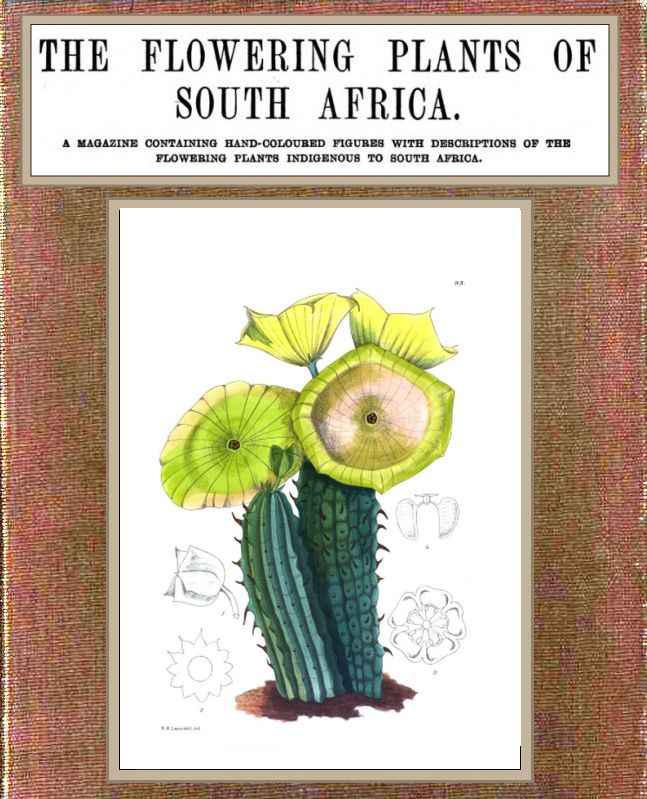
Plate 102.
MESEMBRYANTHEMUM digitatum.
Cape Province.
Ficoideae. Tribe Mesembryeae.
Mesembryanthemum, Linn.; Benth. et Hook. f. Gen. Plant. vol. i. p. 853.
Mesembryanthemum digitatum, Ait. Hort. Kew. ed. 1, vol. ii. p. 181 (1789); M. digitiforme, Thunb. in Acad. Leop.-Car. Ephem., vol. viii. Append, p. 6 (1791); Thunb. Fl. Cap. p. 412; Fl. Cap. vol. ii. p. 405.
This curious Mesembryanthemum was first collected by Carl Thunberg between the Oliphants River and the Bokkeveld Mountains about 150 years ago. Thunberg described his plant in 1789, and in his herbarium there is one sheet with two perfect growths and two flowers upon it. Marloth (Flora of South Africa, Pl. 49) figures a small portion of a plant which, he states, was collected at Van Rhynsdorp by Mr. W. Spilhaus and was as large as a child’s head. The specimens from which our illustration was made were collected in the same locality by Mr. E. Rood and sent to the Division of Botany, Pretoria.
The corpuscula, which are very succulent, show an extremely interesting structure when examined in detail. If a longitudinal section is made, a hard green central core is seen, which is the stem; this is surrounded by long, crystalline cells, and the whole covered in by a juicy tissue. As the green tissue is buried in the stem, it is very probable that the crystalline cells referred to act as lenses and concentrate any light which penetrates the outer tissue on to the chlorophyll-bearing cells. The fleshy leaves are almost devoid of chlorophyll.
The flower is borne at the apex of the stem, but this can only be satisfactorily seen in a longitudinal section. The crystalline cells are continued round the base of the calyx.
Description:—Acaulescent plant with woody underground stems and fleshy aerial stems and leaves. Stems 2-3 cm. long, 2-2·5 cm. in diameter, very succulent, glabrous. Leaves two to each stem, usually one larger than the other, 1·5-2 cm. long, 0·8-1·3 cm. in diameter, terete, blunt, very succulent, glabrous. Flowers white, arising from the apex of the stems but appearing on a casual examination to come from the base of one of the leaves, when expanded 1·2-1·5 cm. in diameter. Petals in more than one row; the outermost row connate into definite groups, 7 mm. long, less than 0·5 mm. broad, linear, subacute. Stamens in four rows; filaments 1 mm. long, filiform; anthers about 1 mm. long, oblong. Calyx covered with crystalline cells; lobes almost membranous, 1 cm. long, 3 mm. broad, oblong, or oblong ovate, obtuse. Ovary sunk in tissue of stem, 5-celled, with several stalked ovules with axile placentation; upper portion of ovary cone-shaped tipped with five terete, acute styles each 1 mm. long.
Plate 102.—Fig. 1, longitudinal section of stem showing sheath of crystalline cells and flower embedded at apex; 2, longitudinal section of flower; 3, sepal; 4, top of ovary showing the five stigmas; 5, cross section of ovary.
F.P.S.A., 1923.
Plate 103.
BRACHYCORYTHIS pubescens.
Cape Province. Natal. Swaziland. Transvaal.
Orchidaceae. Tribe Ophrydeae.
Brachycorythis, Lindl.; Benth. et Hook. f. Gen. Plant. vol. iii. p. 632.
Brachycorythis pubescens, Harv. Thes. Cop. i. 35, t. 54; Fl. Cap. vol. v.
sect. 3, p. 86; Bolus, Orchids of S. Afr. tab. 73.
The genus Brachycorythis is represented in Africa by over twenty species, five of which occur in South Africa, and of these three are endemic. The species described here is known from the Cape Province, Natal, Zululand, Swaziland and the northern Transvaal, and extends into tropical Africa. Its occurrence near Pretoria, in a totally different botanical area, is therefore interesting. Harvey first described the plant from specimens found near Durban by Mr. Sanderson, who stated it was plentiful in the neighbourhood.
This attractive little orchid was collected by General the Rt. Hon. J. C. Smuts on the farm Rietvlei No. 221, at Irene, near Pretoria, at an altitude of about 5000 ft. above sea-level. The plant was found in open grassland in deep red loam soil. It has large spreading finger-like tubers and slightly scented flowers.
Description:—A herbaceous plant with long finger-like tubers about 1 cm. thick. Stem with inflorescence up to 50 cm. high. Leaves erect, crowded 6 cm. long, 3·2 cm. broad at the base of the stem, becoming smaller above, ovate, acuminate, shortly cuspidate, clasping at the base, with the midrib prominent beneath, densely pubescent, with the margins shortly ciliated and somewhat undulate. Inflorescence up to 17 cm. long, racemose, many-flowered. Bracts similar to the leaves but smaller. Upper sepal 5 mm. long, 3 mm. broad, elliptic, rounded above, concave, sparsely pubescent without; lateral sepals 4 mm. long, 2·5 mm. broad, oblong, unequal sided, rounded above, concave, sparsely pubescent without. Lateral petals 6 mm. long, 3·5 mm. broad, oblong, rounded above, concave, unequal sided. Lip 9 mm. long, 7 mm. broad, obovate, 3-lobed, the middle lobe smaller than the two lateral lobes, narrowed in the middle and then expanded to form a deep pouch. Anther cells parallel; pollinia granular, each attached to a separate gland.
Plate 103.—Fig. 1, lower part of plant showing tubers; 2, flower (enlarged); 3, median longitudinal section of flower; 4, sepals; 5, petal; 6, lip; 7, column showing pollinia sacs; 8, pollinium.
F.P.S.A., 1923.
Plate 104.
MACKAYA bella.
Natal.
Acanthaceae. Tribe Justiceae.
MacKaya, Harv.; Benth. et Hook. f. Gen. Plant. vol. ii. p. 1095 (under
Asystasia).
MacKaya bella, Harv. Thes. Cap. i. 8, t. 13; Fl. Cap. vol. v. sect. 1,
p. 44; Wood, Natal Plant. t. 585.
This plant was discovered in Natal by Mr. J. Sanderson, who sent living specimens to Kew, where it flowered first in May 1869. From the material a figure of the plant was published in the Botanical Magazine of the same year. This figure, however, does not accurately represent the plant as it is known in its native habitat and in local cultivation. The flowers are lilac, and not almost white, as indicated in the Botanical Magazine. The late Dr. Medley Wood reproduced a pencil drawing of the plant in “Natal Plants” in 1912, and states it “is a handsome shrub, but it is of no economic value; it is found only in the coast and midland districts of Natal, and does not seem to be very common.” MacKaya bella differs from Crossandra Greenstockii (see Plate 77), which also belongs to the Acanthaceae, in having almost a regular, not a 1-lipped corolla.
Dr. Harvey, who first described the genus, dedicated it to Dr. J. T. MacKay, keeper of the Dublin University Botanic Garden. Our figure was prepared from plants growing in the “Flanagan Arboretum,” Union Buildings, Pretoria.
Description:—A shrub about 1-1·5 m. high. Branches pubescent. Leaves opposite, petioled; blade 3-6 cm. long, 1·3-3·5 cm. broad, elliptic or elliptic-lanceolate, acuminate, obtuse, usually narrowed at the base, margins lobulate or subentire, with the nerves distinct beneath, glabrous; petioles about 1 cm. long, pubescent. Flowers opposite in a terminal lax raceme; the internodes almost 2 cm. long. Bracts 4·5 mm. long, subulate; bracteoles 2, at the base of the pedicels. Pedicel 5-7 mm. long, pubescent. Calyx divided almost to the base; lobes 8 mm. long, acuminate from a base 1 mm. broad, very finely pubescent, and ciliate on the margins. Corolla-tube 3·5 cm. long, 2 cm. in diameter at the throat, campanulate above, becoming cylindric below, finely pubescent; lobes 2 cm. long, 1-1·5 cm. broad, ovate, obtuse, very finely pubescent or glabrous. Fertile stamens two; filaments fixed to narrow portion of corolla-tube, 1·5 cm. long, terete, with a few scattered short stiff hairs; anthers 7 mm. long, bluntly sagittate at the base, hirsute on the back; sterile stamens represented by filaments only. Ovary 3 mm. long, 2-celled, with 2 superposed ovules in each cell, glabrous; style 3·3 cm. long, filiform, with a few scattered hairs at the base; stigma shortly bifid. (National Herb. Pretoria, No. 2638.)
Plate 104.—Fig. 1, calyx; 2, corolla; 3, anther back view and filament; 4, anther front view; 5, ovary; 6, apex of style showing shortly bifid stigma; 7, longitudinal section of ovary.
F.P.S.A., 1923.
Plate 105.
ADENIUM oleifolium.
Transvaal. Cape Province.
Apocynaceae. Tribe Echitideae.
Adenium, Roem. et Schult.; Benth. et Hook. f. Gen. Plant. vol. ii. p. 722.
Adenium oleifolium, Stapf, var. angustifolium, Phillips var. nov., a
typo foliis angustis differt.
The genus Adenium is represented in South Africa by three species found in the Transvaal, Swaziland and the North-Western Cape Province. Species of the genus are also found extending through tropical Africa to Socotra. On Plate 16 we figured Adenium multiflorum, from which the present plant differs in having long narrow leaves; both, however, have very large tuberous underground stems from which the branches arise. The peculiar tailed anthers and the scales in the corolla-throat which sometimes form small pouches are characteristic of the genus.
Specimens were submitted to Kew for confirmation of the name, and the Director reports “very probably A. oleifolium, Stapf, but leaves are much narrower than in the type,” and it was thought advisable to describe this as a narrow-leaved variety.
Our plate was prepared from specimens collected by Dr. W. M. Borcherds at Upington, and forwarded by him to the Division of Botany, Pretoria.
Description:—Plant with large underground tuberous stems from which the branches arise. Branches densely pubescent when young, at length becoming glabrous. Leaves crowded at the ends of the branches, 6-10 cm. long, 2-4 mm. broad, linear, acute, pubescent. Flowers terminal. Sepals 6·5 mm. long, ovate, acuminate, acute, densely pilose, united at the base. Corolla-tube 3·5 cm. long, cylindric and 3 mm. in diameter in lowest third, campanulate and 1·1 cm. in diameter in uppermost ⅔, pubescent without and within and with pockets in the angles formed by the lobes; lobes 1·3 cm. long, 8-9 mm. broad, broadly-elliptic, acuminate, sub-acute, minutely ciliate. Filaments 4 mm. long, thick, terete, densely pilose; anthers 4 mm. long, hairy on the backs, sagittate at the base and produced into a long coiled apical hairy appendage 1 cm. long. Ovary 2 mm. long, 2 mm. broad, glabrous, separating into 2 carpels; style 1·6 cm. long, cylindric, glabrous; stigmas 3 mm. long, lanceolate, subacuminate, with a mass of glandular hairs at the back which fix the stigmas to the connective of the anthers. (National Herb. Pretoria, No. 2598.)
Plate 105.—Fig. 1, plant reduced; 2, corolla laid open; 3, corolla from above; 4, pocket in corolla; 5, calyx; 6, stamens; 7, style and stigma; 8, carpels; 9, median longitudinal section of flower.
F.P.S.A., 1923.
Plate 106.
CRATEROSTIGMA plantagineum.
Transvaal.
Scrophulariaceae. Tribe Gratioleae.
Craterostigma, Hochst.; Benth. et Hook. f. Gen. Plant. vol. ii. p. 954.
Craterostigma plantagineum, Hochst. in Flora, 1841, 669; Fl. Cap.
vol. iv. sect. 2, p. 361.
The Craterostigma figured on the accompanying plate is known from various localities in the Transvaal. It is also recorded from the neighbourhood of Bulawayo in Rhodesia and from other parts of tropical Africa reaching as far north as Arabia and Abyssinia. The genus is mainly a tropical one, and is represented by about a dozen species, three of which are found in South Africa.
C. plantagineum is a charming little plant which would be well worth cultivation in the greenhouse and should be easily grown. Our plate was prepared from specimens collected by Dr. I. B. Pole Evans, C.M.G., on the portion of the farm Rietfontein 448, near Pretoria, belonging to Mr. J. F. Ludorf. The plants were found growing in great profusion in shallow soil not more than one inch deep on a large quartzite outcrop. They were in flower during November and December.
Description:—An acaulescent plant with a rosette of radical leaves. Leaves 6-6·5 cm. long, 3-3·5 cm. broad (the inner smaller), ovate, obtuse, narrowed at the base, with crenulate, ciliated margins and with the nerves depressed above, prominent beneath, glabrous above, pubescent beneath, especially on the veins. Peduncles 3 or more to a plant, 3·5-4 cm. long, terete, pubescent, bearing about 8 opposite flowers in a raceme. Bracts 1 cm. long, 5 mm. broad, ovate-lanceolate, acute, slightly connate at the base, glabrous except on the keel, ciliate. Pedicel 7 mm. long, flat on the upper surface, convex on the lower surface, pubescent, ciliate. Calyx-tube 4·5 mm. long, 2·5 mm. in diameter, deeply fluted, pubescent; lobes 1 mm. long, ovate, sub-acute, ciliated. Corolla 2-lipped; tube 7 mm. long, tubular; lower lip 9 mm. long, 1 cm. broad, 3-lobed, with the lobes obovate, crenulate; upper lip 7 mm. long, oblong-ovate, bilobed at the apex. Stamens of two different kinds; those attached to the lower lip with filaments 7 mm. long, bent at right angles below and then swollen to form two callosities on the lip; those attached to the upper lip 2 mm. long; anther cells diverging, those of each pair of stamens joined. Ovary 2 mm. long, 1·25 mm. in diameter, ovoid; style 8 mm. long, terete, gradually widening above, glabrous; stigma bilobed, with the lobes broadly ovate and somewhat membranous. (National Herb. Pretoria, No. 2644.)
Plate 106.—Fig. 1, median longitudinal section of flower; 2, front view of flower enlarged; 3, bract; 4, calyx; 5, stamens; 6, pistil; 7, lower portion of under surface of leaf; 8, section of pedicel snowing convex and flat surfaces.
F.P.S.A., 1923.
Plate 107.
ALOE comosa.
Cape Province.
Liliaceae. Tribe Aloineae.
Aloe, Linn.; Benth. et Hook. f. Gen. Plant. vol. iii. p. 776.
Aloe comosa, Marloth and A. Berg. in Engl. Bot. Jahrb. vol. 38, p. 86.
The Aloe which forms the subject of this plate is, so far as is known, only found on the Bokkeveld beds in the Clanwilliam and Van Rhynsdorp Districts of the Cape Province. Full-grown plants attain a height of 12-15 ft., and when in full bloom, which is usually during December and January, their long massive inflorescences make such a display of colour in the veld that they cannot fail to attract the notice of the traveller. As will be seen from the illustration, the uppermost flowers are hidden by the long bracts, the flowers in the middle portion of the inflorescence are pink and spreading, while those at the base are pendulous and greenish-white. The stamens are only exserted from the pendulous flowers, and after pollination the filaments contract and are withdrawn into the perianth, which closes round them, leaving the style exserted. This phenomenon is also found in Aloe saponaria figured on Plate 96, and is probably fairly general in the genus Aloe.
The material from which our plate was made was collected by Dr. I. B. Pole Evans, C.M.G., on the Doorn River near Van Rhynsdorp, and brought to Pretoria, where the plants flower regularly every year during December and January. Aloe comosa was first collected and described by Dr. R. Marloth, who found it between Clanwilliam and Van Rhynsdorp in 1904.
Description:—Plant with a short stout stem or sometimes up to 12 ft. bearing a rosette of fleshy leaves at the apex, Leaves up to 52 cm. long, 10 cm. broad in the widest part, ovate-lanceolate, acuminate, acute, flat above, slightly convex beneath, deeply channelled on the upper surface above, with the veins somewhat distinct on the upper surface and with the margins covered with sharp teeth; teeth 5-7 mm. apart, 2 mm. long, ovate. Inflorescence lateral about 1·3 m. long, racemose, narrowly cylindric, with the lowermost flowers pendulous, the upper flowers erect and adpressed and the median flowers spreading. Peduncle about 60 cm. long, 1·5 cm. in diameter, terete, covered with long membranous ovate-acuminate bracts 5 cm. long, 1 cm. broad. Floral-bracts 6 cm. long, lanceolate, long acuminate, acute, with membranous margins, encircling the pedicel. Pedicel 1·8-2 cm. long, at first erect, at length becoming curved, terete. Perianth-tube 1·2 cm. long, campanulate; outer lobes grenadine-pink, 2 cm. long, 5 mm. broad, lanceolate, hooded at the apex, 3-nerved; inner lobes whitish, 2 cm. long, obtuse and hooded at the apex, 1-nerved. Filaments 1·8 cm. long, lengthening to 4 cm. long in old flowers; anthers 3 mm. long, oblong. Ovary ellipsoid; style 2 cm. long, lengthening to 4 cm. in old flowers; stigma simple with a ring of papillose hairs. (National Herb. Pretoria, No. 2643.)
Plate 107.—Fig. 1, entire plant much reduced; 2, inflorescence × ⅔; 3, leaf × ⅔; 4, median longitudinal section of flower; 5, bract; 6, young flower; 7, mature flower with stamens exserted; 8, inner perianth segment; 9, outer perianth segment.
F.P.S.A., 1923.
Plate 108.
PROTEA pityphylla var. latifolia.
Cape Province.
Proteaceae. Tribe Proteae.
Protea, Linn.; Benth. et Hook. f. Gen. Plant. vol. iii. p. 169.
Protea pityphylla, Phill. var. latifolia, Phillips var. nov., a typo foliis
latis differt.
The Protea figured on the accompanying plate is readily distinguished from the species by its flat, linear leaves, and on this character alone has been described as a variety of P. pityphylla, Phill. We are indebted to Miss L. Guthrie of the Bolus Herbarium for the specimens, which she received from Mr. de Wet of Ceres. The plant is stated to grow in the same habitat and to be found associated with P. pityphylla and P. Marlothii. It has the characteristic involucre of the former species, namely, the long leaf-like appendages from the apices of the lowermost bracts and also the same pendulous heads. The section of the genus (§ Pinifoliæ), comprising species with narrowly linear, filiform or needle-shaped leaves, to which this plant belongs is illustrated here for the first time.
Description:—Branches glabrous. Leaves 5·5-6·5 cm. long, 3 mm. broad, linear, bluntly apiculate, slightly narrowed to the base, glabrous. Head sessile, 4·5 cm. long, about 6·5 cm. in diameter, cernuous. Involucral-bracts 7-8-seriate, glabrous; the outer ovate, obtuse, sometimes subacuminate, minutely ciliate, the lowermost produced into long foliaceous appendages resembling the leaves; inner 3·5 cm. long, 1·3 cm. broad, concave, arching over and exceeding the flowers. Perianth-sheath 2 cm. long, dilated and 3-keeled below, setulose on the uppermost portion, otherwise glabrous; lip 5·5 mm. long, 3-toothed, 3-keeled, setulose below; teeth subequal, ·5 mm. long, the middle tooth smaller than the two lateral. Filaments ·5 mm. long; anthers 3·5 mm. long, linear, with an ovate fleshy apical gland less than ·5 mm. long. Ovary covered with long golden hairs; style over 2·5 cm. long, widened and much compressed at the base, sickle-shaped, glabrous; stigma 4 mm. long, scarcely swollen at the junction with the style, obtuse. (National Herb. Pretoria, No. 2586.)
Plate 108.—Fig. 1, receptacle; 2, unopened flower; 3, flower with perianth segments separated; 4, base of style showing the flattened portion.
F.P.S.A., 1923.
Plate 109.
TRIASPIS nelsoni.
Transvaal.
Malpighiaceae. Tribe Hirrae.
Triaspis, Burch.; Benth. et Hook. f. Gen. Plant. vol. i. p. 259.
Triaspis Nelsoni, Oliv. in Hook. Ic. Pl. t. 1418.
Triaspis Nelsoni was first described and figured in 1883 from material collected by Mr. W. Nelson at Pretoria. The figure given by Hooker is incorrect in a few small details. The pedicels, for instance, are articulated and bear 2 small bracteoles; the three styles are not equal, but one is longer than the other two and is deflexed at an angle of about 45°; the anterior petal is exterior in the bud and larger than the other petals.
The genus Triaspis is found in Madagascar, tropical and southern Africa, and was first recorded by the famous traveller Burchell, who collected specimens of a plant he described as T. hypericoides at Kosi Fountain in Bechuanaland in 1812. Since then several species have been recorded from the Transvaal.
The species figured on the accompanying plate is of frequent occurrence on the soils overlying the dolomite outcrops south of Pretoria at an elevation of 4000-5000 ft. above sea-level. It forms a subherbaceous bush not more than two feet high, and the main branches always tend to droop. When in flower it is a most attractive and beautiful object in the veld, and is well worth cultivation in our gardens. In addition to the beauty of its flowers, its large copper-coloured orbicular winged fruits add considerably to its charm and gracefulness. The material from which our plate was prepared was collected by Dr. I. B. Pole Evans, C.M.G., on the farm Doornkloof, Irene, near Pretoria, belonging to General the Rt. Hon. J. C. Smuts.
Description:—A subherbaceous plant with long slender and graceful branches from an underground rootstock. Branches terete, pubescent. Leaves opposite, decussate, 2-3 cm. long, 1-2·2 cm. broad, the upper leaves smaller than the lower, ovate, sub-apiculate, cordate at the base, with distinct reticulate veining and with the midrib prominent beneath, sparsely pubescent, with ciliated margins. Inflorescence a 5-6-flowered axillary raceme, arranged in the axils of the upper leaves. Peduncle 1·3 cm. long, terete, pubescent. Pedicels 1·5 cm. long, articulated in the lowermost ⅓, pubescent, bearing 2 small bracts. Sepals 3·5 mm. long, 1·5 mm. broad, oblong, rounded above, sparsely pubescent. Petals 1 cm. long, 6 mm. broad, concave, oblong, rounded above, produced into a claw at the base, with fimbriated margins; the lowermost petal overlapping the others in bud and larger than the rest. Stamens 10; filaments 5 mm. long, glabrous; stamens 2 mm. long, linear-oblong. Ovary 2 mm. long, globose, villous; styles 3, two stand erect; the posterior style reflexed and smaller than the other two. Fruit 3-winged with the wings deeply saucer-shaped. (National Herb. Pretoria, No. 2642.)
Plate 109.—Fig. 1, bud; 2, median longitudinal section of flower; 3, pistil; 4, fruit..
F.P.S.A., 1923.
Plate 110.
MESEMBRYANTHEMUM pillansii.
Cape Province.
Ficoideae. Tribe Mesembryeae.
Mesembryanthemum, Linn.; Benth. et Hook. f. Gen. Plant. vol. i. p. 853.
Mesembryanthemum Pillansii, Kensit in Plant. Nov. Hort. Then. II.
tab. 57 (1908); Botanical Mag. t. 8703.
Dr. R. Marloth supplies the following interesting note on this plant. “Originally found by Mr. Eustace Pillans (not Mr. N. Pillans, as stated in the Botanical Magazine) on the farm Mouton Valley on the Piquetberg mountains to the north-west of Piquetberg.
The present plants were gathered by me at the same locality in October 1922 on sandstone hills among Protea trees (waabom, P. grandiflora), forming shrublets 1½ to 2 ft. high with erect virgate branches.
The description in the Botanical Magazine is fairly correct, but the coloured petals are all radiating on the wild plants (not some erect and conniving, as stated in the Botanical Magazine for the cultivated plants). They are arranged in 5 groups in front of the sepals. The stigmata are distinct and papillate in the later stages of the flower.
The plant is easily cultivated at Cape Town, and I have had it in flower for several years from September to December.
The flowers are of special biological interest. The stamens do not stand erect as in most other species, but are incurved towards the centre to such an extent that the filaments from opposite stamens meet and the anthers are consequently enclosed in the lentil-shaped cavity thus formed above the concave apex of the ovary. The roof of this cavity is further strengthened by the filiform white inner petals which possess a rough surface and are also tightly incurved inwards, meeting at the centre.
The pollen is produced in profusion, and a mass of white powder is found in every flower when slit open at this stage. In all the flowers examined by me I found a number of small black beetles not more than 2 mm. long and a few specimens of haplothrips, all thoroughly covered with pollen. These insects are able to force their way in between the filaments and inner petals, but cannot escape until the stamens wither. Up to that time no stigmatic surfaces are visible in the centre of the flower, but within a few days, when the flower is about a week old and when the pollen at first accumulated in the concave apex of the ovary has been blown away by the wind, the stigmas develop to a length of 2-3 mm., showing a papillate surface, and are then in a condition to be cross-pollinated by the insects released from flowers in the first stage.”
Description:—A succulent plant. Branches glabrous, angled and somewhat winged. Leaves connate 2·8-4 cm. long, ovate, acute, flat above, acutely keeled beneath, with the margins somewhat scarious. Flowers terminal, about 4 cm. in diameter when expanded. Sepals unequal, ovate, acuminate, acute, two of the sepals have membranous appendages on the inner face. Petals 1·7 cm. long, obovate, produced into a long claw. Stamens bending over into cavity of receptacle; filaments linear. Stigmas sessile on floor of receptacle. (National Herb. Pretoria, No. 2646.)
Plate 110.—Fig. 1, median longitudinal section of flower with sepals and petals removed; 2, sepals; 3, petal enlarged; 4, stamen; 5, cross section of ovary; 6, fruit; 7, section of leaf.
F.P.S.A., 1923.
Plate 111.
ALOE microcantha.
Cape Province, Swaziland, Transvaal.
Liliaceae. Tribe Aloineae.
Aloe, Linn.; Benth. et Hook. f. Gen. Plant. vol. iii. p. 776.
Aloe microcantha, Haw. Suppl. 105; Fl. Cap. vol. vi. p. 306; Sims in
Bot. Mag. t. 2272.
Aloe microcantha, which forms the subject of the accompanying plate, occurs frequently in the open grass veld along the eastern mountain range from Grahamstown northwards as far as the valley of the Limpopo. In Swaziland and the eastern Transvaal it is usually found along the edges of streams and in marshy places. In localities of high rainfall, such as Haenertsberg on the Drakensbergen in the Transvaal, this plant is often a conspicuous and beautiful object on the grassy slopes facing east. It flowers during January and February. As soon as the seed has set, a few months later, the leaves wither almost completely to their bases, leaving a short stem surrounded by a few dried leaves to weather the winter drought.
We are indebted to Mr. Chas. Maggs of Pretoria for the specimen figured in our illustration. It was collected by Mr. Maggs on his Waterval Estate, near Sabie, on the Drakensberg, in January 1921, and forwarded to the Division of Botany, where it flowered in January the following year.
Aloe microcantha was first collected by Bowie and introduced into cultivation in 1819. It was figured in Curtis’ Botanical Magazine in 1821 as a plant of great rarity from the Cape of Good Hope.
Description:—An acaulescent plant. Leaves up to 33 cm. long, 4·5 cm. broad at the base, lanceolate, acuminate, acute, concave, sparsely covered with greenish-white spots near the base and with rigidly ciliated margins. Inflorescence about 50 cm. long, terete, glabrous, bearing a few distant membranous ovate acuminate acute bracts. Inflorescence congested, corymbose. Bracts 1·5 cm. long, ovate, acuminate, acute. Pedicels 3 cm. long, terete, glabrous. Perianth 2·8 to 3·2 cm. long; lobes 2·7 cm. long, 6 mm. broad, linear, obtuse. Filaments 2 cm. long, filiform; anthers linear. Ovary 1 cm. long, cylindric; style 2·7 cm. long, filiform; stigma simple. (National Herb. Pretoria, No. 2645.)
Plate 111.—Fig. 1, plant much reduced; 2, median longitudinal section of flower; 3, perianth segments; 4, anther; 5, style; 6, cross-section of leaf about the middle.
F.P.S.A., 1923.
Plate 112.
ERYTHRINA humeana.
Cape Province, Natal.
Leguminosae. Tribe Phaseoleae.
Erythrina, Linn.; Benth. et Hook. f. Gen. Plant. vol. i. p. 531.
Erythrina Humeana, Spreng. Syst. iii. 243; E. Humei, E. Mey. Comm.
Pl. Afr. Austr. 150; Fl. Cap. vol. i. p. 237.
In a previous issue, on Plate 59, we figured the Kaffir Boom (Erythrina caffra), from which the present species differs in being of a dwarf habit and having the nerves of the leaves and petioles covered with prickles. It is a common plant on the slopes of the Drakensberg in Natal, extending southward to Grahamstown, and during the summer months the bright red flowers are very conspicuous in the veld. The leaves of this species, as well as those of E. caffra, are attacked by a gall-producing insect, and the seeds are attacked by insects to such an extent that it is difficult to find ripe seed.
The species has been known to cultivators in Europe for over 100 years, and was figured in the Botanical Magazine as early as 1823. It is a very handsome shrub which stands from 4 to 8 ft. high, and is well worth cultivation.
Description:—An erect shrub ·9 to 3 m. high. Stem and branches terete, ashen-grey, prickly. Leaves pinnately trifoliate, 5 to 7·5 cm. long and wide, broadly ovate, gradually narrowing to an acute apex, occasionally very much attenuated and 3-veined at the base; the terminal leaflet similar but smaller and broader in proportion to its length; the midribs of all usually bearing prickles; stipule 6 mm. long, oblong, acute; stipellae glandular. Petiole 5 to 7·5 cm. long, with scattered broad-based prickles along its whole length. Peduncle 30 to 40 cm. long, terete, bearing flowers in the upper half. Flowers crowded. Calyx 5-toothed, 1 cm. long, pubescent; tube subcylindric; teeth acute. Vexillum 3·7 cm. long, oblong; alae 1 cm. long, oblong; carina 1·1 cm. long, ovate. Ovary many-ovuled, tipped with the persistent style. Legume 7·5 to 12·5 cm. long, 2-to 5-seeded, torulose with wide spaces between the seeds.
Plate 112.—Fig. 1, leaf and raceme, natural size; 2, calyx, twice natural size; 3, vexillum; 4, wing; 5, keel; 6, stamens; 7, pistil; 8, pod; 9, portion of branch, much reduced.
F.P.S.A., 1923.
Plate 113.
ADENIA digitata.
Transvaal.
Passifloraceae. Tribe Modecceae.
Adenia, Forsk. Fl. Aegypt. Arab. 77 (1775).
Adenia digitata, Engl. Bot. Jahrb. vol. xiv. p. 375; Modecca digitata,
Harv. Thes. Cap. t. 12, 167; Fl. Cap. vol. ii. p. 499.
The species of Adenia described below and figured on the accompanying Plate is of special interest, inasmuch as the large tuberous roots have proved to be extremely poisonous. In October 1922 the plant was brought to the notice of the Division of Botany by Dr. H. Osborne of Pretoria, who reported that two white labourers were admitted to the Pretoria Hospital suspected of having been poisoned by eating a portion of the root, and that one of them died shortly after admission to the Hospital. A sample of the root sent in by Dr. Osborne was submitted to Drs. H. H. Green and W. H. Andrews of the Division of Veterinary Research, and as a result of their investigations two types of poison were discovered. One of these acts very rapidly, and with symptoms which can be attributed to the small amount of a cyanogetic glucoside; the other acts more slowly, but its chemical nature is as yet unknown. A full account of these investigations will be published in the Report of the Director of Veterinary Research.
The fruits of Adenia digitata are berries of a very attractive nature, and also appear to be poisonous, for some years ago in the Pretoria District two native children died after eating them.
The plant is quite common in the Pretoria District, and also occurs in the Barberton District. It has long, graceful branches provided with tendrils, by means of which it climbs up neighbouring bushes and shrubs.
Description:—Roots tuberous, sometimes up to 50 cm. in diameter. Stems striate. Leaves 8 to 14 cm. long, digitately 3-to 5-lobed; the middle lobe pinnatisect; the side lobes again lobed on one side only or pinnatilobed, more rarely almost entire; the mid-rib prominent above and beneath, and with two prominent glands on the upper side at base of the lamina, and with glands beneath at the base of each leaf-segment, glabrous; petiole 1·3 to 1·7 cm. long, 6 to 7 mm. broad, flat above, convex beneath, glabrous. Calyx-tube 1·5 cm. long, campanulate, 1 cm. in diameter above, narrowing to 1·5 mm. in diameter at the base, glabrous; lobes 7 cm. long, 5·5 mm. broad, ovate, obtuse, glabrous; two lobes with entire, the other three with lacerated margins. Petals 9 mm. long, 2·5 mm. broad at the widest part, obovate, acuminate, obtuse, narrowed at the base, with shortly ciliated margins, 3-nerved. Filaments united at the base, 4 mm. long, linear, broadening at the base; anthers 6·5 mm. long, 1·5 mm. broad, linear, falcate when seen in side view. Glands at base of filaments ·5 mm. long, more or less quadrate. Style 1 mm. long, bilobed at the apex. Corona represented by a fimbriated rim. Fruit fleshy, 3·5 cm. long, 2·5 cm. in diameter. Female flower not seen. (National Herb. Pretoria, No. 2639.)