
Plate 189.—Fig. 1, flower-bud; Fig. 2, petal with 2 stamens; Fig. 3, carpels; Fig. 4, longitudinal section of head showing convex receptacle; Fig. 5, cross-section through leaf; Fig. 6, leaf.
F.P.S.A., 1925.
Plate 190.
HAEMANTHUS ALBIFLOS.
Cape Province.
Amaryllidaceae. Tribe Amarylleae.
Haemanthus, Linn.; Benth. et Hook. f. Gen. Plant. vol. iii. p. 730.
Haemanthus albiflos, Jacq. Hort. Schoenbr. i. 31, t. 59; Fl. Cap. vol. vi.
p. 235.
This species of Haemanthus was known to European horticulturists almost 150 years ago and was first shown in colour by Jacquin in 1797. In the Botanical Magazine it was again figured in 1810 (Plate 1239) from plants which flowered in the greenhouse of Messrs. Lee and Kennedy of Hammersmith. The plant has been recorded from the Uitenhage, Graaf Reinet and Somerset East Divisions of the Cape Province, but does not appear to have been extensively collected. In general habit H. albiflos resembles H. natalensis figured in Plate 32, but the leaves are thicker and more fleshy.
The species responds well to proper cultivation and has been successfully grown at the Division of Botany, Pretoria. It was from plants grown at Pretoria that our Plate was prepared.
Description:—Bulb tunicated, 4·5 cm. in diameter; tunics fleshy, white becoming green. Leaves 4, contemporary with the flowers, 42 to 46 cm. long, 10 cm. broad at the widest part, tongue-shaped, obtuse, narrowed to the base, with ciliated margins, dark green on the upper surface, paler on the lower surface. Peduncle 16 cm. long, 1·3 cm. in diameter, erect, compressed, glabrous. Inflorescence a dense umbel, 2·5 cm. in diameter. Involucral-bracts 5, ascending, white with 6 to 9 distinct green nerves, short mucronate, ciliated with reflexed hairs. Pedicels 4 to 5 mm. long, glabrous. Flowers white. Perianth-tube subcylindric, glabrous; segments 1·7 cm. long, linear, obtuse. Stamens 6; filaments[Pg 124] subulate; anthers versatile. Ovary globose, 3 mm. in diameter; style subulate; stigma minutely tricuspidate. (National Herb., Pretoria, No. 2933.)
Plate 190.—Fig. 1, whole plant, much reduced; Fig. 2, single flower; Fig. 3, involucral bract.
F.P.S.A., 1925.
Plate 191.
CEROPEGIA Haygarthii.
Natal, Cape Province.
Asclepiadaceae. Tribe Ceropegieae.
Ceropegia, Linn.; Benth. et Hook. f. Gen. Plant. vol. ii. p. 779.
Ceropegia Haygarthii, Schltr. in Engl. Bot. Jahrb. vol. xxxviii. 46, fig. 7 A;
Fl. Cap. vol. v. sect. i. p. 813.
This beautiful species of Ceropegia is almost unique in the genus on account of the peculiar formation of the corolla-lobes. The illustration should be compared with those given on Plates 39, 44 and 143, and the striking differences will then be seen. It is closely related to C. tristis, Hutch. described on Plate 44, but the corolla-lobes are produced into a much longer cylindric portion and the calyx-lobes are longer.
The specimen from which our illustration was made flowered in the greenhouse at the Division of Botany in July 1925, and like the other species of the genus always attracts attention owing to the peculiar shape of the flowers.
Description:—Stem climbing, fleshy, 3 to 4 mm. thick, glabrous. Leaves small, fleshy, flat, 0·6 to 3·5 cm. long, 0·3 to 2·5 cm. broad, ovate or ovate-lanceolate, acuminate. Cymes 1-2-flowered, lateral at the nodes. Peduncles 2 to 4 cm. long, glabrous. Bracts 2 to 4 mm. long, subulate. Pedicels 1 to 1·4 cm. long, glabrous. Sepals 1 cm. (0·5 cm., Schlechter) long, subulate, glabrous. Corolla abruptly bent at a right angle near the base. Tube (following the bend) about 3·5 cm. long, according to a drawing, or about 2·5 cm. long in dried flowers, globosely inflated at the base, cylindric above, enlarging (according to a drawing) to about 2 cm. in diam. at the mouth, pinkish-white or greenish tinted, spotted with violet, glabrous outside, pilose with very fine long hairs within. Lobes free at the base, abruptly inflexed over the mouth of the tube and produced beneath into broad triangular partition-like green plates or keels, meeting at the[Pg 128] centre and connate into a slender erect column 1 to 1·4 cm. long, then again becoming free and expanding into elliptic-lanceolate replicate segments connate at the tips, forming a small apical ellipsoid cage-like body 5 to 6 mm. long, ciliate on the margins, dull purple or purple-brown. Corona in the flowers seen much eaten by insects, but apparently the outer corona is cupular, with 5 acutely bifid lobes rising to the level of the top of the staminal column, ciliate and hairy within with long fine hairs. Inner corona-lobes 2 mm. long, linear or linear-spathulate, connivent-erect over the staminal column, with very revolute tips. (Fl. Cap.—National Herb., Pretoria, No. 2932.)
Plate 191.—Fig. 1, calyx; Fig. 2, ground plan of corolla from above; Fig. 3, terminal portion of corolla lobes; Fig. 4, corona.
F.P.S.A., 1925.
Plate 192.
PROTEA Harmeri.
Cape Province.
Proteaceae. Tribe Proteae.
Protea, Linn.; Benth. et Hook. f. Gen. Plant. vol. iii. p. 169.
Protea Harmeri, Phillips in Kew Bulletin 1911, p. 83; Fl. Cap. vol. v.
sect. i. p. 593.
A comparison of the accompanying Plate should be made with the illustration on Plate 108. Both the species figured belong to the same section of the genus Protea, all characterised by very narrow leaves.
Protea Harmeri was first found by Dr. (now Sir Sydney) Harmer on a hill near Matjesfontein when he visited South Africa in 1905; it was subsequently collected by Dr. R. Marloth on the Wittebergen and again later in the Zwartberg Pass between Oudtshoorn and Prince Albert. The specimen figured was collected near the summit of the Zwartberg Pass in July 1925. The plant is a bush about 6 ft. high and is extremely handsome, as the dark heads show up in strong relief from the greyish-green leaves.
Description:—A bush about 1 m. high. Branches greyish tomentellous above, becoming glabrous. Leaves 4·5 to 6·5 cm. long, 2·5 to 3·5 mm. broad, linear, obtuse to subacute with a callous point attenuated at the base, margins recurved; youngest leaves finely villous at the base. Head sessile, 2·5 cm. long, about 2·5 cm. in diam., globose; receptacle convex. Involucral-bracts 10-11-seriate; outer ovate, obtuse, glabrous or the lowest very finely pubescent, with membranous ciliate margins; inner oblong-spathulate, obtuse, brick-red, recurved above, glabrous or minutely pubescent, not equalling the styles. Perianth-sheath 1·5 cm. long, 0·75 mm. broad, dilated above, 3-keeled and 3-nerved below, glabrous or hirsute at the apex; lip 4 mm. long, 3-toothed, rufously setulose, glabrescent on the back; teeth subequal, 0·25 mm. long, the[Pg 132] middle one smaller. Stamens all fertile, subsessile; anthers linear, 3 mm. long; apical glands 0·25 mm. long, ovate, obtuse, swollen on the inner face. Ovary 2 mm. long, oblong-obovate in outline, covered with long brown hairs; hypogynous scales 1 mm. long, 0·25 to 0·5 mm. broad, oblong, obtuse; style 2 cm. long, falcate, arching over the centre of the head, terete above, flattened and hollow below, glabrous; stigma 2·25 mm. long, linear, obtuse, grooved, passing into the style. (Fl. Cap.—National Herb., Pretoria, No. 2916.)
Plate 192.—Fig. 1, single flower; Fig. 2, posterior perianth lobe; Fig. 3, pistil; Fig. 4, receptacle.
F.P.S.A., 1925.
Plate 193.
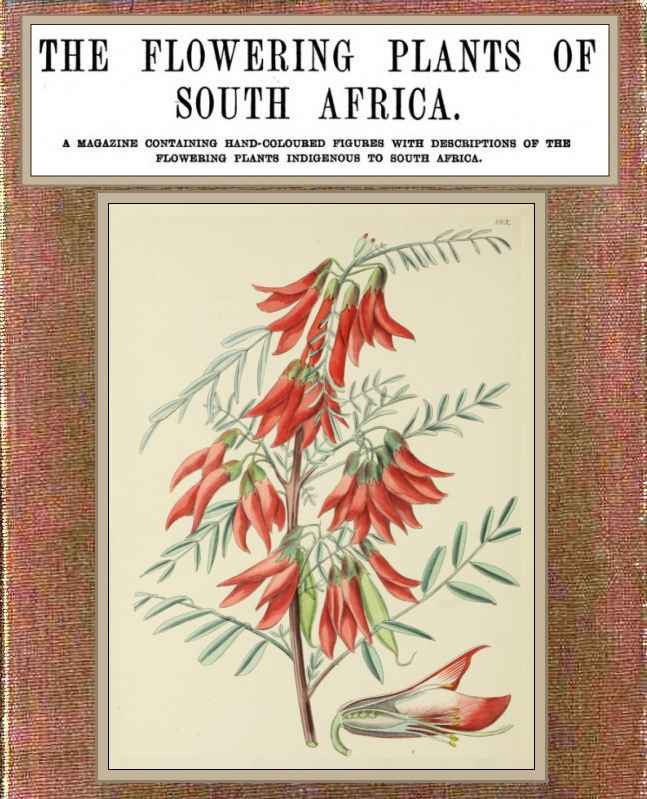
SUTHERLANDIA FRUTESCENS.
Cape Province, Orange Free State, Natal, Transvaal.
Leguminosae. Tribe Galegeae.
Sutherlandia, R.Br.; Benth. et Hook. f. Gen. Plant. vol. i. p. 503.
Sutherlandia frutescens, R.Br. Hort. Kew. ed. 2, p. 327; Fl. Cap. vol. ii.
p. 212.
This plant was named by the great English botanist in honour of James Sutherland, one of the earliest superintendents of the Edinburgh Botanic Gardens. The genus has only one species, which is widely distributed throughout South Africa, and is probably the most handsome native plant in the family Leguminosae. According to the Botanical Magazine, in which the plant was figured (Plate 181), Sutherlandia frutescens was known in cultivation as early as 1683, and later became generally known in European gardens.
Sutherlandia frutescens forms a small bush, but may grow to 3-4 ft. high, and is found usually in fairly dry places. It is known under several local names, but probably the most common is “Kanker bos” (cancer-bush), as it is reputed to be a cure for cancer.
As the plant is easily raised from seed, and the flowers are particularly beautiful, it should be more generally cultivated.
We are indebted to Mr. C. A. Smith, B.Sc., for the specimens which he collected at Fauresmith in the Orange Free State.
Description:—A shrub. Branches pubescent, at length becoming glabrous. Leaves 6 to 9 cm. long, imparipinnate; leaflets alternate or opposite, 1 to 2 cm. long, 3 to 6 mm. broad, lanceolate or oblong, obtuse, thinly pubescent. Inflorescence an axillary raceme, peduncle and pedicels covered with short stiff sparse hairs. Floral-bracts 3 mm. long, oblong. Pedicels 1·2 cm. long. Calyx-tube 1 cm. long, deeply cam[Pg 136]panulate; lobes 4·5 mm. long, ovate, acuminate. Vexillum 3 cm. long, 1·2 cm. broad, obovate, acuminate; alae 8 mm. long, 1·5 mm. broad, oblong, obliquely clawed; keel 3·5 cm. long, 8 mm. broad, more or less oblong, with a linear claw 1·2 cm. long. Stamens diadelphous; filaments filiform. Ovary stalked, 1·5 cm. long, linear, with many ovules; style 1·5 cm. long, bearded on the inner face. Pod membranous, inflated. (National Herb., Pretoria, No. 2943.)
Plate 193.—Fig. 1, median longitudinal section of flower.
F.P.S.A., 1925.
Plate 194.
ORNITHOGALUM ODORATISSIMUM.
Cape Province.
Liliaceae. Tribe Scilleae.
Ornithogalum, Linn.; Benth. et Hook. f. Gen. Plant. vol. iii. p. 815.
Ornithogalum odoratissimum C. A. Smith, sp. nov. Bulbus ovoideo-globosus,
2 cm. diam., tunicis brunneis membranaceis. Folia 2-6, 6-10
cm. longa, anguste linearia, basi leviter dilatata, glabra. Pedunculus
ad 14 cm. longus, cylindricus, glaber. Inflorescentia ad 6 cm. longa,
pauci-vel multiflora. Bracteae 1-1·8 cm. longae, ovato-acuminatae,
membranaceae. Pedicelli 0·5-1 cm. longi, teretes. Segmenta perianthii
1·5 cm. longa, oblonga, apice inflexa pubescentia obtusa. Filamenta
0·5-1 cm. longa, basi 2 mm. lata; antherae oblongae. Ovarium 5 mm.
longum, sessile. Stylus 1·5 cm. longus, teres, apice minute capitatus,
penicillatus. Fructus trigonus.
This Plate should be compared with that of O. Roodeae figured on Plate 75, as the two species are no doubt closely related though differing much in the colour of the flowers and the shape of the leaves. Like O. Roodeae the flowers are very sweet-scented, a character not usually met with in the genus, and a single inflorescence is sufficient to saturate a large room with a pleasant scent, and even when planted out in the garden the strong perfume is noticeable for a considerable distance from the plant. The plant has been compared with Jacquin’s figure of O. suaveolens, from which it differs in being much smaller, and as it has been figured it was thought better to describe it than to definitely state that it is O. suaveolens.
We are indebted to Mrs. E. Rood of van Rhynsdorp for the specimens.
Description:—A simple erect herb. Bulb 2 cm. in diameter, 2·5 cm. high, ovoid, with brown tunics. Leaves 2 to 6, 6 to 10 cm. long, 2 to 3 cm. broad at the base, linear to linear-lanceolate, deeply channelled, glabrous. Peduncle up to 14 cm. long, terete, glabrous. Raceme few to many-[Pg 140]flowered, up to 6 cm. long. Bracts 1 to 1·8 cm. long, ovate-acuminate, membranous, dry, partly sheathing the pedicels. Pedicels 0·5 to 1 cm. long, cylindric, erect-spreading. Perianth-segments 1·5 cm. long, oblong, inflexed obtuse and pubescent at the apex, white with a broad green 3-nerved band. Stamens slightly shorter than the perianth-segments; filaments 2 mm. broad at the base; anthers 2 mm. long, oblong, versatile. Ovary 5 mm. long, sessile; style subequalling the perianth-segments, sub-capitate and penicillate at the apex. Fruit (immature) deeply and bluntly 3-lobed. (National Herb., Pretoria, No. 2941.)
Plate 194.—Fig. 1, median longitudinal section of flower; Fig. 2, cross-section of ovary.
F.P.S.A., 1925.
Plate 195.
ATHRIXIA ELATA.
Basutoland, Cape Province, Natal, O.F.S., Transvaal.
Compositae. Tribe Inuloideae.
Athrixia, Ker.; Benth. et Hook. f. Gen. Plant, vol. ii. p. 328.
Athrixia elata, Sond. in Linn. vol. xxiii. p. 67; Fl. Cap. vol. iii. p. 292.
The plant figured on the accompanying Plate is a much-branched shrub almost 1 m. high, and may be found in flower on the hills surrounding Pretoria during the month of August. It grows in masses in certain localities and flowers very profusely; if brought under cultivation it could no doubt be much improved so as to make it a desirable garden plant.
Athrixia elata is found on the Drakensberg in Natal, in Basutoland, the eastern Free State and on the spurs of the Drakensberg in the northern Transvaal, but extends westwards in the Transvaal as far as Rustenburg. The travellers Burke and Zeyher collected specimens almost 100 years ago on the Magaliesberg, and Cooper also came across the plant in his journey through Basutoland in 1861.
We are indebted to Mr. C. A. Smith, B.Sc., for the specimens from which our Plate was prepared.
Description:—A much-branched shrub. Leaves alternate, sessile, 0·5 to 2·5 cm. long, linear, acute, pungent, with revolute margins, glabrous above, woolly beneath. Heads subsessile, solitary, terminal, 2·5 to 3 cm. in diameter (including the rays). Involucral-bracts in many rows, unequal; the outer gradually shorter, recurved, aristate, 3 to 4 mm. long, 1 mm. broad, narrowly ovate with the apices edged with brown to black, woolly; inner 5 to 6 mm. long, 1 mm. broad, linear-oblong; innermost 7 to 8·5 mm. long, 0·5 to 1 mm. broad, narrow-linear to oblong-elliptic, with membranous margins. Receptacle flat, nude, honeycombed with the margins of the cells evident. Ray-florets female; tube 4 to 5 mm. long,[Pg 144] cylindric, widening above, glabrous; lamina oblong-elliptic. Ovary terete, pilose; style cylindric, glabrous, deeply 2-cleft. Disc-florets hermaphrodite, fertile. Corolla 6 mm. long, tubular, cylindric below, then articulated and the uppermost one-third slightly wider, glabrous. Anthers tailed at the base, with an ovate obtuse apical appendage. Ovary pilose; style cylindric, glabrous, deeply 2-cleft; branches 1 mm. long, linear, truncate, penicillate. Pappus-bristles equalling the corolla-tube, rigid, persistent, subplumose in the uppermost one-third, alternating with minute serrulate scales. (National Herb., Pretoria, 2942.)
Plate 195.—Fig. 1, diagrammatic longitudinal section of head; Fig. 2, ray-floret; Fig. 3, disc-floret; Fig. 4, involucral-bract; Fig. 5, pappus enlarged; Fig. 6, pappus-bristle; Fig. 7, fimbriated pappus-scale.
F.P.S.A., 1925.
Plate 196.
SUTERA Burkeana.
Transvaal, Zululand.
Scrophulariaceae. Tribe Manuleae.
SUTERA, Roth. (including Lyperia, Benth.); Benth. et Hook. f. Gen. Plant.
vol. ii. p. 945.
Sutera Burkeana, Hiern. Fl. Cap. vol. iv. sect. ii. p. 299.
The Sutera Burkeana here figured for the first time is a common plant in some localities around Pretoria and is to be found in flower from the beginning of August onwards. It is a bush up to 2-1/2 ft. high and appears to be very localised in its distribution, as only isolated patches are met with on the hills surrounding Pretoria. It has also been recorded from the neighbourhood of Johannesburg and from Zululand.
The plant flowers profusely, and when in full bloom makes a fine display and would no doubt be improved under proper cultivation.
Our Plate was prepared from specimens collected by Mr. C. A. Smith near Pretoria.
Description:—A much-branched shrub ·3 to 1·3 m. high. Branches glandular-puberulous. Leaves fascicled recurved 3 to 8 mm. long, linear to oblong, cuneate at the base, acute, toothed, punctate. Flowers arranged racemosely at the ends of the branches. Pedicels 7 mm. long, terete, rigid, viscid-puberulous. Calyx 3 to 4 mm. long, deeply 5-lobed; lobes lanceolate-linear or oblong-lanceolate, acute, glandular-hairy. Corolla-tube cylindric, somewhat swollen and twice curved above, glandular-hairy without, softly hairy in the throat; lobes broadly obovate, obtuse, entire, often curled or recurved, glandular-hairy outside. Stamens 4, hardly exserted; filaments filiform, inserted on the corolla-tube. Anthers 1-thecous, all perfect. Ovary 2-chambered with numerous ovules; style subulate, included; stigma obtuse. Fruit a capsule; valves[Pg 148] cleft at the apex. Seeds numerous, regose. (National Herb., Pretoria, No. 2937.)
Plate 196.—Fig. 1, longitudinal section of flower; Fig. 2, pistil; Fig. 3, cross-section of ovary.
F.P.S.A., 1925.
Plate 197.
EUPHORBIA TRIDENTATA.
Cape Province.
Euphorbiaceae. Tribe Euphorbieae.
Euphorbia, Linn.; Benth. et Hook. f. Gen. Plant. vol. iii. p. 258.
Euphorbia tridentata, Lam. Encycl. ii. 416; Fl. Cap. vol. v. sect. ii. p. 298.
The species of Euphorbia figured on the accompanying Plate is a somewhat rare plant and until quite recently it was not known where the plant was found, although it was known in European gardens and figured almost 100 years ago. The plant belongs to a small group of three species in the genus characterised by having the branches constricted at their origin of growth. All of them are very dwarf plants.
We are indebted to Mr. H. M. Bartlett of Riversdale for the specimens which he sent in July 1924, and these were successfully grown at the Division of Botany, Pretoria, and flowered in September 1925.
Description:—Plant dwarf, succulent, spineless, branching from the base. Branches ascending or somewhat spreading, 2·5 to 15 cm. long, 1 to 1·4 cm. thick, cylindric or slightly tapering upwards, tessellately tuberculate with hexagonal flattish tubercles 6 to 10 mm. in diam., having a slightly prominent whitish leaf-scar, glabrous, dull green. Leaves sessile, soon deciduous, 4 to 6 mm. long, 3 to 4 mm. broad, elliptic or elliptic-oblong, acute, dark green, with a reddish minutely toothed margin. Peduncles 3 to 4 at the ends of the branches, about 4 mm. long, bearing a pair of ovate or elliptic bracts and 1 involucre, glabrous. Involucre about 1·3 to 1·8 cm. in diam., cup-shaped, glabrous, with 5 glands and 5 transversely oblong, toothed and ciliate, inflexed, purplish lobes. Glands subcontiguous, about 5 mm. in diam. across the tips, very concave at the basal part, divided into 3 to 4 spreading finger-like corrugated white processes 2 to 3 mm. long. Ovary pedicellate, scarcely exserted, with styles[Pg 152] 7 mm. long, united for two-thirds of their length, with entire spreading tips. (National Herb., Pretoria, No. 2989.)
Plate 197.—Fig. 1, inflorescence; Fig. 2, gland with lobes.
F.P.S.A., 1925.
Plate 198.
VENIDIUM Wyleyi.
Little Namaqualand.
Compositae. Tribe Arctotideae.
Venidium, Less.; Benth. et Hook. f. Gen. Plant, vol. ii. p. 459.
Venidium Wyleyi, Harv. Fl. Cap. vol. iii. p. 463.
This Plate, and that on Plate 117, should be compared with Arctotis Fosteri which we figured on Plate 3, when the difference between the genera Venidium and Arctotis will be seen. In the former genus the fruits are without a pappus or with a very rudimentary one, while in the latter genus a well-developed pappus is always present.
The plant is commonly known as the “Namaqua Daisy,” and in its native home the flower-heads attain a very large size when the season is favourable, but may be quite small when no rain has fallen. Venidium Wyleyi does quite well under cultivation, and is easily grown and forms a very effective border.
We are indebted to Mr. L. R. Vogt of Waterkloof near Pretoria for the specimens, which were grown in his garden.
Description:—An erect herb. Stems terete, hollow, striate, pilose-hoary, laxly leafy. Cauline leaves 1·2 to 15 cm. long, sessile; the lower lyrato-pinnatifid, amply auricled, amplexicaul, on both sides cobwebby-tomentose; the upper broadly ovate, closely crowded in the young stems, cobwebby-tomentose, obtuse, with the margins entire or remotely 1 to 2 toothed. Heads peduncled, terminal, very large and showy, 8 cm. in diam. (including the rays), the buds very hoary. Involucral bracts imbricate, in several rows; the outer narrower, reflexed, herbaceous, green; the innermost row much longer, broadly scariose, spreading below the rays; the whole involucre densely cobwebby. Receptacle 1·8 cm. in diam., convex, deeply honeycombed, with the margins of the cells produced into a few bristles. Ray-florets female, 1-seriate, alternate[Pg 156] rays spreading, others at first ascending, then spreading, giving an appearance of two rows. Corolla ligulate; lamina bright orange coloured, oblong-cuneate, very faintly 3-toothed at apex, of lower whorl smaller (2·5 cm. long) and with a smaller brow-black blotch at the base than that of upper whorl (3 cm. long); tube 3 mm. long, broader at base than at the top, subglabrous. Ovary obovate in outline, muricated, glabrous; style 4 mm. long, cylindric, glabrous; stigmatic portion wider, with the branches 0·5 mm. long, linear, flat, spreading. Disc-florets hermaphrodite, fertile, numerous, crowded on the head. Corolla 4 mm. long, subcylindric, 5-cleft at the apex for about a quarter the length of the tube, with 5 longitudinal rows of glandular hairs; lobes blackish, 1 mm. long, linear, subacute, with the angles between the lobes obtuse. Anthers purplish, black, 2 mm. long, obtuse, with a small suborbicular apical appendage; filaments 1·5 mm. long, linear, flat, at length filiform, inserted on lower half of corolla tube. Ovary obovate in outline, white, muricated, glabrous; style 5·5 mm. long, at first narrowly cylindric, then in upper half abruptly widening into a yellow stigmatic portion, 2 mm. long, slightly cleft at the apex, becoming much exserted. (National Herb., Pretoria, No. 2944.)
Plate 198.—Fig. 1, longitudinal section of receptacle; Fig. 2, ray-floret; Fig. 3, disc-floret; Fig. 4, inner involucral-bract; Fig. 5, outer involucral-bract; Fig. 6, achene.
F.P.S.A., 1923.
Plate 199.
ERICA BLENNA var. GRANDIFLORA.
Cape Province.
Ericaceae. Tribe Ericeae.
Erica, Linn.; Benth. et Hook. f. Gen. Plant. vol. ii. p. 590.
Erica blenna, Salisb. var. grandiflora, Bolus. Fl. Cap. vol. iv. sect. i.
p. 202.
Through the courtesy of Dr. J. Muir of Riversdale we are able to figure for the first time a species of heath, and perhaps one of the most beautiful of all the Cape heaths. The variety grandiflora is only found as far as we know in the Riversdale and Bredasdorp Districts and is by no means a common plant. It is known locally as the “lantern” or “Riversdale” heath. The species itself, like so many of the South African species of Erica, was first collected by Masson about the year 1772, and was successfully cultivated in Europe and figured on more than one occasion in early botanical literature.
Description:—Erect, 0·3 to 0·5 m. high. Branches stout, ascending, virgate or flexuous, puberulous or glabrous. Leaves 3-nate, mostly erect and imbricate or subspreading, linear, subobtuse, flat above, keeled and sulcate beneath, glabrous, 8 to 10 mm. long. Flowers usually solitary, rarely in pairs (“here and there sublateral,” Bentham). Pedicels about 8 mm. long; bracts remote, lanceolate, about 6 mm. long; sepals ovate, acuminate, keel-tipped, thickish, subscarious, viscid, coloured or greenish, about 5 mm. long. Corolla conical-ovoid or suburceolate-conical, much contracted to the mouth but only slightly constricted at the throat, very viscid, 1·6 to 2 cm. long, bright orange-red, the limb and some distance below it green; segments spreading or erect, about one-eighth the length of the tube; filaments broad at the base tapering upwards, bent below the anther; anthers included, dorsifixed well above the base, cuneate, subacute, scaberulous, ciliolate, about 3 mm. long, crested; pore three-fifths to two-thirds the length of the cell; crests quite free[Pg 160] from the filament, subsemiorbicular in outline, deeply inciso-lacerate, about half the length of the cell; style included, straight; stigma capitellate; ovary glabrous. (National Herb., Pretoria, No. 2991.)
Plate 199.—Fig. 1, pedicel showing bracts; Fig. 2, androecium and gynaecium; Fig. 3, single stamen; Fig. 4, pistil; Fig. 5, anther enlarged.
F.P.S.A., 1925.
PLATE 200.
DIMORPHOTHECA CUNEATA.
Cape Province, Natal, Orange Free State.
Compositae. Tribe Calenduleae.
Dimorphotheca, Moench.; Benth. et Hook. f. Gen. Plant. vol. ii. p. 453.
Dimorphotheca cuneata, Less. Syn. 257; Fl. Cap. vol. iii. p. 422.
We are indebted for the specimens, from which the accompanying Plate was prepared, to Mr. C. A. Smith, B.Sc., who collected them in September 1925 on the botanical reserve near Fauresmith, Orange Free State. According to Mr. Smith the plants cover the hill-sides and from a distance appear as large white patches. It flowers very profusely, so much so that the leaves are almost hidden by the mass of flowers. The laminae of the ray-florets are white above and copper-coloured beneath, not yellow as described in the Flora Capensis.
The specimens collected by Mr. Smith are an exact match with those collected by Zeyher (No. 2812). Zeyher No. 3066, quoted by Harvey as D. cuneata, is quite a different plant, perhaps a Tripteris. We have accepted the specific name “cuneata,” as this was the name given by Mr. N. E. Brown to a specimen collected by Mr. E. E. Galpin. Locally known as “mak-bietou.”
Description:—A densely and closely branched bushy shrub up to 1·05 m. high, the older branches naked, rough, the younger short and closely leafy. Leaves varying in shape (linear to obovate) and size (0·5 to 1·3 cm. long), always cuneate at the base, sharply 2 to 4 toothed, obscurely mid-ribbed, gland-dotted, subdecurrent, glabrous or nearly so. Peduncles terminal, 2 to 3·5 cm. long, glandular-pubescent, viscidulous, becoming widened at the top. Involucre uni-seriate, glaucescent, viscidulous; scales linear-acuminate, minutely glandular-puberulous, with pale-edged and ciliate[Pg 164] margins. Receptacle about 3·5 mm. in diam., nude, flat. Ray-florets female, uniseriate. Corolla ligulate, white above, yellow to bronze-coppery below; lamina spreading, finely-three toothed, cuneate at the base; tube of corolla 1·5 mm. long, terete, glandular-hairy. Ovary triquetrous, green, obconic, somewhat curved, glandular hairy with stalked glands, with the angular margins bluntly toothed; style 4·5 mm. long, cylindric, glabrous; branches 2 mm. long, yellow, flat, subacute. Disc-florets hermaphrodite, fertile. Corolla-tube yellow, 3 mm. long, subcylindric, with a 5-fid limb, very densely glandular-hairy at the base, glabrous above. Anthers 3 mm. long, subsagittate at the base, with an ovate obtuse apical appendage. Ovary very much laterally compressed, obcordate, glandular, with a wide thick-rimmed entire marginal wing; style 6 mm. long, cylindric, glabrous; branches appearing truncate with a ring of bristles, capped by a short conical apex. (National Herb., Pretoria, No. 2990.)
Plate 200.—Fig. 1, ray-floret; Fig. 2, ray-achene; Fig. 3, disc-floret; Fig. 4, disc-achene; Fig. 5, stamen.
F.P.S.A., 1925.