
Jesuits expelled from, by Pius IX, 19, 309, 337, 393;
property of Jesuits in, restored to them, 259;
Victor Emmanuel enters, 23, 322;
Pius IX fugitive from, 322;
Pius IX returned to, 328;
capital of Italy established at, 329, 337;
English college established in, by Jesuits, 134;
German college established in, by Loyola, 121, 422.
Russia, Jesuits in, 239, 242-247;
Jesuit order authorized in White Russia by Pius VII, 244, 254;
Jesuits expelled from St. Petersburg and Moscow, 246.
S.
Saldanha, Cardinal, appointed visitor and reformer of the Jesuits, 189;
banished the Father Superior of the Jesuit "Professed House," and
caused arrest of two Jesuits in Brazil, 190;
appointed the Bishop of Para his delegate in South America, 190.
Saragossa, Jesuit intrigues at, 76-83.
Sardinia, hostility of, to Austria, 308;
formed alliance with Piedmont for protection, 308;
invited by Pius IX to co-operate in forming confederacy of Italian
republics with pope as ruler, 311;
declined to co-operate with Pius IX, 311;
became separated from influences of Holy Alliance, 312;
crown of, abdicated by Charles Albert, 312;
Victor Emmanuel became king of, 312.
Satolli, Mgr., deputy pope, sent to United States by Leo XIII, 396;
decision of, upon school question, 397;
results to be expected from success of his mission, 427.
Semper eadem, the Jesuit motto, 138;
the motto of the papacy, 489.
Spain, universities of, condemned infallibility, 70;
Jesuits in, 75-85;
Jesuit intrigues at Saragossa, 76-83;
opposition to Jesuits at Toledo, 84;
acquired possessions in South America, 168;
king of, prohibits Europeans entering Paraguay, 173;
invaded by Louis XVIII, of France, 262;
Jesuits driven out of, 221, 262, 291.
Syllabus of Pius IX, important propositions of, enumerated by Franco, 455.
T.
Temporal power, abolished in Italy, 19, 22, 24, 464;
Jesuit efforts to restore, 24, 27, 28;
Napoleon's letter to Pius VII, concerning, 269, 270;
doctrine of, maintained by Pius IX, 299-301, 310, 315;
Union of Sardinia and Italy, death-blow to, 313, 319;
Louis Napoleon sent troops to Italy to protect, 318;
abolished, 324, 329;
its restoration sought through aid of American people, 348;
restoration of, would convert pope into a king, 362;
not acquired until after fall of Roman Empire, 386;
its abolition asserted to be an international wrong by Leo XIII, 423;
an enemy to peace of the Church, 463;
importance of issue involved in restoration of, 464.
Trent, Council of, assembled by Paul III, 67, 467;
Jesuits at, 108, 469;
Elizabeth declined to send ambassadors to, 136;
forced to assemble by Charles V, 466;
called by Clement VII, 467;
Laynez announced doctrine of infallibility in, 470, 471, 472-475;
did not decree infallibility, 475;
assumed authority over both Protestants and Catholics, 491.
Tournon, De, Cardinal, condemns Jesuits in China and India, 212;
his arrest and death, 214.
U.
Ultramontanes, advocated temporal power and policy of bull "Unam
Sanctam" of Boniface VIII, 481, 482, 483.
Umbria, law of, condemned by Cardinal Pecci (Leo XIII), 376;
archbishop and bishops of, select Pecci to protest against the
infringement of papal rights by Piedmont, 380;
doctrines of Thomas Aquinas taught in schools of, 408.
Unam Sanctam, bull of Boniface VIII, 481, 482, 483, 484, 485, 488, 493;
disinclination of papal writers to publish in full, 482.
United States, policy of, to separate Church from State, 18, 344, 356,
358, 373, 414;
Jesuits in, 25, 29;
maintains the right of self-government, 335;
freedom of conscience a fundamental principle of, 348, 360;
people of, appealed to by papacy to restore temporal power in Italy,
348;
estimated number of Roman Catholics in, 392;
principles of, condemned by popes, 391, 411, 419, 420, 461;
institutions of, considered godless by Jesuits, 395, 462;
patriotism of Roman Catholics in, 422, 490;
infallibility inconsistent with loyalty to, 456.
V.
Vatican, Council of the, declared Pius IX infallible, 321, 427, 428,
471, 478;
decree of infallibility by, not unanimous, 433, 480.
Verona, Congress of "Holy Alliance" met at, 261.
Victor Emmanuel, conciliatory letter of, to Pius IX, 23, 319, and
note, page 320;
entered Rome, 23, 322;
his overture of pacification rejected by Pius IX, 23, 321;
becomes king of Sardinia, 312;
formed Kingdom of Italy, 313.
W.
Washington, President, advised education of youth in science of
government, 15;
his warning against foreign influence, 31.
X.
Xavier, Francis, his mission to the East Indies, 153;
sent to India by King of Portugal, 154;
character assigned to him, 154;
visited Goa, 155;
represented as performing miracles, 155, 156, 159-160, 161, 164;
claimed for him that God gave him the "gift of tongues," 156, 165;
established Jesuit college at Goa, 157, 158;
went to Malabar, 159;
his claim as the "Apostle of the Indies" unsubstantiated, 162;
visited Japan, 162-165;
his gift of tongues a "transient favor," 163, 164;
failed to enter China, 165;
his death, 166;
miraculous account of his remains, 166.
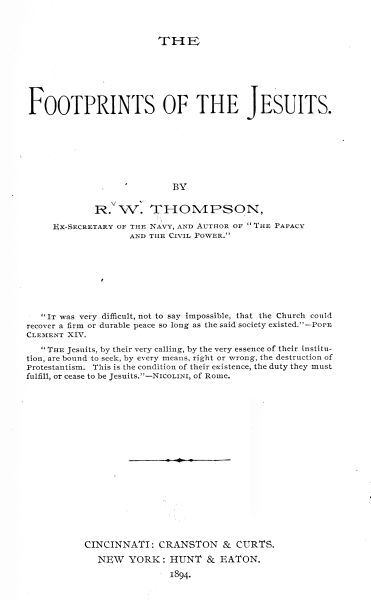
About This Book
A polemical historical study traces the origins and development of the Society of Jesus, examining its founding, institutional organization, and alleged practices, and documents its political interventions in Europe and beyond. The author contends that Jesuit discipline and moral theology support monarchist, politico-religious aims that jeopardize the separation of church and state, and surveys episodes under recent pontificates and Italian unification to illustrate efforts to restore papal temporal power. The text warns that adopting these politico-religious doctrines would imperil constitutional liberties and urges citizens, including Catholics, to resist ecclesiastical interference in civil government while maintaining freedom of private belief.