
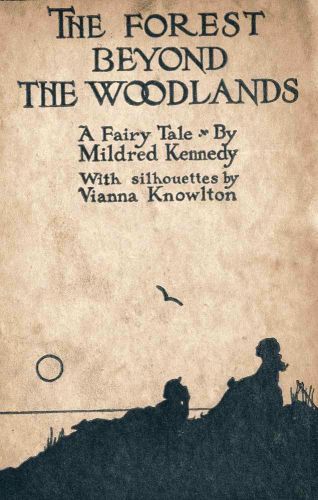
The Project Gutenberg eBook of The Forest Beyond the Woodlands: A Fairy Tale
Title: The Forest Beyond the Woodlands: A Fairy Tale
Author: Mildred Kennedy
Illustrator: Vianna Knowlton
Release date: August 5, 2018 [eBook #57604]
Most recently updated: January 24, 2021
Language: English
Credits: Produced by Mary Glenn Krause, Chuck Greif, amsibert and
the Online Distributed Proofreading Team at
http://www.pgdp.net (This file was produced from images
generously made available by The Internet Archive/American
Libraries.)
|
List of Illustrations (etext transcriber's note) |
THE FOREST
BEYOND
THE WOODLANDS
BORZOI BOOKS
FOR CHILDREN
| A Little Boy Lost | by W. H. Hudson |
| “In its sense of reality and in the unity of childhood with wild nature, I know of no book with which to compare it.... I believe that its appeal will be to children of different ages and to every grown person who has any love of beauty or remembrance of childhood. It is a wonderful book to read aloud to children.”—Annie Carroll Moore in The Bookman. | |
| “Miss Lathrop’s illustrations for ‘A Little Boy Lost’ and for ‘The Three Mulla-Mulgars’ have placed her, at a bound, in the first rank of American imaginative illustrators.”—Chicago Evening Post. | |
| Beautifully illustrated in full color and black and white by Dorothy P. Lathrop. | |
| The Three Mulla-Mulgars | by Walter de la Mare |
| “The story concerns the adventures of three monkeys of royal blood who have left their hut in the African jungle to seek the wonderful kingdom of their Uncle.... A tale of strange creatures and strange landscapes, of adventures and misadventures in faery forests. One of those rare books that everyone will love.”—Chicago Evening Post. | |
| Illustrated in full color and black and white by Dorothy P. Lathrop. | |
| The Forest Beyond the Woodlands | by Mildred Kennedy |
| “A fairy story made up of the ideally right and reliable magic—the bird-song guiding like a silver thread, through a quest that carries us through all manner of portents and crouching perils to rare delights beyond far horizons.... Made doubly delightful by the inclusion of fifteen really extraordinary silhouettes done for the book by Miss Vianna Knowlton.”—Helen Thomas Follett. | |
| The Wonder World We Live In | by Adam Gowans Whyte |
| A book that makes the foundations of real science more thrilling, more romantic, and more simply comprehensible than the usual pseudo-scientific books for children, and that will delight any child whose eyes are opening to the wonders of the world.—Profusely illustrated. | |
| Prince Melody in Music Land | by Elizabeth Simpson |
| “A very delightful book for children. The author has translated much of the dry technique of music lore into a series of connected fairy stories. Children will enjoy while learning.”—Philadelphia Ledger. | |
| Illustrations by Mary Virginia Martin. | |
COPYRIGHT, 1921, BY
ALFRED A. KNOPF, Inc.
PRINTED IN THE UNITED STATES OF AMERICA
TO
Florence A. Browne
the mother of
Ken and Dick
FOR WHOM THIS TALE WAS WRITTEN
CONTENTS
LIST OF ILLUSTRATIONS
THE FOREST
BEYOND
THE WOODLANDS
CHAPTER I
DAVID
DAVID was the son of an honest wood-cutter. He lived with his father in a little cottage on the border of the woodlands. Away, away as far as the eye could see stretched great tree-covered hills and mountains. This vast area was called, by the people of the country, the Dark Forest.
Some feared the mysteries of this unknown and unexplored region, for there were many stories and superstitions concerning giants, gnomes, and elves who dwelt within its shaded wilderness. But David, ever since he could remember, had always had a friendly feeling for the rough, hard bark of a pine or oak tree; and the fringed softness of the paper birch had been a delight to him ever since the day he first noticed its ragged beauty—a late summer afternoon on which, as he returned to his father’s cottage, the setting sun touched the whiteness of the tree-trunk beneath the cool green of its shining leaves.
“Some day I shall go far into the Forest,” he would say to himself. “Who knows what treasures I may find?”
David grew fast and was strong, for his life in the woodlands was one to make any boy well and happy. He learned his father’s trade, and in a short time, although he was not nearly full grown, he could wield an axe as well as many a grown man; in fact, he could put some men to shame, for his skill was far greater than that of the average boy of his age.
One day, while walking along a narrow path used by the wood-cutters, he met an old, old woman. Her dress was brown and made of a coarse homespun. A large basket strapped to her back was filled with pieces of firewood which she had been gathering. When she saw David she called to him. And as he approached her he noticed how beautiful she was; for, although her clothes were ragged, that mattered little—her face seemed more kind and beautiful than any he had ever seen. Her hair—one lock had fallen from beneath the brown cap that she wore—was white as driven snow. Her eyes were the soft colour of oak leaves in winter, and so filled with gentleness that David could only stand and look at her.
“Can you tell me,” she asked in a voice that sounded like a breath of wind stirring through the pine needles, “can you tell me where I can find a bit of water? I have been all day in the woods and have found no spring or brook; and I am thirsty, so thirsty! for a drink of pure, cool mountain water.”
“Yes!” cried David. “There is a beautiful spring not far from here. I will get some of the water for you. Rest here in the shade till I return: it will take me but a few moments.”
As he spoke he lifted her basket, that she might the more easily slip her arms through the leathern straps that served to hold it in place upon her back. She swung her clumsy burden to the ground and thanked him; and as soon as he saw her comfortably seated on a bed of moss beneath a sheltering tree, he hastened on his way towards the spring.
As he walked along he took out his hunting knife. For first he must find a birch tree: he wanted some of its white bark to make a cup in which to carry the water. Soon he came to a beautiful great tree. Cutting a clean wide strip of bark, he shaped it into a bowl-like receptacle. Next he pinned the edges together with twigs, so whittled to a point that they would pierce the bark and hold it in place. Then, hastening to the spring, he filled the birchen cup to overflowing with the clear, cool crystal water. In a few moments he stood before the old woman again and handed her the dripping cup. She took it, drank deeply, and was refreshed.
David gazed upon her. There was something about her that he could not explain; nor could he explain to himself his strange longing to talk to her. She looked up at him and smiled; then she motioned to him to sit down on the moss beside her. David did so.
“Do you live in these woods?” he asked timidly. “I do not remember ever having seen you before.”
“No,” answered the old woman. “My house is a long, long way from here—yet not so very far away, either, if only one is wise enough to follow the trail and not seek any short cuts.”
“Does the trail we are on lead to your home?” asked David, pointing to the woodpath that stretched away before them, seeming to lose itself far in the distance.
“Yes and no,” answered the old woman. “It leads you there if you know how to follow it—but there are many turnings, and some of them will lead you right and some of them will lead you wrong. It is not always easy to know which one to take, and if you choose the wrong one it will lead you far astray.”
“Dear me!” said David, “it is too bad the way is not more clearly marked.”
“It never is,” said the old woman, “and it never can be, for each year the new leaves grow up to cover the old trail, and each year a new trail has to be found. In fact, each one has to make his own trail, even when he seems to be following another’s and deceives himself into thinking that he is doing so. It is the law of the Forest, for any trail other than the one we make ourselves may lead us where we do not desire to go, and all at once we find ourselves deep in the woods, the path lost and we ourselves lost. No: we have to know where we are going and why we are going there. Then, when we know thus much for sure, there is always some sign to follow that will prevent us from losing the way. So you see, although I may start out on this path, that does not mean I shall follow it all the way; it depends upon the way the bird flies.”
“What bird?” asked David.
“The Blue Bird,” answered the old Woman.
“There are no blue birds in these woodlands,” said David. “I have lived here all my life and have never seen one. There are yellow birds and red birds, brown birds and green birds, white birds and black birds; but I have never seen a blue bird—I did not know there was one of that colour.”
“Well,” said the old Woman, “perhaps some day you will see a Blue Bird. When you do—let me give you just this word of advice—follow it, no matter where you are walking, no matter how smooth and beautiful your path may be, no matter through what regions the Bird may lead you. Follow it, follow it, little boy, for it will guide you there.”
“Where?” asked David.
“To the Tree,” answered the old Woman.
“What tree?” asked David.
“To the Tree in the midst of the Garden.”
“What Garden?”
“The Garden in the depths of the Forest.”
“What Forest?”
“The Forest beyond the Woodlands.”
“Is your home there?” asked David.
“Not a very great way from it,” said the old Woman. “You will see a Blue Bird some day, little boy; I am sure of that. I am glad that I met you. Thank you for bringing me the cool, refreshing water. Now I must go on my way, since I have told you about the Blue Bird. Remember, David: seek for it and follow it. You will know what it really means only when you have reached the end of the trail.—Help me lift the basket to my back again.—Thank you.—Now I must be off.”
“Here,” said David, “take this birch cup: you may grow thirsty again before you reach home, and if you come to a brook or spring, you will be glad to have this with you.”
“Thank you, boy.—I am sure you will see the Blue Bird some day, for you have the seeing light in your eye. But don’t forget to look for it!”
She turned and walked slowly down the wooded path.
David returned to his father’s home. For many, many days the memory of the old woman remained with him. Indeed, he never really forgot her, though a very long time passed and strange things happened,
before he saw her again, that sometimes made his memory grow dim.
One day—it must have been several months after this meeting in the woods—David had been felling trees and gathering faggots of wood; for this was his daily task. Suddenly a bird’s clear, glad song broke upon the calm of the noontime air. It was unusual to hear any bird’s song at that hour; but to this fact David gave no thought, for the clear, rich sweetness of the notes held him spellbound. He paused, resting his axe upon the ground, his head thrown back, listening. He closed his eyes, for the beauty of the music was such that he desired to think only of it and to shut out all other thoughts from his mind.
A deep silence fell upon the woodlands. Then, suddenly, but as gently as a breeze stirring the petals of a rose, the song came again—clear, sweet notes that thrilled through David’s heart. All at once, as the music faded again, a bird darted from the topmost branch of a neighbouring birch tree. The sunlight played upon its wings and breast, and the heavenly beauty of the little creature dazzled David’s eyes, as he caught a glimpse of it before it was lost in the deep shadows of the pine-clad hillside. But in that fleeting moment, he saw the colour of the bird.
It was blue—the deep celestial blue of the cloudless sky.
CHAPTER II
THE BLUE BIRD’S TRAIL
IN an instant there appeared to David, as if in a vision, the moss-covered seat and the beautiful little old woman of so many months ago. Again he seemed to hear the words, “When you see the Bird, little boy, follow it.”
Quick as thought David said to himself, “That is the Blue Bird—I will follow it!”
He stooped, picked up his woodsman’s axe and the sharp hunting knife in its leathern case, strapped the belt around his waist, swung the axe over his shoulder, and started off in the direction in which the bird had flown. He ran to the dark cedar grove toward which the Blue Bird had disappeared. There he hurried from tree to tree, seeking, in the thick foliage, the brightly iridescent gleam of the beautiful little creature’s feathers. But no sign of it could David find. After searching and searching, he sat down quite discouraged.
Suddenly he heard again the clear liquid notes of the song. Springing to his feet, he looked in the direction of the bird’s music. And, sure enough, there was the exquisite creature, resting on a twig just above his head.
This time he had a fine chance to study it carefully, to note the markings on its wings, head, and breast; and after this he never forgot how the Blue Bird looked—no, he remembered every detail through all the long years to come.
Its back and wings were of the colour that we sometimes see reflected in the surface of the ocean or of a lake or river—the wonderful deep blue of a serene sky. Its breast was like the shade of the sky on a soft summer day when great white clouds are floating about and a faint haze rests over all the earth. Its head was of the same rich, deep tone as the wings and back, and its throat was of that softer blue of the breast. When the Bird flew, it seemed as if a line of gold encircled it, for the wings and tail were tipped and outlined with a golden yellow band. When one saw it darting through the sunlight, one could not but think of a bit of the sky itself, outlined by a golden sunbeam. Its song was like the music of a rushing mountain brook in early springtime. Having once seen and heard this little songster, David had no other desire than to follow it wherever its flight might lead.
The Bird flew and David followed. It took no long flights, but went from tree to tree. It was as if it understood that David wished to follow, for always, before flying further, it waited till the boy had come to the foot of the tree on which it rested. Such a journey as he made! for in a short time the Bird had left the woodland trail and was flying cross-country, where there was no path to make David’s progress less difficult. Soon he was climbing a steep mountainside; then he descended a deep valley over steep and slippery cliffs; once he became so entangled in briers that he was almost on the point of crying. But he pushed bravely on; and in a little while he stood free from the vexing briers, in an open meadow by the edge of a sparkling lake upon the surface of which bloomed white water lilies. Behind him rose the mountain over which he had journeyed and the steep, high ridges down which he had slipped and fallen; their sheer damp walls shone now, as the sunlight played upon them. It was no easy path that he had walked, and as he looked back upon it he half wondered how he had been able to accomplish it all in safety.
Now his way was very different. He found himself on a well-marked trail, following the edge of the lake through a beautiful pine forest. The trees had scattered their brown leaves upon the ground, and it was very soft under his sore and tired feet. The Bird flew before him, leading him on step by step till at last he came out of the pine forest at the head of the lake. He paused for a moment to look across the smooth surface of the water that stretched away before him. There, beyond its furthest boundary, rose the mountain; and beyond that, he knew, lay his home.
Suddenly the Bird sang. David listened. Again there filled his heart that same mysterious desire to follow wherever the Bird might lead him. Nothing else in the world seemed to him to matter half so much. The Bird flew on. Now they were in a region of white birch trees and low-growing bushes, and the ground all about was covered with a carpet of tiny purple flowers with bright yellow centres.
In the distance David saw a large tree. It was greater than any other tree which grew thereabout, and its broad-spreading branches cast a cool shade. Its huge trunk, roughened and scarred by time, looked as old as the mountain itself. The Bird flew toward it, David still following; and all at once it darted into a hole in the tree-trunk, more than a tall man’s height from the ground, and disappeared from sight. David ran to the
foot of the tree and fastened the head of his axe in the hole, which he could just reach by standing on tiptoe. Then, using the handle of his axe to help him, he pulled himself up till he was able to look in.
Such a sight as met his eyes! Instead of being dark and black, as were most holes of its kind into which David had ever looked, this opening seemed filled with light. It gave him the same feeling of wonder that comes over one when first one looks at the moon through a telescope. He saw a blaze of golden light; and within the light lay a world that seemed to him like Fairyland itself. He gazed and gazed, clinging to the axe handle, digging his toes into the rough bark, lest he fall to the ground and so see no more.
At last, unable to hold on any longer, he was obliged to let go and drop to the ground. Somehow his axe became dislodged from the hole, and try as he might, he could not fasten it in again. He sat down at the foot of the tree, for he was very tired; and in a few moments he had fallen fast asleep.
CHAPTER III
THE LITTLE DOOR IN THE TREE TRUNK
HE had no idea how long he had slept or what awakened him; but when he finally opened his eyes, the sun was low in the western sky. His first thought was of the Blue Bird: what had happened to it? Had it flown away and left David there? Had he really lost the Bird after all this long adventure of following it faithfully? Perhaps it was waiting for him somewhere near; perhaps if he listened he should hear the song again. He waited. The sun sank lower and lower. But no bird’s song came to his listening ear. At last the sun almost touched the horizon.
“I must look for the Bird!” cried David. “Perhaps it is waiting for me to find it.” He jumped up and searched all about in the branches of the great tree, but no trace could he find of his little wingèd guide.
Suddenly he noticed what he had never seen before: the bark on one side of the tree was rolled back, baring the smooth wood underneath. However this had happened, it must have happened a long, long time ago, for the surface was weathered and stained the colour of the rough bark itself. In the middle of this smooth gray surface he noticed a curious little knob, not unlike the handle on a door. Looking more closely, he then discovered a tiny crack running around the smooth portion of the wood, about two inches from the edge of the bark. To his astonishment, he discovered that this was a little door, just large enough for him to crawl through. He opened it, got down on his hands and knees, and crawled in. The door closed behind him with a sharp click-clack, and he found himself standing in a flood of light and at the edge of the same country upon which he had gazed a few moments before, when he had peered into the hole through which the Blue Bird had flown.
He looked about him and rubbed his eyes, for he could not believe that he was really there. The first thing that he noticed was that the sun, instead of being in the western sky as it had been on the other side of the tree, appeared in the east, so that it was now morning in this land, instead of evening. He gazed about him. Everything was marvellously bright and fresh and beautiful. Then he noticed how clearly he could see. All things were more distinct, more clearly outlined, than he had ever known them to be before. “Where am I?” he thought to himself.
Then a voice within him seemed to ask: “Why did you come through the door? Let us go back.”
“Go back!” cried David. “Well, I guess not! This is the most beautiful place I have ever seen: I’m going on.”
“No!” said the Voice. “Come back; I want to go back.”
“Why do you want to go back?” asked David.
“Because I’m afraid,” answered the Voice.
“Afraid! afraid of what?” said David.
“I do not know of what,” answered the Voice. “I’m just afraid—afraid of everything here. The light, for instance—I’m afraid of that. It is too bright, and it hurts.”
David knew that this Voice which he had heard was nothing but the voice of the coward within himself, although he talked aloud to it just as if it were a real person.
“Well,” said David, “walk behind me, then; I will shield you from the light as much as I can. But, for my part, that is the very thing that I most love. Only think how the Blue Bird will look in this light, when we see him again! It is worth staying here just for that alone.”
Some one must have heard the sound of his voice, for when he looked up he saw a young man approaching.
“How did you get in?” asked the stranger.
“Through the little door in the Tree,” answered David.
“How did you find the door?”
“I was seeking for the Blue Bird that I have followed a long, long way, and he flew into a hole in the tree, and I lost him. After I had awakened from a sleep—for I was very tired and so fell fast asleep—I tried to find the Bird again, and in my searching I found the little door.”
“Oh!” said the stranger, “you followed the Blue Bird here, did you? Then you are welcome; you may stay here as long as you wish.”
“That is very nice,” said David. “But do you mind telling me where I am?”
“No,” said the stranger, smiling. “You are on the edge of the Forest.”
“What Forest?” asked David.
“The Forest beyond the Woodlands,” answered the stranger.
“Oh!” said David. “Thank you. I have heard of that Forest before. There is a beautiful Garden in it, is there not? I think I should like to find the Garden: can you tell me how to get to it?”
“There is but one way,” said the stranger. “Follow your nose till you get there.”
David looked up at him in surprise, for he could not quite tell whether the stranger were making fun of him or not.
“I mean it!” said the young man earnestly. “The fragrance from the Garden is so wonderfully sweet that it fills all the air round about. If you take a deep breath now, you will notice what I mean.” He sniffed at the air as he spoke. David did the same; and as he did so he noticed a quality of sweetness that he had never imagined could be in any atmosphere save where hosts of flowers were shedding their gentle fragrance.
“I do see what you mean,” said David.
“Good!” cried the stranger. “I thought you would understand me. It truly is the only way to find the Garden: just to follow your nose till you get there. It sounds queer, doesn’t it? But there is lots of sense in that advice, and it is good to follow. I am sure you will get there. Good luck to you. I must go on my way now.”
CHAPTER IV
AT THE COBBLER’S COTTAGE
“I DON’T like it here!” wailed the voice of the coward within him. “There are too many things that I don’t understand. I’d like to run away from it all.”
“My Grandmother used to tell me never to run away from what I can’t understand,” said David. “Try to understand it—face it, anyway—and if you can’t overcome it, go round it. But always keep your face toward it, because if you run from it, it may run after you, and then there is no telling what may happen. I’m going to face everything in this land! I feel so strong and so happy that you can’t make me afraid—no, not even you, you Doubting Voice—for I’m off to find the Garden, and I want you just to keep still.”
He had walked only a little way when he came to a small cottage. An elderly man was seated on the step, mending a pair of shoes. He called to David as the boy approached.
“What is your name?” asked the man.
“David,” the boy answered.
“Well, well, David,” said the Cobbler, “you are just the little boy I have been looking for. I want you to come into my cottage, and I will show you something.”
Now, the Cobbler was really a witch, and all he wanted to do was to get David into his cottage. Once he had the lad within its doors, he would cast a spell over him that would prevent him from wishing to leave. Then the old Cobbler could do with him as he pleased. But David knew nothing of all this. He entered the cottage; and as he entered, the witch’s spell began to take effect. He forgot the Garden for which he was seeking; he forgot the old woman to whom he had given the cup, and what she had told him; and, saddest of all, he forgot the Blue Bird. This meant that he could neither see nor hear it again till he thought of it himself and sought it of his own free will.
On the table was a tempting supper of cereal and milk, and a large slice of mocha pie stood enticingly before him. The Cobbler motioned to him to be seated and told him that the supper was spread there for him. David was really very hungry, and he sat down and ate a good meal.
Just as he finished the last mouthful of the pie, a little girl entered the room. David, looking at her, thought that he had never in his life seen so beautiful a child. She was about eight years of age. Her hair was golden brown, fine as spun gold, and she wore it pushed back from her face and held in place by a narrow shell band. Her forehead was high and well rounded. And her eyes were so kind and beautiful that David just stood and looked into them, as she in turn was looking into his. It seemed to them both as if they had known one another long, long ago; no, it was as if they had always known one another—as if their meeting now were the most natural thing in the world.
The little girl held out her hand to David.
“What is your name?” he asked her as he took it.
“Ruth,” said the child. “And yours?”
They became friends at once and for ever and ever and ever.
The months passed by, and David and Ruth worked and worked for the Cobbler—for both he and his wife knew how to keep the children busy. But as time went on, the two children grew older and wiser, till at last they grew so wise that they saw right through the old Cobbler and his wife. They knew that the pair pretended a great deal that was not true, simply in order to keep the children in ignorance so that they would fear their elders. For there is nothing that keeps one so filled with fear as ignorance. Many persons who want power just for themselves alone know this, and therefore try to keep others bound in the heavy chains of ignorance.
Many months passed, then. Yet to Ruth and David they seemed but weeks; for the two were held under a certain spell which kept them always in the same state of blindness to past and future. Therefore time, as we know it, had hardly any existence for them; for, in the land where they now dwelt, this was the Law.
So the children grew and grew. And as they grew physically, they also grew mentally. Soon they were approaching the very borderland of womanhood and manhood. The old Cobbler and his wife were really kind enough to them: the only thing that one could find fault with was their extreme selfishness—for selfish they certainly were. Their selfishness showed in their wish that David and Ruth should never hear or know anything that might make the boy and girl restless or desire something other than what the old couple saw fit to give them; for they