
CHAPTER XIV.
CONCLUSION.
It was an appalling situation indeed. There were fully thirty mounted and fully-armed Indians in front of them, not one less in their rear, and on the right and left rose the perpendicular sides of the cañon to a hight of forty feet!
What was to be done?
The trappers had been in many fearful situations, and had passed through more than one frightful experience, but they had never been placed where they were so completely cut off from human help as now. No one could see a ray of hope.
Black Tom was the first to speak. As the group huddled together, staring affrightedly at the hideously painted miscreants that had ambushed and so completely outwitted them, he said, in a voice that was without tremor or quiver, “B’ars and bufflers! this is what I call rough!”
“Is there no hope?” asked Hammond.
“I don’t see the first shadow.”
“Let’s set up a Tipperary screech and charge right down through them,” said Teddy O’Doherty, who clenched his lips, and meant every word he uttered.
“Can’t we do it?” asked Hammond, who saw in the daring proposition of the Irishman, the forlorn but the only hope.
“There ain’t no more chance of doin’ that,” replied the trapper, “than thar is of ridin’ our horses up them forty feet of rocks, that ar’ as straight up and down as the side of a house. Ain’t that so, Steb.?”
“As true as Gospel,” replied the old man, looking fixedly at the red-skins.
“In the name of heaven, then, what is to be done?” demanded Hammond, in desperation.
“Nothin’,” was the reply of Tom, who had something of the Indian stoicism in the presence of the inevitable. “I ax only one thing.”
“What’s that?”
“That I could say good-by to the old woman and little ones at home afore I go under,” he answered, as he drew his hand across his eyes; “but it’s no use.”
“Lamora,” said Hammond, suddenly turning toward the fair girl, “what will become of you?”
“I do not think they will harm me,” she replied. “I am known to many, and will probably be restored to Kipwan after—”
“After we are dead.”
“No—no, don’t say that,” she said, with a quivering lip.
“But you see no hope for us?”
“No.”
“And there is for you; thank heaven for that!” was the fervent exclamation of the young lover. “Lamora, the future was all sunshine to us, but the night has come sooner than we expected. Go back to your Indian friends again, for, after I am gone, you will find none so faithful. Bear me in remembrance, and I shall await your coming from the other shore.”
“Don’t—don’t,” plead the poor girl, bravely striving to keep up.
“Keep near me, Lamora, for when my last moment comes, as come it must, let my last glance be fixed upon you—”
“Stop! stop!” she wailed, “or you will break my heart.” The Blackfeet took the matter quite leisurely. They had the whites in their power, and they indulged in a few whoops, by way of giving vent to their exultation, but still they made no immediate demonstration.
“There is no need of standing here,” said Hammond, a few minutes later, “huddled together like a parcel of sheep, waiting to be shot down. Can one not make terms with them?”
“What’ll you offer?” was the pertinent response of old Stebbins.
“Suppose I go forward, and voluntarily surrender the whole party, what then?”
“If its any enj’yment to you, yer kin do it. Them Blackfeet ain’t used to that kind of business, and bein’ as we bored a hole in one of ’em yesterday, I don’t think it’s likely they’ll think this ar’ a good time to begin; howsumever—”
“Hello! something is up!” exclaimed Hammond. “What does that mean?”
The Blackfeet who had so suddenly cut off their advance were now seen in the greatest consternation. They were shrieking, yelling, leaping from their horses, tumbling over each other—all wild and frantic to get out of the cañon! There seemed to be something in the very center of them that was like an exploding bombshell, and that caused all this panic.
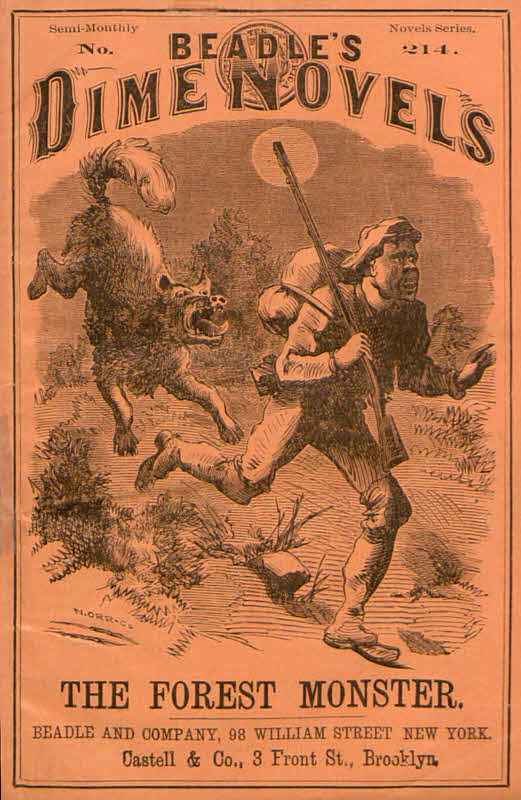
While the whites were gazing spell-bound, they suddenly discerned the cause. A huge body, ringed and spotted in that unmistakable manner, was plunging among them, uttering short, sharp barks, while in the space of half a minute not a Blackfoot remained! Every one had fled!
“It is Jerval! it is Jerval!” exclaimed Lamora, as she descried the creature. “He has not forgotten me! thank heaven!”
The brute seemed to hear her voice, and came lumbering down the cañon toward her.
“B’ars and bufflers!” growled Black Tom, looking uneasily about him, “I don’t fancy you any more than the other varmints.”
“He won’t harm you,” said Lamora; “he is my pet.”
“And mine, too, as the gals always remarked whin they sot eyes on me,” added Teddy. “I allers liked that critter, and now I love him. Come here, let me embrace yees.”
“Go on, Jerval!” called out Lamora, pointing down the cañon toward the other Blackfeet; “drive them away, too.”
But they had caught sight of the hideous creature, and they waited for no further driving, but went tearing down the cañon, with the speed of the wind.
“Now, out of hyar, afore they kin cotch us ag’in!” exclaimed Black Tom; “let’s git on the open prairie as quick as lightning.”
The horses were put to their full gallop, and a few seconds later stood upon the high, level ground, free from all threatened peril. The Indians had vanished with such precipitous haste that not one of them was in sight.
Our friends halted a few seconds, while Jerval came plunging up the cañon after them. When he had fairly reached them, and began frisking around Lamora in his awkward way, Hammond dismounted, and said, addressing the three trappers:
“Before we leave this part of the country forever, let me explain a mystery to you. You have, like hundreds of others, been terrified about this wonderful animal, and I myself have heard many of the marvelous stories told about him. Let me say, however, that he has never killed a man, and never can, for he has not the ability, at least, when he appears in this shape—”
“What!” interrupted Black Tom; “do yer mean to say that he never chawed up nobody?”
“Never,” laughed Hammond; “look here.”
Stooping down, he busied himself for a few moments about the legs and body of the animal, and then uncovered him, and there stood before the astounded gaze of the trio a large Newfoundland dog, that instantly testified its vitality by attempting to leap up to Lamora, to receive her caresses.
While the trappers continued gazing in silent amazement, Hammond continued:
“Some years ago, when the Meagan Indians located in this section, they discovered the presence of gold about them. Knowing this was liable to be found by the hunters that were constantly going back and forth through this section, they hit upon an ingenious expedient. Kipwan, the chief, had been given a young, intelligent Newfoundland dog by a trader, and, knowing the superstitions of the hunters and Indians, he got up this animal, which was made altogether different from any thing that had ever been heard of before. Making a number of hides of buffaloes and wolves into a cloak or coat that fitted the figure of the dog, he painted the outside in this fantastic manner, and then let him run. It was a serious matter for the dog at first, as he came near smothering to death, and could hardly carry his armor around with him; but Kipwan, who is as ingenious as a Yankee, improved on the model, and finally made it as easy upon the canine as an overcoat upon an ordinary man. It was made so that he could breathe easily; but the dried, tough hide was perfectly bullet-proof, except, perhaps, in front of the eyes. It made the dog awkward and lumbering in his movements, and perfectly powerless to do harm. Encased in this shield, he could not harm a rabbit. Jerval, as he was called, seemed to know by instinct what was required of him. He roamed around the country, generally through the night, returning to Kipwan in the morning, when his overcoat was removed, and he looked like himself until nightfall again. Occasionally, when necessary, he was sent out reconnoitering through the day, but not often. It was not long before every Indian and trapper who saw and did not know him, was cracking away at him; but, as none of the bullets could penetrate his skin, Jerval paid little attention to it. When it became known that he was bullet-proof, the exaggerated stories that you have heard began, and he infused such terror that he has long played the part of protector to the Meagans, and you saw a few minutes ago what he accomplished in putting the Blackfeet to flight, when he was perfectly powerless to injure a hair of their heads.”
The trappers gathered around and examined the “armor” more critically. It was most ingeniously constructed, and must have been excessively uncomfortable to the dog, when worn for any length of time. Indeed, it was observed, as a natural result, that most of the long, shaggy hair had fallen from his natural body.
When all were satisfied, Hammond carefully placed the armor upon the Newfoundland, securing it by thongs at the throat, belly and legs, and then, at a word from Lamora, he went lumbering off toward his home, where we take our farewell of him.
The homeward journey was begun, and, although no little danger was encountered, yet the States were reached in safety, with their golden treasure intact. Here, when the precious ore was disposed of, an amount was received which made the trappers comfortable for the rest of their days, and terminated the necessity of their continuing the dangerous calling that two of them had followed so many years. Teddy O’Doherty married a buxom young lass from Tipperary, and became a well-to-do farmer in Kansas, he and his former comrades living near together, and keeping their secret regarding the “Mystery of the Cañon,” long after they had good reason to know that, in the natural order of events, Jerval must have succumbed to old Father Time.
The brightest anticipations of Lamora were realized; for love made her habitation with her and Hammond, and it was ever a source of gratitude that a seeming misfortune had been the means of bringing them together in the singular manner which has been given to our readers; and so now, as then, “He doeth all things well.”
THE END.