
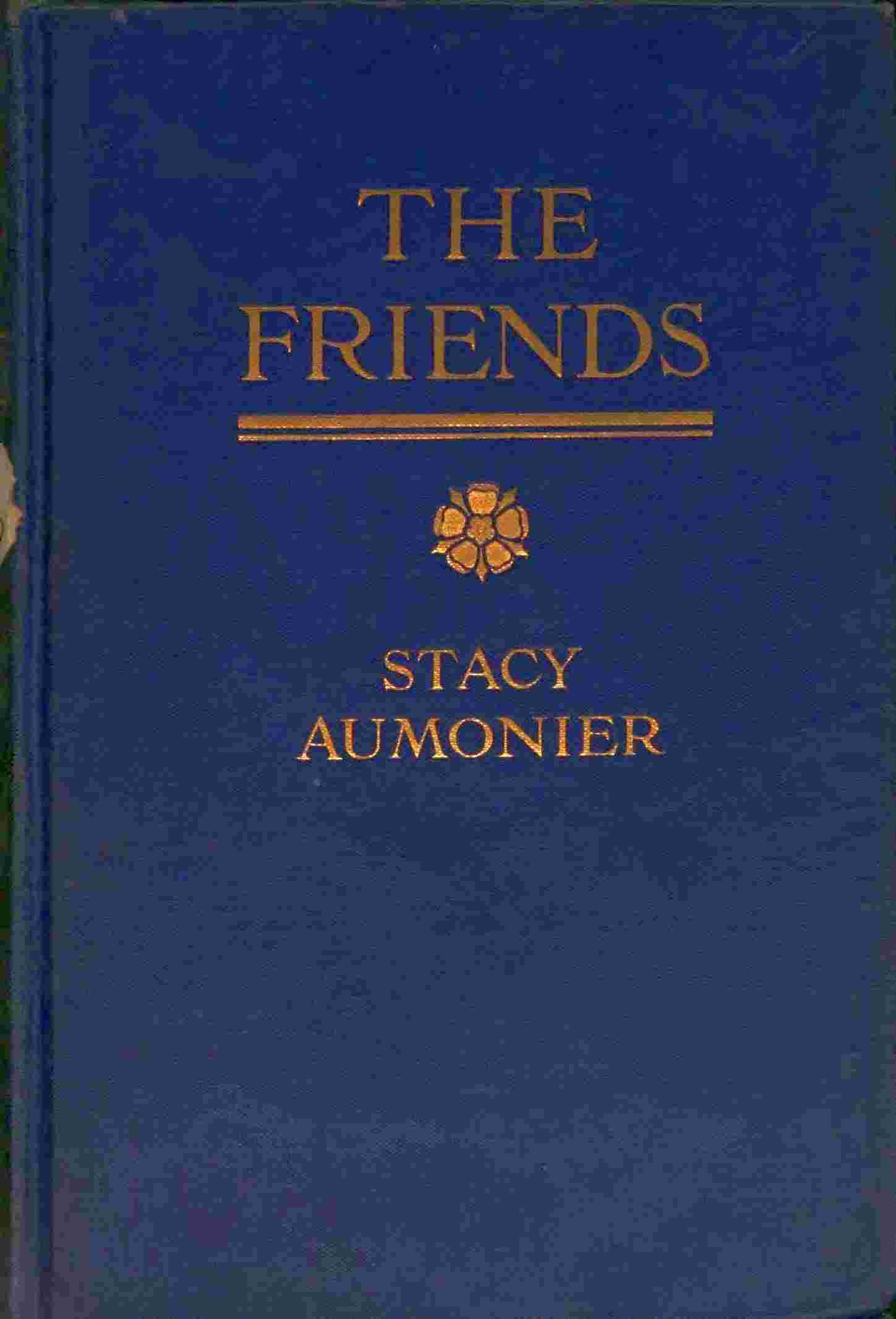
The Project Gutenberg eBook of The friends, and other stories
Title: The friends, and other stories
Author: Stacy Aumonier
Release date: January 8, 2026 [eBook #77648]
Language: English
Original publication: New York: The Century Co, 1915
Credits: The Online Distributed Proofreading Team at https://www.pgdp.net (This book was produced from images made available by the HathiTrust Digital Library.)
THE FRIENDS
THE FRIENDS
AND OTHER STORIES
BY
STACY AUMONIER
Author of “Olga Bardel,” etc.
the wicked, are much more naïve
and simple-hearted than we suppose.
And we ourselves are, too.”
Dostoevsky.
NEW YORK
THE CENTURY CO.
1917
Copyright, 1915, 1917, by
The Century Co.
Published August, 1917
CONTENTS
| PAGE | |
| The Friends | 3 |
| The Packet | 69 |
| “In the Way of Business” | 121 |
THE FRIENDS
AND OTHER STORIES
THE FRIENDS
White and Mapleson often tried to recall the occasion when their friendship began, but neither succeeded. Perhaps it had its origin in some moment when the memory was to some extent blurred. Certain it is that they drifted together across the miasma of commercial London and founded a deep and lasting friendship that found its chief expression in the clinking of glasses in the saloon and luncheon bars of various hostelries off Oxford Street and Bloomsbury.
White acted as an agent for a firm of wire-mattress manufacturers in Old Street in the city, and as his business was conducted principally among the furnishing and upholstering businesses in the West End, and as Mapleson was the manager of the brass bed department at Tauntons, the large Furnishing Emporium in Bloomsbury, it is not surprising that they came in contact and that they had so many interests in common. There is, alas, no doubt that the most absorbing interest of both was the consumption of liquid refreshment, and there is also, alas, no doubt that the friendship was quickened by the curious coincidence of their mental vision when stimulated by alcoholic fumes. And it is here that one or two curious facts relating to the personalities of the two men should be noted. During the day, it would be no uncommon thing for either man to consume anything between ten and fifteen whiskies and sodas, and sometimes even more, yet of neither man could it be said that he ever got really drunk. On the other hand, of neither man could it be said that he was ever really sober. White was of medium height, rather pale, and slight. He had a dark mustache and was always neatly dressed in a dark blue suit with well-fitting boots and gloves. He was extremely quiet and courteous in manner, and his manner varied but little. The effect of alcohol upon him was only to accentuate his courtesy and politeness. Toward the evening his lips would tremble a little, but he would become more and more ingratiating. His voice would descend to a refined gentle croon, his eyes would just glow with a sympathetic light, and he would listen with his head slightly on one side and an expression that conveyed the idea that the remarks of the speaker were a matter of great moment to him. Not that he did not speak himself; on the contrary, he spoke well, but always with a deferential timbre as though attuning himself to the mood and mental attitude of his companion.
On the other hand, Mapleson always started the day badly. He was a large, florid man with a puffy face and strangely colorless eyes. He wore a ponderous frock coat that was just a little out of date, with a waistcoat that hung in folds, and the folds never seemed free from sandwich crumbs and tobacco ash. He had an unfortunate habit with his clothes of never being quite complete. That is to say, if he had on a new top hat his boots were invariably shabby, or if his boots were a recent acquisition his top hat would seem all brushed the wrong way. As I say, he always started the day badly. He would be very late and peevish and would fuss about with pills and cloves. He would complain of not being quite “thumbs up.” Eleven fifteen would invariably find him round at “The Monitor,” leaning against the mahogany bar and asking Mrs. Wylde to mix him “a whisky and peppermint” or some other decoction that between them they considered would be just the thing for his special complaint that morning. “In the way of business,” he would treat and be treated by several other pals in “the sticks,” as this confraternity called the Furnishing Trade. It would be interesting to know what proportion of Mapleson’s and White’s income was devoted to this good cause. When Mapleson would arrive home, sometimes late at night, breathing heavily, and carrying with him the penetrating atmosphere of the taproom, he would say in response to the complaints of his tired wife, “I hate the stuff, my dear. You have to do it though. It’s all in the way of business.”
A sociologist might have discovered (if he were searching for concrete instances) that White and Mapleson spent on each other every year very nearly eighty pounds, although the business they did together amounted to rather less than thirty, an unsound premium surely!
As the day wore on Mapleson would improve. And it was one of the assets of the White-Mapleson friendship that they usually did not meet till lunch-time. Then the two friends would clink glasses and stroll arm-in-arm into Polati’s in Oxford Street, for, as Mapleson would say, “When a man works hard he needs feeding,” and White would agree with him deferentially, and then they would secure a seat not too near the band, and, after thoroughly considering the menu, they would order a “mixed grill” as being “something English and that you can get your teeth into.” During the interval of waiting for the mixed grill, which took fifteen minutes to prepare, Mapleson would insist on standing White a gin and bitters, and of course it was only right and courteous of White to return the compliment. The mixed grill would be washed down with a tankard of ale or more often with whisky and soda, after which the friends would sometimes share a Welsh rarebit or a savory; and it was Mapleson who introduced the plan of finishing the meal with a coffee and liqueur—“It stimulates one’s mind for the afternoon’s business,” he would explain—and White flattered him on his good sense and insisted on standing an extra liqueur, “Just to give value to one’s cigar.” Under the influence of these good things Mapleson would become garrulous, and White even more soothing and sympathetic. This luncheon interval invariably lasted two hours or two hours and a half. They would then part, each to his own business, while making an appointment to meet later in the afternoon at “The Duke of Gadsburg.”
And here a notable fact must be recorded. For an hour or two in the afternoon each man did do some work. And it is a remarkable point that “Tauntons,” the great house in Bloomsbury, always considered Mapleson a good salesman, as so indeed he was. The vast lapses of time that he spent away from business were explained away on the score of active canvassing. His turnover for the year compared favorably with that of the other managers at “Tauntons.” While of White, strange rumors of the enormous fortune that he was accumulating were always current. The natural reserve of the wire-mattress agent, and his remarkable lucidity on matters of finance, added to the fact that he took in and studied “The Statist,” gave him a unique position in the upholstering world. Men would whisper together over their glasses and say, “Ah, old White! he knows a thing or two!” and grave speculations would go on as to whether his income ran into four figures, and in what speculations he invested his money. Considerable profundity was given to these rumors by the fact that White always had money and that he was always willing to lend it. He carried a sovereign purse that seemed inexhaustible.
Mapleson, on the other hand, though natively lavish, had periods of “financial depression.” At these periods he would drink more and become maudlin and mawkish, and it was invariably White who helped him out of his troubles. The two friends would meet later in the afternoon “to take a cup of tea,” and it often happened that Mapleson felt that tea would not be just the thing for his nervous constitution, so White would prescribe a whisky and soda, and they would adjourn to a place where such things may be procured. It is remarkable how quickly the time passed under these conditions, but just before six Mapleson would “run back to the shop to see if any orders had come in.” With studious consideration, White would wait for him. It was generally half-past six or seven before Mapleson returned, thoroughly exhausted with his day’s work.
It was then that the suavity and charm of White’s manner was most ingratiating. He would insist on Mapleson having a comfortable seat by the fire in the saloon, and himself carrying across the drinks from the bar.
Mapleson soon became comforted and would suggest “a game of pills before going home.” Nothing appealed to White more than this. For White was a very remarkable billiard player. Young Charlie Maybird, who is a furniture draughtsman and an expert on sport, used to say that “White could give any pub. marker in London 40 in a 100 and beat him off the mark.” He had a curious, feline way of following the balls round the table; he seemed almost to purr over them, to nurse them and stroke them, and make them perform most astounding twists and turns. And each time he succeeded he would give a little sort of self-depreciatory croon, as much as to say, “I’m so sorry. I really don’t know how the balls happen to do all this.” And yet it is remarkable how often White lost, especially against Mapleson.
Mapleson was one of those players who gave one the impression of being an expert on an off day. As a matter of fact, he never had an “on” day. He was just a very third-rate player, only he would attempt most difficult shots and then give vent to expressions of the utmost surprise and disgust that they didn’t come off.
The billiards would last till eight o’clock or half past, when a feeling of physical exhaustion would prompt the arrangement that “a chop would be a good idea.” They would then adjourn once more to the dining-room at “The Monitor” and regale themselves with chops, cheese, and ale, by which time Mapleson would arrive at the conclusion that it wasn’t worth going home, so an adjournment would be made once more to the bar and the business of the evening would commence.
It might be worth while to recall one or two features of “The Monitor” bar, which was invariably crowded by salesmen and assistants from “Tauntons” and was looked upon as a sort of headquarters of the upholstering trade at that time. It was a large room, fitted in the usual way with glittering mahogany and small glass mirrors. Two long seats upholstered in green leather were set around a cheerful fireplace of blue tiles. There were also four small circular tables with marble tops, and on either side of the fireplace two enormous bright blue Doulton ware pots of hideous design containing palms. On the side facing the bar was a florid staircase with a brass handrail leading up to the dining-and billiard-rooms.
The only difference that a stranger might have felt between this and any other place of a similar description at that time lay perhaps in its mental atmosphere. There was always a curious feeling of freemasonry. In addition to Mrs. Wylde there were two other barmaids, Nancie and Olive, who was also sometimes called “The Titmouse.” They were both tall, rather thin girls, with a wealth of wonderful flaxen hair. They seemed to spend a considerable amount of time (when not engaged in serving) in brewing themselves cocoa and hot milk. Olive was a teetotaler and confessed frankly with regard to alcohol that she “hated the muck,” but Nancie would occasionally drink stout.
To be served by Mrs. Wylde was a treat that only occasionally occurred to the more favored devotees of “The Monitor.” She was a woman of enormous proportions with a white-powdered face, and also a wealth of flaxen hair. She invariably wore a rather shabby black dress trimmed with lace, and a huge bunch of fresh flowers, usually lilies and carnations.
Now everybody who came into the bar of “The Monitor” seemed not only to know Nancie and Olive and Mrs. Wylde by name, but everybody else by their name or nickname. For instance, this sort of thing would happen. A pale, thin, young man with pointed boots and a sort of semi-sporting suit would creep furtively in and go up to the bar and lean across and shake hands with Nancie and after a normal greeting would say, “Has the Captain been in?” and Nancie would reply, “Yes, he was in with the Rabbit about four o’clock,” and the young man would say, “Oh! didn’t he leave nothing for me?” and Nancie would say, “No. I wouldn’t be surprised if he came in later. ’Ere! I tell you what,” and she would draw the young man to a corner of the bar and there would be a whispered conversation for a few moments, and then the young man would go out.
All of which would seem very mysterious to a casual visitor.
Of this atmosphere White and Mapleson were part and parcel. They had their own particular little round table near the fire, where, in spite of Mapleson’s daily avowal to get home, one could rely on finding them nearly every evening. And they gathered around them quite a small colony of kindred spirits. Here they would sit very often till nearly twelve o’clock when “The Monitor” shut, talking and drinking whisky. As the evening advanced Mapleson expanded. One of his favorite themes was Conscription. On this subject he and White were absolutely in accord. “Every man ought to be made to serve his country,” Mapleson would say, bringing his fist down with a bang on the marble table. “He ought to be made to realize his civil responsibilities and what he owes to the Empire! Every man under thirty-five should serve three years” (Mapleson was forty-four). “It seems to me we’re becoming a nation of knock-kneed, sentimental women.”
And White would dilate upon what the Germans were doing and would give precise facts and figures of the strength of the German army, and the cost and probabilities of landing two army corps on the coast of Suffolk.
Another favorite theme was the action of “these silly women!” and Mapleson would set the bar in roars of laughter with a description of what he would do if he were Home Secretary.
Mapleson was very fond of talking about “his principles.” In conversation it seemed that his actions must be hedged in by these iron-bound conventions. In effect they were practically as follows.
Business comes first, always.
Never fail to keep a business appointment.
Never mix port and whisky.
Never give anything to a stranger that you might give to a pal.
He had other rules of life, but they were concerned exclusively with rules of diet and drinking and need not concern us here.
Thoroughly exhausted with the day’s business, Mapleson would leave the imperturbable White just before twelve o’clock, and not infrequently would find it necessary to take a cab to Baker Street to catch his last train to Willesden Green where he lived, and where he would arrive at night, having spent during the day a sum varying between twenty and thirty shillings, which was precisely the amount he allowed his wife every week to keep house for a family of five, and to include food, clothing, and washing.
White lived at Acton, and no one ever quite knew how he arrived there or by what means. But he never failed to report himself at nine o’clock the next morning at Old Street with all his notes, orders, and instructions neatly written out. It was remarkable how long “The Monitor” remained the headquarters of this fraternity, for, as one of them remarked, “the licensing business is very sensitive”; in the same way that a flock of crows will simultaneously and without any apparent reason fly from one hill to another, it will be a sort of fashion for a group of men to patronize a certain establishment and then suddenly to segregate elsewhere. It is true that there were one or two attempts at defection—Charlie Maybird once made an effort to establish a headquarters as far away as “The Trocadero” even, but the birds soon returned to the comforting hostelry of Mrs. Wylde.
And then one summer Mapleson was very ill. He got wet through walking to Baker Street one evening when, after having started, he found he had only three coppers on him. He traveled home in his wet clothes and next day developed a bad chill which turned into pneumonia. For days he lay in a critical state, but thanks to the attention of Mrs. Mapleson, who did not go to bed for three nights, and a careful doctor, he got over the crisis. But the doctor forbade him to go back to business for a fortnight and suggested that, if it were possible to arrange it, a few days at the seaside might set him up. White called several times, and was most anxious and solicitous, and assured Mrs. Mapleson that he would do anything in his power to help his friend, and sent a large basket of expensive fruits and some bottles of very old port wine.
Mapleson’s illness, however, was of more troublesome a nature than appeared at first. After a rather serious relapse, the doctor said that his heart was not quite what it should be, and it was nearly a month before the question of moving him could be considered. Tauntons treated Mapleson very well over this, and his salary was paid every week, only of course he lost his commissions, which in the ordinary way represented the bulk of his income, and it became necessary for Mrs. Mapleson to economize with the utmost skill, especially as the invalid required plenty of good and well-cooked food on regaining his strength. The rest of the family had therefore to go on shorter commons than usual, and matters were not helped by the fact of one of the children developing glands and being in an enfeebled condition. White called one evening and was drinking a glass of the old port with the invalid, and they were discussing how it could be arranged for Mapleson to get a week at Brighton. “I think I could travel now,” said Mapleson, “only I don’t see how the Missus is going to leave Flora.”
It was then that White had an inspiration. If it would help matters in the Mapleson family, he would be pleased to take a week off and go to Brighton with Mapleson. Mapleson hailed this idea with delight, and Mrs. Mapleson was informed on entering the room a little later, “You need not bother about it any more, my dear; White has been good enough to offer to go to Brighton with me.” Mrs. Mapleson was a woman who said very little, and it was difficult on this occasion to know what she thought. In fact her taciturnity at times irritated Mapleson beyond endurance. She merely paused, drew in her thin, pale lips, and murmured, “All right, dear,” and then busied herself with preparing Mapleson’s evening broth.
The friends were very lucky with the weather. Fresh breezes off the Channel tempered the fierce August sun and made the conditions on the front delightful. It might be hinted that perhaps the weather might have been otherwise for the interest that they took in it.
For after the first day or so, finding his vitality returning to him, Mapleson soon persuaded his companion that the choicest spot in Brighton was the saloon bar of “The Old Ship.” And he could not show his gratitude sufficiently. White was given carte blanche to order anything he liked. But White would not listen to such generosity. He knew that the expenses that Mapleson had had to endure must be telling on him, so he insisted on paying at least twice out of three times. Mapleson acknowledged that it was “a hell of a worry and responsibility having a family to keep. They simply eat up the money, my dear chap.”
The week passed quickly enough and soon both were back at their occupations in town. The friendship pursued the even tenor of its way, and it was fifteen months before any incident came to disturb it....
Then one day in October something happened to White. He fell down in the street and was taken to a hospital. It was rumored that he was dead. Consternation prevailed in the upholstering confraternity, and Mapleson made anxious enquiries at the hospital bureau.
It was difficult to gather precise details, but it was announced that White was very ill and that a very serious operation would have to be performed. Mapleson returned to the bar of “The Monitor,” harboring a nameless dread. A strange feeling of physical sickness crept over him. He sat in the corner of the bar sipping his whisky, enveloped in a lugubrious gloom. He heard the young sparks enter and laugh and joke about White. It was a subject of constant and cynical mirth. “Hullo,” they would say; “heard about old White? He’s done in at last!” and then there would be whisperings and chucklings, and he would hear, “Drunk himself to death,” “Doesn’t stand a dog’s chance, my dear chap; my uncle had the same thing. Why, he’s been at it now for about twenty-five years—can’t think how he’s lasted so long!” And then they would come grinning up to Mapleson, hoping for more precise details. “Sorry to hear about your friend, Mr. Mapleson; how did it happen?...”
Mapleson could not stand it. He pushed back his half-filled glass and stumbled out of the bar. He was not conscious of an affection for White, or any sentiment other than a vast fear and a strange absorbing depression. He crept into the saloon of a small house off the Charing Cross Road, where no one would be likely to know him, and sat silently sipping from his glass. It seemed to have no effect upon him. The vision of White lying there—like Death—and perhaps even now the doctors were busy with their little steel knives....
Mapleson shivered. He ordered more whisky and drank it neat. He stumbled on into other bars all the way to Trafalgar Square, drinking and wrestling with his fear. The spirits ultimately took their effect and he sat somewhere, in some dark corner, he could never remember where, with his mind in a state of trance. He remembered being turned out. It must have been twelve o’clock—and engaging a cab—he could just remember his address—and ordering the man to drive home. In the cab he went sound asleep, hopelessly drunk, the first time for many years. He knew nothing more till the next day. Some one must have come down to help carry him in—he was no light weight—perhaps the cabman had to be bribed, too. He woke up about one o’clock feeling very ill and scared. He jumped up and called out, “What the devil’s the time? What are we all doing? Why haven’t I been called?”
Mrs. Mapleson came in—she put her hand on his forehead and said, “It’s all right. I sent a telegram to say you were ill. You had better stop here. I’ll get you some tea.” Mapleson fell back on the pillows, and the sickening recollection of last night came back to him.
Later in the evening Mrs. Mapleson came in again and said, “I hear that Mr. White has had his operation and is going on as well as could be expected.” Beads of perspiration streamed down Mapleson’s face and he murmured, “My God! my God!” That was all that was said, and the next day Mapleson went back to work.
The officials at the hospital seemed curiously reticent about White. The only information to be gleaned for some days was that he was alive. Mapleson went about his work with nerveless indifference. He drank, but his drinking was more automatic than spontaneous. He drank from habit, but he gained neither pleasure nor profit from doing so.
The nameless fear pursued him. Great bags appeared under his eyes which were partly blood-shot. He stooped in his walk, and began to make mistakes in his accounts, and to be abstracted in dealing with customers.
He was arraigned before two of the directors of Tauntons, and one of them finished a harangue by suggesting that “it might be more conformable to business methods if he would remove the traces of yesterday’s breakfast from the folds of his waistcoat.” The large man received these criticisms in apathetic silence. “Poor old Mapleson!” they said round in the bar of “The Monitor.” “I’ve never seen a chap cut up so about anything as he is about White,” and then abstract discussions on friendship would follow and remarkable instances of friendships formed in business.
Of course White would die—that was a settled and arranged thing, and curiously enough little sympathy was expressed, even by those to whom White had lent money. In spite of his charm of manner and his generosity, they all felt that there was something about White they didn’t understand. He was too clever, too secretive.
On Friday he was slightly better, but on Saturday he had a relapse, and on Sunday morning when Mapleson called at the hospital he was informed that White was sinking, and they didn’t expect him to last forty-eight hours.
Mapleson had inured himself to this thought; he had made up his mind to this conclusion from the first, and this last intimation hardly affected him. He went about like one stunned, without volition, without interest. He was only conscious of a vast unhappiness and misery, of which White was in some way a factor.
For five days the wire mattress agent lay on the verge of death, and then he began to rally slightly. The house surgeon said it was one of the most remarkable constitutions he had ever come up against. For three days there was a distinct improvement, followed by another relapse. But still White fought on. At the end of another week he was out of danger. But the convalescence was long and tedious.
When at the end of six weeks he was well enough to leave the hospital, the house-surgeon took him on one side and said, “Now, look here, my friend; we’re going to let you out. And there’s no reason why you shouldn’t get fairly well again. Only I want you quite to understand this: If you touch alcohol again in any form—in any case for years—well, you might as well put a bullet through your own head.” In another ten days White was back at business, looking exactly the same as ever, speaking in the same suave voice. He soon appeared in “The Monitor,” but with the utmost courtesy declined all offers of drinks except ginger ale. It need hardly be said that to Mapleson such an event seemed a miracle. He had sunk into a low morbid condition from which he had never hoped to rise.
Out of courtesy the first evening Mapleson insisted on drinking ginger ale himself so that his friend should not feel out of it.
And they sat and had a long discussion into the night; White giving luminous and precise details of the whole of his illness and operation, eulogizing hospital methods and discussing the whole aspect of society toward therapeutics in a calmly detached way.
But Mapleson was not happy. He was glad to have White back, but the element of fear that White had introduced him to was not eliminated. He felt ill himself, and there somehow seemed a great gap between White in the old days and White drinking ginger ale and talking medicine! For three nights Mapleson kept this up and then thought he would have “just a nightcap.”
It gradually developed into the position that Mapleson resumed his whisky and White stuck to his ginger ale. And it is a curious fact that this arrangement depressed Mapleson more than it did White. He drank copiously and more frequently to try and create an atmosphere of his own, but always there was White looking just the same, talking just the same.
The ginger ale got on Mapleson’s nerves. He felt that he couldn’t stand it, and a strange and enervating depression began to creep over him again. For days this arrangement held good, White seeming utterly indifferent as to what he drank, and Mapleson getting more and more depressed because White didn’t drink whisky. At length Mapleson suggested one evening that “surely just one” wouldn’t hurt White. But White said with the deepest tone of regret that he was afraid it would be rather unwise, and, as a matter of fact, he had got so used to doing without it that he really hardly missed it.
From that moment a settled gloom and depression took hold of Mapleson. He just stood there looking at White and listening to him, but hardly troubling to speak himself. He felt utterly wretched. He got into such a state that White began to show a sympathetic alarm, and one evening toward the end of February as they were sitting at their favorite table in “The Monitor” White said, “Well, I’ll just have a whisky and soda with you if you like.”
That was one of the happiest evenings of Mapleson’s life. Directly his friend began to drink some chord in his own nature responded, his eyes glowed, he became garrulous and entertaining.
They had another and then went to the Oxford Music Hall into the lounge, but there was such a crowd that they could not see the stage so they went to the bar at the back, and had another drink and a talk. How they talked that night! They talked about business, and about dogs, and conscription, and women, and the Empire, and tobacco, and the staff of Tauntons. They had a wild orgy of talk and drink. That night White drank eleven whiskies and sodas, and Mapleson got cheerfully and gloriously drunk.
It was perhaps as well that the friends enjoyed this bacchanale for it was the last time they met. By four o’clock the next afternoon White was dead....
Mapleson heard of it the following night. He was leaning against the fireplace in “The Monitor,” expatiating upon the wonderful improvement in White and extolling his virtues, when young Howard Aldridge, the junior salesman to Mr. Vincent Pelt, of Tauntons, came in to say that White’s brother-in-law had just rung up Mr. Pelt to say that White was dead. When Mapleson heard this he muttered, “My Christ!”
These were the last words that Mapleson ever uttered in the bar of “The Monitor.”
He picked up his hat and went out into the street. It was the same feeling of numbed terror and physical sickness that assailed him. With no plan of action arranged, he surprised his wife by arriving home before ten o’clock, and by going to bed. He was shivering. She took him up a hot-water bottle and she said, “I’m sorry to hear about White.” Mapleson didn’t answer, but his teeth chattered. He lay awake half the night thinking of Death....
The next day he got up and went to business as usual. But for the second time the head of the firm felt it his duty to point out one or two cases of negligence to Mapleson and to warn him that “these things must not happen in the future.”
Two days later Mapleson received a postcard signed by “F. Peabody” to say that the funeral of the late G. L. White would take place at such and such a church at East Acton and would leave the “Elms” Castlereach Road, Acton, at 12 o’clock, and it was intimated that a seat for Mr. Mapleson would be found in a carriage.
A fine driving rain out of a leaden sky greeted Mapleson when he set out for White’s funeral on the Saturday. His wife tried to persuade him not to go, for he was really ill. But he made no comment. He fiddled about with a Cassell’s time-table and could come to no satisfactory decision about the way to get there. His wife ultimately looked him up a train to Hammersmith from which terminus he could get a train. Before reaching Hammersmith a strange revulsion came over him. Why, after all, should he go to this funeral! White wouldn’t know about it, and what did he know of White’s relations? A strange choking and giddiness came over him, and at Hammersmith he found a comfortable refreshment room, where he partook himself, and decided that after refreshing he would go on to business.
After having two whiskies, however, he changed his mind. “No,” he muttered to himself, “I’ll see it through.” He boarded a tram that went in the direction of Acton. He found that he had to change trams at one point. It seemed an interminable journey. He kept wondering how White managed to get home at night from Oxford Street at 12 o’clock. He felt cold and wretched. The effect of the whisky wore off.
At last he reached Acton and asked for Castlereach Road. Nobody seemed to know it. He was directed first in one direction and then in another; at last a postman put him on the right track, but suggested that as it was some way he might get a ’bus to Gaddes Green and then it was only about fifteen minutes’ walk.
Mapleson set off, keeping a sharp lookout for a place of refreshment, for the reactionary spirit was once more upon him. The ’bus put him down at a forlorn looking corner where there was only a sort of workman’s alehouse. “I expect I’ll pass one on the way,” he thought, and taking his directions from the assistant of a greengrocer’s shop he set out once more through the rain.
The farther he went the meaner and more sordid did the streets become. He did not pass a single public house that he felt he could approach. “I expect the neighborhood will change soon,” he thought. “I expect I’ve come the wrong way. Why, every one said White must be making at least eight hundred a year! He wouldn’t live in a place like this.”
At length he came to a break in the neighborhood where some newly built villas crowded each other on the heels of the more ancient squalor. An errand boy told him that “Castlereach Road was the second turning on the right off Goldsmith’s havenue.” He found Goldsmith’s Avenue where a barrel organ was vomiting lugubrious music to an audience listening from the shelter of their windows, and swarms of dirty children were hurrying through the rain on nameless errands. A slice of bread and jam was thrown from a second story window to a little boy in the street and missed Mapleson’s hat by inches. His progress was in any case the source of considerable mirth to the inhabitants.
At last he came to Castlereach Road. After the noise and bustle of Goldsmith’s Avenue it seemed like the end of the world. It was a long straight road of buff-colored villas with stucco facings and slate roofs, all identically the same. From the end where Mapleson entered it, it looked interminably and utterly deserted. Doubtless if it had been a fine day the gutters would have been crowded with children, but with the pouring rain there was not a soul in sight.
Mapleson blundered on in search of number 227, and as he did so a thought occurred to him that he and White had a common secret apart. He always had felt in his inmost heart a little ashamed of his red-brick villa in Willesden Green, and that was one reason why he had always kept business well apart from domestic affairs, and White had casually referred to “his place at Acton.” His place at Acton! Mapleson entered it, horribly tired, horribly sober, horribly wretched. All the blinds were down. It had taken so long to get there he half hoped that he was too late.
A tall, gaunt woman in black with a slight down on her upper lip opened the door. She seemed surprised to see him.
He explained who he was.
She said, “Oh, yes. My! you are early. It’s only half-past twelve!”
“Half-past twelve!” said Mapleson, “but I thought the funeral was to be at twelve.”
Then the gaunt woman called into a little side room, “’Ere, Uncle Frank, what ’ave you been up to? Did you tell Mr. Maple that the funeral was at twelve?”
“Oh, don’t sye that! don’t sye that!” came a voice from the room, and a small man with sandy hair and wizened features and small, dark, greedy eyes came out into the hall. “Oh, don’t sye that, Mr. Mapleson; I’m Peabody. I quite thought I said two o’clock!”
Mapleson had a wild impulse to whistle for a cab or a fire-engine and to drive away from this, anywhere. But the utter helplessness of his position held him fast. Before he had time to give the matter serious thought he was being shown into the drawing-room, a small stuffy room with a blue floral wall paper and bamboo furniture, and many framed photographs, and the gaunt woman was saying, “Oh, Uncle Frank, how could you have made that mistyke!” And Uncle Frank was explaining how it might have occurred and at the same time saying that they must make the best of it, that Mr. Mapleson would have a bit of lunch, “there was a nice cut of cold leg of mutton and of course no one under circumstances like this would expect an elaborate meal; in fact no one would feel like it apart from anything else.” And then the gaunt woman left the room, and Mapleson was alone with Uncle Frank.
Mapleson could not recollect ever having met any one whom he so cordially hated at sight. He had a sort of smug perpetual grin, a habit of running his hands down his thighs as far as his knees, and giving vent to a curious clicking noise with his cheeks. “Well, this is a very sad hoccasion, Mr. Mapleson,” he said; “very sad indeed. Poor George, did you know him well? Eva, his wife, you know, she’s upstairs quite prostrate; that was her sister who showed you in. Yes, yes, well, how true it is that in the Midst of Life we are in Death! I’m afraid poor George was careless, you know. Very careless! Clever, mind you, clever as they make ’em, but careless. Do you know, Mr. Mapleson, he hadn’t even insured his life! And he’s left no will! There isn’t enough to pay his funeral expenses! Fortunately Eva’s clever, oh, yes, she’s clever with her fingers; they say there’s no one in the neighborhood can touch her in the millinery. Oh, yes, she’s been at it some time! Why, bless my soul, do you know she’s paid the rent of this ’ouse for the last four years. Oh, she’s a clever woman! Poor soul though, her great consolation is that George didn’t die in the ’orspital. Yes, Mr. Mapleson, he died upstairs quiet as a lamb. She was there at the end—it was a great consolation!”
And Uncle Frank nodded his head and his little eyes sparkled, but the grin never left his lips. Mapleson said nothing, but the two men sat there in a somber silence, Uncle Frank occasionally nodding his head and muttering, “it’s a sad hoccasion.”
The rain increased and it seemed unnaturally dark in the blue drawing-room, and Mapleson felt that he had sat there an eternity, consumed by desire to get away, when there was another knock at the door, and a youth was let in.
Uncle Frank called him “Chris,” and he seemed to be a cousin or some near relation of White’s. He was a raw youth who had just gone to business and was very conscious of his collars and cuffs. He seemed to take to Mapleson and he sat watching him furtively. Mapleson seemed so very much man of the world, so very desirable a personality. He made many advances to draw the large man out, but the latter felt a repugnance for him in only a slight less degree than in the case of Uncle Frank.
At length the gaunt sister asked them all into the dining-room, which was a room on the other side of the passage that seemed even smaller and stuffier than the drawing-room. It was papered with a dark red paper and the woodwork painted chocolate. As they crossed the hall they passed Mrs. White, who had apparently been persuaded by her sister “to try and take something.” She was a little shriveled person with white cheeks and her eyes were red with weeping.
She hurried by the men without speaking, and a curious thought struck Mapleson. During the twenty years or so that he had known White, he could not recollect him speaking of his wife. He probably had done so, but he could not recollect it. He remembered him talking about “his place at Acton” but never of his wife. He did not feel entirely surprised. White was probably ashamed.
In the window of the dining-room were several bird-cages containing two canaries, a bull-finch, and a small, highly colored bird, that hopped from the floor of its cage on to a perch and kept up a toneless squeak, with monotonous regularity. Uncle Frank went up to the cage and tapped the wires and called out, “Ah, there he is! cheep! cheep! This is our little Orstrylian bird, Mr. Mapleson! Isn’t he! Yes, yes, he’s our clever little Orstrylian bird!” and during the course of the hurried meal of cold mutton and cheese, the birds formed a constant diversion. Uncle Frank would continually jump up and call out, “Oh, yes, he’s our little Orstrylian bird!”
Mapleson tried to recall whether he had ever discussed birds with White, and he felt convinced that he had not. And yet it seemed a strange thing, White apparently had had these birds for some time, three different varieties in his own house! Mapleson would have enjoyed talking about birds with White; he could almost hear White’s voice, and his precise and suave manner of discussing their ways and peculiarities. And the terrible thought came to him that he would never hear White talk about birds, never, never.
This breach of confidence on White’s part of never telling him that he kept birds upset Mapleson even more than his breach of confidence in not talking about his wife.
“Oh, yes, he’s a clever little Orstrylian bird!” A terrible desire came to Mapleson to throw Uncle Frank through the window the next time he heard this remark.
Before they had finished the meal three other male relations appeared, and a craving came over Mapleson for a drink. Then the sister came down with a decanter of sherry and said that perhaps the gentlemen would like some. Uncle Frank poured out a glass all round. It was thin sickly stuff and to the brass bed manager like a thimbleful of dew in a parched desert. A horrible feeling of repugnance came over him; of repugnance against all these people, against the discomfort he found himself in.
After all, who was White? When all was said and done White was really nothing to him, only a man he’d met in the course of business and had a lot of drinks and talked with. At that moment he felt he disliked White and all his sniveling relations.
He wanted to go, to get away from it all, but he couldn’t see how. There was half a glass of sherry left in the decanter. He unblushingly took it as the funeral cortège arrived. There were two ramshackle carriages and a hearse and a crowd of dirty children had collected. He tried to mumble some excuse for not going, to Uncle Frank, but his words were lost by an intensely painful scene that took place in the hall as the coffin was being brought down. He did not notice that the sister with the down on her upper lip became an inspired creature for a few moments, and her face became almost beautiful....
He felt that he was an alien element among all these people, that they were nothing to him, and that he was nothing to them, and he felt an intense, insatiable desire for a drink. If he couldn’t get a drink he felt he would go mad.
Some one touched him on the arm and said, “Will you come with us in the second carriage, Mr. Mapleson?” He felt himself walking out of the house and through a row of dirty children. For a moment he contemplated bolting up the street and out of sight, but the feeling that the children would probably follow him and jeer paralyzed this action, and then he was in the carriage, with Chris and another male relation who was patently moved by the solemnity of the occasion.
Chris wriggled about and tried to engage him in banal conversation with an air that suggested, “Of course, Mr. Mapleson, this is a sad affair, but we men of the world know how to behave.”
The dismal cortège proceeded at an ambling trot, occasionally stopping. Chris gave up for the moment trying to be entertaining, and the forlorn relation talked about funeral services and the comfort of sympathy in time of bereavement. They crawled past rows of congested villas and miles of indescribable domesticity of every kind, till as they were turning round a rather broader avenue than usual where there were shops, the forlorn relation said, “We shall be in the cemetery in five minutes.”
And then Mapleson had an inspiration. They were ambling along this dreary thoroughfare, when his eye suddenly caught a large and resplendent public house. It was picked out in two shades of green and displayed a gilt signboard denoting, “The Men of Kent.”
Almost without thinking and certainly in less time than it takes to chronicle, Mapleson muttered something to his two companions and called out of the window to the driver to stop. He jumped out and called out to the driver of the hearse and the other carriage to stop, and then, before any one realized what it was all about, he darted into the saloon bar of “The Men of Kent.”
The bar was fortunately empty, but through the little glass shutters two women and a man in the private bar watched the performance.
There was a moment of dazed surprise followed by a high shriek of laughter and a woman’s voice in strident crescendo, “Oh, Gawd! He’s stopped the funeral to come in an’ ’ave a drink! Oh, my Gawd!” Mapleson’s tongue seemed to cling to the roof of his mouth but he gasped out an order for a whisky and soda. To the barman these incidents were nothing and he served the drink instantly, but to the three in the private bar it was a matter of intense enjoyment. The other woman took it up. “Well, I’m damned! That’s the first time I’ve known that ’appen—Gawd! fancy stoppin’ a funeral to come and ’ave a drink!” and then the other woman, “Lap it up, Charlie! won’t you let me ’ave a drop, old bird?” and the man bawled out, “’Ere, I sye, ain’t the others comin’ in! Let’s make a dye of it!”
The women continued shrieking with laughter, and the appalling ignominy of his position came home to him. He knew that he was damned in the eyes of White’s friends.
Curiously enough the thought of White had passed out of his mind altogether. He was a thing in revolt against Society, without feelings, and without principles.
Yet when the whisky was put in front of him, his hand trembled and he could not drink it. He fumbled with the glass, threw down sixpence and darted out of the bar again.
In the meanwhile, Uncle Frank and other members of the funeral party had got out of the carriages and were having a whispered consultation on the curb. Instructions had evidently been given for the cortège to proceed, for Uncle Frank was talking to the driver of the hearse when Mapleson appeared.
As they all got back into the carriages, the three people came out of the bar and raised a cheer, and one of the women called out, “Oh, don’t go, dearie! come back and fondle me!” and the other two started a song and dance on the pavement. Mapleson lay all of a heap in the corner of the carriage and he noticed that he was alone with Chris. The forlorn relation had gone into the other carriage.
In a few minutes they arrived at a church, a large new building with early Victorian Gothic arches and a profusion of colored glass. The funeral party huddled together in the gloom of the large church, and somehow the paucity of their numbers seemed even more depressing than the wretchedness of their appearance.
Mapleson sat a little way back, and curiously enough his mind kept reverting during the service to the little birds. He felt a distinct grievance against White on account of the little birds. Why hadn’t White told him? especially about the small Australian bird? It would have made a distinctly interesting subject of conversation.
The service seemed interminably long, and it was a relief when the tall, rather good-looking young clergyman led the way out into the cemetery. The rain was still driving in penetrating gusts, and as they stood by the graveside the relations looked askance at each other, uncertain whether it was the proper thing to do to hold up an umbrella. As to Mapleson, he was indifferent. For one thing he had not brought an umbrella. But it seemed frightfully cold.
They lowered the coffin into the grave and earth was sprinkled. For a second it flashed through his mind, “That’s White being let down,” and then a feeling of indifference and repugnance followed, and the craving desire to get away from all these sordid happenings. Then he suddenly thought of White’s wife. “A miserable looking slattern, she was!” he thought. “Why, what was she sniveling about? What could she have been to White, or White to her? Why, he never mentioned her during twenty years!”
He experienced a slight feeling of relief when the service finished and the party broke up, and he hastily made for the cemetery gates, knowing that White’s friends would be as anxious to avoid him as he was to avoid them, but he had not reached them before some one came hurrying behind and caught him up.
It was the young man named Chris. “I expect you ’re going up west, Mr. Mapleson,” he said. “If it’s not putting myself in the way, I’ll come too.” Mapleson gave an inarticulate grunt that conveyed nothing at all, but the young man was not to be put off.
There was something about the bulk of Mapleson and the pendulous lines of his clothes and person that made Chris feel when he was walking with him that he was “knocking about town” and “mixing with the world.” He was himself apprenticed to a firm of wall-paper manufacturers, and he felt that Mapleson would be able to enlighten him on the prospects and the outlook of the furnishing and decorating trade. He talked gaily of antique furniture till they came to a gaunt yellow brick station.
On enquiry there seemed to be no trains that went from it to any recognizable or habitable spot, but outside were two melancholy hackney carriages. By this time Mapleson was desperate and a strange feeling of giddiness possessed him.
He got in and told the driver vaguely “to drive up to London.” Chris came to the rescue and explained to him that he might drive to Shepherd’s Bush first. They started off and rattled once more through the wilderness of dreary villas.
The young man accepted the position he found himself in with perfect composure. He attributed Mapleson’s silence to an expansive boredom, and he talked with discretion and with a sort of callous tact. Before they reached Shepherd’s Bush, however, Mapleson muttered something about feeling faint, and Chris immediately suggested that they should go and have a drink. “You might bring me something in,” said Mapleson. “I’ll have a brandy neat.” They drove helplessly through neat avenues and roads for nearly ten minutes without passing anything in the way of a public house. At last they came to a grocer’s shop, licensed to sell spirits not to be consumed on the premises. “Go and buy me a bottle of brandy,” said Mapleson. The young man got out and soon returned with a six-and-sixpenny bottle of Hennessy’s three star brandy and a corkscrew. He paid for it himself, relying on the natural honor of Mapleson to settle up afterwards, but the matter was never mentioned again.
He drew the cork, and Mapleson took a long swig and then wiped the mouth of the bottle and offered it to Chris. Chris behaved like a man and also took a draft but spluttered rather.
For the rest of the journey Mapleson at regular intervals took thoughtful and meditative swigs and gradually began to revive. He went so far as to ask Chris if he knew anything about the little birds and how long White had had them. Chris said he knew he had had the canaries for four or five years and the bull-finch for two years. He didn’t know much about the little Australian bird. This information seemed to cause Mapleson to revert to his former gloom.
When they reached Shepherd’s Bush the cabman refused to go farther. So they got out and got into another cab, Mapleson carrying the brandy bottle under his arm. He took it upon himself to tell the cabman—this time a taxi—“to drive round the Outer Circle of Hyde Park and to take the damned hood down.”
It was about half-past four when they reached Hyde Park and the rain had ceased a little. It was the fashionable hour for the afternoon drive. Magnificent motors and two-horse phaëtons were ambling round well within the regulation limit. Their cab was soon almost hemmed in by the equipages of the great world. But after they had completed the circle once, and Mapleson lay back with his feet on the opposite seat, and his hat all brushed the wrong way, and without the slightest compunction held the large brandy bottle to his lips every few yards, Chris began to feel that there was a limit to his desire to “mix with the world.”
He got the cab to stop near the Marble Arch, and explained to Mapleson that he must get out and take the tube to business.
And then there was a scene. Mapleson, who up to that time had not addressed a personal word to Chris, suddenly became maudlin. He cried, and said that he had never taken to any one as he had to Chris; he was the dearest fellow in the world; he mustn’t leave him; now that White was dead he was the only friend he had.
But people began to collect on the sidewalk and Chris simply ran off. The taxi-driver began to be suspicious about his fare which was registered fourteen shillings. But Mapleson gave him a sovereign on account and told him to drive to Cleopatra’s Needle on the Embankment.
By the time they reached there the brandy bottle was three quarters empty and tears were streaming down his cheeks. He offered the driver a drink, but the driver was not “one of that sort” and gruffly suggested that Mapleson “had better drive ’ome.” So he got out of the cab pathetically and settled with the driver and sat on a seat of the Embankment, hugging his bottle and staring at the river.
Now it is very difficult to know exactly what Mapleson did the rest of that afternoon between the time when he dismissed the cabman and half-past eight when he turned up in the bar of “The Monitor.”
It is only known that he struggled in there at that time, looking as white as a sheet. He was wet through, and his clothes were covered with mud. He struggled across to the corner where he and White used to sit, and sat down. The bar was fairly crowded at the time, and young Chris made his début there. He felt that he would be a person of interest. When Mapleson appeared he went up to him, but Mapleson didn’t know him, and said nothing.
Several others came up and advised Mapleson to go home and change his clothes and have a drink first, but he just stared stupidly ahead and made no comment. Some one brought some whisky and put it before him, but he ignored it. They then came to the conclusion that he was ill, so they sent for a cab and two of them volunteered to see him home.
Just as they were about to lead him out, he stood up. He then stretched out his arms and waved them away. He picked up the glass of whisky and raised it slowly to his lips. But before it reached them he dropped it and fell backwards across the table.
“Women, you know,” said Charlie Maybird the other day, addressing two friends in “The Monitor,” “are silly creatures. They think love and friendship is all a question of kissin’ and cuddlin’. They think business is all buyin’ and sellin’; they don’t think men can make friendships in business. Crikey! I reckon there’s more friendships made in business—real friendships, I mean—than ever there is outside. Look at the case of White and Mapleson! I tell you those two men loved each other! For over twenty years they were inseparable; there was nothing they would not have done for each other; hand and glove they was over everything. I’ve never seen a chap crumple up so as Mapleson did when White died; in fact, from the very day when White was took ill. He went about like a wraithe. I’ll never forget that night when he came in here after the funeral. He sat over there, look, by the fireplace. He looked as though his ’eart was broken! Suddenly he stood up and lifted his glass and then dropped it and then fell backwards crash on to the floor! They carried him and took him to the ’orspital, but he never regained consciousness. The doctors said it was fatty degeneration of the ’eart, ’elped on by some kidney trouble. But I know better! He died of a broken ’eart. Lord, yes; I tell you there’s a lot of romance in the furnishing trade!”
“Did he leave any money?” asked one of the friends.
“My word, yes! More than White,” answered the genial Charles. “White never left a bean, and it seems his missus had not only been paying the rent out of her millinery but allowed White some. White was a card, he was!”
“And what did Mapleson leave?”
“Mapleson left nearly four pounds!”
“’S truth! is that all?”
“Four pounds and a wife and five kids, the eldest twelve!”
“A wife and five kids! How the hell does she manage to keep things going?”
“Oh, Gawd knows! Come on, let’s go over to the Oxford and see what’s on!”