
The Project Gutenberg eBook of The General Historie of Virginia, New England & the Summer Isles (Vol. I)
Title: The General Historie of Virginia, New England & the Summer Isles (Vol. I)
Author: John Smith
Release date: January 9, 2018 [eBook #56347]
Language: English
Credits: Produced by Roger Burch with scans from the Internet Archives
{Transcriber's Note: British, archaic and inconsistent spellings have been left as in the original, as have capitalizations. A few obvious typographical errors have been changed. Margin notes, except when they refer to either the whole paragraph or the beginning of the paragraph, are indicated where they occur in the text with {MN} and inserted in full at the beginning of the paragraph to which they refer. Material in square or round brackets are as in the original; transcriber's notes are in curly brackets. Several maps and illustrations are mentioned in the text, but none appear in the original book, nor does the index. Pagination of the 1624 edition, which this edition places in the margins, have been left interlinear to more nearly indicate their original placement.}
The Travels of
Captaine John Smith
In Two Volumes
Volume I
GLASGOW
PRINTED AT THE UNIVERSITY PRESS BY ROBERT MACLEHOSE & COMPANY LTD. FOR JAMES MACLEHOSE AND SONS, PUBLISHERS TO THE UNIVERSITY OF GLASGOW
| MACMILLAN AND CO. LTD. | LONDON |
| THE MACMILLAN CO. | NEW YORK |
| THE MACMILLAN CO. OF CANADA | TORONTO |
| SIMPKIN, HAMILTON AND CO. | LONDON |
| MACMILLAN AND BOWES | CAMBRIDGE |
| DOUGLAS AND FOULIS | EDINBURGH |
MCMVII
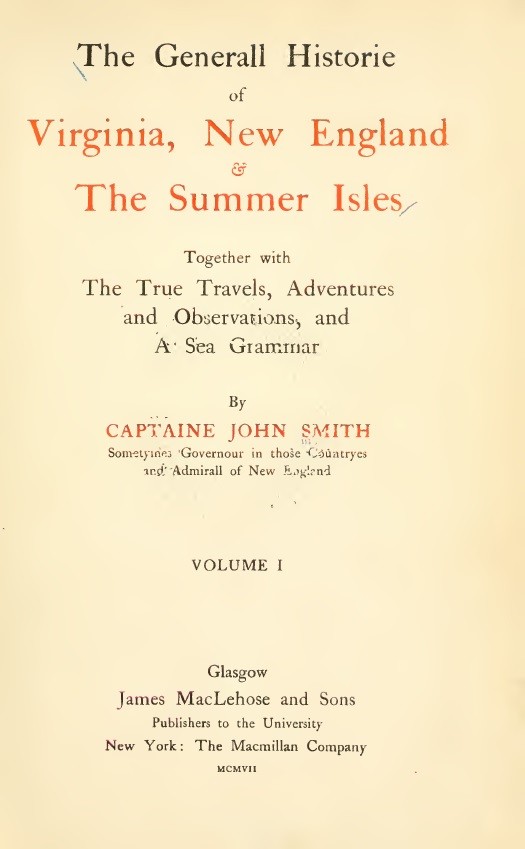
The Generall Historie
of
Virginia, New England
&
The Summer Isles
Together with
The True Travels, Adventures
and Observations, and
A Sea Grammar
By
CAPTAINE JOHN SMITH
Sometimes Governour in those Countryes
VOLUME I
Glasgow
James MacLehose and Sons
Publishers to the University
New York: The Macmillan Company
MCMVII
THE TABLE
| Page | |
| Publishers' Note, | xvii |
| The Epistle Dedicatorie to the Duchesse of Richmond and Lenox, | xxii |
| A Preface of foure Poynts, | xxv |
| Panegyrick Verses, | xxvii |
The Contents of the generall History, divided into six Books:
THE FIRST BOOKE.
| A.D. 1170 1488 1492 | The first voyage to the new World, by Madock Prince of Wales. The next by Hanno Prince of Carthage, and how it was offred K. Hen.7. by Chr. Cullumbus, that undertooke it for the Spanyards. 1492. | 1 |
1497 1576 1583 1584 | How John Cabot was imployed by King Hen. the 7. and found the Continent before Cullumbus. Also Sir Martin Frobisher, and Sir Humphrey Gilbert ranged towards the North. And how Captaine Amidas was sent to discover the coast of Florida by Sir Walter Raleigh and his associates. And the Country Wingandacoa was called Virginia by Queene Elizabeth. | 2 |
1585 | Sir Richard Greenvill sent thither with 108. he left for a plantation. The discovery of the Rivers Chawonok and Moratoc. The trechery of their King, who with eight more were slaine, and they all returned to England againe the same yeare with Sir Francis Drake. | 10 |
The Observations of Master Heriot. Of their commodities, victuall, fruits, beasts, fishes, and foules. Their Religion, and beliefe of God, of the Creation of the world, and man; the immortalitie of the soule; the subtiltie of their Priests; the peoples simplicitie, and desire of salvation; and other Accidents. | 19 | |
1586 | Sir Rich. Greenvill sent to supply them. Not finding them, left fiftie. Their successe. | 26 |
1587 | Master White sent to relieve them, found they were all slaine, yet left 115. more, and departed. | 26 |
1589 | Returning the second time, he could not heare of them; his Observations and Accidents. | 30 |
1602 | A discovery by Captaine Gosnoll of Elizabeths Isles; his Observations, Relations, and returne. | 33 |
The voyage of Captaine Pring to the same Coast. | 37 | |
1603 | The discovery of Captaine Waymouth; his Observations, Relations, and returne. | 38 |
1605 | A Map of the old Virginia, with the figures of the Salvages. | 40 |
THE SECOND BOOKE.
Of Virginia now planted, discovered by Captaine Smith.
| 1606 | The Latitude, Temperature, and Capes; a description of Chisapeack Bay, and seaven navigable Rivers that fall into it, with their severall Inhabitants, and diversitie of Language. | 43 |
1606 | Of things growing Naturally, as woods, fruits, gummes, berries, herbs, roots; also of beasts, birds, and fishes; how they divide the yeare, prepare their ground, plant their corne, and use it, and other victuall. | 52 |
What commodities may be had by industry. The description of the people, their numbers, constitutions, dispositions, attyre, buildings, lodgings and gardens, their usage of children, striking of fire, making their Bowes and Arrowes, knives, swords, targets, and boats: how they spinne, make fish-hooks, and ginnes, and their order of hunting. Consultations and order in Warres. | 60 | |
Their musicke, entertainment, trade, Physicke, Chirurgery and Charmes. Their Religion, God, burials ordinary and extraordinary, Temples, Priests, Ornaments, solemnities, Conjurations, Altars, sacrifices, black boyes, and resurrection. | 70 | |
The manner of their government, their Emperor; his attendants, watch, treasury, wives, successors & authority: tenure of their lands, and manner of punishment, with some words of their Language Englished. | 77 | |
And a Mappe of the Countrey of Virginia now planted. |
THE THIRD BOOKE.
Of the Accidents and Proceedings of the English.
| 1606 | Their orders of government, Accidents in going, first landing and government setled. | 85 |
1607 | The Salvages assault the Fort, the ships returne, their names were left, occasion of sicknes, plenty unexpected, the building of James Towne, the beginning of Trade, two projects to abandon the Country. | 88 |
A.D. 1607 | Their first attempts upon the Salvages. Captaine Smith taken prisoner; their order of Triumph, and how he should have beene executed, was preserved, saved James towne from being surprised, how they Conjured him. Powhatan entertained him, would have slaine him; how Pocahontas his daughter saved him, and sent him to James Towne. The third plot to abandon the Countrey suppressed. | 96 |
Their first Supply and Accidents. The Salvages opinion of our God. Captaine Smith revisits Powhatan; James Towne burnt; A conceited gold mine; A needlesse charge; Captaine Newports returne for England. | 104 | |
1608 | James Towne rebuilt, with a Church and Store-house; The Salvages plot to murther all the English; their insolencies suppressed. Different opinions among the Councell. | 110 |
Their names landed in this Supply. | 113 | |
The discovery of the Bay of Chisapeack. Their fight and conference with the Kuskarawaoks; Ambuscadoes prevented in the river Patawomek; A mine like Antimony. How to deale with the Salvages. Smith neare killed with a Stingray. With many other Accidents in the discovery. A needlesse misery at James towne redressed. | 115 | |
The second Voyage to discover the Bay. Their incounter with the Massawomekes and Tockwhoghs; the Sasquesahanoughs offer subjection to the English. The exceeding love of the Salvage Mosco. Their fight with the Rapahanocks; their fight with the Manahokes. The King of Hassaninga's brother taken prisoner; his relation of those mountainers; peace concluded with all those Nations. The discovery of the river Payankatank their fight with the Nandsamunds, & Chisapeacks; their returne to James town. | 124 | |
A.D. 1608 | The Presidency surrendred to Cap. Smith. The second Supply by Captaine Newport, many Presents sent from England to Powhatan, his scorne, Consultations; factions suppressed; Cap. Smith visiteth Powhatan; Pocahontas entertaines him with a Maske; the Coronation of Powhatan, and Conditions. The discovery of the Monacans; a punishment for swearing; the Chickahamanians forced to Contribution; the abuses of the Mariners; Master Scriveners voyage to Werowocomoco. | 138 |
Captaine Smiths Relation to England of the estate of the Colony: the names of them arrived in this Supply. Nandsamund forced to Contribution. The first Marriage in Virginia. Apamatuck discovered. | 147 | |
Captaine Smiths journey to Pamaunkee. The discovery of the Chawwonocks. Smiths discourse to Powhatan; His reply and flattery; and his discourse of Peace and Warre. Powhatans plot to murther Smith, discovered by his daughter Pocahontas. | 154 | |
Their escape at Pamaunkee. The Dutchmen deceive Captaine Winne, and arme the Salvages; sixteene English beset by seven hundred Salvages, Smith takes their King Opechankanough prisoner; the Salvages excuse & reconcilement. Master Scrivener and others drowned; Master Wiffins desperate journey to Pamaunkee; Powhatan constraines his men again to be trecherous; he is forced to fraught their Ship; Smith poysoned; the Dutch mens trechery. | 163 | |
The Dutch-mens plot to murther Smith. He taketh the King of Paspahegh prisoner, and others; they become all subject to the English. A Salvage smoothered, yet recovered; three or foure Salvages slaine in drying stolne powder. | 174 | |
A.D. 1608 | Great extremity occasioned by ratts; Bread made of dryed Sturgeon; the punishment for loyterers; the discovery of the Mangoags. Captaine Argals first arrivall; the inconveniences in a Plantation. | 179 |
1609 | The government altered; the arrivall of the third Supply; mutinies; Nandsamund planted; breach of peace with the Salvages; Powhatans chiefe seat bought for Copper; Mutinies. Captaine Smith blowne up with Gun-powder; a bloudy intent; the causes why he left the Country and his Commission; his returne for England; the ends of the Dutch-men. | 187 |
Certaine Verses of seaven Gentlemen. | 199 |
THE FOURTH BOOKE.
With their Proceedings after the alteration of the Government.
1610 | How the mutiners proceeded; the Salvages revolt; the planting point Comfort. Them at Nandsamund, and the Fals, defeated by the Salvages. Captaine Ratliff, with thirtie slaine by Powhatan. The fruits of improvidence. The arrivall of Sir Thomas Gates. James Towne abandoned. The arrivall of the Lord La Warre; their actions, and both their returnes. | 203 |
1611 | The government left to Captaine Percie; & his Proceedings. The arrivall of Sir Thomas Dale, and his actions. | 211 |
1612 1613 | The second arrivall of Sir Thomas Gates; the building Henerico; and the Bermudas; how Captaine Argall tooke Pocahontas prisoner, Dales voyage to Pamaunkee. The marriage of Pocahontas to Master Rolfe. Articles of Peace with the Salvages. | 215 |
1614 | The government left to Sir Thomas Dale. Captaine Argals voyage to port Royall. Master Hamers to Powhatan; and their Accidents. | 223 |
A.D. 1615 1616 | The manner of the Lottery. A Spanish Shippe in Virginia. Dale with Pocahontas comes for England. Capt. Yerley left Deputy Governour; his warres and peace with the Chickahamanians, and proceedings. | 228 |
1617 1618 | A relation to Queene Anne of the quality & condition of Pocahontas; how the Queen entertained her; Capt. Argall sent governour; the death of Powhatan; ten English slaine; Argals accidents and proceedings. The Lord de la Warre sent againe governour; his death. A relation of their present estates. Haile-stones 8. inches about. | 236 |
1619 | Sir George Yerley sent governor; Waraskoyack planted. A parliament in Virginia; foure Corporations appointed; the adventures of Cap. Ward; the number of ships and men sent this yeare; gifts given; Patents granted. | 245 |
1620 | A desperate Sea fight by Captaine Chester with two Spanish men of warre; the names of the Adventurers. | 250 |
1621 | Notes and observations. A relation of their estates by Master Stockam. The arrivall of Sir Francis Wyat with nine ships. Master Gockings plantation; and their accidents; the number of ships and men sent this yeare; gifts given, Patents granted. | 268 |
Master Pories journeyes to Pawtuxunt, and other places, with his accidents. | 274 | |
1622 | Capt. Each sent to build Forts and Barks. The cause and manner of the Massacre; the numbers slaine; the providence of Cap. Nuse; Cap. Chroshaw his voyage to Patowomek. | 277 |
A.D. 1622 1623 | Capt. Smiths offer to the Company to suppresse the Salvages. Their answer; the manner of the Sallery; Chroshaw stayes at Patawomek; the escape of Waters and his wife. Cap. Hamar goes to Patawomek; Chroshaws plot for all their preservations. Capt. Madison sent to Patawomek. Cap. Powell kils three Salvages. Sir George Yerleys journey to Acomack. The misery of Captaine Nuse. The kindness of the King of Patawomek; a vile policy of a Salvage; Madisons mischiefe unto the Patawomeks. It was not well don to make Opechankanough drinke healths. 300. surpriseth Nandsamund and Pamaunkee. The opinion of Cap. Smith how to subject the Salvages. The arrivall of Cap. Butler in Virginia, and other Accidents. | 295 |
The losse of Cap. Spilman and 26. men. A particular of such necessaries as are fit for private persons or families. | 313 | |
1624 | A briefe relation by Cap. Smith to his Majesties Commissioners, for the reformation of Virginia. The 7 questions the right Worthie Commissioners demanded, and his answers; how the King hath pleased to take it into his consideration. | 318 |
At this present two ships are going; more a preparing; new Commissions sent. A Proclamation, no Tobacco be used in England, but what shall come from Virginia, or the Somer Isles; quere the Proclamation. |
THE FIFT BOOKE.
| 1593 | A Mappe of the Somer Isles and Fortresses. The description of the Isles, the fruits, fishes, soyle, ayre, beasts, birds, with the relation of the shipwrack of Henry May. | 331 |
1609 1610 1611 | The shipwrack of Sir Tho. Gates, and Sir George Somers; their accidents, deliverance and arrivall in Virginia. Somers returne to the Isles; his death, and Epitaph, the accidents hapned; three men lived there alone two yeares. | 341 |
A.D. 1612 1613 1614 | Master More sent to make a plantation. A peece of Amber Greece found of 80. pound weight; much dissension; Mores Industrie in fortifying and waighing Ordnance out of the wracks. Their first Supply; a strange increase of Potatoes. The attempt of 2 Spanish ships; a great mortality; a strange being of Ravens; a new Supply, with their Accidents, and Moores returne. | 348 |
1615 | The rent of the six governours; a wonderfull accident of Milliard, not much lesse then a miracle. | 355 |
1616 1617 1618 | The government of Ca. Tuckar; Assises; the strange adventure of 5 men in a boat; plants from the West Indies; the endevours of Cap. Powell; Assises. The Country neer devoured with ratts; their strange confusion. The divisions of the Isles into Tribes, and Tribes into shares, by Mr. Norwood; the names of the adventurers, and their shares. | 359 |
The first Magazin; two exployts of desperate fugitives. The returne of Cap. Tuckar. Cap. Kendall left deputy-governor, and their Accidents. | 372 | |
1619 1620 1621 | The government of Cap. Butler; A platforme burnt, and much hurt by a Hericano. The refortifying the Kings Castle. The arrivall of two Dutch Frigots. The rebuilding the Mount, and a Tombe for Sir George Somers. The reformation of their lawes and officers. Their Assises. A Parliament. Their acts; their opinion of the Magazin. The building three Bridges. The generall Assises; A strange deliverance of a Spanish wracke. A strange Sodomy; many Ordnances got from wracks. Their estates present. | 376 |
1622 1623 1624 | Master Barnard sent to be governour; his arrivall, death, and funerall, with the proceedings of Mr. Harrison his successor, & Cap. Woodhouse their governor. | 394 |
ILLUSTRATIONS
| Page | |
| Facsimile of the Engraved Title Page of "The Generall Historie," 1624, | xx |
Portrait of Frances, Duchess of Richmond and Lenox, | xxviii |
Portrait of Pocahontas, | 104 |
A description of part of the Adventures of Captain Smith in Virginia, with Map of Ould Virginia, | 208 |
Map of The Summer Isles, | 368 |
Map of Virginia, | 396 |
PUBLISHERS' NOTE
John Smith "was borne in Willoughby in Lincolneshire, and a Scholler in the two Free-schooles of Alford and Louth." His father, George Smith, "anciently descended from the ancient Smiths of Crudley in Lancashire," was a farmer-tenant of Lord Willoughby, to whom he bequeathed as a token of his "dewtifull good will the best of my two yeares old colts." John, the eldest son, was baptised in the Parish Church of Willoughby, on the 6th January, 1579. "His parents dying when he was about thirteene yeeres of age, left him a competent meanes, which hee not being capable to manage, little regarded; his minde being even then set upon brave adventures, sould his Satchell, bookes, and all he had intending secretly to get to Sea, but that his fathers death stayed him." About the age of fifteen he was bound apprentice to "Master Thomas Sendell of Linne the greatest Merchant of all those parts; but because hee would not presently send him to Sea, he never saw his master in eight yeeres after." At length he succeeded in attending Peregrine Bertie, second son of Lord Willoughby, to France, but in a few weeks he was sent back to England "his service being needlesse." Unwelcome at home, his friends "liberally gave him (but out of his owne estate) ten shillings to be rid of him." With this he made his way to Paris and made friends with "one Master David Hume, who making some use of his purse, gave him Letters to his friends in Scotland to preferre him to King James." Smith, however, having spent nearly all his money in Rouen, went to Havre where "he first began to learne the life of a souldier." He next served two or three years in the Low Countries. Thence proceeding to Scotland (being shipwrecked on the Holy Island on the way) he delivered his letters, but "After much kinde usage amongst those honest Scots," finding he had "neither money nor means to make him a Courtier" he returned to Willoughby. Here he retired to the woods, built himself a "Pavillion of boughs" and lived chiefly on venison, "his exercise a good horse, with his lance and Ring," his books Macchiavelli's "Art of War" and Marcus Aurelius. Tiring of this life after a short time he returned to the Low Countries and began the adventurous career of which he gives such an enthralling description in his "True Travels, Adventures and Observations."
In 1605 he returned to England, and the next year prepared to join an expedition to Guiana but the scheme was frustrated by the death of the intended leader, Charles Lee. On 19th December 1606 he sailed from Blackwall with the Colonists for Virginia. For the next three years he was busily employed, as his "Generall Historie of Virginia" witnesses, in founding the Colony; in September 1609 he narrowly escaped death by the accidental explosion of a bag of gun-powder, and left for England to recruit his health. He did not return to Virginia, but for the next few
{Transcriber's Note: Two pages (xix and xx) are missing from the original at this point.}
most learned Treasurer of Antiquitie. The question as to the truth of the adventures recorded in this book has given rise to heated and prolonged controversy.
Smith was a prolific writer of tracts and pamphlets on the colonisation of Virginia and New England, but the substance of them is contained in "The Generall Historie" and "The True Travels."
In accordance with the scheme of this series, the edition here presented is an exact reprint of the Original Editions except that the letters i, j, u and v have been altered to conform to modern usage, and obvious printers' errors, both of spelling and punctuation, have been corrected. References to the pages of the original editions are given in the margin, and a full index has been added.
Glasgow, February, 1907.
TO THE ILLUSTRIOUS AND MOST NOBLE
PRINCESSE,
THE LADY FRANCIS,
Duchesse of Richmond and Lenox.
May it please your Grace,
This History, as for the raritie and varietie of the subject, so much more for the judicious Eyes it is like to undergoe, and most of all for that great Name, whereof it dareth implore Protection, might and ought to have beene clad in better robes then my rude military hand can cut out in Paper Ornaments. But because, of the most things therein, I am no Compiler by hearsay, but have beene a reall Actor; I take my selfe to have a propertie in them: and therefore have beene bold to challenge them to come under the reach of my owne rough Pen. That, which hath beene indured and passed through with hardship and danger, is thereby sweetned to the Actor, when he becometh the Relator. I have deeply hazarded my selfe in doing and suffering, and why should I sticke to hazard my reputation in Recording? He that acteth two parts is the more borne withall if he come short, or fayle in one of them. Where shall we looke to finde a Julius Caesar, whose achievments shine as cleare in his owne Commentaries, as they did in the field? I confesse, my hand, though able to weild a weapon among the Barbarous, yet well may tremble in handling a Pen among so many Judicious: especially when I am so bold as to call so piercing, and so glorious an Eye, as your Grace, to view these poore ragged lines.
Yet my comfort is, that heretofore honorable and vertuous Ladies, and comparable but amongst themselves, have offred me rescue and protection in my greatest dangers: even in forraine parts, I have felt reliefe from that sex. The beauteous Lady Tragabigzanda, when I was a slave to the Turkes, did all she could to secure me. When I overcame the Bashaw of Nalbrits in Tartaria, the charitable Lady Callamata supplyed my necessities. In the utmost of many extremities, that blessed Pokahontas, the great Kings daughter of Virginia, oft saved my life. When I escaped the crueltie of Pirats and most furious stormes, a long time alone in a small Boat at Sea, and driven ashore in France, the good Lady Madam Chanoyes, bountifully assisted me.
And so verily these my adventures have tasted the same influence from your Gratious hand, which hath given birth to the publication of this Narration. If therefore your Grace shall daigne to cast your eye on this poore Booke, view I pray you rather your owne Bountie (without which it had dyed in the wombe) then my imperfections, which have no helpe but the shrine of your glorious Name to be sheltered from censorious condemnation. Vouchsafe some glimpse of your honorable aspect, to accept these my labours; to protect them under the shadow of your excellent Name: which will inable them to be presented to the Kings royall Majestie, the most admired Prince Charles, and the Queene of Bohemia: your sweet Recommendations will make it the worthier of their good countenances. And as all my endevours are their due tribute: so this Page shall record to posteritie, that my service shall be to pray to God, that you may still continue the renowned of your sexe, the most honored of men, and the highly blessed of God.
Your Graces faithfull
and devoted servant,
JOHN SMITH.
A Preface of foure Poynts.
| I. | This plaine History humbly sheweth the truth: that our most royall King James hath place and opportunitie to inlarge his ancient Dominions without wronging any; (which is a condition most agreeable to his most just and pious resolutions:) and the Prince his Highness may see where to plant new Colonies. The gaining Provinces addeth to the Kings Crown: but the reducing Heathen people to civilitie and true Religion, bringeth honour to the King of Heaven. If his Princely wisedome and powerfull hand, renowned through the world for admirable government, please but to set these new Estates into order; their composure will be singular: the counsell of divers is confused; the generall Stocke is consumed; nothing but the touch of the Kings sacred hand can erect a Monarchy. |
II. | Most noble Lords and worthy Gentlemen, it is your Honors that have imployed great paines and large expence in laying the foundation of this State, wherein much hath beene buried under ground, yet some thing hath sprung up, and given you a taste of your adventures. Let no difficulties alter your noble intentions. The action is an honour to your Country: and the issue may well reimburse you your summes expended. Our practices have hitherto beene but assayes, and are still to be amended. Let your bountie supply the necessities of weake beginnings, and your excellent judgements rectifie the proceedings; the returne cannot choose in the end but bring you good Commodities, and good contentments, by your advancing shipping and fishing so usefull unto our Nation. |
III. | Yee valiant and generous spirits, personall possessors of these new-found Territories, banish from among you Cowardise, covetousnes, jealousies, and idlenes, enemies to the raising your honours and fortunes; vertue, industry, and amitie, will make you good and great, and your merits live to ensuing Ages. You that in contempt of necessities, hazard your lives and estates, imploying your studies and labours in these faire endevours, live and prosper as I desire my soule should prosper. |
IIII. | For my selfe let emulation and envie cease, I ever intended my actions should be upright: now my care hath beene that my Relations should give every man they concerne, their due. But had I not discovered and lived in the most of those parts. I could not possibly have collected the substantiall truth from such a number of variable Relations, that would have made a Volume at least of a thousand sheets. Though the beginning may seeme harsh in regard of the Antiquities, brevitie, and names; a pleasanter Discourse ensues. The stile of a Souldier is not eloquent, but honest and justifiable; so I desire all my friends and well-wishers to excuse and accept it, and if any be so noble as to respect it, he that brought New England to light, though long since brought in obscuritie, he is againe to be found a true servant to all good designes. |
So I ever rest yours to command,
JOHN SMITH.
PANEGYRICK VERSES.
A Gentleman desirous to be unknowne, yet a great Benefactor to Virginia,
his love to the Author, the Company, and History.
Stay, reade, behold, skill, courage, knowledge, Arts; Wonder of Nature: Mirror of our Clime. Mars, Vulcan, Neptune strive to have their parts, Rare Ornaments, rich honours of our time. From far fetcht Indies, and Virginia's soyle, Here Smith is come to shew his Art and skill: He was the Smith that hammered famins foyle, And on Powhatan's Emperour had his will. Though first Columbus, Indies true Christofer; Cabots, brave Florida, much admirer; Meta Incognita, rare Martin Forbisher; Gilberts brave Humphery, Neptunes devourer; Captaine Amadis, Raleighs discoverer; Sir Richard Grenvill, Zealands brave coaster: Drake, doomes, drowne, death, Spaines scorner; Gosnolds Relates, Pring prime observer. Though these be gone, and left behinde a name, Yet Smith is here to Anvile out a peece To after Ages, and eternall Fame, That we may have the golden Jasons fleece. He Vulcan like did forge a true Plantation, And chain'd their Kings, to his immortall glory; Restoring peace and plentie to the Nation, Regaining honour to this worthy Story. By him the Infidels had due correction, He blew the bellowes still of peace and plentie: He made the Indians bow unto subjection, And Planters ne're return'd to Albion empty. The Colonies pin'd, starv'd, staring, bones so feeble, By his brave projects, proved strong againe: The Souldiers' lowance he did seeke to treble, And made the Salvage in uncouth place remaine. He left the Countrey in prosperous happie state, And plenty stood with peace at each mans doore: Regarding not the Salvage love nor hate: Themselves grew well, the Indians wondrous poore. This there he did and now is home return'd, To shew us all that never thither goe: That in his heart, he deepely oft hath mourn'd, Because the Action goeth on so slow.