
The Project Gutenberg eBook of The Geologic Story of Arches National Park
Title: The Geologic Story of Arches National Park
Author: Stanley William Lohman
Illustrator: John R. Stacy
Release date: February 3, 2016 [eBook #51116]
Most recently updated: October 22, 2024
Language: English
Credits: Produced by Stephen Hutcheson, Dave Morgan and the Online
Distributed Proofreading Team at http://www.pgdp.net
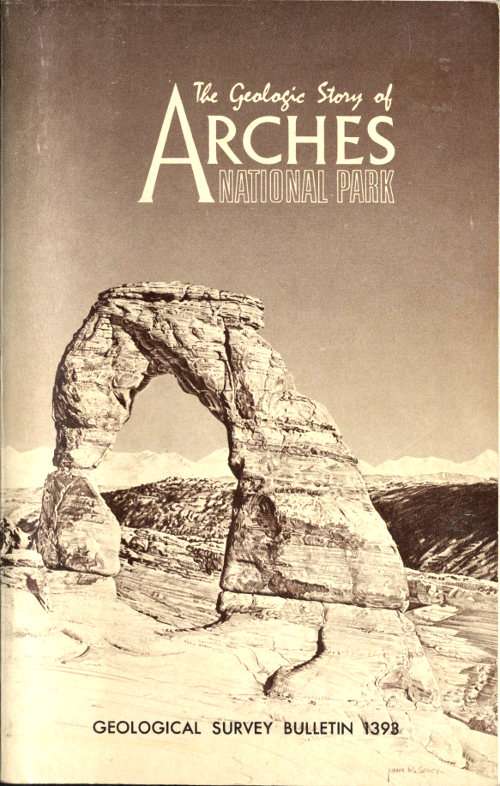
BALANCED ROCK, guarding The Windows section of Arches National Park. Rock is Slick Rock Member of Entrada Sandstone resting upon crinkly bedded Dewey Bridge Member of the Entrada. White rock in foreground is Navajo Sandstone. La Sal Mountains on right skyline. (Frontispiece)
The Geologic Story of
Arches
NATIONAL PARK
By S. W. Lohman
Graphics by
John R. Stacy
GEOLOGICAL SURVEY BULLETIN 1393
UNITED STATES DEPARTMENT OF THE INTERIOR
ROGERS C. B. MORTON, Secretary
GEOLOGICAL SURVEY
V. E. McKelvey, Director
U.S. GOVERNMENT PRINTING OFFICE: 1975
- Library of Congress Cataloging in Publication Data
- Lohman, Stanley William, 1907-
- The geologic story of Arches National Park.
- (Geological Survey Bulletin 1393)
- Bibliography: p.
- Includes index.
- Supt. of Docs. no.: I 19.3:1393
- 1. Geology—Utah—Arches National Park—Guide-books.
- 2. Arches National Park, Utah—Guide-books.
- I. Title. II. Series: United States Geological Survey
- Bulletin 1393.
- QE75.B9 No. 1393 [QE170.A7] 557.3′08s [557.92′58]
- 74-23324
For sale by the Superintendent of Documents, U. S. Government Printing Office
Washington, D. C. 20402
Stock Number 024-001-02598-1
Contents
- Page
- Beginning of a monument 1
- Graduation to a park 5
- Early history 9
- Prehistoric people 9
- Late arrivals 12
- Geographic setting 18
- Deposition of the rock materials 20
- Bending and breaking of the rocks 24
- Uplift and erosion of the Plateau 33
- Origin and development of the arches 37
- Examples of arches 46
- How to see the park 50
- A trip through the park 52
- Colorado River canyon 52
- Headquarters area 57
- Courthouse Towers area 63
- The Windows section 68
- Delicate Arch area 74
- Fiery Furnace 79
- Salt Valley and Klondike Bluffs 82
- Devils Garden 83
- Summary of geologic history 98
- Additional reading 104
- Acknowledgments 105
- Selected references 105
- Index 109
Figures
- Page
- Frontispiece. Balanced Rock.
- 1. Arches National Park 6
- 2. Rock art in Arches National Park 11
- 3. Wolfe’s Bar-DX Ranch 14
- 4. Rock column of Arches National Park 21
- 5. Common types of rock folds 25
- 6. Common types of rock faults 26
- 7. Paradox basin 27
- 8. Geologic section across northwest end of Arches National Park 28
- 9. Index map of northwestern part of Arches National Park 28
- 10. Gravity anomalies over Salt Valley 31
- 11. Tilted block of rocks in Cache Valley graben 34
- 12. Jointed northeast flank of Salt Valley anticline 36
- 13. Index map 38
- 14. Tunnel Arch 43
- 15. “Baby Arch” 44
- 16. Broken Arch 45
- 17. Double Arch 47
- 18. Pothole Arch 48
- 19. Glen Canyon Group 53
- 20. Navajo Sandstone cliffs 54
- 21. Mouth of Salt Wash 55
- 22. Southeast end of faulted Cache Valley anticline 56
- 23. Faulted Seven Mile-Moab Valley anticline 58
- 24. Three Penguins 59
- 25. Moab Valley 60
- 26. Faulted wall of Entrada Sandstone 61
- 27. Park Avenue 62
- 28. Balanced rocks on south wall of Park Avenue 64
- 29. Courthouse Towers 65
- 30. The Three Gossips 66
- 31. Sheep Rock 66
- 32. Petrified sand dunes 67
- 33. “Hoodoos and goblins” 68
- 34. Eye of The Whale 69
- 35. Intricate crossbeds in Navajo Sandstone 70
- 36. Cove Arch and Cove of Caves 71
- 37. North Window 72
- 38. Looking southwestward through North Window 73
- 39. South Window 74
- 40. Turret Arch 75
- 41. Parade of Elephants 76
- 42. Suspension foot bridge across Salt Wash 78
- 43. Delicate Arch 78
- 44. Fiery Furnace 80
- 45. Trail to Sand Dune Arch 81
- 46. Sand Dune Arch 82
- 47. Tower Arch 84
- 48. Skyline Arch 85
- 49. Campground in Devils Garden 86
- 50. View north from campground 87
- 51. Southeastern part of Devils Garden trail 88
- 52. Pine Tree Arch 89
- 53. Landscape Arch 91
- 54. Navajo Arch 92
- 55. Partition Arch 93
- 56. Double O Arch 93
- 57. Dark Angel 94
- 58. “Indian-Head Arch” 95
- 59. Geologic time spiral 96
Beginning of a Monument
According to former Superintendent Bates Wilson (1956), Prof. Lawrence M. Gould, of the University of Michigan, was the first to recognize the geologic and scenic values of the Arches area in eastern Utah and to urge its creation as a national monument. Mrs. Faun McConkie Tanner[1] told me that Professor Gould, who had done a thesis problem in the nearby La Sal Mountains, was first taken through the area by Marv Turnbow, third owner of Wolfe cabin. (See p. 12.) When Professor Gould went into ecstasy over the beautiful scenery, Turnbow replied, “I didn’t know there was anything unusual about it.”
Dr. J. W. Williams, generally regarded as father of the monument, and L. L. (Bish) Taylor, of the Moab Times-Independent, were the local leaders in following up on Gould’s suggestion and, with the help of the Moab Lions Club, their efforts finally succeeded on April 12, 1929, when President Herbert Hoover proclaimed Arches National Monument, then comprising only 7 square miles.[2] It was enlarged to about 53 square miles by President Franklin D. Roosevelt’s Proclamation of November 25, 1938, and remained at nearly that size, with some boundary adjustments on July 22, 1960, until it was enlarged to about 130 square miles by President Lyndon B. Johnson’s Proclamation of January 20, 1969.
According to Breed (1947), Harry Goulding, of Monument Valley, in a specially equipped car, traversed the rugged sand and rocks of the Arches region in the fall of 1936 and, thus, became the first person to drive a car into The Windows section of Arches National Monument. Soon after, a bulldozer followed Harry’s tracks and made a passable trail.
When my family and I visited the monument in 1946, the entrance was about 12 miles northwest of Moab on U.S. Highway 163 (then U.S. 160), where Goulding’s old tire tracks led eastward past a small sign reading “Arches National Monument 8 miles.” This primitive road crossed the sandy, normally dry Courthouse Wash and ended in what is now called The Windows section. At that time there was no water or ranger station, nor were there any picnic tables or other improvements within the monument proper, and the custodian was housed in an old barracks of the Civilian Conservation Corps near what is now the entrance, 5 miles northwest of Moab.
Former Custodian Russell L. Mahan reported (oral commun., May 1973) that soon after our initial visit in 1946 a 500-gallon tank was installed near Double Arch in The Windows section and connected to a drinking fountain and that two picnic tables and a pit toilet were added. At that time the only access to Salt Valley and what is now called Devils Garden was a primitive dirt road which, according to Breed (1947, p. 175), left old U.S. Highway 160 (now U.S. 163) 24 miles northwest of Moab, went 22 miles east, then followed Salt Valley Wash down to Wolfe cabin (fig. 1).
According to Abbey (1971), who served as a seasonal ranger beginning about 1958, a sign had by then been erected at the crossing of Courthouse Wash which read:
WARNING: QUICKSAND
DO NOT CROSS WASH
WHEN WATER IS RUNNING
The ranger station, his home for 6 months of the year, was what Abbey described as “a little tin housetrailer.” Nearby was an information display under a “lean-to shelter.” He had propane fuel for heat, cooking, and refrigeration, and a small gasoline-engine-driven generator for lights at night. His water came from the 500-gallon tank, which was filled at intervals from a tank truck. At that time there were three small dry campgrounds, each with tables, fireplaces, garbage cans, and pit toilets. By that time an extension of the dirt road led northward to Devils Garden, and some trails had been built and marked.
Bates Wilson became Custodian of the monument in 1949 and later became Superintendent not only of Arches but also of the nearby new Canyonlands National Park (Lohman, 1974) and the more distant Natural Bridges National Monument. In the fall of 1969, Bates told me of some of his early experiences in the undeveloped monument, including the evening when 22 cars were marooned on the wrong (northeast) side of Courthouse Wash after a flash flood. Bates and his “lone” ranger brought ropes, coffee, and what food they could obtain in town after closing time, threw a line across the swollen stream, had a tourist pull a rope across, then took turns wading the stream with one hand on the rope and the other balancing supplies on his shoulder. After a fire had been built and hot coffee and food passed around, the spirits of the stranded group rose considerably, except for one irate woman from the East, who refused to budge from her car. Bates and his helper finally got the last car out about 1 a.m., after the flood had subsided, and Mrs. Wilson then supplied lodging and more food and coffee for those who needed it.
During and for sometime after World War II and the Korean War, lack of maintenance funds and personnel had prevented improvement of the facilities in many of our national parks and monuments, particularly in undeveloped ones like Arches. The day was saved through the wisdom and foresight of former Park Service Director Conrad L. Wirth, who saw the need and desirability of putting the whole “want” list into one attractive, marketable package. In the words of Everhart (1972, p. 36):
Selection of a name is of course recognized as the most important decision in any large-scale enterprise, and here Wirth struck pure gold. In 1966 the Park Service would be celebrating its fiftieth anniversary. What a God-given target to shoot for! Why not produce a ten-year program, which would begin in 1956, aimed to bring every park up to standard by 1966—and call it Mission 66?
The ensuing well-documented and cost-estimated plan for Mission 66 was enthusiastically backed by President Dwight D. Eisenhower and approved and well supported by Congress to the tune of more than $1 billion during the 10-year period. For Arches, this included a new entrance, Park Headquarters, Visitor Center, a museum boasting a bust of founder Dr. Williams, and modern housing for park personnel, all 5 miles northwest of Moab. By 1958 (Pierson, 1960) a fine new paved road between Park Headquarters and Balanced Rock (frontispiece) was completed. These badly needed improvements were followed by the completion of the paved road all the way to Devils Garden, the building of the modern campground, picnic facilities, and amphitheater in the Devils Garden, and the construction of turnouts and marked trails.
Graduation to a Park
Arches graduated to a full-fledged national park when President Richard M. Nixon signed a Congressional Bill on November 16, 1971. The change in status was accompanied by boundary changes that reduced the area to about 114 square miles. The loss of most of Dry Mesa, just east of the present boundary (fig. 1), was offset in part by gains of new land northwest of Devils Garden. The present (1974) boundaries, roads, trails, and named features of the park are shown in figure 1.
The park was virtually completed at graduation time, and so far this change in status has shown up mainly in new entrance signs, a new 1972 brochure and map, and a very informative “Guide to an Auto Tour of Arches National Park,” keyed to numbered signs at parking spaces. About all that remain to be added are new wayside exhibits, some boundary fences, and spur roads and trails.
ARCHES NATIONAL PARK, showing location in Utah,
boundaries, streams, highways and roads, trails, landforms, principal
named features, and the city of Moab. The reader is referred
to figure 7 and to road maps issued by the State or by oil
companies for the locations of other nearby towns and features.
Visitors also may obtain pamphlets, from the entrance station
or from the National Park Service office in Moab, which contain
up-to-date maps of the park and the latest available information
on roads, trails, campsites, and picnic sites. (Fig. 1)
High-resolution Map
Although Arches had officially become a park in November 1971, it was not formally dedicated until May 15, 1972. The ceremony began by having the Federal, State, and local dignitaries and other guests totaling 140 persons board the Canyon King, a 93-foot replica of a Mississippi River sternwheeler (Lansford, 1972; Lohman, 1974, fig. 69), for its maiden voyage down the Colorado River. After about half an hour, the heavily laden boat became stuck on a sandbar, and after a 90-minute wait the passengers were rescued by jet boats. This delayed a luncheon at the Visitor Center put on by the Moab Lions Club. Following the luncheon, Park Superintendent Bates Wilson made a brief welcoming address, then introduced J. Leonard Volz, Director of the Midwest Region of the National Park Service, who served as master of ceremonies. Speakers included Utah Governor Calvin L. Rampton, Senator Frank E. Moss, a representative of Senator Wallace F. Bennett, Representatives Sherman P. Lloyd of Utah and Wayne Aspinall of Colorado, and Mitchell Melich, Solicitor General of the Department of Interior, representing Secretary Rogers C. B. Morton. After the speeches, a commemorative plaque, donated by the Canyonlands Natural History Association, was unveiled by Senator Moss and Mr. Melich.
Most of the color photographs were taken by me on 4- × 5-inch film in a tripod-mounted press camera, using lenses of several focal lengths, but a few were taken on 35-mm film, using lenses of various focal lengths. I am grateful to several friends for the color photographs credited to them in the figure captions. The black and white photographs were kindly loaned from the Moab and Arches files of the National Park Service. The points from which most of the photographs were taken are shown in figure 13.
Early History
Prehistoric People
The Canyon lands in and south of Arches were inhabited by cliff dwellers centuries before the first visits of the Spaniards and fur trappers. Projectile points and other artifacts found in the nearby La Sal and Abajo Mountains indicate occupation by aborigines during the period from about 3000-2000 B.C. to about A.D. 1 (Hunt, Alice, 1956). The Fremont people occupied the area around A.D. 850 or 900, and the Pueblo or Anasazi people from about A.D. 1075 to their departure in the late 12th century (Jennings, 1970). Most of the evidence for these early occupations has been found in and south of Canyonlands National Park (Lohman, 1974), but some traces of these and possibly earlier cultures have been found also within Arches National Park.
Ross A. Maxwell (National Park Service, written commun., 1941) investigated two caves in the Entrada Sandstone in the upper reaches of Salt Wash that contain Anasazi ruins. He mentioned that perhaps a dozen or more other caves should be checked for evidence of former occupation and, also, that he found several ancient campsites littered with flint chips and broken tools.
One cave Maxwell explored some 5 miles north of Wolfe Ranch and north of the park is about 300 feet long and 100 to 150 feet deep. It contains the remains of one or more ruins of a structure he thought may have covered much of the floor. The remaining parts of walls now are only two to four tiers of stones in height, although originally they may have been more than one story high. Maxwell explored a second cave on the east side of Salt Wash, about 2 miles north of Wolfe Ranch, which contains 16 storage cists of adobe.
The faces of many older sandstone cliffs or ledges are darkened by desert varnish—a natural pigment of iron and manganese oxides. The prehistoric inhabitants of the Plateau learned that effective and enduring designs, called petroglyphs, could be created simply by chiseling or pecking through the thin dark layer to reveal the buff or tan sandstone beneath. Most petroglyphs were created by the Anasazi, but those showing men mounted on horses were done by Ute tribesmen after the Spaniards brought in horses in the 1500’s. The Fremont people and some earlier people painted figures on rock faces, called pictographs, and some of these had pecked outlines.
The so-called “Moab panel” was described by Beckwith (1934, p. 177) as a petroglyph, but, as pointed out by Schaafsma (1971, p. 72, 73), it comprises figures having pecked outlines and painted bodies, which actually are combinations of petroglyphs and pictographs. This beautifully preserved group of paintings is shown in the upper photograph of figure 2. Mrs. Schaafsma goes on to say, concerning the “Moab panel”:
The long tapered body, the antenna like headdresses, and the staring eyes are characteristic features of Barrier Canyon style figures elsewhere * * *. Of special interest here are the large shields held by certain figures. A visit to this site indicated that the shields, although apparently of some antiquity, have been superimposed over some of the Barrier Canyon figures. Whether or not this was done by the Barrier Canyon style artists themselves or later comers to the site is impossible to tell.
Although definite proof seems lacking, she suggested (written commun., Nov. 3, 1973) that the “‘Barrier Canyon style’[3] * * * is earlier than the work in the same region clearly attributable to the Fremont.” Note the three bullet holes in and near the right-hand shield. A ledge above the panel that contained petroglyphs during her earlier visit had fallen to the base of the cliff by the time my wife and I inspected the panel in September 1973.
ROCK ART IN ARCHES NATIONAL PARK. A (above), “Moab panel,” on cliff of Wingate Sandstone above U.S. Highway 163 between Courthouse Wash and Colorado River, believed to be the work of “Barrier Canyon” style people. B (below), Petroglyphs on ledge of sandstone in Morrison Formation on east side of Salt Wash just north of Wolfe Ranch, believed to have been cut by Ute tribesmen. (Fig. 2)
Mrs. Schaafsma believes the petroglyphs in the lower photograph of figure 2 to be the work of Ute tribesmen, not only because of the horses, but also because of the stiff-legged appearance of the mountain sheep. Note the bullet hole above the panel.
Late Arrivals
Later arrivals in and near Arches National Park included first Spanish explorers, then trappers, cattlemen, cattle rustlers and horse thieves, followed in the present century by oil drillers, uranium hunters, jeepsters, and tourists. Butch Cassidy, the Sundance Kid, and other members of The Wild Bunch are known to have frequented parts of what is now Canyonlands National Park (Baker, Pearl, 1971), but it is not certain whether or not any of them traversed what is now Arches National Park.
The first settler in what is now Arches National Park was a Civil War veteran named John Wesley Wolfe, who was discharged from the Union Army about 3 weeks before the Battle of Bull Run because he suffered from varicose veins. In 1888 his doctor told him he had to leave Ohio for a dryer climate or he would not live 6 months, so he took his son Fred west and settled on a tract of 150 acres along the west bank of Salt Wash, where his “Wolfe cabin” still stands (figs. 1, 3). From family letters and newspaper clippings compiled by Mrs. Maxine Newell and other members of the National Park Service (Maxine Newell, written commun., 1971), we learn what life in the area was like:
We have started a cattle spread on a desert homestead. We call it the Bar-DX Ranch. Fred and I live in a little log house on the bank of a creek that is sometimes dry, sometimes flooded from bank to bank with roaring muddy water. We are surrounded with rocks—gigantic red rock formations, massive arches and weird figures, the like of which youve [sic] never seen. The desert is a hostile, demanding country, hot in summer, cold in winter. The Bar-DX Ranch is a day’s ride from the nearest store, out of the range of schools.
Although John Wolfe had promised his wife and his other children that he would return home the first fall that his cattle sales netted enough money, he and Fred stayed on and on, and his wife refused to go west and join her husband and son. Eighteen years later he sent money from his pension check to his daughter, Mrs. Flora Stanley, his son-in-law, Ed Stanley, and his two grandchildren, Esther and Ferol, to join him and Fred at the ranch. Their train was met at Thompson Springs (now Thompson), Utah (fig. 7), by John Wolfe for the 30-mile ride to the ranch by horse and wagon. Sight of the tiny log cabin with only a dirt floor brought tears to his daughter’s eyes, but her spirits rose considerably after John Wolfe promised to build a new log cabin with a wooden floor. But the children were enchanted with this strange country, with the building of the new cabin, and, especially, with getting to go rabbit hunting with Grandpa Wolfe. The Stanleys stayed at the ranch until Esther was 10, then moved to Moab to await the arrival of their third child, Volna.
In 1910 John Wolfe sold the Bar-DX Ranch, and the entire family moved to Kansas. John Wolfe later moved back to Ohio, and died at Etna, Licking County, on October 22, 1913, at the age of 84, 25 years after his doctor had warned him to move to a dryer climate or face an early death.
Wolfe had sold his spread to Tommy Larson, who later sold it to J. Marv Turnbow and his partners, Lester Walker and Stib Beeson. The old log cabin gradually came to be known as the “Turnbow cabin,” and this name appeared on early maps of the area by the U.S. Geological Survey and on early pamphlets by the National Park Service, partly because Marv Turnbow served as a camphand in 1927 assisting in the first detailed geologic mapping of the area (Dane, 1935, p. 4). In 1947 the ranch was sold to Emmett Elizondo, who later sold it to the Government for inclusion in what was then the monument.
From information supplied by Wolfe’s granddaughter, Mrs. Esther Stanley Rison, and his great-granddaughter, Mrs. Hazel Wolfe Hastler, who visited the cabin in July 1970, the original name Wolfe cabin, or Wolfe Ranch, has been restored, and appears on the newer maps and pamphlets. (See fig. 1.) What remains of Wolfe’s Bar-DX Ranch is shown in figure 3.
WOLFE’S BAR-DX RANCH, on west bank of Salt Wash at start of trail to Delicate Arch. Left to right: Corral, wagon, “new” cabin, and root cellar. “Old” cabin, which formerly was to right of photograph, was washed away by a flood in 1906. (Fig. 3)
Arches National Park is surrounded by active uranium and vanadium mines and by many test wells for oil, gas, and potash; it is underlain by extensive salt and potash deposits. Oil and gas are produced a few miles to the north and east, and potash is being produced about 12 miles to the south (Lohman, 1974).
Uranium and vanadium have been mined on the Colorado Plateau since 1898 (Dane, 1935, p. 176) and in the Yellow Cat area (also called Thompson’s area), just north of the park (fig. 1), since about 1911 (Stokes, 1952, p. 7). The deposits in the Yellow Cat area occur in the Salt Wash Sandstone Member of the Morrison Formation (fig. 4). According to Pete Beroni (U.S. Atomic Energy Commission, oral commun., August 6, 1973), some ore is still being produced in the Yellow Cat area, and the production of vanadium ore will increase as soon as the uranium mill at Moab is converted to also handle vanadium ore. The Corral and so-called Shinarump mines along the southwest side of Moab Canyon just north of Sevenmile Canyon (fig. 1) are still actively producing uranium ore from the Moss Back Member of the Chinle Formation, according to Mr. Beroni.
The occurrences of salt and potash in and near the park and the attempts to find oil and gas nearby are discussed in a recent report (Hite and Lohman, 1973), and the deposits beneath Moab, Salt, and Cache Valleys are discussed in later chapters.
In 1955 and 1956 the Pacific Northwest Pipeline, known also as the “Scenic Inch,” was constructed by the Pacific Northwest Pipeline Corp. to transmit natural gas from wells in the San Juan Basin of northwestern New Mexico for a total of 1,487 miles to the Pacific Northwest, with additional pickups from gas fields in northeastern Utah, northwestern Colorado, and southwestern Wyoming (Walters, 1956). This 26-inch pipeline follows the general route of U.S. Highway 163 from Cortez, Colo., past Moab to Sevenmile Canyon 10 miles northwest of Moab, where it turns abruptly to the northeast and crosses about the middle of Arches National Park. It crosses the park road and the flat area between the Fiery Furnace and the southeast end of Devils Garden, but the scars are so well healed that most visitors are unaware of its existence unless they happen to look southwestward across Salt Valley, where the filled excavation is still visible. The filled trench also appears in the lower middle of figure 23.
Unlike Canyonlands National Park a few miles to the south, Arches was not on the route of the famous early-day river expeditions of John Wesley Powell or of most of those that followed; however, the southeastern boundary of the park is the Colorado River, formerly the Grand, which was traversed by the first leg of the ill-fated Brown-Stanton expedition (Dellenbaugh, 1902, p. 343-369; Lohman, 1974).
The canyon of the Colorado River along the southeastern park boundary is deep and beautiful and is a favorite stretch of quiet water for boaters and floaters. Partly paved State Highway 128 on the east bank is a part of a most scenic drive from Moab to Cisco—a small railroad town about 32 miles northeast of the eastern border of figure 1 (fig. 7). This road has been variously called the “Moab Mail Road,” the “Cisco Cutoff,” the “Dewey Road,” or the “Dewey Bridge Road” after an old suspension bridge (fig. 7) across the Colorado River at the old townsite of Dewey about 12 miles south of Cisco. During the summer this deep colorful canyon may be viewed at night by artificial illumination. Each evening one-half hour after sundown, an 80-passenger jet boat leaves a dock north of the highway bridge, carries passengers several miles upstream, then floats slowly downstream followed by a truck on the highway carrying 40,000 watts of searchlights which play back and forth on the colorful red canyon walls, while the passengers listen to a taped discourse. The entire trip requires about 2 hours.
The spectacular arches and red rocks of Arches and vicinity have been used to advantage in making color movies and color TV shows. Parts of the recent Walt Disney film “Run, Cougar, Run” were filmed beneath Delicate Arch (fig. 43), in Professor Valley of the Colorado River just east of the park (fig. 7), and in other sections of the canyon country.
Ever since military jet aircraft broke the sound barrier, there has been a growing number of protests from concerned citizens, organizations, and National Park Service officials concerning the dangers sonic booms have posed to Indian ruins and delicate erosional forms in our national parks and monuments, such as natural bridges, arches and windows, balanced rocks, and natural spires or towers. Many instances of damaged ruins, roads, erosional forms, and broken windows were reported. My wife and I can vouch for the destructive power of such booms, for in October 1969, while we were having breakfast at Squaw Flat Campground in The Needles section of Canyonlands National Park, a particularly severe blast from a low-flying jet not only violently rocked our jack-supported trailer but broke the windshield of our car.
At Arches National Park, particular fear was felt for Landscape Arch (fig. 53), thought to be the longest natural stone arch in the world, and many a special round trip from headquarters involving 47 road miles and 2 trail miles was made to check on the condition of this arch after especially loud sonic booms were heard. Finally, in April 1972, following a rash of newspaper and magazine articles that spread across the nation, the Secretary of the Air Force put a virtual stop to this danger by ruling that, except in an emergency (Moab Times-Independent, April 12, 1972):
Supersonic flights must not only avoid passing over national parks, they also may not fly near them, according to the new regulation. For each 1,000 feet of altitude, the pilot must allow one-half mile between the flight path and the park boundary. The regulation also prohibits supersonic flights below 30,000 feet (over land) so the high speed planes must allow 15 miles between the nearest park boundary and the flight path.
Let us hope that with the aid of this long-needed regulation and cooperation from visitors, the arches will remain intact for many more generations to see.
Geographic Setting
Geologists have divided the United States into many provinces, each of which has distinctive geologic and topographic characteristics that set it apart from the others. One of the most intriguing and scenic of these is the Colorado Plateaus province, referred to in this report simply as the Colorado Plateau, or the Plateau (Hunt, C. B., 1956, fig. 1). This province, which covers some 150,000 square miles and is not all plateaus, as we shall see, extends from Rifle, Colo., at the northeast to a little beyond Flagstaff, Ariz., at the southwest, and from Cedar City, Utah, at the west nearly to Albuquerque, N. Mex., at the southeast. Arches National Park occupies part of the Canyon Lands Section, one of the six subdivisions of the Plateau. As the names imply, the Canyon Lands Section of the Plateau comprises a high plateau generally ranging in altitude from 5,000 to 7,000 feet, which has been intricately dissected by literally thousands of canyons.
Arches National Park is drained entirely by the Colorado River, whose deep canyon borders the park on the southeast (fig. 1). Most of the park is drained by Salt Wash, which enters the Colorado River just southeast of The Windows section, but the southwestern part is drained by Courthouse Wash and Moab Canyon, whose flows join the Colorado just west of the bridge on which U.S. Highway 163 crosses the river.
When viewed at a distance of 1 foot, the shaded relief map (fig. 1) shows the general shape of the land surface in and near Arches National Park to the same horizontal scale as it would appear to a person in a spacecraft flying at a height of 250,000 feet, or about 47.5 miles. This map was prepared from part of the reverse side of a plastic-relief map[4] at a scale of 1:250,000 by the U.S. Army Map Service of the Moab quadrangle, using a simple time- and money-saving method (Stacy, 1962).