
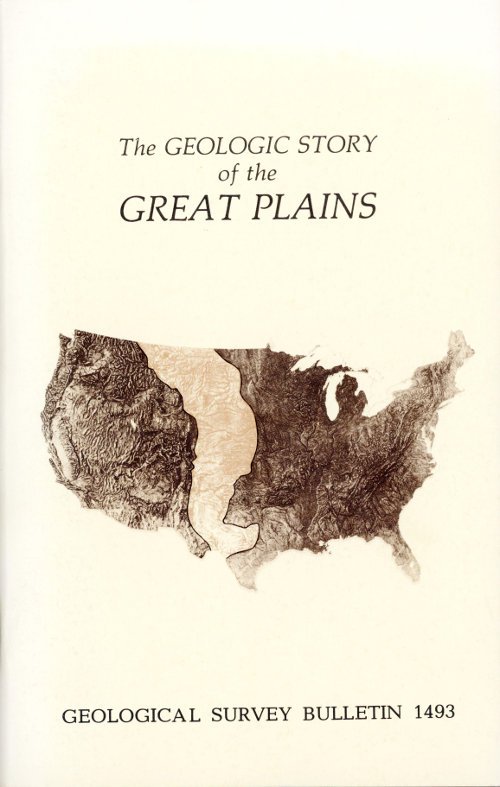
The Project Gutenberg eBook of The Geologic Story of the Great Plains
Title: The Geologic Story of the Great Plains
Author: Donald E. Trimble
Release date: October 6, 2020 [eBook #63396]
Most recently updated: October 18, 2024
Language: English
Credits: Produced by Stephen Hutcheson and the Online Distributed
Proofreading Team at https://www.pgdp.net
DENVER, COLORADO
But from these immense prairies may arise one great advantage to the United States, viz., the restriction of our population to some certain limits, and thereby a continuation of the union. Our citizens being so prone to rambling, and extending themselves on the frontiers, will, through necessity, be constrained to limit their extent on the west to the borders of the Missouri and the Mississippi, while they leave the prairies, incapable of cultivation, to the wandering and uncivilized Aborigines of the country. Zebulon Pike
Exploratory Travels Through The Western Territories of North America comprising a voyage from St. Louis, on the Mississippi, to the source of that river, and a journey through the interior of Louisiana and the north-eastern provinces of New Spain. Performed in the years 1805, 1806, and 1807, by order of the Government of the United States. By Zebulon Montgomery Pike. Published by Paternoster-Row, London, 1811: W. H. Lawrence and Company, Denver, 1889. Quotation from pages 230-231, 1889 edition.
The GEOLOGIC STORY of
The GREAT PLAINS
By DONALD E. TRIMBLE
A nontechnical description of the origin and evolution of the landscape of the Great Plains
GEOLOGICAL SURVEY BULLETIN 1493
UNITED STATES DEPARTMENT OF THE INTERIOR
CECIL D. ANDRUS, Secretary
GEOLOGICAL SURVEY
H. William Menard, Director
UNITED STATES GOVERNMENT PRINTING OFFICE, WASHINGTON: 1980
- Library of Congress Cataloging in Publication Data
- Trimble, Donald E.
- The geologic story of the Great Plains.
- (U.S. Geological Survey Bulletin 1493)
- Bibliography: p. 50
- Includes index.
- Supt. of Docs. no.: I 19.3: 1493
- I. Geology—Great Plains. I. Title.
- II. Series: United States Geological Survey Bulletin 1493.
- QE75.B9 no. 1493 [QE71] 557.3s [557.8] 80-607022
For sale by the Superintendent of Documents, U.S. Government Printing Office
Washington, D.C. 20402
CONTENTS
- Introduction 1
- What is the Great Plains? 5
- The Great Plains—its parts 7
- Early history 10
- Warping and stream deposition 11
- Sculpturing the land 18
- Landforms of today—The surface features of the Great Plains 19
- Black Hills 20
- Central Texas Uplift 22
- Raton Section 23
- High Plains 25
- Missouri Plateau 32
- Preglacial Drainage 33
- Glaciated Missouri Plateau 33
- Unglaciated Missouri Plateau 36
- The Colorado Piedmont 42
- Pecos Valley 45
- Edwards Plateau 46
- Plains Border Section 48
- Epilogue 49
- Acknowledgments 49
- Some source references 50
FIGURES
- FRONTISPIECE. Aerial photograph of Denver.
- 1. Index map 3
- 2-3. Maps showing:
- 2. Physical divisions of the United States and maximum extent of the continental ice sheets 6
- 3. The Great Plains province and its sections 8
- 4. Photograph of Mescalero escarpment and southern High Plains 9
- 5. Geologic time chart 12
- 6-8. Maps showing:
- 6. Paleogeography of U.S. in Late Cretaceous 14
- 7. Structural setting of the Great Plains 14
- 8. Progressive southward expansion of areas of deposition 17
- 9. Photograph of Big Horn strip mine at Acme, Wyo. 18
- 10. Black Hills diagram 21
- 11-16. Photographs showing:
- 11. Weathering of granite at Sylvan Lake in the Black Hills 22
- 12. Capulin Mountain National Monument, N. Mex. 24
- 13. Mesa de Maya, Colo. 25
- 14. Spanish Peaks, Colo. 26
- 15. “The Gangplank,” Wyo. 27
- 16. Scotts Bluff National Monument, Nebr. 28
- 17. Aerial photograph of the Nebraska Sand Hills 30
- 18. Map of the Nebraska Sand Hills 31
- 19-30. Photographs showing:
- 19. Loess plain in Nebraska 32
- 20. Ground moraine on the Coteau du Missouri in North Dakota 34
- 21. Slump blocks in North Unit of Theodore Roosevelt National Memorial Park, N. Dak. 36
- 22. Highwood Mountains, Mont. 37
- 23. Devils Tower National Monument, Wyo. 38
- 24. Glaciated valley in Crazy Mountains, Mont. 39
- 25. Powder River Basin in vicinity of Tongue River 40
- 26. Badlands National Monument, S. Dak. 41
- 27. Badlands of Little Missouri River in South Unit of Theodore Roosevelt National Memorial Park, N. Dak. 42
- 28. Hogback ridges along the Front Range, Colo. 43
- 29. Pawnee Buttes, Colo. 44
- 30. Edwards Plateau, Tex. 47
TABLE
The GEOLOGIC STORY of
The GREAT PLAINS
By Donald E. Trimble
INTRODUCTION
The Great Plains! The words alone create a sense of space and a feeling of destiny—a challenge. But what exactly is this special part of Western America that contains so much of our history? How did it come to be? Why is it different?
Geographically, the Great Plains is an immense sweep of country; it reaches from Mexico far north into Canada and spreads out east of the Rocky Mountains like a huge welcome mat. So often maligned as a drab, featureless area, the Great Plains is in fact a land of marked contrasts and limitless variety: canyons carved into solid rock of an arid land by the waters of the Pecos and the Rio Grande; the seemingly endless grainfields of Kansas; the desolation of the Badlands; the beauty of the Black Hills.
Before it was broken by the plow, most of the Great Plains from the Texas panhandle northward was treeless grassland. Trees grew only along the floodplains of streams and on the few mountain masses of the northern Great Plains. These lush prairies once were the grazing ground for immense herds of bison, and the land provided a bountiful life for those Indians who followed the herds. South of the grasslands, in Texas, shrubs mixed with the grasses: creosote bush along the valley of the Pecos River; mesquite, oak, and juniper to the east.
The general lack of trees suggests that this is a land of little moisture, as indeed it is. Nearly all of the Great Plains receives less than 24 inches of rainfall a year, and most of it receives less than 16 inches. This dryness and the strength of sunshine in this area, which lies mostly between 2,000 and 6,000 feet above sea level, create the semiarid environment that typifies the Great Plains. But it was not always so. When the last continental glacier stood near its maximum extent, some 12,000-14,000 years ago, spruce forest reached southward as far as Kansas, and the Great Plains farther south was covered by deciduous forest. The trees retreated northward as the ice front receded, and the Great Plains has been a treeless grassland for the last 8,000-10,000 years.
For more than half a century after Lewis and Clark crossed the country in 1805-6, the Great Plains was the testing ground of frontier America—here America grew to maturity (fig. 1). In 1805-7, explorer Zebulon Pike crossed the south-central Great Plains, following the Arkansas River from near Great Bend, Kans., to the Rocky Mountains. In later years, Santa Fe traders, lured by the wealth of New Mexican trade, followed Pike’s path as far as Bents Fort, Colo., where they turned southwestward away from the river route. Those pioneers who later crossed the plains on the Oregon Trail reached the Platte River near the place that would become Kearney, Nebr., by a nearly direct route from Independence, Mo., and followed the Platte across the central part of the Great Plains.
Although these routes may have seemed long and tedious to those dusty travelers, they provided relatively easy access to the Rocky Mountains and had a continuous supply of fresh water, an absolute necessity in these plains. The minds of those frontiersmen surely were occupied with the dangers and demands of the moment—and with dreams—but the time afforded by the slow pace of travel also gave them ample opportunity for thought about the origins of their surroundings.
Today’s traveler, who has less time for contemplation, races past a changing kaleidoscope of landscape. The increased awareness created by this rapidity of change perhaps is even more likely to stimulate questions about the origin of this landscape.
Figure 1.—Index map of the Great Plains showing route of Lewis and Clark and the Santa Fe and Oregon Trails.
For instance, the westbound traveler on Interstate Highway 70 traverses nearly a thousand miles of low, rounded hills after leaving the Appalachians; the rolling landscape is broken only by a few flat areas where glacial ice or small lakes once stood. Suddenly, near Salina, Kans., the observant traveler senses a difference in the landscape. Instead of rounded hills, widely or closely spaced, he sees on the skyline flat surfaces, or remnants of flat surfaces. As he climbs gently westward these broken horizontal lines stand etched against the sky. About 35 miles west of Salina he finds himself on a broad, flat plateau, where seemingly he can see forever. True, in places he descends into stream valleys, but only briefly, for he soon climbs back onto the flat surface.
This plateau surface continues for 300 miles to the west—to within 100 miles of the abrupt front of the Rocky Mountains. East-flowing streams, such as the Smoky Hill, the Saline, the Solomon, and the Republican Rivers and their tributary branches, have cut their valleys into this surface, but these valleys become increasingly shallow and disappear entirely near the western rim of the plateau in eastern Colorado.
The distant peaks of the Rockies are seen for the first time as the traveler approaches the escarpment that forms the western edge of this great plateau. After crossing the escarpment near Limon, Colo., he begins the long gentle descent to Denver, on the South Platte River near the foot of the mountains that loom so awesomely ahead. He has crossed the Great Plains. The distances have been great, but the contrasts have been marked.
Had our traveler selected a different route, either to the north or south, he would have found even greater contrasts, for the Great Plains has many parts, each with its own distinctive aspect. Why should such diverse landscapes be considered parts of the Great Plains? What are their unifying features? And what created this landscape? Has it always been this way? If not, when was it formed? How was it formed?
We will look here at some of the answers to those questions. The history of events that produced the landscape of the Great Plains is interpreted both from the materials that compose the landforms and from the landforms themselves. As we will see, all landforms are the result of geologic processes in action. These processes determine not only the size and shape of the landforms, but also the materials of which they are made. These geologic processes, which form and shape our Earth’s surface, are simply the inevitable actions of the restless interior of the Earth and of the air, water, and carbon dioxide of the atmosphere, aided by gravity and solar heating (or lack of it). They all have helped sculpture the fascinating diversity of the part of our land we call the Great Plains.
WHAT IS THE GREAT PLAINS?
The United States has been subdivided into physiographic regions that, although they have great diversity within themselves, are distinctly different from each other (fig. 2).
From the Rocky Mountains on the west to the Appalachians on the east, the interior of our country is a vast lowland (see cover) known as the Interior Plains. These plains are bounded on the south by a region of Interior Highlands, consisting of the Ozark Plateaus and the Ouachita province, and by the Coastal Plain. In the Great Lakes region, the Interior Plains laps onto the most ancient part of the continent, the Superior Upland. West of the Great Lakes it extends far to the north into Canada. Certainly the Rocky Mountains are distinctly different from the region to the east, which is the Great Plains. The Great Plains, then, is the western part of the great Interior Plains. The Rocky Mountains form its western margin. But what determines its eastern margin?
During the Pleistocene Epoch or Great Ice Age, huge glaciers formed in Canada and advanced southward into the great, central, low-lying Interior Plains of the United States. (See figure 2.) These glaciers and their deposits modified the surface of the land they covered, mostly between the Missouri and the Ohio Rivers; they smoothed the contours and gave the land a more subdued aspect than it had before they came. This glacially smoothed and modified land is called the Central Lowland. Although the ice sheets lapped onto the northern part, the Great Plains is the largely unglaciated region that extends from the Gulf Coastal Plain in Texas northward into Canada between the Central Lowland and the foot of the Rocky Mountains. Its eastern margin in Texas and Oklahoma is marked by a prominent escarpment, the Caprock escarpment. Its southern margin, where it abuts the Coastal Plain in Texas, is at another abrupt rise or scarp along the Balcones fault zone.
Figure 2.—Physical divisions of the United States and maximum extent of the continental ice sheets during the Great Ice Age.
THE GREAT PLAINS—ITS PARTS
Within the Great Plains are many large areas that differ greatly from adjoining areas (fig. 3). The Black Hills stands out distinctively from the surrounding lower land, and its dark, forested prominence can be seen for scores of miles from any direction. At the southern end of the Great Plains is another, less imposing, forested prominence—the Central Texas Uplift. Most impressive, perhaps, is the huge, nearly flat plateau known as the High Plains, which extends southward from the northern border of Nebraska through the Panhandle of Texas, and which forms the central part of the Great Plains. The east and west rims of the southern High Plains are at high, cliffed, erosional escarpments—the Caprock escarpment on the east and the Mescalero escarpment on the west. The north edge of the High Plains is defined by another escarpment, the Pine Ridge escarpment, which separates the High Plains from a region that has been greatly dissected by the Missouri River and its tributaries. There, several levels of rolling upland are surmounted by small mountainous masses and flat-topped buttes and are entrenched by streams. This region is the Missouri Plateau. The continental glacier lapped onto the northeastern part of the Missouri Plateau and altered its surface.
The South Platte and Arkansas Rivers and their tributaries have similarly dissected an area along the mountain front that is called the Colorado Piedmont, and the Pecos River has excavated a broad valley trending southward from the Sangre de Cristo Mountains in New Mexico into Texas. The Mescalero escarpment separates the Pecos Valley from the southern High Plains (fig. 4). South and east of the Pecos Valley, extending to the Rio Grande and the Coastal Plain, is a broad plateau of bare, stripped, flat-lying limestone layers bearing little but cactus that is called the Edwards Plateau. Green, crop-filled valleys with gently sloping valley walls and rounded stream divides trend eastward from the High Plains of western Kansas and characterize a Plains Border section. And finally, between the Colorado Piedmont on the north and the Pecos Valley on the south, volcanic vents, cinder cones, and lava fields form another distinctive terrain in the part of the Great Plains called the Raton section.
Figure 3.—The Great Plains province and its sections.
Figure 4.—Mescalero escarpment and the southern High Plains (Llano Estacado) south of Tucumcari, N. Mex., Photograph by C. D. Miller, U. S. Geological Survey.
Can such diverse parts of our land have a sufficiently common origin to justify their being considered part of one unified whole—the Great Plains? Probably so, but to understand why, we must examine some of the earlier geologic history of the Great Plains as well as subsequent events revealed in the present landforms. We will find that all parts of this region we call the Great Plains have a similar early history, and that the differences we see are the results of local dominance of certain processes in the ultimate shaping of the landscape, mostly during the last few million years. The distinctive character of the landscape in each section is determined in part by both the early events and the later shaping processes.
EARLY HISTORY
The Interior Plains, of which the Great Plains is the western, mostly unglaciated part (fig. 2), is the least complicated part of our continent geologically except for the Coastal Plain. For most of the half billion years from 570 million (fig. 5) until about 70 million years ago, shallow seas lay across the interior of our continent (fig. 6). A thick sequence of layered sediments, mostly between 5,000 and 10,000 feet thick, but more in places, was deposited onto the subsiding floor of the interior ocean (table 1). These sediments, now consolidated into rock, rest on a floor of very old rocks that are much like the ancient rocks of the Superior Upland.
About 70 million years ago the seas were displaced from the continental interior by slow uplift of the continent, and the landscape that appeared was simply the extensive, nearly flat floor of the former sea.
WARPING AND STREAM DEPOSITION
Most of these rocks of marine origin lie at considerable depth beneath the land surface, concealed by an overlying thick, layered sequence of rocks laid down by streams, wind, and glaciers. Nevertheless, their geologic character, position, and form are exceptionally well known from information gained from thousands of wells that have been drilled for oil. The initial, nearly horizontal position of the layers of rock beneath the Interior Plains has been little disturbed except where mountains like the Black Hills were uplifted about 70 million years ago. At those places, which are all in the northern and southern parts of the Great Plains, the sedimentary layers have been warped up and locally broken by the rise of hot molten rock from depth. Elsewhere in the Interior Plains, however, earth forces of about the same period caused only a reemphasis of gentle undulations in the Earth’s crust.
These undulations affected both the older basement rocks and the overlying sedimentary rocks, and they take the form of gentle basins and arches that in some places span several States. (See sketch map, figure 7.) A series of narrow basins lies along the mountain front on the west side of the Great Plains. A broad, discontinuous arch extends southwest from the Superior Upland to the Rocky Mountain front to form a buried divide that separates the large Williston basin on the north from the Anadarko basin to the south.
While the flat-lying layers of the Interior Plains were being only gently warped, vastly different earth movements were taking place farther west, in the area of the present Rocky Mountains. Along a relatively narrow north-trending belt, extending from Mexico to Alaska, the land was being uplifted at a great rate. The layers of sedimentary rock deposited in the inland sea were stripped from the crest of the rising mountainous belt by erosion and transported to its flanks as the gravel, sand, and mud of streams and rivers. This transported sediment was deposited on the plains to form the rocks of the Cretaceous Hell Creek, Lance, Laramie, Vermejo, and Raton Formations. Vegetation thrived on this alluvial plain, and thick accumulations of woody debris were buried to ultimately become coal. This lush vegetation provided ample food for the hordes of three-horned dinosaurs (Triceratops) that roamed these plains. Their fossilized remains are found from Canada to New Mexico.
Figure 5.—Geologic time chart and the progression of life forms. Note Cretaceous Triceratops, Oligocene Titanotheres, and Miocene Moropus.
GEOLOGIC TIME
The Age of the EarthThe Earth is very old—4.5 billion years or more according to recent estimates. Most of the evidence for an ancient Earth is contained in the rocks that form the Earth’s crust. The rock layers themselves—like pages in a long and complicated history—record the surface-shaping events of the past, and buried within them are traces of life—the plants and animals that evolved from organic structures that existed perhaps 3 billion years ago.
Also contained in rocks once molten are radioactive elements whose isotopes provide Earth scientists with an atomic clock. Within these rocks, “parent” isotopes decay at a predictable rate to form “daughter” isotopes. By determining the relative amounts of parent and daughter isotopes, the age of these rocks can be calculated.
Thus, the results of studies of rock layers (stratigraphy), and of fossils (paleontology), coupled with the ages of certain rocks as measured by atomic clocks (geochronology), attest to a very old Earth!
Figure 6.—Generalized paleogeographic map of the United States in Late Cretaceous time (65 to 80 million years ago), when most of the Great Plains was beneath the sea.
Figure 7.—Structural setting of the Great Plains. Williston basin and Anadarko basin are separated by a midcontinental arch.
Table 1.—Generalized chart of rocks of the Great Plains
| Geologic age Millions of years ago | Missouri Plateau—Black Hills | High Plains—Plains Border—Colorado Piedmont | Pecos Valley—Edwards Plateau—Central Texas |
|---|---|---|---|
| Quaternary | |||
| Pleistocene | Glacial deposits, alluvium, and terrace deposits | Alluvium, sand dunes, and loess | Piedmont, terrace, and bolson deposits |
| 2 | erosional surface | ||
| Tertiary | |||
| Pliocene | EROSION | ||
| 5 | Flaxville Gravel and Ogallala Formation | Ogallala formation | |
| Miocene | Arikaree Formation | Arikaree Formation | |
| 22-24 | erosional surface | ||
| Oligocene | White River Group | White River Group | Mostly missing because of erosion or nondeposition |
| 37-38 | erosional surface | ||
| Eocene | Wasatch and Golden Valley Formations | ||
| 53-54 | Dawson Arkose | ||
| Paleocene | Fort Union Formation | Denver, Poison Canyon, and Raton Formations | |
| 65 | |||
| Cretaceous | Hell Creek and Lance Formations | Vermejo and Laramie Formations | |
| Fox Hills Sandstone | Trinidad and Fox Hills Sandstones | ||
| Shales, sandstones, and limestones deposited in Late Cretaceous sea | |||
| Dakota Sandstone and Lakota Formation | Dakota Sandstone | ||
| Glen Rose and Edwards Limestones | |||
| 136 | |||
| Jurassic | Sundance Formation, Ellis Group, and Unkpapa Sandstone | Morrison Formation | Jurassic rocks not present |
| 190-195 | |||
| Triassic | Dominantly red rocks | ||
| 225 | |||
| PALEOZOIC | Paleozoic rocks, undivided | ||
| 570 | |||
| PRECAMBRIAN | Precambrian rocks, undivided | ||
As the mountains continued to rise, the eroding streams cut into the old core rocks of the mountains, and that debris too was carried to the flanks and onto the adjoining plains. The mountainous belt continued to rise intermittently, and volcanoes began to appear about 50 million years ago. Together, the mountains and volcanoes provided huge quantities of sediment, which the streams transported to the plains and deposited. The areas nearest the mountains were covered by sediments of Late Cretaceous and Paleocene age (table 1)—the Poison Canyon Formation to the south, the Dawson and Denver Formations in the Denver area, and the Fort Union Formation to the north (fig. 8). Vegetation continued to flourish, especially in the northern part of the Great Plains, and was buried to form the thick lignite and subbituminous coal beds of the Fort Union Formation (fig. 9). The earliest mammals, most of whose remains come from the Paleocene Fort Union Formation, have few modern survivors.
Beginning about 45 million years ago, in Eocene time, there was a long period of stability lasting perhaps 10 million years, when there was little uplift of the mountains and, therefore, little deposition on the plains. A widespread and strongly developed soil formed over much of the Great Plains during this period of stability. With renewed uplift and volcanism in the mountains at the end of this period, great quantities of sediment again were carried to the plains by streams and spread over the northern Great Plains and southeastward to the arch or divide separating the Williston and Anadarko basins (fig. 8). Those sediments form the White River Group, in which the South Dakota Badlands are carved. In addition to the Titanotheres, huge beasts with large, long horns on their snouts who lived only during the Oligocene (37 to 22 million years ago), vast herds of camels, rhinoceroses, horses, and tapirs—animals now found native only on other continents—grazed those Oligocene semiarid grassland plains.
Figure 8.—Progressive southeastward expansion of areas covered by Paleocene, Oligocene, and Miocene-Pliocene sedimentary deposits.
- Powder River basin
- Denver basin
- Raton basin
- PLAINS
- Margin of Oligocene deposition
- Margin of Miocene-Pliocene deposition
Figure 9.—Big Horn coal strip mine in Fort Union Formation at Acme, Wyo. Photograph by F. W. Osterwald, U.S. Geological Survey.
Sometime between 20 and 30 million years ago the streams began depositing sand and gravel beyond the divide, and, for another 10 million years or more, stream sediments of the Arikaree and Ogallala Formations spread over the entire Great Plains from Canada to Texas, except where mountainous areas such as the Black Hills stood above the plains. Between 5 and 10 million years ago, then, the entire Great Plains was an eastward-sloping depositional plain surmounted only by a few mountain masses. Horses, camels, rhinoceroses, and a strange horselike creature with clawed feet (called Moropus) lived on this plain.
SCULPTURING THE LAND
Sometime between 5 and 10 million years ago, however, a great change took place, apparently as a result of regional uplift of the entire western part of the continent. While before, the streams had been depositing sediment on the plains for more than 60 million years, building up a huge thickness of sedimentary rock layers, now the streams were forced to cut down into and excavate the sediments they had formerly deposited. As uplift continued—and it may still be continuing—the streams cut deeper and deeper into the layered stack and developed tributary systems that excavated broad areas. High divides were left between streams in some places, and broad plateaus were formed and remain in other places. The great central area was essentially untouched by erosion and remained standing above the dissected areas surrounding it as the escarpment-rimmed plateau that is the High Plains.
This downcutting and excavation by streams, then, which began between 5 and 10 million years ago, roughed out the landscape of the Great Plains and created the sections we call the Missouri Plateau, the Colorado Piedmont, the Pecos Valley, the Edwards Plateau, and the Plains Border Section. Nearly all the individual landforms that now attract the eye have been created by geologic processes during the last 2 million years. It truly is a young landscape.
LANDFORMS OF TODAY—The surface features of the Great Plains
The mountainous sections of the Great Plains were formed long before the remaining areas were outlined by erosion. Uplift of the Black Hills and the Central Texas Uplift began as the continental interior was raised and the last Cretaceous sea was displaced, 65 to 70 million years ago. They stood well above the surrounding plains long before any sediments from the distant Rocky Mountains began to accumulate at their bases. In southern Colorado and northern New Mexico, molten rock invaded the sedimentary layers between 22 and 26 million years ago. The Spanish Peaks were formed at this time from hot magma that domed up the surface layers but did not break through; the magma has since cooled and solidified and has been exposed by erosion. Elsewhere the magma reached the surface, forming volcanoes, fissures, and basalt flows. A great thickness of basalt flows accumulated at Raton Mesa and Mesa de Maya between 8 and 2 million years ago. Volcanism has continued intermittently, and the huge cinder cone of Capulin Mountain was created by explosive eruption only 10,000 to 4,000 years ago. Most of these volcanic masses were formed before major downcutting by the streams began. Other igneous intrusions and volcanic areas in the northern Great Plains similarly were formed before the streams were incised.
To examine the origin of the present landscape and of the landforms typical of the various sections of the Great Plains, it is convenient to begin with the Black Hills, the Central Texas Uplift, and the Raton section simply because they were formed first—they existed before the other sections were outlined.
BLACK HILLS
The Black Hills is a huge, elliptically domed area in northwestern South Dakota and northeastern Wyoming, about 125 miles long and 65 miles wide (fig. 10). Rapid City, S. Dak., is on the Missouri Plateau at the east edge of the Black Hills. Uplift caused erosion to remove the overlying cover of marine sedimentary rocks and expose the granite and metamorphic rocks that form the core of the dome. The peaks of the central part of the Black Hills presently are 3,000 to 4,000 feet above the surrounding plains. Harney Peak, with an altitude of 7,242 feet, is the highest point in South Dakota. These central spires and peaks all are carved from granite and other igneous and metamorphic rocks that form the core of the uplift. The heads of four of our great Presidents are sculpted from this granite at Mount Rushmore National Memorial. Joints in the rocks have controlled weathering processes that influenced the final shaping of many of these landforms. Closely spaced joints have produced the spires of the Needles area, and widely spaced joints have produced the rounded forms of granite that are seen near Sylvan Lake (fig. 11).
Marine sedimentary rocks surrounding the old core rocks form well-defined belts. Lying against the old core rocks and completely surrounding them are Paleozoic limestones that form the Limestone Plateau (fig. 10). These tilted layers have steep erosional scarps facing the central part of the Black Hills. Wind Cave and Jewel Cave were produced by ground water dissolving these limestones along joints. These caves are sufficiently impressive to be designated as a national park and a national monument, respectively. Encircling the Limestone Plateau is a continuous valley cut in soft Triassic shale. This valley has been called “the Racetrack,” because of its continuity, and the Red Valley, because of its color. Surrounding the Red Valley is an outer hogback ridge formed by the tilted layers of the Dakota Sandstone, which are quite hard and resistant to erosion. Streams that flow from the central part of the Black Hills pass through the Dakota hogback in narrow gaps.
Figure 10.—Diagram of the Black Hills uplift by A. N. Strahler (Strahler and Strahler, 1978). Used by permission.
- Dakota Sandstone hogback
- Limestone plateau
- Belle Fourche River
- Spearfish
- Bear Butte
- Sundance
- Red Valley
- Rapid City
- Red Valley
- Hot Springs
- Cheyenne River
- Edgemont
- Mt. Rushmore National Monument
- Jewel Cave National Monument
- Wind Cave National Park