
WeRead Powered by ReaderPub
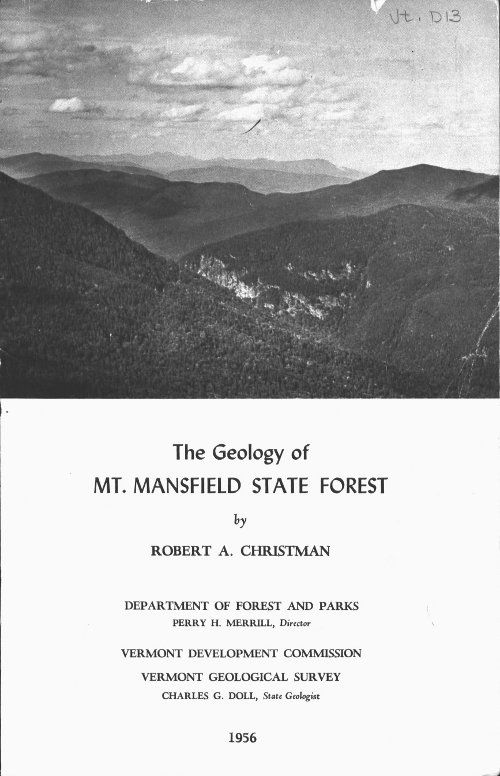
The Geology of Mt. Mansfield State Forest cover

The Geology of Mt. Mansfield State Forest

Chapter 16: Transcriber’s Notes
Open in WeRead

Explore more books like this:

About This Book

The pamphlet guides visitors through the geology of the Mount Mansfield area in four parts: rock descriptions, structural geology, glacial history, and site-specific observations. It explains that the dominant rock is a mica‑albite‑quartz schist produced by metamorphism of ancient marine sediments under heat and pressure, which created foliation and later folding. The account describes subsequent uplift and erosion that exposed the schists, summarizes evidence used to assign a Cambro‑Ordovician age of roughly 380–500 million years, and notes regional correlations to formations sometimes called Pinney Hollow or Camels Hump, concluding with accessible field examples for observing the described features.

The cliffs at Smugglers Notch as seen looking south from the west wall of the Notch.

FOOTNOTES

[1]Rocks are classified as being either igneous, sedimentary, or metamorphic. Igneous rocks form by the solidification of molten material; sedimentary rocks form by the accumulation of sediments derived from older rocks; and metamorphic rocks form by recrystallization of older rocks under conditions of high temperatures and pressures.

MOUNT MANSFIELD STATE FOREST

High-resolution Version

Transcriber’s Notes

  • Silently corrected a few typos.
  • Retained publication information from the printed edition: this eBook is public-domain in the country of publication.
  • In the text versions only, text in italics is delimited by _underscores_.