
WeRead Powered by ReaderPub
The German Classics from the Fourth to the Nineteenth Century, Vol. 1 (of 2) cover

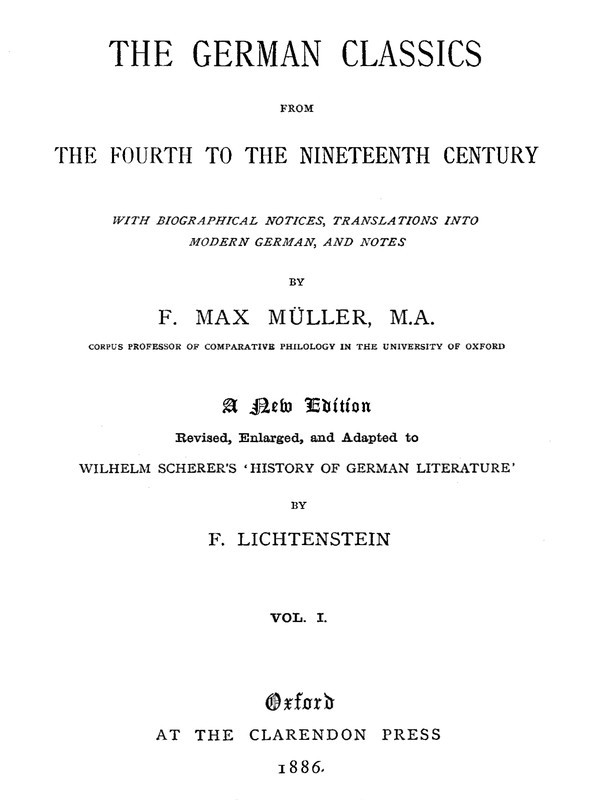
The German Classics from the Fourth to the Nineteenth Century, Vol. 1 (of 2)

Chapter 30: SANGALLER RHETORIK.
Open in WeRead

About This Book

A companion anthology assembles representative extracts of German prose and poetry from the fourth to the nineteenth century, chosen to illustrate the literary periods treated in a contemporary scholarly history. It presents original medieval and early‑modern texts alongside modern German renderings, and includes biographical notices, editorial notes, and guidance on transcription, orthography, and layout. Selection principles and chapter headings follow the historian’s framework while certain major figures receive extended treatment, and the volume intermixes poems, prose excerpts, and critical commentary to serve as a practical reading‑book and reference for students and general readers.

SANGALLER RHETORIK.

[Scherer D. 61, E. 55.]

Bruchstück eines Jagdgedichtes aus dem Capitel ‘quid sit elocutio’ der Sangallischen Rhetorik. Herausgegeben in den Denkmälern Nr. 26.

Der heber gât in lîtun, ‖ trégit spér in sîtun:
sîn báld éllin ‖ ne lâzet ín véllin .....
Imo sínt fûoze ‖ fûodermâze,
ímo sínt púrste ‖ ébenhô fórste 10
únde zéne sîne ‖ zuuélifélnîge.
Der Eber geht auf der Leite (dem Abhang), ‖ trägt einen Speer in der Seite:
Seine kühne Kraft ‖ lässt ihn nicht fallen....
Er hat Füsse ‖ fudermässig (von dem Mass einer Wagenlast)
Er hat Borsten ‖ ebenso hoch wie der Wald,
Und seine Zähne sind ‖ zwölf Ellen lang.