
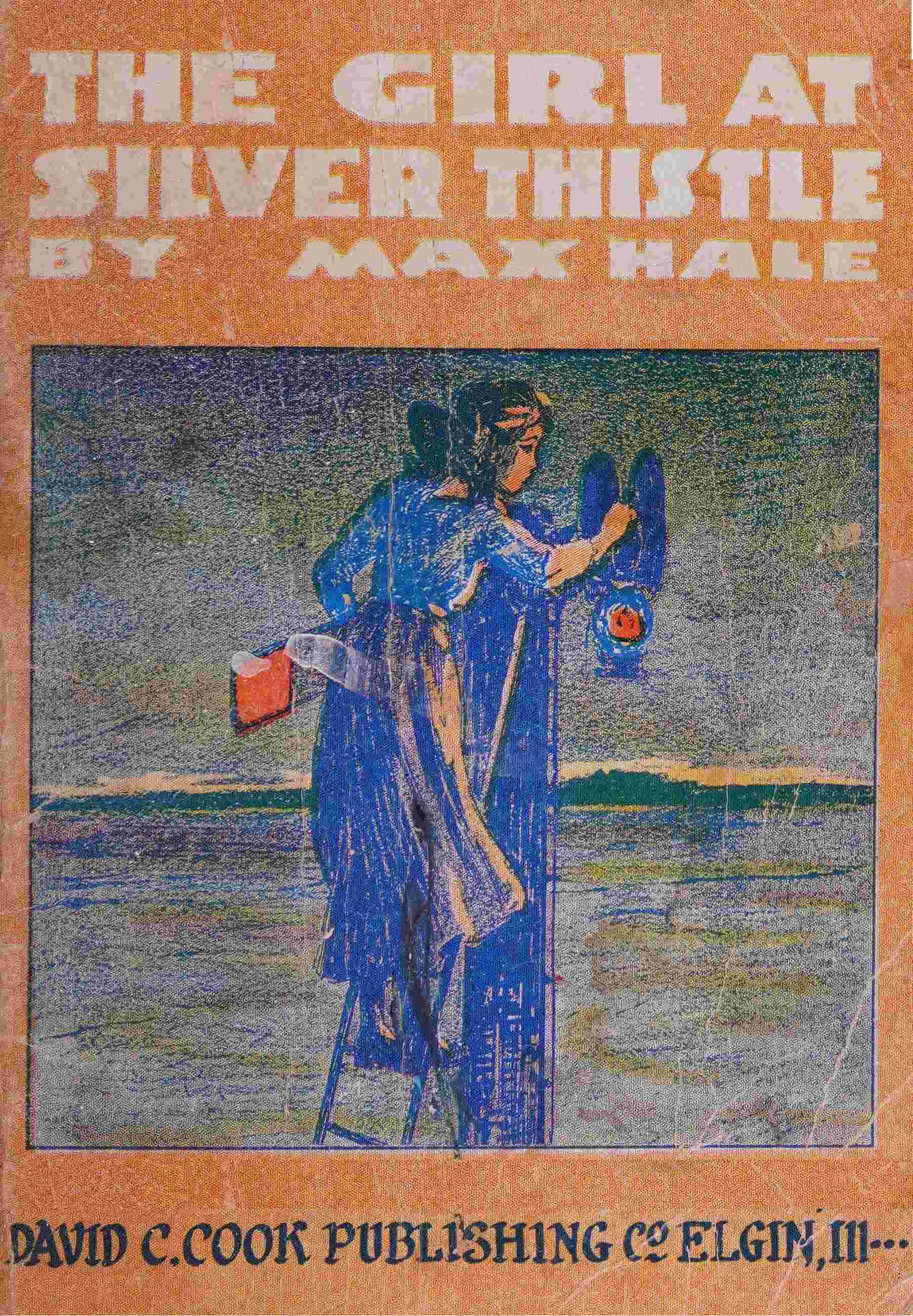
The Girl at Silver
Thistle
CHAPTER ONE
Though it was only five-thirty, supper was over in the yellow station-house at Silver Thistle. Nevada Buckley, singing as merrily as the nightingale, had put away the broom and the floor mop, in the regular task of helping her mother keep the little house tidy. Through the open window of the kitchen, came the staccato firing of a motor exhaust. Without looking at the clock on the shelf, the girl knew it was exactly twenty-eight minutes to six. Also and without looking toward the railroad, she knew that her father, Robert Buckley, had shut down the gas engine that pumped water into the big red tank. He was hauling out the “speeder” to make his regular evening run over the line to place the lamps in the block signals. Regularity and routine, even away out there on the desert, were things of importance at Silver Thistle. Nevada turned and saw her mother lay the last of the three sandwiches in her father’s lunch pail. The lid was clamped on. The girl picked up the pail and hurried out. In a moment she had skipped down the track and placed it in the hamper of the little car. Her father was seated and ready for the start.
“How is the tank, father?” she asked shouting her words in his ear so as to be heard above the loud firing of the motor.
“Plenty of water, Neva,” he told her. “You won’t need to start the engine this evening.” He had his hand on the clutch lever, and the car started forward as he shouted back, “but there’ll be a ‘Special’ through at six-twenty. Jim Fuson, who went through on Number Ten, told me about it. It will follow Number Sixteen.” He was gone then, with the speed of a rocket, straight toward the setting sun. As the “speeder” shot away, he waved a bronzed hand both to the girl on the track and to the one who stood in the door of the station-house.
“A ‘Special’!” said Nevada to herself. “I wonder what it could be? Father didn’t say—and Jim Fuson may not have told him. I wonder and oh, I hope it’s the private car of Superintendent Foster!” She spoke these latter words with an eagerness that proved a keen desire. Let it be said that in the life of those who lived at Silver Thistle, in the heart of the great Mohave desert, the “comings and goings” of the trains were events of importance. And “Specials” being out of the ordinary, were peculiarly so, for they, like all others, had to stop at Silver Thistle for water. And this gave the girl of the little yellow station-house an opportunity to catch fleeting glimpses of the dignitaries and officials of the road, the big men who traveled in private coaches, and who had servants to wait upon them. Famous singers, governors of states, and millionaires also traveled that way, and all of them had to stop at Silver Thistle.
It was not a great deal of notice most of these big or famous folk gave to the ruddy-cheeked girl at the lonely pump-station. And Nevada had only a fleeting peep at most of them through the polished plate-glass windows. Yet there was one who had noticed her. This one was a girl like herself—like herself in years only. For this other girl was not ruddy-cheeked, with arms and neck tanned brown by the desert sun and wind. She was, as Nevada caught sight of her, just a slender slip of a girl, with pale cheeks and big, appealing eyes. Nevada remembered those eyes, for they had looked through the wide window of the big private car straight down at her. She had even smiled, a sweet, kindly smile, when the desert girl returned her gaze!
That was a month ago, when the private car of Superintendent Foster, on its regular round, paused at Silver Thistle. Now it was time for the big car, with its brightly varnished body and shining brass rails to arrive again. Nevada wondered if the pale-faced girl, with the appealing eyes, would look out and smile at her again through the wide plate-glass window.
Hopefully and expectantly, she returned to the house, singing as before. She gave her mother’s glowing face a fond touch of the hand as she went through the door and passed on to her own room. Here she took down a book she had been reading, but she could not get interested in the story. Seated by the open window, she kept lifting her eyes to look down the railroad track of which the long lines of shimmering steel faded away in the distance. Silver Thistle, with its group of three tiny buildings and a water tank, was an oasis in the desert. Around the lonely station spread endless miles of yellow sand, broken only by clumps of gray-green mesquite. Away over on the border line—on the very edge of the world, it seemed, the Funeral Range formed a dim, zigzagged line between earth and sky.
Once, when Nevada raised her eyes and looked down the track, she saw a black dot appear at the end of the shimmering line. This dot seemed to dance about at first, as if playing with the heat waves; but it grew larger and steadier as the moments passed, soon resolving itself into the form of a locomotive trailed by a long line of passenger cars. Across the desert it came, its swift passage now marked by a rumbling roar, and hurling the dust in a long, thin cloud. When the musical tritone of the whistle reached her, Nevada closed her book with a snap and leaned out of the window. In less than a minute Number Seven, with a loud screeching of its brakes, slid to a halt at the water tank.
The huge, palpitating locomotive, its air-pump breathing hard, like a hound after a hard chase, halted but a few yards from Nevada’s open window. Out of the cab was thrust the gray head of Jerry Kerrigan. Though a pair of motor goggles, worn to protect his keen gray eyes from the flying sand, gave his face a grotesque look, it could not completely hide the jovial smile the veteran engineer ever had for the girl of Silver Thistle. The train stopped but long enough to take water. Then the great, black monster, trembling with the power of its mighty strength, leaned to its load, and moved forward, belching a cloud of smoke from its stack.
“Oh, say, Neva—” Jerry called back, “I almost forgot: The superintendent’s ‘Special’ is just behind us! And, say—his girl will be with him! Look for her!”
The train was gone, with a roar, leaving a smell of burned oil in its wake.
Singing again, even more joyfully, Nevada stood by the window, watching for the “Special.” There came another rumbling roar from down the track, followed by another musical call of a locomotive’s whistle, and a minute later the “Special” had come to a halt at the water tank. There were only two cars—a pitiful load it seemed for that great, high-wheeled engine. The rear car alone attracted the attention of the desert girl. Her eager eyes took in every detail, and a happy smile brightened her face when she saw the name, painted in gold letters on the side. She repeated the name aloud:
“Debue! Debue!”
While she looked, a girl came out on the rear platform, to stand for a while inside the brass railing. Behind her followed a portly, white-haired man—a man whose features and bearing portrayed power and purpose and leadership. Nevada’s heart fluttered exultantly, for the girl was the one who had smiled down at her through the wide window of the coach—and the man who stood near her was Superintendent Foster.
To Nevada’s ear came the joyful exclamation of the girl: “Oh, how lovely they are! I must have some of them. Please, father, can’t I have just a minute to pick some of them?”
Then she turned her big, appealing eyes to her father, and the superintendent with a smile, nodded his assent. “Go ahead, my dear! But be careful—and stay only a minute.”
Wondering what it was the girl had admired and wanted, Nevada watched while a porter opened the railing gate and placed a footstool under the lower step. The girl tripped down lightly and ran out across the right-of-way. Nevada followed her with keenly interested gaze. When the girl uttered another exclamation of delight, Nevada knew what it was that had attracted her. She was plucking the tall thistles—the long-stemmed, silver-plumed thistles that had given the isolated station its name.
She was plucking the tall thistles.
Nevada, too, had admired the silver thistles—admired them for their hardihood, their happy way of nodding their plumed heads in pleasant salutation when nearly all other growing things were dried up, blistered and burned by the desert heat. She was glad this other girl loved them and could see the simple, unadorned beauty they possessed. She had a big vase filled with them in her room, and another in the cozy living-room of the station-house. Had she only known—could she only have guessed, she would have gathered an armload of them and had them ready when the “Special” arrived. What a chance that would have been to get acquainted, to have received a word from the girl who had smiled down at her!
Just then, she heard a loud, shrieking cry. It came with startling suddenness, causing her to lift her head quickly and look out of the window. The first cry was instantly followed by another, louder than the first. The girl in the silver thistles was standing stiffly erect, holding a long, slender hand above her head. From her hand dangled a wriggling, twisting thing that fell to the ground while the desert girl looked.
“It’s a scorpion—a scorpion! She has been stung by a scorpion!” Nevada spoke aloud in tones of sympathy and alarm. The girl continued to scream while her father and the porter hurried from the car.
Nevada whirled swiftly from the window and out of her room. She knew that help was needed out there, and needed quickly. And she knew what must be done.
“Mother!” she called. “Mother—quick, hot water, ammonia, olive oil—the superintendent’s daughter has been stung by a scorpion!”
She was out of the house then, and running swiftly as a deer down the track.