
Before Nevada reached the rear coach of the “Special,” the superintendent’s daughter, supported by her father, was taken to the car steps. Her wild cries had subsided, but she continued to moan with pain. She had dropped her load of pink-tinted thistle blossoms. Her face was ghastly pale. Her big eyes were filled with a strange terror. She wrung her injured hand incessantly, now opening, now closing her rapidly stiffening fingers.
“Poor dear! Poor dear!” said her father with affectionate sympathy. “Be quiet, Sweetheart—we will help you. Quick, Sam, up the step! We must make a fast run to Alcazar!”
Alcazar, the next town of any importance or size, where medical aid could be had, was one hundred miles away. It could not be reached, even by the “Special,” in less than one hour and twenty minutes. By that time the deadly venom from the scorpion’s sting would have done its fatal work.
Nevada Buckley heard the name of the distant town spoken and she guessed the intention of the superintendent. In his anxiety and alarm he had not observed the coming of the desert girl. But now she made her presence known, speaking to him quickly. “Please, Mr. Foster, bring her to the house. Mother and I know what to do. Don’t take her on until she is relieved.”
The superintendent lifted his head in surprise. Anxiety was printed on his usually serene countenance. “Are you certain?” he said. “It must be cared for at once. We can make a fast run to Alcazar—”
“It would take too long,” Nevada cried. “Bring her to mother. She is getting things ready now. We know just what to do. I was stung by a scorpion in almost the same way.”
Nevada drew closer and looked unflinchingly into the steady gray eyes of the railroad magnate. For a brief moment he seemed not only to be gazing at her, but sounding the depths of her very soul, measuring her ability, her sincerity. It was his way of estimating the worth of those whom he trusted. And this was the time when his trust meant more than ever.
“Very well,” he said in tones of finality. “We’ll take her to the house! Come, Sam, help me carry her! Easy now, easy, that’s the man!” The two lifted the injured girl and carried her between them. Nevada ran on ahead. Her mother had built a quick fire in the kitchen stove and already the kettle was singing. The living-room sofa was drawn out to a convenient position. Near it was placed a stand with a ready ammonia bottle, olive oil, bandages and a sharp-bladed penknife.
“Lay her here,” directed Nevada, when the two men entered with their burden, followed by other members of the crew, all offering their assistance, all eager to help. They waited at the door, their caps in their hands, while Nevada, with the deftness and sureness of a trained nurse, proceeded to remove the poison and dress the wound of the superintendent’s daughter. Their hearts went to their throats, brave fellows though they were, when the half-unconscious girl screamed with pain. Then her head dropped limp on the arm of her father, while Nevada worked on with swift-moving fingers.
“It’s out now, the worst of the poison is out!” she spoke assuringly, as she poured on the soothing olive oil and wrapped the injured finger with a broad bandage. “She will soon be all right.”
She brought cold water, the coldest that could be had in the station-house, dipped her cool fingers in the basin and rubbed them gently over the forehead of the unconscious girl. After a time—a very long time it seemed to those who anxiously waited—a bit of color came into the pale face, and the big, dark eyes opened wide and staring. They gazed first into the strong face of the superintendent, who began at once to talk to his daughter in words of happy assurance. Then they looked up into the ruddy face of Nevada, looked up, as they had looked through the window that day, in mute appeal, with real kindness and genuine sympathy. When Nevada smiled, the other girl smiled in return.
“Where am I?” asked the wounded girl in wonderment, as her gaze shifted from one to another of the group around her in the little room lighted by the red glow of the sunset. But now dusk was falling and Mrs. Buckley placed a lamp on the stand as Mr. Foster answered.
“You’re at Silver Thistle, in a house of friends,” he said. “This Little Doctor Lady has removed the scorpion’s sting, for which we are thankful.”
Nevada bathed the hand again, and this time the girl on the sofa gave her a happy look of recognition. “Oh, I know!” she exclaimed, raising her uninjured hand to the warm, round cheek so near her. “You are the girl at Silver Thistle. I’ve seen you. And I’ve wanted to meet you.”
Thrilled by the kindness and sympathy of the girl’s words, Nevada lovingly touched her lips to the outstretched hand, then took it in her own cool fingers and pressed it tenderly. It was the beginning of a real friendship, the welding of human hearts, and Superintendent Foster, big stern man that he was, looked on with eyes of understanding. He tried to speak, but a lump came up in his throat and choked him.
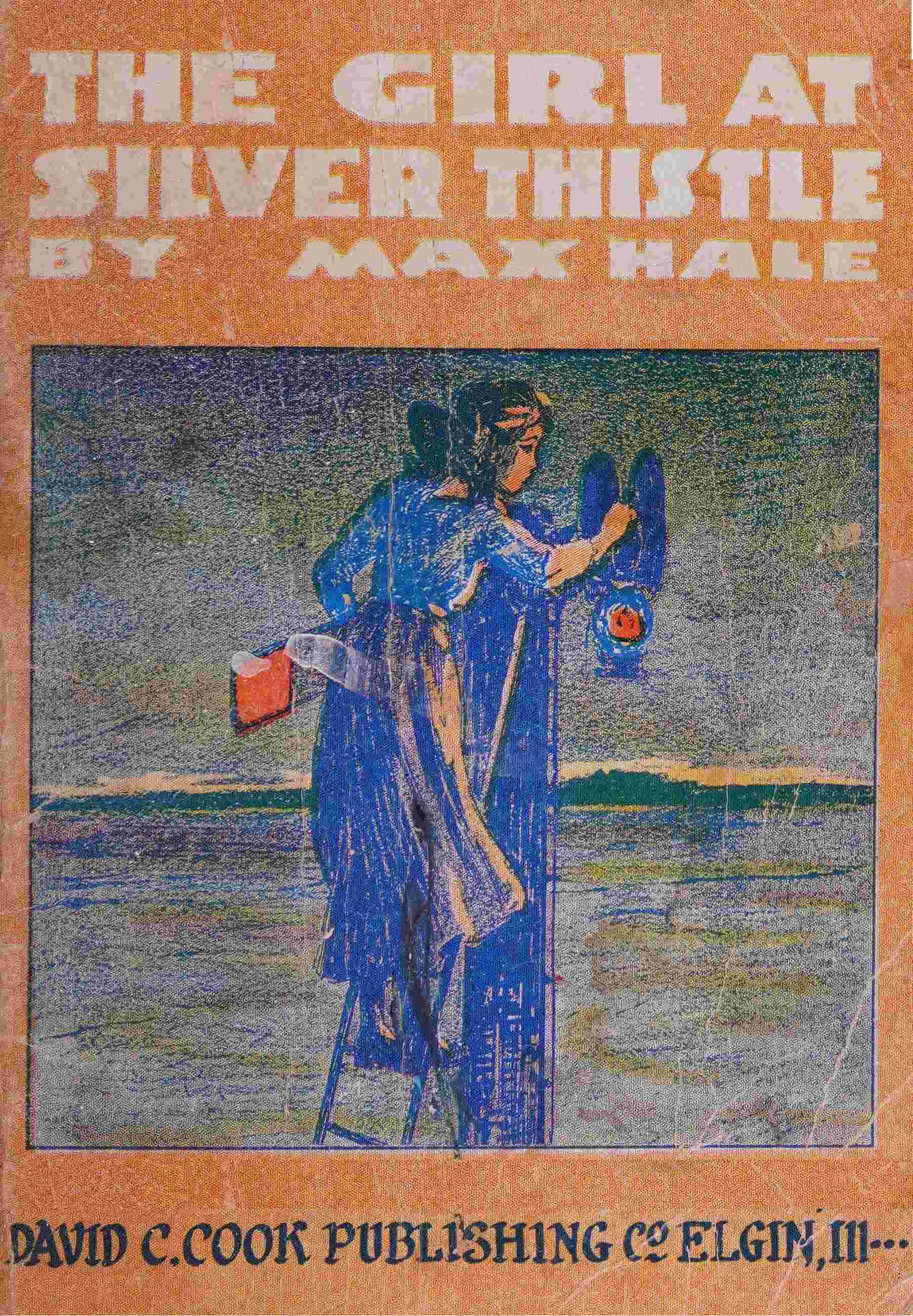
Just then the uniformed conductor of the “Special,” cap in hand, and carrying a brightly polished lantern, came in on tiptoe and touched the superintendent on the shoulder. “I beg pardon,” he said in low tones, “I merely ask for orders. We’re an hour behind now, Number Eighteen is behind us, and Number Eleven is waiting at Sand Ridge siding.”
“You’re right,” spoke the magnate quickly. During the past hour of anxiety and uncertainty he had forgotten everything save this one who was dearer to him than all else in the world—forgotten that he was a railroad man with a life of routine keyed to schedules, time tables and orders. “We’ve tied up the line, all right,” he added with a smile. “The road is probably wondering what’s wrong. No doubt they think that the ‘Special’ is lost in the desert. We’ll move on, Ralston, in just a few minutes.”
“Very well, sir,” the train chief responded, as he turned and left the room.
A tense silence followed the conductor’s exit, during which the superintendent’s gray eyes were held on the upturned face of the desert girl. She knew the meaning of that look, and her heart sank. It meant the magnate was making ready to go.
“My Little Doctor Lady,” he said finally. “I’m in a position where I feel I must take orders from you. How about it—may we move the patient? May we take her on right away?”
Might they take her away—this girl who had come into her life, whose kindness, sympathy and friendship promised so much? Nevada did not reply at once. She wanted the girl to stay. Already the superintendent had tarried an hour, a very long time for a railroad chief to tarry at a place like Silver Thistle. Nevada wished with all her heart that the girl might stay. But she would tell the truth.
“She could be moved safely,” she said at length, “for the poison is out of her hand, and the inflammation will soon leave. You can get a doctor and nurse at Alcazar. But if you would trust her with us—for a time—I would—”
Nevada hesitated. Though she had summoned all her courage to make this heart demand, she found herself unable to finish what was on her mind to speak. The superintendent’s gray eyes were sounding the depths of her being again. It was a big thing to ask of him, a bigger thing, no doubt, than was his custom lightly to grant. He kept on searching her, even when she ceased speaking. And when he turned his gaze away, he let it shift to Mrs. Buckley, then from one corner to another of the little room. He was measuring them, gauging them, that he might be sure.
Nevada, watching him, found no offense in his searching glances. She was filled with the spirit of the railroad, and she knew how much depended upon human faith and confidence. She begged only for an opportunity to serve, to prove herself a capable, trustworthy friend to this daughter of the chief. She looked down into the white face again, and was thrilled when the girl said:
“Let me stay, father, just a little while. There’s so much sunshine out here in the desert, and this dear girl and I will have such a good time—”
“Oh, yes, we will indeed!” Nevada brought in exultantly.
A happy smile came again into the face of Mr. Foster. “Very well, my dear,” he assented. “I will go on, and leave you here.” He turned and said to Mrs. Buckley: “I have known your husband for some time, by his record. There is not a mark against him. And I feel that I know him better since I have witnessed what his daughter can do.”
The little woman of the station house blushed proudly. He turned again to Nevada. “Little Doctor Lady, I’m going to leave my daughter with you for a week. It will require just that length of time for me to make the round. Remember that for real loved ones, I am alone in the world except for her. She is everything to me.”
“I am going to leave my daughter with you for a week.”
A tear glittered on his cheek as he stooped and kissed his daughter’s white face. “Good-by, Sweetheart,” he spoke in affectionate farewell. “Get well. Get all the sunshine you can. Be careful, and obey the orders of the Little Doctor Lady!”
She clung to him a moment, with her well hand, and then let him go. He rose quickly, erect and alert, a railroad man again. “Sam,” he spoke to the porter, “bring her suit case and luggage bag from the car. She will need nothing more!” As he went out of the door he called to the conductor, who paced restlessly back and forth. “All ready, Ralston,” he said. “Make quick time to Sand Ridge!”
Nevada, stooping by the sofa, with the hand of the girl pressed in her own, heard the shrill call of the locomotive as its five long blasts brought in the rear brakeman. Then the bell clanged, and with a mighty roar, as if impatient of the delay, the superintendent’s “Special” whirled away into the desert night.