
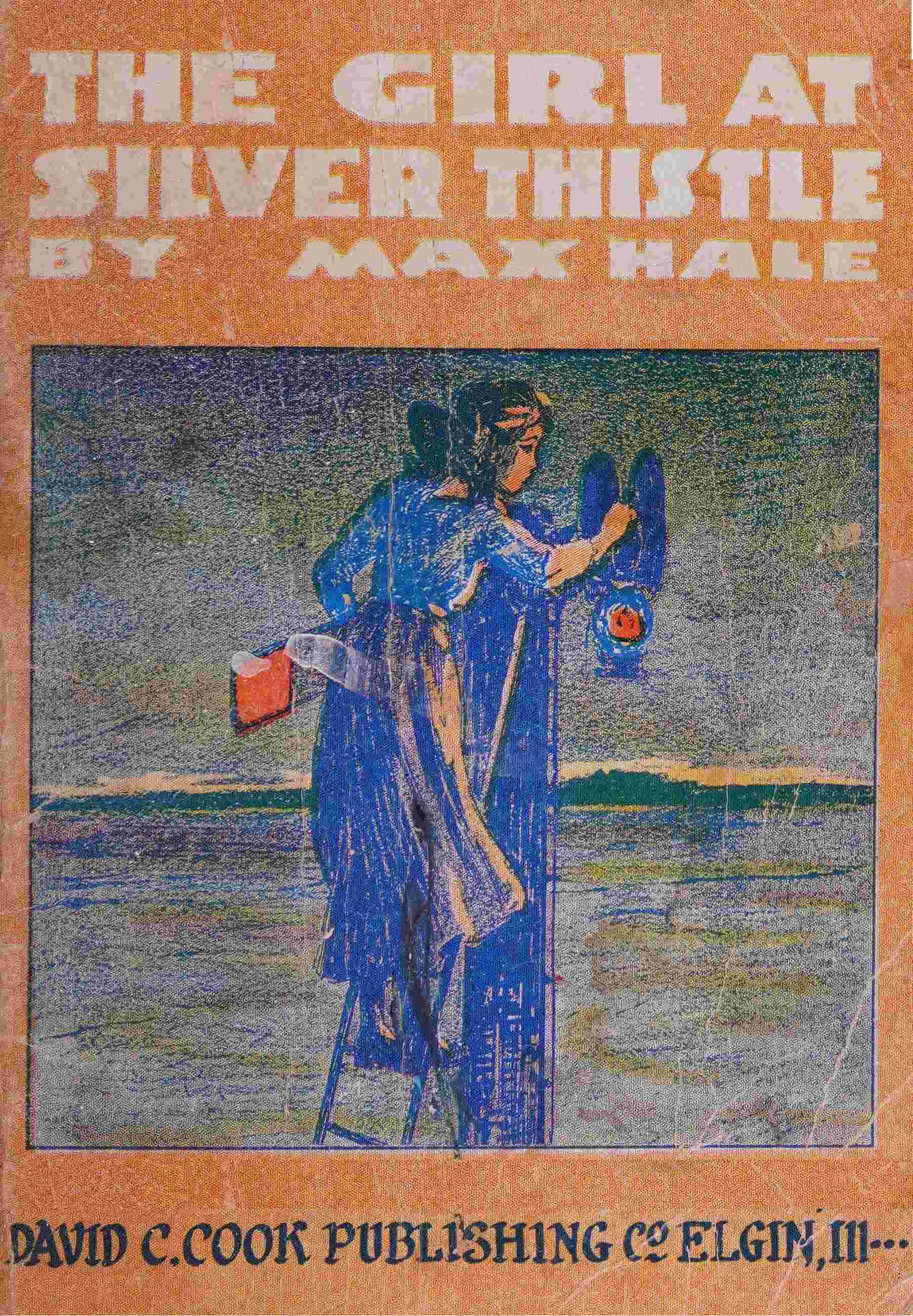
So intense was Nevada’s fear that Debue was lost, that she stood like one paralyzed. A score of terrorizing possibilities, connected with the mysterious appearance of that midnight prowler and of the man’s head that had appeared for a moment above the sand ridge came into her mind.
At length she started forward, then dropped again to scan the trail closely. It was getting dark now and tracks of any sort were hard to see, yet there were no new footprints on the sand-blown path. Then she made a trumpet of her hands and called and called; then listened intently. There was no responding cry. A breathless quietude settled over the desert. The nightingales were hushed. It was as if all living creatures of the vast sand wastes had gone to sleep. “Oh, Debue, Debue! Why did I let you go?” she cried aloud, but the great void around her brought no echoing cry.
She made a trumpet of her hands and called.
The rumble of a train, far away in the distance, reminded her that in a few short hours the superintendent’s “Special” would arrive at Silver Thistle. If Debue were not there to meet her father—it was too dreadful a thing to contemplate. She recalled the last words of the chief, spoken to her as he firmly gripped her hand and gazed into her face, “I leave her in your care. She is everything to me. I am going to trust you!”
To her belonged the true spirit of the railroad, which meant that failure of duty, failure to make good on a trust imposed, was an unpardonable sin. Tears streamed down Nevada’s face as she paced up and down the ridge, wrung her hands helplessly and shouted out over the desert. It was not that she lacked courage, but the thought that Debue was lost because of her own neglect all but overwhelmed her.
But she realized that she must go out into the desert and find her friend, who was possibly wandering in an aimless circle not a great distance from the “lookout.” She knew from the observations made of the trail in daylight, that Debue got off the path before she had fully crossed the mesa. The trail made a sweeping curve, of which fact Debue had probably never taken note. And, Nevada reasoned, when she got off the beaten path, she had gone straight ahead. On this supposition, she went back halfway across the mesa, then turned round and took a direct course from the coulee. She reached it fully a half-mile west of the regular trail crossing. The opposite slope was rough and broken with outcroppings of shale rock that still held the heat of the sun absorbed through the blistering day. Beyond were ravines, equally rough, but grown with straggling clumps of mesquite.
On the summit of the knob, when she had caught her breath, she again gave a long, shrill call. In the stillness of the desert the pounding of her own heart was the loudest thing she heard. Conquering terror, she started on again. Debue, she believed, would naturally have followed the ridge, but in what direction, was a guess. The “lookout” path turned to the left, so to the left she went, pausing now and then to shout and listen.
It had become lighter because the stars were brighter. But with a feeling of uneasiness, she observed that the handle of the Big Dipper was swinging up from the ragged hump of the Vermilion Cliffs. This meant that time was swiftly passing. Away off in the distance sounded the low rumble of a train. In less than two hours the superintendent’s “Special” would be due at Silver Thistle. The increased rumbling of the approaching train brought a new course of reasoning to her mind. Debue would undoubtedly hear it, and unless she was too badly confused, would take a course calculated to lead her toward the railroad. If she had wandered along the shale ridge, she would reach the track a mile or more west of the station-house. The possibility of this gave Nevada renewed hope and courage, and believing that she would come upon Debue either on some nearby sand-ridge or on the railroad, she started swiftly toward the tracks.
But at the farther border of the mesa she halted abruptly. The distant edge dropped precipitately, broken by a deep coulee. At the edge of this her startled eyes caught the twinkle of a light almost directly below her. A momentary glimpse proved the light to come from a camp fire built of dry mesquite boughs and sagebrush. Its glow revealed the rough, unshaven faces of three men squatted in grotesque poses close around. They wore the garb, with slouched hats and leather chaps, of plainsmen. Behind them, dimly outlined, were three horses, saddled and bridled as if ready at any moment for instant service.
Nevada, afraid that the men had heard her, dodged behind a mesquite clump and lay quietly. Her heart pounded like a trip-hammer. Her breathing seemed loud enough to betray her. From her position under the bush she tried to solve the mystery of the strange trio. Why were they there? Why had they made a long ride across the desert, miles from the main-traveled roads? Why were they hiding, and what were they waiting for? These questions repeated themselves over and over in her baffled mind.
Though she had no definite reason for thinking so, she believed the men were connected in some way with the night prowler at the station-house, and the appearance of head and shoulders she had seen above the sand ridge while she and Debue had stood on the “lookout.” With these thoughts came the dreadful fear that it was the presence of the magnate’s daughter that had brought them there. Almost unbelievable as it was, the possibility that Debue might be down there, bound helplessly, ran through Nevada’s mind. She had heard of the daughters of rich men being carried off and held for ransom. That such an evil plot should not be carried out with her friend, she resolved she would risk her own life, if necessary.
Discreetly Nevada decided to learn first if Debue were really down there, held captive by the trio. Crawling and using intervening clumps of mesquite to screen her approach, she moved quietly as a cat down the steep slope. Within twenty feet of the men a dry twig under her snapped with a loud, startling sound.
“What was that?” she heard one of the men exclaim in a coarse voice of alarm.
“Sounded like a mesquite a-poppin’,” another replied.
“Then there must be somethin’ comin’ down into the draw!” declared the man who had first spoken.
“Don’t get excited, Bill,” said the third man, assuringly. “You’ll need steady nerves if we put this job through.”
“Just the same, it pays to be careful,” the nervous one said.
The creak of leather chaps and the jingle of spurs conveyed to Nevada the information that the trio had lifted themselves from their squatting position.
She knew that those peering eyes were searching the surrounding growth, and that the ears of the three were listening intently. Her heart almost stopped beating, when from a distant ridge a long-drawn, tremulous cry came shrill and far-reaching.
“Now you ought to know what got on your nerves, Bill,” spoke one of the men with a low chuckle.
“A coyote, eh?”
“Yes, nothin’ but a coyote!” the other two declared positively.
“Them critters have mighty queer voices. Sometimes they sound almost human,” one of the three added knowingly. “Most of the time, on nights like this, they sound howlishly inhuman.”
Once more the girl under the mesquite heard the jingle of spurs. She took a long breath of relief, for she knew the men were again squatted round the fire. Her ears were strained tensely to catch every word spoken.