
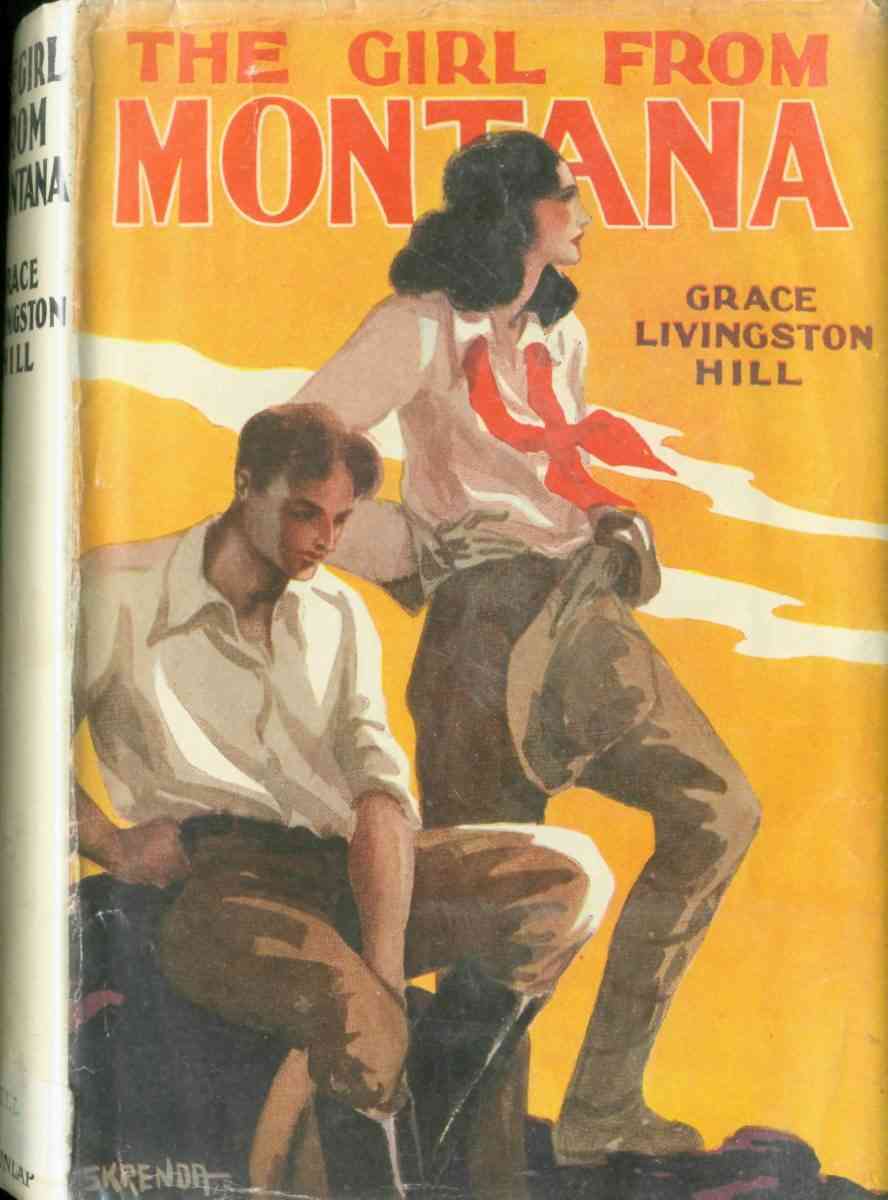
CHAPTER IV
THE TWO FUGITIVES
"I'm not anybody in particular," he answered, "and I'm not just sure where I belong. I live in Pennsylvania, but I didn't seem to belong there exactly, at least not just now, and so I came out here to see if I belonged anywhere else. I concluded yesterday that I didn't. At least, not until I came in sight of you. But I suspect I am running away myself. In fact, that is just what I am doing, running away from a woman!"
He looked at her with his honest hazel eyes, and she liked him. She felt he was telling her the truth, but it seemed to be a truth he was just finding out for himself as he talked.
"Why do you run away from a woman? How could a woman hurt you? Can she shoot?"
He flashed her a look of amusement and pain mingled.
"She uses other weapons," he said. "Her words are darts, and her looks are swords."
"What a queer woman! Does she ride well?"
"Yes, in an automobile!"
"What is that?" She asked the question shyly as if she feared he might laugh again; and he looked down, and perceived that he was talking far above her. In fact, he was talking to himself more than to the girl.
There was a bitter pleasure in speaking of his lost lady to this wild creature who almost seemed of another kind, more like an intelligent bird or flower.
"An automobile is a carriage that moves about without horses," he answered her gravely. "It moves by machinery."
"I should not like it," said the girl decidedly. "Horses are better than machines. I saw a machine once. It was to cut wheat. It made a noise, and did not go fast. It frightened me."
"But automobiles go very fast, faster than any horses And they do not all make a noise."
The girl looked around apprehensively.
"My horse can go very fast. You do not know how fast. If you see her coming, I will change horses with you. You must ride to the nearest bench and over, and then turn backward on your tracks. She will never find you that way. And I am not afraid of a woman."
The man broke into a hearty laugh, loud and long. He laughed until the tears rolled down his cheeks; and the girl, offended, rode haughtily beside him. Then all in a moment he grew quite grave.
"Excuse me," he said; "I am not laughing at you now, though it looks that way. I am laughing out of the bitterness of my soul at the picture you put before me. Although I am running away from her, the lady will not come out in her automobile to look for me. She does not want me!"
"She does not want you! And yet you ran away from her?"
"That's exactly it," he said. "You see, I wanted her!"
"Oh!" She gave a sharp, quick gasp of intelligence, and was silent. After a full minute she rode quite close to his horse, and laid her small brown hand on the animal's mane.
"I am sorry," she said simply.
"Thank you," he answered. "I'm sure I don't know why I told you. I never told any one before."
There was a long silence between them. The man seemed to have forgotten her as he rode with his eyes upon his horse's neck, and his thoughts apparently far away.
At last the girl said softly, as if she were rendering return for the confidence given her, "I ran away from a man."
The man lifted his eyes courteously, questioningly, and waited.
"He is big and dark and handsome. He shoots to kill. He killed my brother. I hate him. He wants me, and I ran away from him. But he is a coward. I frightened him away. He is afraid of dead men that he has killed."
The young man gave his attention now to the extraordinary story which the girl told as if it were a common occurrence.
"But where are your people, your family and friends? Why do they not send the man away?"
"They're all back there in the sand," she said with a sad little flicker of a smile and a gesture that told of tragedy. "I said the prayer over them. Mother always wanted it when we died. There wasn't anybody left but me. I said it, and then I came away. It was cold moonlight, and there were noises. The horse was afraid. But I said it. Do you suppose it will do any good?"
She fastened her eyes upon the young man with her last words as if demanding an answer. The color came up to his cheeks. He felt embarrassed at such a question before her trouble.
"Why, I should think it ought to," he stammered. "Of course it will," he added with more confident comfort.
"Did you ever say the prayer?"
"Why,—I—yes, I believe I have," he answered somewhat uncertainly.
"Did it do any good?" She hung upon his words.
"Why, I—believe—yes, I suppose it did. That is, praying is always a good thing. The fact is, it's a long time since I've tried it. But of course it's all right."
A curious topic for conversation between a young man and woman on a ride through the wilderness. The man had never thought about prayer for so many minutes consecutively in the whole of his life; at least, not since the days when his nurse tried to teach him "Now I lay me."
"Why don't you try it about the lady?" asked the girl suddenly.
"Well, the fact is, I never thought of it."
"Don't you believe it will do any good?"
"Well, I suppose it might."
"Then let's try it. Let's get off now, quick, and both say it. Maybe it will help us both. Do you know it all through? Can't you say it?" This last anxiously, as he hesitated and looked doubtful.
The color came into the man's face. Somehow this girl put him in a very bad light. He couldn't shoot; and, if he couldn't pray, what would she think of him?
"Why, I think I could manage to say it with help," he answered uneasily. "But what if that man should suddenly appear on the scene?"
"You don't think the prayer is any good, or you wouldn't say that." She said it sadly, hopelessly.
"O, why, certainly," he said, "only I thought there might be some better time to try it; but, if you say so, we'll stop right here." He sprang to the ground, and offered to assist her; but she was beside him before he could get around his horse's head.
Down she dropped, and clasped her hands as a little child might have done, and closed her eyes.
"Our Father," she repeated slowly, precisely, as if every word belonged to a charm and must be repeated just right or it would not work. The man's mumbling words halted after hers. He was reflecting upon the curious tableau they would make to the chance passer-by on the desert if there were any passers-by. It was strange, this aloneness. There was a wideness here that made praying seem more natural than it would have been at home in the open country.
The prayer, by reason of the unaccustomed lips, went slowly; but, when it was finished, the girl sprang to her saddle again with a businesslike expression.
"I feel better," she said with a winning smile. "Don't you? Don't you think He heard?"
"Who heard?"
"Why, 'our Father.'"
"O, certainly! That is, I've always been taught to suppose He did. I haven't much experimental knowledge in this line, but I dare say it'll do some good some where. Now do you suppose we could get some of that very sparkling water? I feel exceedingly thirsty."
They spurred their horses, and were soon beside the stream, refreshing themselves.
"Did you ride all night?" asked the girl.
"Pretty much," answered the man. "I stopped once to rest a few minutes; but a sound in the distance stirred me up again, and I was afraid to lose my chance of catching you, lest I should be hopelessly lost. You see, I went out with a party hunting, and I sulked behind. They went off up a steep climb, and I said I'd wander around below till they got back, or perhaps ride back to camp; but, when I tried to find the camp, it wasn't where I had left it."
"Well, you've got to lie down and sleep awhile," said the girl decidedly. "You can't keep going like that. It'll kill you. You lie down, and I'll watch, and get dinner. I'm going to cook that bird."
He demurred, but in the end she had her way; for he was exceedingly weary, and she saw it. So he let her spread the old coat down for him while he gathered some wood for a fire, and then he lay down and watched her simple preparations for the meal. Before he knew it he was asleep.
When he came to himself, there was a curious blending of dream and reality. He thought his lady was coming to him across the rough plains in an automobile, with gray wings like those of the bird the girl had shot, and his prayer as he knelt in the sand was drawing her, while overhead the air was full of a wild, sweet music from strange birds that mocked and called and trilled. But, when the automobile reached him and stopped, the lady withered into a little, old, dried-up creature of ashes; and the girl of the plains was sitting in her place radiant and beautiful.
He opened his eyes, and saw the rude little dinner set, and smelt the delicious odor of the roasted bird. The girl was standing on the other side of the fire, gravely whistling a most extraordinary song, like unto all the birds of the air at once.
She had made a little cake out of the corn-meal, and they feasted royally.
"I caught two fishes in the brook. We'll take them along for supper," she said as they packed the things again for starting. He tried to get her to take a rest also, and let him watch; but she insisted that they must go on, and promised to rest just before dark. "For we must travel hard at night, you know," she added fearfully.
He questioned her more about the man who might be pursuing, and came to understand her fears.
"The scoundrel!" he muttered, looking at the delicate features and clear, lovely profile of the girl. He felt a strong desire to throttle the evil man.
He asked a good many questions about her life, and was filled with wonder over the flower-like girl who seemed to have blossomed in the wilderness with no hand to cultivate her save a lazy, clever, drunken father, and a kind but ignorant mother. How could she have escaped being coarsened amid such surroundings. How was it, with such brothers as she had, that she had come forth as lovely and unhurt as she seemed? He somehow began to feel a great anxiety for her lonely future and a desire to put her in the way of protection. But at present they were still in the wilderness; and he began to be glad that he was here too, and might have the privilege of protecting her now, if there should be need.
As it grew toward evening, they came upon a little grassy spot in a coulee where the horses might rest and eat. Here they stopped, and the girl threw herself under a shelter of trees, with the old coat for a pillow, and rested, while the man paced up and down at a distance, gathering wood for a fire, and watching the horizon. As night came on, the city-bred man longed for shelter. He was by no means a coward where known quantities were concerned, but to face wild animals and drunken brigands in a strange, wild plain with no help near was anything but an enlivening prospect. He could not understand why they had not come upon some human habitation by this time. He had never realized how vast this country was before. When he came westward on the train he did not remember to have traversed such long stretches of country without a sign of civilization, though of course a train went so much faster than a horse that he had no adequate means of judging. Then, besides, they were on no trail now, and had probably gone in a most roundabout way to anywhere. In reality they had twice come within five miles of little homesteads, tucked away beside a stream in a fertile spot; but they had not known it. A mile further to the right at one spot would have put them on the trail and made their way easier and shorter, but that they could not know.
The girl did not rest long. She seemed to feel her pursuit more as the darkness crept on, and kept anxiously looking for the moon.
"We must go toward the moon," she said as she watched the bright spot coming in the east.
They ate their supper of fish and corn-bread with the appetite that grows on horseback, and by the time they had started on their way again the moon spread a path of silver before them, and they went forward feeling as if they had known each other a long time. For a while their fears and hopes were blended in one.
Meantime, as the sun sank and the moon rose, a traveller rode up the steep ascent to the little lonely cabin which the girl had left. He was handsome and dark and strong, with a scarlet kerchief knotted at his throat; and he rode slowly, cautiously, looking furtively about and ahead of him. He was doubly armed, and his pistols gleamed in the moonlight, while an ugly knife nestled keenly in a secret sheath.
He was wicked, for the look upon his face was not good to see; and he was a coward, for he started at the flutter of a night-bird hurrying late to its home in a rock by the wayside. The mist rising from the valley in wreaths of silver gauze startled him again as he rounded the trail to the cabin, and for an instant he stopped and drew his dagger, thinking the ghost he feared was walking thus early. A draught from the bottle he carried in his pocket steadied his nerves, and he went on, but stopped again in front of the cabin; for there stood another horse, and there in the doorway stood a figure in the darkness! His curses rang through the still air and smote the moonlight. His pistol flashed forth a volley of fire to second him.
In answer to his demand who was there came another torrent of profanity. It was one of his comrades of the day before. He explained that he and two others had come up to pay a visit to the pretty girl. They had had a wager as to who could win her, and they had come to try; but she was not here. The door was fastened. They had forced it. There was no sign of her about. The other two had gone down to the place where her brother was buried to see whether she was there. Women were known to be sentimental. She might be that kind. He had agreed to wait here, but he was getting uneasy. Perhaps, if the other two found her, they might not be fair.
The last comer with a mighty oath explained that the girl belonged to him, and that no one had a right to her. He demanded that the other come with him to the grave, and see what had become of the girl; and then they would all go and drink together—but the girl belonged to him.
They rode to the place of the graves, and met the two others returning; but there was no sign of the girl, and the three taunted the one, saying that the girl had given him the slip. Amid much argument as to whose she was and where she was, they rode on cursing through God's beauty. They passed the bottle continually, that their nerves might be the steadier; and, when they came to the deserted cabin once more, they paused and discussed what to do.
At last it was agreed that they should start on a quest after her, and with oaths, and coarse jests, and drinking, they started down the trail of which the girl had gone in search by her roundabout way.
CHAPTER V
A NIGHT RIDE
It was a wonderful night that the two spent wading the sea of moonlight together on the plain. The almost unearthly beauty of the scene grew upon them. They had none of the loneliness that had possessed each the night before, and might now discover all the wonders of the way.
Early in the way they came upon a prairie-dogs' village, and the man would have lingered watching with curiosity, had not the girl urged him on. It was the time of night when she had started to run away, and the same apprehension that filled her then came upon her with the evening. She longed to be out of the land which held the man she feared. She would rather bury herself in the earth and smother to death than be caught by him. But, as they rode on, she told her companion much of the habits of the curious little creatures they had seen; and then, as the night settled down upon them, she pointed out the dark, stealing creatures that slipped from their way now and then, or gleamed with a fearsome green eye from some temporary refuge.
At first the cold shivers kept running up and down the young man as he realized that here before him in the sage-brush was a real live animal about which he had read so much, and which he had come out bravely to hunt. He kept his hand upon his revolver, and was constantly on the alert, nervously looking behind lest a troop of coyotes or wolves should be quietly stealing upon him. But, as the girl talked fearlessly of them in much the same way as we talk of a neighbor's fierce dog, he grew gradually calmer, and was able to watch a dark, velvet-footed moving object ahead without starting.
By and by he pointed to the heavens, and talked of the stars. Did she know that constellation? No? Then he explained. Such and such stars were so many miles from the earth. He told their names, and a bit of mythology connected with the name, and then went on to speak of the moon, and the possibility of its once having been inhabited.
The girl listened amazed. She knew certain stars as landmarks, telling east from west and north from south; and she had often watched them one by one coming out, and counted them her friends; but that they were worlds, and that the inhabitants of this earth knew anything whatever about the heavenly bodies, she had never heard. Question after question she plied him with, some of them showing extraordinary intelligence and thought, and others showing deeper ignorance than a little child in our kindergartens would show.
He wondered more and more as their talk went on. He grew deeply interested in unfolding the wonders of the heavens to her; and, as he studied her pure profile in the moonlight with eager, searching, wistful gaze, her beauty impressed him more and more. In the East the man had a friend, an artist. He thought how wonderful a theme for a painting this scene would make. The girl in picturesque hat of soft felt, riding with careless ease and grace; horse, maiden, plain, bathed in a sea of silver.
More and more as she talked the man wondered how this girl reared in the wilds had acquired a speech so free from grammatical errors. She was apparently deeply ignorant, and yet with a very few exceptions she made no serious errors in English. How was it to be accounted for?
He began to ply her with questions about herself, but could not find that she had ever come into contact with people who were educated. She had not even lived in any of the miserable little towns that flourish in the wildest of the West, and not within several hundred miles of a city. Their nearest neighbors in one direction had been forty miles away, she said, and said it as if that were an everyday distance for a neighbor to live.
Mail? They had had a letter once that she could remember, when she was a little girl. It was just a few lines in pencil to say that her mother's father had died. He had been killed in an accident of some sort, working in the city where he lived. Her mother had kept the letter and cried over it till almost all the pencil marks were gone.
No, they had no mail on the mountain where their homestead was.
Yes, her father went there first because he thought he had discovered gold, but it turned out to be a mistake; so, as they had no other place to go to, and no money to go with, they had just stayed there; and her father and brothers had been cow-punchers, but she and her mother had scarcely ever gone away from home. There were the little children to care for; and, when they died, her mother did not care to go, and would not let her go far alone.
O, yes, she had ridden a great deal, sometimes with her brothers, but not often. They went with rough men, and her mother felt afraid to have her go. The men all drank. Her brothers drank. Her father drank too. She stated it as if it were a sad fact common to all mankind, and ended with the statement which was almost, not quite, a question, "I guess you drink too."
"Well," said the young man hesitatingly, "not that way. I take a glass of wine now and then in company, you know—"
"Yes, I know," sighed the girl. "Men are all alike. Mother used to say so. She said men were different from women. They had to drink. She said they all did it. Only she said her father never did; but he was very good, though he had to work hard."
"Indeed," said the young man, his color rising in the moonlight, "indeed, you make a mistake. I don't drink at all, not that way. I'm not like them. I—why, I only—well, the fact is, I don't care a red cent about the stuff anyway; and I don't want you to think I'm like them. If it will do you any good, I'll never touch it again, not a drop."
He said it earnestly. He was trying to vindicate himself. Just why he should care to do so he did not know, only that all at once it was very necessary that he should appear different in the eyes of this girl from, the other men she had known.
"Will you really?" she asked, turning to look in his face. "Will you promise that?"
"Why, certainly I will," he said, a trifle embarrassed that she had taken him at his word. "Of course I will. I tell you it's nothing to me. I only took a glass at the club occasionally when the other men were drinking, and sometimes when I went to banquets, class banquets, you know, and dinners—"
Now the girl had never heard of class banquets, but to take a glass occasionally when the other men were drinking was what her brothers did; and so she sighed, and said: "Yes, you may promise, but I know you won't keep it. Father promised too; but, when he got with the other men, it did no good. Men are all alike."
"But I'm not," he insisted stoutly. "I tell you I'm not. I don't drink, and I won't drink. I promise you solemnly here under God's sky that I'll never drink another drop of intoxicating liquor again if I know it as long as I live."
He put out his hand toward her, and she put her own into it with a quick grasp for just an instant.
"Then you're not like other men, after all," she said with a glad ring in her voice. "That must be why I wasn't so very much afraid of you when I woke up and found you standing there."
A distinct sense of pleasure came over him at her words. Why it should make him glad that she had not been afraid of him when she had first seen him in the wilderness he did not know. He forgot all about his own troubles. He forgot the lady in the automobile. Right then and there he dropped her out of his thoughts. He did not know it; but she was forgotten, and he did not think about her any more during that journey. Something had erased her. He had run away from her, and he had succeeded most effectually, more so than he knew.
There in the desert the man took his first temperance pledge, urged thereto by a girl who had never heard of a temperance pledge in her life, had never joined a woman's temperance society, and knew nothing about women's crusades. Her own heart had taught her out of a bitter experience just how to use her God-given influence.
They came to a long stretch of level ground then, smooth and hard; and the horses as with common consent set out to gallop shoulder to shoulder in a wild, exhilarating skim across the plain. Talking was impossible. The man reflected that he was making great strides in experience, first a prayer and then a pledge, all in the wilderness. If any one had told him he was going into the West for this, he would have laughed him to scorn.
Towards morning they rode more slowly. Their horses were growing jaded. They talked in lower tones as they looked toward the east. It was as if they feared they might waken some one too soon. There is something awesome about the dawning of a new day, and especially when one has been sailing a sea of silver all night. It is like coming back from an unreal world into a sad, real one. Each was almost sorry that the night was over. The new day might hold so much of hardship or relief, so much of trouble or surprise; and this night had been perfect, a jewel cut to set in memory with every facet flashing to the light. They did not like to get back to reality from the converse they had held together. It was an experience for each which would never be forgotten.
Once there came the distant sound of shots and shouts. The two shrank nearer each other, and the man laid his strong hand protectingly on the mane of the girl's horse; but he did not touch her hand. The lady of his thoughts had sometimes let him hold her jewelled hand, and smiled with drooping lashes when he fondled it; and, when she had tired of him, other admirers might claim the same privilege. But this woman of the wilderness—he would not even in his thoughts presume to touch her little brown, firm hand. Somehow she had commanded his honor and respect from the first minute, even before she shot the bird.
Once a bob-cat shot across their path but a few feet in front of them, and later a kit-fox ran growling up with ruffled fur; but the girl's quick shot soon put it to flight, and they passed on through the dawning morning of the first real Sabbath day the girl had ever known.
"It is Sunday morning at home," said the man gravely as he watched the sun lift its rosy head from the mist of mountain and valley outspread before them. "Do you have such an institution out here?"
The girl grew white about the lips. "Awful things happen on Sunday," she said with a shudder.
He felt a great pity rising in his heart for her, and strove to turn her thoughts in other directions. Evidently there was a recent sorrow connected with the Sabbath.
"You are tired," said he, "and the horses are tired. See! We ought to stop and rest. The daylight has come, and nothing can hurt us. Here is a good place, and sheltered. We can fasten the horses behind these bushes, and no one will guess we are here."
She assented, and they dismounted. The man cut an opening into a clump of thick growth with his knife, and there they fastened the weary horses, well hidden from sight if any one chanced that way. The girl lay down a few feet away in a spot almost entirely surrounded by sage-brush which had reached an unusual height and made a fine hiding-place. Just outside the entrance of this natural chamber the man lay down on a fragrant bed of sage-brush. He had gathered enough for the girl first, and spread out the old coat over it; and she had dropped asleep almost as soon as she lay down. But, although his own bed of sage-brush was tolerably comfortable, even to one accustomed all his life to the finest springs and hair mattress that money could buy, and although the girl had insisted that he must rest too, for he was weary and there was no need to watch, sleep would not come to his eyelids.
He lay there resting and thinking. How strange was the experience through which he was passing! Came ever a wealthy, college-bred, society man into the like before? What did it all mean? His being lost, his wandering for a day, the sight of this girl and his pursuit, the prayer under the open sky, and that night of splendor under the moonlight riding side by side. It was like some marvellous tale.
And this girl! Where was she going? What was to become of her? Out in the world where he came from, were they ever to reach it, she would be nothing. Her station in life was beneath his so far that the only recognition she could have would be one which would degrade her. This solitary journey they were taking, how the world would lift up its hands in horror at it! A girl without a chaperon! She was impossible! And yet it all seemed right and good, and the girl was evidently recognized by the angels; else how had she escaped from degradation thus far?
Ah! How did he know she had? But he smiled at that. No one could look into that pure, sweet face, and doubt that she was as good as she was beautiful. If it was not so, he hoped he would never find it out. She seemed to him a woman yet unspoiled, and he shrank from the thought of what the world might do for her—the world and its cultivation, which would not be for her, because she was friendless and without money or home. The world would have nothing but toil to give her, with a meagre living.
Where was she going, and what was she proposing to do? Must he not try to help her in some way? Did not the fact that she had saved his life demand so much from him? If he had not found her, he must surely have starved before he got out of this wild place. Even yet starvation was not an impossibility; for they had not reached any signs of habitation yet, and there was but one more portion of corn-meal and a little coffee left. They had but two matches now, and there had been no more flights of birds, nor brooks with fishes.
In fact, the man found a great deal to worry about as he lay there, too weary with the unaccustomed exercise and experiences to sleep.
He reflected that the girl had told him very little, after all, about her plans. He must ask her. He wished he knew more of her family. If he were only older and she younger, or if he had the right kind of a woman friend to whom he might take her, or send her! How horrible that that scoundrel was after her! Such men were not men, but beasts, and should be shot down.
Far off in the distance, it might have been in the air or in his imagination, there sometimes floated a sound as of faint voices or shouts; but they came and went, and he listened, and by and by heard no more. The horses breathed heavily behind their sage-brush stable, and the sun rose higher and hotter. At last sleep came, troubled, fitful, but sleep, oblivion. This time there was no lady in an automobile.
It was high noon when he awoke, for the sun had reached around the sage-brush, and was pouring full into his face. He was very uncomfortable, and moreover an uneasy sense of something wrong pervaded his mind. Had he or had he not, heard a strange, low, sibilant, writhing sound just as he came to consciousness? Why did he feel that something, some one, had passed him but a moment before?
He rubbed his eyes open, and fanned himself with his hat. There was not a sound to be heard save a distant hawk in the heavens, and the breathing of the horses. He stepped over, and made sure that they were all right, and then came back. Was the girl still sleeping? Should he call her? But what should he call her? She had no name to him as yet. He could not say, "My dear madam" in the wilderness, nor yet "mademoiselle."
Perhaps it was she who had passed him. Perhaps she was looking about for water, or for fire-wood. He cast his eyes about, but the thick growth of sage-brush everywhere prevented his seeing much. He stepped to the right and then to the left of the little enclosure where she had gone to sleep, but there was no sign of life.
At last the sense of uneasiness grew upon him until he spoke.
"Are you awake yet?" he ventured; but the words somehow stuck in his throat, and would not sound out clearly. He ventured the question again, but it seemed to go no further than the gray-green foliage in front of him. Did he catch an alert movement, the sound of attention, alarm? Had he perhaps frightened her?
His flesh grew creepy, and he was angry with himself that he stood here actually trembling and for no reason. He felt that there was danger in the air. What could it mean? He had never been a believer in premonitions or superstitions of any kind. But the thought came to him that perhaps that evil man had come softly while he slept, and had stolen the girl away. Then all at once a horror seized him, and he made up his mind to end this suspense and venture in to see whether she were safe.
CHAPTER VI
A CHRISTIAN ENDEAVOR MEETING IN THE WILDERNESS
He stepped boldly around the green barrier, and his first glance told him she was lying there still asleep; but the consciousness of another presence held him from going away. There, coiled on the ground with venomous fangs extended and eyes glittering like slimy jewels, was a rattlesnake, close beside her.
For a second he gazed with a kind of fascinated horror, and his brain refused to act. Then he knew he must do something, and at once. He had read of serpents and travellers' encounters with them, but no memory of what was to be done under such circumstances came. Shoot? He dared not. He would be more likely to kill the girl than the serpent, and in any event would precipitate the calamity. Neither was there any way to awaken the girl and drag her from peril, for the slightest movement upon her part would bring the poisoned fangs upon her.
He cast his eyes about for some weapon, but there was not a stick or a stone in sight. He was a good golf-player; if he had a loaded stick, he could easily take the serpent's head off, he thought; but there was no stick. There was only one hope, he felt, and that would be to attract the creature to himself; and he hardly dared move lest the fascinated gaze should close upon the victim as she lay there sweetly sleeping, unaware of her new peril.
Suddenly he knew what to do. Silently he stepped back out of sight, tore off his coat, and then cautiously approached the snake again, holding the coat up before him. There was an instant's pause when he calculated whether the coat could drop between the snake and the smooth brown arm in front before the terrible fangs would get there; and then the coat dropped, the man bravely holding one end of it as a wall between the serpent and the girl, crying to her in an agony of frenzy to awaken and run.
There was a terrible moment in which he realized that the girl was saved and he himself was in peril of death, while he held to the coat till the girl was on her feet in safety. Then he saw the writhing coil at his feet turn and fasten its eyes of fury upon him. He was conscious of being uncertain whether his fingers could let go the coat, and whether his trembling knees could carry him away before the serpent struck; then it was all over, and he and the girl were standing outside the sage-brush, with the sound of the pistol dying away among the echoes, and the fine ache of his arm where her fingers had grasped him to drag him from danger.
The serpent was dead. She had shot it. She took that as coolly as she had taken the bird in its flight. But she stood looking at him with great eyes of gratitude, and he looked at her amazed that they were both alive, and scarcely understanding all that had happened.
The girl broke the stillness.
"You are what they call a 'tenderfoot,'" she said significantly.
"Yes," he assented humbly, "I guess I am. I couldn't have shot it to save anybody's life."
"You are a tenderfoot, and you couldn't shoot," she continued eulogistically, as if it were necessary to have it all stated plainly, "but you—you are what my brother used to call 'a white man.' You couldn't shoot; but you could risk your life, and hold that coat, and look death in the face. You are no tenderfoot."
There was eloquence in her eyes, and in her voice there were tears. She turned away to hide if any were in her eyes. But the man put out his hand on her sure little brown one, and took it firmly in his own, looking down upon her with his own eyes filled with tears of which he was not ashamed.
"And what am I to say to you for saving my life?" he said.
"I? O, that was easy," said the girl, rousing to the commonplace. "I can always shoot. Only you were hard to drag away. You seemed to want to stay there and die with your coat."
"They laughed at me for wearing that coat when we started away. They said a hunter never bothered himself with extra clothing," he mused as they walked away from the terrible spot.
"Do you think it was the prayer?" asked the girl suddenly.
"It may be!" said the man with wondering accent.
Then quietly, thoughtfully, they mounted and rode onward.
Their way, due east, led them around the shoulder of a hill. It was tolerably smooth, but they were obliged to go single file, so there was very little talking done.
It was nearly the middle of the afternoon when all at once a sound reached them from below, a sound so new that it was startling. They stopped their horses, and looked at each other. It was the faint sound of singing wafted on the light breeze, singing that came in whiffs like a perfume, and then died out. Cautiously they guided their horses on around the hill, keeping close together now. It was plain they were approaching some human being or beings. No bird could sing like that. There were indistinct words to the music.
They rounded the hillside, and stopped again side by side. There below them lay the trail for which they had been searching, and just beneath them, nestled against the hill, was a little schoolhouse of logs, weather-boarded, its windows open; and behind it and around it were horses tied, some of them hitched to wagons, but most of them with saddles.
The singing was clear and distinct now. They could hear the words. "O, that will be glory for me, glory for me, glory for me—"
"What is it?" she whispered.
"Why, I suspect it is a Sunday school or something of the kind."
"O! A school! Could we go in?"
"If you like," said the man, enjoying her simplicity. "We can tie out horses here behind the building, and they can rest. There is fresh grass in this sheltered place; see?"
He led her down behind the schoolhouse to a spot where the horses could not be seen from the trail. The girl peered curiously around the corner into the window. There sat two young girls about her own age, and one of them smiled at her. It seemed an invitation. She smiled back, and went on to the doorway reassured. When she entered the room, she found them pointing to a seat near a window, behind a small desk.
There were desks all over the room at regular intervals, and a larger desk up in front. Almost all the people sat at desks.
There was a curious wooden box in front at one side of, the big desk, and a girl sat before it pushing down some black and white strips that looked like sticks, and making her feet go, and singing with all her might. The curious box made music, the same music the people were singing. Was it a piano? she wondered. She had heard of pianos. Her father used to talk about them. O, and what was that her mother used to want? A "cab'net-organ." Perhaps this was a cab'net-organ. At any rate, she was entranced with the music.
Up behind the man who sat at the big desk was a large board painted black with some white marks on it. The sunlight glinted across it, and she could not tell what they were; but, when she moved a little, she saw quite clearly it was a large cross with words underneath it—"He will hide me."
It was a strange place. The girl looked around shyly, and felt submerged in the volume of song that rolled around her, from voices untrained, perhaps, but hearts that knew whereof they sang. To her it was heavenly music, if she had the least conception of what such music was like. "Glory," "glory," "glory!" The words seemed to fit the day, and the sunshine, and the deliverance that had come to her so recently. She looked around for her companion and deliverer to enjoy it with him, but he had not come in yet.
The two girls were handing her a book now and pointing to the place. She could read. Her mother had taught her just a little before the other children were born, but not much in the way of literature had ever come in her way. She grasped the book eagerly, hungrily, and looked where the finger pointed. Yes, there were the words. "Glory for me!" "Glory for me!" Did that mean her? Was there glory for her anywhere in the world? She sighed with the joy of the possibility, as the "Glory Song" rolled along, led by the enthusiasm of one who had recently come from a big city where it had been sung in a great revival service. Some kind friend had given some copies of a leaflet containing it and a few other new songs to this little handful of Christians, and they were singing them as if they had been a thousand strong.
The singing ceased and the man at the big desk said, "Let us have the verses."
"'The eternal God is thy refuge, and underneath are the everlasting arms,'" said a careworn woman in the front seat.
"'He shall cover thee with his feathers, and under his wings shalt thou trust,'" said a young man next.
"'In the time of trouble he shall hide me in his pavilion; in the secret of his tabernacle shall he hide me,'" read the girl who had handed the book. The slip of paper she had written it on fluttered to the floor at the feet of the stranger, and the stranger stooped and picked it up, offering it back; but the other girl shook her head, and the stranger kept it, looking wonderingly at the words, trying to puzzle out a meaning.
There were other verses repeated, but just then a sound smote upon the girl's ear which deadened all others. In spite of herself she began to tremble. Even her lips seemed to her to move with the weakness of her fear. She looked up, and the man was just coming toward the door; but her eyes grew dizzy, and a faintness seemed to come over her.
Up the trail on horseback, with shouts and ribald songs, rode four rough men, too drunk to know where they were going. The little schoolhouse seemed to attract their attention as they passed, and just for deviltry they shouted out a volley of oaths and vile talk to the worshippers within. One in particular, the leader, looked straight into the face of the young man as he returned from fastening the horses and was about to enter the schoolhouse, and pretended to point his pistol at him, discharging it immediately into the air. This was the signal for some wild firing as the men rode on past the schoolhouse, leaving a train of curses behind them to haunt the air and struggle with the "Glory Song" in the memories of those who heard.
The girl looked out from her seat beside the window, and saw the evil face of the man from whom she had fled. She thought for a terrible minute, which seemed ages long to her, that she was cornered now. She began to look about on the people there helplessly, and wonder whether they would save her, would help her, in her time of need. Would they be able to fight and prevail against those four terrible men mad with liquor?
Suppose he said she was his—his wife, perhaps, or sister, who had run away. What could they do? Would they believe her? Would the man who had saved her life a few minutes ago believe her? Would anybody help her?
The party passed, and the man came in and sat down beside her quietly enough; but without a word or a look he knew at once who the man was he had just seen. His soul trembled for the girl, and his anger rose hot. He felt that a man like that ought to be wiped off the face of the earth in some way, or placed in solitary confinement the rest of his life.
He looked down at the girl, trembling, brave, white, beside him; and he felt like gathering her in his arms and hiding her himself, such a frail, brave, courageous little soul she seemed. But the calm nerve with which she had shot the serpent was gone now. He saw she was trembling and ready to cry. Then he smiled upon her, a smile the like of which he had never given to human being before; at least, not since he was a tiny baby and smiled confidingly into his mother's face. Something in that smile was like sunshine to a nervous chill.
The girl felt the comfort of it, though she still trembled. Down her eyes drooped to the paper in her shaking hands. Then gradually, letter by letter, word by word, the verse spoke to her. Not all the meaning she gathered, for "pavilion" and "tabernacle" were unknown words to her, but the hiding she could understand. She had been hidden in her time of trouble. Some one had done it. "He"—the word would fit the man by her side, for he had helped to hide her, and to save her more than once; but just now there came a dim perception that it was some other He, some One greater who had worked this miracle and saved her once more to go on perhaps to better things.
There were many things said in that meeting, good and wise and true. They might have been helpful to the girl if she had understood, but her thoughts had much to do. One grain of truth she had gathered for her future use. There was a "hiding" somewhere in this world, and she had had it in a time of trouble. One moment more out upon the open, and the terrible man might have seen her.
There came a time of prayer in which all heads were bowed, and a voice here and there murmured a few soft little words which she did not comprehend; but at the close they all joined in "the prayer"; and, when she heard the words, "Our Father," she closed her eyes, which had been curiously open and watching, and joined her voice softly with the rest. Somehow it seemed to connect her safety with "our Father," and she felt a stronger faith than ever in her prayer.
The young man listened intently to all he heard. There was something strangely impressive to him in this simple worship out in what to him was a vast wilderness. He felt more of the true spirit of worship than he had ever felt at home sitting in the handsomely upholstered pew beside his mother and sister while the choir-boys chanted the processional and the light filtered through costly windows of many colors over the large and cultivated congregation. There was something about the words of these people that went straight to the heart more than all the intonings of the cultured voices he had ever heard. Truly they meant what they said, and God had been a reality to them in many a time of trouble. That seemed to be the theme of the afternoon, the saving power of the eternal God, made perfect through the need and the trust of His people. He was reminded more than once of the incident of the morning and the miraculous saving of his own and his companion's life.
When the meeting was over, the people gathered in groups and talked with one another. The girl who had handed the book came over and spoke to the strangers, putting out her hand pleasantly. She was the missionary's daughter.
"What is this? School?" asked the stranger eagerly.
"Yes, this is the schoolhouse," said the missionary's daughter; "but this meeting is Christian Endeavor. Do you live near here? Can't you come every time?"
"No. I live a long way off," said the girl sadly. "That is, I did. I don't live anywhere now. I'm going away."
"I wish you lived here. Then you could come to our meeting. Did you have a Christian Endeavor where you lived?"
"No. I never saw one before. It's nice. I like it."
Another girl came up now, and put out her hand in greeting. "You must come again," she said politely.
"I don't know," said the visitor. "I sha'n't be coming back soon."
"Are you going far?"
"As far as I can. I'm going East."
"O," said the inquisitor; and then, seeing the missionary's daughter was talking to some one else, she whispered, nodding toward the man, "Is he your husband?"
The girl looked startled, while a slow color mounted into her cheeks.
"No," said she gravely, thoughtfully. "But—he saved my life a little while ago."
"Oh!" said the other, awestruck. "My! And ain't he handsome? How did he do it?"
But the girl could not talk about it. She shuddered.
"It was a dreadful snake," she said, "and I was—I didn't see it. It was awful! I can't tell you about it."
"My!" said the girl. "How terrible!"
The people were passing out now. The man was talking with the missionary, asking the road to somewhere. The girl suddenly realized that this hour of preciousness was over, and life was to be faced again. Those men, those terrible men! She had recognized the others as having been among her brother's funeral train. Where were they, and why had they gone that way? Were they on her track? Had they any clue to her whereabouts? Would they turn back pretty soon, and catch her when the people were gone home?
It appeared that the nearest town was Malta, sixteen miles away, down in the direction where the party of men had passed. There were only four houses near the schoolhouse, and they were scattered in different directions along the stream in the valley. The two stood still near the door after the congregation had scattered. The girl suddenly shivered. As she looked down the road, she seemed again to see the coarse face of the man she feared, and to hear his loud laughter and oaths. What if he should come back again? "I cannot go that way!" she said, pointing down the trail toward Malta. "I would rather die with wild beasts."
"No!" said the man with decision. "On no account can we go that way. Was that the man you ran away from?"
"Yes." She looked up at him, her eyes filled with wonder over the way in which he had coupled his lot with hers.
"Poor little girl!" he said with deep feeling. "You would be better off with the beasts. Come, let us hurry away from here!"
They turned sharply away from the trail, and followed down behind a family who were almost out of sight around the hill. There would be a chance of getting some provisions, the man thought. The girl thought of nothing except to get away. They rode hard, and soon came within hailing-distance of the people ahead of them, and asked a few questions.
No, there were no houses to the north until you were over the Canadian line, and the trail was hard to follow. Few people went that way. Most went down to Malta. Why didn't they go to Malta? There was a road there, and stores. It was by all means the best way. Yes, there was another house about twenty miles away on this trail. It was a large ranch, and was near to another town that had a railroad. The people seldom came this way, as there were other places more accessible to them. The trail was little used, and might be hard to find in some places; but, if they kept the Cottonwood Creek in sight, and followed on to the end of the valley, and then crossed the bench to the right, they would be in sight of it, and couldn't miss it. It was a good twenty miles beyond their house; but, if the travellers didn't miss the way, they might reach it before dark. Yes, the people could supply a few provisions at their house if the strangers didn't mind taking what was at hand.
The man in the wagon tried his best to find out where the two were going and what they were going for; but the man from the East baffled his curiosity in a most dexterous manner, so that, when the two rode away from the two-roomed log house where the kind-hearted people lived, they left no clue to their identity or mission beyond the fact that they were going quite a journey, and had got a little off their trail and run out of provisions.
They felt comparatively safe from pursuit for a few hours at least, for the men could scarcely return and trace them very soon. They had not stopped to eat anything; but all the milk they could drink had been given to them, and its refreshing strength was racing through their veins. They started upon their long ride with the pleasure of their companionship strong upon them.
"What was it all about?" asked the girl as they settled into a steady gait after a long gallop across a smooth level place.
He looked at her questioningly.
"The school. What did it mean? She said it was a Christian Endeavor. What is that?"
"Why, some sort of a religious meeting, or something of that kind, I suppose," he answered lamely. "Did you enjoy it?"
"Yes," she answered solemnly, "I liked it. I never went to such a thing before. The girl said they had one everywhere all over the world. What do you think she meant?"
"Why, I don't know, I'm sure, unless it's some kind of a society. But it looked to me like a prayer meeting. I've heard about prayer meetings, but I never went to one, though I never supposed they were so interesting. That was a remarkable story that old man told of how he was taken care of that night among the Indians. He evidently believes that prayer helps people."
"Don't you?" she asked quickly.
"O, certainly!" he said, "but there was something so genuine about the way the old man told it that it made you feel it in a new way."
"It is all new to me," said the girl. "But mother used to go to Sunday school and church and prayer meeting. She's often told me about it. She used to sing sometimes. One song was 'Rock of Ages.' Did you ever hear that?